Traffic Sign
Detection for
Vision-based
Driver’s
Assistance
Prepared By: HUDA SEYAM
Date: 5/17/2021
in Land-based
Vehicles
 Purpose
 Proposed algorithm
 color enhancement
 color segmentation
 edge detector
 Hough transform
OUTLINE
 Experimental results
 Findings
 Challenges & limitation
 Future work
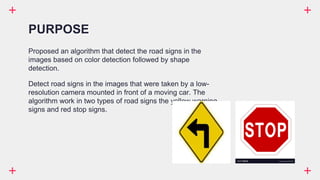
Proposed an algorithm that detect the road signs in the
images based on color detection followed by shape
detection.
Detect road signs in the images that were taken by a low-
resolution camera mounted in front of a moving car. The
algorithm work in two types of road signs the yellow warning
signs and red stop signs.
PURPOSE
PROPOSED ALGORITHM
STEP 01
Color Enhancement
STEP 04
Hough Transform
STEP 02
Color Segmentation
STEP 03
Edge Detector
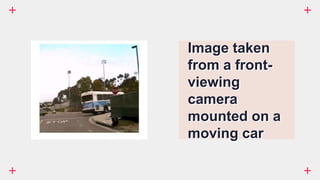
Image taken
from a front-
viewing
camera
mounted on a
moving car
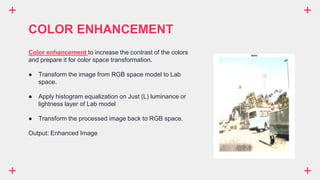
COLOR ENHANCEMENT
Color enhancement to increase the contrast of the colors
and prepare it for color space transformation.
● Transform the image from RGB space model to Lab
space.
● Apply histogram equalization on Just (L) luminance or
lightness layer of Lab model
● Transform the processed image back to RGB space.
Output: Enhanced Image
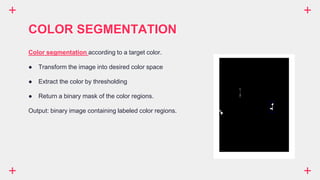
COLOR SEGMENTATION
Color segmentation according to a target color.
● Transform the image into desired color space
● Extract the color by thresholding
● Return a binary mask of the color regions.
Output: binary image containing labeled color regions.
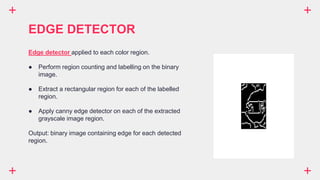
EDGE DETECTOR
Edge detector applied to each color region.
● Perform region counting and labelling on the binary
image.
● Extract a rectangular region for each of the labelled
region.
● Apply canny edge detector on each of the extracted
grayscale image region.
Output: binary image containing edge for each detected
region.
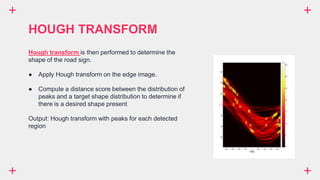
HOUGH TRANSFORM
Hough transform is then performed to determine the
shape of the road sign.
● Apply Hough transform on the edge image.
● Compute a distance score between the distribution of
peaks and a target shape distribution to determine if
there is a desired shape present
Output: Hough transform with peaks for each detected
region
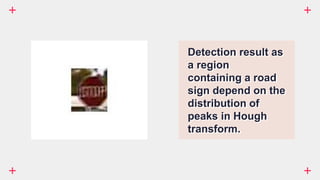
Detection result as
a region
containing a road
sign depend on the
distribution of
peaks in Hough
transform.
EXPERIMENTAL RESULTS
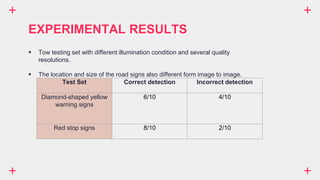
Test Set Correct detection Incorrect detection
Diamond-shaped yellow
warning signs
6/10 4/10
Red stop signs 8/10 2/10
 Tow testing set with different illumination condition and several quality
resolutions.
 The location and size of the road signs also different form image to image.
 Experimental results show that
The color-based detection is sensitive
to illumination conditions
The shape detection is sensitive to
the
complexity of the background.
FINDING
S
Challenges
 The complexity of background creates huge error in shape detection because it has a
great number of outliers in Hough transform.
 The low-resolution image effects the edge extraction.
Limitation
 The algorithm requires a priori knowledge of the color and shape of the traffic sign
being detected.
 The algorithm will not be able to tell if the given information is incorrect.
CHALLENGES & LIMITATION
FUTURE WORK
Improving the detection accuracy by
using Machine-learning techniques
Reference
Zhang, S. (2016). Traffic sign detection for
vision-based driver’s assistance in land-based
vehicles. Technical report, School of
Aeronautics and Astronautics-Stanford
University.
CREDITS: This presentation template was created by Slidesgo,
including icons by Flaticon, and infographics & images by Freepik
THANKS A
LOT!
Do you have any questions?

Traffic Sign Detection

  • 1.
    Traffic Sign Detection for Vision-based Driver’s Assistance PreparedBy: HUDA SEYAM Date: 5/17/2021 in Land-based Vehicles
  • 2.
     Purpose  Proposedalgorithm  color enhancement  color segmentation  edge detector  Hough transform OUTLINE  Experimental results  Findings  Challenges & limitation  Future work
  • 3.
    Proposed an algorithmthat detect the road signs in the images based on color detection followed by shape detection. Detect road signs in the images that were taken by a low- resolution camera mounted in front of a moving car. The algorithm work in two types of road signs the yellow warning signs and red stop signs. PURPOSE
  • 4.
    PROPOSED ALGORITHM STEP 01 ColorEnhancement STEP 04 Hough Transform STEP 02 Color Segmentation STEP 03 Edge Detector
  • 5.
    Image taken from afront- viewing camera mounted on a moving car
  • 6.
    COLOR ENHANCEMENT Color enhancementto increase the contrast of the colors and prepare it for color space transformation. ● Transform the image from RGB space model to Lab space. ● Apply histogram equalization on Just (L) luminance or lightness layer of Lab model ● Transform the processed image back to RGB space. Output: Enhanced Image
  • 7.
    COLOR SEGMENTATION Color segmentationaccording to a target color. ● Transform the image into desired color space ● Extract the color by thresholding ● Return a binary mask of the color regions. Output: binary image containing labeled color regions.
  • 8.
    EDGE DETECTOR Edge detectorapplied to each color region. ● Perform region counting and labelling on the binary image. ● Extract a rectangular region for each of the labelled region. ● Apply canny edge detector on each of the extracted grayscale image region. Output: binary image containing edge for each detected region.
  • 9.
    HOUGH TRANSFORM Hough transformis then performed to determine the shape of the road sign. ● Apply Hough transform on the edge image. ● Compute a distance score between the distribution of peaks and a target shape distribution to determine if there is a desired shape present Output: Hough transform with peaks for each detected region
  • 10.
    Detection result as aregion containing a road sign depend on the distribution of peaks in Hough transform.
  • 11.
    EXPERIMENTAL RESULTS Test SetCorrect detection Incorrect detection Diamond-shaped yellow warning signs 6/10 4/10 Red stop signs 8/10 2/10  Tow testing set with different illumination condition and several quality resolutions.  The location and size of the road signs also different form image to image.
  • 12.
     Experimental resultsshow that The color-based detection is sensitive to illumination conditions The shape detection is sensitive to the complexity of the background. FINDING S
  • 13.
    Challenges  The complexityof background creates huge error in shape detection because it has a great number of outliers in Hough transform.  The low-resolution image effects the edge extraction. Limitation  The algorithm requires a priori knowledge of the color and shape of the traffic sign being detected.  The algorithm will not be able to tell if the given information is incorrect. CHALLENGES & LIMITATION
  • 14.
    FUTURE WORK Improving thedetection accuracy by using Machine-learning techniques
  • 15.
    Reference Zhang, S. (2016).Traffic sign detection for vision-based driver’s assistance in land-based vehicles. Technical report, School of Aeronautics and Astronautics-Stanford University.
  • 16.
    CREDITS: This presentationtemplate was created by Slidesgo, including icons by Flaticon, and infographics & images by Freepik THANKS A LOT! Do you have any questions?