1
T.S.ELIOT
Mustheena . K
B.ED ENGLISH
KSTC
TRADITION AND THE INDIVIDUAL
TALENT
T.S.ELIOT
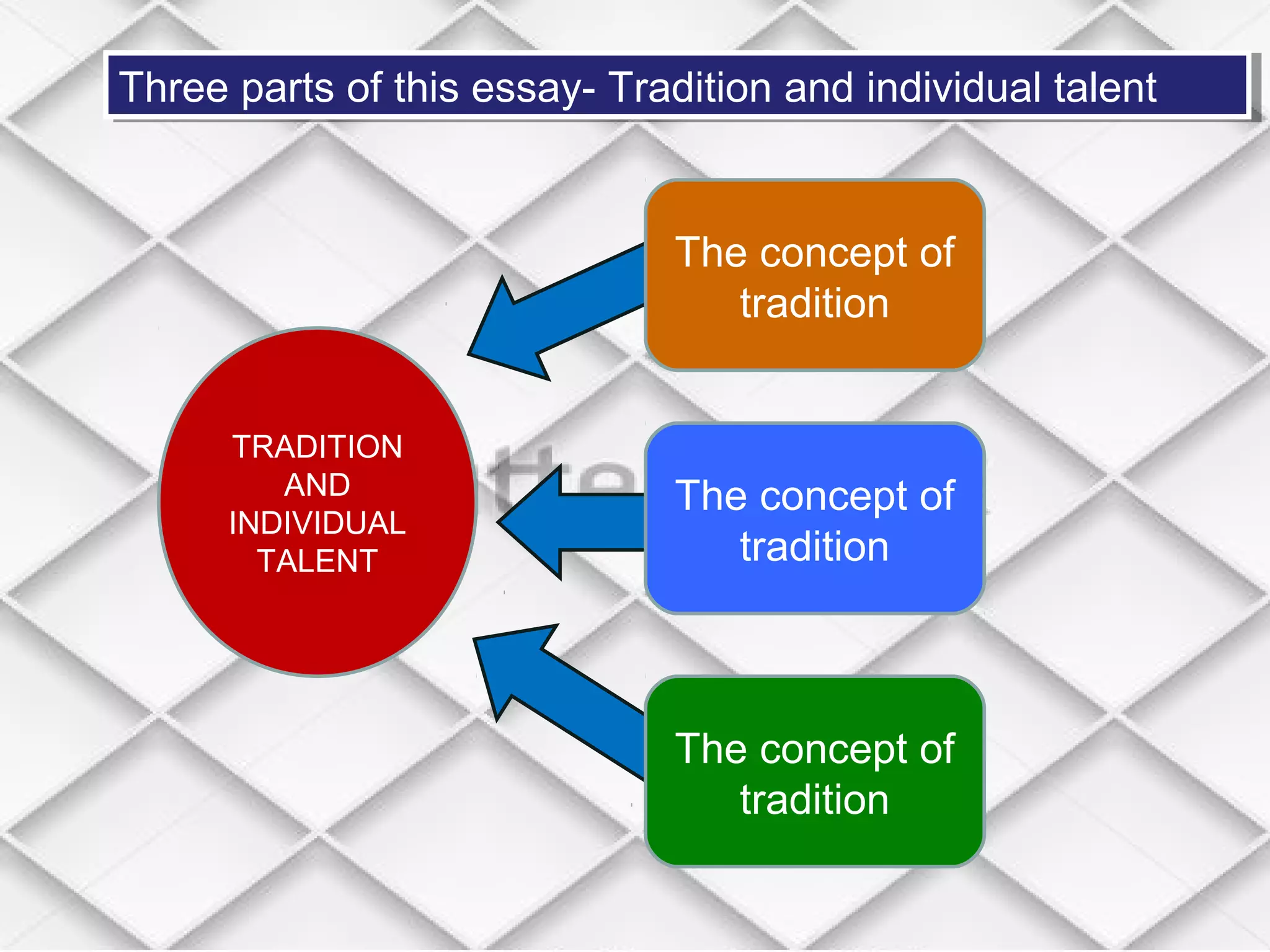
Three parts of this essay- Tradition and individual talentThree parts of this essay- Tradition and individual talent
TRADITION
AND
INDIVIDUAL
TALENT
The concept of
tradition
The concept of
tradition
The concept of
tradition
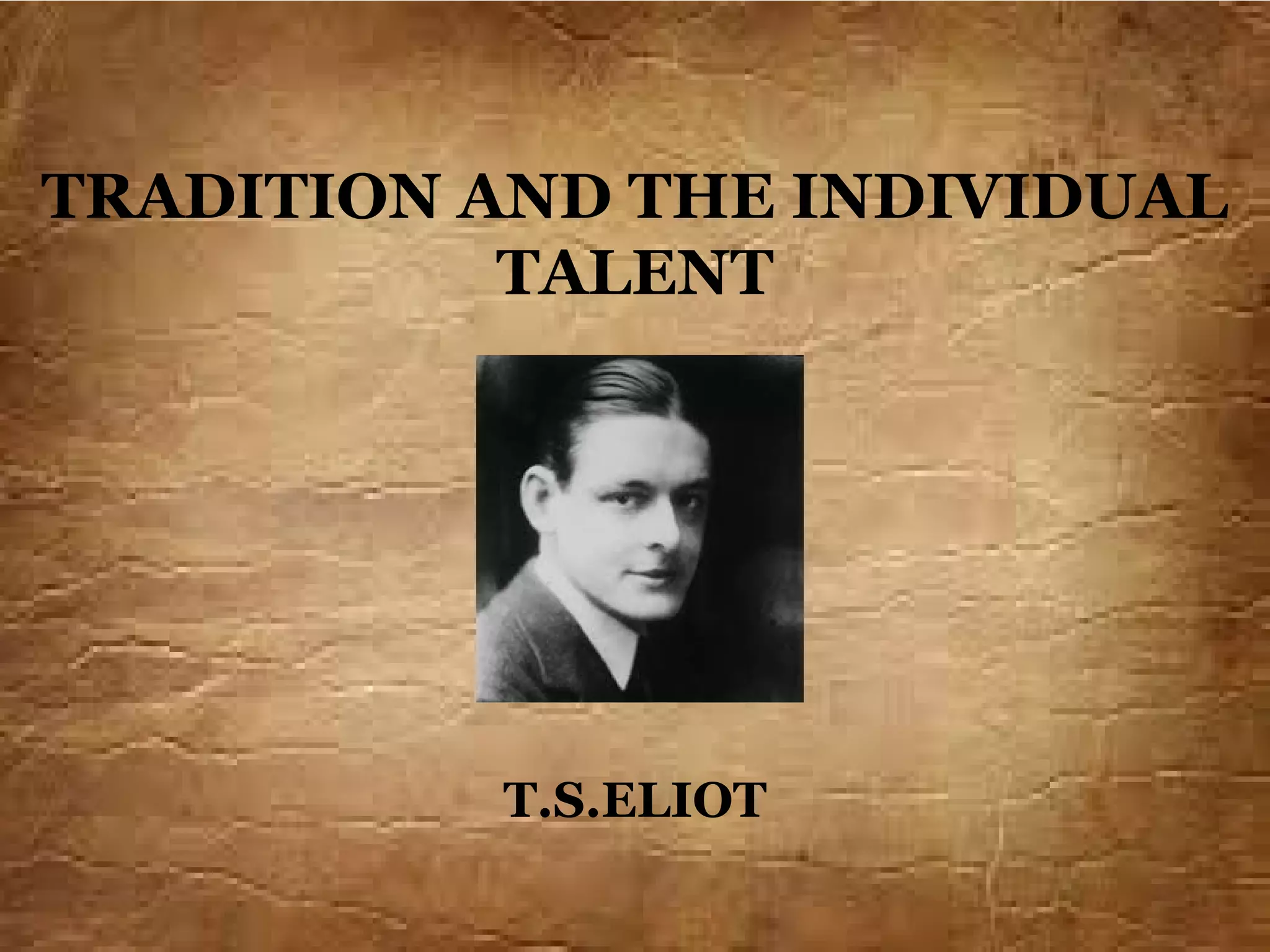
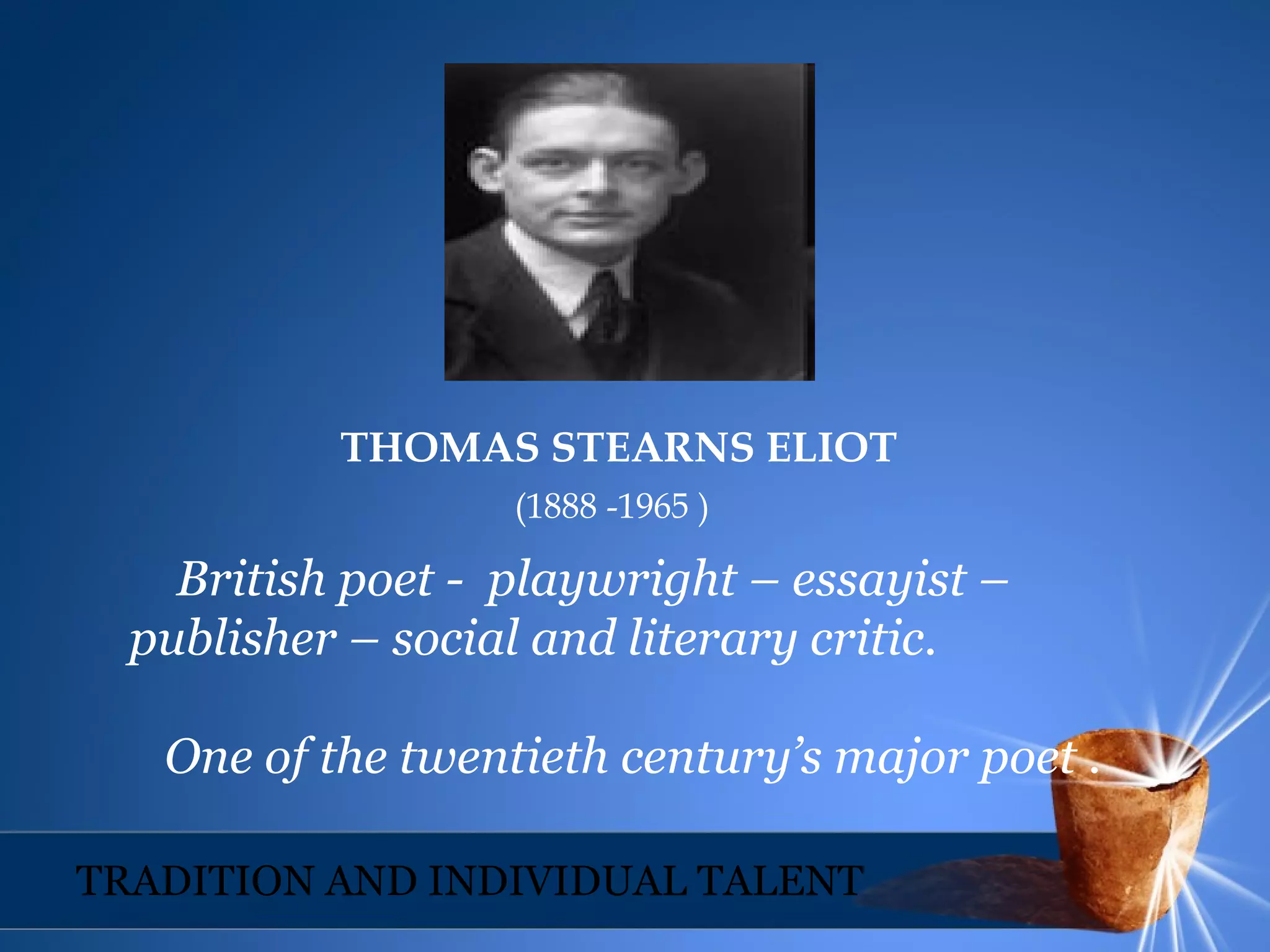
THOMAS STEARNS ELIOT
(1888 -1965 )
British poet - playwright – essayist –
publisher – social and literary critic.
One of the twentieth century’s major poet .
TRADITION AND INDIVIDUAL TALENT
CONTRIBUTIONS :
Objective Correlation
Theory of Impersonality
Concept of Tradition
Disassociation of sensibility
ESSAYS :
Traditional and Individual Talent (1919)
 Hamlet and His Problems (1920)
 Metaphysical Poets (1921)
TRADITION AND INDIVIDUAL TALENT
Introduction :
• “Tradition and Individual Talent ” (1919) is an essay
written by the poet and literary critic T. S. Eliot.
• The essay was first published in ‘The Egoist ’ (1919) and
later in Eliot’s first book of criticism , “The Sacred Wood
”(1920).
• Tradition and Individual Talent is one of the more well
known work that Eliot produced in his critic capacity .
• It formulates Eliot’s influential conception of the
relationship between the poet and the literary tradition
which proceeds him .
TRADITION AND INDIVIDUAL TALENT
TRADITIONAL AND INDIVIDUAL TALENTTRADITIONAL AND INDIVIDUAL TALENT (1919)
This essay is divided into three parts . That are :
Part one : The Concept of “ Tradition ”
Part two : The Theory of Impersonal Poetry
Part three : The Conclusion or Summing up.
TRADITION AND INDIVIDUAL TALENT
The Concept of “Tradition” :
 Eliot presents his conception of tradition and the definition of poet and
poetry in relation to it.
 For Eliot ,the term “tradition” is imbued with a special and complex
character.
 It represents a “simultaneous order” , by which Eliot means a historical
timelessness – a fusion of past and present , and at the same time , a
sense of present temporality.
 Eliot claims that this “historical sense” is not only a resemblance of
traditional works but an awareness and understanding of their relation
to his poetry.
 The historical sense involves a perception , not only the pastness of
past , but of its presence.
TRADITION AND INDIVIDUAL TALENT
 The difference between present and past is that , the conscious
present is an awareness of the past in a way and to an extent which the
past’s awareness of itself cannot show.
 When a poet engages in a new work he realizes an aesthetic “ideal
order” , as it has been established by the literary tradition that has
come before him.
 As such , the act of artistic creation does not take place in a vacuum.
 The inclusion of new work alters the way in which the past is seen ,
elements of past that are noted and realized.
 The progress of an artist is a continual self-sacrifice , a continual
extinction of personality.
 This leads to Eliot’s so called “Impersonality Theory” of poetry.
TRADITION AND INDIVIDUAL TALENT
The Theory of Impersonal Poetry:
 Honest criticism and sensitive appreciation is directed not upon the
poet but upon the poetry.
 Eliot compares the poet’s mind to a catalyst ,
- in which the reactants are feelings and emotion that are
synthesized to create an artistic image that captures these same
feelings and emotion.
- While the mind of poet is necessary for production , it emerges
unaffected by the process.
- The artist stores feelings and emotions , and properly unites
them into a specific combination ,which is the artistic product.
TRADITION AND INDIVIDUAL TALENT
 The poet has, not a “personality” to express , but a particular medium
, which is only a medium and not a personality , in which impression
and experience combine in peculiar and unexpected ways.
- Impression and experiences which are important for the man may
not take place in the poetry , and those which become important in the
poetry , may play quite an ignorable part in the man , the personality.
 It is not his personal emotions , the emotions provoked by particular
event in his life , that the poet is in any way remarkable or interesting .
- His particular emotions may be simple , crude or flat.
- Great work do not express the personal emotion of the poet .
-And the poet does not reveal his own unique and novel emotions,
but rather , by drawing an ordinary ones and channeling them through
the intensity of poetry.
TRADITION AND INDIVIDUAL TALENT
 According to Eliot ‘poetry is not a turning loose of emotion , but an
escape from emotion ; it is not the expression of personality , but an
escape from personality’.
- But ,of course, only those who have personality and emotions
know what it means to want to escape from these things.
 Since , successful poetry is impersonal and , therefore , exists
independent of its poet , it outlives the poet and can incorporate into
the timeless “ideal order” of the “living” literary tradition.
 ‘Talent’ , especially in the arts , is a genius ,that one is born
with. Instead talent is acquired through a careful study of
poetry.
TRADITION AND INDIVIDUAL TALENT
Conclusion :
 Tradition and Individual Talent (1919) is an essay
written by T.S.Eliot.
 According to him , the emotion of art is impersonal.
 And the poet cannot reach this impersonality without
surrendering himself wholly to the work to be done.
 And he is not likely to know what is to be done unless
he lives in what is not merely the present , but the present
moment of past , unless he is conscious , not of what is
dead , but of what is already living.
TRADITION AND INDIVIDUAL TALENT
Tradition and individual talent

Tradition and individual talent

  • 1.
  • 2.
    TRADITION AND THEINDIVIDUAL TALENT T.S.ELIOT
  • 3.
    Three parts ofthis essay- Tradition and individual talentThree parts of this essay- Tradition and individual talent TRADITION AND INDIVIDUAL TALENT The concept of tradition The concept of tradition The concept of tradition
  • 4.
    THOMAS STEARNS ELIOT (1888-1965 ) British poet - playwright – essayist – publisher – social and literary critic. One of the twentieth century’s major poet . TRADITION AND INDIVIDUAL TALENT
  • 5.
    CONTRIBUTIONS : Objective Correlation Theoryof Impersonality Concept of Tradition Disassociation of sensibility ESSAYS : Traditional and Individual Talent (1919)  Hamlet and His Problems (1920)  Metaphysical Poets (1921) TRADITION AND INDIVIDUAL TALENT
  • 6.
    Introduction : • “Traditionand Individual Talent ” (1919) is an essay written by the poet and literary critic T. S. Eliot. • The essay was first published in ‘The Egoist ’ (1919) and later in Eliot’s first book of criticism , “The Sacred Wood ”(1920). • Tradition and Individual Talent is one of the more well known work that Eliot produced in his critic capacity . • It formulates Eliot’s influential conception of the relationship between the poet and the literary tradition which proceeds him . TRADITION AND INDIVIDUAL TALENT
  • 7.
    TRADITIONAL AND INDIVIDUALTALENTTRADITIONAL AND INDIVIDUAL TALENT (1919) This essay is divided into three parts . That are : Part one : The Concept of “ Tradition ” Part two : The Theory of Impersonal Poetry Part three : The Conclusion or Summing up. TRADITION AND INDIVIDUAL TALENT
  • 8.
    The Concept of“Tradition” :  Eliot presents his conception of tradition and the definition of poet and poetry in relation to it.  For Eliot ,the term “tradition” is imbued with a special and complex character.  It represents a “simultaneous order” , by which Eliot means a historical timelessness – a fusion of past and present , and at the same time , a sense of present temporality.  Eliot claims that this “historical sense” is not only a resemblance of traditional works but an awareness and understanding of their relation to his poetry.  The historical sense involves a perception , not only the pastness of past , but of its presence. TRADITION AND INDIVIDUAL TALENT
  • 9.
     The differencebetween present and past is that , the conscious present is an awareness of the past in a way and to an extent which the past’s awareness of itself cannot show.  When a poet engages in a new work he realizes an aesthetic “ideal order” , as it has been established by the literary tradition that has come before him.  As such , the act of artistic creation does not take place in a vacuum.  The inclusion of new work alters the way in which the past is seen , elements of past that are noted and realized.  The progress of an artist is a continual self-sacrifice , a continual extinction of personality.  This leads to Eliot’s so called “Impersonality Theory” of poetry. TRADITION AND INDIVIDUAL TALENT
  • 10.
    The Theory ofImpersonal Poetry:  Honest criticism and sensitive appreciation is directed not upon the poet but upon the poetry.  Eliot compares the poet’s mind to a catalyst , - in which the reactants are feelings and emotion that are synthesized to create an artistic image that captures these same feelings and emotion. - While the mind of poet is necessary for production , it emerges unaffected by the process. - The artist stores feelings and emotions , and properly unites them into a specific combination ,which is the artistic product. TRADITION AND INDIVIDUAL TALENT
  • 11.
     The poethas, not a “personality” to express , but a particular medium , which is only a medium and not a personality , in which impression and experience combine in peculiar and unexpected ways. - Impression and experiences which are important for the man may not take place in the poetry , and those which become important in the poetry , may play quite an ignorable part in the man , the personality.  It is not his personal emotions , the emotions provoked by particular event in his life , that the poet is in any way remarkable or interesting . - His particular emotions may be simple , crude or flat. - Great work do not express the personal emotion of the poet . -And the poet does not reveal his own unique and novel emotions, but rather , by drawing an ordinary ones and channeling them through the intensity of poetry. TRADITION AND INDIVIDUAL TALENT
  • 12.
     According toEliot ‘poetry is not a turning loose of emotion , but an escape from emotion ; it is not the expression of personality , but an escape from personality’. - But ,of course, only those who have personality and emotions know what it means to want to escape from these things.  Since , successful poetry is impersonal and , therefore , exists independent of its poet , it outlives the poet and can incorporate into the timeless “ideal order” of the “living” literary tradition.  ‘Talent’ , especially in the arts , is a genius ,that one is born with. Instead talent is acquired through a careful study of poetry. TRADITION AND INDIVIDUAL TALENT
  • 13.
    Conclusion :  Traditionand Individual Talent (1919) is an essay written by T.S.Eliot.  According to him , the emotion of art is impersonal.  And the poet cannot reach this impersonality without surrendering himself wholly to the work to be done.  And he is not likely to know what is to be done unless he lives in what is not merely the present , but the present moment of past , unless he is conscious , not of what is dead , but of what is already living. TRADITION AND INDIVIDUAL TALENT