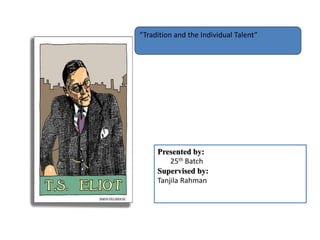
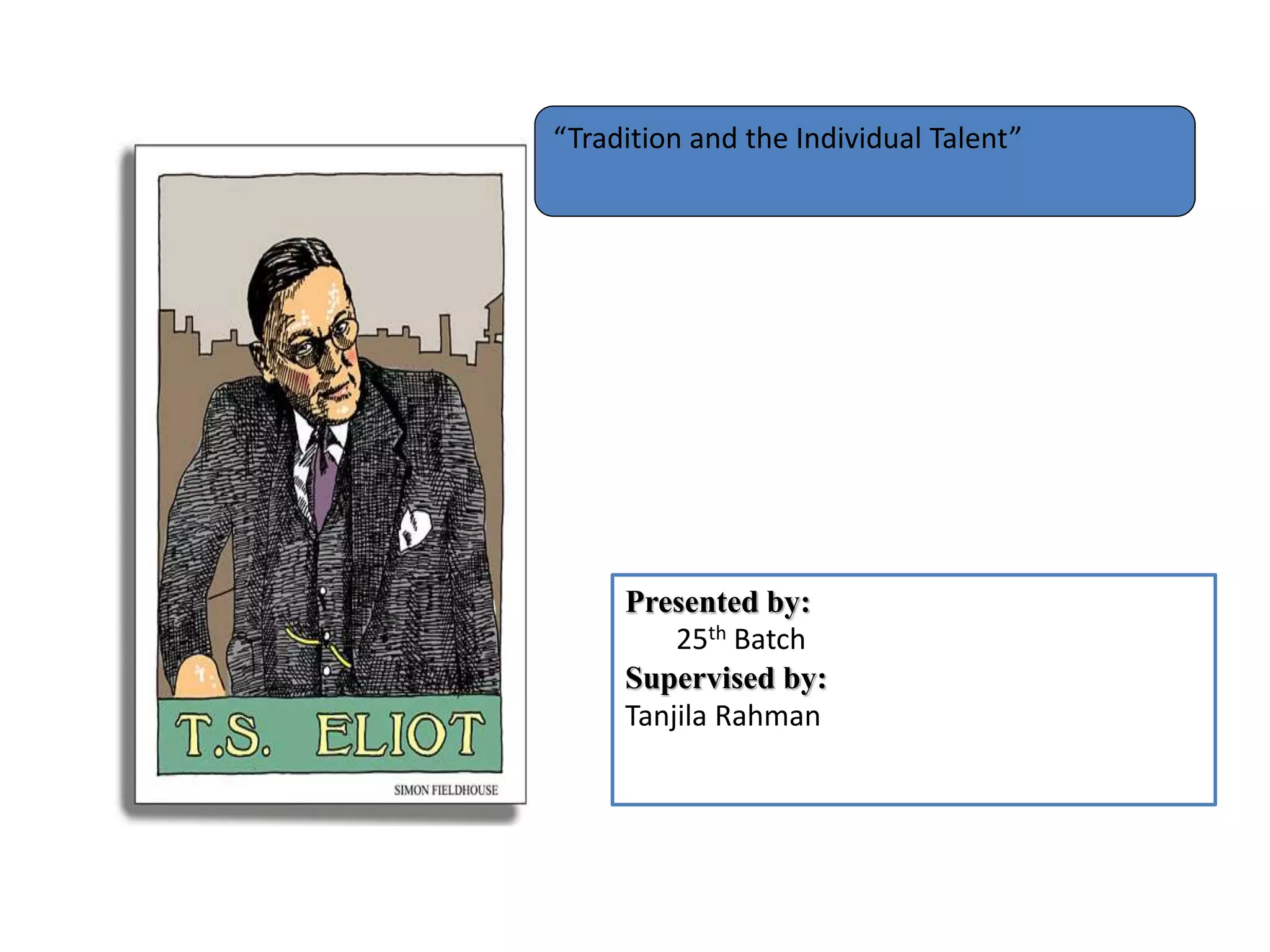


“Tradition and the Individual Talent” 
Presented by: 
25th Batch 
Supervised by: 
Tanjila Rahman
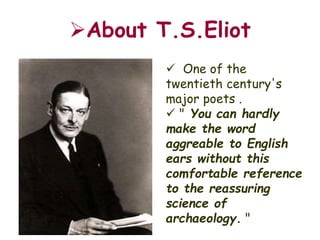
About T.S.Eliot 
 One of the 
twentieth century's 
major poets . 
 " You can hardly 
make the word 
aggreable to English 
ears without this 
comfortable reference 
to the reassuring 
science of 
archaeology. "
Tradition and Individual 
Talent 
 " Tradition and 
Individual Talent " 
was published in 
1919.
Tradition and the individual talent 
 Its Three Parts 
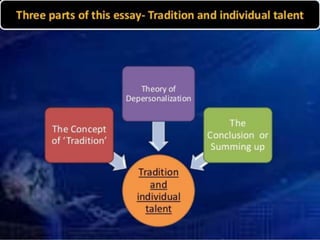
The essay is divided into three parts: 
 The first part gives us Eliot’s concept of 
tradition, and 
 In the second part is developed his theory of 
the impersonality of poetry. 
 The short, third part is in the nature of a 
conclusion, or summing up of the whole 
discussion.
Tradition and the individual talent 
 Traditional Elements: Their Significance 
Eliot begins the essay by pointing out that the word ‘tradition’ is 
generally regarded as a word of censure. It is a word disagreeable to 
the English ears. When the English praise a poet, they praise him for 
those-aspects of his work which are ‘individual’ and original. It is 
supposed that his chief merit lies in such parts. This undue stress on 
individuality shows that the English have an uncritical turn of mind. 
They praise the poet for the wrong thing. If they examine the matter 
critically with an unprejudiced mind, they will realize that the best and 
the most individual part of a poet’s work is that which shows the 
maximum influence of the writers of the past. To quote his own 
words: “Whereas if we approach a poet without this prejudice, we 
shall often find that not only the best, but the most individual part of 
his work may be those in which the dead poets, his ancestors, assert 
their immortality most vigorously.’
The Literary Tradition: Ways in 
Which It Can Be Acquired 
Tradition in the true sense of the term cannot be inherited, it 
can only be obtained by hard labor. 
 In brief, the sense of tradition implies: 
a) A recognition of the continuity of literature, 
b) A critical judgment as to which of the writers of the past 
continue to be significant in the present, 
c) A knowledge of these significant writers obtained through 
painstaking effort.
Relationship between Tradition & 
Individual 
 No poet, no artist of any art, has his 
complete meaning alone. 
His significance, his appreciation is 
the appreciation of his relation to the 
dead poets and artists.
Relationship between Tradition & 
Individual 
Conformity between the old and the new 
 The existing which is modified by the introduction of 
the new work of art among them. 
 The whole existing order must be, if ever so slightly, 
altered; and so the relations, proportions, values of 
each work of art toward the whole are readjusted; and 
this is conformity between the old and the new.
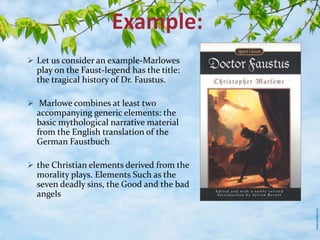
Example: 
 Let us consider an example-Marlowes 
play on the Faust-legend has the title: 
the tragical history of Dr. Faustus. 
 Marlowe combines at least two 
accompanying generic elements: the 
basic mythological narrative material 
from the English translation of the 
German Faustbuch 
 the Christian elements derived from the 
morality plays. Elements Such as the 
seven deadly sins, the Good and the bad 
angels
Concept of poet: 
“What is Poetry?” by T.S. Eliot 
A poem may appear to mean very different things to different 
readers, and all of these meanings may be different from what the 
author thought he meant. 
The conception of poetry as a living whole of all the poetry that 
has ever been written.
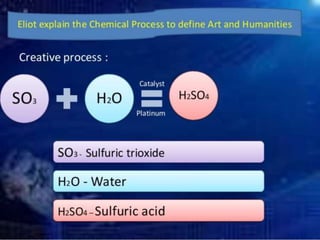
The Analogy of the Catalyst 
It is in this depersonalization that art may be said to 
approach the condition of science. I shall, therefore, invite 
you to consider, as a suggestive analogy, the action which 
takes place when a bit of finely filiated platinum is introduced 
into a chamber containing oxygen and sulphur dioxide. The 
analogy was that of the catalyst. When the two gases are 
mixed in the presence of a filament of platinum, they form 
sulphurous acid. This combination takes place only if the 
platinum is present; nevertheless the newly formed acid 
contains no trace of platinum, and the platinum itself is 
apparently unaffected; has remained inert, neutral, and 
unchanged. The mind of the poet is the shred of platinum. It 
may partly or exclusively operate upon the experience of the 
man himself; but, the more perfect the artist, the more 
completely separate in him will be the man who suffers and 
the mind which creates; the more perfectly will the mind 
digest and transmute the passions which are its material.
Theory of depersonalization: 
• depersonalization is relation to the sense of tradition. 
The point of view which I am struggling to attack is 
perhaps related to the metaphysical theory of the 
substantial unity of the soul: for my meaning is, that the 
poet has, not a “personality” to express, but a particular 
medium, which is only a medium and not a personality, 
in which impressions and experiences combine in 
peculiar and unexpected ways. Impressions and 
experiences which are important for the man may take 
no place in the poetry, and those which become 
important in the poetry may play quite a negligible part in 
the man, the personality.
Emotion recollected in tranquility 
• We must believe that “emotion recollected in 
tranquility” is an inexact formula. For it is neither 
emotion, nor recollection, nor, without distortion of 
meaning, tranquility. It is a concentration, and a new 
thing resulting from the concentration, of a very great 
number of experiences which to the practical and 
active person would not seem to be experiences at all; 
it is a concentration which does not happen 
consciously or of deliberation.
Poetry, an Escape from Personality and 
Personal Emotions 
• The poet concludes: “Poetry is not a turning loose of 
emotion, but an escape from emotion; it is not the 
expression of personality, but an escape from 
personality.”
Criticism of Eliot: 
 Edmund Wilson, being one of the critics who 
praised Eliot, called him "one of our only 
authentic poets" 
Post-colonial critic Chinua Achebe also 
challenges Eliot 
Harold Bloom presents a conception of tradition 
that differs from that of Eliot.
Thank 
You For 
Listen 
Me 
I hope 
you 
like it

T.s eliot(final)

  • 1.
    “Tradition and theIndividual Talent” Presented by: 25th Batch Supervised by: Tanjila Rahman
  • 2.
    About T.S.Eliot One of the twentieth century's major poets .  " You can hardly make the word aggreable to English ears without this comfortable reference to the reassuring science of archaeology. "
  • 4.
    Tradition and Individual Talent  " Tradition and Individual Talent " was published in 1919.
  • 5.
    Tradition and theindividual talent  Its Three Parts The essay is divided into three parts:  The first part gives us Eliot’s concept of tradition, and  In the second part is developed his theory of the impersonality of poetry.  The short, third part is in the nature of a conclusion, or summing up of the whole discussion.
  • 6.
    Tradition and theindividual talent  Traditional Elements: Their Significance Eliot begins the essay by pointing out that the word ‘tradition’ is generally regarded as a word of censure. It is a word disagreeable to the English ears. When the English praise a poet, they praise him for those-aspects of his work which are ‘individual’ and original. It is supposed that his chief merit lies in such parts. This undue stress on individuality shows that the English have an uncritical turn of mind. They praise the poet for the wrong thing. If they examine the matter critically with an unprejudiced mind, they will realize that the best and the most individual part of a poet’s work is that which shows the maximum influence of the writers of the past. To quote his own words: “Whereas if we approach a poet without this prejudice, we shall often find that not only the best, but the most individual part of his work may be those in which the dead poets, his ancestors, assert their immortality most vigorously.’
  • 7.
    The Literary Tradition:Ways in Which It Can Be Acquired Tradition in the true sense of the term cannot be inherited, it can only be obtained by hard labor.  In brief, the sense of tradition implies: a) A recognition of the continuity of literature, b) A critical judgment as to which of the writers of the past continue to be significant in the present, c) A knowledge of these significant writers obtained through painstaking effort.
  • 8.
    Relationship between Tradition& Individual  No poet, no artist of any art, has his complete meaning alone. His significance, his appreciation is the appreciation of his relation to the dead poets and artists.
  • 9.
    Relationship between Tradition& Individual Conformity between the old and the new  The existing which is modified by the introduction of the new work of art among them.  The whole existing order must be, if ever so slightly, altered; and so the relations, proportions, values of each work of art toward the whole are readjusted; and this is conformity between the old and the new.
  • 10.
    Example:  Letus consider an example-Marlowes play on the Faust-legend has the title: the tragical history of Dr. Faustus.  Marlowe combines at least two accompanying generic elements: the basic mythological narrative material from the English translation of the German Faustbuch  the Christian elements derived from the morality plays. Elements Such as the seven deadly sins, the Good and the bad angels
  • 11.
    Concept of poet: “What is Poetry?” by T.S. Eliot A poem may appear to mean very different things to different readers, and all of these meanings may be different from what the author thought he meant. The conception of poetry as a living whole of all the poetry that has ever been written.
  • 12.
    The Analogy ofthe Catalyst It is in this depersonalization that art may be said to approach the condition of science. I shall, therefore, invite you to consider, as a suggestive analogy, the action which takes place when a bit of finely filiated platinum is introduced into a chamber containing oxygen and sulphur dioxide. The analogy was that of the catalyst. When the two gases are mixed in the presence of a filament of platinum, they form sulphurous acid. This combination takes place only if the platinum is present; nevertheless the newly formed acid contains no trace of platinum, and the platinum itself is apparently unaffected; has remained inert, neutral, and unchanged. The mind of the poet is the shred of platinum. It may partly or exclusively operate upon the experience of the man himself; but, the more perfect the artist, the more completely separate in him will be the man who suffers and the mind which creates; the more perfectly will the mind digest and transmute the passions which are its material.
  • 13.
    Theory of depersonalization: • depersonalization is relation to the sense of tradition. The point of view which I am struggling to attack is perhaps related to the metaphysical theory of the substantial unity of the soul: for my meaning is, that the poet has, not a “personality” to express, but a particular medium, which is only a medium and not a personality, in which impressions and experiences combine in peculiar and unexpected ways. Impressions and experiences which are important for the man may take no place in the poetry, and those which become important in the poetry may play quite a negligible part in the man, the personality.
  • 14.
    Emotion recollected intranquility • We must believe that “emotion recollected in tranquility” is an inexact formula. For it is neither emotion, nor recollection, nor, without distortion of meaning, tranquility. It is a concentration, and a new thing resulting from the concentration, of a very great number of experiences which to the practical and active person would not seem to be experiences at all; it is a concentration which does not happen consciously or of deliberation.
  • 15.
    Poetry, an Escapefrom Personality and Personal Emotions • The poet concludes: “Poetry is not a turning loose of emotion, but an escape from emotion; it is not the expression of personality, but an escape from personality.”
  • 16.
    Criticism of Eliot:  Edmund Wilson, being one of the critics who praised Eliot, called him "one of our only authentic poets" Post-colonial critic Chinua Achebe also challenges Eliot Harold Bloom presents a conception of tradition that differs from that of Eliot.
  • 17.
    Thank You For Listen Me I hope you like it