Presented by:-
Pranshay Sharma
(90)
Juvenile papillomatosis is the most
common benign neoplasm of the
larynx in children.
It is viral in origin and is caused by
human papilloma DNA virus type 6
and 11.
It is presumed that affected children
got the disease at birth from their
mothers who had vaginal human
papilloma virus disease.
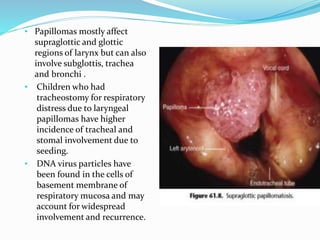
• Papillomas mostly affect
supraglottic and glottic
regions of larynx but can also
involve subglottis, trachea
and bronchi .
• Children who had
tracheostomy for respiratory
distress due to laryngeal
papillomas have higher
incidence of tracheal and
stomal involvement due to
seeding.
• DNA virus particles have
been found in the cells of
basement membrane of
respiratory mucosa and may
account for widespread
involvement and recurrence.
SIGN AND SYMPTOPMS
 Patient, often a child, between the age of 3 and 5 years
presents with hoarseness or aphonia with respiratory
difficulty or even stridor.
 Diagnosis is made by flexible fibreoptic laryngoscopy
and later confirmed by direct laryngoscopy and biopsy.
 Papillomas are known for recurrence but rarely
undergo malignant change.
TREATMENT
 Treatment consists of microlaryngoscopy and CO2
laser excision avoiding injury to vocal ligament.
 Recurrence is common and procedure needs to be
repeated several times.
 In the absence of facilities of CO2 laser, tumour can
be removed under microscope with cup forceps or a
debrider similar to the one used in endoscopic nasal
surgery.
 Aim of therapy is to maintain a good airway, preserve
voice and avoid recurrence.
 Besides surgery, various medical therapies are being
used an adjuvants.
 Alpha-2a has shown promising results but has several
side effects including fever, chills, myalgia, arthralgia,
headache, loss of weight and suppression of bone
marrow.
 Similarly 13-cis-retinoic acid has been used. This too
has several side effects.

Juvenile papillomatosis

  • 1.
  • 2.
    Juvenile papillomatosis isthe most common benign neoplasm of the larynx in children. It is viral in origin and is caused by human papilloma DNA virus type 6 and 11. It is presumed that affected children got the disease at birth from their mothers who had vaginal human papilloma virus disease.
  • 3.
    • Papillomas mostlyaffect supraglottic and glottic regions of larynx but can also involve subglottis, trachea and bronchi . • Children who had tracheostomy for respiratory distress due to laryngeal papillomas have higher incidence of tracheal and stomal involvement due to seeding. • DNA virus particles have been found in the cells of basement membrane of respiratory mucosa and may account for widespread involvement and recurrence.
  • 4.
    SIGN AND SYMPTOPMS Patient, often a child, between the age of 3 and 5 years presents with hoarseness or aphonia with respiratory difficulty or even stridor.  Diagnosis is made by flexible fibreoptic laryngoscopy and later confirmed by direct laryngoscopy and biopsy.  Papillomas are known for recurrence but rarely undergo malignant change.
  • 5.
    TREATMENT  Treatment consistsof microlaryngoscopy and CO2 laser excision avoiding injury to vocal ligament.  Recurrence is common and procedure needs to be repeated several times.  In the absence of facilities of CO2 laser, tumour can be removed under microscope with cup forceps or a debrider similar to the one used in endoscopic nasal surgery.  Aim of therapy is to maintain a good airway, preserve voice and avoid recurrence.
  • 6.
     Besides surgery,various medical therapies are being used an adjuvants.  Alpha-2a has shown promising results but has several side effects including fever, chills, myalgia, arthralgia, headache, loss of weight and suppression of bone marrow.  Similarly 13-cis-retinoic acid has been used. This too has several side effects.