UNIT - 2
TQM PRINCIPLES
Leadership
The most important and critical issue
for quality system success.
Why need good leaders for total
quality management system?
What makes a good
leader/leadership?
• Vision
• Cohesion, synergy and collaboration
• Empower people
• Core values
• Shared values
• Ethics
• Proactive and problem prevention
• Communications
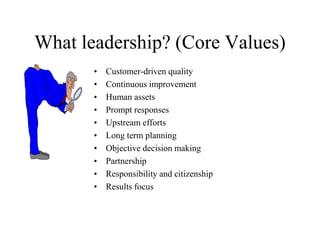
What leadership? (Core Values)
• Customer-driven quality
• Continuous improvement
• Human assets
• Prompt responses
• Upstream efforts
• Long term planning
• Objective decision making
• Partnership
• Responsibility and citizenship
• Results focus
Shared Values
• Truth and Honesty
• Trust
• Unselfishness
• Receptive
• Personal risks
• Credits to others
• Integrity
• Considerate to others
Leaders don't create followers,
they create more leaders.
Tom Peters in "Fast Company"
Effective Leadership, by David L.
Goetsch, Prentice Hall, 2005
Effective Leadership: Step 1-5
1. Develop a vision and commit to achieving it.
2. Project unquestionable integrity and selflessness.
3. Establish credibility and good stewardship.
4. Develop a can-do attitude and seek responsibility
5. Develop self-discipline, time management and
execution skills.
Effective Leadership, by David L.
Goetsch, Prentice Hall, 2005
Effective Leadership: Step 6-10
6. Be a creative problem solver and decision
maker.
7. Be a positive change agent.
8. Be an effective team builder.
9. Empower followers to lead themselves.
10. Be an effective conflict managers and
consensus builder
Role of senior management
• TQM implementation
• Quality council
• MBWA
• Decision making
• Strong information base
• Facilities and support
• Communication
• Time on quality
• Encourage
• Role model
Vision Statement
• Declaration
• Realistic picture
• Concise
Mission Statement
• Who we are?
• Who are the customers?
• What we do?
• How we do it?
Quality Policy Statement
• A general guide for everyone
• Approved by the CEO
• Awareness and implemented by everyone
• Required by ISO/QS 9000 standards for
quality systems.
+
TEAMS
• T- together
• E-each
• A-achieve
• M-more
• S-success
5S
THE SECRET TO
JAPANESE SUCCESS
• WHAT PROBLEMS DO U COMMONLY
ENCOUNTER AT YOUR WORKPLACE
• HIGH ABSENTEEISM
• HIGH TURNOVER
• DEMOTIVATED EMPLOYEES
• DISORDERED/ CLUTTERED
ENVIRONMENT
• MISTAKES/ERRORS
• THE SOLUTION TO ALL THESE
PROBLEMS IS
5S
5S
HOUSEKEEPING TECHNIQUE
PRODUCTIVITY AND SAFETY
ENHANCEMENT TECHNIQUE
IDEA BEHIND 5S
• IN ORDER TO ACHIEVE HIGH
LEVELS OF QUALITY, SAFETY,AND
PRODUCTIVITY, WORKERS MUST
HAVE A CONDUCIVE WORKING
ENVIRONMENT
WHAT IS 5S?
• Developed by the Japanese
• Housekeeping System
• Helps Create a Better Working
Environment and a Consistently
High Quality Process
THE 5S PRINCIPLES
• SEIRI – Organisation/Sort out
• SEITON – Orderliness/Systemize
• SEISO – The Cleaning/Shining
• SEIKETSU – STANDARDIZE
• SHITSUKE - Sustain/Discipline
DISCOVERY OF 5S
• Thirty years ago researchers started
studying the secret of success of
Japanese manufacturing companies
• 5S turned out to be the most
impressive "secret"
• The factories were so well organized
that abnormal situations were readily
apparent
DISCOVERY OF 5S
• Equipments were so clean and well
maintained that any problem such
as a loose bolt or leaking oil could
be easily seen
• This passion of cleanliness and
orderliness became a hallmark of
Japanese organizations
ADVANTAGES OF 5S
• If tools and materials are conveniently
located in uncluttered work areas
• Operators spend less time looking for
items
• This leads to higher workstation
efficiency, a fundamental goal in mass
production
ADVANTAGES OF 5S
• A clean and tidy workplace leads
to greater well being and increased
motivation
• Company image improves
ADVANTAGES OF 5S
• Health and Safety is ensured
• Machine maintenance
• Quality
• Productivity
• Lean Manufacturing
ADVANTAGES OF 5S
• RESULTS IN A PLACE EASIER TO
MANAGE
• SMOOTH WORKING NO
OBSTRUCTION
• NO DEVIATION, NO PROBLEMS
• B/C EVERYONE KNOWS WHERE THE
THINGS ARE SPPOSEDF TO BE
ADVANTAGES OF 5S
• TIME SAVING
• QUICK RETRIEVAL
• ACCIDENTS & MISTAKES
MINIMIZED
• INCREASES SPACE
• CREATES WORKPLACE
OWNERSHIP
ADVANTAGES OF 5S
• FOUNDATION OF ALL QC TOOLS
• CONTINUOUS QUALITY
IMPROVEMENT
• LEAN MANUFACTURING
• KINDERGARTEN OF QUALITY
TOOLS & TECHNIQUES
ADVANTAGES OF 5S
• VISUAL MANAGEMENT SYSTEM
• VISUAL CONTROL TO SEE THE
ABNORMALITIES
• SIMPLE SIGNALS THAT PROVIDE AN
UNDERSTANDING OF THE CONDITION(
NORMAL/ ABNORMAL)
• A LOOK AT THE PROCESS REVEALS ITS
DIRECTION (RIGHT/WRONG)
KINERGARTEN OF ALL THE QC
TOOLS
• 5S IS THE STARTING POINT OF
ALL THE QC TOOLS
• COULD BE SAID AS THE PRE-
REQUISITE OF ALL QC TOOLS
METHODOLOGY
OF 5S
1. ORGANISATION(SEIRI)
• Decide what you need
• Remove unnecessary clutter
• All tools, gauges, materials, classified
and then stored
• Remove items which are broken,
unusable or only occasionally used
2. ORDERLINESS(SEITON)
• ONCE YOU HAVE ELIMINATED ALL
THE UNNEEDED ITEMS
• NOW TURN TO THE LEFT OVER
ITEMS
ORDERLINESS(SEITON)
Organise layout of tools and
equipment
–Designated locations
–Use tapes and labels
–Ensure everything is
available as it is needed and
at the “point of use”
ORDERLINESS(SEITON)
Workplace Checkpoints:-
• Positions of aisles and storage places
clearly marked?
• Tools classified and stored by frequency
of use?
• Pallets stacked correctly?
• Safety equipment easily accessible?
• Floors in good condition?
3. SEISO (CLEAN/SHINE)
• Create a spotless workplace
• Identify and eliminate causes of
dirt and grime – remove the need
to clean
• Sweep, dust, polish and paint
SEISO (CLEAN/SHINE)
• Divide areas into zones
• Define responsibilities for cleaning
• Tools and equipment must be owned by
an individual
• Focus on removing the need to clean
4. SEIKETSU (STANDARDISE)
• Generate a maintenance system for the
first three
• Develop procedures, schedules,
practices
• Continue to assess the use and disposal
of items
• Regularly audit using checklists and
measures of housekeeping
• Real challenge is to keep it clean
5. SHITSUKE (SUSTAIN /
DISCIPLINE)
• Means inoculate courtesy & good habits
• Driving force behind all 5S
• Deming’s point number 1: Constancy of
purpose
• Make it a way of life
• Part of health and safety
• Involve the whole workforce*
• Develop and keep good habits
SUPPLIER PARTNERSHIP
Organization and suppliers have the same goal – to satisfy
the end user.
 Working with supplier in a partnering atmosphere will yield high
quality product and services.
 In the 1980s procurement decisions were based on price,
awarding contracts to the lowest bidder, sacrificing the quality
and timely delivery
 Deming suggested that long term relationship of loyalty and trust
should be developed with the supplier to ensure improved
products & services.
 Just-in-Time (JIT) concept calls for raw materials and
components to be delivered in small quantities only when they
are required and not before.
INTRODUCTION
Partnering is a long-term commitment between two or more
organizations for the purpose of achieving specific business goals
& objectives.
 The relationship is based upon trust, dedication to common goals
and objectives.
 Benefits include:
o Improved Quality,
o Increased efficiency,
o Lower cost,
o Increased opportunity for innovation, &
o Continuous improvement of products and services
 The three key elements of partnering are:
o Long-term commitment.
o Trust.
o Shared vision.
PARTNERING
 Long-term commitment provides the needed environment
for both parties to work toward continuous improvement.
 Total organization involvement is necessary, CEO to the
workers.
 Each party contributes its unique strengths to the process.
 A supplier may only take risks in a long-term commitment.
 Dependency appears as a national consequence in a long
term commitment, it is not a sign of weakness, but a sign of
strength of the relationship and is necessary for competitive
advantage.
Long-term commitment
Trust
 The strength of Partnering is based on fairness and parity.
 Trust enables the resources and knowledge of each
partner to be combined to eliminate an adversarial
relationship.
 Mutual trust forms the basis for a strong working
relationship.
 Open and frequent communication avoids misdirection,
disputes and strengthens the relationship.
 The parties may share or integrate resources such as
training activities, administrative systems and equipment.
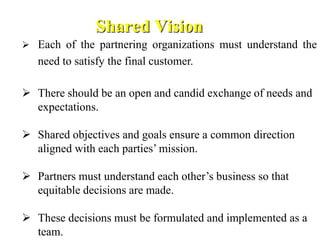
Shared Vision
 Each of the partnering organizations must understand the
need to satisfy the final customer.
 There should be an open and candid exchange of needs and
expectations.
 Shared objectives and goals ensure a common direction
aligned with each parties’ mission.
 Partners must understand each other’s business so that
equitable decisions are made.
 These decisions must be formulated and implemented as a
team.
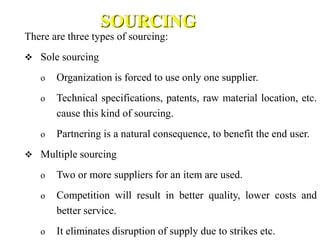
SOURCING
There are three types of sourcing:
 Sole sourcing
o Organization is forced to use only one supplier.
o Technical specifications, patents, raw material location, etc.
cause this kind of sourcing.
o Partnering is a natural consequence, to benefit the end user.
 Multiple sourcing
o Two or more suppliers for an item are used.
o Competition will result in better quality, lower costs and
better service.
o It eliminates disruption of supply due to strikes etc.
SOURCING cont’d...
 Single sourcing
o A planned decision by the organization to select one
supplier for an item when several sources are available.
o Advantages for the organizations include reduced cost,
complete accountability, supplier loyalty, partnering and a
better end product with less variability.
o Advantages for the supplier include new business from the
customer, reduced cost of the business and production
processes.
o It has allowed organization to reduce their supplier base.
SUPPLIER SELECTION
Following are the conditions for the selection and evaluation of
suppliers:
1. Supplier knows management policy of the organization.
2. Stable management system of supplier , respected by others.
3. Supplier has the capability of dealing with technological
innovations.
4. Supplier can supply material meeting quality specifications.
5. Supplier has capability to meet the amount of production.
6. Supplier not to breach corporate secrets.
SUPPLIER SELECTION cont’d….
7. The supplier is easily accessible in terms of
transpiration and communication.
8. The supplier is sincere in implementing the contract
provisions.
9. The supplier has an effective quality system and
improvement program.
10. The supplier has a track record of customer
satisfaction and organization credibility.
These conditions go beyond evaluating a supplier on
the basis of quality, price and delivery.
Stages
• Survey
• Enquiry
• Negotiate
• Selection
• Evaluation or Experience
PRINCIPLES OF
CUSTOMER/SUPPLIER RELATIONS
Dr. Kaoru Ishikawa has suggested ten principles:
1. Customer and supplier are fully responsible for Quality
control.
2. Customer and supplier should respect each others
independence.
3. Supplier is entitled to complete information from the
customer.
4. Non-adversarial contract between customer and
supplier is needed for quality, quantity, price, delivery
method & payments.
5. Supplier should provide quality to meet customers
satisfaction.
PRINCIPLES OF
CUSTOMER/SUPPLIER RELATIONS
6. Product quality evaluation methods should be
decided by the mutual consent of both the parties.
7. Amicable settlement of disputes between customer
and supplier should be established in the contract.
8. Continuous information exchange will improve the
product or service quality.
9. To maintain an amicable relationship, both the
parties should do procurement, production, and
inventory planning.
10. Best interest of the end user should be considered
while doing business transactions.
SUPPLIER CERTIFICATION
ASQC has developed the following certification
criteria:
1. Customer and supplier shall have agreed on specifications
which are mutually developed, justifiable, and not
ambiguous.
2. Supplier shall have no product-related lot rejection for a
significant period of time.
3. Supplier shall have no non-product related rejections for a
stated period of time.
4. Supplier shall have no negative non-product related
incidents for a stated period of time.
5. Supplier shall have a fully documented quality system.
(ISO 9000)
SUPPLIER CERTIFICATION
6. Supplier shall have successfully passed an on-site system
evaluation.
7. Supplier must make inspections and tests. (Laboratory
results & SPC are used)
8. Supplier shall have the ability to timely provide inspection
and test data.
Occasionally it may be necessary to decertify a supplier as
a result of a major problem.
Benefits of certification include customer/supplier
partnership, direct shipment to stock and reduction of
supplier numbers to a manageable level.
SUPPLIER RATING
Supplier rating system is based on quality,
delivery and other added services.
The objectives of a rating system are:
o To obtain an overall rating of supplier performance.
o To ensure communication with suppliers in the areas of
quality, service, delivery and other desired measures.
o To provide supplier with a detailed and factual record of
problems for corrective action.
o To enhance the relationship between the customer and the
supplier.
RELATIONSHIP DEVELOPMENT
All the previously discussed issues contribute to
the development of the relationship. It includes:
1. Inspection
The goal is to eliminate or automate the inspection
process. It has four phases:
o 100% inspection,
o Sampling,
o Audit, and
o Identity check.
RELATIONSHIP DEVELOPMENT
2. Training
All personnel should receive quality awareness and
problem solving, technical and safety training.
 Team approach
Customer/supplier teams are established in areas such as
product design, process design and quality system.
4. Recognition and Award
Incentives/recognition in the form of newsletters, letter of
accommodation, ensures that suppliers remain committed
to a quality improvement strategy.

Tqm principles

  • 1.
    UNIT - 2 TQMPRINCIPLES
  • 2.
    Leadership The most importantand critical issue for quality system success.
  • 3.
    Why need goodleaders for total quality management system?
  • 4.
    What makes agood leader/leadership? • Vision • Cohesion, synergy and collaboration • Empower people • Core values • Shared values • Ethics • Proactive and problem prevention • Communications
  • 5.
    What leadership? (CoreValues) • Customer-driven quality • Continuous improvement • Human assets • Prompt responses • Upstream efforts • Long term planning • Objective decision making • Partnership • Responsibility and citizenship • Results focus
  • 6.
    Shared Values • Truthand Honesty • Trust • Unselfishness • Receptive • Personal risks • Credits to others • Integrity • Considerate to others
  • 7.
    Leaders don't createfollowers, they create more leaders. Tom Peters in "Fast Company"
  • 8.
    Effective Leadership, byDavid L. Goetsch, Prentice Hall, 2005 Effective Leadership: Step 1-5 1. Develop a vision and commit to achieving it. 2. Project unquestionable integrity and selflessness. 3. Establish credibility and good stewardship. 4. Develop a can-do attitude and seek responsibility 5. Develop self-discipline, time management and execution skills.
  • 9.
    Effective Leadership, byDavid L. Goetsch, Prentice Hall, 2005 Effective Leadership: Step 6-10 6. Be a creative problem solver and decision maker. 7. Be a positive change agent. 8. Be an effective team builder. 9. Empower followers to lead themselves. 10. Be an effective conflict managers and consensus builder
  • 10.
    Role of seniormanagement • TQM implementation • Quality council • MBWA • Decision making • Strong information base • Facilities and support • Communication • Time on quality • Encourage • Role model
  • 11.
    Vision Statement • Declaration •Realistic picture • Concise
  • 12.
    Mission Statement • Whowe are? • Who are the customers? • What we do? • How we do it?
  • 13.
    Quality Policy Statement •A general guide for everyone • Approved by the CEO • Awareness and implemented by everyone • Required by ISO/QS 9000 standards for quality systems.
  • 37.
  • 43.
    TEAMS • T- together •E-each • A-achieve • M-more • S-success
  • 67.
  • 68.
    • WHAT PROBLEMSDO U COMMONLY ENCOUNTER AT YOUR WORKPLACE • HIGH ABSENTEEISM • HIGH TURNOVER • DEMOTIVATED EMPLOYEES • DISORDERED/ CLUTTERED ENVIRONMENT • MISTAKES/ERRORS
  • 69.
    • THE SOLUTIONTO ALL THESE PROBLEMS IS 5S
  • 70.
    5S HOUSEKEEPING TECHNIQUE PRODUCTIVITY ANDSAFETY ENHANCEMENT TECHNIQUE
  • 71.
    IDEA BEHIND 5S •IN ORDER TO ACHIEVE HIGH LEVELS OF QUALITY, SAFETY,AND PRODUCTIVITY, WORKERS MUST HAVE A CONDUCIVE WORKING ENVIRONMENT
  • 72.
    WHAT IS 5S? •Developed by the Japanese • Housekeeping System • Helps Create a Better Working Environment and a Consistently High Quality Process
  • 73.
    THE 5S PRINCIPLES •SEIRI – Organisation/Sort out • SEITON – Orderliness/Systemize • SEISO – The Cleaning/Shining • SEIKETSU – STANDARDIZE • SHITSUKE - Sustain/Discipline
  • 74.
    DISCOVERY OF 5S •Thirty years ago researchers started studying the secret of success of Japanese manufacturing companies • 5S turned out to be the most impressive "secret" • The factories were so well organized that abnormal situations were readily apparent
  • 75.
    DISCOVERY OF 5S •Equipments were so clean and well maintained that any problem such as a loose bolt or leaking oil could be easily seen • This passion of cleanliness and orderliness became a hallmark of Japanese organizations
  • 76.
    ADVANTAGES OF 5S •If tools and materials are conveniently located in uncluttered work areas • Operators spend less time looking for items • This leads to higher workstation efficiency, a fundamental goal in mass production
  • 77.
    ADVANTAGES OF 5S •A clean and tidy workplace leads to greater well being and increased motivation • Company image improves
  • 78.
    ADVANTAGES OF 5S •Health and Safety is ensured • Machine maintenance • Quality • Productivity • Lean Manufacturing
  • 79.
    ADVANTAGES OF 5S •RESULTS IN A PLACE EASIER TO MANAGE • SMOOTH WORKING NO OBSTRUCTION • NO DEVIATION, NO PROBLEMS • B/C EVERYONE KNOWS WHERE THE THINGS ARE SPPOSEDF TO BE
  • 80.
    ADVANTAGES OF 5S •TIME SAVING • QUICK RETRIEVAL • ACCIDENTS & MISTAKES MINIMIZED • INCREASES SPACE • CREATES WORKPLACE OWNERSHIP
  • 81.
    ADVANTAGES OF 5S •FOUNDATION OF ALL QC TOOLS • CONTINUOUS QUALITY IMPROVEMENT • LEAN MANUFACTURING • KINDERGARTEN OF QUALITY TOOLS & TECHNIQUES
  • 82.
    ADVANTAGES OF 5S •VISUAL MANAGEMENT SYSTEM • VISUAL CONTROL TO SEE THE ABNORMALITIES • SIMPLE SIGNALS THAT PROVIDE AN UNDERSTANDING OF THE CONDITION( NORMAL/ ABNORMAL) • A LOOK AT THE PROCESS REVEALS ITS DIRECTION (RIGHT/WRONG)
  • 83.
    KINERGARTEN OF ALLTHE QC TOOLS • 5S IS THE STARTING POINT OF ALL THE QC TOOLS • COULD BE SAID AS THE PRE- REQUISITE OF ALL QC TOOLS
  • 84.
  • 85.
    1. ORGANISATION(SEIRI) • Decidewhat you need • Remove unnecessary clutter • All tools, gauges, materials, classified and then stored • Remove items which are broken, unusable or only occasionally used
  • 86.
    2. ORDERLINESS(SEITON) • ONCEYOU HAVE ELIMINATED ALL THE UNNEEDED ITEMS • NOW TURN TO THE LEFT OVER ITEMS
  • 87.
    ORDERLINESS(SEITON) Organise layout oftools and equipment –Designated locations –Use tapes and labels –Ensure everything is available as it is needed and at the “point of use”
  • 88.
    ORDERLINESS(SEITON) Workplace Checkpoints:- • Positionsof aisles and storage places clearly marked? • Tools classified and stored by frequency of use? • Pallets stacked correctly? • Safety equipment easily accessible? • Floors in good condition?
  • 89.
    3. SEISO (CLEAN/SHINE) •Create a spotless workplace • Identify and eliminate causes of dirt and grime – remove the need to clean • Sweep, dust, polish and paint
  • 90.
    SEISO (CLEAN/SHINE) • Divideareas into zones • Define responsibilities for cleaning • Tools and equipment must be owned by an individual • Focus on removing the need to clean
  • 91.
    4. SEIKETSU (STANDARDISE) •Generate a maintenance system for the first three • Develop procedures, schedules, practices • Continue to assess the use and disposal of items • Regularly audit using checklists and measures of housekeeping • Real challenge is to keep it clean
  • 92.
    5. SHITSUKE (SUSTAIN/ DISCIPLINE) • Means inoculate courtesy & good habits • Driving force behind all 5S • Deming’s point number 1: Constancy of purpose • Make it a way of life • Part of health and safety • Involve the whole workforce* • Develop and keep good habits
  • 93.
  • 94.
    Organization and suppliershave the same goal – to satisfy the end user.  Working with supplier in a partnering atmosphere will yield high quality product and services.  In the 1980s procurement decisions were based on price, awarding contracts to the lowest bidder, sacrificing the quality and timely delivery  Deming suggested that long term relationship of loyalty and trust should be developed with the supplier to ensure improved products & services.  Just-in-Time (JIT) concept calls for raw materials and components to be delivered in small quantities only when they are required and not before. INTRODUCTION
  • 95.
    Partnering is along-term commitment between two or more organizations for the purpose of achieving specific business goals & objectives.  The relationship is based upon trust, dedication to common goals and objectives.  Benefits include: o Improved Quality, o Increased efficiency, o Lower cost, o Increased opportunity for innovation, & o Continuous improvement of products and services  The three key elements of partnering are: o Long-term commitment. o Trust. o Shared vision. PARTNERING
  • 96.
     Long-term commitmentprovides the needed environment for both parties to work toward continuous improvement.  Total organization involvement is necessary, CEO to the workers.  Each party contributes its unique strengths to the process.  A supplier may only take risks in a long-term commitment.  Dependency appears as a national consequence in a long term commitment, it is not a sign of weakness, but a sign of strength of the relationship and is necessary for competitive advantage. Long-term commitment
  • 97.
    Trust  The strengthof Partnering is based on fairness and parity.  Trust enables the resources and knowledge of each partner to be combined to eliminate an adversarial relationship.  Mutual trust forms the basis for a strong working relationship.  Open and frequent communication avoids misdirection, disputes and strengthens the relationship.  The parties may share or integrate resources such as training activities, administrative systems and equipment.
  • 98.
    Shared Vision  Eachof the partnering organizations must understand the need to satisfy the final customer.  There should be an open and candid exchange of needs and expectations.  Shared objectives and goals ensure a common direction aligned with each parties’ mission.  Partners must understand each other’s business so that equitable decisions are made.  These decisions must be formulated and implemented as a team.
  • 99.
    SOURCING There are threetypes of sourcing:  Sole sourcing o Organization is forced to use only one supplier. o Technical specifications, patents, raw material location, etc. cause this kind of sourcing. o Partnering is a natural consequence, to benefit the end user.  Multiple sourcing o Two or more suppliers for an item are used. o Competition will result in better quality, lower costs and better service. o It eliminates disruption of supply due to strikes etc.
  • 100.
    SOURCING cont’d...  Singlesourcing o A planned decision by the organization to select one supplier for an item when several sources are available. o Advantages for the organizations include reduced cost, complete accountability, supplier loyalty, partnering and a better end product with less variability. o Advantages for the supplier include new business from the customer, reduced cost of the business and production processes. o It has allowed organization to reduce their supplier base.
  • 101.
    SUPPLIER SELECTION Following arethe conditions for the selection and evaluation of suppliers: 1. Supplier knows management policy of the organization. 2. Stable management system of supplier , respected by others. 3. Supplier has the capability of dealing with technological innovations. 4. Supplier can supply material meeting quality specifications. 5. Supplier has capability to meet the amount of production. 6. Supplier not to breach corporate secrets.
  • 102.
    SUPPLIER SELECTION cont’d…. 7.The supplier is easily accessible in terms of transpiration and communication. 8. The supplier is sincere in implementing the contract provisions. 9. The supplier has an effective quality system and improvement program. 10. The supplier has a track record of customer satisfaction and organization credibility. These conditions go beyond evaluating a supplier on the basis of quality, price and delivery.
  • 103.
    Stages • Survey • Enquiry •Negotiate • Selection • Evaluation or Experience
  • 104.
    PRINCIPLES OF CUSTOMER/SUPPLIER RELATIONS Dr.Kaoru Ishikawa has suggested ten principles: 1. Customer and supplier are fully responsible for Quality control. 2. Customer and supplier should respect each others independence. 3. Supplier is entitled to complete information from the customer. 4. Non-adversarial contract between customer and supplier is needed for quality, quantity, price, delivery method & payments. 5. Supplier should provide quality to meet customers satisfaction.
  • 105.
    PRINCIPLES OF CUSTOMER/SUPPLIER RELATIONS 6.Product quality evaluation methods should be decided by the mutual consent of both the parties. 7. Amicable settlement of disputes between customer and supplier should be established in the contract. 8. Continuous information exchange will improve the product or service quality. 9. To maintain an amicable relationship, both the parties should do procurement, production, and inventory planning. 10. Best interest of the end user should be considered while doing business transactions.
  • 106.
    SUPPLIER CERTIFICATION ASQC hasdeveloped the following certification criteria: 1. Customer and supplier shall have agreed on specifications which are mutually developed, justifiable, and not ambiguous. 2. Supplier shall have no product-related lot rejection for a significant period of time. 3. Supplier shall have no non-product related rejections for a stated period of time. 4. Supplier shall have no negative non-product related incidents for a stated period of time. 5. Supplier shall have a fully documented quality system. (ISO 9000)
  • 107.
    SUPPLIER CERTIFICATION 6. Suppliershall have successfully passed an on-site system evaluation. 7. Supplier must make inspections and tests. (Laboratory results & SPC are used) 8. Supplier shall have the ability to timely provide inspection and test data. Occasionally it may be necessary to decertify a supplier as a result of a major problem. Benefits of certification include customer/supplier partnership, direct shipment to stock and reduction of supplier numbers to a manageable level.
  • 108.
    SUPPLIER RATING Supplier ratingsystem is based on quality, delivery and other added services. The objectives of a rating system are: o To obtain an overall rating of supplier performance. o To ensure communication with suppliers in the areas of quality, service, delivery and other desired measures. o To provide supplier with a detailed and factual record of problems for corrective action. o To enhance the relationship between the customer and the supplier.
  • 109.
    RELATIONSHIP DEVELOPMENT All thepreviously discussed issues contribute to the development of the relationship. It includes: 1. Inspection The goal is to eliminate or automate the inspection process. It has four phases: o 100% inspection, o Sampling, o Audit, and o Identity check.
  • 110.
    RELATIONSHIP DEVELOPMENT 2. Training Allpersonnel should receive quality awareness and problem solving, technical and safety training.  Team approach Customer/supplier teams are established in areas such as product design, process design and quality system. 4. Recognition and Award Incentives/recognition in the form of newsletters, letter of accommodation, ensures that suppliers remain committed to a quality improvement strategy.