Quality control
and
improvement concepts
Outline
1.
2.
3.
4.
5.

History
Development
Dimensions of Quality
Quality Control
Total Quality management
History
1.
2.
3.
4.
5.
6.

7.

13th century – craftsmen into union(guilds).
1700 – Industrial Revolution
1776 – Adam Smith – division of labour
1790 – Eli Whitney – Interchangeable parts
Henry Ford – car industry in USA
World War II- Inspection of every unit of
product (bullets, rifles).
Walter Shewhart (1924) introduced statistical
control chart concepts.
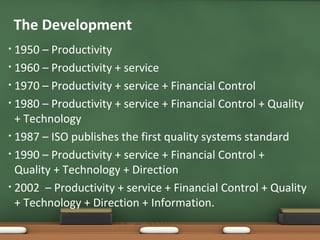
The Development
1950 – Productivity
• 1960 – Productivity + service
• 1970 – Productivity + service + Financial Control
• 1980 – Productivity + service + Financial Control + Quality
+ Technology
• 1987 – ISO publishes the first quality systems standard
• 1990 – Productivity + service + Financial Control +
Quality + Technology + Direction
• 2002 – Productivity + service + Financial Control + Quality
+ Technology + Direction + Information.
•
The Meaning of Quality &
Quality Improvement
We may define quality in many ways. Most people
have a conceptual understanding of quality as relating to one or
more desirable characteristics that a product or service should
possess.
Quality has become one of the most important consumer
decision factors in the selection among competing products and
services.
The phenomenon is widespread, regardless of whether
the consumer is an individual, an industrial organization, a retail
store, a bank or financial institution, or
a military defense program.
Cont..
Consequently, understanding and Improving
quality are key factors leading to business success,
growth and enhanced competitiveness.
There is a substantial return on investment
from improved quality and from successfully employing
quality as an integral part of overall business strategy.
Quality means: fitness for use
- quality of design
- quality of conformance
Quality is inversely proportional to variability.
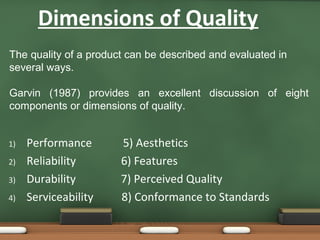
Dimensions of Quality
The quality of a product can be described and evaluated in
several ways.
Garvin (1987) provides an excellent discussion of eight
components or dimensions of quality.

1)
2)
3)
4)

Performance
Reliability
Durability
Serviceability

5) Aesthetics
6) Features
7) Perceived Quality
8) Conformance to Standards
Quality is fitness for use
Whether

the product, even when produced to standards,
was actually “fit-for-use” by the customer.

All

goods and services are produced in various
grades or levels of quality. These variations in grades or
levels of quality are intentional, and, consequently, the
appropriate technical term is quality of design.
The

quality of conformance is how well the product
conforms to the specifications required by the design
Cont..

For example, all automobiles have as their basic
objective providing safe transportation for the consumer.
However, automobiles differ with respect to size,
appointments, appearance, and performance.
These differences are the result of intentional design
differences among the types of automobiles. These
design differences include the types of materials
used in construction, specifications on the components,
reliability obtained through engineering development of
engines and drive trains, and other accessories or
equipment.
Cont..
Quality is inversely proportional to variability
This definition of Montgomery implies that if the
variability in a product's important characteristics
decreases, the quality of the product increases.



Quality improvement is the reduction of variability in
processes and products
 Excessive variability in process performance often
results in waste.
Cont..
For example, consider the wasted money, time, and effort
that is associated with the repairs represented.
Therefore, an alternate and frequently very useful definition is
that quality improvement is the reduction of waste.
This definition is particularly effective in service industries,
where there may not be as many things that can be directly
measured.
In service industries, a quality problem may be an error or a
mistake, the correction of which requires effort and expense. By
improving the service process, this wasted effort and expense
can be avoided.
Quality characteristics:
Every product possesses a number of elements that
jointly describe what the user or consumer thinks of
as quality.
These parameters are often called quality
characteristics. Sometimes these are called critical-toquality (CTQ) characteristics. Quality characteristics
may be of several types:
1. Physical: length, weight, voltage, viscosity
2. Sensory: taste, appearance, color
3. Time Orientation: reliability, durability, serviceability
Statistical Methods for Quality Control
and Improvement
Specifically, we focus on three major areas

1)Statistical process control.
2)Design of experiments.
3)Acceptance sampling.
Statistical Process Control (SPC)
• Control charts are used for process monitoring and
variability reduction.
• SPC is an on-line(in-process) quality control tool.
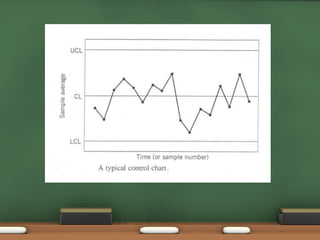
• The chart has a center line (CL) and upper and
lower control limits (UCL and LCL).The center
line represents where this process characteristic
should fall if there are no unusual sources of
variability present.
Advantages
These charts are extremely useful in phase I
implementation of SPC, where the process is
likely to be out of control and experiencing
assignable causes that result in large shifts in
the monitored parameters.
Shewhart charts are also very useful in the
diagnostic aspects of bringing an unruly process
into statistical control, because the patterns on
these charts often provide guidance regarding
the nature of the assignable cause.
Disadvantages
A major disadvantage of a Shewhart control
chart is that it uses only the information about
the process contained in the last sample
observation and it ignores any information
given by the entire sequence of points. This
feature makes the Shewhart control chart
relatively insensitive to small process shifts.
This potentially makes Shewhart control charts
less useful in phase II monitoring
problems(Cusum and EWMA control charts).
Design of Experiments
A designed experiment is extremely helpful in
discovering the key variables influencing the quality
characteristics of interest in the process.
• Experimental design is an approach to systematically
varying the controllable input factors in the process
and determine the effect these factors have on the
output responses.
• Experimental designs are off-line(used during
development activities) quality tools.
• Crucial for variability reduction.
•
Applications

Experimental design is a critically important engineering tool for
improving a manufacturing process. It also has extensive application
in the development of new processes.
Application of these techniques early in process development can
result in
1. Improved yield
2. Reduced variability and closer conformance to the nominal
3. Reduced development time
4. Reduced overall costs
Experimental design methods can also play a major role in engineering
design activities, where new products are developed and existing
ones improved.
Acceptance Sampling
Acceptance sampling is the inspection and classification
of a sample of the product selected at random from a
larger batch or lot and the ultimate decision about
disposition of the lot.
• Two types:
1. Outgoing inspection – after production
2. Incoming inspection – before use in production
•
Advantages of Sampling
When acceptance sampling is contrasted with 100%
inspection, it has the following advantages:
1. It is usually less expensive because there is less inspection.
2. There is less handling of the product, hence reduced
damage.
3. It is applicable to destructive testing.
4. Fewer personnel are involved in inspection activities.
5. It often greatly reduces the amount of inspection error.
Disadvantages of Sampling
1. There are risks of accepting “bad” lots and
rejecting “good” lots.
2. Less information is usually generated about the
product or about the process that manufactured
the product.
3. Acceptance sampling requires planning and
documentation of the acceptance sampling
procedure whereas 100% inspection does not.
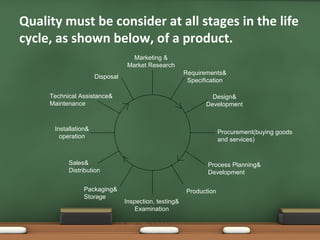
Quality must be consider at all stages in the life
cycle, as shown below, of a product.
Marketing &
Market Research
Requirements&
Specification

Disposal
Technical Assistance&
Maintenance

Design&
Development

Installation&
operation

Procurement(buying goods
and services)

Sales&
Distribution
Packaging&
Storage

Process Planning&
Development
Production
Inspection, testing&
Examination
Quality Planning
Quality planning is a strategic activity, and it is just as
vital to an organization’s long term business success as
the product development plan, the financial plan, the
marketing plan, and plans for the utilization of human
resources. Without a strategic quality plan, an
enormous amount of time, money, and effort will be
wasted by the organization dealing with faulty
designs, manufacturing defects, field failures, and
customer complaints.
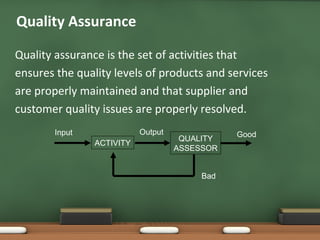
Quality Assurance
Quality assurance is the set of activities that
ensures the quality levels of products and services
are properly maintained and that supplier and
customer quality issues are properly resolved.
Output

Input
ACTIVITY

QUALITY
ASSESSOR
Bad

Good
Quality control and improvement
Involve the set of activities used to ensure
that the products and services meet requirements
and are improved on a continuous basis. Since
variability is often a major source of poor quality,
statistical techniques, including SPC and designed
experiments, are the major tools of quality control
and improvement.
Total Quality Management
“A strategy for improving overall performance
and quality competitiveness”
1.
2.
3.

Involves every aspect of the business
Involves every person
Requires total commitment
Total quality management (TQM)
is a strategy for implementing and managing
quality improvement activities on an organization
wide basis.
TQM began in the early 1980s, with the
philosophies of Deming and Juran as the focal
point.
TQM include
1) Lack of top down, high-level management
commitment and involvement
2) General as opposed to specific business-resultsoriented objectives
3) Too much emphasis on widespread training as
opposed to focused technical education.
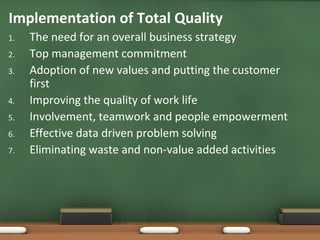
Implementation of Total Quality
1.
2.
3.
4.
5.
6.
7.

The need for an overall business strategy
Top management commitment
Adoption of new values and putting the customer
first
Improving the quality of work life
Involvement, teamwork and people empowerment
Effective data driven problem solving
Eliminating waste and non-value added activities
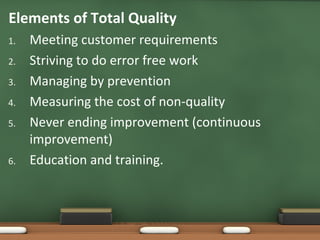
Elements of Total Quality
1.
2.
3.
4.
5.

6.

Meeting customer requirements
Striving to do error free work
Managing by prevention
Measuring the cost of non-quality
Never ending improvement (continuous
improvement)
Education and training.
Presented:BANDARU KRISHNA KUMAR
Qualification: M.SC(APPLIED STATISTICS)

Quality control and improvement concepts

  • 1.
  • 2.
  • 3.
    History 1. 2. 3. 4. 5. 6. 7. 13th century –craftsmen into union(guilds). 1700 – Industrial Revolution 1776 – Adam Smith – division of labour 1790 – Eli Whitney – Interchangeable parts Henry Ford – car industry in USA World War II- Inspection of every unit of product (bullets, rifles). Walter Shewhart (1924) introduced statistical control chart concepts.
  • 4.
    The Development 1950 –Productivity • 1960 – Productivity + service • 1970 – Productivity + service + Financial Control • 1980 – Productivity + service + Financial Control + Quality + Technology • 1987 – ISO publishes the first quality systems standard • 1990 – Productivity + service + Financial Control + Quality + Technology + Direction • 2002 – Productivity + service + Financial Control + Quality + Technology + Direction + Information. •
  • 5.
    The Meaning ofQuality & Quality Improvement We may define quality in many ways. Most people have a conceptual understanding of quality as relating to one or more desirable characteristics that a product or service should possess. Quality has become one of the most important consumer decision factors in the selection among competing products and services. The phenomenon is widespread, regardless of whether the consumer is an individual, an industrial organization, a retail store, a bank or financial institution, or a military defense program.
  • 6.
    Cont.. Consequently, understanding andImproving quality are key factors leading to business success, growth and enhanced competitiveness. There is a substantial return on investment from improved quality and from successfully employing quality as an integral part of overall business strategy. Quality means: fitness for use - quality of design - quality of conformance Quality is inversely proportional to variability.
  • 7.
    Dimensions of Quality Thequality of a product can be described and evaluated in several ways. Garvin (1987) provides an excellent discussion of eight components or dimensions of quality. 1) 2) 3) 4) Performance Reliability Durability Serviceability 5) Aesthetics 6) Features 7) Perceived Quality 8) Conformance to Standards
  • 8.
    Quality is fitnessfor use Whether the product, even when produced to standards, was actually “fit-for-use” by the customer. All goods and services are produced in various grades or levels of quality. These variations in grades or levels of quality are intentional, and, consequently, the appropriate technical term is quality of design. The quality of conformance is how well the product conforms to the specifications required by the design
  • 9.
    Cont.. For example, allautomobiles have as their basic objective providing safe transportation for the consumer. However, automobiles differ with respect to size, appointments, appearance, and performance. These differences are the result of intentional design differences among the types of automobiles. These design differences include the types of materials used in construction, specifications on the components, reliability obtained through engineering development of engines and drive trains, and other accessories or equipment.
  • 10.
    Cont.. Quality is inverselyproportional to variability This definition of Montgomery implies that if the variability in a product's important characteristics decreases, the quality of the product increases.  Quality improvement is the reduction of variability in processes and products  Excessive variability in process performance often results in waste.
  • 11.
    Cont.. For example, considerthe wasted money, time, and effort that is associated with the repairs represented. Therefore, an alternate and frequently very useful definition is that quality improvement is the reduction of waste. This definition is particularly effective in service industries, where there may not be as many things that can be directly measured. In service industries, a quality problem may be an error or a mistake, the correction of which requires effort and expense. By improving the service process, this wasted effort and expense can be avoided.
  • 12.
    Quality characteristics: Every productpossesses a number of elements that jointly describe what the user or consumer thinks of as quality. These parameters are often called quality characteristics. Sometimes these are called critical-toquality (CTQ) characteristics. Quality characteristics may be of several types: 1. Physical: length, weight, voltage, viscosity 2. Sensory: taste, appearance, color 3. Time Orientation: reliability, durability, serviceability
  • 13.
    Statistical Methods forQuality Control and Improvement Specifically, we focus on three major areas 1)Statistical process control. 2)Design of experiments. 3)Acceptance sampling.
  • 14.
    Statistical Process Control(SPC) • Control charts are used for process monitoring and variability reduction. • SPC is an on-line(in-process) quality control tool. • The chart has a center line (CL) and upper and lower control limits (UCL and LCL).The center line represents where this process characteristic should fall if there are no unusual sources of variability present.
  • 15.
    Advantages These charts areextremely useful in phase I implementation of SPC, where the process is likely to be out of control and experiencing assignable causes that result in large shifts in the monitored parameters. Shewhart charts are also very useful in the diagnostic aspects of bringing an unruly process into statistical control, because the patterns on these charts often provide guidance regarding the nature of the assignable cause.
  • 16.
    Disadvantages A major disadvantageof a Shewhart control chart is that it uses only the information about the process contained in the last sample observation and it ignores any information given by the entire sequence of points. This feature makes the Shewhart control chart relatively insensitive to small process shifts. This potentially makes Shewhart control charts less useful in phase II monitoring problems(Cusum and EWMA control charts).
  • 18.
    Design of Experiments Adesigned experiment is extremely helpful in discovering the key variables influencing the quality characteristics of interest in the process. • Experimental design is an approach to systematically varying the controllable input factors in the process and determine the effect these factors have on the output responses. • Experimental designs are off-line(used during development activities) quality tools. • Crucial for variability reduction. •
  • 19.
    Applications Experimental design isa critically important engineering tool for improving a manufacturing process. It also has extensive application in the development of new processes. Application of these techniques early in process development can result in 1. Improved yield 2. Reduced variability and closer conformance to the nominal 3. Reduced development time 4. Reduced overall costs Experimental design methods can also play a major role in engineering design activities, where new products are developed and existing ones improved.
  • 20.
    Acceptance Sampling Acceptance samplingis the inspection and classification of a sample of the product selected at random from a larger batch or lot and the ultimate decision about disposition of the lot. • Two types: 1. Outgoing inspection – after production 2. Incoming inspection – before use in production •
  • 21.
    Advantages of Sampling Whenacceptance sampling is contrasted with 100% inspection, it has the following advantages: 1. It is usually less expensive because there is less inspection. 2. There is less handling of the product, hence reduced damage. 3. It is applicable to destructive testing. 4. Fewer personnel are involved in inspection activities. 5. It often greatly reduces the amount of inspection error.
  • 22.
    Disadvantages of Sampling 1.There are risks of accepting “bad” lots and rejecting “good” lots. 2. Less information is usually generated about the product or about the process that manufactured the product. 3. Acceptance sampling requires planning and documentation of the acceptance sampling procedure whereas 100% inspection does not.
  • 23.
    Quality must beconsider at all stages in the life cycle, as shown below, of a product. Marketing & Market Research Requirements& Specification Disposal Technical Assistance& Maintenance Design& Development Installation& operation Procurement(buying goods and services) Sales& Distribution Packaging& Storage Process Planning& Development Production Inspection, testing& Examination
  • 24.
    Quality Planning Quality planningis a strategic activity, and it is just as vital to an organization’s long term business success as the product development plan, the financial plan, the marketing plan, and plans for the utilization of human resources. Without a strategic quality plan, an enormous amount of time, money, and effort will be wasted by the organization dealing with faulty designs, manufacturing defects, field failures, and customer complaints.
  • 25.
    Quality Assurance Quality assuranceis the set of activities that ensures the quality levels of products and services are properly maintained and that supplier and customer quality issues are properly resolved. Output Input ACTIVITY QUALITY ASSESSOR Bad Good
  • 26.
    Quality control andimprovement Involve the set of activities used to ensure that the products and services meet requirements and are improved on a continuous basis. Since variability is often a major source of poor quality, statistical techniques, including SPC and designed experiments, are the major tools of quality control and improvement.
  • 28.
    Total Quality Management “Astrategy for improving overall performance and quality competitiveness” 1. 2. 3. Involves every aspect of the business Involves every person Requires total commitment
  • 29.
    Total quality management(TQM) is a strategy for implementing and managing quality improvement activities on an organization wide basis. TQM began in the early 1980s, with the philosophies of Deming and Juran as the focal point.
  • 30.
    TQM include 1) Lackof top down, high-level management commitment and involvement 2) General as opposed to specific business-resultsoriented objectives 3) Too much emphasis on widespread training as opposed to focused technical education.
  • 31.
    Implementation of TotalQuality 1. 2. 3. 4. 5. 6. 7. The need for an overall business strategy Top management commitment Adoption of new values and putting the customer first Improving the quality of work life Involvement, teamwork and people empowerment Effective data driven problem solving Eliminating waste and non-value added activities
  • 32.
    Elements of TotalQuality 1. 2. 3. 4. 5. 6. Meeting customer requirements Striving to do error free work Managing by prevention Measuring the cost of non-quality Never ending improvement (continuous improvement) Education and training.
  • 33.