INVENTORY CONTROL
AND
RECENT TRENDS IN PPC
UNIT - 5
INVENTORY
 Inventory is a stock of an item or ideal
resource held for future use.
INVENTORY DEFINED
 The term inventory includes
1) raw material
2) In processed finished package
3) Other stocks
TYPES OF INVENTORY
 CLASSIFICATION BASED ON MATERIAL
FLOW:
1. Raw material inventories
2. Brought out parts inventories
3. Work in process inventories
4. Finished goods inventories
5. MRO INVENTORIES (Maintenance, Repair,
Operation)
 CLASSIFICATION BASED ON NATURE
OF USE:
1. Anticipation inventories (expected demand)
2. Fluctuation inventories ( Avoid risk)
3. Lot size inventories ( large lots to get discounts)
4. Transportation inventories (one place to another)
PURPOSE OF HOLDING STOCK
1. To maintain independence of operations
2. To meet variation in product demand
3. To allow flexibility in production scheduling
4. To provide safe guard of raw materials
5. To take advantages of price discounts
6. To utilize the advantage of price fluctuations
7. To prevent loss of orders
INVENTORY CONTROL
 Scientific method for what to order, when to
order, how much to order, how much to stock.
INVENTORY DECISIONS:
1. HOW MUCH (order quantity)
2. WHEN TO REPLISH (order level)
FUNCTIONS OF INVENTORY CONTROL:
1. Effective running of the stores
2. Technology responsibilities
3. Stock control system
OBJECTIVE OF INVENTORY CONTROL
1. To ensure Continuous supply of materials.
2. To maintain overall investment
3. To minimize holding and replacement
shortage
4. To keep in active , waste at minimal level
5. To supply of product , raw materials
regurarly.
WHAT ARE INVENTORY COSTS?
1. ORDERING COSTS
2. CARRYING COSTS (HOLDING COSTS)
3. SHORTGE (OR STOCK OUT) COSTS
4. PURCHASE COSTS
TERMS USED IN INVENTORY CONTROL
1. Demand
2. Order cycle
3. Lead time
4. Re order level
5. Safety or buffer stock
6. Re order quantity
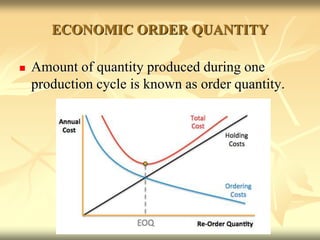
ECONOMIC ORDER QUANTITY
 Amount of quantity produced during one
production cycle is known as order quantity.
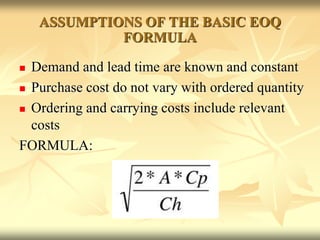
ASSUMPTIONS OF THE BASIC EOQ
FORMULA
 Demand and lead time are known and constant
 Purchase cost do not vary with ordered quantity
 Ordering and carrying costs include relevant
costs
FORMULA:
TYPES OF INVENTORY SYSTEMS
 TWO GENERAL TYPES OF INVENTORY
SYSTEMS.
 FIXED ORDER QUANTITY MODEL (Q-model)
 FIXED TIME PERIOD MODELS (P-model)
13
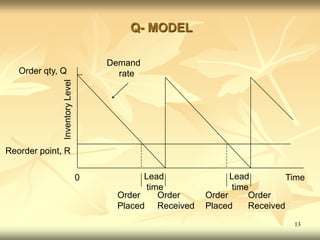
Q- MODEL
Demand
rate
0 Time
Lead
time
Lead
time
Order
Placed
Order
Placed
Order
Received
Order
Received
Inventory
Level
Reorder point, R
Order qty, Q
INVENTORY DECISION PARAMETERS
FOR Q- MODEL
1. Re- order quantity (how much to order)
2. Re –order level (when to order)
RE- ORDER LEVEL = SAFETY STOCK +
LEAD TIME CONSUMPTION
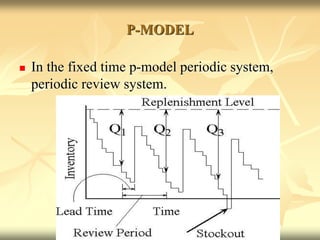
P-MODEL
 In the fixed time p-model periodic system,
periodic review system.
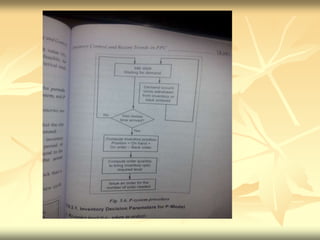
INVENTORY DECISION PARAMETER
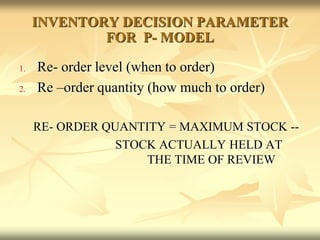
FOR P- MODEL
1. Re- order level (when to order)
2. Re –order quantity (how much to order)
RE- ORDER QUANTITY = MAXIMUM STOCK --
STOCK ACTUALLY HELD AT
THE TIME OF REVIEW
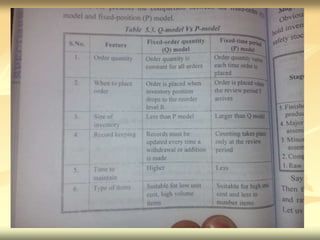
Q- MODEL vs P- MODEL
EFFECT OF DEMAND ON INVENTORIES
 STAGE-I- producing components from raw
materials
 STAGE-II – producing minor components
from components
 STAGE-III – producing major assemblies
from components
 STAGE-IV – assembling the final product
VARIOUS INVENTORY CONTROL
TECHNIQUES
 Various inventory control otherwise called as
selective inventory control.
 selective inventory control refers to the
variation in method of control in item to item
on some selective basis
SELECTIVE INVENTORY CONTROL
TECHNIQUES
1. ABC ANALYSIS- Always , Better, Control analysis
2. VED ANALYSIS – Vital , Essential, Desirable analysis
3. HML ANALYSIS- High, Medium, Low analysis
4. FSN ANALYSIS- fast moving , Slow moving, Non
moving analysis
5. SOS ANALYSIS- Seasonal, Off-Seasonal analysis
6. GOLF ANALYSIS- Government, Ordinary, Local,
Foreign analysis
7. XYZ ANALYSIS
8. BAR CODE ANALYSIS
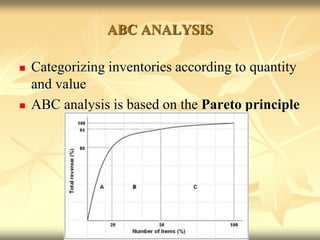
ABC ANALYSIS
 Categorizing inventories according to quantity
and value
 ABC analysis is based on the Pareto principle
PROCEDURE FOR ABC ANALYSIS
1. Identify all the items being used list them and
estimate the annual consumption
2. Collect cost data for individual items
3. Find out annual usage or consumption in
rupees
4. Arrange in descending order (annual usage)
5. Calculate cumulative annul usage express in
the percentage of total annual usage.
6. Plot cumultive usage percentage against
cumulative item percentage and segerate in to
A,B,C
RECENT TRENDS IN PPC
APPLICATIONS OF COMPUTERS IN PPC:
1. Plant logistics
2. Cost accounting
3. Estimation
4. Quality management
5. Simulation
6. Scheduling
7. Etc,.
COMPUTERISED PRODUCTION AND
PLANNING AND CONTROL
1. Product structure processer
2. Material requirement
3. Product costing system
4. Inventory management system
5. Master production scheduling system
6. Capacity planning system
7. Shop floor control and monitoring system
JUST IN TIME PRODUCTION SYSTEM
 JIT is a management philosophy
 Eliminate sources of manufacturing waste
 Right part in the right place in the right time.
 OTHER NAMES:
 Short cycle manufacturing
 Stockless production
 Zero inventory manufacturing
OBJECTIVES OF JIT
1. Zero defects
2. Zero inventories
3. Zero setup time
4. Zero breakdowns
5. Zero handling
6. Zero lead time
7. Lot size
SEVEN WASTES OF JIT
1. Waste of over production
2. Waste of waiting
3. Waste of transportation
4. Waste of process itself
5. Waste of stock
6. Waste of motion
7. Waste of making defective products
JIT ELEMENTS
1. TECHNOLOGY MANAGEMENT
2. PEOPLE MANAGEMET
3. SYSTEMS MANAGEMENT
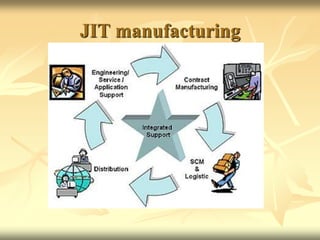
JIT manufacturing
KANBAN PRODUCTION CONTROL
SYSTEM
 TWO MAIN TYPES OF KANBAN:
1. Production kanban (P-kanban)
 It signals need to produce more parts
2. Transport kanban (T-kanban or move kanban)
 It signals need to deliver more parts to the
next work centre
TWO CARD KANBAN
MANUFACTURING RESOURCE
PLANNING (MRP-II)
 MRP-II represents the natural evolution of
closed loop MRP (Material Requirement
Planning)
 FUNCTIONS OF MRP:
1. Management planning
2. Customer services
3. Operations planning
4. Operations execution
5. Financial functions
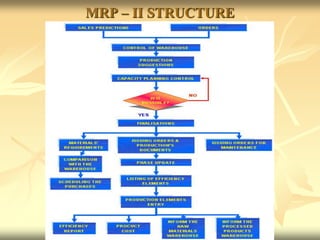
MRP – II STRUCTURE
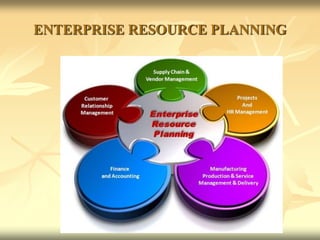
ENTERPRISE RESOURCE
PLANNING
 ERP is a new system concept every enterprise
function is integrated with a flow of
information
 ERP Vs MRP-II
 ERP has a technical requirements such as graphical
user interface, database , fourth generation
language, etc,.
INFORMATIONS
REQUIREMENTS OF ERP
1. Sales customer order demand relation ship
2. Manufacturing resource data
3. Inventory status data
4. Manufacturing process information
5. Customer information
6. Customer satisfaction information
7. Vendor and supply chain detail data
ENTERPRISE RESOURCE PLANNING
IMPLEMENTATION OF ERP
1. Identify the needs of ERP implementation
packages
2. Evaluating the existing business situation
3. Make decisions on regarding situations
4. Re engineer business process to achieve desired
results
5. Evaluate the various available ERP packages
6. Choose suitable ERP package
7. Install
8. Finalise
MODULES OF ERP
1. Finance module
2. Manufacturing module
3. Distribution module
4. Service module
5. Transportation module
6. Process module
7. Project module
8. Tools module
9. Other modules

UNIT-V.ppt

  • 1.
  • 2.
    INVENTORY  Inventory isa stock of an item or ideal resource held for future use. INVENTORY DEFINED  The term inventory includes 1) raw material 2) In processed finished package 3) Other stocks
  • 3.
    TYPES OF INVENTORY CLASSIFICATION BASED ON MATERIAL FLOW: 1. Raw material inventories 2. Brought out parts inventories 3. Work in process inventories 4. Finished goods inventories 5. MRO INVENTORIES (Maintenance, Repair, Operation)
  • 4.
     CLASSIFICATION BASEDON NATURE OF USE: 1. Anticipation inventories (expected demand) 2. Fluctuation inventories ( Avoid risk) 3. Lot size inventories ( large lots to get discounts) 4. Transportation inventories (one place to another)
  • 5.
    PURPOSE OF HOLDINGSTOCK 1. To maintain independence of operations 2. To meet variation in product demand 3. To allow flexibility in production scheduling 4. To provide safe guard of raw materials 5. To take advantages of price discounts 6. To utilize the advantage of price fluctuations 7. To prevent loss of orders
  • 6.
    INVENTORY CONTROL  Scientificmethod for what to order, when to order, how much to order, how much to stock. INVENTORY DECISIONS: 1. HOW MUCH (order quantity) 2. WHEN TO REPLISH (order level) FUNCTIONS OF INVENTORY CONTROL: 1. Effective running of the stores 2. Technology responsibilities 3. Stock control system
  • 7.
    OBJECTIVE OF INVENTORYCONTROL 1. To ensure Continuous supply of materials. 2. To maintain overall investment 3. To minimize holding and replacement shortage 4. To keep in active , waste at minimal level 5. To supply of product , raw materials regurarly.
  • 8.
    WHAT ARE INVENTORYCOSTS? 1. ORDERING COSTS 2. CARRYING COSTS (HOLDING COSTS) 3. SHORTGE (OR STOCK OUT) COSTS 4. PURCHASE COSTS
  • 9.
    TERMS USED ININVENTORY CONTROL 1. Demand 2. Order cycle 3. Lead time 4. Re order level 5. Safety or buffer stock 6. Re order quantity
  • 10.
    ECONOMIC ORDER QUANTITY Amount of quantity produced during one production cycle is known as order quantity.
  • 11.
    ASSUMPTIONS OF THEBASIC EOQ FORMULA  Demand and lead time are known and constant  Purchase cost do not vary with ordered quantity  Ordering and carrying costs include relevant costs FORMULA:
  • 12.
    TYPES OF INVENTORYSYSTEMS  TWO GENERAL TYPES OF INVENTORY SYSTEMS.  FIXED ORDER QUANTITY MODEL (Q-model)  FIXED TIME PERIOD MODELS (P-model)
  • 13.
  • 15.
    INVENTORY DECISION PARAMETERS FORQ- MODEL 1. Re- order quantity (how much to order) 2. Re –order level (when to order) RE- ORDER LEVEL = SAFETY STOCK + LEAD TIME CONSUMPTION
  • 16.
    P-MODEL  In thefixed time p-model periodic system, periodic review system.
  • 18.
    INVENTORY DECISION PARAMETER FORP- MODEL 1. Re- order level (when to order) 2. Re –order quantity (how much to order) RE- ORDER QUANTITY = MAXIMUM STOCK -- STOCK ACTUALLY HELD AT THE TIME OF REVIEW
  • 19.
    Q- MODEL vsP- MODEL
  • 20.
    EFFECT OF DEMANDON INVENTORIES  STAGE-I- producing components from raw materials  STAGE-II – producing minor components from components  STAGE-III – producing major assemblies from components  STAGE-IV – assembling the final product
  • 21.
    VARIOUS INVENTORY CONTROL TECHNIQUES Various inventory control otherwise called as selective inventory control.  selective inventory control refers to the variation in method of control in item to item on some selective basis
  • 22.
    SELECTIVE INVENTORY CONTROL TECHNIQUES 1.ABC ANALYSIS- Always , Better, Control analysis 2. VED ANALYSIS – Vital , Essential, Desirable analysis 3. HML ANALYSIS- High, Medium, Low analysis 4. FSN ANALYSIS- fast moving , Slow moving, Non moving analysis 5. SOS ANALYSIS- Seasonal, Off-Seasonal analysis 6. GOLF ANALYSIS- Government, Ordinary, Local, Foreign analysis 7. XYZ ANALYSIS 8. BAR CODE ANALYSIS
  • 23.
    ABC ANALYSIS  Categorizinginventories according to quantity and value  ABC analysis is based on the Pareto principle
  • 24.
    PROCEDURE FOR ABCANALYSIS 1. Identify all the items being used list them and estimate the annual consumption 2. Collect cost data for individual items 3. Find out annual usage or consumption in rupees 4. Arrange in descending order (annual usage) 5. Calculate cumulative annul usage express in the percentage of total annual usage. 6. Plot cumultive usage percentage against cumulative item percentage and segerate in to A,B,C
  • 25.
    RECENT TRENDS INPPC APPLICATIONS OF COMPUTERS IN PPC: 1. Plant logistics 2. Cost accounting 3. Estimation 4. Quality management 5. Simulation 6. Scheduling 7. Etc,.
  • 26.
    COMPUTERISED PRODUCTION AND PLANNINGAND CONTROL 1. Product structure processer 2. Material requirement 3. Product costing system 4. Inventory management system 5. Master production scheduling system 6. Capacity planning system 7. Shop floor control and monitoring system
  • 27.
    JUST IN TIMEPRODUCTION SYSTEM  JIT is a management philosophy  Eliminate sources of manufacturing waste  Right part in the right place in the right time.  OTHER NAMES:  Short cycle manufacturing  Stockless production  Zero inventory manufacturing
  • 28.
    OBJECTIVES OF JIT 1.Zero defects 2. Zero inventories 3. Zero setup time 4. Zero breakdowns 5. Zero handling 6. Zero lead time 7. Lot size
  • 29.
    SEVEN WASTES OFJIT 1. Waste of over production 2. Waste of waiting 3. Waste of transportation 4. Waste of process itself 5. Waste of stock 6. Waste of motion 7. Waste of making defective products
  • 30.
    JIT ELEMENTS 1. TECHNOLOGYMANAGEMENT 2. PEOPLE MANAGEMET 3. SYSTEMS MANAGEMENT
  • 31.
  • 32.
    KANBAN PRODUCTION CONTROL SYSTEM TWO MAIN TYPES OF KANBAN: 1. Production kanban (P-kanban)  It signals need to produce more parts 2. Transport kanban (T-kanban or move kanban)  It signals need to deliver more parts to the next work centre
  • 33.
  • 34.
    MANUFACTURING RESOURCE PLANNING (MRP-II) MRP-II represents the natural evolution of closed loop MRP (Material Requirement Planning)  FUNCTIONS OF MRP: 1. Management planning 2. Customer services 3. Operations planning 4. Operations execution 5. Financial functions
  • 35.
    MRP – IISTRUCTURE
  • 36.
    ENTERPRISE RESOURCE PLANNING  ERPis a new system concept every enterprise function is integrated with a flow of information  ERP Vs MRP-II  ERP has a technical requirements such as graphical user interface, database , fourth generation language, etc,.
  • 37.
    INFORMATIONS REQUIREMENTS OF ERP 1.Sales customer order demand relation ship 2. Manufacturing resource data 3. Inventory status data 4. Manufacturing process information 5. Customer information 6. Customer satisfaction information 7. Vendor and supply chain detail data
  • 38.
  • 39.
    IMPLEMENTATION OF ERP 1.Identify the needs of ERP implementation packages 2. Evaluating the existing business situation 3. Make decisions on regarding situations 4. Re engineer business process to achieve desired results 5. Evaluate the various available ERP packages 6. Choose suitable ERP package 7. Install 8. Finalise
  • 40.
    MODULES OF ERP 1.Finance module 2. Manufacturing module 3. Distribution module 4. Service module 5. Transportation module 6. Process module 7. Project module 8. Tools module 9. Other modules