3
KAIZEN
“The starting pointfor improvement is to
recognize the need. This comes from
recognition of a problem. If no problem is
recognized, there is no recognition of the need
for improvement. Complacency is the arch-
enemy of Kaizen. Therefore, Kaizen emphasizes
awareness and provides clues for identifying
problems.”
4.
4
KAIZEN
A culture ofsustained continuous improvement
focusing on eliminating waste in all systems and
processes of an organization, starting with the
GEMBA (or work place)
Involves all operations and work units
Other names
Continuous Improvement
Zero-defect
Six Sigma
5.
5
7 Basic Typesof Waste (MUDA)
1. Overproduction-producing more than what is
demanded by the customer.
2. Inventory- storing more than the absolute minimum
needed.
3. Transport- the un necessary movement of materials.
4. Delay- waiting for the next process step.
5. Excess Processing- due to poor tool or design
6. Wasted motion- un necessary reaching, walking, or
looking for parts, tools, prints, information, and so on
7. Defective Products-scrap and rework
6.
6
Take Five
• Takefive minutes to think about these
questions and answers:
• 1. What continuous improvement activities
have you done in your department/section?
• 2. Can you think of one thing you could
change that would improve the way you do
your operation or process?
7.
7
Why KAIZEN
• Intensecompetitive environment
• Continued advances in the technological
environment
• Increasing difficult economic environment
• Fluctuating changes in the social/cultural
environment
8.
8
Principles in KAIZENImplementation
1. Human Resources are the most important
company assets, processes must evolve by gradual
improvement rather than radical changes.
2. Improvement must be based on
statistical/quantitative evaluation of process
performance.
3. Support throughout the entire structure is
necessary to become successful in developing a
strong KAIZEN approach.
9.
9
10 Basic Principlesfor Improvement
1. Discard conventional fixed ideas
2. Think of how to do it, not why it cannot be done
3. Do not make excuses, Start by questioning current practices
4. Do not seek perfection. Do it right away even if for only 50% of
target
5. Correct it right away, if you make mistake
6. Do not spend money for Kaizen, use your wisdom
7. Wisdom is brought out when faced with hardship
8. Ask “WHY?” five times and seek root causes
9. Seek the wisdom of ten people rather than the knowledge of one
10. Kaizen ideas are infinite
10.
10
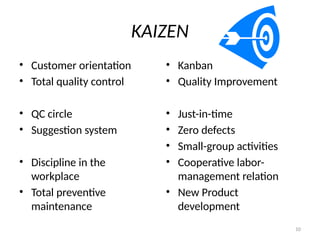
KAIZEN
• Customer orientation
•Total quality control
• QC circle
• Suggestion system
• Discipline in the
workplace
• Total preventive
maintenance
• Kanban
• Quality Improvement
• Just-in-time
• Zero defects
• Small-group activities
• Cooperative labor-
management relation
• New Product
development
11.
11
Role of TopManagement
• Establish KAIZEN as the overriding
corporate strategy
• Communicate to all levels of the organization
• Allocate the resources necessary for KAIZEN to
work
12.
12
Role of MiddleManagement
• Implement the KAIZEN policies established by
the top management
• Establishing, maintaining and improving work
standards
• Ensuring that employees receive the training
necessary to understand and implement KAIZEN
• Ensuring that employees learn how to use
problem solving and improvement tools.
13.
13
Role of Supervisors
•Apply KAIZEN approach in their functional roles
• Develop plans for carrying our the KAIZEN
approach at the functional level
• Improve communication at the workplace
• Maintain morale
• Provide coaching for teamwork activities
• Solicit KAIZEN suggestions from employees
• Make KAIZEN suggestions
14.
14
Role of Employees
•Participate in KAIZEN through
teamwork activities
• Make Kaizen suggestions
• Engage in continuous self-improvement activities
• Continually enhance job skills through education
and training
• Continually broaden job skills through cross
functional training
16
Suggestion Schemes
• Wespend most of the waking hours working
for our organization
• We all get bright ideas- how to do the job in a
safer, better and cheaper way
• How to improve stakeholder satisfaction
• How to make our customer happy because
they are satisfied
17.
17
Suggestion Schemes: Objective
•To promote innovation and creativity
• To improve safety, quality, productivity,
profitability, and services
• To enhance opportunity for the sense of belonging
• To pursue Excellence at individual, team and
organizational levels
• To promote rational, structured processes to
recognize and reward employees suggestions in
the above context
18.
18
The wet BlanketList
• I am too busy to study it
• It’s good idea, but the timing is premature
• It is not in the budget
• Theory is different from practice
• Isn’t there something else for you to do?
• I think if doesn’t match our corporate policy
• It isn’t our business – let someone else think about it
• Are you dissatisfied with your work?
• It’s not improvement, it’s common sense
• I know the result, even if we don’t do it
• I will not be held accountable for it
• Can you think of a better idea?
19.
19
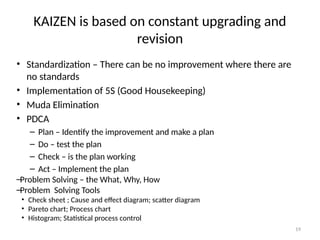
KAIZEN is basedon constant upgrading and
revision
• Standardization – There can be no improvement where there are
no standards
• Implementation of 5S (Good Housekeeping)
• Muda Elimination
• PDCA
– Plan – Identify the improvement and make a plan
– Do – test the plan
– Check – is the plan working
– Act – Implement the plan
–Problem Solving – the What, Why, How
–Problem Solving Tools
• Check sheet ; Cause and effect diagram; scatter diagram
• Pareto chart; Process chart
• Histogram; Statistical process control
20.
20
Conclusion
• Change themethod. After implementing idea,
don’t go back to the old way of doing things.
• Focus on small changes
• Have realistic constraints
• You may already be practicing KAIZEN and not
realizing it
• The simplicity of KAIZEN can make it hard to
accept as a management theory
21.
21
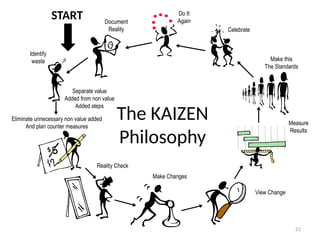
The KAIZEN
Philosophy
START Document
Reality
DoIt
Again
Celebrate
Make this
The Standards
Measure
Results
View Change
Make Changes
Reality Check
Eliminate unnecessary non value added
And plan counter measures
Separate value
Added from non value
Added steps
Identify
waste