
nd
W
n
<
n
a+8Society of
Manufacturing
Engineers
2002
MSO2-124
Implementing Design for
Manufacture Rules
author(s)
R. DUMITRESCU
T. SZECSI
Dublin City University
Dublin, Ireland
abstract
This paper shows a new approach in incorporating manufacturing constraints
at the design stage into an intelligent system, which analyses the design
features from a CAD drawing, relates them to machining feature, and then
suggests the available manufacturing processes capable of producing these
features. The system also examines whether design for manufacture rules
are violated by the features’ characteristics and conclude on their
manufacturing possibility. Production type, materials, tolerances, surface
finish, feature’s characteristics, and accessibility are taken into consideration.
This paper originally appeared in the Proceedings of the 1lti International
Conference on Flexible Automation and Intelligent Manufacturing (FAIM ‘Ol),
July 16-I 8, 2001, Dublin, Ireland, and has been republished with permission
of the authors and the Dublin City University.
terms
Design for Manufacture
Design & Machining Features
Computer Aided Design
Society of Manufacturing Engineers
One SME Drive l P.O. Box 930 l Dearborn, MI 48121
Phone (313) 271-1500
www.sme.org
Copyright (c) 2002 Society of Manufacturing Engineers. All rights reserved.
SME TECHNICAL PAPERS
This Technical Paper may not be reproduced in whole or in part
in any form without the express written permission of the Society
of Manufacturing Engineers. By publishing this paper, SME
neither endorses any product, service or information discussed
herein, nor offers any technical advice. SME specifically
disclaims any warranty of reliability or safety of any of the
information contained herein.
Copyright (c) 2002 Society of Manufacturing Engineers. All rights reserved.
IMPLEMENTING DESIGN FOR MANUFACTURE RULES
R. Dumitrescu andT. Szecsi
School of Mechanical andManufacturing Engineering, Dublin City University, Ireland.
ABSTRACT
This paper shows a new approachin incorporating manufacturing constraints at the design
stageinto an intelligent system,which analysesthe designfeaturesfrom a CAD drawing, relates
them to machining features,andthen suggeststhe available manufacturing processescapableof
producing these features.The system also examineswhether design for manufacture rules are
violated by the features’ characteristics and conclude on their manufacturing possibility.
Production type? materials, tolerances, surface finish, and feature’s characteristics and
accessibility aretaken into consideration.
KEYWORDS: Design for Manufacture, Computer Aided Design (CAD), Design &
Machining Features
1. INTRODUCTION ,
Classically, the designing environment was basedon what we call today the “over-the-
wall” system [2], where the interaction between designersand manufacturing engineers was
minimal and manufacturing issueswere only superficially consideredfrom the beginning of a
design. One way of overcoming this problem is to have a team of designersand manufacturing
engineersworking together at the design stage. These teams use analysing tools, which help
them evaluatethe design.Design For Manufacture is oneof thesetools that enhancea numberof
general rules about the manufacturability of a part (i.e. the relative easeof manufacturing a
Par-Q
In the last years,Design For Manufacture (DFM) approachhasbecomea real interestas
it was found that the design stagedeterminesmost of the cost of the development of a product.
As market needshave increasedand the competition to remain on the market hasbecomevery
tight, it is a crucial issue to reduce the time of the product development [11.Customers are
demanding high quality products at competitive prices and the design is the first step in
satisfying their requirements [7]. Thus, it is necessaryto apply manufacturing constrainsfrom
the very beginning of the design stage,in order to avoid costly changesthat may occur later
becauseof the difficulty or impossibility to implement some manufacturing processes.This
practiceis essentialin reducingthe costof aproduct considerably.
The history of DFM is describedin [l] from the early beginning. Eli Whitney is known
asthe personwho introducedthe interchangeablepartsconcept.Still in a growing phase,DFM is
believed to become even more important in the next years. Nowadays, the increase of the
importance of the DFM conceptis closely relatedto the drastic developmentandhugeprogresses
Copyright (c) 2002 Society of Manufacturing Engineers. All rights reserved.
2
achievedin computation resourcesduring the last decade,making available high performance
hardware and software at affordable prices. Although CAD systemshave been available since
almost 30 yearsandthey areprogressively spreadingin almost all fields of today’s engineering,
thereis still a lot to do in the field of computerisation of DFM [13.
The aim of this researchis the development of an intelligent system for implementing
DFM rules, which hasits origins in the idea of helping designersby offering them supportwith
manufacturing constraints information. The purpose is to improve the design quality and to
decreasethe time-to-market, as rapid product development is becoming a critical factor to a
company’sposition [2]. It is well known that improperly designedpartscan still beproducedbut
with anunjustifiable increasein manufacturing costsandtime, andit is the aim of the DFM tools
to help usersto optimise their designs.
In the following section of this paper, feature conceptterminology and usageare briefly
reviewed. The third and fourth sectionsexplain our approachand intentions in developing the
system.Discussionsand examplesof hole features are also included in the fourth section. The
capabilities and limitations of the approach are concluded in the fifth section, and the further
work planned to continue our researchand its perspectivesare explained. Some examples of
machining featuresaregiven in the annexat the endof thepaper.
2. FEATURE CONCEPT
The integration of CAD systemsto CAM and CAE systemscould not be achievedwithout
the help of feature concept.Indeed, CAPP hasto interpret the part from a CAD data in terms of
features [I 11,which most often are manufacturing features.Based on the viewpoint, different
types of features can be defined. During the design process, a part is created using design
features,which later have to be interpreted into manufacturing, assembly or inspection features
via dedicatedrecognition tools.
2.1 Feature Definition
A feature is a set of faces or regions of one part with distinct topological, geometrical
and/or manufacturing information. Featurescharacterisethe product and help in analysing the
design concurrently using numerical or knowledge-basedsystems[121.If the product is viewed
from the designing stand point. then features are called design features and they present only
topological and geometrical information; if the product is viewed from the manufacturing stand
point, then featuresare called manufacturing featuresand they presenttopological, geometrical
andmanufacturing Xorrnation.
In [S], a feature is defined as a stereotypical geometric shape associated with some
engineering significance. The authors also mention about the predefined feature, which has a
fixed topology and has been defined in a library. Another way of defining a feature is given in
[12], where a feature representsthe geometry of a part or assembly and building blocks for
product definition or for geometry reasoning. It hasto be mentioned that as the researchgoes
deeperinto this area,different typesof featuresaredevelopedsystematically.
2.2 Design Features
Design Featuresarethosefeaturesusedat the design stagedefined by the useror from the
CAD modeller library and which do not take into considerationany manufacturing, assemblyor
Copyright (c) 2002 Society of Manufacturing Engineers. All rights reserved.
3
inspection constrains. They might have shapesand/or locations impossible to produce and/or
reachwith the available technology at a given moment and in a given company. [7] deals with
threetypes of design features:depression,protrusion, andtransition features.The authorsdefine
the depressionfeature asan increment to the volume of a shapesuchasboss,and the protrusion
featureas a decrementsuch as a hole. The transition feature could be either a decrementor an
increment,dependingon whether its profile is convexor concave.
Examples of design features can be found in [4,6,7] as slot, hole, pocket, rounding,
cylinder, block, protrusion, cut, chamfer, user-defined features, etc. The user-defined design
features are based on planar profiles swept into three-dimensional shapesby extrusions and
revolutions.
2.3 Feature-based Desiw
A systemwhere the designercreatesthe part by picking the entities from a feature library
is called a feature-baseddesign system [4]. Today’s CAD systemshave their own pre-defmed
featurelibrary. [4,12] show that the main advantagesof designing with featuresare the less-time
consuming aspectwhen re-design of a part is needed.In this case,once a parent-featureis re-
positioned it will automatically re-position all its child-features, as features are relatively
positionedoneagainstanother.Reuseof design is not usually the casein classicalCAD systems,
whereeverythinghad to bereconsideredalmost from the beginning.
When the feature library does not satisfy a company, a user-defin.edone adaptable to
different types of products can be createdwhere there is a real needfor this, as it is time and
moneyconsuming [9]. Still the creationof anadequatefeaturelibrary is not trivial.
2.4 Manufacturing Features
A manufacturing featureis interpreted in [8] asa continuous volume that can be removed
by a single machining operation in a single set-up.It dependsnot only on the shapeand size of
the geometric feature, but also on the manufacturing processto be usedto produce this feature
[9]. The definition of the manufacturing featuresis general&d in [lo] to the whole engineering
approach,as being a function of the part (or some portion of the part) and specific factory
resourcesto be usedto producethat (portion of the) part; from herethe authorsconcludethat a
manufacturingfeatureis the function of machinetools, setup,tools andparts.
It can be found in [5,6,1l] that there are different manufacturing features,namely: hole,
pocket,openpocket, face, boss,step,open step,slot, notch, grove, knurl, thread, fillet, chamfer,
etc.
2.5 Design by Manufacturing Features
Design by Manufacturing Featureswould be the most promising in the evolution of CAD
systems,where the designer would have to use manufacturing featuresand to think in process
planning terms,i.e. manufacturing techniquesandcostissues[9]. This approachassumesthat the
designercreatesthe part in terms of manufacturing operations. It would be the best to use in
practice,but it is still unnatural for the designers.
2.6 Manufacturability Analysis
Unfortunately, it is still impossible to completely replace the human decision factor with
an automatic manufacturing analysis system becausethe relation between design details and
Copyright (c) 2002 Society of Manufacturing Engineers. All rights reserved.
4
processing is often very complex and not easily reduced to formulas or simple relationships.
Specifying a manufacturing processfor a feature is a difficult decision since for someparticular
situations onewell-known expensiveoperation can be cheaperthan two cheaperoperations and
an automatic selection of the manufacturing sequencemay ignore the expensive manufacturing
processesfor the two cheaperones.The main aim of this researchis to develop a systemwhich
helpsdesignersin making better designsin lesstime.
3. OVERVIEW OF THE APPROACH
As it wasmentioned in the first section,considerationof the manufacturing aspectsat the
design stageis very important as experiencehas shown that up to 70 per cent of the product’s
cost [2,7] is directly generated at the design stage. The final cost of the product may be
significantly increasedbecauseof an inefficient design of the product, an improper selection of
the material, production type or surfacefinish. Therefore, the design of one product is the most
suitable stagewhere changesand interventions with regardto the manufacturing aspectsshould
take place for an optimal manufacture. We presenthere an approachof an intelligent system,
which interactively assiststhe designerduring his or her work with manufacturing issues.
NowadaysCAD systems,when using, askfor precisegeometric data,which is more than
the designaspectof a part andthe designershouldcareonly aboutthe functional requirementsof
the part. This fact could push the designerto think about all the product’s specification. Yet, the
designer has no clear idea about the manufacturing processes’capability of
designedpart.
producing the
Fig. 1. Information Transfer
Copyright (c) 2002 Society of Manufacturing Engineers. All rights reserved.
5
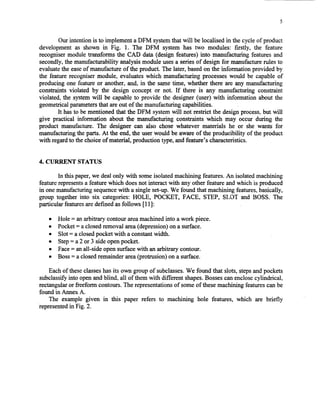
Our intention is to implement a DFM systemthat will be localised in the cycle of product
development as shown in Fig. 1. The DFM system has two modules: firstly, the feature
recognisermodule transforms the CAD data (design features) into manufacturing features and
secondly,the manufacturability analysis module usesa seriesof design for manufacturerules to
evaluatethe easeof manufactureof the product. The later, basedon the information provided by
the feature recognisermodule, evaluateswhich manufacturing processeswould be capable of
producing one feature or another, and, in the sametime, whether there are any manufacturing
constraints violated by the design concept or not. If there is any manufacturing constraint
violated, the systemwill be capable to provide the designer (user) with information about the
geometricalparametersthat areout of the manufacturing capabilities.
It hasto be mentioned that the DFM systemwill not restrict the designprocess,but will
give practical information about the manufacturing constraints which may occur during the
product manufacture. The designer can also chose whatever materials he or she wants for
manufacturing the parts. At the end,the userwould be aware of the producibility of the product
with regardto thechoice of material, production type, andfeature’s characteristics.
4. CURRENT STATUS
In this paper,we dealonly with someisolatedmachining features.An isolatedmachining
featurerepresentsa featurewhich doesnot interact with any other feature and which is produced
in onemanufacturingsequencewith a single set-up.We found that machining features,basically,
group together into six categories: HOLE, POCKET, FACE, STEP, SIUI and BOSS. The
particular featuresaredefined asfollows [111:
l Hole = anarbitrary contour areamachinedinto a work piece.
l Pocket= aclosedremoval area(depression)on a surface.
l Slot = a closedpocket with a constantwidth.
l Step= a2 or 3 sideopenpocket.
l Face= anall-side opensurfacewith an arbitrary contour.
l Boss= a closedremainder area(protrusion) on a surface.
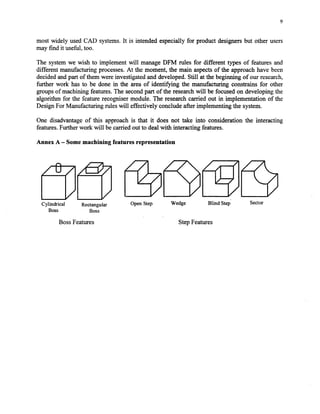
Eachof theseclasseshasits own group of subclasses.We found that slots,stepsandpockets
subclassifyinto openandblind, all of them with different shapes.Bossescanenclosecylindrical,
rectangularor freeform contours.The representationsof someof thesemachining featurescanbe
found in Annex A.
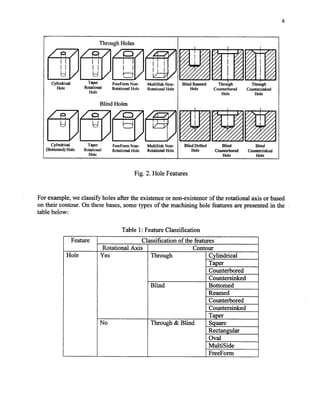
The example given in this paper refers to machining hole features, which are briefly
‘representedin Fig. 2.
Copyright (c) 2002 Society of Manufacturing Engineers. All rights reserved.
6
ThroughHoles
Cylindrical
Hole
Tapa
Rotational
Hole
FreeFormNon- MultiSide Non-
RotationalHole Rotational Hole
Blind Reamed
Hole
Th&&
Counterbored
Hole
CountaSillked
Hole
Blind Holes
Cylindrical
(Bottomed)Hole
Taper
Rotational
Hole
FreeFormNon-
Rotational IIde
MultiSide Non-
RotationalHole
Blind Drilled
Hole
Blind
Counterbored
Hole
Blind
Countersinkcd
Hole
Fig. 2. Hole Features
For-example,we classify holesafter the existenceor non-existenceof the rotational axis or based
on their contour. On thesebases,sometypes of the machining hole featuresarepresentedin the
table below:
Table 1: FeatureClassification
Feature
Hole
Rotational Axis
Yes
No Through & Blind
Copyright (c) 2002 Society of Manufacturing Engineers. All rights reserved.
7
If we refer only to the rotational andnon-rotational types of holes,the manufacturing processes
for producing them may significantly differ and therefore, a manufacturing analysis has to be
doneto decideuponthe appropriateprocessto beused.
After the feature mapping process (i.e. mapping of the design features into manufacturing
features), the manufacturability analysis module identifies, if any, the machining processes
capableof producing the required featureof the part, basedon the:
l production type,
l material type,
0 feature’scharacteristics,
l tolerancesand surfacefinish,
o feature’saccessibility andposition,
virhichthe designerhasto selectandprovide to the DFM system.
At the moment we decidedthat the manufacturing analysisprocesswill take into consideration
only the most common materials, the normal values for tolerances, surface finish and some
specific feature’s characteristics.In order to keep the product’s cost as low as possible, the
systemwill not take into consideration the closestvalues for tolerancesand surface finish. The
samerule appliesfor production type andparticular featurescharacteristics.
In the example below (Table 2), the feature considered is a cylindrical through hole. Its
characteristicsare the hole diameter, the hole depth and the depth-to-diameter ratio of the hole.
From the design stage,the geometrical and topological characteristicsare known. Further, the
designerhasto provide the DFM systemwith the information concerningthe production type he
or shewants to be usedwhen manufacturing the part, the material of the part, and the valuesof
tolerancesand surface finish to be achieved. After processing all this information, the most
suitable manufacturing processwill be selected for the specific feature. In our example, the
drilling processwas selectedfrom the library. Further, the constraintsof the drilling processare
applied to the hole and warn the designerabout the limitations of the this process.One of these
refersto the diameter size(concerningthe standardtill sizes),which cannotbe lessthan 1.5mm
orgreaterthan38mm [3].
Table 2: Manufacturability Analysis
Feature Production Material Surface Depth-to- Tolerances Manufacturing
Type Finish diameter [=a Processes
[run1 ratio
Cylindrical Mass Carbon 1.6-3.2 3:l *(0.05-0.25) Drilling
Through Production Steel
Hole
Another limitation of the drilling processfrom the economical point of view is the maximum
value of the depth-to-diameterratio, which should not exceed3:1. Although the applicability of
Copyright (c) 2002 Society of Manufacturing Engineers. All rights reserved.
S
this machining processmay exceedtheselimits, this will significantly increasethe product’s cost
andit is contraryto the aim of our Design For Manufacturing approach.
The systemwill also analysethe accessibility of the feature and its relative position on the part.
For example, if the hole is unreachable for the drill or bushing, or its position is not
perpendicular to the entry face, the designerwill also be warned to ensurethat the hole is in a
proper location andposition on thepart to avoid manufacturing difficulties.
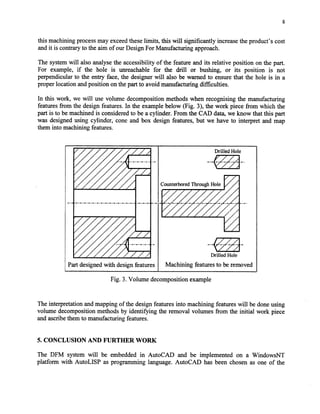
In this work, we will use volume decomposition methods when recognising the manufacturing
featuresfrom the design features.In the examplebelow (Fig. 3), the work piece from which the
part is to be machinedis consideredto be a cylinder. From the CAD data,we know that this part
was designedusing cylinder, cone and box design features,but we have to interpret and map
them into machining features.
Drilled Hole
I, , , I
CounterboredThrough Hole
-.
aI Drilled Hole
Partdesignedwith designfeatures ) Machining featuresto beremoved
Fig. 3. Volume decomposition example
The interpretation andmapping of the designfeaturesinto machining featureswill be doneusing
volume decomposition methods by identifying the removal volumes from the initial work piece
andascribethem to manufacturing features.
5. CONCLUSION AND FURTHER WORK
The DFM system will be embedded in AutoCAD and be implemented on a WindowsNT
platform with AutoLISP as programming language. AutoCAD has been chosen as one of the
Copyright (c) 2002 Society of Manufacturing Engineers. All rights reserved.
9
most widely usedCAD systems.It is intended especially for product designersbut other users
may find it useful, too.
The systemwe wish to implement will manageDFM rules for different types of features and
different manufacturing processes.At the moment, the main aspectsof the approachhave been
decidedandpart of them were investigatedand developed.Still at the beginning of our research,
further work has to be done in the areaof identifying the manuhacturingconstrains for other
groupsof machining features.The secondpart of the researchwill be focusedon developing the
algorithm for the feature recognisermodule. The researchcarried out in implementation of the
DesignFor Manufacturing ruleswill effectively concludeafter implementing the system.
One disadvantageof this approach is that it does not take into consideration the interacting
features.Furtherwork will becarriedout to dealwith interacting features.
Annex A - Some machining features representation
Cylindrical Rectangular
Boss Boss
OpenStep Wedge Blind Step. Sector
BossFeatures StepFeatures
Copyright (c) 2002 Society of Manufacturing Engineers. All rights reserved.
Through Slot Features
Round V-shaped
Slot Slot
Rectangular
Slot
Dovetail
Slot
FreeForm
Slot
T-shaped
Slot
Slot Features
Blind Pocket Open Pocket
Blind Freeform
Pocket
Open Freefarm
Pocket
PocketFeatures
References
Blind Slot Features
Rectangular
Slot
FreeForm
Slot
[l] JamesG. Bralla, Handbook of Product Designfor Manufacturing - A Practical Guide to
Low-CostProduction, McGraw-Hill Book Company, 1999.
Copyright (c) 2002 Society of Manufacturing Engineers. All rights reserved.
PI
PI
PI
PI
WI
VI
VI
PI
G. Boothroyd, P. Dewhurst, W. Knight, Product Designfor Manufacture and Assembly,
Marcel Dekker, 1994.
Mahmoud M. Farag, Selection of Materials and Manufacturing Processes for
Engineering Design, PrenticeHall International Ltd., 1989.
D. Jacquel, J. Salmon, Design for Manufacturability: a feature-based agent-driven
approach,Pro.c Instn. A4ec.hEngrs., Vol2 14,PartB, 2000.
X. William Xu, Jack J. Ding, Integrating Design with Manufacturing, Proc. Pacific
Conferenceon Manufacturing, August 1998.
Jae Yeol Lee and Kwangsoo Kim, A feature-based approach to extracting machining
features, Elsevier, 1999.
D. T. Phamand S. S. Dimov, An approachto concurrentengineering,Proc lnstn Mech
Engrs, Vo1212,Part B, pg 13-27.
S. GaoandJ. J. Shah,Automatic recognition of interacting machiningfeatures basedon
minimal condition subgraph, Elsevier, 1999.
B. John Davies, CIM software and interfaces, Computersin Industry, Vol 33, pg 91-99,
1997.
[lo] R. Stage, C. Roberts, M. Handerson, Generating resource based flexible form
manufacturing featuresthrough objective driven clustering, Computer-AidedDesign, Vol
31,pg 119-130,1999.
[l l] X. Yan, K. Yamazaki, 9. Liu, Recognition of machining featuresand feature topologies
from NC programs,ComputerAided Design, Vol32, pg 605616,200O.
[121 Jami J ShahandMartti Mantyla, Parametric and Feature-BasedCADLCAM, 1995.
Copyright (c) 2002 Society of Manufacturing Engineers. All rights reserved.

Tp02 pub31

  • 1.
    nd W n < n a+8Society of Manufacturing Engineers 2002 MSO2-124 Implementing Designfor Manufacture Rules author(s) R. DUMITRESCU T. SZECSI Dublin City University Dublin, Ireland abstract This paper shows a new approach in incorporating manufacturing constraints at the design stage into an intelligent system, which analyses the design features from a CAD drawing, relates them to machining feature, and then suggests the available manufacturing processes capable of producing these features. The system also examines whether design for manufacture rules are violated by the features’ characteristics and conclude on their manufacturing possibility. Production type, materials, tolerances, surface finish, feature’s characteristics, and accessibility are taken into consideration. This paper originally appeared in the Proceedings of the 1lti International Conference on Flexible Automation and Intelligent Manufacturing (FAIM ‘Ol), July 16-I 8, 2001, Dublin, Ireland, and has been republished with permission of the authors and the Dublin City University. terms Design for Manufacture Design & Machining Features Computer Aided Design Society of Manufacturing Engineers One SME Drive l P.O. Box 930 l Dearborn, MI 48121 Phone (313) 271-1500 www.sme.org Copyright (c) 2002 Society of Manufacturing Engineers. All rights reserved.
  • 2.
    SME TECHNICAL PAPERS ThisTechnical Paper may not be reproduced in whole or in part in any form without the express written permission of the Society of Manufacturing Engineers. By publishing this paper, SME neither endorses any product, service or information discussed herein, nor offers any technical advice. SME specifically disclaims any warranty of reliability or safety of any of the information contained herein. Copyright (c) 2002 Society of Manufacturing Engineers. All rights reserved.
  • 3.
    IMPLEMENTING DESIGN FORMANUFACTURE RULES R. Dumitrescu andT. Szecsi School of Mechanical andManufacturing Engineering, Dublin City University, Ireland. ABSTRACT This paper shows a new approachin incorporating manufacturing constraints at the design stageinto an intelligent system,which analysesthe designfeaturesfrom a CAD drawing, relates them to machining features,andthen suggeststhe available manufacturing processescapableof producing these features.The system also examineswhether design for manufacture rules are violated by the features’ characteristics and conclude on their manufacturing possibility. Production type? materials, tolerances, surface finish, and feature’s characteristics and accessibility aretaken into consideration. KEYWORDS: Design for Manufacture, Computer Aided Design (CAD), Design & Machining Features 1. INTRODUCTION , Classically, the designing environment was basedon what we call today the “over-the- wall” system [2], where the interaction between designersand manufacturing engineers was minimal and manufacturing issueswere only superficially consideredfrom the beginning of a design. One way of overcoming this problem is to have a team of designersand manufacturing engineersworking together at the design stage. These teams use analysing tools, which help them evaluatethe design.Design For Manufacture is oneof thesetools that enhancea numberof general rules about the manufacturability of a part (i.e. the relative easeof manufacturing a Par-Q In the last years,Design For Manufacture (DFM) approachhasbecomea real interestas it was found that the design stagedeterminesmost of the cost of the development of a product. As market needshave increasedand the competition to remain on the market hasbecomevery tight, it is a crucial issue to reduce the time of the product development [11.Customers are demanding high quality products at competitive prices and the design is the first step in satisfying their requirements [7]. Thus, it is necessaryto apply manufacturing constrainsfrom the very beginning of the design stage,in order to avoid costly changesthat may occur later becauseof the difficulty or impossibility to implement some manufacturing processes.This practiceis essentialin reducingthe costof aproduct considerably. The history of DFM is describedin [l] from the early beginning. Eli Whitney is known asthe personwho introducedthe interchangeablepartsconcept.Still in a growing phase,DFM is believed to become even more important in the next years. Nowadays, the increase of the importance of the DFM conceptis closely relatedto the drastic developmentandhugeprogresses Copyright (c) 2002 Society of Manufacturing Engineers. All rights reserved.
  • 4.
    2 achievedin computation resourcesduringthe last decade,making available high performance hardware and software at affordable prices. Although CAD systemshave been available since almost 30 yearsandthey areprogressively spreadingin almost all fields of today’s engineering, thereis still a lot to do in the field of computerisation of DFM [13. The aim of this researchis the development of an intelligent system for implementing DFM rules, which hasits origins in the idea of helping designersby offering them supportwith manufacturing constraints information. The purpose is to improve the design quality and to decreasethe time-to-market, as rapid product development is becoming a critical factor to a company’sposition [2]. It is well known that improperly designedpartscan still beproducedbut with anunjustifiable increasein manufacturing costsandtime, andit is the aim of the DFM tools to help usersto optimise their designs. In the following section of this paper, feature conceptterminology and usageare briefly reviewed. The third and fourth sectionsexplain our approachand intentions in developing the system.Discussionsand examplesof hole features are also included in the fourth section. The capabilities and limitations of the approach are concluded in the fifth section, and the further work planned to continue our researchand its perspectivesare explained. Some examples of machining featuresaregiven in the annexat the endof thepaper. 2. FEATURE CONCEPT The integration of CAD systemsto CAM and CAE systemscould not be achievedwithout the help of feature concept.Indeed, CAPP hasto interpret the part from a CAD data in terms of features [I 11,which most often are manufacturing features.Based on the viewpoint, different types of features can be defined. During the design process, a part is created using design features,which later have to be interpreted into manufacturing, assembly or inspection features via dedicatedrecognition tools. 2.1 Feature Definition A feature is a set of faces or regions of one part with distinct topological, geometrical and/or manufacturing information. Featurescharacterisethe product and help in analysing the design concurrently using numerical or knowledge-basedsystems[121.If the product is viewed from the designing stand point. then features are called design features and they present only topological and geometrical information; if the product is viewed from the manufacturing stand point, then featuresare called manufacturing featuresand they presenttopological, geometrical andmanufacturing Xorrnation. In [S], a feature is defined as a stereotypical geometric shape associated with some engineering significance. The authors also mention about the predefined feature, which has a fixed topology and has been defined in a library. Another way of defining a feature is given in [12], where a feature representsthe geometry of a part or assembly and building blocks for product definition or for geometry reasoning. It hasto be mentioned that as the researchgoes deeperinto this area,different typesof featuresaredevelopedsystematically. 2.2 Design Features Design Featuresarethosefeaturesusedat the design stagedefined by the useror from the CAD modeller library and which do not take into considerationany manufacturing, assemblyor Copyright (c) 2002 Society of Manufacturing Engineers. All rights reserved.
  • 5.
    3 inspection constrains. Theymight have shapesand/or locations impossible to produce and/or reachwith the available technology at a given moment and in a given company. [7] deals with threetypes of design features:depression,protrusion, andtransition features.The authorsdefine the depressionfeature asan increment to the volume of a shapesuchasboss,and the protrusion featureas a decrementsuch as a hole. The transition feature could be either a decrementor an increment,dependingon whether its profile is convexor concave. Examples of design features can be found in [4,6,7] as slot, hole, pocket, rounding, cylinder, block, protrusion, cut, chamfer, user-defined features, etc. The user-defined design features are based on planar profiles swept into three-dimensional shapesby extrusions and revolutions. 2.3 Feature-based Desiw A systemwhere the designercreatesthe part by picking the entities from a feature library is called a feature-baseddesign system [4]. Today’s CAD systemshave their own pre-defmed featurelibrary. [4,12] show that the main advantagesof designing with featuresare the less-time consuming aspectwhen re-design of a part is needed.In this case,once a parent-featureis re- positioned it will automatically re-position all its child-features, as features are relatively positionedoneagainstanother.Reuseof design is not usually the casein classicalCAD systems, whereeverythinghad to bereconsideredalmost from the beginning. When the feature library does not satisfy a company, a user-defin.edone adaptable to different types of products can be createdwhere there is a real needfor this, as it is time and moneyconsuming [9]. Still the creationof anadequatefeaturelibrary is not trivial. 2.4 Manufacturing Features A manufacturing featureis interpreted in [8] asa continuous volume that can be removed by a single machining operation in a single set-up.It dependsnot only on the shapeand size of the geometric feature, but also on the manufacturing processto be usedto produce this feature [9]. The definition of the manufacturing featuresis general&d in [lo] to the whole engineering approach,as being a function of the part (or some portion of the part) and specific factory resourcesto be usedto producethat (portion of the) part; from herethe authorsconcludethat a manufacturingfeatureis the function of machinetools, setup,tools andparts. It can be found in [5,6,1l] that there are different manufacturing features,namely: hole, pocket,openpocket, face, boss,step,open step,slot, notch, grove, knurl, thread, fillet, chamfer, etc. 2.5 Design by Manufacturing Features Design by Manufacturing Featureswould be the most promising in the evolution of CAD systems,where the designer would have to use manufacturing featuresand to think in process planning terms,i.e. manufacturing techniquesandcostissues[9]. This approachassumesthat the designercreatesthe part in terms of manufacturing operations. It would be the best to use in practice,but it is still unnatural for the designers. 2.6 Manufacturability Analysis Unfortunately, it is still impossible to completely replace the human decision factor with an automatic manufacturing analysis system becausethe relation between design details and Copyright (c) 2002 Society of Manufacturing Engineers. All rights reserved.
  • 6.
    4 processing is oftenvery complex and not easily reduced to formulas or simple relationships. Specifying a manufacturing processfor a feature is a difficult decision since for someparticular situations onewell-known expensiveoperation can be cheaperthan two cheaperoperations and an automatic selection of the manufacturing sequencemay ignore the expensive manufacturing processesfor the two cheaperones.The main aim of this researchis to develop a systemwhich helpsdesignersin making better designsin lesstime. 3. OVERVIEW OF THE APPROACH As it wasmentioned in the first section,considerationof the manufacturing aspectsat the design stageis very important as experiencehas shown that up to 70 per cent of the product’s cost [2,7] is directly generated at the design stage. The final cost of the product may be significantly increasedbecauseof an inefficient design of the product, an improper selection of the material, production type or surfacefinish. Therefore, the design of one product is the most suitable stagewhere changesand interventions with regardto the manufacturing aspectsshould take place for an optimal manufacture. We presenthere an approachof an intelligent system, which interactively assiststhe designerduring his or her work with manufacturing issues. NowadaysCAD systems,when using, askfor precisegeometric data,which is more than the designaspectof a part andthe designershouldcareonly aboutthe functional requirementsof the part. This fact could push the designerto think about all the product’s specification. Yet, the designer has no clear idea about the manufacturing processes’capability of designedpart. producing the Fig. 1. Information Transfer Copyright (c) 2002 Society of Manufacturing Engineers. All rights reserved.
  • 7.
    5 Our intention isto implement a DFM systemthat will be localised in the cycle of product development as shown in Fig. 1. The DFM system has two modules: firstly, the feature recognisermodule transforms the CAD data (design features) into manufacturing features and secondly,the manufacturability analysis module usesa seriesof design for manufacturerules to evaluatethe easeof manufactureof the product. The later, basedon the information provided by the feature recognisermodule, evaluateswhich manufacturing processeswould be capable of producing one feature or another, and, in the sametime, whether there are any manufacturing constraints violated by the design concept or not. If there is any manufacturing constraint violated, the systemwill be capable to provide the designer (user) with information about the geometricalparametersthat areout of the manufacturing capabilities. It hasto be mentioned that the DFM systemwill not restrict the designprocess,but will give practical information about the manufacturing constraints which may occur during the product manufacture. The designer can also chose whatever materials he or she wants for manufacturing the parts. At the end,the userwould be aware of the producibility of the product with regardto thechoice of material, production type, andfeature’s characteristics. 4. CURRENT STATUS In this paper,we dealonly with someisolatedmachining features.An isolatedmachining featurerepresentsa featurewhich doesnot interact with any other feature and which is produced in onemanufacturingsequencewith a single set-up.We found that machining features,basically, group together into six categories: HOLE, POCKET, FACE, STEP, SIUI and BOSS. The particular featuresaredefined asfollows [111: l Hole = anarbitrary contour areamachinedinto a work piece. l Pocket= aclosedremoval area(depression)on a surface. l Slot = a closedpocket with a constantwidth. l Step= a2 or 3 sideopenpocket. l Face= anall-side opensurfacewith an arbitrary contour. l Boss= a closedremainder area(protrusion) on a surface. Eachof theseclasseshasits own group of subclasses.We found that slots,stepsandpockets subclassifyinto openandblind, all of them with different shapes.Bossescanenclosecylindrical, rectangularor freeform contours.The representationsof someof thesemachining featurescanbe found in Annex A. The example given in this paper refers to machining hole features, which are briefly ‘representedin Fig. 2. Copyright (c) 2002 Society of Manufacturing Engineers. All rights reserved.
  • 8.
    6 ThroughHoles Cylindrical Hole Tapa Rotational Hole FreeFormNon- MultiSide Non- RotationalHoleRotational Hole Blind Reamed Hole Th&& Counterbored Hole CountaSillked Hole Blind Holes Cylindrical (Bottomed)Hole Taper Rotational Hole FreeFormNon- Rotational IIde MultiSide Non- RotationalHole Blind Drilled Hole Blind Counterbored Hole Blind Countersinkcd Hole Fig. 2. Hole Features For-example,we classify holesafter the existenceor non-existenceof the rotational axis or based on their contour. On thesebases,sometypes of the machining hole featuresarepresentedin the table below: Table 1: FeatureClassification Feature Hole Rotational Axis Yes No Through & Blind Copyright (c) 2002 Society of Manufacturing Engineers. All rights reserved.
  • 9.
    7 If we referonly to the rotational andnon-rotational types of holes,the manufacturing processes for producing them may significantly differ and therefore, a manufacturing analysis has to be doneto decideuponthe appropriateprocessto beused. After the feature mapping process (i.e. mapping of the design features into manufacturing features), the manufacturability analysis module identifies, if any, the machining processes capableof producing the required featureof the part, basedon the: l production type, l material type, 0 feature’scharacteristics, l tolerancesand surfacefinish, o feature’saccessibility andposition, virhichthe designerhasto selectandprovide to the DFM system. At the moment we decidedthat the manufacturing analysisprocesswill take into consideration only the most common materials, the normal values for tolerances, surface finish and some specific feature’s characteristics.In order to keep the product’s cost as low as possible, the systemwill not take into consideration the closestvalues for tolerancesand surface finish. The samerule appliesfor production type andparticular featurescharacteristics. In the example below (Table 2), the feature considered is a cylindrical through hole. Its characteristicsare the hole diameter, the hole depth and the depth-to-diameter ratio of the hole. From the design stage,the geometrical and topological characteristicsare known. Further, the designerhasto provide the DFM systemwith the information concerningthe production type he or shewants to be usedwhen manufacturing the part, the material of the part, and the valuesof tolerancesand surface finish to be achieved. After processing all this information, the most suitable manufacturing processwill be selected for the specific feature. In our example, the drilling processwas selectedfrom the library. Further, the constraintsof the drilling processare applied to the hole and warn the designerabout the limitations of the this process.One of these refersto the diameter size(concerningthe standardtill sizes),which cannotbe lessthan 1.5mm orgreaterthan38mm [3]. Table 2: Manufacturability Analysis Feature Production Material Surface Depth-to- Tolerances Manufacturing Type Finish diameter [=a Processes [run1 ratio Cylindrical Mass Carbon 1.6-3.2 3:l *(0.05-0.25) Drilling Through Production Steel Hole Another limitation of the drilling processfrom the economical point of view is the maximum value of the depth-to-diameterratio, which should not exceed3:1. Although the applicability of Copyright (c) 2002 Society of Manufacturing Engineers. All rights reserved.
  • 10.
    S this machining processmayexceedtheselimits, this will significantly increasethe product’s cost andit is contraryto the aim of our Design For Manufacturing approach. The systemwill also analysethe accessibility of the feature and its relative position on the part. For example, if the hole is unreachable for the drill or bushing, or its position is not perpendicular to the entry face, the designerwill also be warned to ensurethat the hole is in a proper location andposition on thepart to avoid manufacturing difficulties. In this work, we will use volume decomposition methods when recognising the manufacturing featuresfrom the design features.In the examplebelow (Fig. 3), the work piece from which the part is to be machinedis consideredto be a cylinder. From the CAD data,we know that this part was designedusing cylinder, cone and box design features,but we have to interpret and map them into machining features. Drilled Hole I, , , I CounterboredThrough Hole -. aI Drilled Hole Partdesignedwith designfeatures ) Machining featuresto beremoved Fig. 3. Volume decomposition example The interpretation andmapping of the designfeaturesinto machining featureswill be doneusing volume decomposition methods by identifying the removal volumes from the initial work piece andascribethem to manufacturing features. 5. CONCLUSION AND FURTHER WORK The DFM system will be embedded in AutoCAD and be implemented on a WindowsNT platform with AutoLISP as programming language. AutoCAD has been chosen as one of the Copyright (c) 2002 Society of Manufacturing Engineers. All rights reserved.
  • 11.
    9 most widely usedCADsystems.It is intended especially for product designersbut other users may find it useful, too. The systemwe wish to implement will manageDFM rules for different types of features and different manufacturing processes.At the moment, the main aspectsof the approachhave been decidedandpart of them were investigatedand developed.Still at the beginning of our research, further work has to be done in the areaof identifying the manuhacturingconstrains for other groupsof machining features.The secondpart of the researchwill be focusedon developing the algorithm for the feature recognisermodule. The researchcarried out in implementation of the DesignFor Manufacturing ruleswill effectively concludeafter implementing the system. One disadvantageof this approach is that it does not take into consideration the interacting features.Furtherwork will becarriedout to dealwith interacting features. Annex A - Some machining features representation Cylindrical Rectangular Boss Boss OpenStep Wedge Blind Step. Sector BossFeatures StepFeatures Copyright (c) 2002 Society of Manufacturing Engineers. All rights reserved.
  • 12.
    Through Slot Features RoundV-shaped Slot Slot Rectangular Slot Dovetail Slot FreeForm Slot T-shaped Slot Slot Features Blind Pocket Open Pocket Blind Freeform Pocket Open Freefarm Pocket PocketFeatures References Blind Slot Features Rectangular Slot FreeForm Slot [l] JamesG. Bralla, Handbook of Product Designfor Manufacturing - A Practical Guide to Low-CostProduction, McGraw-Hill Book Company, 1999. Copyright (c) 2002 Society of Manufacturing Engineers. All rights reserved.
  • 13.
    PI PI PI PI WI VI VI PI G. Boothroyd, P.Dewhurst, W. Knight, Product Designfor Manufacture and Assembly, Marcel Dekker, 1994. Mahmoud M. Farag, Selection of Materials and Manufacturing Processes for Engineering Design, PrenticeHall International Ltd., 1989. D. Jacquel, J. Salmon, Design for Manufacturability: a feature-based agent-driven approach,Pro.c Instn. A4ec.hEngrs., Vol2 14,PartB, 2000. X. William Xu, Jack J. Ding, Integrating Design with Manufacturing, Proc. Pacific Conferenceon Manufacturing, August 1998. Jae Yeol Lee and Kwangsoo Kim, A feature-based approach to extracting machining features, Elsevier, 1999. D. T. Phamand S. S. Dimov, An approachto concurrentengineering,Proc lnstn Mech Engrs, Vo1212,Part B, pg 13-27. S. GaoandJ. J. Shah,Automatic recognition of interacting machiningfeatures basedon minimal condition subgraph, Elsevier, 1999. B. John Davies, CIM software and interfaces, Computersin Industry, Vol 33, pg 91-99, 1997. [lo] R. Stage, C. Roberts, M. Handerson, Generating resource based flexible form manufacturing featuresthrough objective driven clustering, Computer-AidedDesign, Vol 31,pg 119-130,1999. [l l] X. Yan, K. Yamazaki, 9. Liu, Recognition of machining featuresand feature topologies from NC programs,ComputerAided Design, Vol32, pg 605616,200O. [121 Jami J ShahandMartti Mantyla, Parametric and Feature-BasedCADLCAM, 1995. Copyright (c) 2002 Society of Manufacturing Engineers. All rights reserved.