. Company  Overview Significant actions undertaken by GM  (since the completion of the case after 2005) Reducing legacy cost with the United Auto Workers agreement  Increasing vehicles resale value by reducing sales to fleet operations - Sold off stakes as well as the General Motors Acceptance Corporation To decrease exposure to failing international operations and to increase liquidity Internal & External Analysis Business Level Strategy Corporate Level Strategy Alternative 2 Recommendation Implementation Alternative 1
GM’ s current Strategic Plan Four Point Turnaround Plan Reduce labour expenses Cut legacy costs Decrease production capacity 4. New designs and marketing strategies Costs reduction do not guaranty successful competition GM must differentiate its products for customers to get a sense of value-added Must appeal to needs and trends of local markets instead of using a global Company  Overview Internal & External Analysis Business Level Strategy Corporate Level Strategy Alternative 2 Recommendation Implementation Alternative 1
Problem Statement What organizational changes must GM implement in the North American market to earn above average returns and improve its ability to compete in future, developing markets? Case analysis focus on North American market Must first develop a successful domestic strategy to be able to compete  internationally Company Overview Internal & External Analysis Business Level Strategy Corporate Level Strategy Alternative 2 Recommendation Implementation Alternative 1
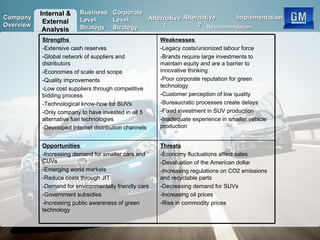
Internal & External Analysis Business Level Strategy Corporate Level Strategy Alternative 2 Recommendation Implementation Company Overview Threats -Economy fluctuations affect sales -Devaluation of the American dollar -Increasing regulations on CO2 emissions and recyclable parts -Decreasing demand for SUVs -Increasing oil prices -Rise in commodity prices Opportunities  -Increasing demand for smaller cars and CUVs -Emerging world markets -Reduce costs through JIT -Demand for environmentally friendly cars -Government subsidies -Increasing public awareness of green technology Weaknesses  -Legacy costs/unionized labour force -Brands require large investments to maintain equity and are a barrier to innovative thinking -Poor corporate reputation for green technology -Customer perception of low quality -Bureaucratic processes create delays -Fixed investment in SUV production -Inadequate experience in smaller vehicle production Strengths  - Extensive cash reserves -Global network of suppliers and distributors -Economies of scale and scope -Quality improvements -Low cost suppliers through competitive bidding process -Technological know-how for SUVs -Only company to have invested in all 5 alternative fuel technologies -Developed internet distribution channels Alternative 1
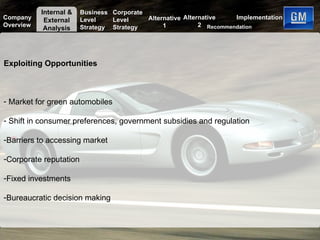
Internal & External Analysis Exploiting Opportunities Market for green automobiles Shift in consumer preferences, government subsidies and regulation Barriers to accessing market Corporate reputation Fixed investments Bureaucratic decision making Business Level Strategy Corporate Level Strategy Alternative 2 Recommendation Implementation Company Overview Alternative 1
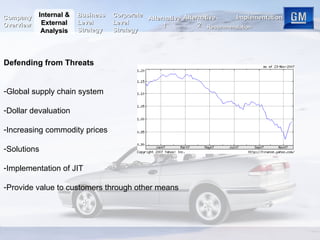
Defending from Threats Global supply chain system Dollar devaluation Increasing commodity prices Solutions Implementation of JIT Provide value to customers through other means Internal & External Analysis Business Level Strategy Corporate Level Strategy Alternative 2 Recommendation Implementation Company Overview Alternative 1
Business Level Strategy - Integrated BLS Failed application Trade-off between cost and differentiation Implications of unionized labour force and legacy costs Business Level Strategy Internal & External Analysis Corporate Level Strategy Alternative 2 Recommendation Implementation Company Overview Alternative 1
Corporate Level Strategy & Organizational Structure Related Linked - Multi Divisional Structure Centralization of key processes  - Regions represent autonomous Strategic Business units - Brands are a subdivision of the SBU’s with minimum control over processes - Minimal links to identical brands in different regions Corporate Level Strategy Internal & External Analysis Business Level Strategy Alternative 2 Recommendation Implementation Company Overview Alternative 1
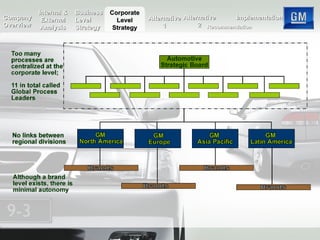
Problems with Current Structure Structure focuses on cost reductions Direct conflict with the intended integrated differentiation/cost leadership strategy - Brand level management is almost inexistent at the SBU level which results in lack of  differentiation - Regional SBUs do not have enough control over their regions.** Corporate Level Strategy Internal & External Analysis Business Level Strategy Alternative 2 Recommendation Implementation Company Overview Alternative 1
Corporate Level Strategy Internal & External Analysis Business Level Strategy Alternative 2 Recommendation Implementation Company Overview Alternative 1
Alternative One Keep all brands but differentiate effectively - Decrease model portfolios of each brand Engineer an organization change to make the company more flexible and able to select the right brand for the right market - Increases product differentiation amongst brands and reduces inter- brand competition - Marketing for each brand will be more efficient and customer loyalty can be captured - Each brand will have a more specific market trend to address thus will be more competent in predicting demand  Lower inventory costs Alternative 1 Internal & External Analysis Business Level Strategy Corporate Level Strategy Alternative 2 Recommendation Implementation Company Overview
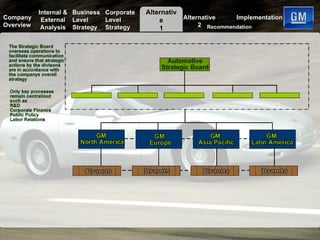
Organization Changes to Support the Initiative Start with decentralization but aim for an overall more coherent organization through the pursue of a related constrained strategy  Key processes such as R&D, Marketing, Human Resources will need to be better centralized to achieve consistency - Brand Management needs additional power - Regional SBUs  more control and better coordination with the others Follow a related constrained strategy with increased coordination amongst divisions - Increased brand autonomy on marketing/product development will ensure differentiation Alternative 1 Internal & External Analysis Business Level Strategy Corporate Level Strategy Alternative 2 Recommendation Implementation Company Overview
Alternative 1 Internal & External Analysis Business Level Strategy Corporate Level Strategy Alternative 2 Recommendation Implementation Company Overview
Pros - Uses 8 brands to capture customer loyalty - Enables brands to focus on specific market niches - Allows for reaching economies of scale and scope throughout the whole organization - No extensive organizational restructuring is needed Cons - Slow process, would take long before we see if the differentiation efforts have succeeded - As the market demand changes and market niches are exploited or eliminated, brands might start competing with each other once again - Very difficult for GM to control all these brands consistently - Organization structure is could result to be less flexible* Alternative 1 Internal & External Analysis Business Level Strategy Corporate Level Strategy Alternative 2 Recommendation Implementation Company Overview
Alternative 2 Divest some brands but keep rich model portfolios for remaining brands and reform the company’s structure to provide each brand division with more autonomy  Divest 4 brands: Buick – Saab – Hummer – Pontiac Restructuring in to a decentralized organization in order to put more emphasis on individual brands rather than regional divisions - Market research, internal and external analysis required in order to make this alternative successful - Unit sold by brand in 2006 Hummer: 56 789   Saab: 133 167 Pontiac: 145 183   Cadillac: 220 000 - growth of 290% compared to 2005 Saturn: 226 375   Buick: 403 690 - bright spot in China (280 000 units)  but overall lost 13 billion in the past 7quarters   GMC: 542 000 Chevrolet: 1 180 000 Alternative 2 Internal & External Analysis Business Level Strategy Corporate Level Strategy Recommendation Implementation Company Overview Alternative 1
Alternative 2 Internal & External Analysis Business Level Strategy Corporate Level Strategy Recommendation Implementation Company Overview Alternative 1
Pros - Focused resources on less brands - Distinct target markets which define brand equity - More capital to invest in R&D for each specific brand  - More autonomy to brands which decrease decision making time Cons Shut down plants and lay off workers  Loss of brand loyal customers - Large amount of resources required to settle distribution contracts - Initial decrease in sales and profits will affect shareholder value in the short term  Alternative 2 Internal & External Analysis Business Level Strategy Corporate Level Strategy Recommendation Implementation Company Overview Alternative 1
Internal & External Analysis Business Level Strategy Corporate Level Strategy Alternative 2 Implementation Company Overview Recommendation Alternative 1
Implementation - Year 1 - Analysis of potential synergies within brands and corporate organization and market research to determine market segments for each remaining brand to target - Begin to phase out brands - Begin organizational change - Formulation of tactical and strategic decisions to be implemented - Develop yearly goals, new corporate vision and mission - Invest heavily in to R&D for new designs Internal & External Analysis Business Level Strategy Corporate Level Strategy Alternative 2 Company Overview Recommendation Implementation Alternative 1
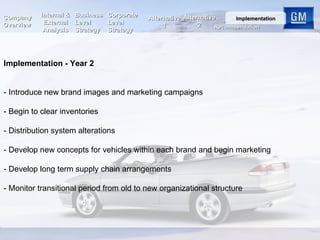
Implementation - Year 2 - Introduce new brand images and marketing campaigns - Begin to clear inventories  - Distribution system alterations - Develop new concepts for vehicles within each brand and begin marketing  - Develop long term supply chain arrangements - Monitor transitional period from old to new organizational structure Internal & External Analysis Business Level Strategy Corporate Level Strategy Alternative 2 Company Overview Recommendation Implementation Alternative 1
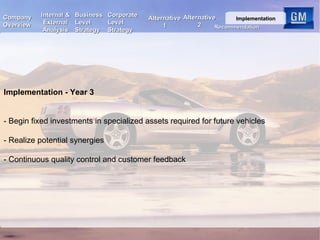
Implementation - Year 3 - Begin fixed investments in specialized assets required for future vehicles - Realize potential synergies - Continuous quality control and customer feedback Internal & External Analysis Business Level Strategy Corporate Level Strategy Alternative 2 Company Overview Implementation Recommendation Alternative 1
Alex Side Andrea Bergamini Amanda Eluidge Laurence Vezina-Montplaisir Stelios Charalambous Vanessa Leung

General Motors Case Analysis

  • 1.
  • 2.
    . Company Overview Significant actions undertaken by GM (since the completion of the case after 2005) Reducing legacy cost with the United Auto Workers agreement Increasing vehicles resale value by reducing sales to fleet operations - Sold off stakes as well as the General Motors Acceptance Corporation To decrease exposure to failing international operations and to increase liquidity Internal & External Analysis Business Level Strategy Corporate Level Strategy Alternative 2 Recommendation Implementation Alternative 1
  • 3.
    GM’ s currentStrategic Plan Four Point Turnaround Plan Reduce labour expenses Cut legacy costs Decrease production capacity 4. New designs and marketing strategies Costs reduction do not guaranty successful competition GM must differentiate its products for customers to get a sense of value-added Must appeal to needs and trends of local markets instead of using a global Company Overview Internal & External Analysis Business Level Strategy Corporate Level Strategy Alternative 2 Recommendation Implementation Alternative 1
  • 4.
    Problem Statement Whatorganizational changes must GM implement in the North American market to earn above average returns and improve its ability to compete in future, developing markets? Case analysis focus on North American market Must first develop a successful domestic strategy to be able to compete internationally Company Overview Internal & External Analysis Business Level Strategy Corporate Level Strategy Alternative 2 Recommendation Implementation Alternative 1
  • 5.
    Internal & ExternalAnalysis Business Level Strategy Corporate Level Strategy Alternative 2 Recommendation Implementation Company Overview Threats -Economy fluctuations affect sales -Devaluation of the American dollar -Increasing regulations on CO2 emissions and recyclable parts -Decreasing demand for SUVs -Increasing oil prices -Rise in commodity prices Opportunities -Increasing demand for smaller cars and CUVs -Emerging world markets -Reduce costs through JIT -Demand for environmentally friendly cars -Government subsidies -Increasing public awareness of green technology Weaknesses -Legacy costs/unionized labour force -Brands require large investments to maintain equity and are a barrier to innovative thinking -Poor corporate reputation for green technology -Customer perception of low quality -Bureaucratic processes create delays -Fixed investment in SUV production -Inadequate experience in smaller vehicle production Strengths - Extensive cash reserves -Global network of suppliers and distributors -Economies of scale and scope -Quality improvements -Low cost suppliers through competitive bidding process -Technological know-how for SUVs -Only company to have invested in all 5 alternative fuel technologies -Developed internet distribution channels Alternative 1
  • 6.
    Internal & ExternalAnalysis Exploiting Opportunities Market for green automobiles Shift in consumer preferences, government subsidies and regulation Barriers to accessing market Corporate reputation Fixed investments Bureaucratic decision making Business Level Strategy Corporate Level Strategy Alternative 2 Recommendation Implementation Company Overview Alternative 1
  • 7.
    Defending from ThreatsGlobal supply chain system Dollar devaluation Increasing commodity prices Solutions Implementation of JIT Provide value to customers through other means Internal & External Analysis Business Level Strategy Corporate Level Strategy Alternative 2 Recommendation Implementation Company Overview Alternative 1
  • 8.
    Business Level Strategy- Integrated BLS Failed application Trade-off between cost and differentiation Implications of unionized labour force and legacy costs Business Level Strategy Internal & External Analysis Corporate Level Strategy Alternative 2 Recommendation Implementation Company Overview Alternative 1
  • 9.
    Corporate Level Strategy& Organizational Structure Related Linked - Multi Divisional Structure Centralization of key processes - Regions represent autonomous Strategic Business units - Brands are a subdivision of the SBU’s with minimum control over processes - Minimal links to identical brands in different regions Corporate Level Strategy Internal & External Analysis Business Level Strategy Alternative 2 Recommendation Implementation Company Overview Alternative 1
  • 10.
    Problems with CurrentStructure Structure focuses on cost reductions Direct conflict with the intended integrated differentiation/cost leadership strategy - Brand level management is almost inexistent at the SBU level which results in lack of differentiation - Regional SBUs do not have enough control over their regions.** Corporate Level Strategy Internal & External Analysis Business Level Strategy Alternative 2 Recommendation Implementation Company Overview Alternative 1
  • 11.
    Corporate Level StrategyInternal & External Analysis Business Level Strategy Alternative 2 Recommendation Implementation Company Overview Alternative 1
  • 12.
    Alternative One Keepall brands but differentiate effectively - Decrease model portfolios of each brand Engineer an organization change to make the company more flexible and able to select the right brand for the right market - Increases product differentiation amongst brands and reduces inter- brand competition - Marketing for each brand will be more efficient and customer loyalty can be captured - Each brand will have a more specific market trend to address thus will be more competent in predicting demand Lower inventory costs Alternative 1 Internal & External Analysis Business Level Strategy Corporate Level Strategy Alternative 2 Recommendation Implementation Company Overview
  • 13.
    Organization Changes toSupport the Initiative Start with decentralization but aim for an overall more coherent organization through the pursue of a related constrained strategy Key processes such as R&D, Marketing, Human Resources will need to be better centralized to achieve consistency - Brand Management needs additional power - Regional SBUs more control and better coordination with the others Follow a related constrained strategy with increased coordination amongst divisions - Increased brand autonomy on marketing/product development will ensure differentiation Alternative 1 Internal & External Analysis Business Level Strategy Corporate Level Strategy Alternative 2 Recommendation Implementation Company Overview
  • 14.
    Alternative 1 Internal& External Analysis Business Level Strategy Corporate Level Strategy Alternative 2 Recommendation Implementation Company Overview
  • 15.
    Pros - Uses8 brands to capture customer loyalty - Enables brands to focus on specific market niches - Allows for reaching economies of scale and scope throughout the whole organization - No extensive organizational restructuring is needed Cons - Slow process, would take long before we see if the differentiation efforts have succeeded - As the market demand changes and market niches are exploited or eliminated, brands might start competing with each other once again - Very difficult for GM to control all these brands consistently - Organization structure is could result to be less flexible* Alternative 1 Internal & External Analysis Business Level Strategy Corporate Level Strategy Alternative 2 Recommendation Implementation Company Overview
  • 16.
    Alternative 2 Divestsome brands but keep rich model portfolios for remaining brands and reform the company’s structure to provide each brand division with more autonomy Divest 4 brands: Buick – Saab – Hummer – Pontiac Restructuring in to a decentralized organization in order to put more emphasis on individual brands rather than regional divisions - Market research, internal and external analysis required in order to make this alternative successful - Unit sold by brand in 2006 Hummer: 56 789 Saab: 133 167 Pontiac: 145 183 Cadillac: 220 000 - growth of 290% compared to 2005 Saturn: 226 375 Buick: 403 690 - bright spot in China (280 000 units) but overall lost 13 billion in the past 7quarters GMC: 542 000 Chevrolet: 1 180 000 Alternative 2 Internal & External Analysis Business Level Strategy Corporate Level Strategy Recommendation Implementation Company Overview Alternative 1
  • 17.
    Alternative 2 Internal& External Analysis Business Level Strategy Corporate Level Strategy Recommendation Implementation Company Overview Alternative 1
  • 18.
    Pros - Focusedresources on less brands - Distinct target markets which define brand equity - More capital to invest in R&D for each specific brand - More autonomy to brands which decrease decision making time Cons Shut down plants and lay off workers Loss of brand loyal customers - Large amount of resources required to settle distribution contracts - Initial decrease in sales and profits will affect shareholder value in the short term Alternative 2 Internal & External Analysis Business Level Strategy Corporate Level Strategy Recommendation Implementation Company Overview Alternative 1
  • 19.
    Internal & ExternalAnalysis Business Level Strategy Corporate Level Strategy Alternative 2 Implementation Company Overview Recommendation Alternative 1
  • 20.
    Implementation - Year1 - Analysis of potential synergies within brands and corporate organization and market research to determine market segments for each remaining brand to target - Begin to phase out brands - Begin organizational change - Formulation of tactical and strategic decisions to be implemented - Develop yearly goals, new corporate vision and mission - Invest heavily in to R&D for new designs Internal & External Analysis Business Level Strategy Corporate Level Strategy Alternative 2 Company Overview Recommendation Implementation Alternative 1
  • 21.
    Implementation - Year2 - Introduce new brand images and marketing campaigns - Begin to clear inventories - Distribution system alterations - Develop new concepts for vehicles within each brand and begin marketing - Develop long term supply chain arrangements - Monitor transitional period from old to new organizational structure Internal & External Analysis Business Level Strategy Corporate Level Strategy Alternative 2 Company Overview Recommendation Implementation Alternative 1
  • 22.
    Implementation - Year3 - Begin fixed investments in specialized assets required for future vehicles - Realize potential synergies - Continuous quality control and customer feedback Internal & External Analysis Business Level Strategy Corporate Level Strategy Alternative 2 Company Overview Implementation Recommendation Alternative 1
  • 23.
    Alex Side AndreaBergamini Amanda Eluidge Laurence Vezina-Montplaisir Stelios Charalambous Vanessa Leung