By (Group-6):
Alok Kumar
Devi Sushrith
Kannidi Anudeep Sushanth
Pradeep Chandra Rentapalli
Ruthra Prasad
Venkata Narendra
A Case Study On
DONNER COMPANY
Submitted to
Professor L.S.Murthy
VISAKHAPATNAM
DONNER COMPANY:
• Founded in 1985, it was specialized in manufacturing circuit boards for experimental
prototype boards and for pilot production runs.
• It performed its operations based on the specifications given by the customers.
• Promises delivery of small orders in less than three weeks and five weeks for larger
orders with more than 1000 boards.
Manufacturing process:
• Donner's process produced boards known as "SMOBC" boards. Manufacturing of
these boards involves three steps.
Preparation
-Artwork generation
-Inspect and shear
-Punch tooling holes
Image transfer
-From drilling to
etch and tin strip
Fabrication
-Solder mask
-Solder dip
-Profiling
-Inspect and
Pack
Operating procedure:
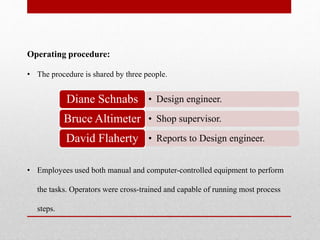
• The procedure is shared by three people.
• Employees used both manual and computer-controlled equipment to perform
the tasks. Operators were cross-trained and capable of running most process
steps.
• Design engineer.Diane Schnabs
• Shop supervisor.Bruce Altimeter
• Reports to Design engineer.David Flaherty
Problems faced by DONNER company:
.
• Second half of
month is
overly
crowded.
• From <1% to
>3%
• Rush orders
and Reworks
• Totally
unstable
Production
Bottleneck
Frequent
Rescheduling
Shipment
Inconsistency
Increase in
rate of returns
RECOMMONDATIONS:
• For the layout problem of wastage in time due to the employees switching in
between operations, it would be practical if a certain batch of people are assigned
with the certain work and that only.
• For similar problems like the plater needing to walk all the way to the plating tanks
for 18’ every 3 to 4 minutes, the desk can be moved to closer vicinity as there is no
danger of damage to the equipment or the employee.
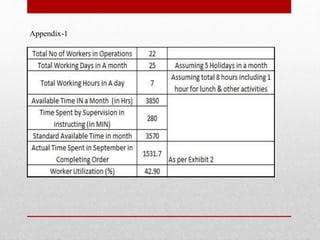
• The utilization of workers is low, even they hired 8 new workers who are not so
skilled, which results in increased labour cost. So, its better to make full use of
technology rather than increasing man power. (refer appendix-1)
Effective use of CNC drill and CNC router:
• Due to the “shop floor policy”, the company was unable to use CNC products to full
potential.
• Standard Time Taken by Machine= Setup Time + Run Time per Hole*No of
Holes*order size
For Manual Drill, Time Required= 15 + .08*500*N
For CNC Drill, Time Required= 240 + .004*500*N
As per assumption, 15 + .08*500*N=240 + .004*500*N
N=5.625 i.e. approx. 6.
• For Order size below 6, it is advisable to use Manual Drill while for order size 6 or
more, using CNC drill is better as it will save time.
• Similarly, for order size above 200, CNC router is preferable.
Calculation of DFPR:
From the above table it is clearly reflected, increase in batch size will result in
bottle neck, as an order of size 200 we could not even process an order in a day. If
the order size further increases it will cost in much delay.
Appendix-1
Queries…..?
THANK YOU

Donner Case, Operation Management, HBR case

  • 1.
    By (Group-6): Alok Kumar DeviSushrith Kannidi Anudeep Sushanth Pradeep Chandra Rentapalli Ruthra Prasad Venkata Narendra A Case Study On DONNER COMPANY Submitted to Professor L.S.Murthy VISAKHAPATNAM
  • 2.
    DONNER COMPANY: • Foundedin 1985, it was specialized in manufacturing circuit boards for experimental prototype boards and for pilot production runs. • It performed its operations based on the specifications given by the customers. • Promises delivery of small orders in less than three weeks and five weeks for larger orders with more than 1000 boards.
  • 3.
    Manufacturing process: • Donner'sprocess produced boards known as "SMOBC" boards. Manufacturing of these boards involves three steps. Preparation -Artwork generation -Inspect and shear -Punch tooling holes Image transfer -From drilling to etch and tin strip Fabrication -Solder mask -Solder dip -Profiling -Inspect and Pack
  • 4.
    Operating procedure: • Theprocedure is shared by three people. • Employees used both manual and computer-controlled equipment to perform the tasks. Operators were cross-trained and capable of running most process steps. • Design engineer.Diane Schnabs • Shop supervisor.Bruce Altimeter • Reports to Design engineer.David Flaherty
  • 5.
    Problems faced byDONNER company: . • Second half of month is overly crowded. • From <1% to >3% • Rush orders and Reworks • Totally unstable Production Bottleneck Frequent Rescheduling Shipment Inconsistency Increase in rate of returns
  • 6.
    RECOMMONDATIONS: • For thelayout problem of wastage in time due to the employees switching in between operations, it would be practical if a certain batch of people are assigned with the certain work and that only. • For similar problems like the plater needing to walk all the way to the plating tanks for 18’ every 3 to 4 minutes, the desk can be moved to closer vicinity as there is no danger of damage to the equipment or the employee. • The utilization of workers is low, even they hired 8 new workers who are not so skilled, which results in increased labour cost. So, its better to make full use of technology rather than increasing man power. (refer appendix-1)
  • 7.
    Effective use ofCNC drill and CNC router: • Due to the “shop floor policy”, the company was unable to use CNC products to full potential. • Standard Time Taken by Machine= Setup Time + Run Time per Hole*No of Holes*order size For Manual Drill, Time Required= 15 + .08*500*N For CNC Drill, Time Required= 240 + .004*500*N As per assumption, 15 + .08*500*N=240 + .004*500*N N=5.625 i.e. approx. 6. • For Order size below 6, it is advisable to use Manual Drill while for order size 6 or more, using CNC drill is better as it will save time. • Similarly, for order size above 200, CNC router is preferable.
  • 8.
    Calculation of DFPR: Fromthe above table it is clearly reflected, increase in batch size will result in bottle neck, as an order of size 200 we could not even process an order in a day. If the order size further increases it will cost in much delay.
  • 9.
  • 10.
  • 11.