XeroxandFujiXerox
Group No 8
Ruchi Sao 13PGP048 Geeta Hansdah 13PGP079
Trisha Gajbhiye 13PGP116 Bhavana Ziradkar 13PGP118
Sai Shilpa 13PGP125
Xerox’s
International
Expansion
Funded by Haloid Corporation in 1946.
Renamed as Xerox Corporation in 1961 with the introduction of 914 copier in 1959.
50/50 JV with Rank Organization of Britain in 1956 with 66% of profits of Rank Xerox.
By 60s, established subsidiaries in Mexico, Italy, Germany, France & Australia.
In 1964, right to market xerographic products in the Western hemisphere.
Refused xerography licenses to Japanese firms on the grounds of commercially immature technology.
Out of 27 companies, Fuji Photo Film (FPF) was chosen for partnership in Japan.
3/22/2016 Indian Institute of Management Raipur 2
Establishment
of Fuji Xerox
 Fuji Xerox- 50/50 JV between FPF & RX in 1962.
 Disapproved by Japanese Govt. as solely a sales company ,
hence later became a contracting partner with Rank Xerox
with exclusive patents in Japan.
 Exclusive rights to FX to sell in Japan, Indonesia, South Korea,
the Philippines, Taiwan, Thailand & Indochina.
 FX paid royalty of 5% on revenues from the sales plus 50% of
its profit to RX.
3/22/2016 Indian Institute of Management Raipur 3
Development
of Fuji Xerox’s
Capabilities
 Xerox machines were disassembled & studied to determine
the equipment & supplies necessary for production.
 3 FPF engineers spent two months touring Xerox & RX
production facilities.
 Imported machines were sold first, then assembled products
finally the domestic production of copiers.
 Expansion of product line – faster version of 914 & a smaller
desktop model, 2400 (in 1967).
 Establishment of sales subsidiaries throughout FX’s licensed
territory.
3/22/2016 Indian Institute of Management Raipur 4
Contd…
 By late 1960s, FX’s market declined due to :
 Threat from substitute technologies- electrostatic copier from
Ricoh.
 Scheduled expiration of Xerox’s core patents between 1968 &
1973
 Transfer of FPF copier plants to FX in 1971 along with
construction of a 160,000 sq.-foot manufacturing &
engineering facility by FX.
 Addition of 1% in the share of Xerox from RX to an increased
51% control of the JV-making it a subsidiary of Xerox.
 Xerox received 66% of RX’s profit & 33% of FX’s profit.
3/22/2016 Indian Institute of Management Raipur 5
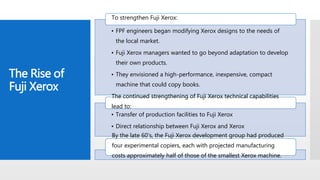
The Rise of
Fuji Xerox
• FPF engineers began modifying Xerox designs to the needs of
the local market.
• Fuji Xerox managers wanted to go beyond adaptation to develop
their own products.
• They envisioned a high-performance, inexpensive, compact
machine that could copy books.
To strengthen Fuji Xerox:
• Transfer of production facilities to Fuji Xerox
• Direct relationship between Fuji Xerox and Xerox
The continued strengthening of Fuji Xerox technical capabilities
lead to:
By the late 60's, the Fuji Xerox development group had produced
four experimental copiers, each with projected manufacturing
costs approximately half of those of the smallest Xerox machine.
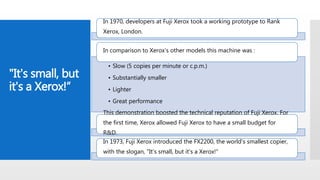
"It's small, but
it's a Xerox!“
In 1970, developers at Fuji Xerox took a working prototype to Rank
Xerox, London.
• Slow (5 copies per minute or c.p.m.)
• Substantially smaller
• Lighter
• Great performance
In comparison to Xerox’s other models this machine was :
This demonstration boosted the technical reputation of Fuji Xerox. For
the first time, Xerox allowed Fuji Xerox to have a small budget for
R&D.
In 1973, Fuji Xerox introduced the FX2200, the world's smallest copier,
with the slogan, "It's small, but it's a Xerox!"
Competitors
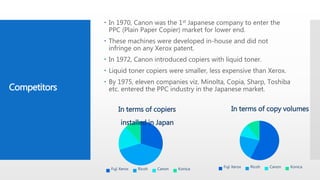
 In 1970, Canon was the 1st Japanese company to enter the
PPC (Plain Paper Copier) market for lower end.
 These machines were developed in-house and did not
infringe on any Xerox patent.
 In 1972, Canon introduced copiers with liquid toner.
 Liquid toner copiers were smaller, less expensive than Xerox.
 By 1975, eleven companies viz. Minolta, Copia, Sharp, Toshiba
etc. entered the PPC industry in the Japanese market.
In terms of copiers
installed in Japan
Fuji Xerox Ricoh Canon Konica
In terms of copy volumes
Fuji Xerox Ricoh Canon Konica
Declaration of
independence
 In 1975, the company launched its Total Quality Control
program.
 The focal point of the campaign was the development
of dantotsu, "Absolute No. 1 Product."
 The marketing and engineering departments were given a
seemingly impossible task:
To develop a compact, 40 c.p.m. machine, to be manufactured
at half the cost of comparable machines and with half the
number of parts of previous models, and to do it in two years.
• Two years later, the FX3500 was ready.
• By 1979, the FX3500 had broken the Japanese record for
annual sales of copiers sold in one year.
• In 1980, Fuji Xerox won the Japanese Government's
prestigious Deming Prize, awarded annually to a company
achieving outstanding quality for its effort to develop the
FX3500.
Independence
born out of
necessity
 The FX3500 project came after Xerox had canceled a series of
low- to mid-volume copiers on which Fuji Xerox was
depending.
 Code-named SAM, Moses, Mohawk, Elf, Peter, Paul and Mary,
each was cancelled in mid-development, even though Fuji
Xerox needed models of this type in its product line.
“As long as I am responsible for the survival of
this company, I can no longer be totally
dependent on you for developing products. We
are going to have to develop our own."
- Tony Kobayashi
Xerox’s Lost Decade
New
Competition
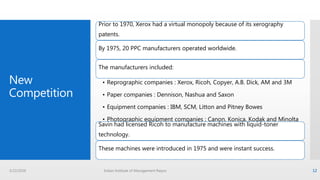
Prior to 1970, Xerox had a virtual monopoly because of its xerography
patents.
By 1975, 20 PPC manufacturers operated worldwide.
The manufacturers included:
• Reprographic companies : Xerox, Ricoh, Copyer, A.B. Dick, AM and 3M
• Paper companies : Dennison, Nashua and Saxon
• Equipment companies : IBM, SCM, Litton and Pitney Bowes
• Photographic equipment companies : Canon, Konica, Kodak and Minolta
• Consumer electronics companies : Sharp and Toshiba
Savin had licensed Ricoh to manufacture machines with liquid-toner
technology.
These machines were introduced in 1975 and were instant success.
3/22/2016 Indian Institute of Management Raipur 12
Contd…
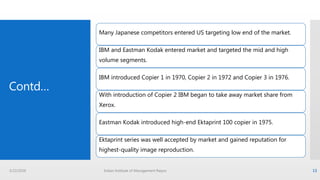
Many Japanese competitors entered US targeting low end of the market.
IBM and Eastman Kodak entered market and targeted the mid and high
volume segments.
IBM introduced Copier 1 in 1970, Copier 2 in 1972 and Copier 3 in 1976.
With introduction of Copier 2 IBM began to take away market share from
Xerox.
Eastman Kodak introduced high-end Ektaprint 100 copier in 1975.
Ektaprint series was well accepted by market and gained reputation for
highest-quality image reproduction.
3/22/2016 Indian Institute of Management Raipur 13
Xerox’s
Stagnation
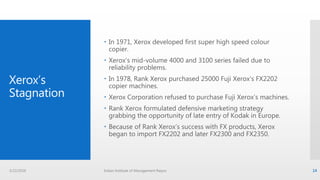
 In 1971, Xerox developed first super high speed colour
copier.
 Xerox’s mid-volume 4000 and 3100 series failed due to
reliability problems.
 In 1978, Rank Xerox purchased 25000 Fuji Xerox’s FX2202
copier machines.
 Xerox Corporation refused to purchase Fuji Xerox’s machines.
 Rank Xerox formulated defensive marketing strategy
grabbing the opportunity of late entry of Kodak in Europe.
 Because of Rank Xerox’s success with FX products, Xerox
began to import FX2202 and later FX2300 and FX2350.
3/22/2016 Indian Institute of Management Raipur 14
Courtroom
Battles
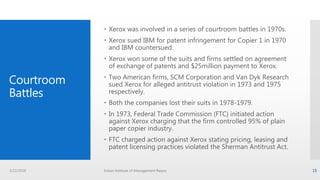
 Xerox was involved in a series of courtroom battles in 1970s.
 Xerox sued IBM for patent infringement for Copier 1 in 1970
and IBM countersued.
 Xerox won some of the suits and firms settled on agreement
of exchange of patents and $25million payment to Xerox.
 Two American firms, SCM Corporation and Van Dyk Research
sued Xerox for alleged antitrust violation in 1973 and 1975
respectively.
 Both the companies lost their suits in 1978-1979.
 In 1973, Federal Trade Commission (FTC) initiated action
against Xerox charging that the firm controlled 95% of plain
paper copier industry.
 FTC charged action against Xerox stating pricing, leasing and
patent licensing practices violated the Sherman Antitrust Act.
3/22/2016 Indian Institute of Management Raipur 15
Contd…
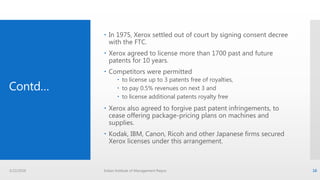
 In 1975, Xerox settled out of court by signing consent decree
with the FTC.
 Xerox agreed to license more than 1700 past and future
patents for 10 years.
 Competitors were permitted
 to license up to 3 patents free of royalties,
 to pay 0.5% revenues on next 3 and
 to license additional patents royalty free
 Xerox also agreed to forgive past patent infringements, to
cease offering package-pricing plans on machines and
supplies.
 Kodak, IBM, Canon, Ricoh and other Japanese firms secured
Xerox licenses under this arrangement.
3/22/2016 Indian Institute of Management Raipur 16
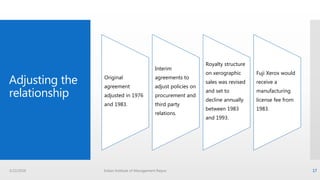
Adjusting the
relationship
Original
agreement
adjusted in 1976
and 1983.
Interim
agreements to
adjust policies on
procurement and
third party
relations.
Royalty structure
on xerographic
sales was revised
and set to
decline annually
between 1983
and 1993.
Fuji Xerox would
receive a
manufacturing
license fee from
1983.
3/22/2016 Indian Institute of Management Raipur 17
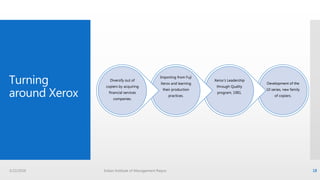
Turning
around Xerox
Development of the
10 series, new family
of copiers.
Xerox’s Leadership
through Quality
program, 1981.
Importing from Fuji
Xerox and learning
their production
practices.
Diversify out of
copiers by acquiring
financial services
companies.
3/22/2016 Indian Institute of Management Raipur 18
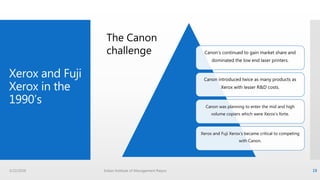
Xerox and Fuji
Xerox in the
1990’s
Canon’s continued to gain market share and
dominated the low end laser printers.
Canon introduced twice as many products as
Xerox with lesser R&D costs.
Canon was planning to enter the mid and high
volume copiers which were Xerox’s forte.
Xerox and Fuji Xerox’s became critical to competing
with Canon.
3/22/2016 Indian Institute of Management Raipur 19
The Canon
challenge
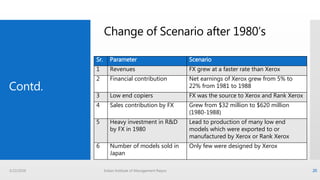
Change of Scenario after 1980’s
3/22/2016 Indian Institute of Management Raipur 20
Sr. Parameter Scenario
1 Revenues FX grew at a faster rate than Xerox
2 Financial contribution Net earnings of Xerox grew from 5% to
22% from 1981 to 1988
3 Low end copiers FX was the source to Xerox and Rank Xerox
4 Sales contribution by FX Grew from $32 million to $620 million
(1980-1988)
5 Heavy investment in R&D
by FX in 1980
Lead to production of many low end
models which were exported to or
manufactured by Xerox or Rank Xerox
6 Number of models sold in
Japan
Only few were designed by Xerox
Contd.
Contd.
3/22/2016 Indian Institute of Management Raipur 21
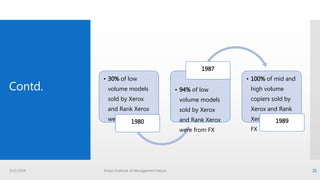
• 30% of low
volume models
sold by Xerox
and Rank Xerox
were from FX1980
• 94% of low
volume models
sold by Xerox
and Rank Xerox
were from FX
1987
• 100% of mid and
high volume
copiers sold by
Xerox and Rank
Xerox were from
FX
1989
Contd.
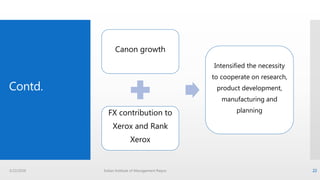
Canon growth
FX contribution to
Xerox and Rank
Xerox
Intensified the necessity
to cooperate on research,
product development,
manufacturing and
planning
3/22/2016 Indian Institute of Management Raipur 22
Strategy
Summits
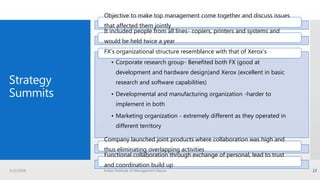
Objective to make top management come together and discuss issues
that affected them jointly
It included people from all lines- copiers, printers and systems and
would be held twice a year
• Corporate research group- Benefited both FX (good at
development and hardware design)and Xerox (excellent in basic
research and software capabilities)
• Developmental and manufacturing organization -harder to
implement in both
• Marketing organization - extremely different as they operated in
different territory
FX’s organizational structure resemblance with that of Xerox’s
Company launched joint products where collaboration was high and
thus eliminating overlapping activities
Functional collaboration through exchange of personal, lead to trust
and coordination build up
3/22/2016 Indian Institute of Management Raipur 23
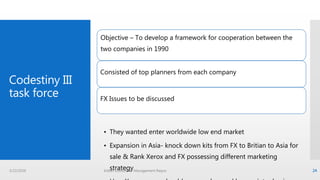
Codestiny III
task force
Objective – To develop a framework for cooperation between the
two companies in 1990
Consisted of top planners from each company
FX Issues to be discussed
• They wanted enter worldwide low end market
• Expansion in Asia- knock down kits from FX to Britian to Asia for
sale & Rank Xerox and FX possessing different marketing
strategy3/22/2016 Indian Institute of Management Raipur 24
What role did FX play in
Xerox’s global strategy?
How did that role change in
the 1990’s and beyond (after
the case period)?
Question 1
3/22/2016 Indian Institute of Management Raipur 25
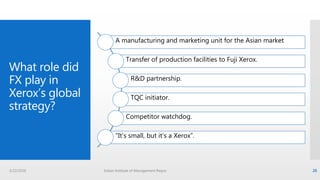
A manufacturing and marketing unit for the Asian market
Transfer of production facilities to Fuji Xerox.
R&D partnership.
TQC initiator.
Competitor watchdog.
“It’s small, but it’s a Xerox”.
3/22/2016 Indian Institute of Management Raipur 26
What role did
FX play in
Xerox’s global
strategy?
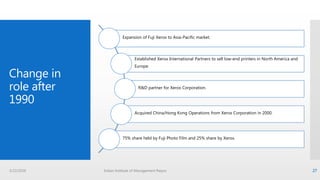
Change in
role after
1990
Expansion of Fuji Xerox to Asia-Pacific market.
Established Xerox International Partners to sell low-end printers in North America and
Europe.
R&D partner for Xerox Corporation.
Acquired China/Hong Kong Operations from Xerox Corporation in 2000.
75% share held by Fuji Photo Film and 25% share by Xerox.
3/22/2016 Indian Institute of Management Raipur 27
Was FX a successful joint
venture in 1990?
How do you measure its
performance?
Question 2
3/22/2016 Indian Institute of Management Raipur 28
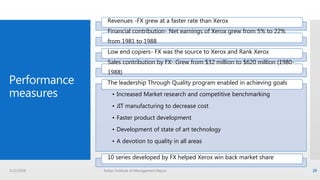
Performance
measures
Revenues -FX grew at a faster rate than Xerox
Financial contribution- Net earnings of Xerox grew from 5% to 22%
from 1981 to 1988
Low end copiers- FX was the source to Xerox and Rank Xerox
Sales contribution by FX- Grew from $32 million to $620 million (1980-
1988)
• Increased Market research and competitive benchmarking
• JIT manufacturing to decrease cost
• Faster product development
• Development of state of art technology
• A devotion to quality in all areas
The leadership Through Quality program enabled in achieving goals
10 series developed by FX helped Xerox win back market share
3/22/2016 Indian Institute of Management Raipur 29
What were the key
success factors in this
alliance? What were the
changes after 1990?
Question 3
3/22/2016 Indian Institute of Management Raipur 30
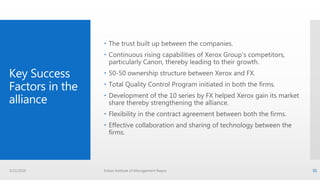
Key Success
Factors in the
alliance
 The trust built up between the companies.
 Continuous rising capabilities of Xerox Group’s competitors,
particularly Canon, thereby leading to their growth.
 50-50 ownership structure between Xerox and FX.
 Total Quality Control Program initiated in both the firms.
 Development of the 10 series by FX helped Xerox gain its market
share thereby strengthening the alliance.
 Flexibility in the contract agreement between both the firms.
 Effective collaboration and sharing of technology between the
firms.
3/22/2016 Indian Institute of Management Raipur 31
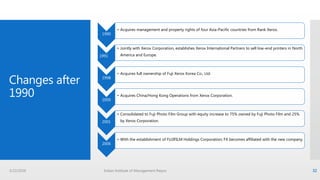
Changes after
1990
1990
• Acquires management and property rights of four Asia-Pacific countries from Rank Xerox.
1991
• Jointly with Xerox Corporation, establishes Xerox International Partners to sell low-end printers in North
America and Europe.
1998
• Acquires full ownership of Fuji Xerox Korea Co., Ltd.
2000
• Acquires China/Hong Kong Operations from Xerox Corporation.
2001
• Consolidated to Fuji Photo Film Group with equity increase to 75% owned by Fuji Photo Film and 25%
by Xerox Corporation.
2006
• With the establishment of FUJIFILM Holdings Corporation; FX becomes affiliated with the new company.
3/22/2016 Indian Institute of Management Raipur 32
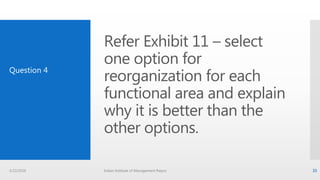
Refer Exhibit 11 – select
one option for
reorganization for each
functional area and explain
why it is better than the
other options.
3/22/2016 Indian Institute of Management Raipur 33
Question 4
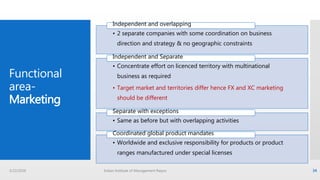
Functional
area-
Marketing
• 2 separate companies with some coordination on business
direction and strategy & no geographic constraints
Independent and overlapping
• Concentrate effort on licenced territory with multinational
business as required
• Target market and territories differ hence FX and XC marketing
should be different
Independent and Separate
• Same as before but with overlapping activities
Separate with exceptions
• Worldwide and exclusive responsibility for products or product
ranges manufactured under special licenses
Coordinated global product mandates
3/22/2016 Indian Institute of Management Raipur 34
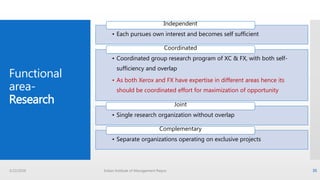
Functional
area-
Research
• Each pursues own interest and becomes self sufficient
Independent
• Coordinated group research program of XC & FX, with both self-
sufficiency and overlap
• As both Xerox and FX have expertise in different areas hence its
should be coordinated effort for maximization of opportunity
Coordinated
• Single research organization without overlap
Joint
• Separate organizations operating on exclusive projects
Complementary
3/22/2016 Indian Institute of Management Raipur 35
Functional
area-
Development
and
Manufacturing
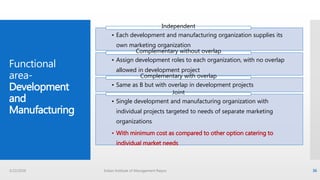
• Each development and manufacturing organization supplies its
own marketing organization
Independent
• Assign development roles to each organization, with no overlap
allowed in development project
Complementary without overlap
• Same as B but with overlap in development projects
Complementary with overlap
• Single development and manufacturing organization with
individual projects targeted to needs of separate marketing
organizations
• With minimum cost as compared to other option catering to
individual market needs
Joint
3/22/2016 Indian Institute of Management Raipur 36
Thank you
3/22/2016 Indian Institute of Management Raipur 37

Xerox & Fuji Xerox

  • 1.
    XeroxandFujiXerox Group No 8 RuchiSao 13PGP048 Geeta Hansdah 13PGP079 Trisha Gajbhiye 13PGP116 Bhavana Ziradkar 13PGP118 Sai Shilpa 13PGP125
  • 2.
    Xerox’s International Expansion Funded by HaloidCorporation in 1946. Renamed as Xerox Corporation in 1961 with the introduction of 914 copier in 1959. 50/50 JV with Rank Organization of Britain in 1956 with 66% of profits of Rank Xerox. By 60s, established subsidiaries in Mexico, Italy, Germany, France & Australia. In 1964, right to market xerographic products in the Western hemisphere. Refused xerography licenses to Japanese firms on the grounds of commercially immature technology. Out of 27 companies, Fuji Photo Film (FPF) was chosen for partnership in Japan. 3/22/2016 Indian Institute of Management Raipur 2
  • 3.
    Establishment of Fuji Xerox Fuji Xerox- 50/50 JV between FPF & RX in 1962.  Disapproved by Japanese Govt. as solely a sales company , hence later became a contracting partner with Rank Xerox with exclusive patents in Japan.  Exclusive rights to FX to sell in Japan, Indonesia, South Korea, the Philippines, Taiwan, Thailand & Indochina.  FX paid royalty of 5% on revenues from the sales plus 50% of its profit to RX. 3/22/2016 Indian Institute of Management Raipur 3
  • 4.
    Development of Fuji Xerox’s Capabilities Xerox machines were disassembled & studied to determine the equipment & supplies necessary for production.  3 FPF engineers spent two months touring Xerox & RX production facilities.  Imported machines were sold first, then assembled products finally the domestic production of copiers.  Expansion of product line – faster version of 914 & a smaller desktop model, 2400 (in 1967).  Establishment of sales subsidiaries throughout FX’s licensed territory. 3/22/2016 Indian Institute of Management Raipur 4
  • 5.
    Contd…  By late1960s, FX’s market declined due to :  Threat from substitute technologies- electrostatic copier from Ricoh.  Scheduled expiration of Xerox’s core patents between 1968 & 1973  Transfer of FPF copier plants to FX in 1971 along with construction of a 160,000 sq.-foot manufacturing & engineering facility by FX.  Addition of 1% in the share of Xerox from RX to an increased 51% control of the JV-making it a subsidiary of Xerox.  Xerox received 66% of RX’s profit & 33% of FX’s profit. 3/22/2016 Indian Institute of Management Raipur 5
  • 6.
    The Rise of FujiXerox • FPF engineers began modifying Xerox designs to the needs of the local market. • Fuji Xerox managers wanted to go beyond adaptation to develop their own products. • They envisioned a high-performance, inexpensive, compact machine that could copy books. To strengthen Fuji Xerox: • Transfer of production facilities to Fuji Xerox • Direct relationship between Fuji Xerox and Xerox The continued strengthening of Fuji Xerox technical capabilities lead to: By the late 60's, the Fuji Xerox development group had produced four experimental copiers, each with projected manufacturing costs approximately half of those of the smallest Xerox machine.
  • 7.
    "It's small, but it'sa Xerox!“ In 1970, developers at Fuji Xerox took a working prototype to Rank Xerox, London. • Slow (5 copies per minute or c.p.m.) • Substantially smaller • Lighter • Great performance In comparison to Xerox’s other models this machine was : This demonstration boosted the technical reputation of Fuji Xerox. For the first time, Xerox allowed Fuji Xerox to have a small budget for R&D. In 1973, Fuji Xerox introduced the FX2200, the world's smallest copier, with the slogan, "It's small, but it's a Xerox!"
  • 8.
    Competitors  In 1970,Canon was the 1st Japanese company to enter the PPC (Plain Paper Copier) market for lower end.  These machines were developed in-house and did not infringe on any Xerox patent.  In 1972, Canon introduced copiers with liquid toner.  Liquid toner copiers were smaller, less expensive than Xerox.  By 1975, eleven companies viz. Minolta, Copia, Sharp, Toshiba etc. entered the PPC industry in the Japanese market. In terms of copiers installed in Japan Fuji Xerox Ricoh Canon Konica In terms of copy volumes Fuji Xerox Ricoh Canon Konica
  • 9.
    Declaration of independence  In1975, the company launched its Total Quality Control program.  The focal point of the campaign was the development of dantotsu, "Absolute No. 1 Product."  The marketing and engineering departments were given a seemingly impossible task: To develop a compact, 40 c.p.m. machine, to be manufactured at half the cost of comparable machines and with half the number of parts of previous models, and to do it in two years. • Two years later, the FX3500 was ready. • By 1979, the FX3500 had broken the Japanese record for annual sales of copiers sold in one year. • In 1980, Fuji Xerox won the Japanese Government's prestigious Deming Prize, awarded annually to a company achieving outstanding quality for its effort to develop the FX3500.
  • 10.
    Independence born out of necessity The FX3500 project came after Xerox had canceled a series of low- to mid-volume copiers on which Fuji Xerox was depending.  Code-named SAM, Moses, Mohawk, Elf, Peter, Paul and Mary, each was cancelled in mid-development, even though Fuji Xerox needed models of this type in its product line. “As long as I am responsible for the survival of this company, I can no longer be totally dependent on you for developing products. We are going to have to develop our own." - Tony Kobayashi
  • 11.
  • 12.
    New Competition Prior to 1970,Xerox had a virtual monopoly because of its xerography patents. By 1975, 20 PPC manufacturers operated worldwide. The manufacturers included: • Reprographic companies : Xerox, Ricoh, Copyer, A.B. Dick, AM and 3M • Paper companies : Dennison, Nashua and Saxon • Equipment companies : IBM, SCM, Litton and Pitney Bowes • Photographic equipment companies : Canon, Konica, Kodak and Minolta • Consumer electronics companies : Sharp and Toshiba Savin had licensed Ricoh to manufacture machines with liquid-toner technology. These machines were introduced in 1975 and were instant success. 3/22/2016 Indian Institute of Management Raipur 12
  • 13.
    Contd… Many Japanese competitorsentered US targeting low end of the market. IBM and Eastman Kodak entered market and targeted the mid and high volume segments. IBM introduced Copier 1 in 1970, Copier 2 in 1972 and Copier 3 in 1976. With introduction of Copier 2 IBM began to take away market share from Xerox. Eastman Kodak introduced high-end Ektaprint 100 copier in 1975. Ektaprint series was well accepted by market and gained reputation for highest-quality image reproduction. 3/22/2016 Indian Institute of Management Raipur 13
  • 14.
    Xerox’s Stagnation  In 1971,Xerox developed first super high speed colour copier.  Xerox’s mid-volume 4000 and 3100 series failed due to reliability problems.  In 1978, Rank Xerox purchased 25000 Fuji Xerox’s FX2202 copier machines.  Xerox Corporation refused to purchase Fuji Xerox’s machines.  Rank Xerox formulated defensive marketing strategy grabbing the opportunity of late entry of Kodak in Europe.  Because of Rank Xerox’s success with FX products, Xerox began to import FX2202 and later FX2300 and FX2350. 3/22/2016 Indian Institute of Management Raipur 14
  • 15.
    Courtroom Battles  Xerox wasinvolved in a series of courtroom battles in 1970s.  Xerox sued IBM for patent infringement for Copier 1 in 1970 and IBM countersued.  Xerox won some of the suits and firms settled on agreement of exchange of patents and $25million payment to Xerox.  Two American firms, SCM Corporation and Van Dyk Research sued Xerox for alleged antitrust violation in 1973 and 1975 respectively.  Both the companies lost their suits in 1978-1979.  In 1973, Federal Trade Commission (FTC) initiated action against Xerox charging that the firm controlled 95% of plain paper copier industry.  FTC charged action against Xerox stating pricing, leasing and patent licensing practices violated the Sherman Antitrust Act. 3/22/2016 Indian Institute of Management Raipur 15
  • 16.
    Contd…  In 1975,Xerox settled out of court by signing consent decree with the FTC.  Xerox agreed to license more than 1700 past and future patents for 10 years.  Competitors were permitted  to license up to 3 patents free of royalties,  to pay 0.5% revenues on next 3 and  to license additional patents royalty free  Xerox also agreed to forgive past patent infringements, to cease offering package-pricing plans on machines and supplies.  Kodak, IBM, Canon, Ricoh and other Japanese firms secured Xerox licenses under this arrangement. 3/22/2016 Indian Institute of Management Raipur 16
  • 17.
    Adjusting the relationship Original agreement adjusted in1976 and 1983. Interim agreements to adjust policies on procurement and third party relations. Royalty structure on xerographic sales was revised and set to decline annually between 1983 and 1993. Fuji Xerox would receive a manufacturing license fee from 1983. 3/22/2016 Indian Institute of Management Raipur 17
  • 18.
    Turning around Xerox Development ofthe 10 series, new family of copiers. Xerox’s Leadership through Quality program, 1981. Importing from Fuji Xerox and learning their production practices. Diversify out of copiers by acquiring financial services companies. 3/22/2016 Indian Institute of Management Raipur 18
  • 19.
    Xerox and Fuji Xeroxin the 1990’s Canon’s continued to gain market share and dominated the low end laser printers. Canon introduced twice as many products as Xerox with lesser R&D costs. Canon was planning to enter the mid and high volume copiers which were Xerox’s forte. Xerox and Fuji Xerox’s became critical to competing with Canon. 3/22/2016 Indian Institute of Management Raipur 19 The Canon challenge
  • 20.
    Change of Scenarioafter 1980’s 3/22/2016 Indian Institute of Management Raipur 20 Sr. Parameter Scenario 1 Revenues FX grew at a faster rate than Xerox 2 Financial contribution Net earnings of Xerox grew from 5% to 22% from 1981 to 1988 3 Low end copiers FX was the source to Xerox and Rank Xerox 4 Sales contribution by FX Grew from $32 million to $620 million (1980-1988) 5 Heavy investment in R&D by FX in 1980 Lead to production of many low end models which were exported to or manufactured by Xerox or Rank Xerox 6 Number of models sold in Japan Only few were designed by Xerox Contd.
  • 21.
    Contd. 3/22/2016 Indian Instituteof Management Raipur 21 • 30% of low volume models sold by Xerox and Rank Xerox were from FX1980 • 94% of low volume models sold by Xerox and Rank Xerox were from FX 1987 • 100% of mid and high volume copiers sold by Xerox and Rank Xerox were from FX 1989
  • 22.
    Contd. Canon growth FX contributionto Xerox and Rank Xerox Intensified the necessity to cooperate on research, product development, manufacturing and planning 3/22/2016 Indian Institute of Management Raipur 22
  • 23.
    Strategy Summits Objective to maketop management come together and discuss issues that affected them jointly It included people from all lines- copiers, printers and systems and would be held twice a year • Corporate research group- Benefited both FX (good at development and hardware design)and Xerox (excellent in basic research and software capabilities) • Developmental and manufacturing organization -harder to implement in both • Marketing organization - extremely different as they operated in different territory FX’s organizational structure resemblance with that of Xerox’s Company launched joint products where collaboration was high and thus eliminating overlapping activities Functional collaboration through exchange of personal, lead to trust and coordination build up 3/22/2016 Indian Institute of Management Raipur 23
  • 24.
    Codestiny III task force Objective– To develop a framework for cooperation between the two companies in 1990 Consisted of top planners from each company FX Issues to be discussed • They wanted enter worldwide low end market • Expansion in Asia- knock down kits from FX to Britian to Asia for sale & Rank Xerox and FX possessing different marketing strategy3/22/2016 Indian Institute of Management Raipur 24
  • 25.
    What role didFX play in Xerox’s global strategy? How did that role change in the 1990’s and beyond (after the case period)? Question 1 3/22/2016 Indian Institute of Management Raipur 25
  • 26.
    A manufacturing andmarketing unit for the Asian market Transfer of production facilities to Fuji Xerox. R&D partnership. TQC initiator. Competitor watchdog. “It’s small, but it’s a Xerox”. 3/22/2016 Indian Institute of Management Raipur 26 What role did FX play in Xerox’s global strategy?
  • 27.
    Change in role after 1990 Expansionof Fuji Xerox to Asia-Pacific market. Established Xerox International Partners to sell low-end printers in North America and Europe. R&D partner for Xerox Corporation. Acquired China/Hong Kong Operations from Xerox Corporation in 2000. 75% share held by Fuji Photo Film and 25% share by Xerox. 3/22/2016 Indian Institute of Management Raipur 27
  • 28.
    Was FX asuccessful joint venture in 1990? How do you measure its performance? Question 2 3/22/2016 Indian Institute of Management Raipur 28
  • 29.
    Performance measures Revenues -FX grewat a faster rate than Xerox Financial contribution- Net earnings of Xerox grew from 5% to 22% from 1981 to 1988 Low end copiers- FX was the source to Xerox and Rank Xerox Sales contribution by FX- Grew from $32 million to $620 million (1980- 1988) • Increased Market research and competitive benchmarking • JIT manufacturing to decrease cost • Faster product development • Development of state of art technology • A devotion to quality in all areas The leadership Through Quality program enabled in achieving goals 10 series developed by FX helped Xerox win back market share 3/22/2016 Indian Institute of Management Raipur 29
  • 30.
    What were thekey success factors in this alliance? What were the changes after 1990? Question 3 3/22/2016 Indian Institute of Management Raipur 30
  • 31.
    Key Success Factors inthe alliance  The trust built up between the companies.  Continuous rising capabilities of Xerox Group’s competitors, particularly Canon, thereby leading to their growth.  50-50 ownership structure between Xerox and FX.  Total Quality Control Program initiated in both the firms.  Development of the 10 series by FX helped Xerox gain its market share thereby strengthening the alliance.  Flexibility in the contract agreement between both the firms.  Effective collaboration and sharing of technology between the firms. 3/22/2016 Indian Institute of Management Raipur 31
  • 32.
    Changes after 1990 1990 • Acquiresmanagement and property rights of four Asia-Pacific countries from Rank Xerox. 1991 • Jointly with Xerox Corporation, establishes Xerox International Partners to sell low-end printers in North America and Europe. 1998 • Acquires full ownership of Fuji Xerox Korea Co., Ltd. 2000 • Acquires China/Hong Kong Operations from Xerox Corporation. 2001 • Consolidated to Fuji Photo Film Group with equity increase to 75% owned by Fuji Photo Film and 25% by Xerox Corporation. 2006 • With the establishment of FUJIFILM Holdings Corporation; FX becomes affiliated with the new company. 3/22/2016 Indian Institute of Management Raipur 32
  • 33.
    Refer Exhibit 11– select one option for reorganization for each functional area and explain why it is better than the other options. 3/22/2016 Indian Institute of Management Raipur 33 Question 4
  • 34.
    Functional area- Marketing • 2 separatecompanies with some coordination on business direction and strategy & no geographic constraints Independent and overlapping • Concentrate effort on licenced territory with multinational business as required • Target market and territories differ hence FX and XC marketing should be different Independent and Separate • Same as before but with overlapping activities Separate with exceptions • Worldwide and exclusive responsibility for products or product ranges manufactured under special licenses Coordinated global product mandates 3/22/2016 Indian Institute of Management Raipur 34
  • 35.
    Functional area- Research • Each pursuesown interest and becomes self sufficient Independent • Coordinated group research program of XC & FX, with both self- sufficiency and overlap • As both Xerox and FX have expertise in different areas hence its should be coordinated effort for maximization of opportunity Coordinated • Single research organization without overlap Joint • Separate organizations operating on exclusive projects Complementary 3/22/2016 Indian Institute of Management Raipur 35
  • 36.
    Functional area- Development and Manufacturing • Each developmentand manufacturing organization supplies its own marketing organization Independent • Assign development roles to each organization, with no overlap allowed in development project Complementary without overlap • Same as B but with overlap in development projects Complementary with overlap • Single development and manufacturing organization with individual projects targeted to needs of separate marketing organizations • With minimum cost as compared to other option catering to individual market needs Joint 3/22/2016 Indian Institute of Management Raipur 36
  • 37.
    Thank you 3/22/2016 IndianInstitute of Management Raipur 37

Editor's Notes

  • #7 Fuji Xerox insisted the Xerox Grp. to develop small copiers as an integral part of its worldwide strategy. Xerox did not gave much importance to the lower end of the market but Fuji Xerox envisioned rising demand for small copiers in japan.