Toyota Supplier Support
Center
TOYOTA PRODUCTION SYSTEMS
• Integrated System
– Technical
– Managerial
– Philosophy
– Human Development
Forms the ORGANIZATION CULTURE
Kiichiro Toyoda’s Philosophy
• Used this philosophy to compete with Ford and
other automobile manufacturers
• Compete with large volume
manufacturers in price, quality and
availability to satisfy customer needs
while producing in small quantities with
limited capital expenditure
Toyota Philosophy
• Customer First
• People are the most valuable resources
• Kaizen
• Shop Floor Focus
Toyota Philosophy
 Eliminate Waste / Muda of overproduction
Pace of production = Pace of sales
 Efficiency is gauged by the ability of a plant to
meet exact customer requirements with the
least amount of resources
Toyota Philosophy
• KAIZEN is about people:
By knowing they are adding value for
customer
By having a safe work environment
By utilizing their creativity
By developing themselves
Toyota GOAL
• HIGHEST QUALITY
• LOWEST COST
• SHORTEST LEAD TIME
Toyota Production System (TPS)
• Influenced by:
– Business Needs
– Company Philosophy
TPS
• Foundation is STABILITY
• STABILITY is dependant on 4 M’s
• Man
• Machine
• Material
• Method
TPS
• Problems impacting stable production:
•Equipment
•Defects
•Rework
•Shortage
•Absenteeism
•Morale
TPS
• Tradition Approach to solve problems
• Maintain large inventories
• Add more shifts or work overtime
• Purchase more equipment
TPS
• TPS Approach to solve problems
• Expose and attack problems
• Seek out Root cause of problems
• Fix problems 1 by 1
• Do not pass defective part on - inspect at the
process and fix
• Quality feedback immediate
• Defects are visible at the source
TPS
• Build Quality:
• Make abnormalities easy to notice
• Call for help
• Take quick action to fix so
– Prevent building defect
– Do not pass defect
• Separate Man’s work and Machine’s work
• Identify man’s work separately from Machine’s
work
TPS
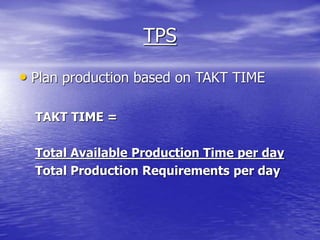
• Plan production based on TAKT TIME
TAKT TIME =
Total Available Production Time per day
Total Production Requirements per day
TPS
• ALWAYS :
Pace of production = Pace of sales
TPS
• Always have Standardized Work:
• Most efficient work flow maintaining
– Safety
– Quality
– Quantity
– Cost
• Main consideration on human movement
• Should change when
– Production Requirements change
– Improved operation method is identified
TPS
• All relevant work site information is available at
each jobsite through three worksheets
1. Production capacity Sheet
2. Standardized work combination table
– Indicates flow of human work within a process
– Specifies exact time requirement for each work step
– Job design based in takt time
– Useful for problem identification in relationship between
man and machine
TPS
3. Standardized work chart
– Illustrates the work sequence and process layout
– Indicates takt time and standard in process stock
– Useful as a method of work site management
Note: Examples of the three documents are attached with the
presentation
Problems while implementing TPS
• Human Mindset
– Same way for 30 years
– People fear losing jobs
– Teams are not effective
– How to motivate “kaizen”
effort
– Why must we change
– Manpower has no discipline
– Why must I do
standardized work if I can
do faster my way
• Misconceptions
– TPS only makes me work
harder
– Long distances between
supplier and manufacturer
– No Money
– Just another program
– Equipment not capable
Problems while implementing TPS
• Leadership/management
– What to do with people
“kaizened” out
– Large lot sizes, lower costs
– Run machine for 24 hours
– No support from top mgmt
– Top mgmt often changes
• Business Environment
– Unlevel customer orders
– Many customers, not all
advocate TPS
– Many different job
classifications
– Piece rate system
– Many products, one day
turnaround
– Union won’t go along with
TPS
KAIZEN
• Points of motion Kaizen
• Hard Work
– Bending
– Reaching
• Waiting
– Waiting time in front of machine
• Walking
– Eliminate or reduce
KAIZEN
• Operator work while walking
• Hand movements
– Wide hand movements
– Muda hand movements
– Hands waiting?
• Material Flow
– Work being carried on a straight and level path
– Part direction change
• Eye Movements
– Operator Checking?

Tps

  • 1.
  • 2.
    TOYOTA PRODUCTION SYSTEMS •Integrated System – Technical – Managerial – Philosophy – Human Development Forms the ORGANIZATION CULTURE
  • 3.
    Kiichiro Toyoda’s Philosophy •Used this philosophy to compete with Ford and other automobile manufacturers • Compete with large volume manufacturers in price, quality and availability to satisfy customer needs while producing in small quantities with limited capital expenditure
  • 4.
    Toyota Philosophy • CustomerFirst • People are the most valuable resources • Kaizen • Shop Floor Focus
  • 5.
    Toyota Philosophy  EliminateWaste / Muda of overproduction Pace of production = Pace of sales  Efficiency is gauged by the ability of a plant to meet exact customer requirements with the least amount of resources
  • 6.
    Toyota Philosophy • KAIZENis about people: By knowing they are adding value for customer By having a safe work environment By utilizing their creativity By developing themselves
  • 7.
    Toyota GOAL • HIGHESTQUALITY • LOWEST COST • SHORTEST LEAD TIME
  • 8.
    Toyota Production System(TPS) • Influenced by: – Business Needs – Company Philosophy
  • 9.
    TPS • Foundation isSTABILITY • STABILITY is dependant on 4 M’s • Man • Machine • Material • Method
  • 10.
    TPS • Problems impactingstable production: •Equipment •Defects •Rework •Shortage •Absenteeism •Morale
  • 11.
    TPS • Tradition Approachto solve problems • Maintain large inventories • Add more shifts or work overtime • Purchase more equipment
  • 12.
    TPS • TPS Approachto solve problems • Expose and attack problems • Seek out Root cause of problems • Fix problems 1 by 1 • Do not pass defective part on - inspect at the process and fix • Quality feedback immediate • Defects are visible at the source
  • 13.
    TPS • Build Quality: •Make abnormalities easy to notice • Call for help • Take quick action to fix so – Prevent building defect – Do not pass defect • Separate Man’s work and Machine’s work • Identify man’s work separately from Machine’s work
  • 14.
    TPS • Plan productionbased on TAKT TIME TAKT TIME = Total Available Production Time per day Total Production Requirements per day
  • 15.
    TPS • ALWAYS : Paceof production = Pace of sales
  • 16.
    TPS • Always haveStandardized Work: • Most efficient work flow maintaining – Safety – Quality – Quantity – Cost • Main consideration on human movement • Should change when – Production Requirements change – Improved operation method is identified
  • 17.
    TPS • All relevantwork site information is available at each jobsite through three worksheets 1. Production capacity Sheet 2. Standardized work combination table – Indicates flow of human work within a process – Specifies exact time requirement for each work step – Job design based in takt time – Useful for problem identification in relationship between man and machine
  • 18.
    TPS 3. Standardized workchart – Illustrates the work sequence and process layout – Indicates takt time and standard in process stock – Useful as a method of work site management Note: Examples of the three documents are attached with the presentation
  • 19.
    Problems while implementingTPS • Human Mindset – Same way for 30 years – People fear losing jobs – Teams are not effective – How to motivate “kaizen” effort – Why must we change – Manpower has no discipline – Why must I do standardized work if I can do faster my way • Misconceptions – TPS only makes me work harder – Long distances between supplier and manufacturer – No Money – Just another program – Equipment not capable
  • 20.
    Problems while implementingTPS • Leadership/management – What to do with people “kaizened” out – Large lot sizes, lower costs – Run machine for 24 hours – No support from top mgmt – Top mgmt often changes • Business Environment – Unlevel customer orders – Many customers, not all advocate TPS – Many different job classifications – Piece rate system – Many products, one day turnaround – Union won’t go along with TPS
  • 21.
    KAIZEN • Points ofmotion Kaizen • Hard Work – Bending – Reaching • Waiting – Waiting time in front of machine • Walking – Eliminate or reduce
  • 22.
    KAIZEN • Operator workwhile walking • Hand movements – Wide hand movements – Muda hand movements – Hands waiting? • Material Flow – Work being carried on a straight and level path – Part direction change • Eye Movements – Operator Checking?