COURSE TITLE ENVIRONMENTAL TOXICOLOGY
COURSE CODE ZOL- 610
CREDIT HOURS 3 (2-1)
SEMESTER BS ZOOLOGY 8TH
M-A, E-A, E-B
DEPARTMENT OF ZOOLOGY
COURSE CONTENTS
ENVIRONMENTAL TOXICOLOGY ZOL 610 3(2-1)
Toxicology: History , Terms and definitions, principles of Toxicology, Development
and present scope of environmental toxicology, Framework of environmental
toxicology, toxicological evaluation, Sources of environmental toxicants, /
Pollutants: Gaseous chemicals and heavy metals, toxicity testing,
Characteristics of exposure, spectrum of Toxic effects, Indices of toxicity, toxico-
dynamics, toxico-kinetics (absorption, distribution and elimination of toxic agents)
Biotransformation, Detoxification and biodegradation. Pollution and remediation,
ecological risk assessment
Toxicity Studies
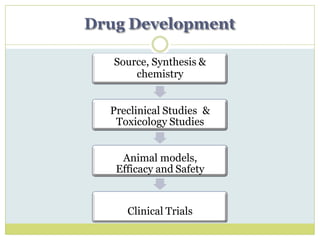
Source, Synthesis &
chemistry
Preclinical Studies &
Toxicology Studies
Animal models,
Efficacy and Safety
Clinical Trials
Drug Development
Preclinical Safety & Toxicity Testing
 Aims at discovering complications or sequelae
arising from the pharmacological actions of
drug and any unexpected side-effects.
Primary Goals
Estimate safe starting dose for clinical studies &
subsequent dose escalation schemes in humans.
Identify potential target organs for toxicity and study
whether such toxicity is reversible.
Assess dose dependence & relationship to exposure
Assess hazards that cannot be evaluated in clinical trials
(e.g. carcinogenicity and teratogenicity)
Identify hazards and estimate safe dose range
Necessity of toxicity studies
 Completely novel compound of unique action under
consideration
 Any chemical modification made to a known drug
 Formulations of a compound are considered
( Separately as well as formulated form)
 Novel combination of drugs made available as a single
formulation
 Veterinary drugs → if treatment is given to animals
intended for human food
Requirements
 Chemical Criteria
 Substance used in toxicity studies should be as pure as
material to be given to man
Materials: Animals
 Species:
 Species difference → single largest difficulty in
interpretation of toxicity studies
 Species →health, behaviour, endemic disease and
reaction to well studied toxic agent is familiar
 Two different species(Rodent & Non Rodent) used
 Should differ phylogenetically as widely as possible
Materials: Animals
 Species:
 Species in which test material is pharmacologically active
due to presence of receptor should be used
Ex. Avoid dogs for studying toxic effects of
sulphonamides, monkeys are better
 Strains:
 Use either animals derived from random breeding in
a closed colony or hybrids of two inbred lines
Materials: Animals
 Number, age and sex:
 Should be sufficient
 Long term experiments i.e. Carcinogen testing, large
number may be necessary to detect relatively low
incidence of the reactions
 Young immature animals are preferred generally → rapid
growth, but for detection of actions on endocrine and
reproductive systems, sexually mature animals are
required
 Should include groups of both males and females
Route / Frequency of administration
 Two routes to be used, one should be which is
intended for clinical use
 Aim should be to maintain the appropriate blood and
tissue level of the compound under consideration for
test duration
Duration
 Depends on type of the test (acute, sub-acute, chronic)
 All the important toxic effects of test substances can
probably predicted from experiments lasting no more
than three months
 In the absence of any rational basis for choosing a period,
a duration of twice the maximum exposure likely for
the human beings is convenient guide. 2 yrs. max
Toxicity Studies
 Systemic Toxicity studies
 Reproductive toxicology studies
 Local Toxicity studies
 Allergenicity/ Hypersensetivity studies
 Genotoxicity studies
 Carcinogenicity studies
Systemic
Toxicity Studies
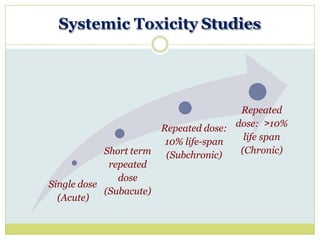
Single dose
(Acute)
Short term
repeated
dose
(Subacute)
Repeated dose:
10% life-span
(Subchronic)
Repeated
dose: >10%
life span
(Chronic)
Systemic Toxicity Studies
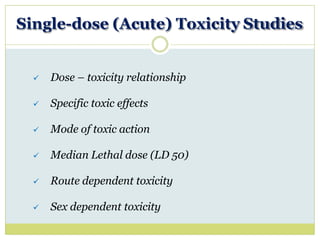
Single-dose (Acute) Toxicity Studies
 Dose – toxicity relationship
 Specific toxic effects
 Mode of toxic action
 Median Lethal dose (LD 50)
 Route dependent toxicity
 Sex dependent toxicity
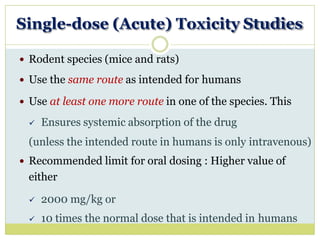
Single-dose (Acute) Toxicity Studies
 Rodent species (mice and rats)
 Use the same route as intended for humans
 Use at least one more route in one of the species. This
 Ensures systemic absorption of the drug
(unless the intended route in humans is only intravenous)
 Recommended limit for oral dosing : Higher value of
either
 2000 mg/kg or
 10 times the normal dose that is intended in humans
Single-dose (Acute) Toxicity Studies
 At least 5 animals / sex / group
 At least 4 graded doses (4 dose-groups)
 Observation for toxic effects (if any) : 14 days
 Obsevation for mortality :
 7 days [parenteral administration]
 14 days [oral administration]
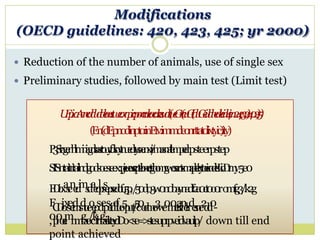
 Reduction of the number of animals, use of single sex
 Preliminary studies, followed by main test (Limit test)
U
F
p
i
x
a
A
e
n
c
d
d
u
d
t
d
e
o
o
s
t
w
e
o
x
n
p
i
r
c
p
o
r
c
c
o
l
e
a
c
d
s
e
s
u
d
r
(
u
e
G
r
(
e
u
G
i
(
d
u
G
e
i
u
l
d
i
i
n
e
d
l
e
e
i
n
l
4
i
e
n
2
4
e
3
2
)
4
0
2
)
5
)
(
E
n
(
d
E
p
n
o
d
i
n
p
t
o
:
i
n
E
t
v
:
i
m
m
d
eo
n
r
t
t
a
t
o
l
i
x
t
y
i
c
)
i
t
y
)
P
3
S
i
r
a
g
e
n
h
l
i
i
t
m
i
n
i
a
g
n
l
s
a
s
r
t
o
u
y
f
d
s
o
y
t
n
u
:
e
d
1
y
s
a
e
:
n
x
1
i
/
m
a
s
n
a
t
i
l
e
m
p
e
a
l
rpsteerpstep
S
I
S
n
t
a
i
t
r
i
t
a
i
l
n
d
g
o
d
s
o
e
s
:
e
e
x
:p
j
e
u
e
x
s
c
p
t
t
e
i
b
n
c
e
t
g
i
l
n
o
m
g
w
o
s
e
r
o
t
x
m
a
p
l
e
i
t
c
y
t
t
o
e
i
x
n
d
i
c
s
L
i
o
D
t
m
y5e0
F
D
i
o
x
a
s
e
n
e
d
i
m
s
d
t
a
e
o
l
p
s
s
e
p
s
e
d
o
f
u
5
p
,/
5
0
d
,
o
3
w
0
n
0
b
a
y
n
a
d
f
2
a
0
c
t
0
o
0
ro
m
f
g
3
/
.
k
2
g
F
C
D
i
o
x
s
e
e
t
d
i
n
s
d
t
u
e
o
e
p
s
d
e
p
s
e
t
i
d
o
l
l
f
u
o
5
p
u
,t
/
5
c
0
o
d
,
m
o
3
w
e
0
n
0
r
e
t
a
i
v
l
n
e
lr
d
e
s
n
e
2
d
d
0
-
,
0
p
i
0
o
.
e
i
.
m
n
m
t
g
a
o
/
c
k
r
h
t
g
a
i
e
l
i
v
t
e
y
d
D
o
<
s
e
=
>
s
t
e
s
u
p
r
p
v
e
i
d
v
a
u
l
p/ down till end
point achieved
Modifications
(OECD guidelines: 420, 423, 425; yr 2000)
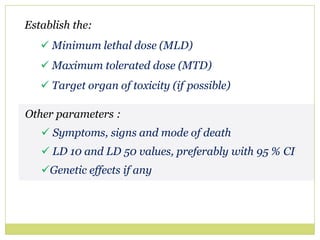
Other parameters :
 Symptoms, signs and mode of death
 LD 10 and LD 50 values, preferably with 95 % CI
Genetic effects if any
Establish the:
 Minimum lethal dose (MLD)
 Maximum tolerated dose (MTD)
 Target organ of toxicity (if possible)
Cytotoxic anticancer agents
 MTD determined first in Mice
 Findings in Rat confirmed to establish a linear
relationship between toxicity and body surface area
 MTD can be established in non-rodent species, if:
 Predictability is known to be poor in Rodents
(e.g. Antifolates)
 Drug has a novel mechanism of action
Toxicokinetic studies
Generation of pharmacokinetic data (ADME):
• A part of non-clinical toxicity studies or
• A separate supportive study
Purpose:
• Assessment of systemic exposure of test substance
• Relationship of toxicology to dose and time course
• Choose species & regimen in subsequent toxicity studies
• Designing of subsequent non-clinical toxicity studies
Rodents
• One rodent species (preferably rat)
• At least 4 graded doses including control
• Minimum of 5 animals of each sex
• Proposed clinical route of administration
• Test substance given daily for 10 consecutive days
Dose-ranging study
 Establishment of MTD for repeated dose studies
 Identification of Target organ of toxicity
Non-Rodents
• One male and one female (Dogs > Primates)
• Starting dose (3 or 5 x extrapolated effective dose) or
MTD
(whichever is less)
• Dose escalation every 3rd day, lowered if toxicity seen
• Then test substance given daily for 10 consecutive days
Repeated-dose Toxicity Studies
 Duration depends on proposed clinical trial
 At least 2 species, one non-rodent
 Species-specific pharmacokinetics, if any, should
preferably resemble human beings
 Route intended for human clinical use
Repeated-dose Toxicity Studies
 Wherever applicable, include a Control group
 3 other groups are formed, as:
 Highest dose
 Lowest dose
 Intermediate dose
Observable toxicity [MTD]
No observable toxicity
[NOAEL]
intended therapeutic dose or
multiple of it
Some symptoms ; not gross
toxicity or death placed
logarithmically betn doses
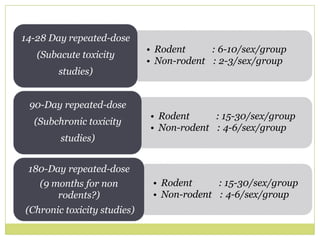
• Rodent
• Non-rodent
: 6-10/sex/group
: 2-3/sex/group
14-28 Day repeated-dose
(Subacute toxicity
studies)
• Rodent
• Non-rodent
: 15-30/sex/group
: 4-6/sex/group
90-Day repeated-dose
(Subchronic toxicity
studies)
• Rodent
• Non-rodent
: 15-30/sex/group
: 4-6/sex/group
180-Day repeated-dose
(9 months for non
rodents?)
(Chronic toxicity studies)
In all cases:
 Behavioural : General appearance, activity,
behaviour
 Physiological : Body weight, food intake
 Biochemical : Hematology, serum and urine
analysis
 Pathological : Organ weights, gross & microscopic
study of viscera & tissues
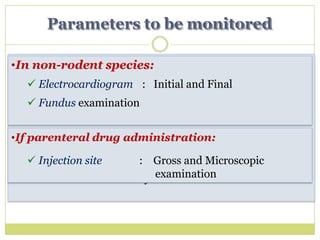
Parameters to be monitored
 Injection site : Gross and Microscopic
examination
•In non-rodent species:
 Electrocardiogram : Initial and Final
 Fundus examination
•If parenteral drug administration:
Reproductive
Toxicology
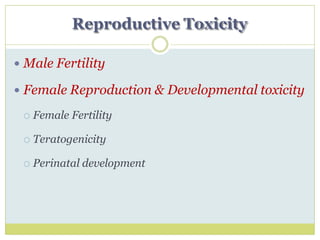
Reproductive Toxicity
 Male Fertility
 Female Reproduction & Developmental toxicity
 Female Fertility
 Teratogenicity
 Perinatal development
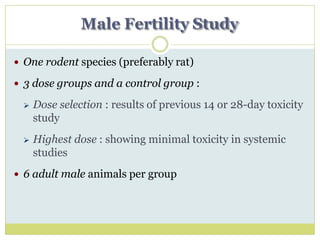
Male Fertility Study
 One rodent species (preferably rat)
 3 dose groups and a control group :
 Dose selection : results of previous 14 or 28-day toxicity
study
 Highest dose : showing minimal toxicity in systemic
studies
 6 adult male animals per group
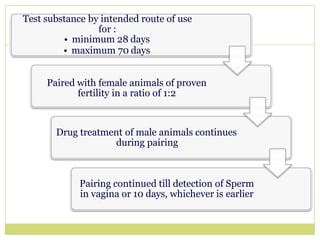
Test substance by intended route of use
for :
• minimum 28 days
• maximum 70 days
Paired with female animals of proven
fertility in a ratio of 1:2
Drug treatment of male animals continues
during pairing
Pairing continued till detection of Sperm
in vagina or 10 days, whichever is earlier
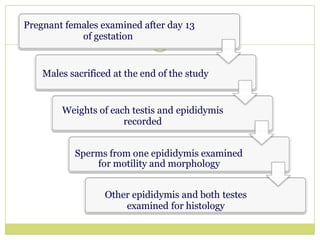
Pregnant females examined after day 13
of gestation
Males sacrificed at the end of the study
Weights of each testis and epididymis
recorded
Sperms from one epididymis examined
for motility and morphology
Other epididymis and both testes
examined for histology
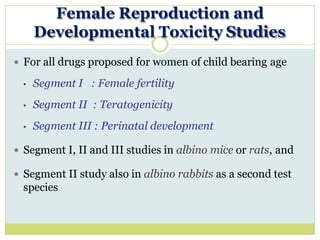
Female Reproduction and
Developmental Toxicity Studies
 For all drugs proposed for women of child bearing age
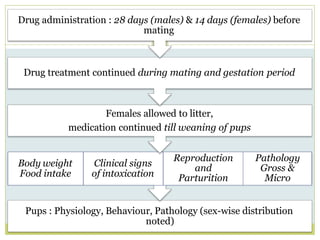
• Segment I : Female fertility
• Segment II : Teratogenicity
• Segment III : Perinatal development
 Segment I, II and III studies in albino mice or rats, and
 Segment II study also in albino rabbits as a second test
species
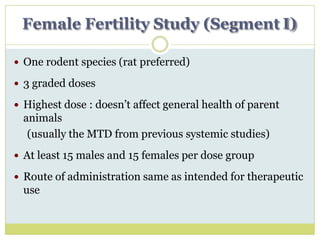
Female Fertility Study (Segment I)
 One rodent species (rat preferred)
 3 graded doses
 Highest dose : doesn’t affect general health of parent
animals
(usually the MTD from previous systemic studies)
 At least 15 males and 15 females per dose group
 Route of administration same as intended for therapeutic
use
Pups : Physiology, Behaviour, Pathology (sex-wise distribution
noted)
Body weight
Food intake
Clinical signs
of intoxication
Reproduction
and
Parturition
Pathology
Gross &
Micro
Drug treatment continued during mating and gestation period
Females allowed to litter,
medication continued till weaning of pups
Drug administration : 28 days (males) & 14 days (females) before
mating
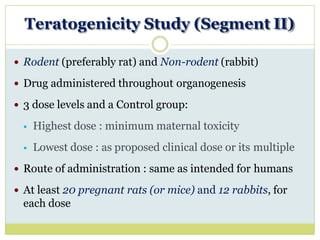
Teratogenicity Study (Segment II)
 Rodent (preferably rat) and Non-rodent (rabbit)
 Drug administered throughout organogenesis
 3 dose levels and a Control group:
 Highest dose : minimum maternal toxicity
 Lowest dose : as proposed clinical dose or its multiple
 Route of administration : same as intended for humans
 At least 20 pregnant rats (or mice) and 12 rabbits, for
each dose
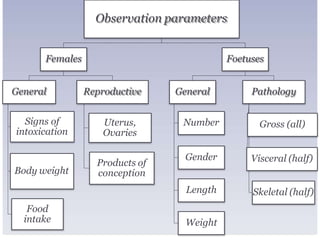
Observation parameters
Females
General
Signs of
intoxication
Body weight
Food
intake
Reproductive
Uterus,
Ovaries
Products of
conception
Foetuses
General
Number
Gender
Length
Weight
Pathology
Gross (all)
Visceral (half)
Skeletal (half)
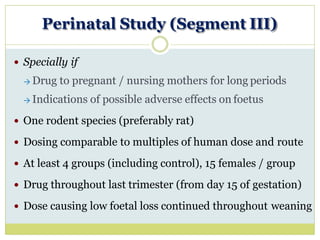
Perinatal Study (Segment III)
 Specially if
→ Drug to pregnant / nursing mothers for long periods
→ Indications of possible adverse effects on foetus
 One rodent species (preferably rat)
 Dosing comparable to multiples of human dose and route
 At least 4 groups (including control), 15 females / group
 Drug throughout last trimester (from day 15 of gestation)
 Dose causing low foetal loss continued throughout weaning
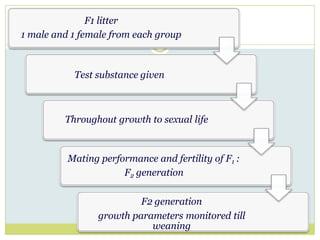
F1 litter
1 male and 1 female from each group
Test substance given
Throughout growth to sexual life
Mating performance and fertility of F1 :
F2 generation
F2 generation
growth parameters monitored till
weaning
Local
Toxicity
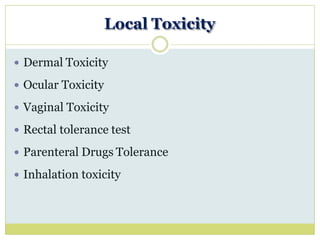
Local Toxicity
 Dermal Toxicity
 Ocular Toxicity
 Vaginal Toxicity
 Rectal tolerance test
 Parenteral Drugs Tolerance
 Inhalation toxicity
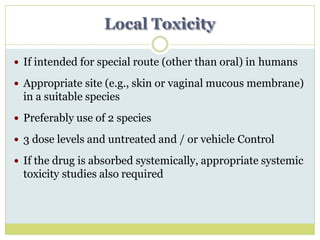
Local Toxicity
 If intended for special route (other than oral) in humans
 Appropriate site (e.g., skin or vaginal mucous membrane)
in a suitable species
 Preferably use of 2 species
 3 dose levels and untreated and / or vehicle Control
 If the drug is absorbed systemically, appropriate systemic
toxicity studies also required
Dermal Toxicity
 As cutaneous contamination is always a possibility
 Rabbit and Rat
 Applied on shaved skin
 Concentrations 7 fold higher than the clinical doses
 Period of application : 7 to 90 days
 Evaluation
› Local signs (erythema, oedema and eschar formation)
› Histological examination of sites of application
Ocular toxicity studies
 2 species, including an albino rabbit with a large
conjunctival sac
 Initial single dose application:
To decide exposure concentrations for repeated-dose
studies
Repeated dose study :
 Duration subject to clinical use (Maximum of 90 days)
 2 different concentrations exceeding human dose
 In acute studies, one eye kept as control. A separate control
group should be included in repeated-dose studies.
Ocular toxicity studies
 Evaluation
 Slit-lamp examination
 To detect the changes in cornea, iris and aqueous
humor.
 Fluorescent dyes (sodium fluorescein, 0.25 to 1.0%)
 To detect defects in surface epithelium
 Intra-ocular tension monitored by a tonometer
 Histological examination (fixation in Davidson’s or
Zenker’s fluid)
Vaginal Toxicity Test
 Rabbit or Dog
 Topical application (vaginal mucosa) as pessary, cream or
ointment
 6-10 animals per dose group
 Higher concentrations / several daily applications (in
multiples of daily human dose)
 7-30 days, as per clinical use
 Observation parameters :
 General : swelling, closure of introitus
 Histopathology of vaginal wall
Rectal Tolerance Test
 Preparations meant for rectal administration
 In rabbits or dogs
 6-10 animals per dose group
 Volume comparable to human dose (or the maximum possible
volume) to achieve administration of multiples of daily human dose
 7-30 days, as per clinical use
 Observation parameters
 Clinical signs :- signs of pain, blood and/or mucus in faeces,
condition of anal region/sphincter
 Gross examination and (if required)
 Histological examination of rectal mucosa
Parenteral Drugs
 Intravenous/ intramuscular/ subcutaneous/ intradermal
inj.
 Injection sites in systemic toxicity studies examined
grossly and microscopically
 If needed, reversibility of adverse effects may be
determined on a case to case basis
Inhalation toxicity studies
 1 rodent and 1 non-rodent species
 Acute, subacute and chronic toxicity studies according to
the intended duration of human exposure
 Gases and vapors given in whole body exposure
chambers; aerosols are given by nose-only method
 Dose (limit dose of 5mg/l) in multiples of human
exposure
 Particle size of 4 micron (especially for aerosols) with not
less that 25% being 1 micron
Inhalation toxicity studies
 3 dose groups and a control
 Duration of exposure : maximum of 6 hr/day & 5
days/week
Evaluation :
 Respiratory rate, BALF examination, histological
examination of respiratory passages and lung tissue
 Regular parameters of systemic toxicity studies or
assessment of margin of safety
Allergenicity /
Hypersensitivity
Allergenicity / Hypersensitivity
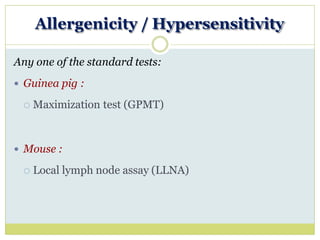
Any one of the standard tests:
 Guinea pig :
 Maximization test (GPMT)
 Mouse :
 Local lymph node assay (LLNA)
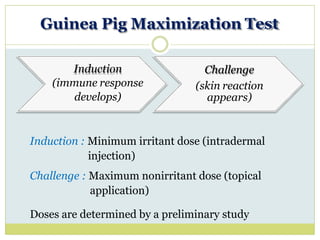
Guinea Pig Maximization Test
Challenge
(skin reaction
appears)
Induction : Minimum irritant dose (intradermal
injection)
Challenge : Maximum nonirritant dose (topical
application)
Doses are determined by a preliminary study
Induction
(immune response
develops)
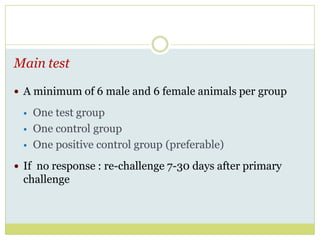
Main test
 A minimum of 6 male and 6 female animals per group
 One test group
 One control group
 One positive control group (preferable)
 If no response : re-challenge 7-30 days after primary
challenge
Induction (Day 0)
3 pairs of intradermal injections on either shoulders :
• 0.1 ml Freund’s adjuvant alone
• 0.1 ml test material (lowest irritant dose)
• 0.1 ml test material in Freund’s adjuvant
Day 7 : Topical patch at prepared shoulders (lowest irritant dose)
Challenge (Day 21)
Topical patch at prepared flanks (highest non-irritant dose)
• Left side: Test agent
• Right side: Vehicle
Evaluation [Edema and Erythema] after 48 hr.
Local Lymph Node Assay
 Mice of the same sex, either only males or only females
 Drug treatment given on ear skin
 3 graded doses (the highest being maximum nonirritant
dose) plus vehicle control
 A minimum of 6 mice per group
Test material applied on ear skin on 3 consecutive days
On day 5, i.v. 3H-thymidine / bromo-deoxy-uridine (BrdU)
Draining auricular lymph nodes dissected after 5 hrs
Evaluation : Increase in 3H-thymidine or BrdU
incorporation
Genotoxicity
 Genotoxic compounds are presumed to be trans-species
carcinogens, need not require long-term carcinogenicity
studies
 If intended for chronic administration, a chronic toxicity
study (up to one year) to detect early tumorigenic effects
ICH Standard Tests are generally conducted
• In vitro test for gene mutation in bacteria
• In vitro cytogenetic evaluation of chromosomal
damage :
• Mammalian cells or
• Mouse lymphoma tk assay
• In vivo test for chromosomal damage using rodent
hematopoietic cells
Ames’ Test
( Bacterial Reverse Mutation Assay )
 S. typhimurium tester strains TA98, TA100, TA102,
TA1535, TA97 or
 Escherichia coli WP2 uvrA or Escherichia coli WP2 uvrA
 In-vitro exposure at a minimum of 5 log dose levels
 “Solvent” and “positive control”
 2.5 fold (or more) increase in number of revertants in
comparison to spontaneous revertants are considered
positive
In-vitro cytogenetic assay
 Performed in CHO cells or on human lymphocyte in
culture
 In-vitro exposure using a minimum of 3 log doses
 “Solvent” and “positive control”
 [Positive control : Cyclophosphamide / Mitomycin C
gives a reproducible and detectable increase in
clastogenic effect]
 > 50% inhibition of cells is considered significant
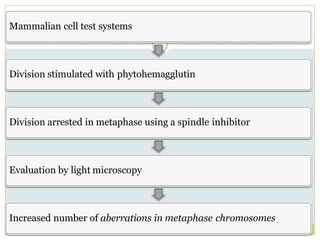
Mammalian cell test systems
Division stimulated with phytohemagglutin
Division arrested in metaphase using a spindle inhibitor
Evaluation by light microscopy
Increased number of aberrations in metaphase chromosomes
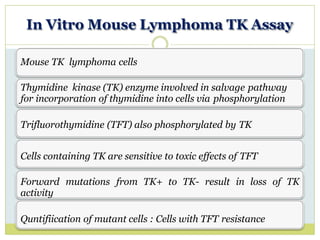
In Vitro Mouse Lymphoma TK Assay
Mouse TK lymphoma cells
Thymidine kinase (TK) enzyme involved in salvage pathway
for incorporation of thymidine into cells via phosphorylation
Trifluorothymidine (TFT) also phosphorylated by TK
Cells containing TK are sensitive to toxic effects of TFT
Forward mutations from TK+ to TK- result in loss of TK
activity
Quntifiication of mutant cells : Cells with TFT resistance
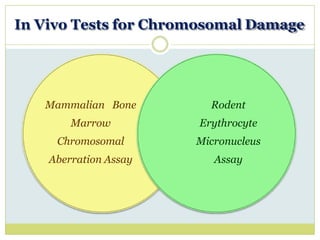
In Vivo Tests for Chromosomal Damage
Mammalian Bone
Marrow
Chromosomal
Aberration Assay
Rodent
Erythrocyte
Micronucleus
Assay
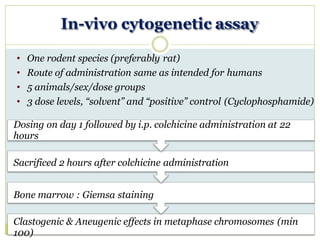
In-vivo cytogenetic assay
• One rodent species (preferably rat)
• Route of administration same as intended for humans
• 5 animals/sex/dose groups
• 3 dose levels, “solvent” and “positive” control (Cyclophosphamide)
Dosing on day 1 followed by i.p. colchicine administration at 22
hours
Sacrificed 2 hours after colchicine administration
Bone marrow : Giemsa staining
Clastogenic & Aneugenic effects in metaphase chromosomes (min
100)
In-vivo micronucleus assay
• 1 rodent species (preferably mouse) needed
• Route of administration of test substance same as humans
• 5 animals / sex / dose groups
• At least 3 dose levels, plus “solvent” and “positive” control
• Positive control : mitomycin C or cyclophosphamide
Dosing : day 1 and 2 of study
Sacrifice of animals 6 hours after the last injection
Bone marrow : Smeared with May Gruenwald / Giemsa stain
↑micronuclei in polychromatic erythrocytes [M-PCE] (min 1000)
Carcinogenicity
Carcinogenicity
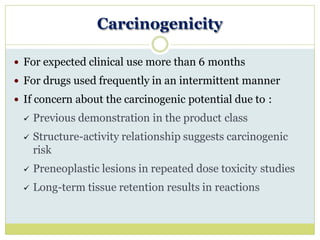
 For expected clinical use more than 6 months
 For drugs used frequently in an intermittent manner
 If concern about the carcinogenic potential due to :
 Previous demonstration in the product class
 Structure-activity relationship suggests carcinogenic
risk
 Preneoplastic lesions in repeated dose toxicity studies
 Long-term tissue retention results in reactions
Carcinogenicity
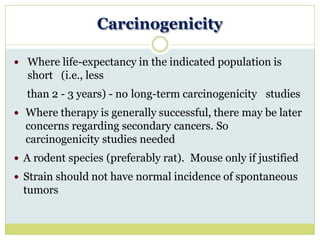
 Where life-expectancy in the indicated population is
short (i.e., less
than 2 - 3 years) - no long-term carcinogenicity studies
 Where therapy is generally successful, there may be later
concerns regarding secondary cancers. So
carcinogenicity studies needed
 A rodent species (preferably rat). Mouse only if justified
 Strain should not have normal incidence of spontaneous
tumors
Carcinogenicity
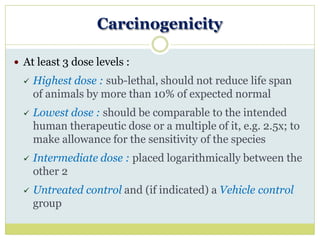
 At least 3 dose levels :
 Highest dose : sub-lethal, should not reduce life span
of animals by more than 10% of expected normal
 Lowest dose : should be comparable to the intended
human therapeutic dose or a multiple of it, e.g. 2.5x; to
make allowance for the sensitivity of the species
 Intermediate dose : placed logarithmically between the
other 2
 Untreated control and (if indicated) a Vehicle control
group
Carcinogenicity
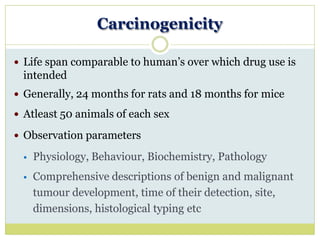
 Life span comparable to human’s over which drug use is
intended
 Generally, 24 months for rats and 18 months for mice
 Atleast 50 animals of each sex
 Observation parameters
 Physiology, Behaviour, Biochemistry, Pathology
 Comprehensive descriptions of benign and malignant
tumour development, time of their detection, site,
dimensions, histological typing etc
Carcinogenicity
Requirements of Clinical
Trials and Marketing
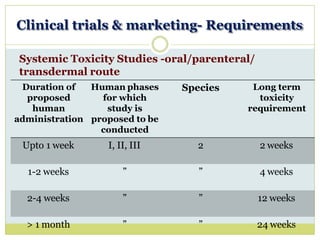
Clinical trials & marketing- Requirements
Systemic Toxicity Studies -oral/parenteral/
transdermal route
Duration of
proposed
human
administration
Human phases
for which
study is
proposed to be
conducted
Species Long term
toxicity
requirement
Upto 1 week I, II, III 2 2 weeks
1-2 weeks ” ” 4 weeks
2-4 weeks ” ” 12 weeks
> 1 month ” ” 24 weeks
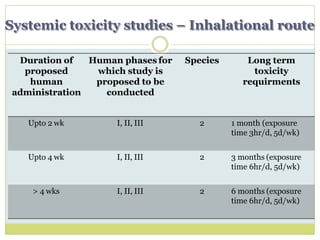
Systemic toxicity studies – Inhalational route
Duration of
proposed
human
administration
Human phases for
which study is
proposed to be
conducted
Species Long term
toxicity
requirments
Upto 2 wk I, II, III 2 1 month (exposure
time 3hr/d, 5d/wk)
Upto 4 wk I, II, III 2 3 months (exposure
time 6hr/d, 5d/wk)
> 4 wks I, II, III 2 6 months (exposure
time 6hr/d, 5d/wk)
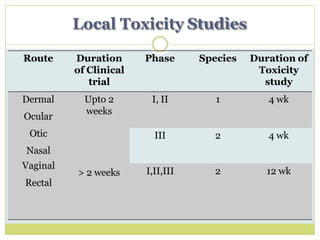
Local Toxicity Studies
Route Duration
of Clinical
trial
Phase Species Duration of
Toxicity
study
Dermal
Ocular
Upto 2
weeks
I, II 1 4 wk
Otic
Nasal
Vaginal
Rectal
> 2 weeks
III 2 4 wk
I,II,III 2 12 wk
REFRENCES
• Hughes, W. William. 2005. Essentials of environmental toxicology: The Effects of
Environmentally Hazardous Substances on Human Health. Taylor & Francis, 325
Chestnut St., Suite 800, Philadelphia, Pa 19106. pp. 71-78
• Shaw, I. and J. Chadwick. 2002. Principles of Environmental Toxicology. Taylor &
Francis Ltd, 1 Gunpowder Square, London EC4A 3DF.
• Yu, Ming-Ho. 2005. Environmental toxicology: biological and health effects of
pollutants. 2nd edition. CRC Press LLC, 2000 N.W. Corporate Blvd., Boca Raton,
Florida 33431

Toxicity studies

  • 1.
    COURSE TITLE ENVIRONMENTALTOXICOLOGY COURSE CODE ZOL- 610 CREDIT HOURS 3 (2-1) SEMESTER BS ZOOLOGY 8TH M-A, E-A, E-B DEPARTMENT OF ZOOLOGY
  • 2.
    COURSE CONTENTS ENVIRONMENTAL TOXICOLOGYZOL 610 3(2-1) Toxicology: History , Terms and definitions, principles of Toxicology, Development and present scope of environmental toxicology, Framework of environmental toxicology, toxicological evaluation, Sources of environmental toxicants, / Pollutants: Gaseous chemicals and heavy metals, toxicity testing, Characteristics of exposure, spectrum of Toxic effects, Indices of toxicity, toxico- dynamics, toxico-kinetics (absorption, distribution and elimination of toxic agents) Biotransformation, Detoxification and biodegradation. Pollution and remediation, ecological risk assessment
  • 3.
  • 4.
    Source, Synthesis & chemistry PreclinicalStudies & Toxicology Studies Animal models, Efficacy and Safety Clinical Trials Drug Development
  • 5.
    Preclinical Safety &Toxicity Testing  Aims at discovering complications or sequelae arising from the pharmacological actions of drug and any unexpected side-effects.
  • 6.
    Primary Goals Estimate safestarting dose for clinical studies & subsequent dose escalation schemes in humans. Identify potential target organs for toxicity and study whether such toxicity is reversible. Assess dose dependence & relationship to exposure Assess hazards that cannot be evaluated in clinical trials (e.g. carcinogenicity and teratogenicity) Identify hazards and estimate safe dose range
  • 7.
    Necessity of toxicitystudies  Completely novel compound of unique action under consideration  Any chemical modification made to a known drug  Formulations of a compound are considered ( Separately as well as formulated form)  Novel combination of drugs made available as a single formulation  Veterinary drugs → if treatment is given to animals intended for human food
  • 8.
    Requirements  Chemical Criteria Substance used in toxicity studies should be as pure as material to be given to man
  • 9.
    Materials: Animals  Species: Species difference → single largest difficulty in interpretation of toxicity studies  Species →health, behaviour, endemic disease and reaction to well studied toxic agent is familiar  Two different species(Rodent & Non Rodent) used  Should differ phylogenetically as widely as possible
  • 10.
    Materials: Animals  Species: Species in which test material is pharmacologically active due to presence of receptor should be used Ex. Avoid dogs for studying toxic effects of sulphonamides, monkeys are better  Strains:  Use either animals derived from random breeding in a closed colony or hybrids of two inbred lines
  • 11.
    Materials: Animals  Number,age and sex:  Should be sufficient  Long term experiments i.e. Carcinogen testing, large number may be necessary to detect relatively low incidence of the reactions  Young immature animals are preferred generally → rapid growth, but for detection of actions on endocrine and reproductive systems, sexually mature animals are required  Should include groups of both males and females
  • 12.
    Route / Frequencyof administration  Two routes to be used, one should be which is intended for clinical use  Aim should be to maintain the appropriate blood and tissue level of the compound under consideration for test duration
  • 13.
    Duration  Depends ontype of the test (acute, sub-acute, chronic)  All the important toxic effects of test substances can probably predicted from experiments lasting no more than three months  In the absence of any rational basis for choosing a period, a duration of twice the maximum exposure likely for the human beings is convenient guide. 2 yrs. max
  • 14.
    Toxicity Studies  SystemicToxicity studies  Reproductive toxicology studies  Local Toxicity studies  Allergenicity/ Hypersensetivity studies  Genotoxicity studies  Carcinogenicity studies
  • 15.
  • 16.
    Single dose (Acute) Short term repeated dose (Subacute) Repeateddose: 10% life-span (Subchronic) Repeated dose: >10% life span (Chronic) Systemic Toxicity Studies
  • 17.
    Single-dose (Acute) ToxicityStudies  Dose – toxicity relationship  Specific toxic effects  Mode of toxic action  Median Lethal dose (LD 50)  Route dependent toxicity  Sex dependent toxicity
  • 18.
    Single-dose (Acute) ToxicityStudies  Rodent species (mice and rats)  Use the same route as intended for humans  Use at least one more route in one of the species. This  Ensures systemic absorption of the drug (unless the intended route in humans is only intravenous)  Recommended limit for oral dosing : Higher value of either  2000 mg/kg or  10 times the normal dose that is intended in humans
  • 19.
    Single-dose (Acute) ToxicityStudies  At least 5 animals / sex / group  At least 4 graded doses (4 dose-groups)  Observation for toxic effects (if any) : 14 days  Obsevation for mortality :  7 days [parenteral administration]  14 days [oral administration]
  • 20.
     Reduction ofthe number of animals, use of single sex  Preliminary studies, followed by main test (Limit test) U F p i x a A e n c d d u d t d e o o s t w e o x n p i r c p o r c c o l e a c d s e s u d r ( u e G r ( e u G i ( d u G e i u l d i i n e d l e e i n l 4 i e n 2 4 e 3 2 ) 4 0 2 ) 5 ) ( E n ( d E p n o d i n p t o : i n E t v : i m m d eo n r t t a t o l i x t y i c ) i t y ) P 3 S i r a g e n h l i i t m i n i a g n l s a s r t o u y f d s o y t n u : e d 1 y s a e : n x 1 i / m a s n a t i l e m p e a l rpsteerpstep S I S n t a i t r i t a i l n d g o d s o e s : e e x :p j e u e x s c p t t e i b n c e t g i l n o m g w o s e r o t x m a p l e i t c y t t o e i x n d i c s L i o D t m y5e0 F D i o x a s e n e d i m s d t a e o l p s s e p s e d o f u 5 p ,/ 5 0 d , o 3 w 0 n 0 b a y n a d f 2 a 0 c t 0 o 0 ro m f g 3 / . k 2 g F C D i o x s e e t d i n s d t u e o e p s d e p s e t i d o l l f u o 5 p u ,t / 5 c 0 o d , m o 3 w e 0 n 0 r e t a i v l n e lr d e s n e 2 d d 0 - , 0 p i 0 o . e i . m n m t g a o / c k r h t g a i e l i v t e y d D o < s e = > s t e s u p r p v e i d v a u l p/ down till end point achieved Modifications (OECD guidelines: 420, 423, 425; yr 2000)
  • 21.
    Other parameters : Symptoms, signs and mode of death  LD 10 and LD 50 values, preferably with 95 % CI Genetic effects if any Establish the:  Minimum lethal dose (MLD)  Maximum tolerated dose (MTD)  Target organ of toxicity (if possible)
  • 22.
    Cytotoxic anticancer agents MTD determined first in Mice  Findings in Rat confirmed to establish a linear relationship between toxicity and body surface area  MTD can be established in non-rodent species, if:  Predictability is known to be poor in Rodents (e.g. Antifolates)  Drug has a novel mechanism of action
  • 23.
    Toxicokinetic studies Generation ofpharmacokinetic data (ADME): • A part of non-clinical toxicity studies or • A separate supportive study Purpose: • Assessment of systemic exposure of test substance • Relationship of toxicology to dose and time course • Choose species & regimen in subsequent toxicity studies • Designing of subsequent non-clinical toxicity studies
  • 24.
    Rodents • One rodentspecies (preferably rat) • At least 4 graded doses including control • Minimum of 5 animals of each sex • Proposed clinical route of administration • Test substance given daily for 10 consecutive days Dose-ranging study  Establishment of MTD for repeated dose studies  Identification of Target organ of toxicity Non-Rodents • One male and one female (Dogs > Primates) • Starting dose (3 or 5 x extrapolated effective dose) or MTD (whichever is less) • Dose escalation every 3rd day, lowered if toxicity seen • Then test substance given daily for 10 consecutive days
  • 25.
    Repeated-dose Toxicity Studies Duration depends on proposed clinical trial  At least 2 species, one non-rodent  Species-specific pharmacokinetics, if any, should preferably resemble human beings  Route intended for human clinical use
  • 26.
    Repeated-dose Toxicity Studies Wherever applicable, include a Control group  3 other groups are formed, as:  Highest dose  Lowest dose  Intermediate dose Observable toxicity [MTD] No observable toxicity [NOAEL] intended therapeutic dose or multiple of it Some symptoms ; not gross toxicity or death placed logarithmically betn doses
  • 27.
    • Rodent • Non-rodent :6-10/sex/group : 2-3/sex/group 14-28 Day repeated-dose (Subacute toxicity studies) • Rodent • Non-rodent : 15-30/sex/group : 4-6/sex/group 90-Day repeated-dose (Subchronic toxicity studies) • Rodent • Non-rodent : 15-30/sex/group : 4-6/sex/group 180-Day repeated-dose (9 months for non rodents?) (Chronic toxicity studies)
  • 28.
    In all cases: Behavioural : General appearance, activity, behaviour  Physiological : Body weight, food intake  Biochemical : Hematology, serum and urine analysis  Pathological : Organ weights, gross & microscopic study of viscera & tissues Parameters to be monitored  Injection site : Gross and Microscopic examination •In non-rodent species:  Electrocardiogram : Initial and Final  Fundus examination •If parenteral drug administration:
  • 29.
  • 30.
    Reproductive Toxicity  MaleFertility  Female Reproduction & Developmental toxicity  Female Fertility  Teratogenicity  Perinatal development
  • 31.
    Male Fertility Study One rodent species (preferably rat)  3 dose groups and a control group :  Dose selection : results of previous 14 or 28-day toxicity study  Highest dose : showing minimal toxicity in systemic studies  6 adult male animals per group
  • 32.
    Test substance byintended route of use for : • minimum 28 days • maximum 70 days Paired with female animals of proven fertility in a ratio of 1:2 Drug treatment of male animals continues during pairing Pairing continued till detection of Sperm in vagina or 10 days, whichever is earlier
  • 33.
    Pregnant females examinedafter day 13 of gestation Males sacrificed at the end of the study Weights of each testis and epididymis recorded Sperms from one epididymis examined for motility and morphology Other epididymis and both testes examined for histology
  • 34.
    Female Reproduction and DevelopmentalToxicity Studies  For all drugs proposed for women of child bearing age • Segment I : Female fertility • Segment II : Teratogenicity • Segment III : Perinatal development  Segment I, II and III studies in albino mice or rats, and  Segment II study also in albino rabbits as a second test species
  • 35.
    Female Fertility Study(Segment I)  One rodent species (rat preferred)  3 graded doses  Highest dose : doesn’t affect general health of parent animals (usually the MTD from previous systemic studies)  At least 15 males and 15 females per dose group  Route of administration same as intended for therapeutic use
  • 36.
    Pups : Physiology,Behaviour, Pathology (sex-wise distribution noted) Body weight Food intake Clinical signs of intoxication Reproduction and Parturition Pathology Gross & Micro Drug treatment continued during mating and gestation period Females allowed to litter, medication continued till weaning of pups Drug administration : 28 days (males) & 14 days (females) before mating
  • 37.
    Teratogenicity Study (SegmentII)  Rodent (preferably rat) and Non-rodent (rabbit)  Drug administered throughout organogenesis  3 dose levels and a Control group:  Highest dose : minimum maternal toxicity  Lowest dose : as proposed clinical dose or its multiple  Route of administration : same as intended for humans  At least 20 pregnant rats (or mice) and 12 rabbits, for each dose
  • 38.
    Observation parameters Females General Signs of intoxication Bodyweight Food intake Reproductive Uterus, Ovaries Products of conception Foetuses General Number Gender Length Weight Pathology Gross (all) Visceral (half) Skeletal (half)
  • 39.
    Perinatal Study (SegmentIII)  Specially if → Drug to pregnant / nursing mothers for long periods → Indications of possible adverse effects on foetus  One rodent species (preferably rat)  Dosing comparable to multiples of human dose and route  At least 4 groups (including control), 15 females / group  Drug throughout last trimester (from day 15 of gestation)  Dose causing low foetal loss continued throughout weaning
  • 40.
    F1 litter 1 maleand 1 female from each group Test substance given Throughout growth to sexual life Mating performance and fertility of F1 : F2 generation F2 generation growth parameters monitored till weaning
  • 41.
  • 42.
    Local Toxicity  DermalToxicity  Ocular Toxicity  Vaginal Toxicity  Rectal tolerance test  Parenteral Drugs Tolerance  Inhalation toxicity
  • 43.
    Local Toxicity  Ifintended for special route (other than oral) in humans  Appropriate site (e.g., skin or vaginal mucous membrane) in a suitable species  Preferably use of 2 species  3 dose levels and untreated and / or vehicle Control  If the drug is absorbed systemically, appropriate systemic toxicity studies also required
  • 44.
    Dermal Toxicity  Ascutaneous contamination is always a possibility  Rabbit and Rat  Applied on shaved skin  Concentrations 7 fold higher than the clinical doses  Period of application : 7 to 90 days  Evaluation › Local signs (erythema, oedema and eschar formation) › Histological examination of sites of application
  • 45.
    Ocular toxicity studies 2 species, including an albino rabbit with a large conjunctival sac  Initial single dose application: To decide exposure concentrations for repeated-dose studies Repeated dose study :  Duration subject to clinical use (Maximum of 90 days)  2 different concentrations exceeding human dose  In acute studies, one eye kept as control. A separate control group should be included in repeated-dose studies.
  • 46.
    Ocular toxicity studies Evaluation  Slit-lamp examination  To detect the changes in cornea, iris and aqueous humor.  Fluorescent dyes (sodium fluorescein, 0.25 to 1.0%)  To detect defects in surface epithelium  Intra-ocular tension monitored by a tonometer  Histological examination (fixation in Davidson’s or Zenker’s fluid)
  • 47.
    Vaginal Toxicity Test Rabbit or Dog  Topical application (vaginal mucosa) as pessary, cream or ointment  6-10 animals per dose group  Higher concentrations / several daily applications (in multiples of daily human dose)  7-30 days, as per clinical use  Observation parameters :  General : swelling, closure of introitus  Histopathology of vaginal wall
  • 48.
    Rectal Tolerance Test Preparations meant for rectal administration  In rabbits or dogs  6-10 animals per dose group  Volume comparable to human dose (or the maximum possible volume) to achieve administration of multiples of daily human dose  7-30 days, as per clinical use  Observation parameters  Clinical signs :- signs of pain, blood and/or mucus in faeces, condition of anal region/sphincter  Gross examination and (if required)  Histological examination of rectal mucosa
  • 49.
    Parenteral Drugs  Intravenous/intramuscular/ subcutaneous/ intradermal inj.  Injection sites in systemic toxicity studies examined grossly and microscopically  If needed, reversibility of adverse effects may be determined on a case to case basis
  • 50.
    Inhalation toxicity studies 1 rodent and 1 non-rodent species  Acute, subacute and chronic toxicity studies according to the intended duration of human exposure  Gases and vapors given in whole body exposure chambers; aerosols are given by nose-only method  Dose (limit dose of 5mg/l) in multiples of human exposure  Particle size of 4 micron (especially for aerosols) with not less that 25% being 1 micron
  • 51.
    Inhalation toxicity studies 3 dose groups and a control  Duration of exposure : maximum of 6 hr/day & 5 days/week Evaluation :  Respiratory rate, BALF examination, histological examination of respiratory passages and lung tissue  Regular parameters of systemic toxicity studies or assessment of margin of safety
  • 52.
  • 53.
    Allergenicity / Hypersensitivity Anyone of the standard tests:  Guinea pig :  Maximization test (GPMT)  Mouse :  Local lymph node assay (LLNA)
  • 54.
    Guinea Pig MaximizationTest Challenge (skin reaction appears) Induction : Minimum irritant dose (intradermal injection) Challenge : Maximum nonirritant dose (topical application) Doses are determined by a preliminary study Induction (immune response develops)
  • 55.
    Main test  Aminimum of 6 male and 6 female animals per group  One test group  One control group  One positive control group (preferable)  If no response : re-challenge 7-30 days after primary challenge
  • 56.
    Induction (Day 0) 3pairs of intradermal injections on either shoulders : • 0.1 ml Freund’s adjuvant alone • 0.1 ml test material (lowest irritant dose) • 0.1 ml test material in Freund’s adjuvant Day 7 : Topical patch at prepared shoulders (lowest irritant dose) Challenge (Day 21) Topical patch at prepared flanks (highest non-irritant dose) • Left side: Test agent • Right side: Vehicle Evaluation [Edema and Erythema] after 48 hr.
  • 57.
    Local Lymph NodeAssay  Mice of the same sex, either only males or only females  Drug treatment given on ear skin  3 graded doses (the highest being maximum nonirritant dose) plus vehicle control  A minimum of 6 mice per group Test material applied on ear skin on 3 consecutive days On day 5, i.v. 3H-thymidine / bromo-deoxy-uridine (BrdU) Draining auricular lymph nodes dissected after 5 hrs Evaluation : Increase in 3H-thymidine or BrdU incorporation
  • 58.
  • 59.
     Genotoxic compoundsare presumed to be trans-species carcinogens, need not require long-term carcinogenicity studies  If intended for chronic administration, a chronic toxicity study (up to one year) to detect early tumorigenic effects ICH Standard Tests are generally conducted • In vitro test for gene mutation in bacteria • In vitro cytogenetic evaluation of chromosomal damage : • Mammalian cells or • Mouse lymphoma tk assay • In vivo test for chromosomal damage using rodent hematopoietic cells
  • 60.
    Ames’ Test ( BacterialReverse Mutation Assay )  S. typhimurium tester strains TA98, TA100, TA102, TA1535, TA97 or  Escherichia coli WP2 uvrA or Escherichia coli WP2 uvrA  In-vitro exposure at a minimum of 5 log dose levels  “Solvent” and “positive control”  2.5 fold (or more) increase in number of revertants in comparison to spontaneous revertants are considered positive
  • 61.
    In-vitro cytogenetic assay Performed in CHO cells or on human lymphocyte in culture  In-vitro exposure using a minimum of 3 log doses  “Solvent” and “positive control”  [Positive control : Cyclophosphamide / Mitomycin C gives a reproducible and detectable increase in clastogenic effect]  > 50% inhibition of cells is considered significant
  • 62.
    Mammalian cell testsystems Division stimulated with phytohemagglutin Division arrested in metaphase using a spindle inhibitor Evaluation by light microscopy Increased number of aberrations in metaphase chromosomes
  • 63.
    In Vitro MouseLymphoma TK Assay Mouse TK lymphoma cells Thymidine kinase (TK) enzyme involved in salvage pathway for incorporation of thymidine into cells via phosphorylation Trifluorothymidine (TFT) also phosphorylated by TK Cells containing TK are sensitive to toxic effects of TFT Forward mutations from TK+ to TK- result in loss of TK activity Quntifiication of mutant cells : Cells with TFT resistance
  • 64.
    In Vivo Testsfor Chromosomal Damage Mammalian Bone Marrow Chromosomal Aberration Assay Rodent Erythrocyte Micronucleus Assay
  • 65.
    In-vivo cytogenetic assay •One rodent species (preferably rat) • Route of administration same as intended for humans • 5 animals/sex/dose groups • 3 dose levels, “solvent” and “positive” control (Cyclophosphamide) Dosing on day 1 followed by i.p. colchicine administration at 22 hours Sacrificed 2 hours after colchicine administration Bone marrow : Giemsa staining Clastogenic & Aneugenic effects in metaphase chromosomes (min 100)
  • 66.
    In-vivo micronucleus assay •1 rodent species (preferably mouse) needed • Route of administration of test substance same as humans • 5 animals / sex / dose groups • At least 3 dose levels, plus “solvent” and “positive” control • Positive control : mitomycin C or cyclophosphamide Dosing : day 1 and 2 of study Sacrifice of animals 6 hours after the last injection Bone marrow : Smeared with May Gruenwald / Giemsa stain ↑micronuclei in polychromatic erythrocytes [M-PCE] (min 1000)
  • 67.
  • 68.
    Carcinogenicity  For expectedclinical use more than 6 months  For drugs used frequently in an intermittent manner  If concern about the carcinogenic potential due to :  Previous demonstration in the product class  Structure-activity relationship suggests carcinogenic risk  Preneoplastic lesions in repeated dose toxicity studies  Long-term tissue retention results in reactions
  • 69.
    Carcinogenicity  Where life-expectancyin the indicated population is short (i.e., less than 2 - 3 years) - no long-term carcinogenicity studies  Where therapy is generally successful, there may be later concerns regarding secondary cancers. So carcinogenicity studies needed  A rodent species (preferably rat). Mouse only if justified  Strain should not have normal incidence of spontaneous tumors
  • 70.
    Carcinogenicity  At least3 dose levels :  Highest dose : sub-lethal, should not reduce life span of animals by more than 10% of expected normal  Lowest dose : should be comparable to the intended human therapeutic dose or a multiple of it, e.g. 2.5x; to make allowance for the sensitivity of the species  Intermediate dose : placed logarithmically between the other 2  Untreated control and (if indicated) a Vehicle control group
  • 71.
    Carcinogenicity  Life spancomparable to human’s over which drug use is intended  Generally, 24 months for rats and 18 months for mice  Atleast 50 animals of each sex  Observation parameters  Physiology, Behaviour, Biochemistry, Pathology  Comprehensive descriptions of benign and malignant tumour development, time of their detection, site, dimensions, histological typing etc
  • 72.
  • 73.
  • 74.
    Clinical trials &marketing- Requirements Systemic Toxicity Studies -oral/parenteral/ transdermal route Duration of proposed human administration Human phases for which study is proposed to be conducted Species Long term toxicity requirement Upto 1 week I, II, III 2 2 weeks 1-2 weeks ” ” 4 weeks 2-4 weeks ” ” 12 weeks > 1 month ” ” 24 weeks
  • 75.
    Systemic toxicity studies– Inhalational route Duration of proposed human administration Human phases for which study is proposed to be conducted Species Long term toxicity requirments Upto 2 wk I, II, III 2 1 month (exposure time 3hr/d, 5d/wk) Upto 4 wk I, II, III 2 3 months (exposure time 6hr/d, 5d/wk) > 4 wks I, II, III 2 6 months (exposure time 6hr/d, 5d/wk)
  • 76.
    Local Toxicity Studies RouteDuration of Clinical trial Phase Species Duration of Toxicity study Dermal Ocular Upto 2 weeks I, II 1 4 wk Otic Nasal Vaginal Rectal > 2 weeks III 2 4 wk I,II,III 2 12 wk
  • 77.
    REFRENCES • Hughes, W.William. 2005. Essentials of environmental toxicology: The Effects of Environmentally Hazardous Substances on Human Health. Taylor & Francis, 325 Chestnut St., Suite 800, Philadelphia, Pa 19106. pp. 71-78 • Shaw, I. and J. Chadwick. 2002. Principles of Environmental Toxicology. Taylor & Francis Ltd, 1 Gunpowder Square, London EC4A 3DF. • Yu, Ming-Ho. 2005. Environmental toxicology: biological and health effects of pollutants. 2nd edition. CRC Press LLC, 2000 N.W. Corporate Blvd., Boca Raton, Florida 33431