Module 1
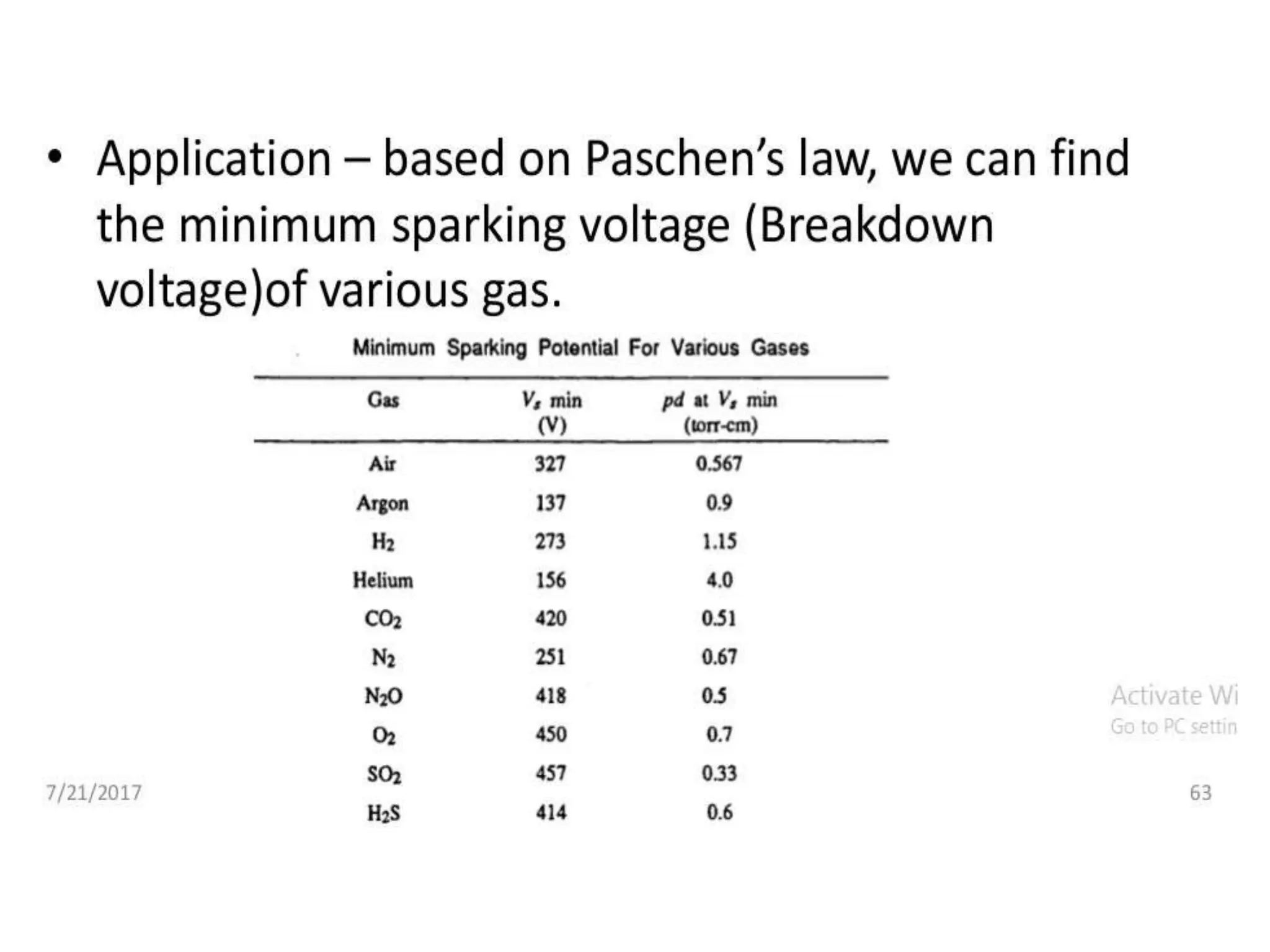
• Conduction and Breakdown in Gases: Gases as Insulating
Media, Collision Process, Ionization Processes, Townsend's
Current Growth Equation, Current Growth in the Presence of
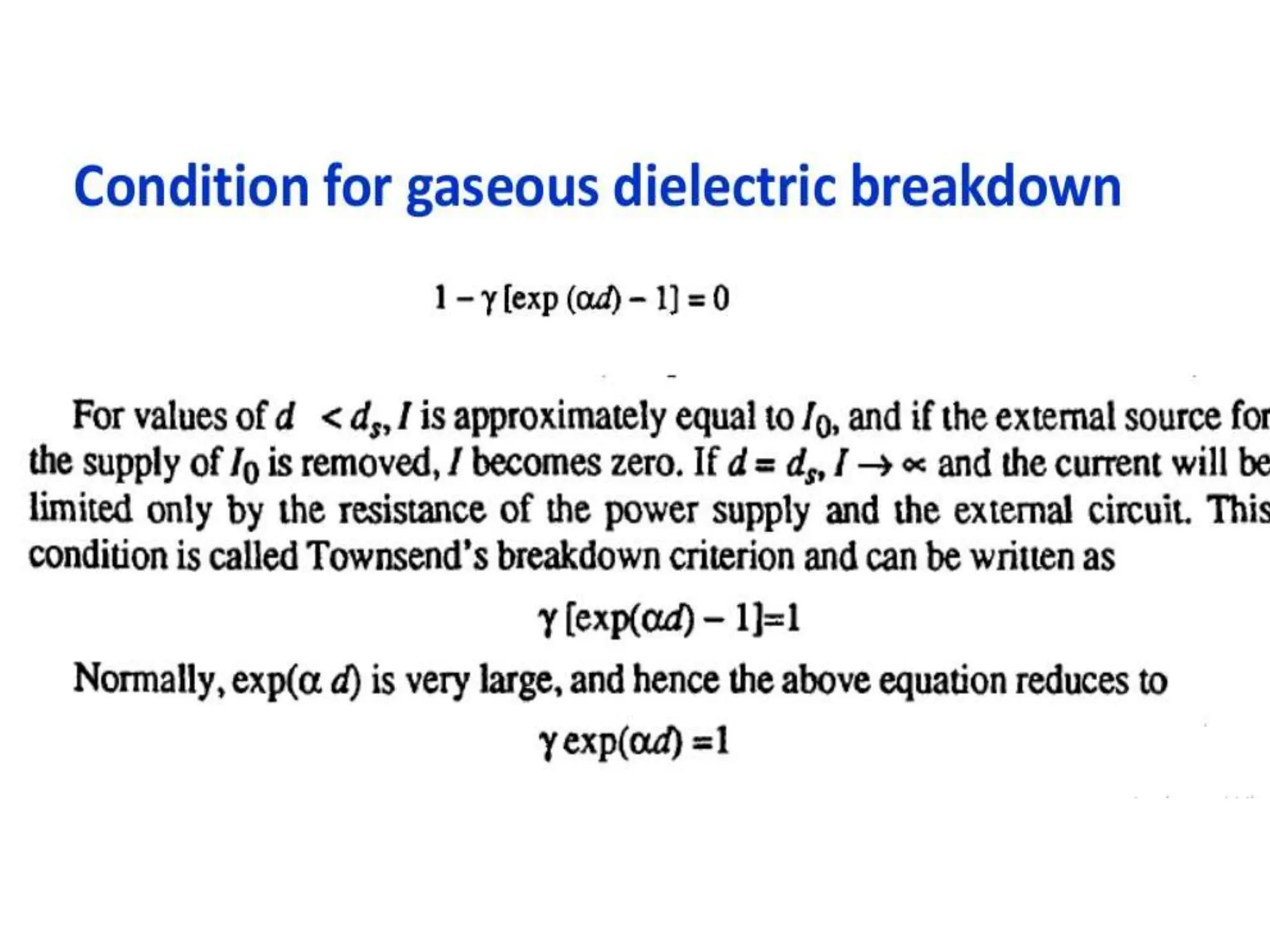
Secondary Processes, Townsend's Criterion for Breakdown,
Experimental Determination of Coefficients α and γ,
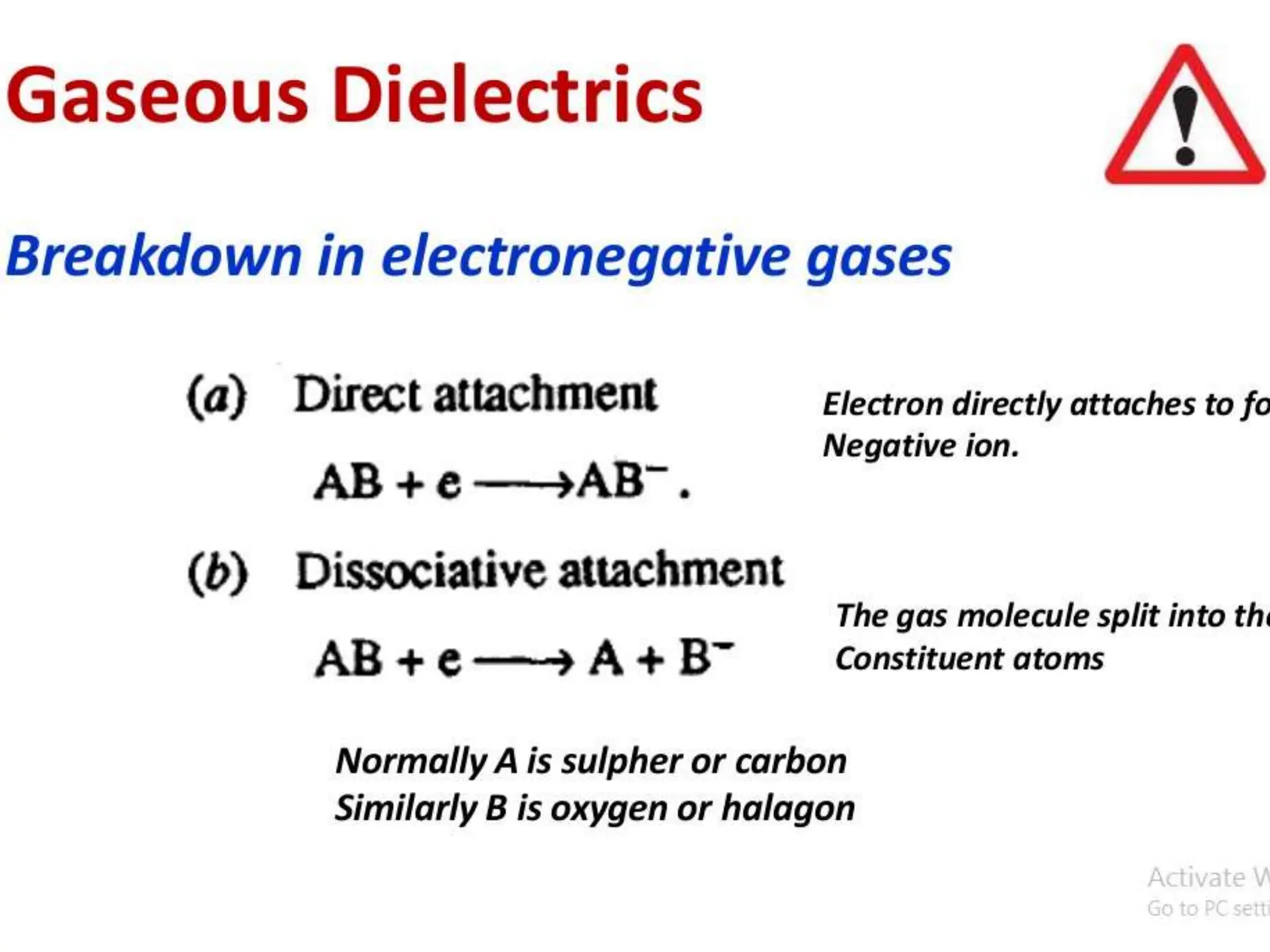
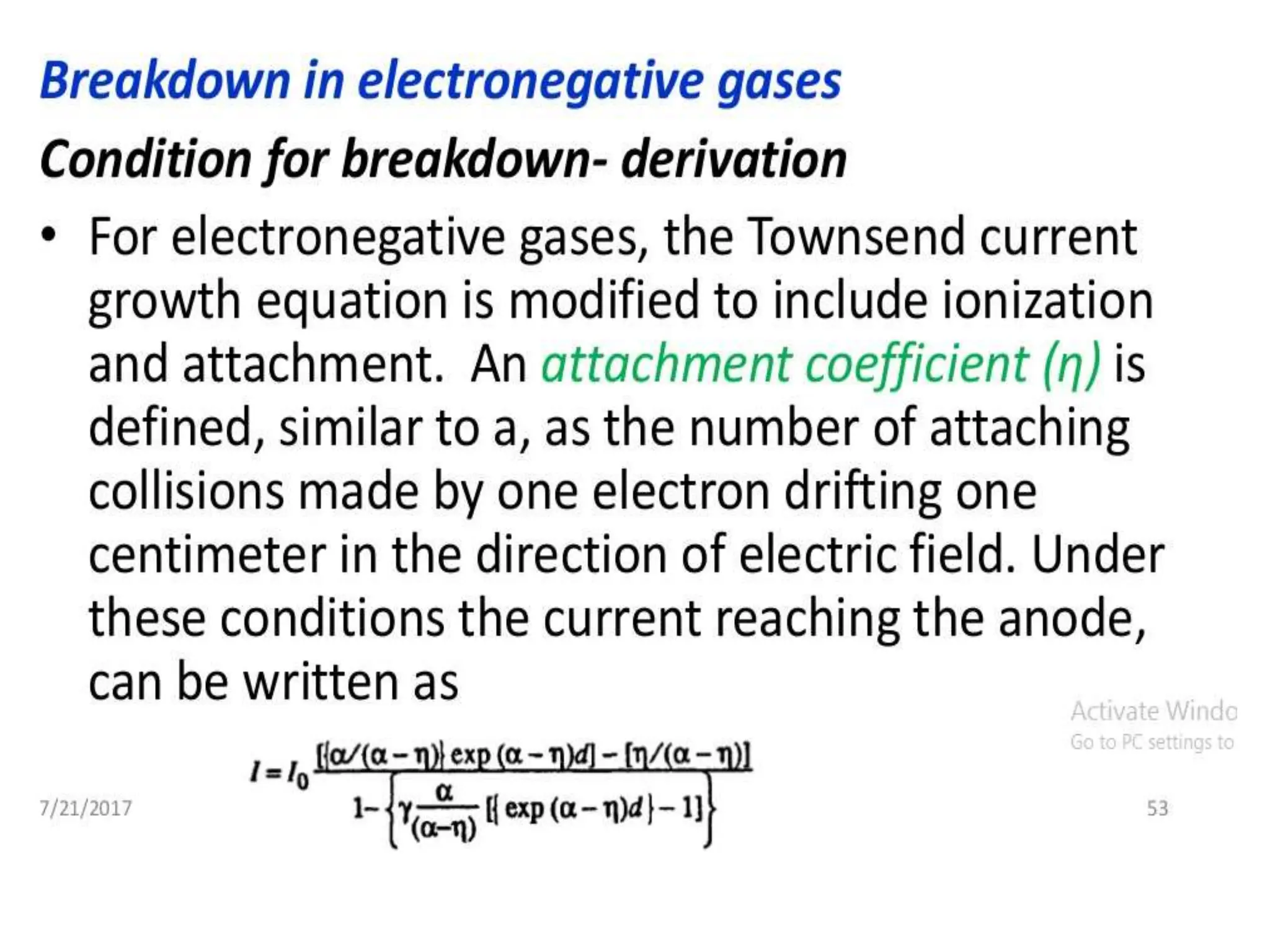
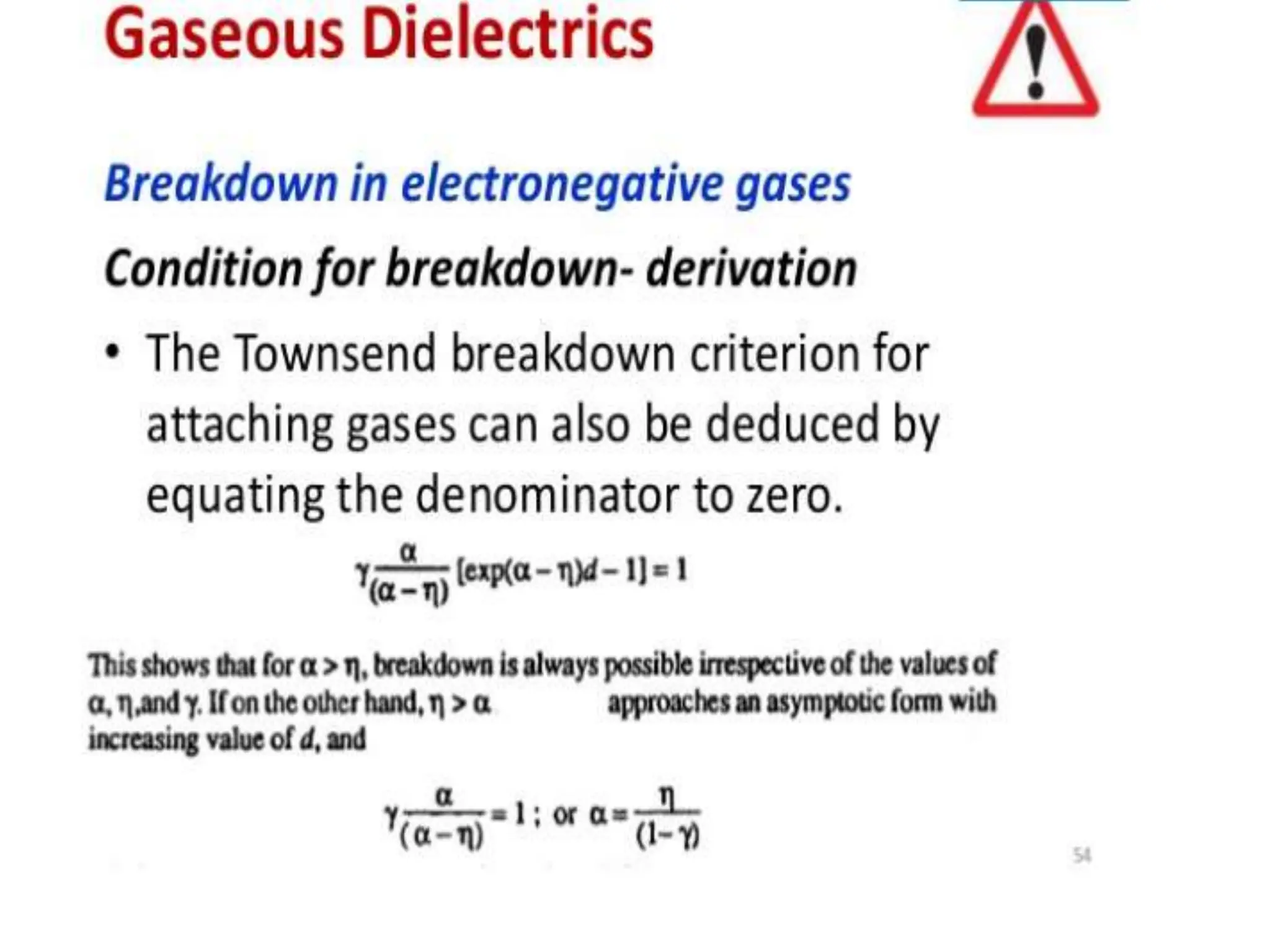
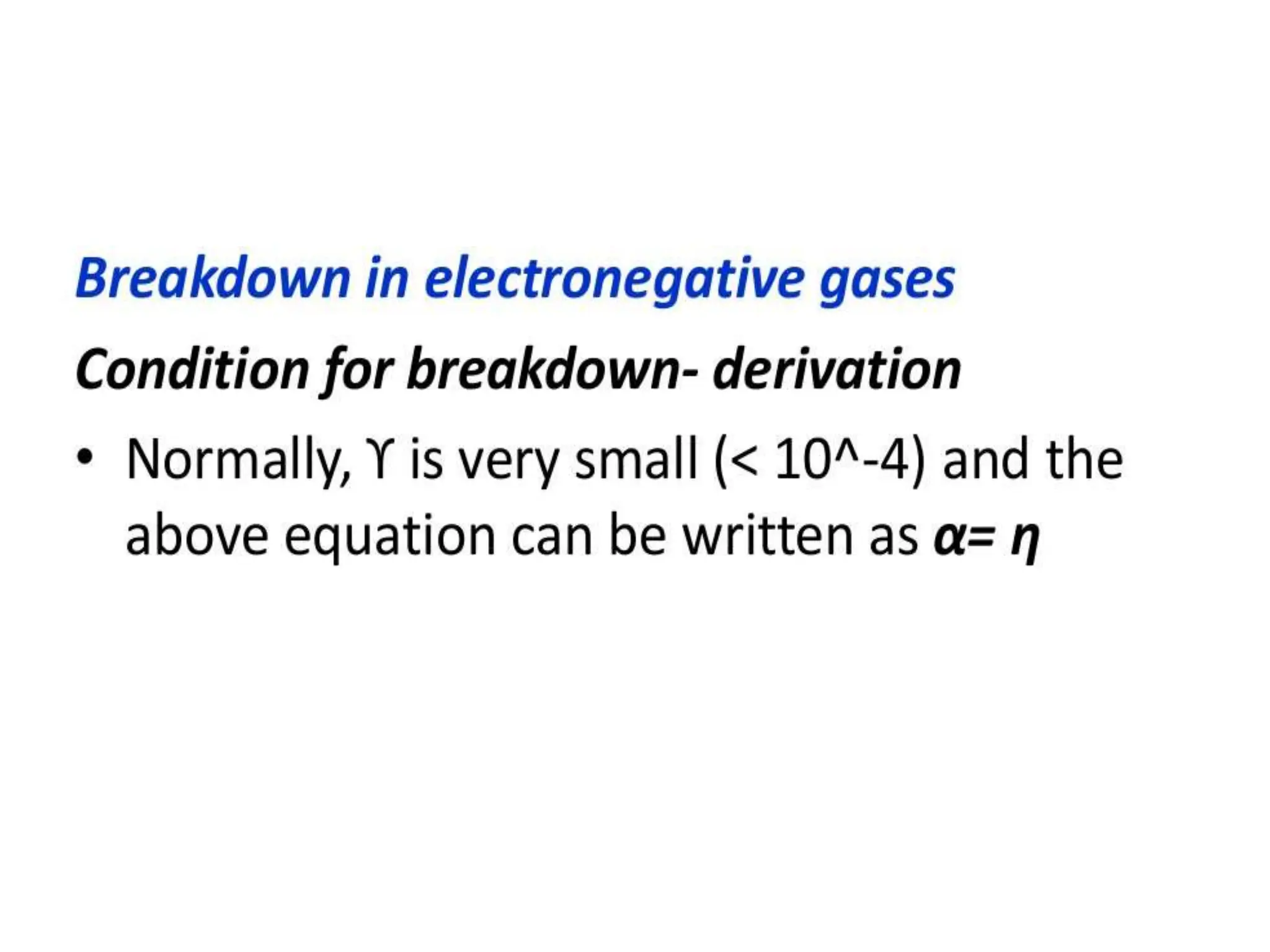
Breakdown in Electronegative Gases, Time Lags for
Breakdown, Streamer Theory of Breakdown in Gases,
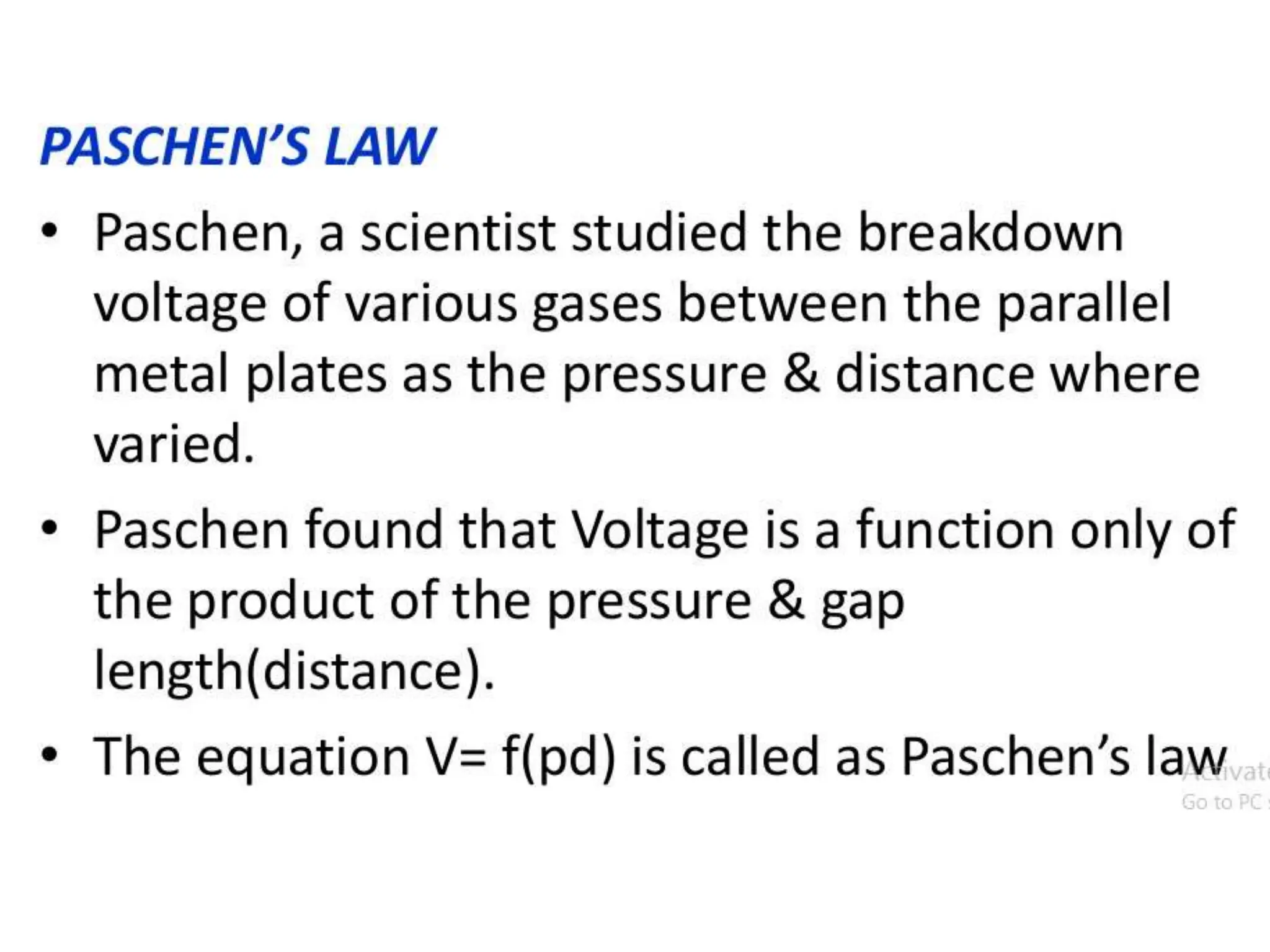
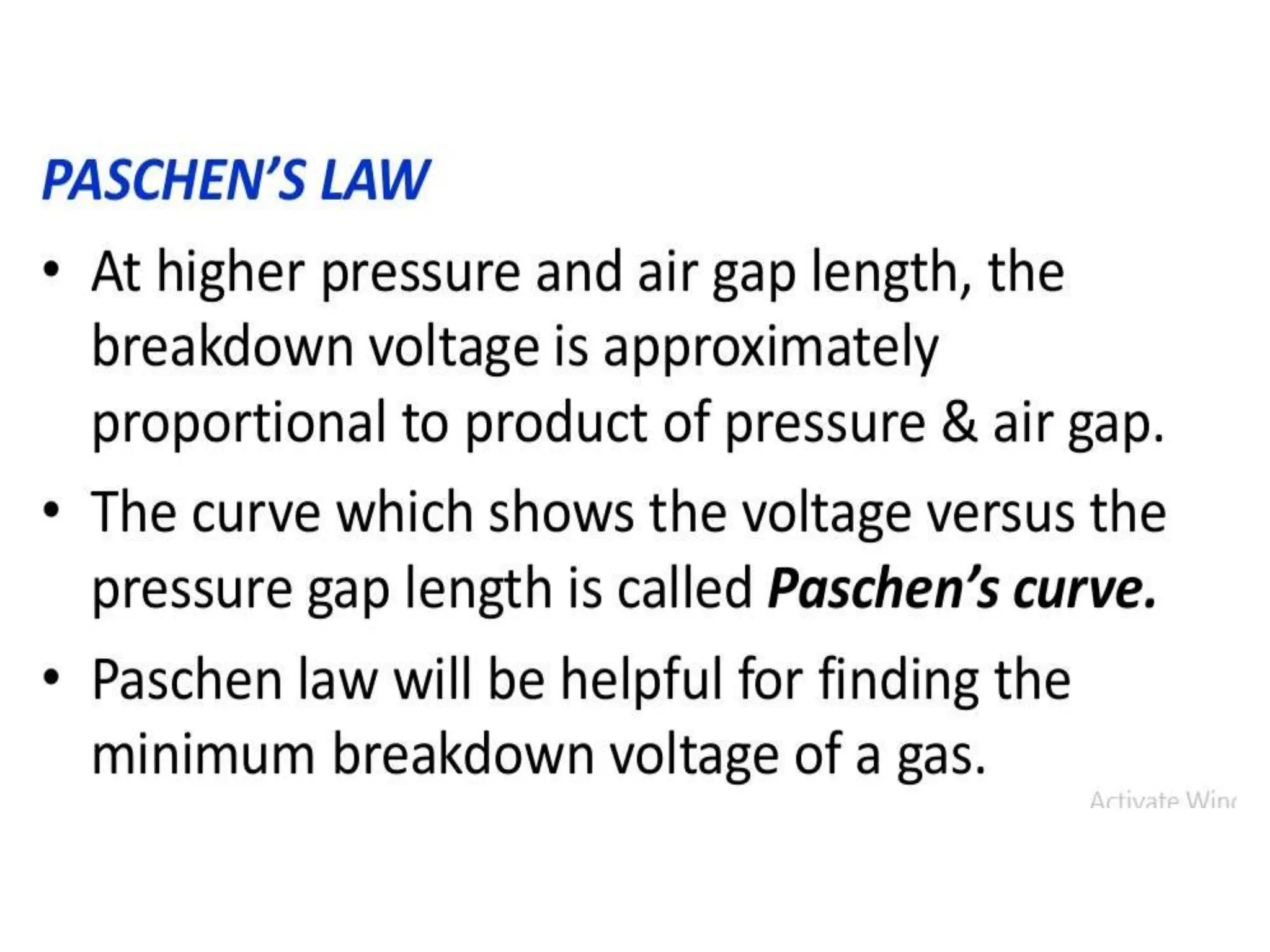
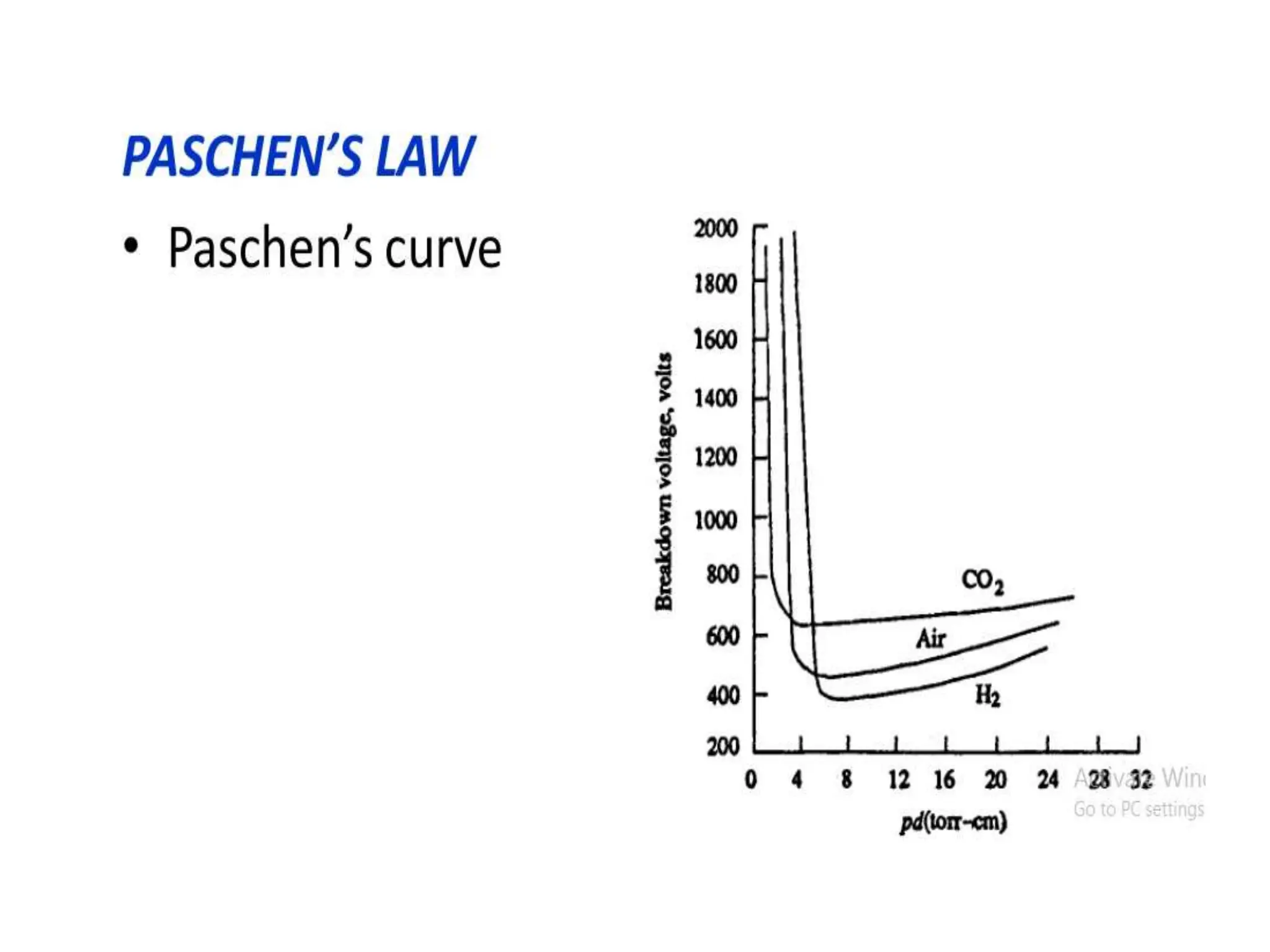
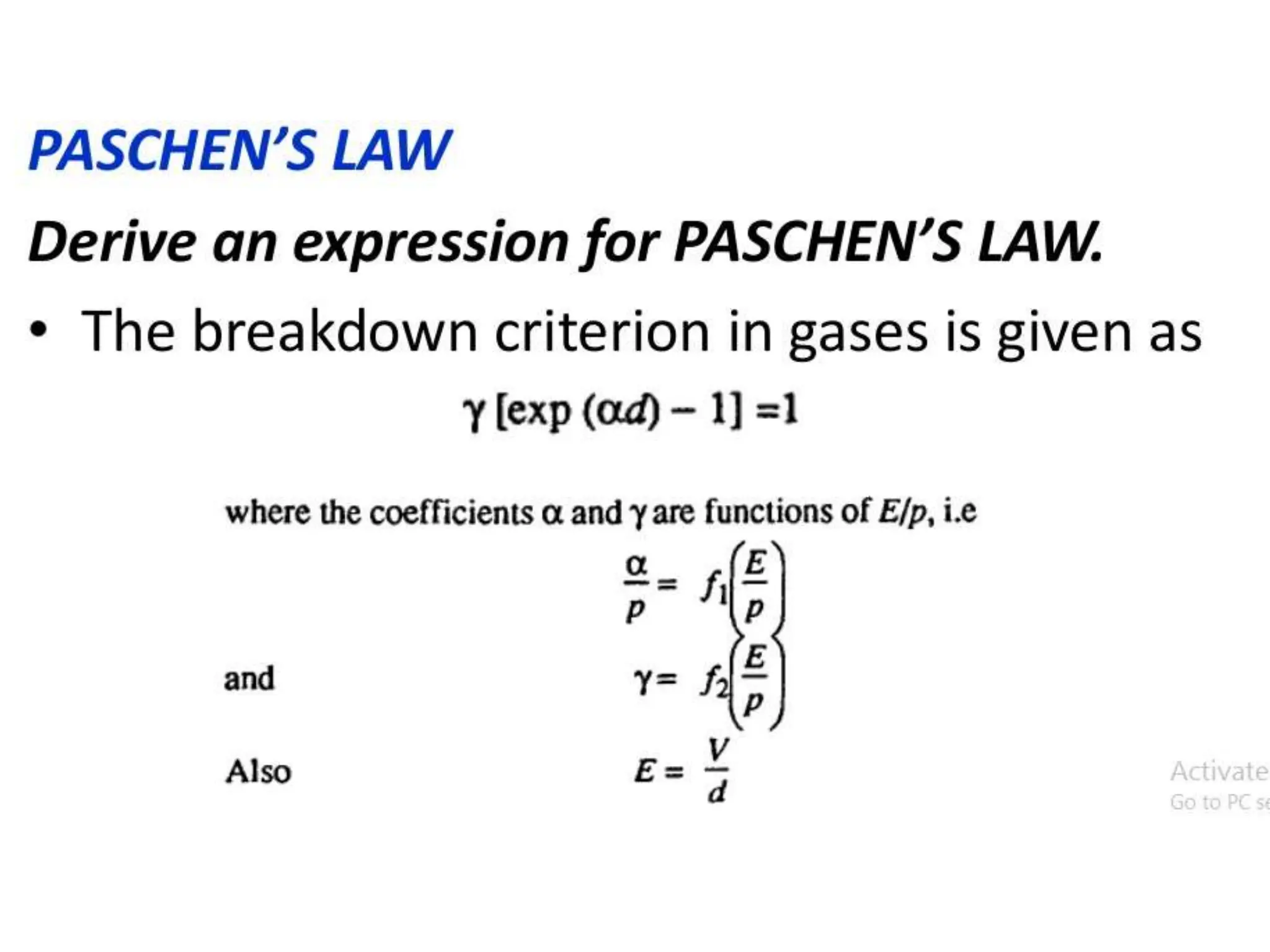
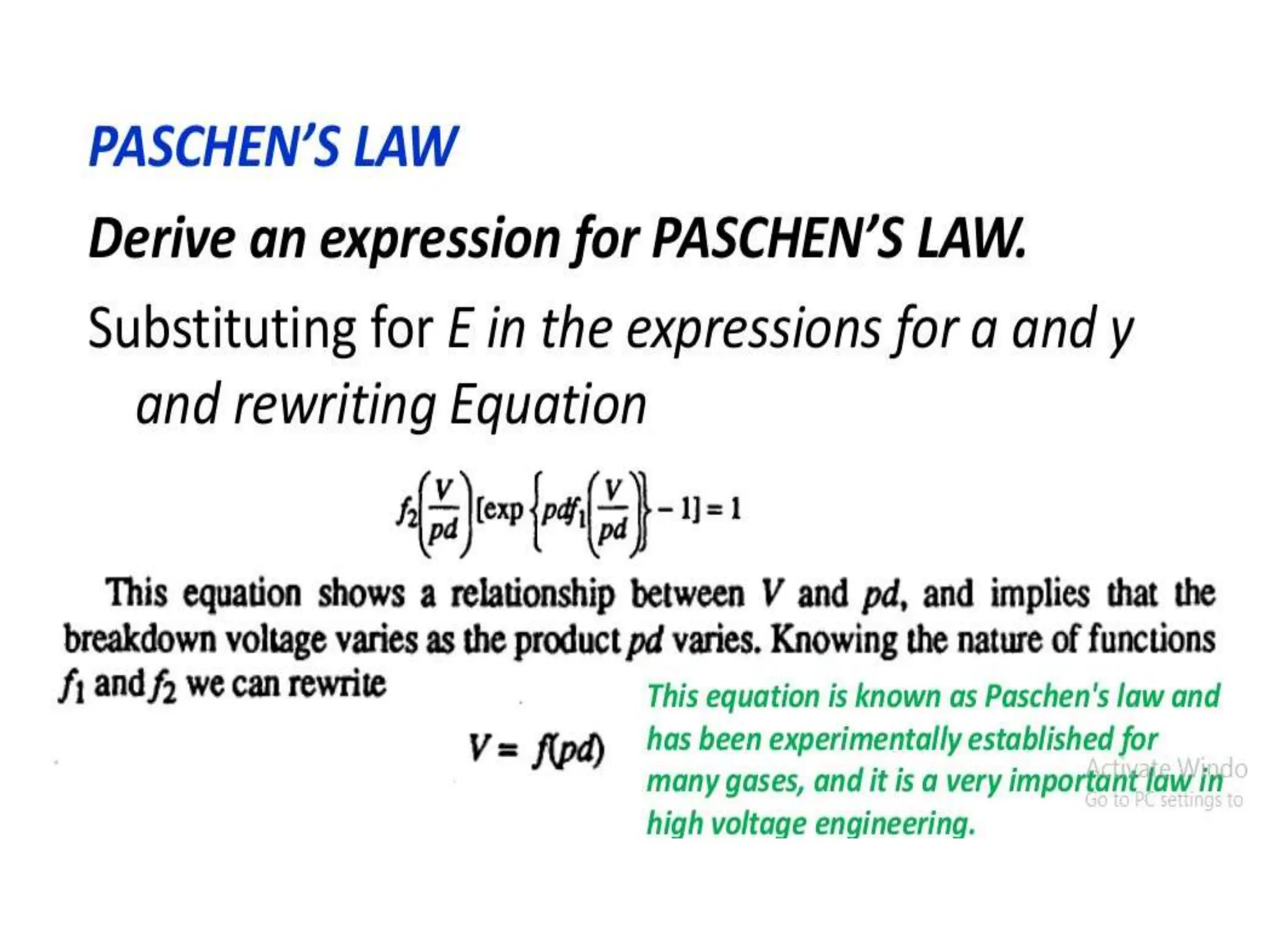
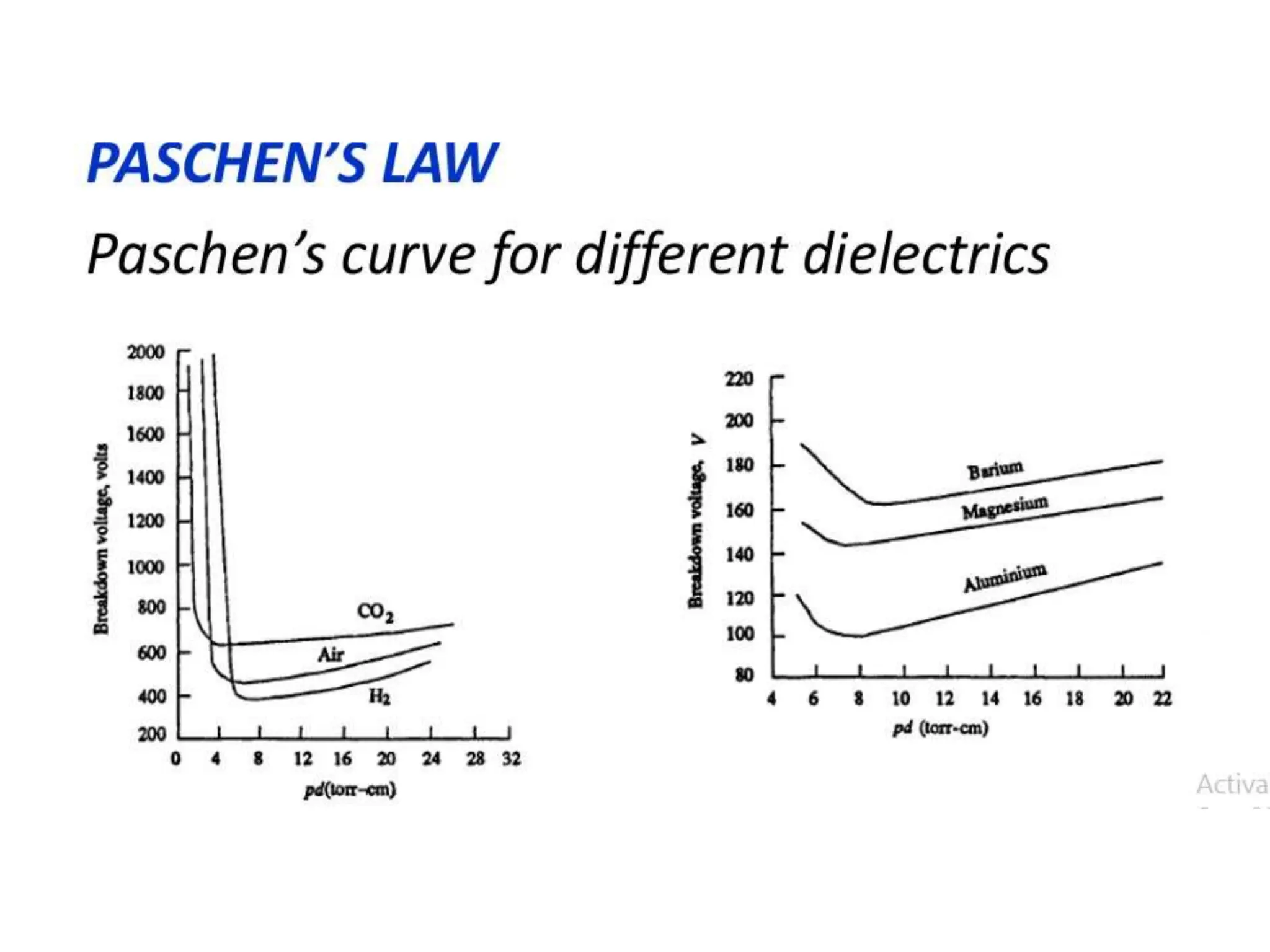
Paschen's Law, Breakdown in Non-Uniform Fields and Corona
Discharges.
• Conduction and Breakdown in Liquid Dielectrics: Liquids as
Insulators, Pure Liquids and Commercial Liquids, Conduction
and Breakdown in Pure Liquids, Conduction and Breakdown
in Commercial Liquids.
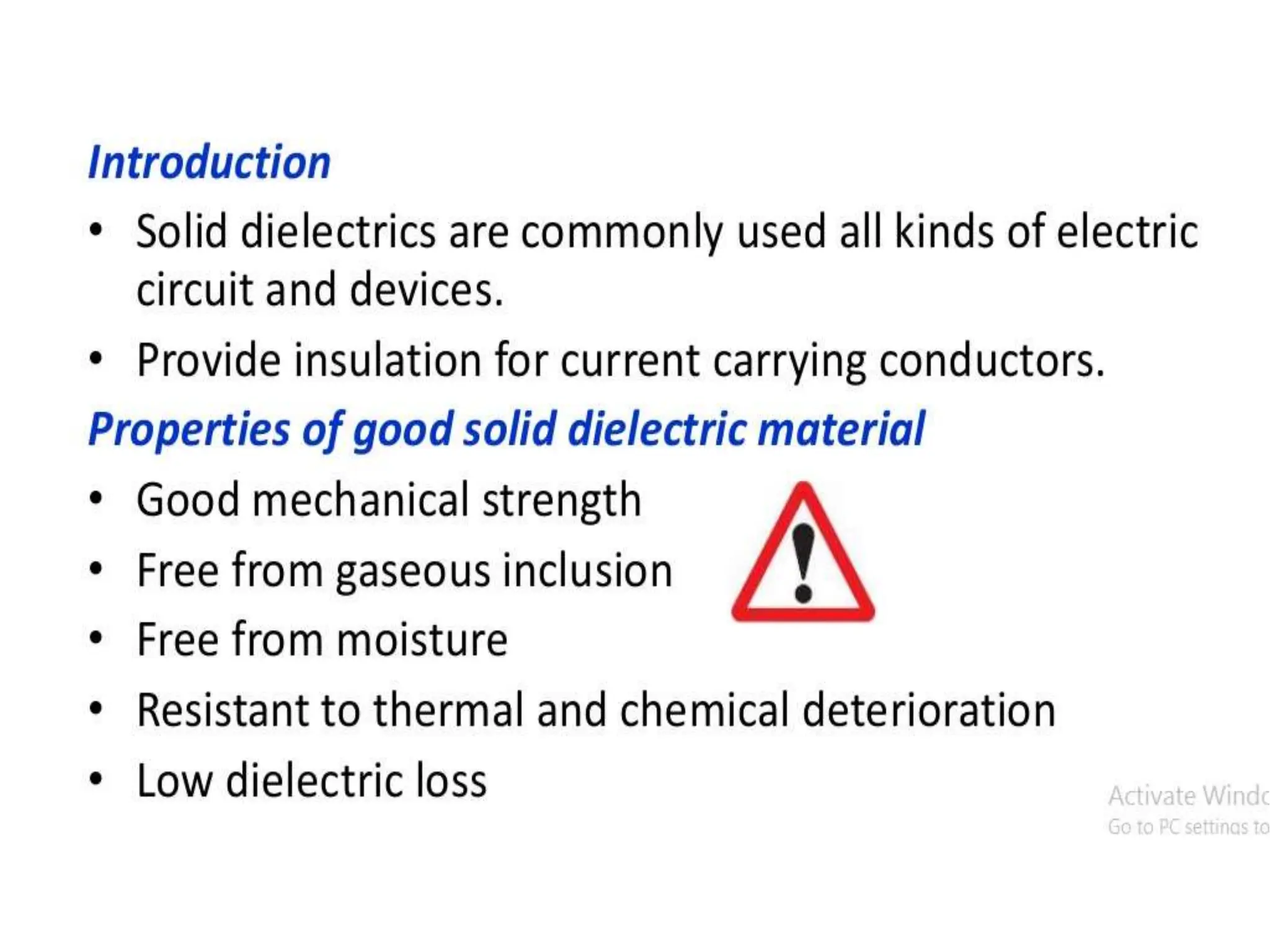
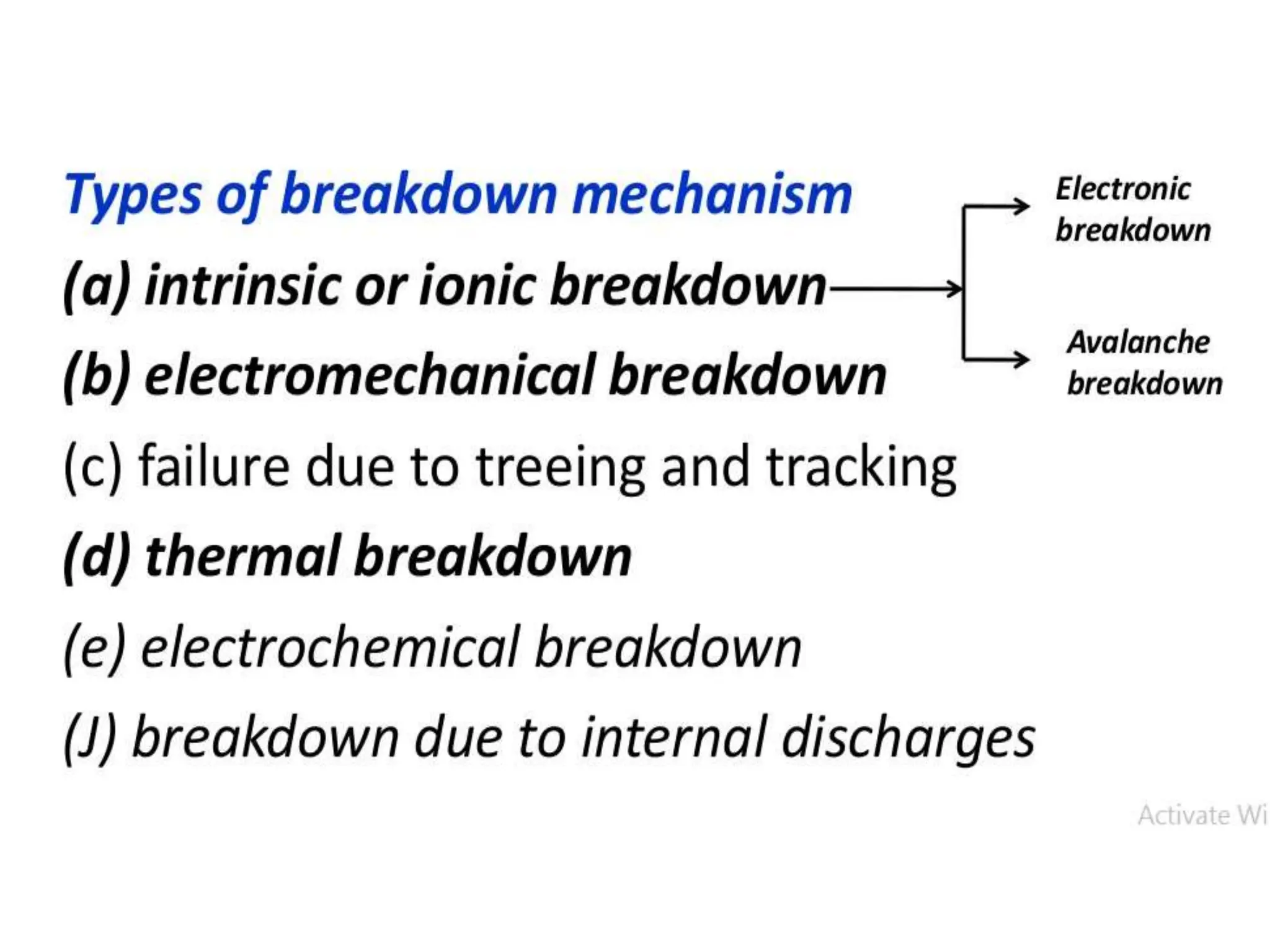
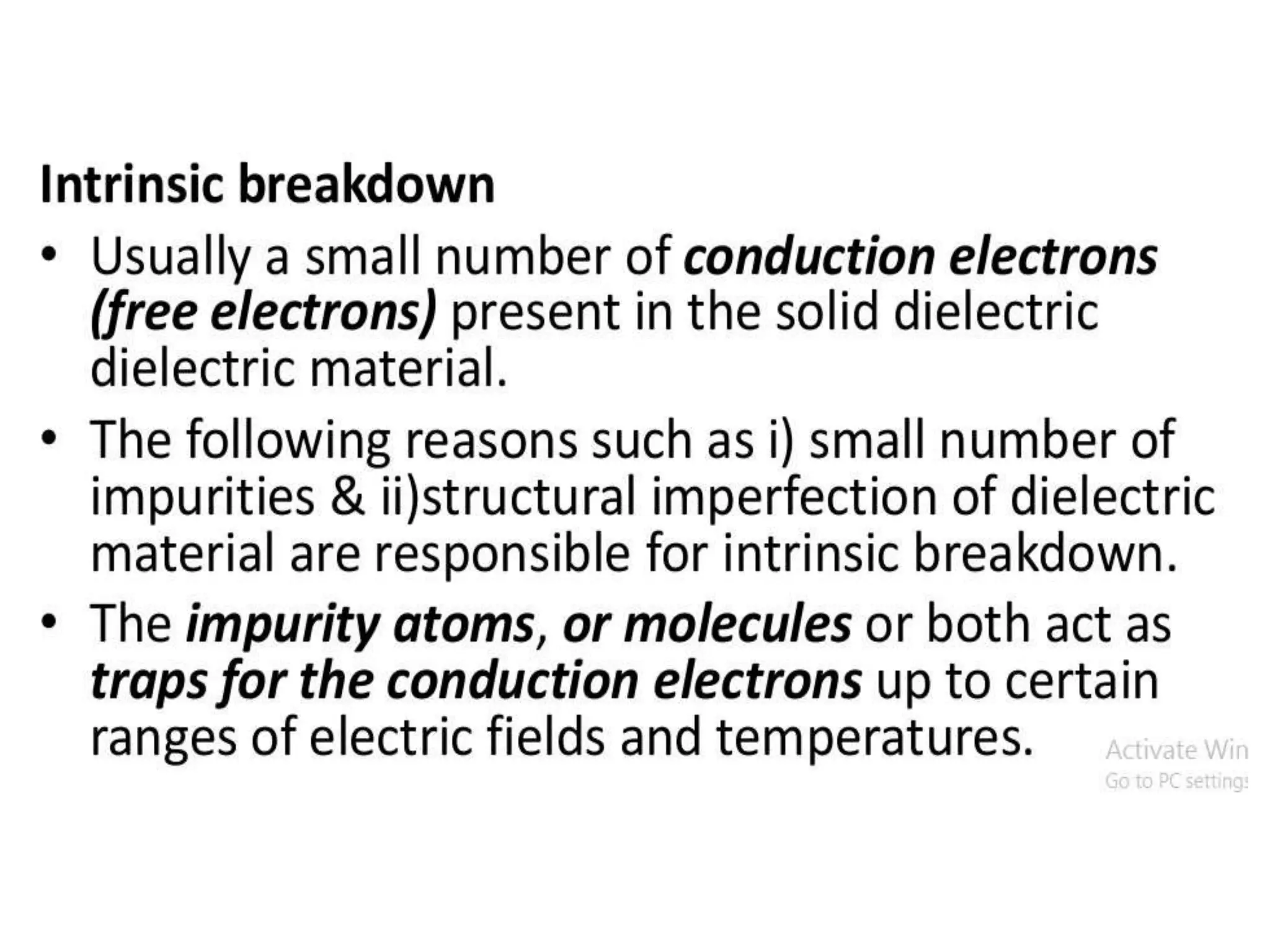
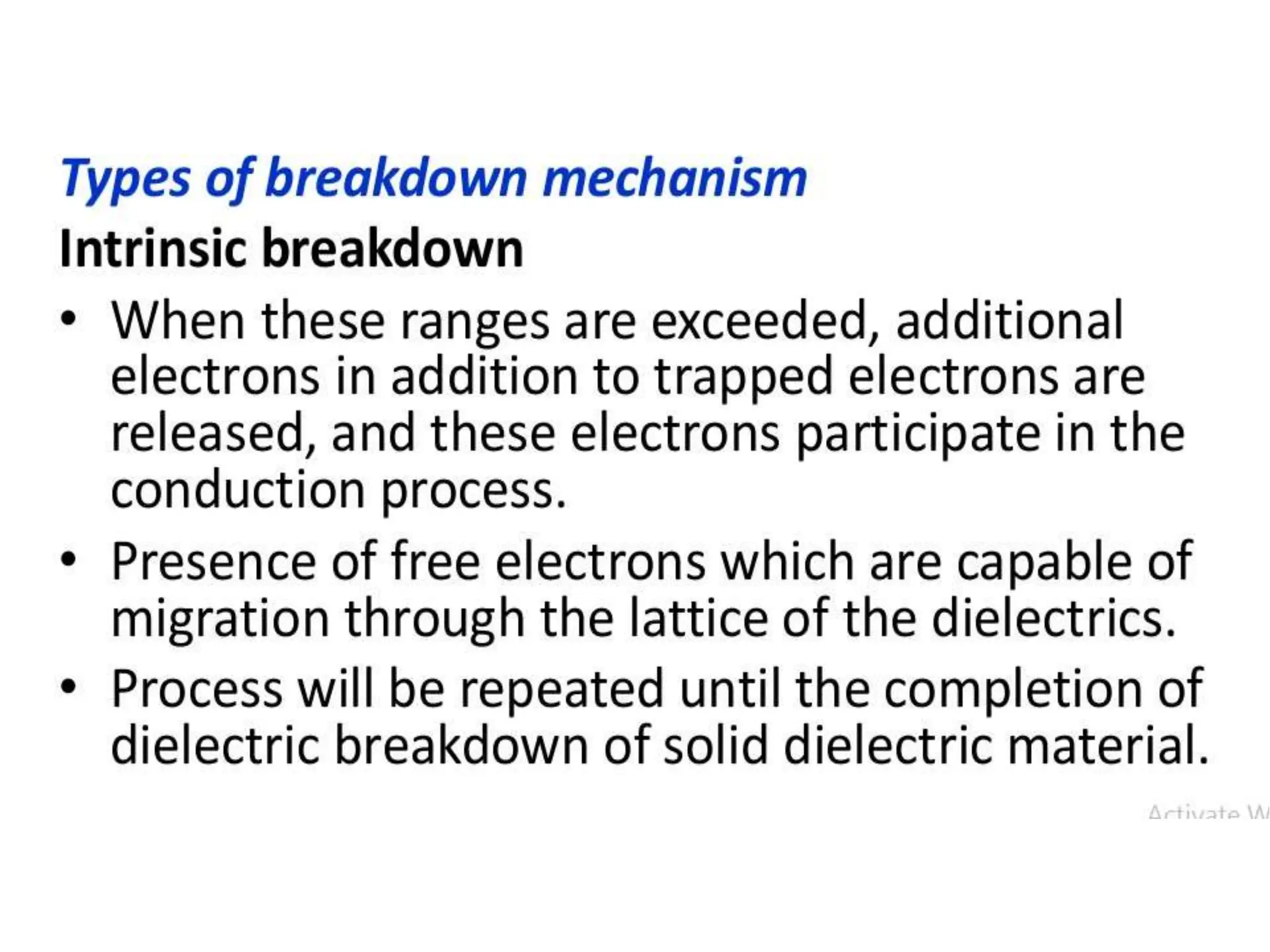
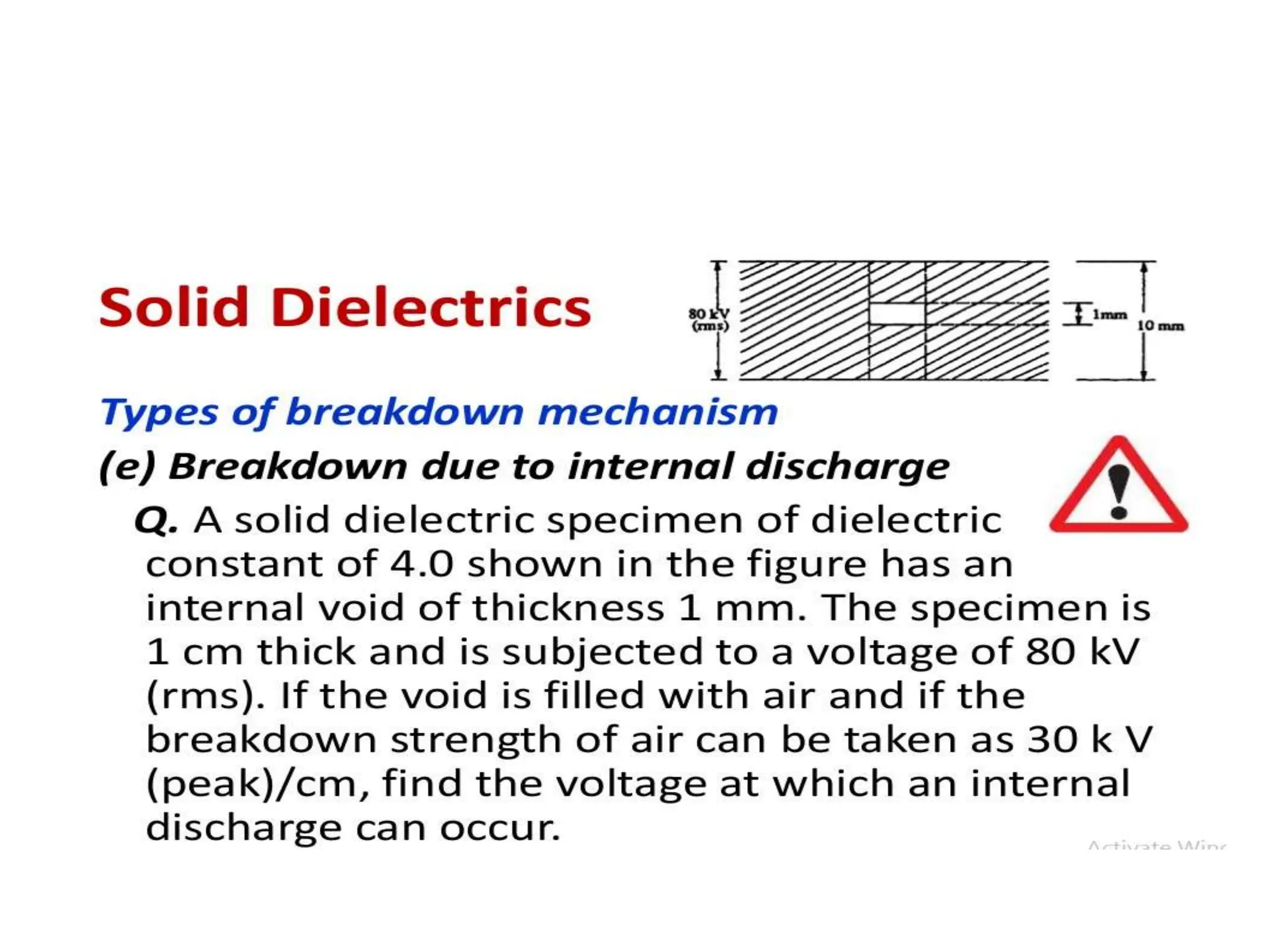
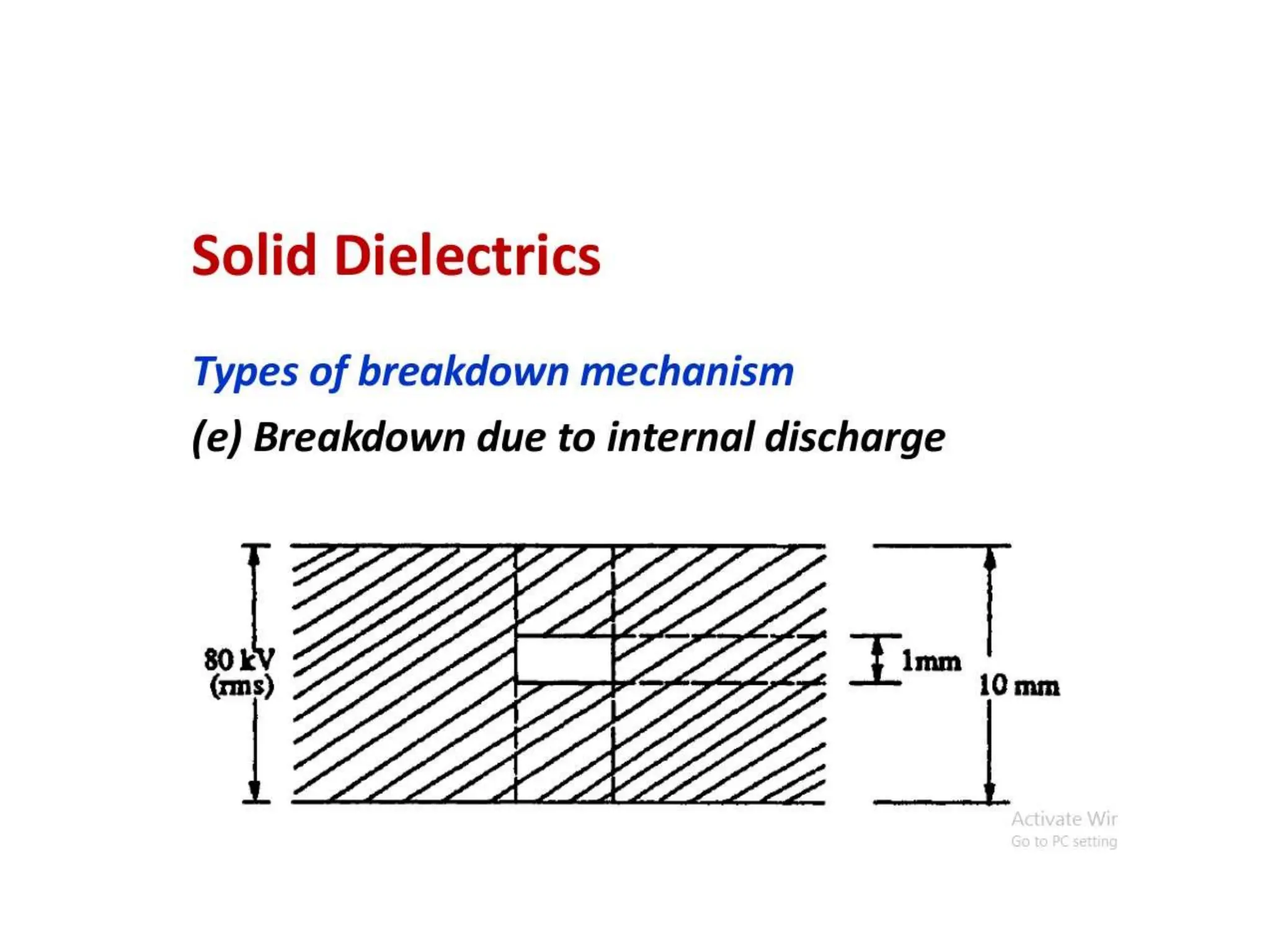
• Breakdown in Solid Dielectrics: Introduction, Intrinsic
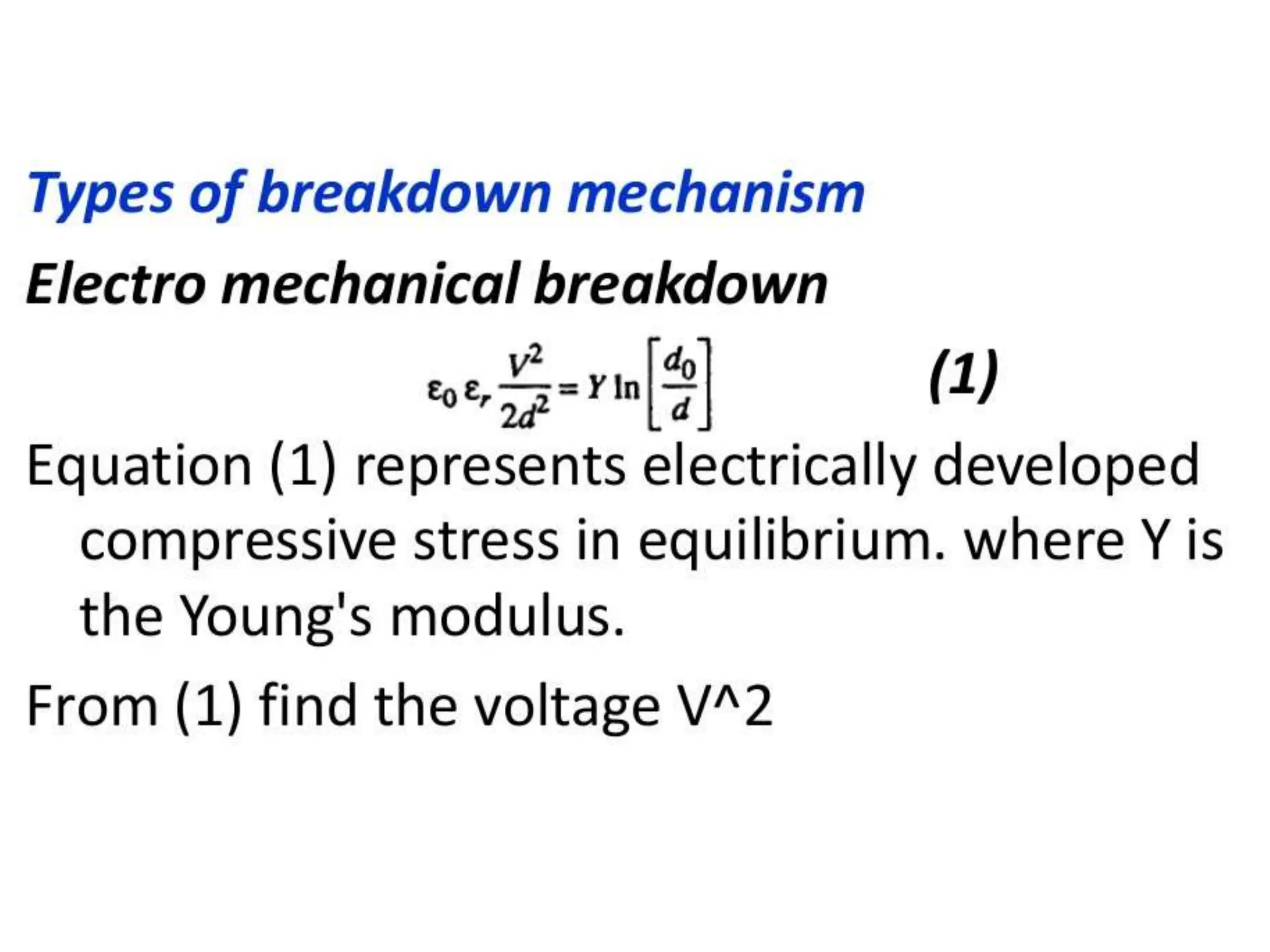
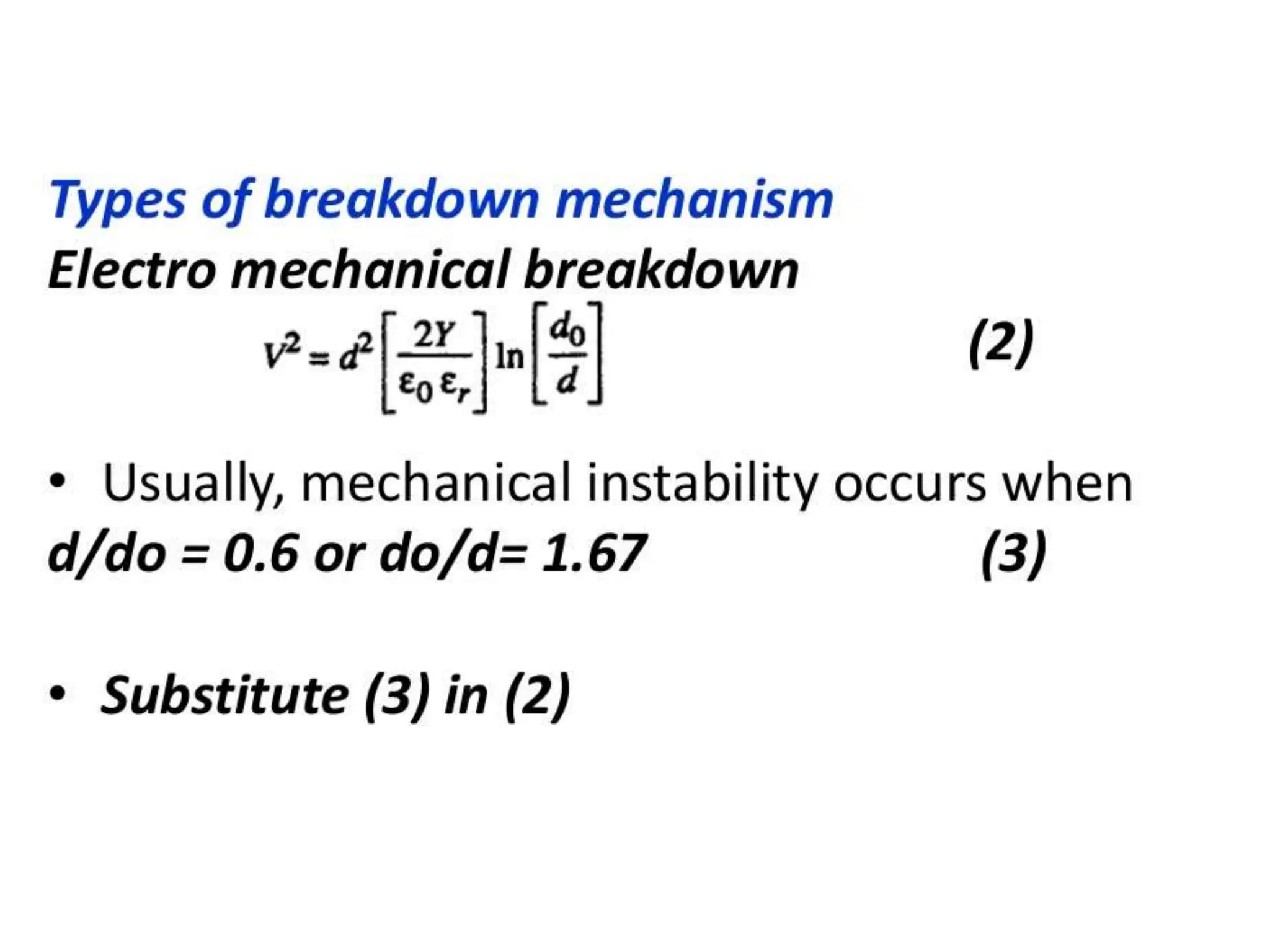
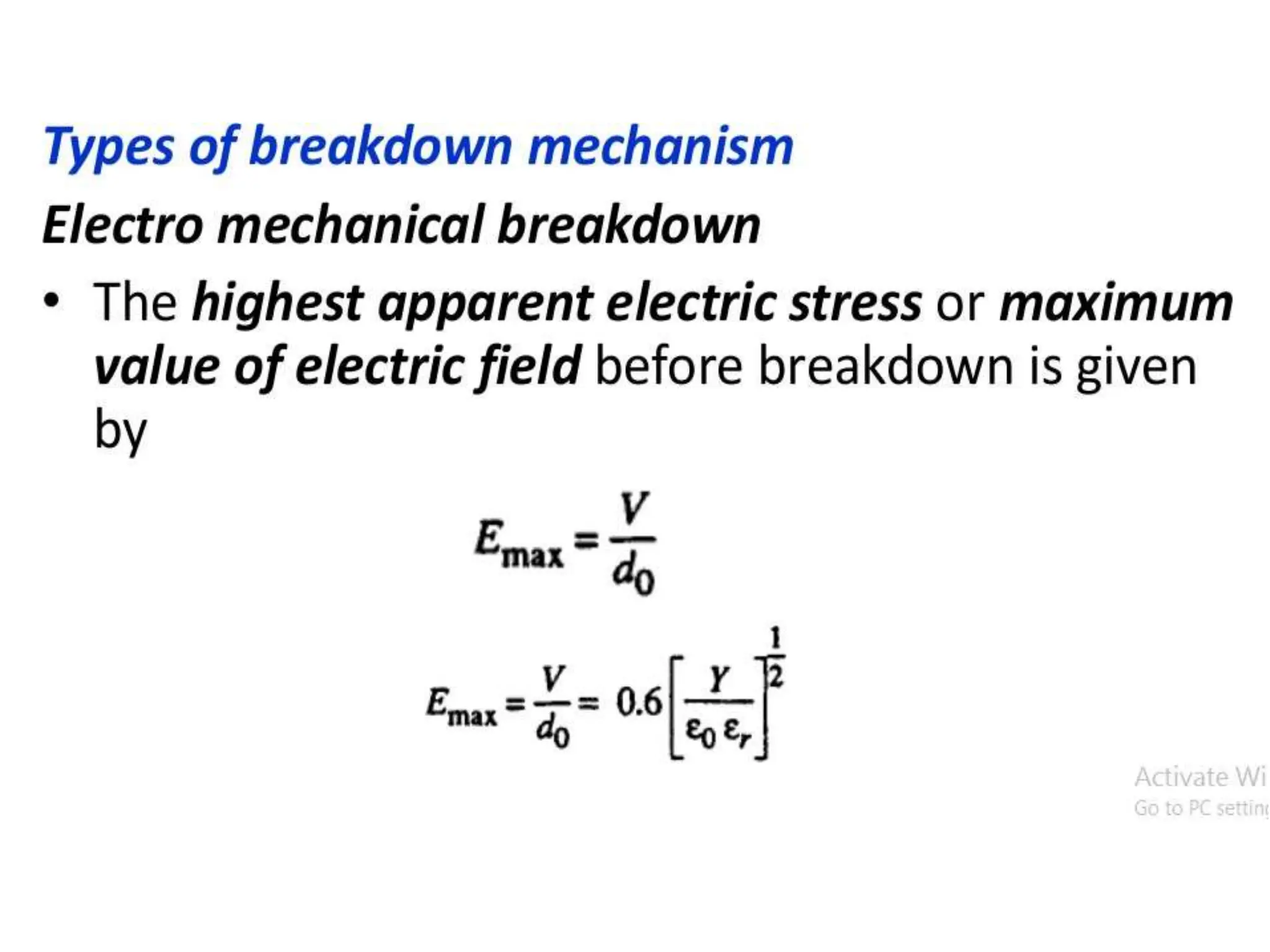
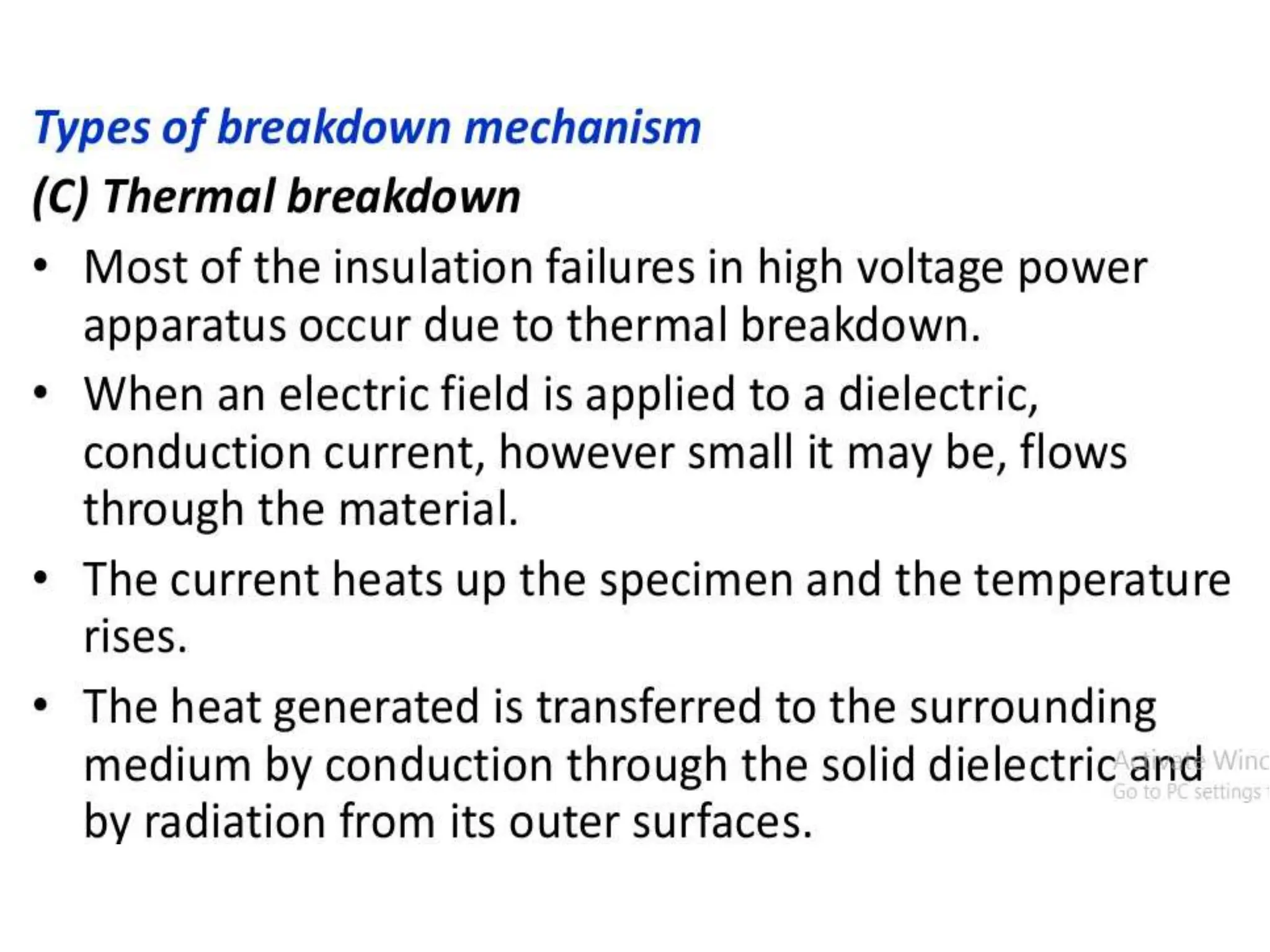
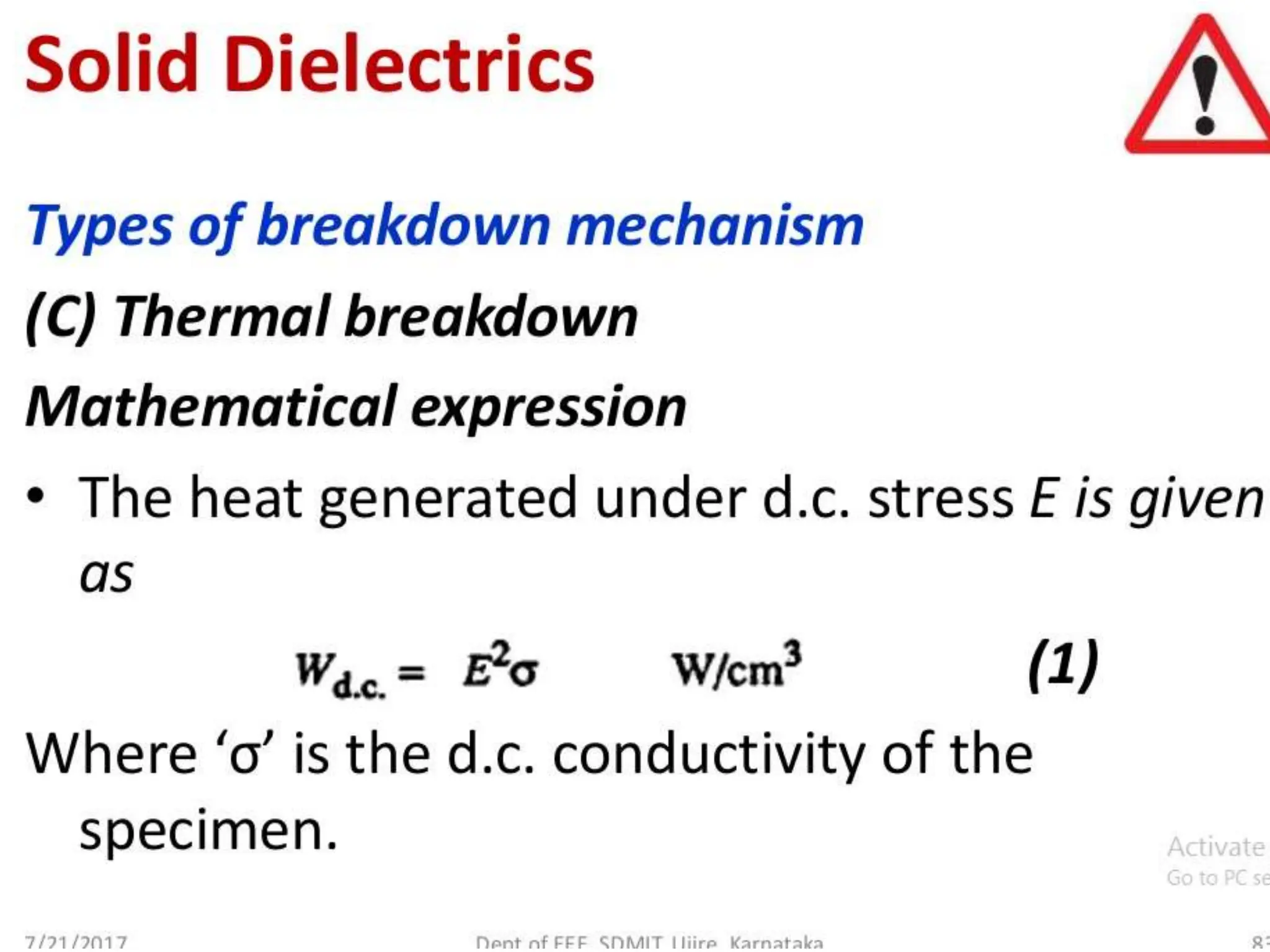
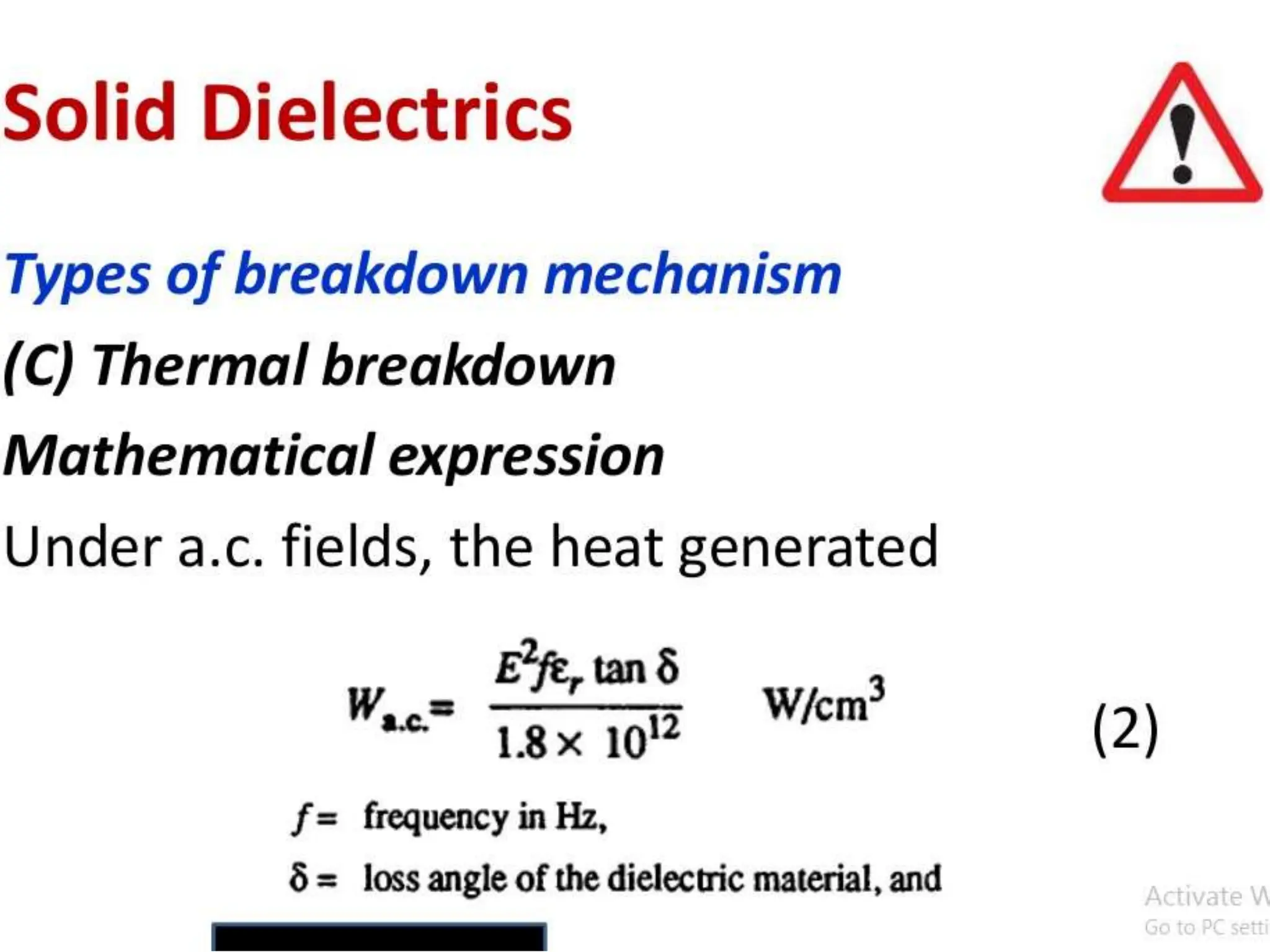
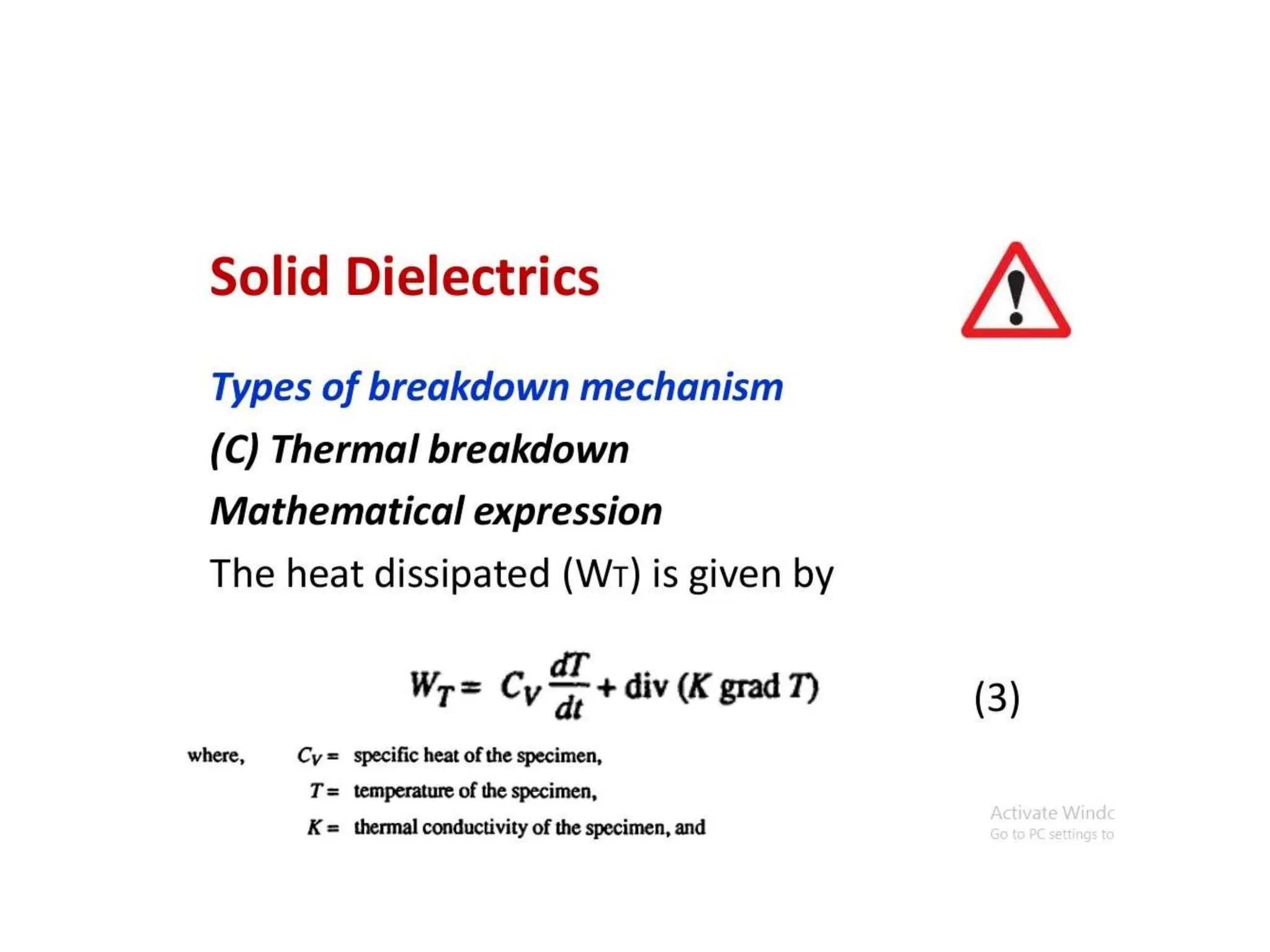
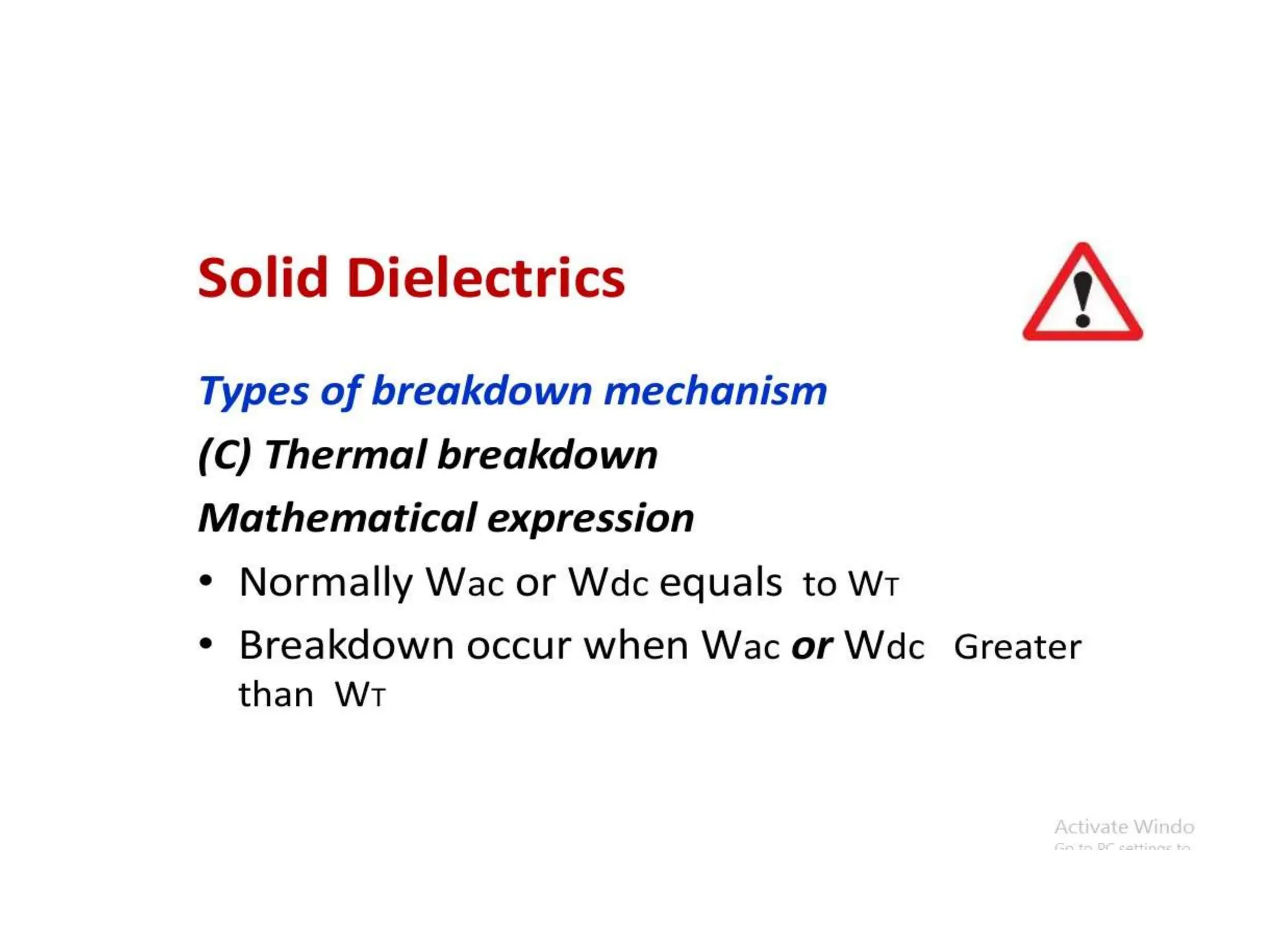
Breakdown, Electromechanical Breakdown, Thermal
Breakdown.
Breakdown in solid dielectrics:
Intrinsic Breakdown, avalanche
breakdown, thermal breakdown, and
electro mechanic breakdown.
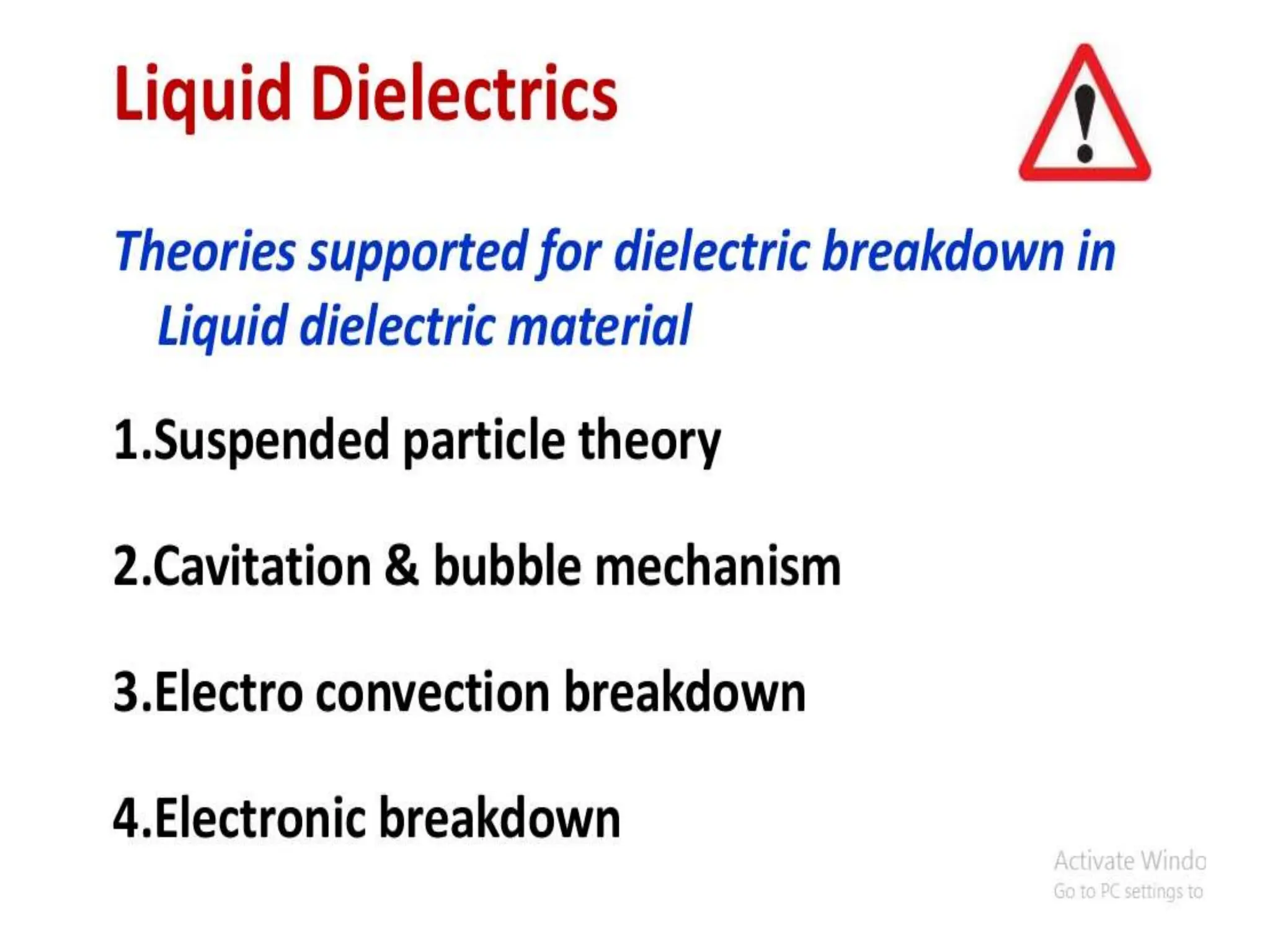
Breakdown of liquid dielectrics:
Suspended particle theory, electronic
Breakdown, cavity breakdown
(bubble’s theory), electro convection
breakdown
Dielectrics or Dielectric material
What is Dielectrics………………….?
• Dielectric material is a poor conductor of
electricity.
• But it can be conducted by applying high
electric field.
• It is an efficient supporter of electric field.
• Whenever we are applying electric field the
position of ions get changed and support for
electricity conduction.
• Examples of dielectric materials are mica, glass,
ceramics etc.
Dielectric Strength Definition……?
• The dielectric strength of an insulating
material is defined as the maximum
dielectric stress with the material can
withstand.
Factors affecting Dielectric strength
• Pressure
• Temperature
• Humidity
• Nature of applied voltage
• Imperfection of material
Types of Dielectrics
Dielectrics Gas or Vacuum Dielectrics
Liquid Dielectrics
Solid Dielectrics
Composite Dielectrics
Gas or Vacuum Dielectrics
• It has high dielectric strength (10^7
V/cm)
• Breakdown occur in the gas or vacuum is
due to collisional ionization. (Ionization by
collision)
• If the applied voltage is sufficiently large
electrons are multiplied in an exponential
manner & breakdown will be occurred.
• Examples- Sulpher Hexa Fluoride, CO2 etc
Types of Liquid Dielectrics
• The liquid dielectric are used in HV
equipment for dual purpose of
insulation & heat dissipation.
• Temporary failure can be quickly re-
insulated by the liquid flow to the
affected area.
• Highly purified liquid is more suitable
to serve as a dielectric medium
• Dielectric strength is up to 1 MV/cm
• Breakdown strength reduces due to
impurities.
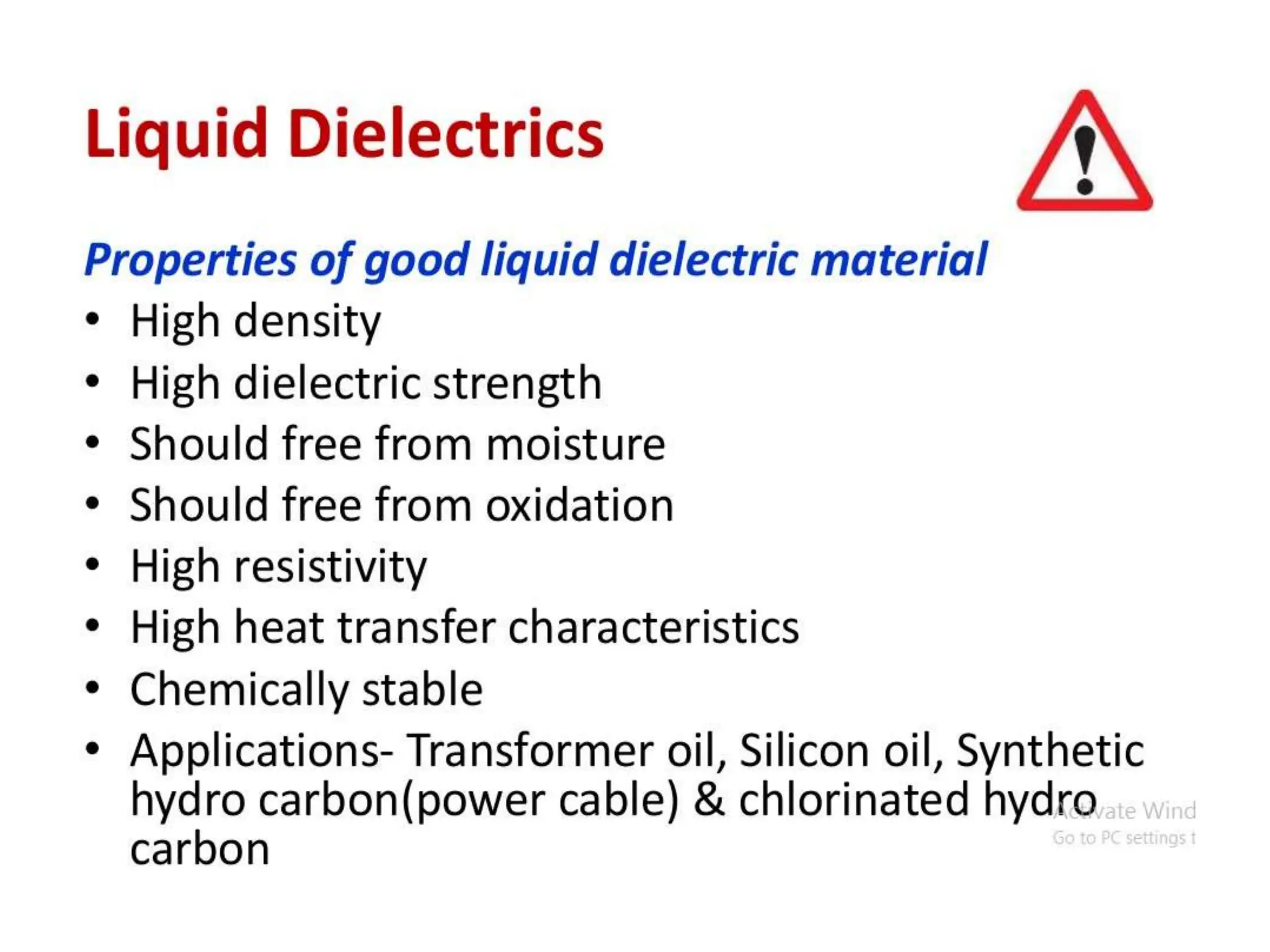
• Selection of liquid dielectric is based on
dielectric strength, viscosity, stability, flash
point, gas constant etc
• Examples- Petroleum, transformer oil
(Mineral oil) etc
• Applications- Area where equipments is
continuously operated like Distribution
Transformer
Solid Dielectrics
• It has good mechanical strength &
bonding capability.
• Dielectric strength – 10MV/cm
• Examples- Inorganic materials (Ceramics,
glass etc) , Organic materials(PVC,
Polyethylene, natural rubber etc)
• Application- Electrical apparatus
Composite Dielectrics
• Combination of more than two kinds of
insulators
• Chemically stable
• Long life span
• But dielectric constant of two material
should match
• Two insulators never react together.
• Examples – Oil impregnated paper, Oil
impregnated metalized plastic film.
Analysis on Gaseous Dielectrics
Desirable properties of gaseous dielectric
materials
• A good dielectric gas should have high
dielectric strength
• High thermal stability
• Chemical inertness
• Non inflammability
• Low toxicity
• Low boiling point
• Good heat transfer properties
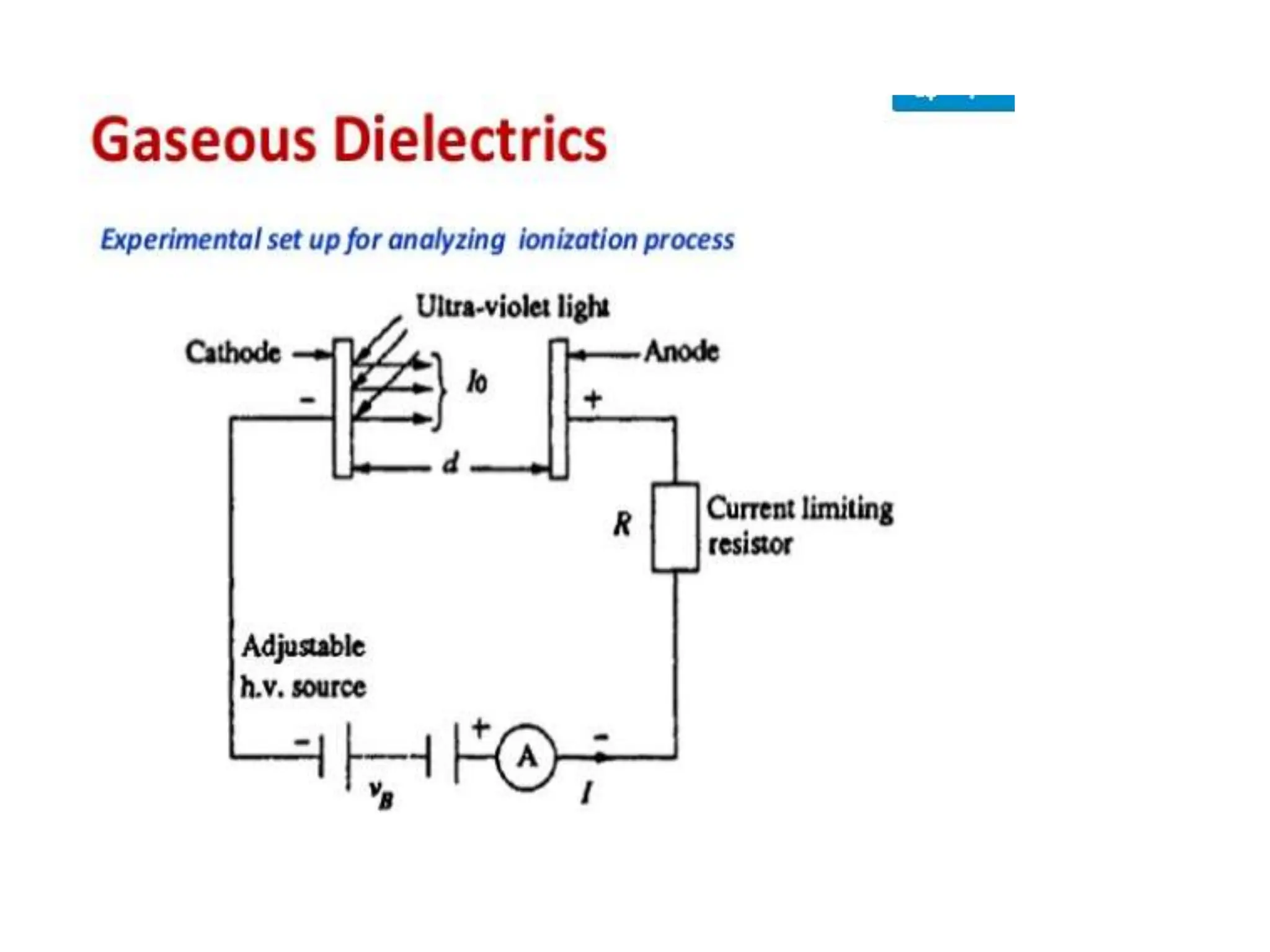
Gaseous Dielectrics Ionization process
• When a high voltage is applied in
between two electrodes immersed in a
gaseous medium, the gas becomes
conductor & dielectric breakdown occurs.
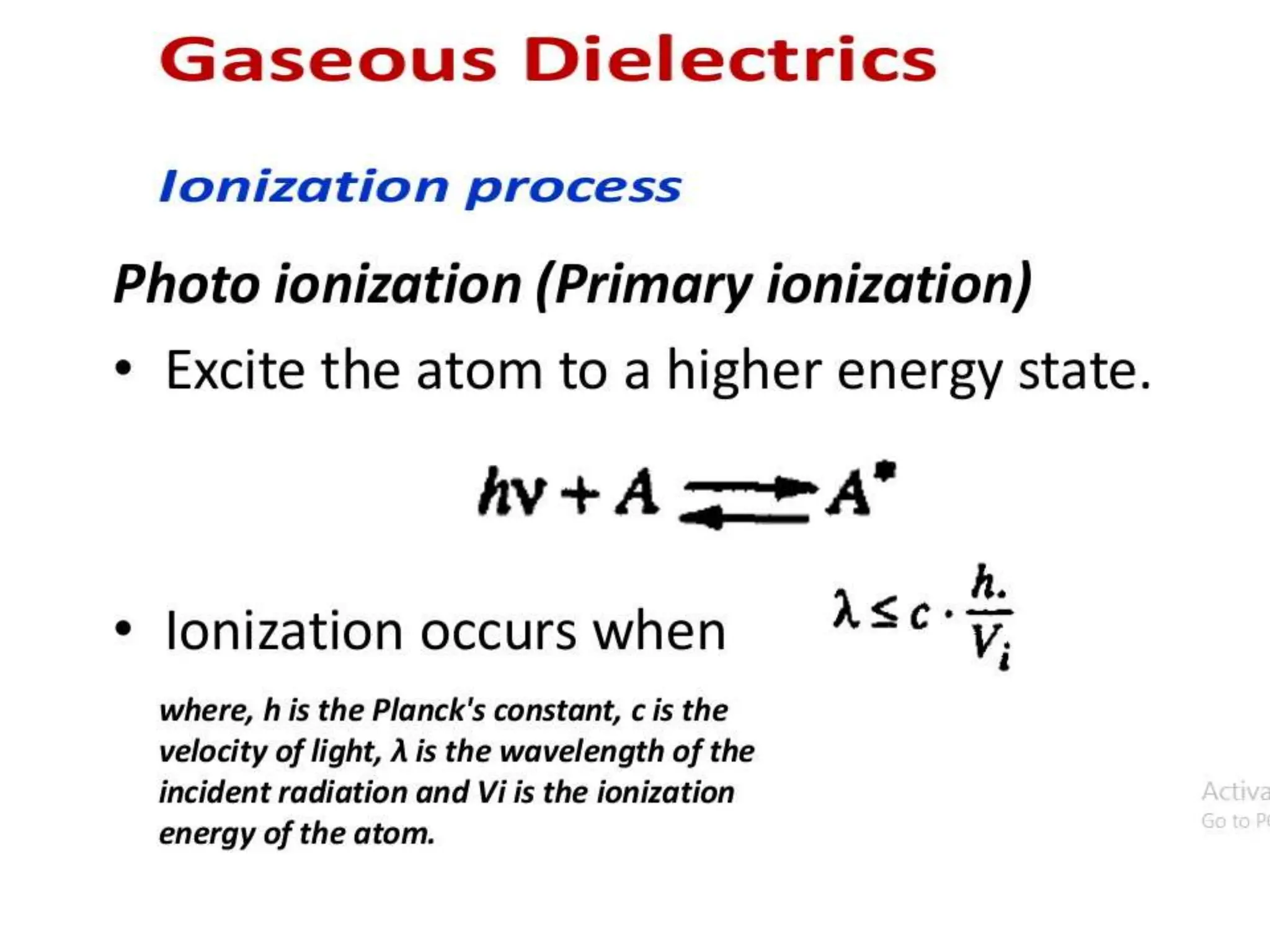
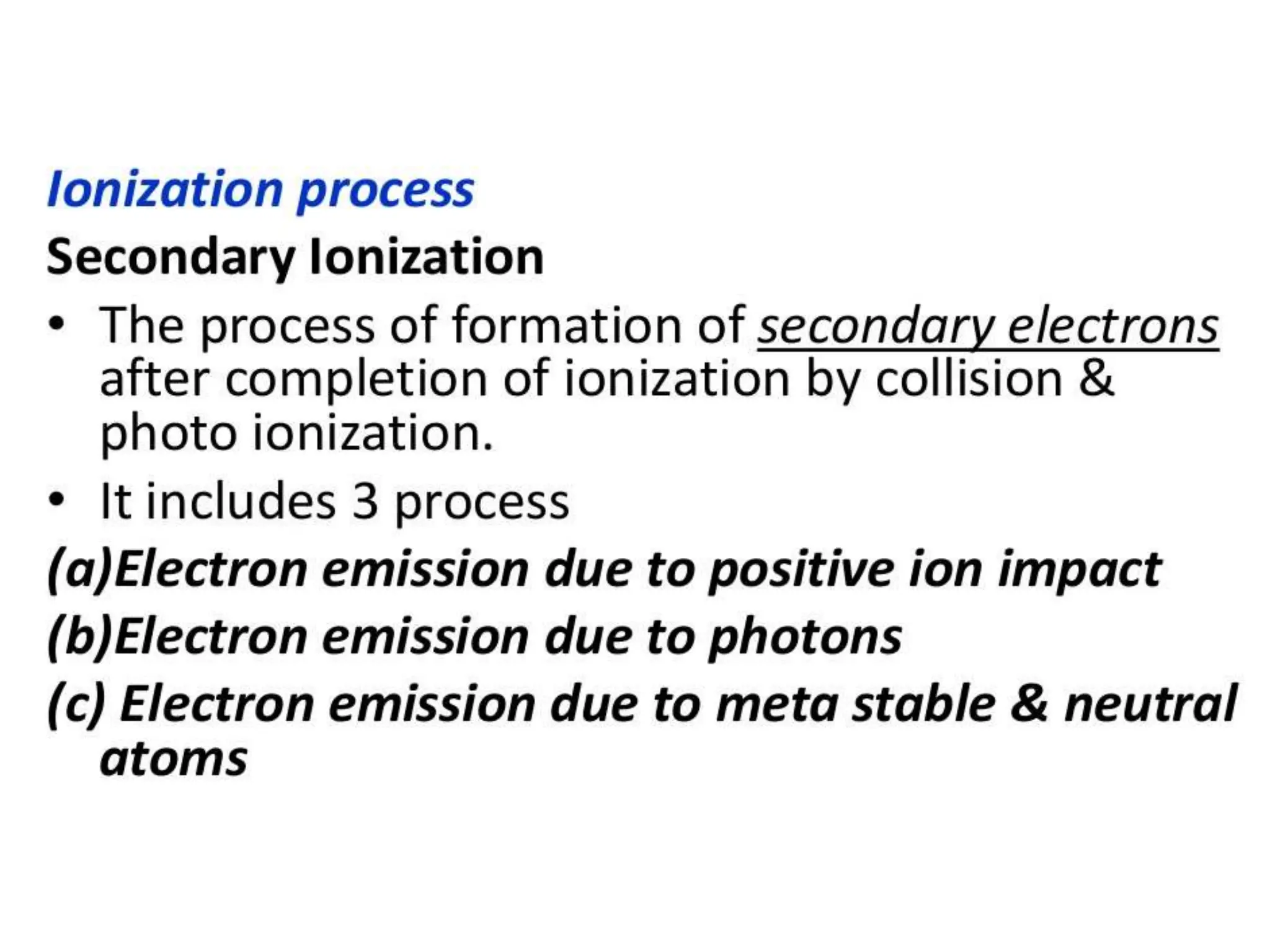
• The processes that are primarily
responsible for the breakdown of gas are
Primary ionization process & secondary
ionization process.
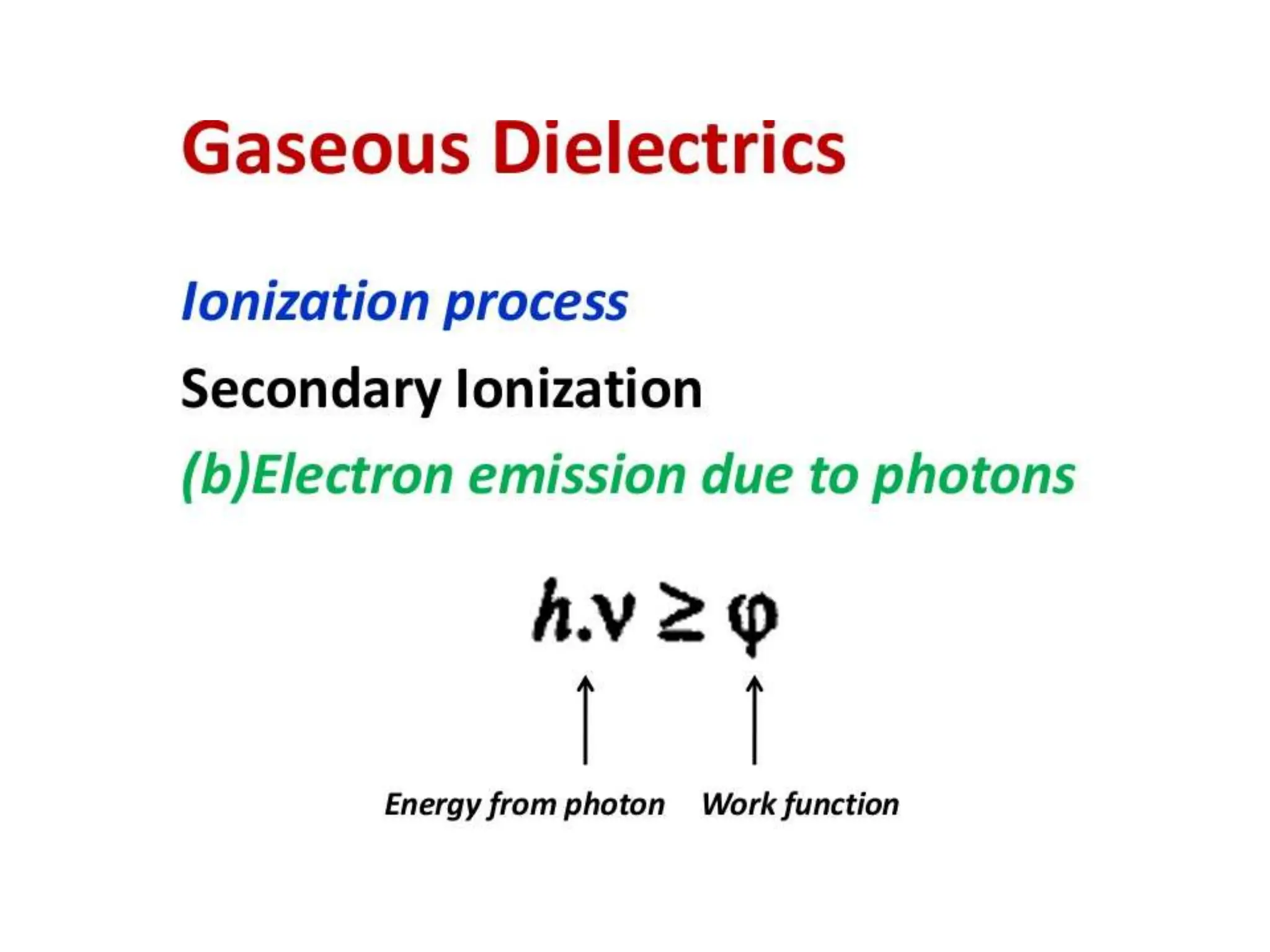
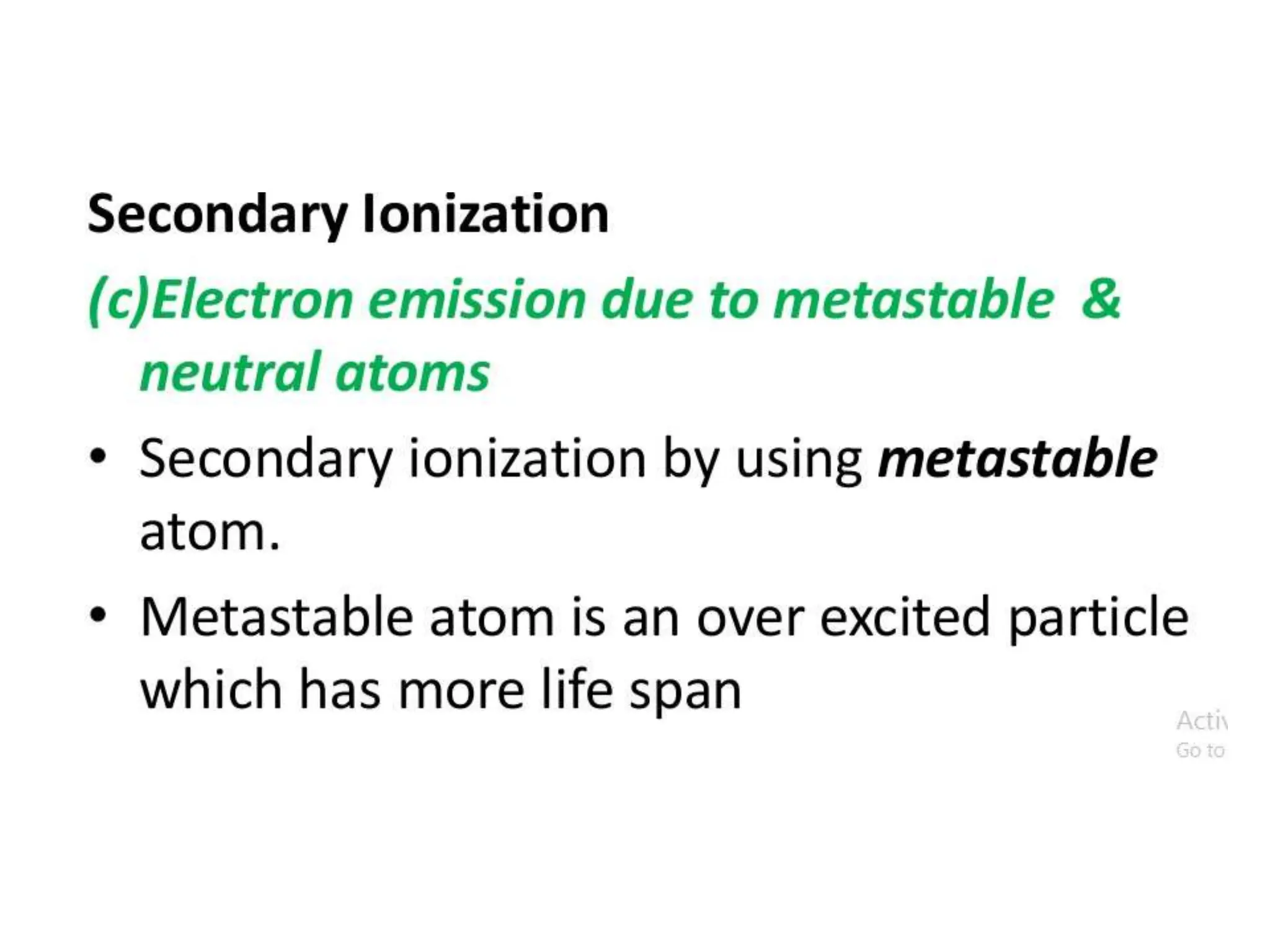
Ionization process
1.Primary ionization process
Gaseous Dielectrics Ionization by collision
Photo ionization
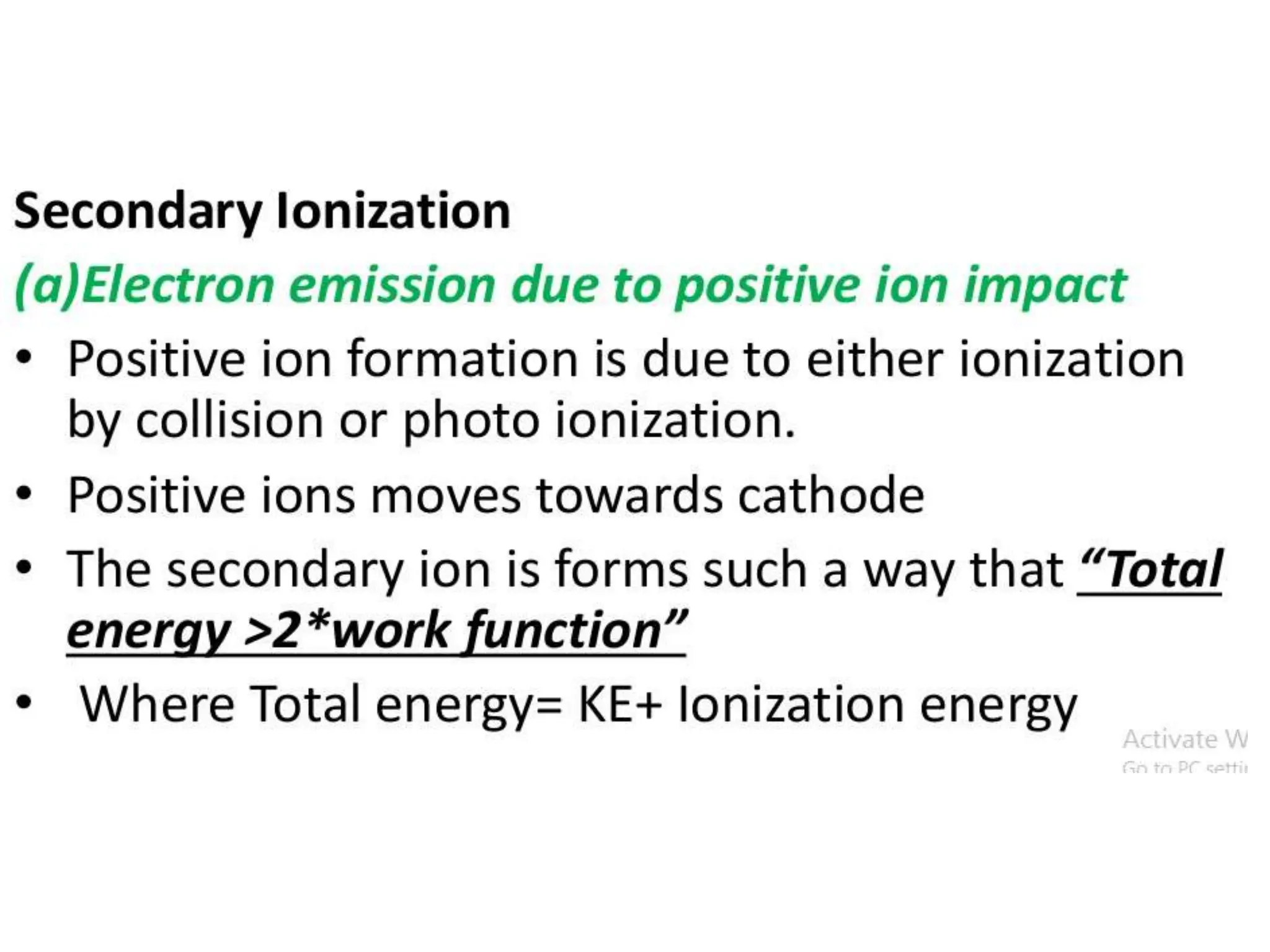
2.Secondary Ionization Process
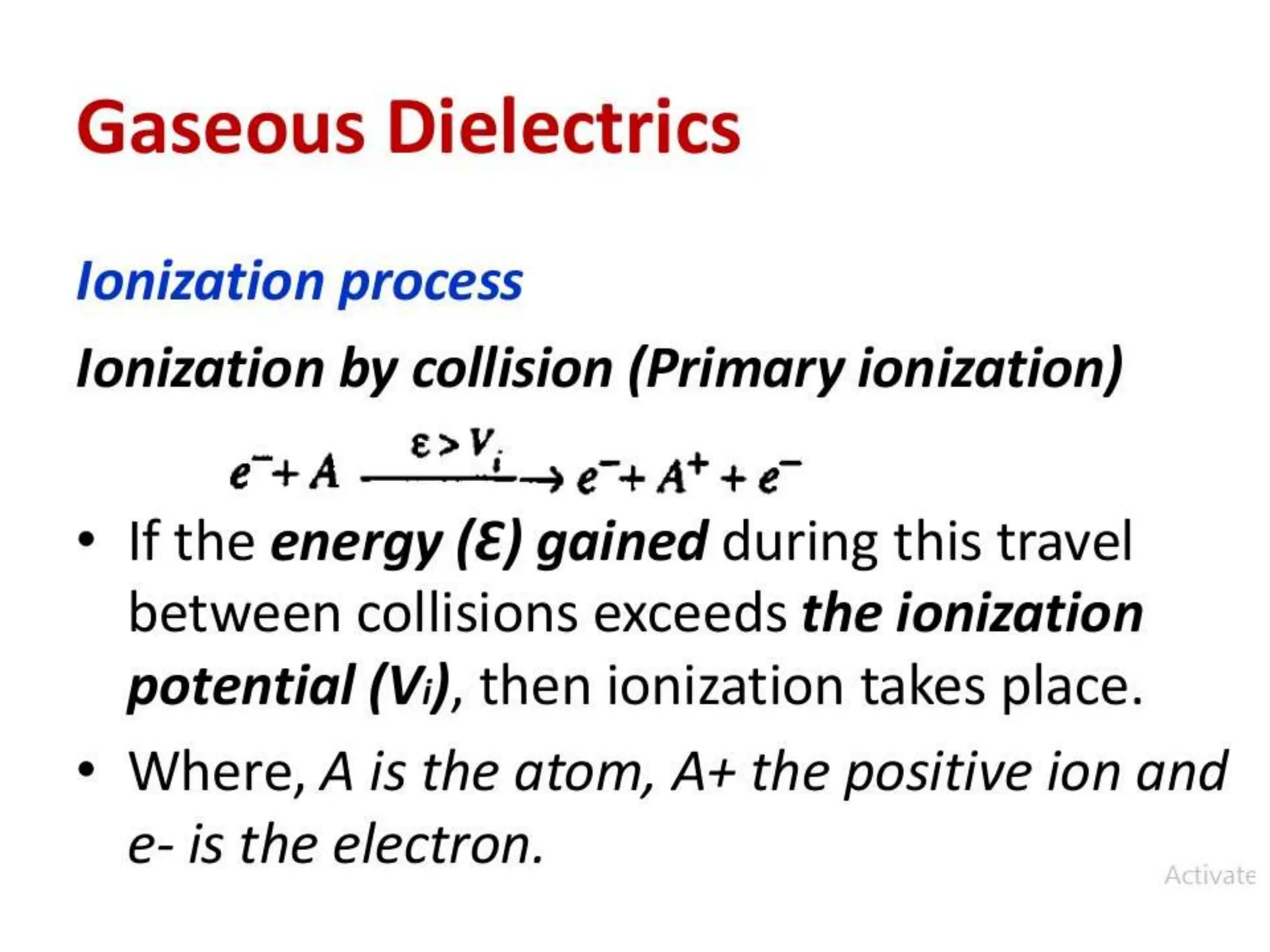
Ionization process Ionization by collision
(Primary ionization)
• The process of liberating an electron from a
gas molecule with the simultaneous production
of a positive ion is called ionization.
• In the process of ionization by collision, a free
electron collides with a neutral gas molecule
and gives rise to a new electron and a positive
ion.
• As a result electron is moving towards anode
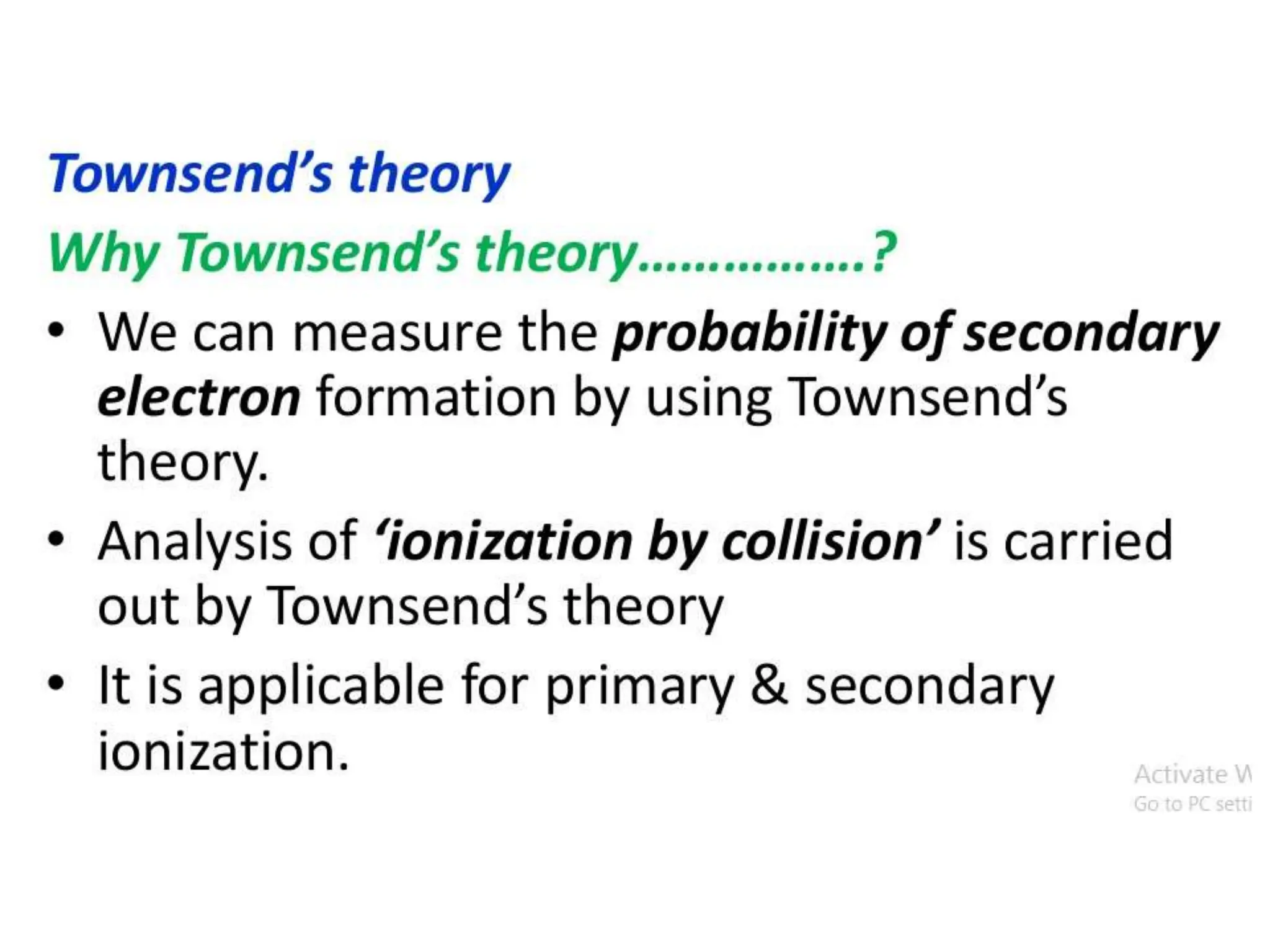
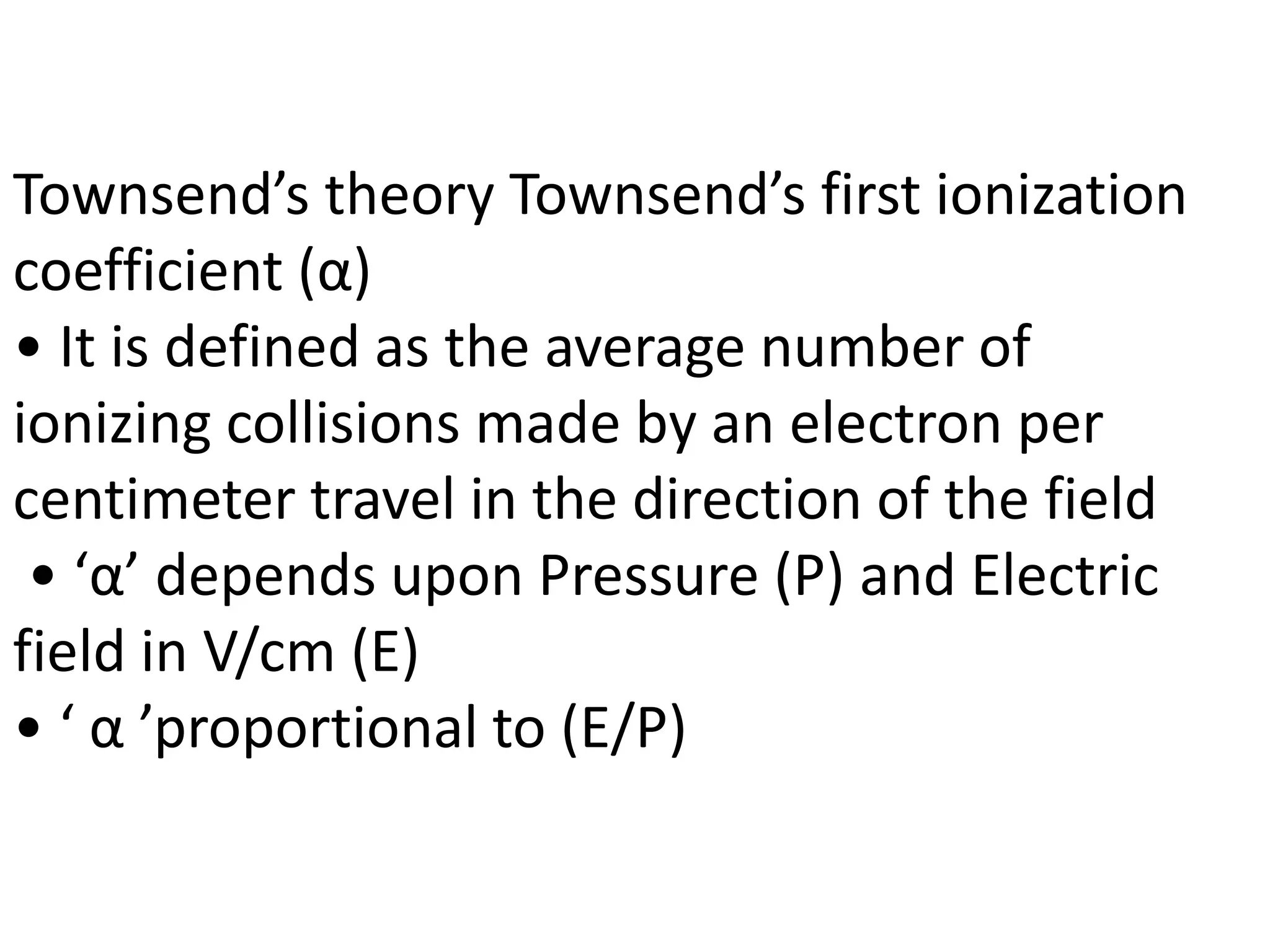
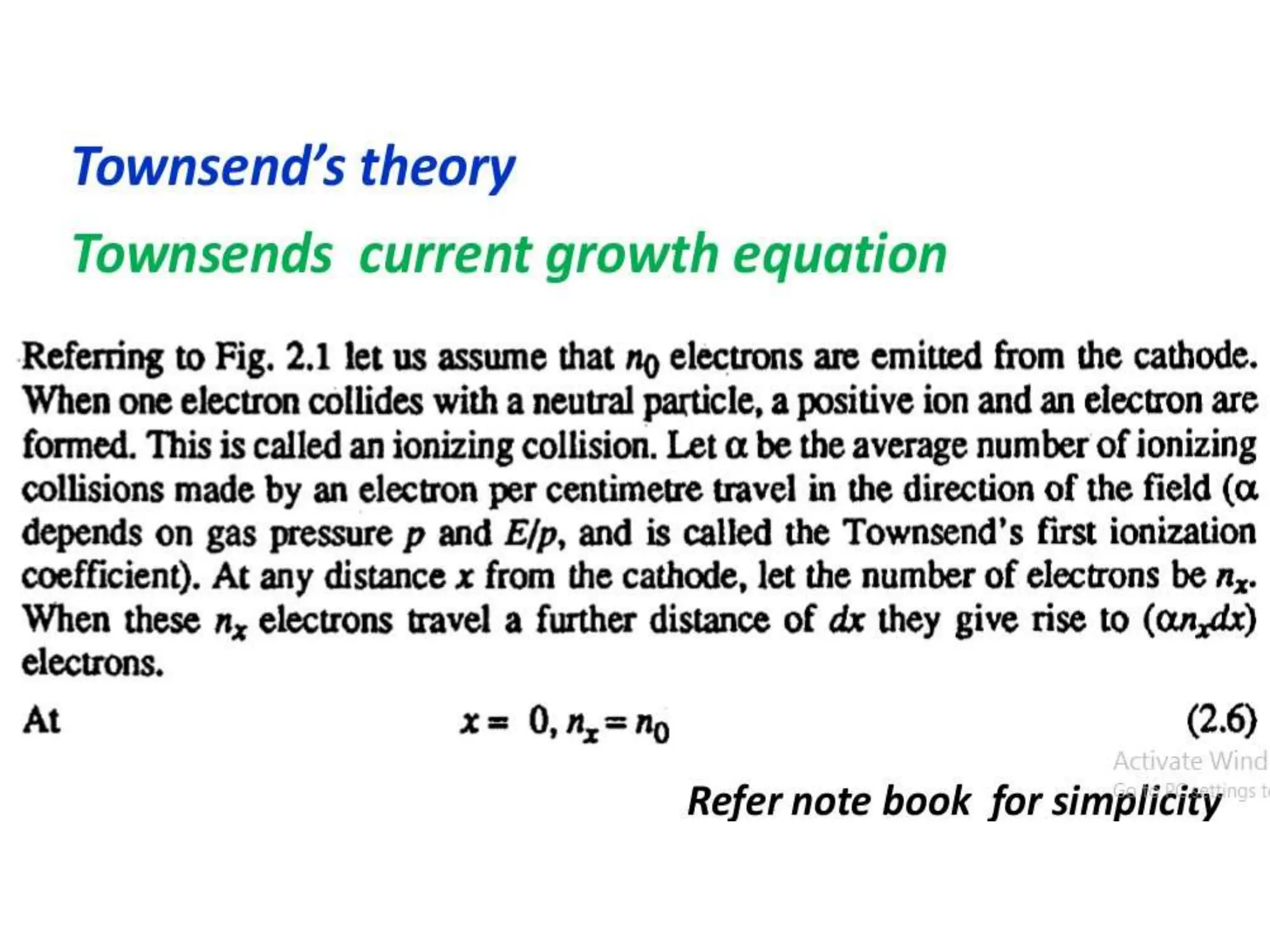
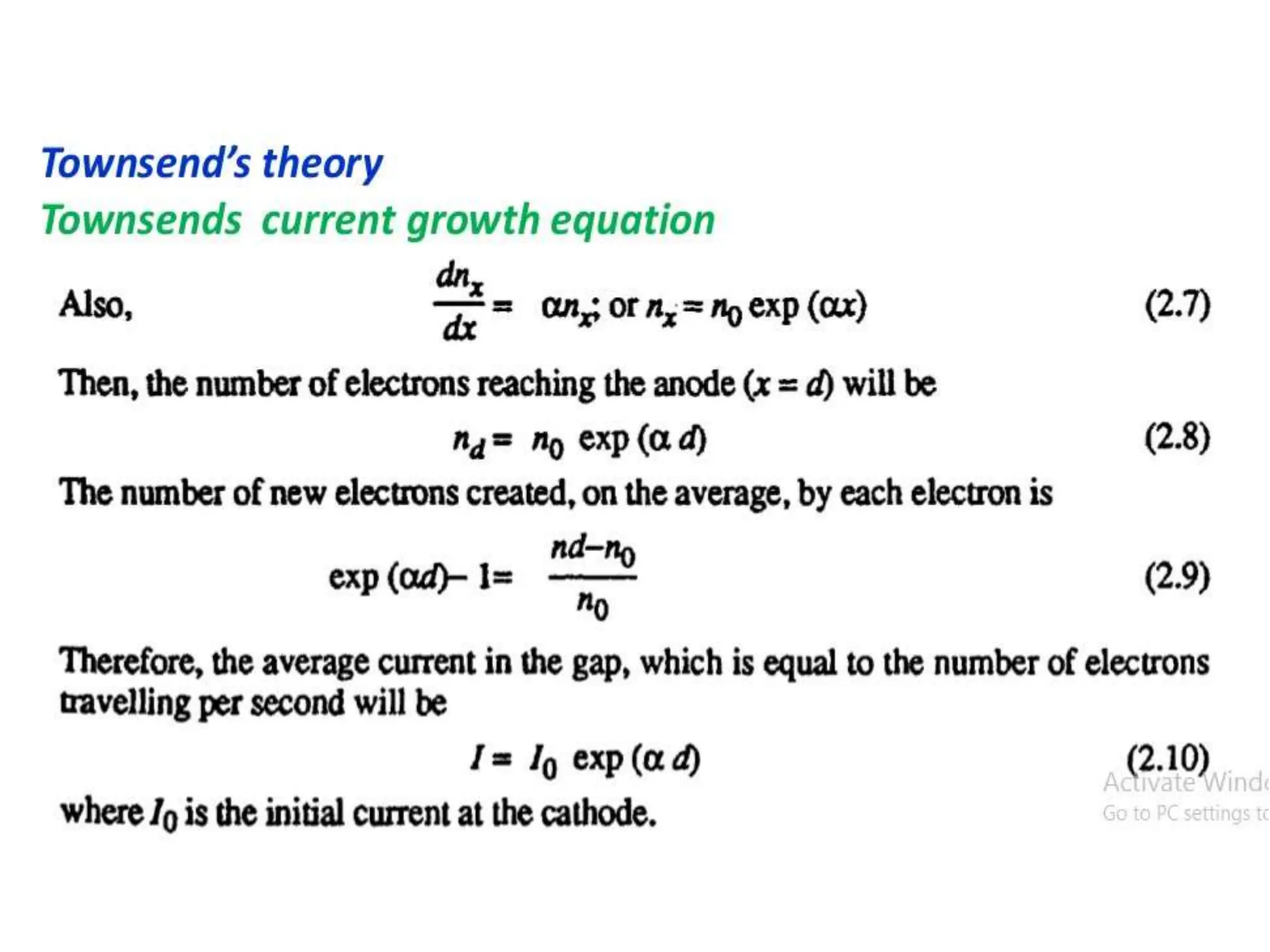
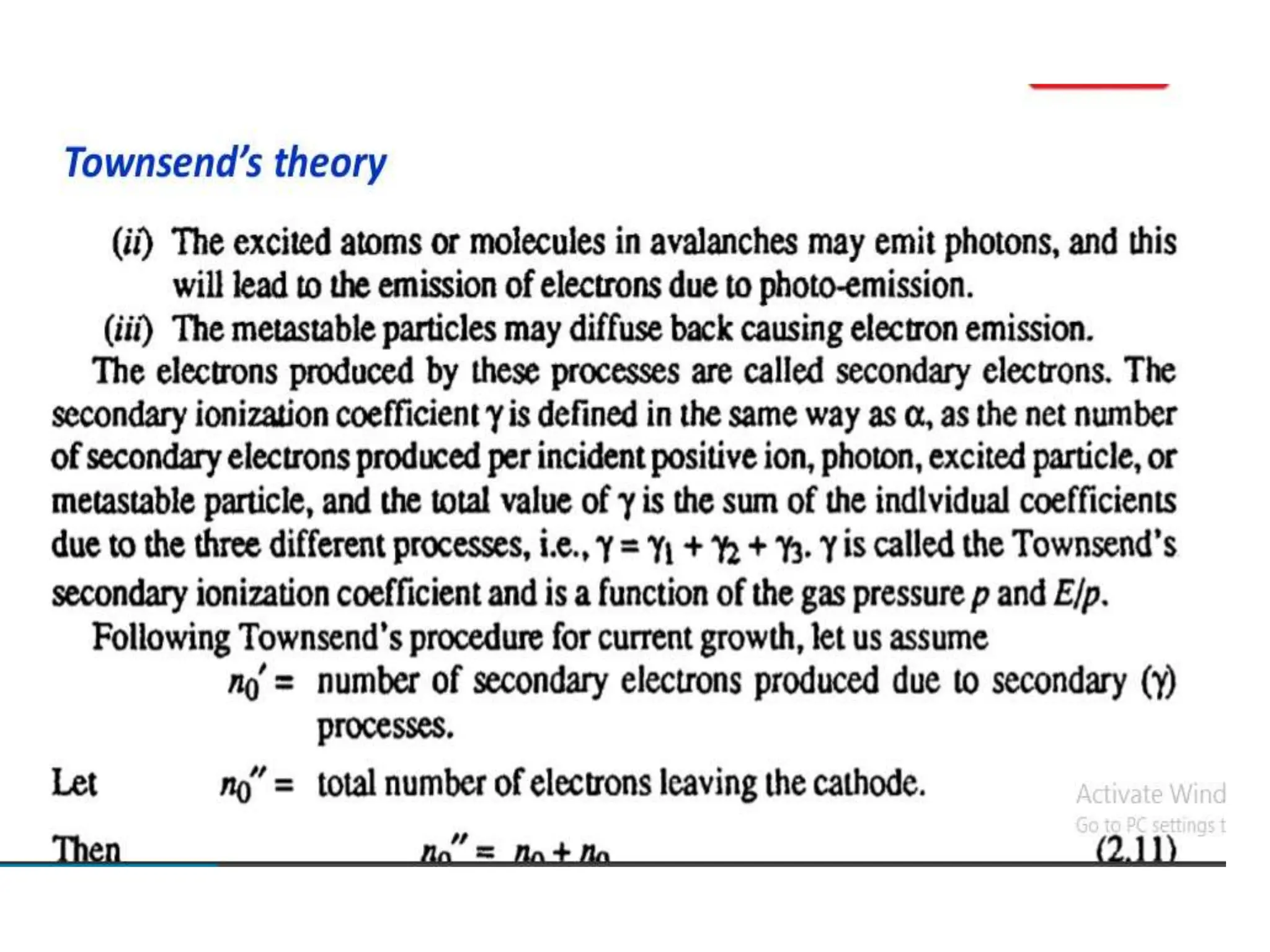
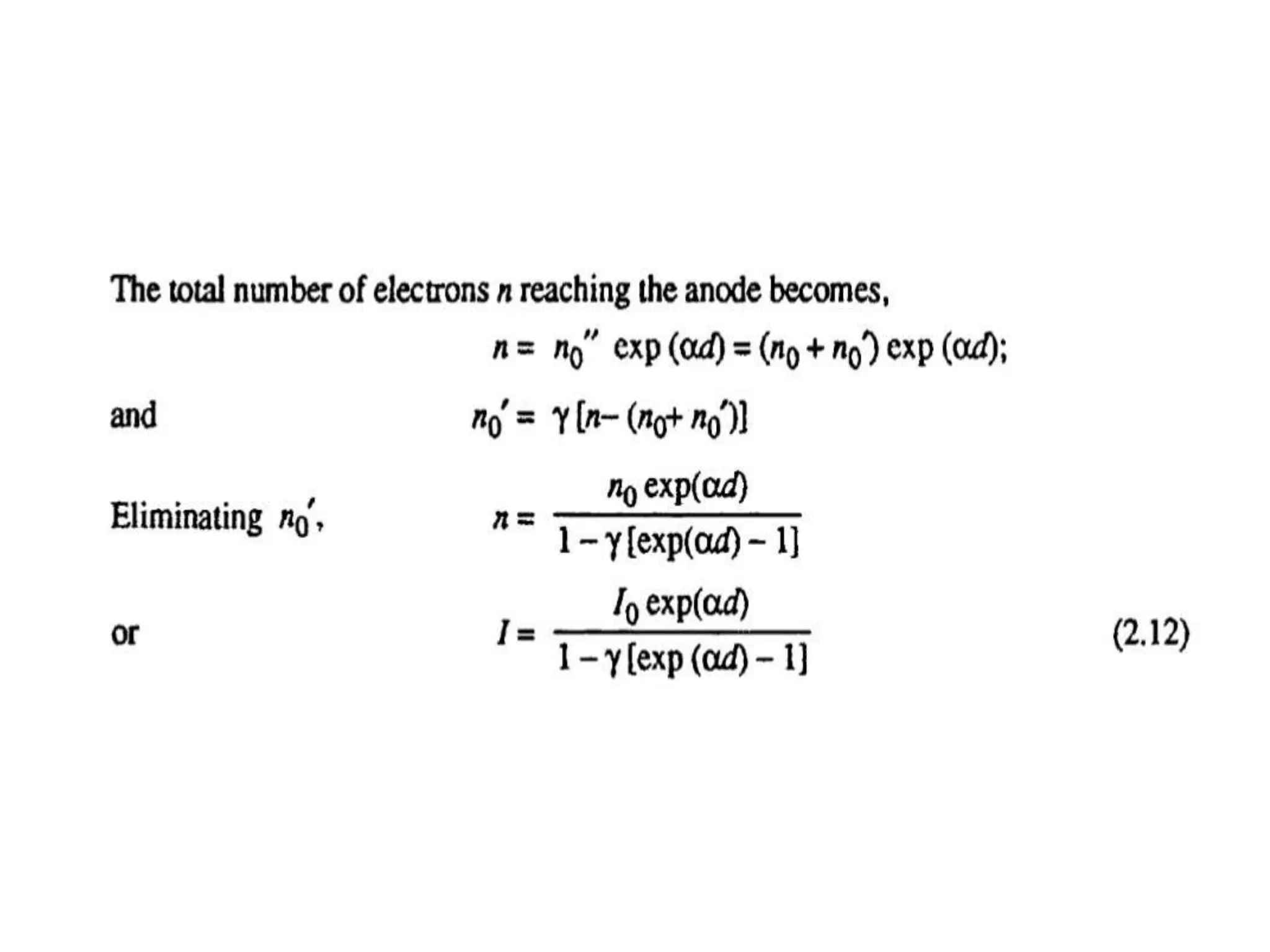
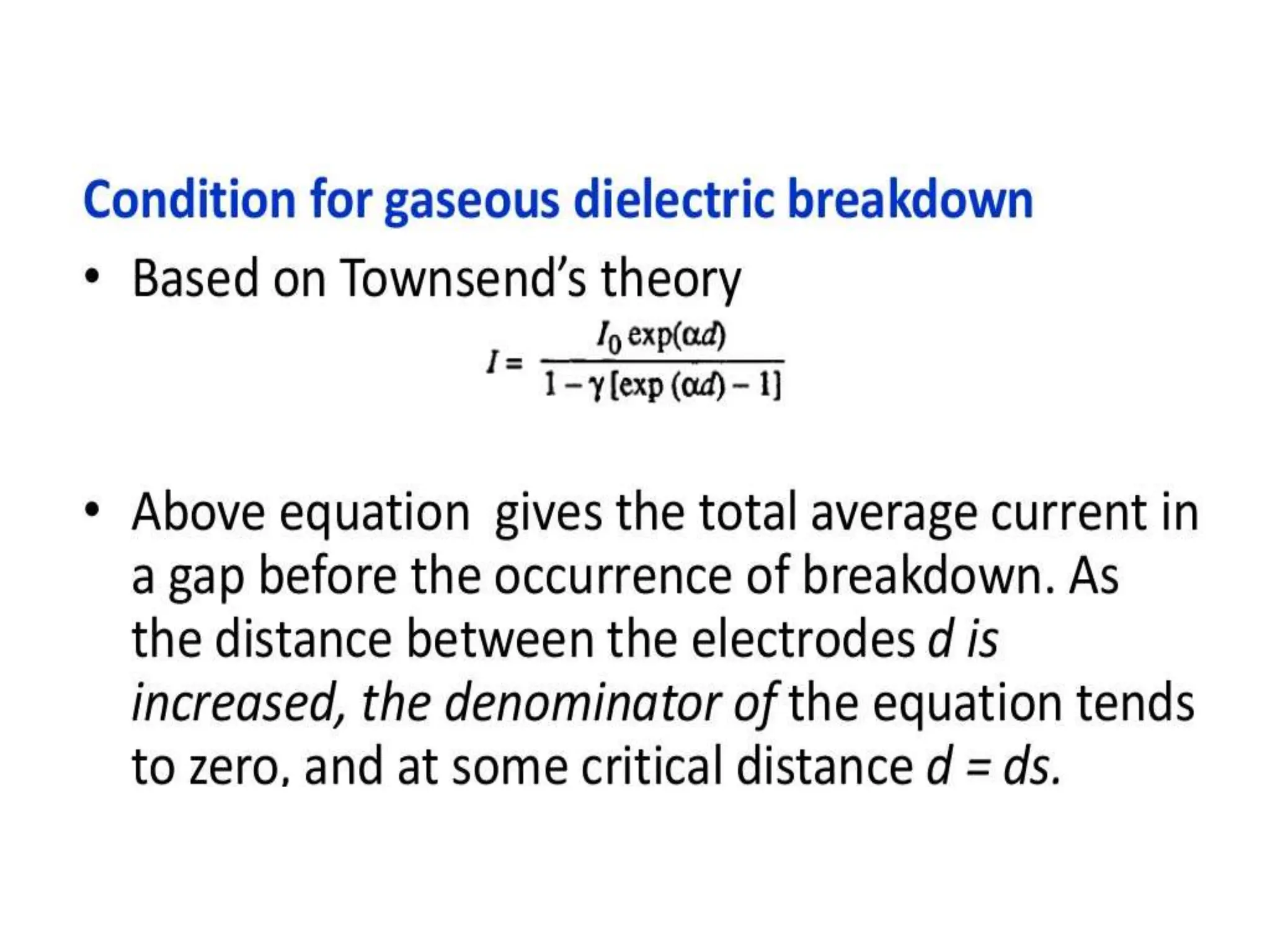
Townsend’s theory Townsend’s first ionization
coefficient (α)
• It is defined as the average number of
ionizing collisions made by an electron per
centimeter travel in the direction of the field
• ‘α’ depends upon Pressure (P) and Electric
field in V/cm (E)
• ‘ α ’proportional to (E/P)
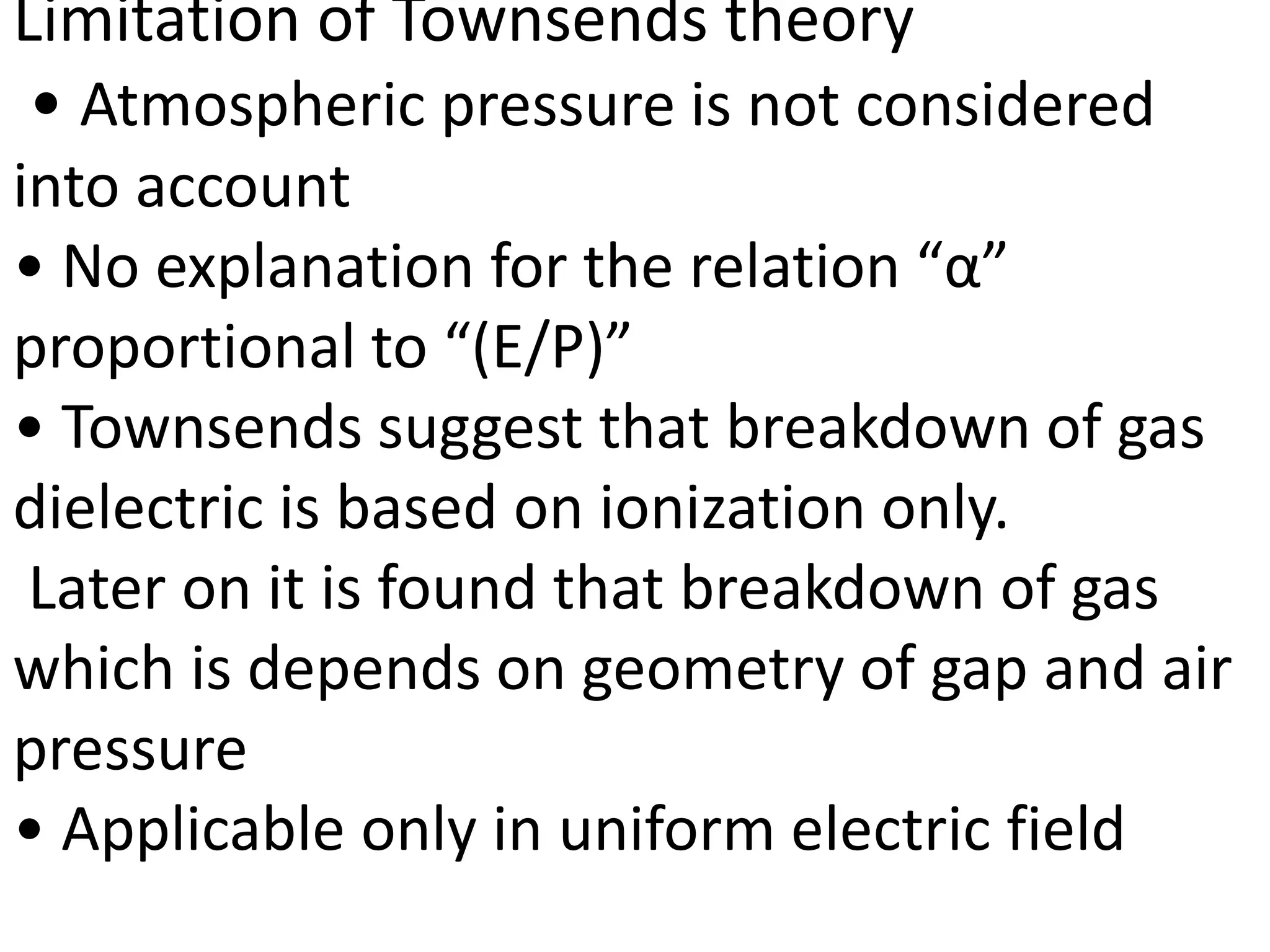
Limitation of Townsends theory
• Atmospheric pressure is not considered
into account
• No explanation for the relation “α”
proportional to “(E/P)”
• Townsends suggest that breakdown of gas
dielectric is based on ionization only.
Later on it is found that breakdown of gas
which is depends on geometry of gap and air
pressure
• Applicable only in uniform electric field
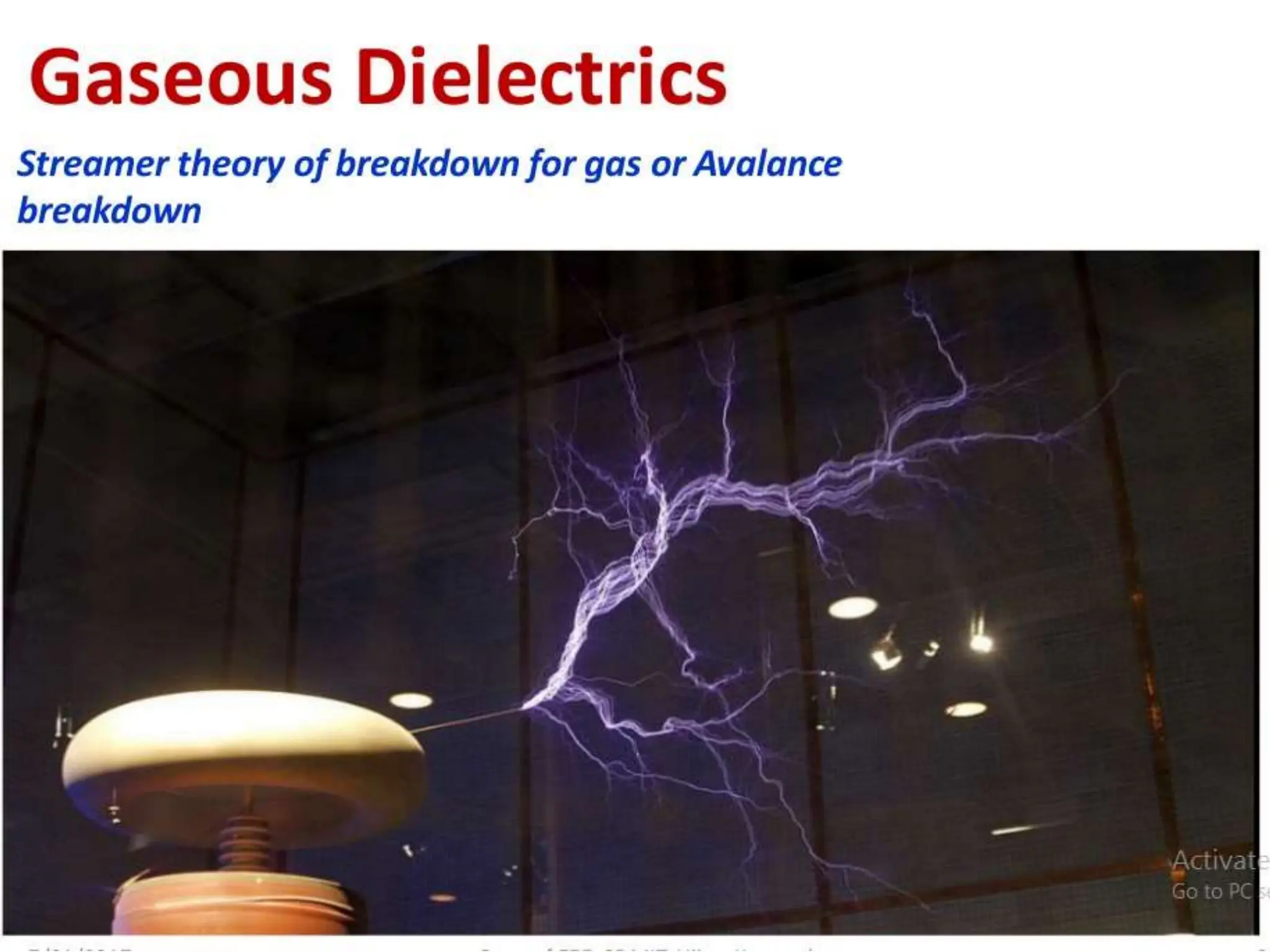
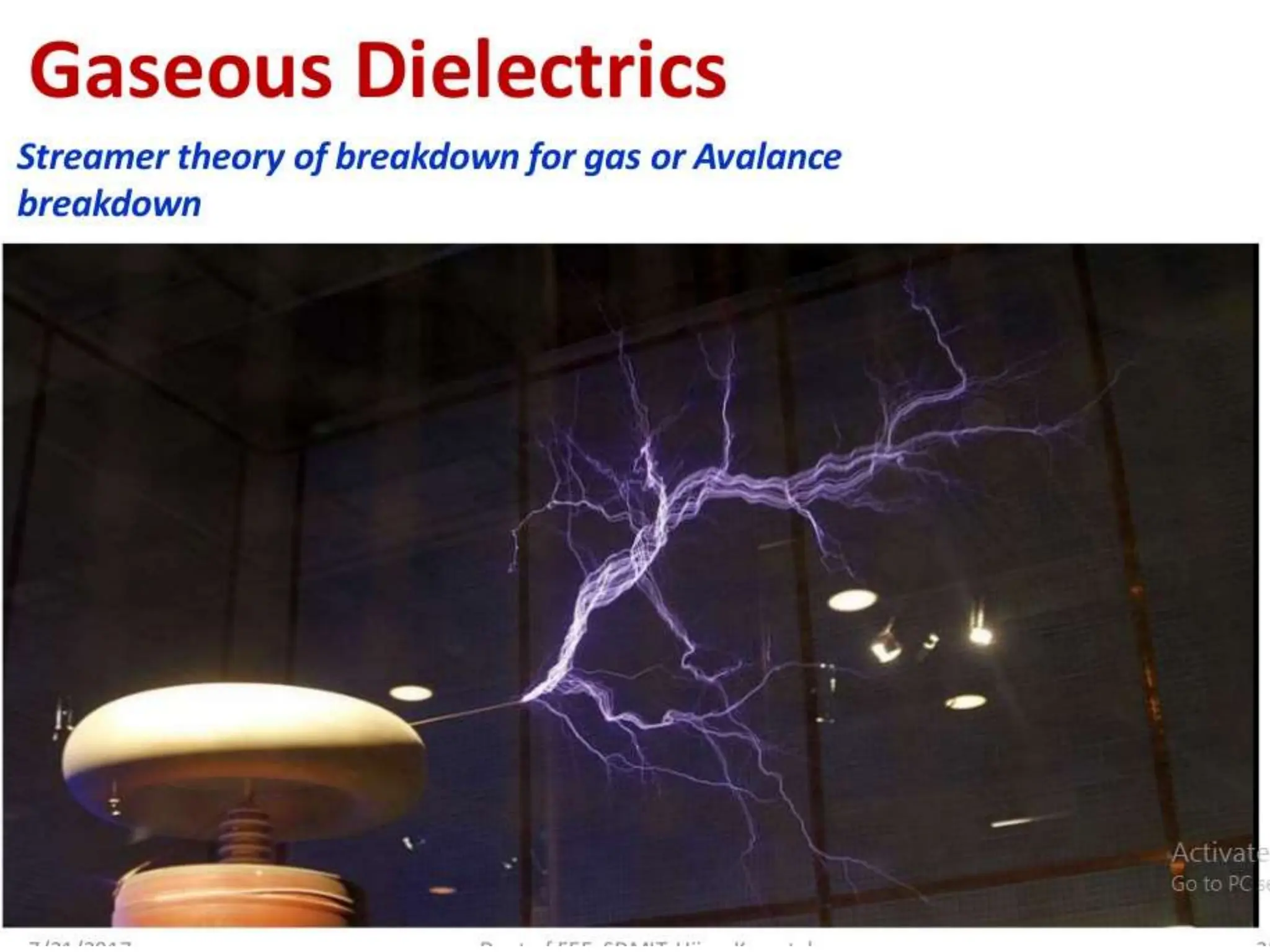
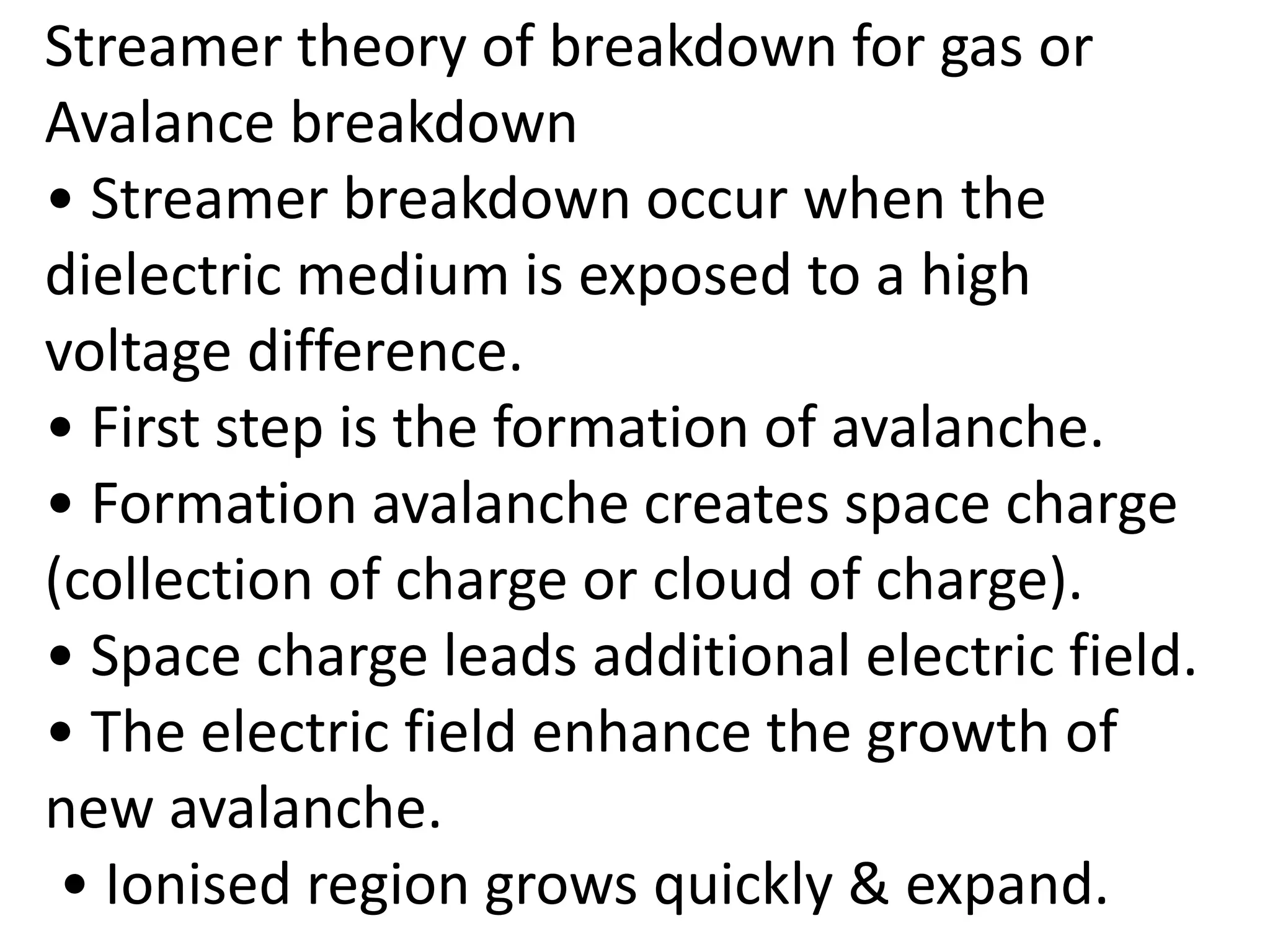
Streamer theory of breakdown for gas or
Avalance breakdown
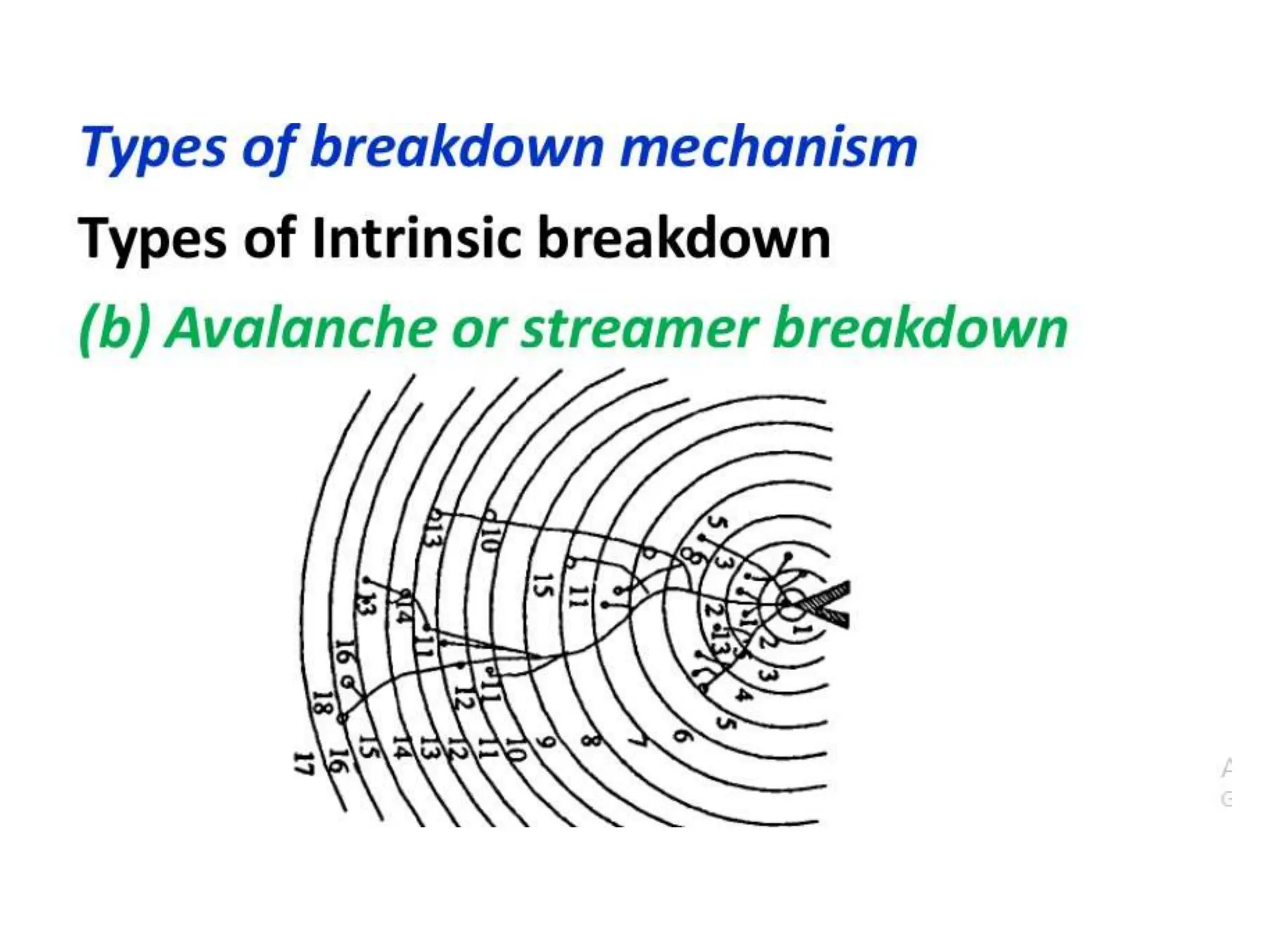
• Streamer breakdown occur when the
dielectric medium is exposed to a high
voltage difference.
• First step is the formation of avalanche.
• Formation avalanche creates space charge
(collection of charge or cloud of charge).
• Space charge leads additional electric field.
• The electric field enhance the growth of
new avalanche.
• Ionised region grows quickly & expand.
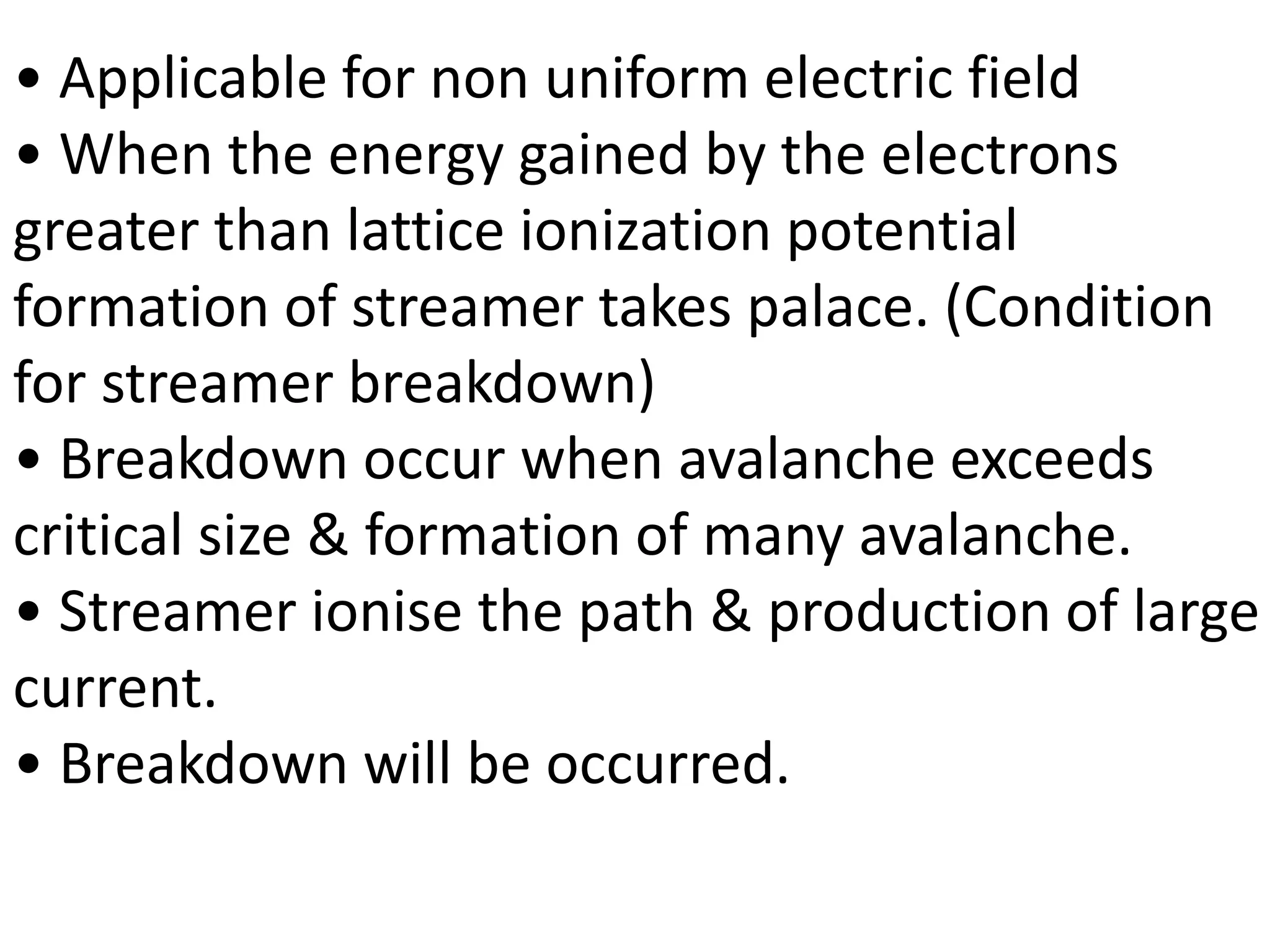
• Applicable for non uniform electric field
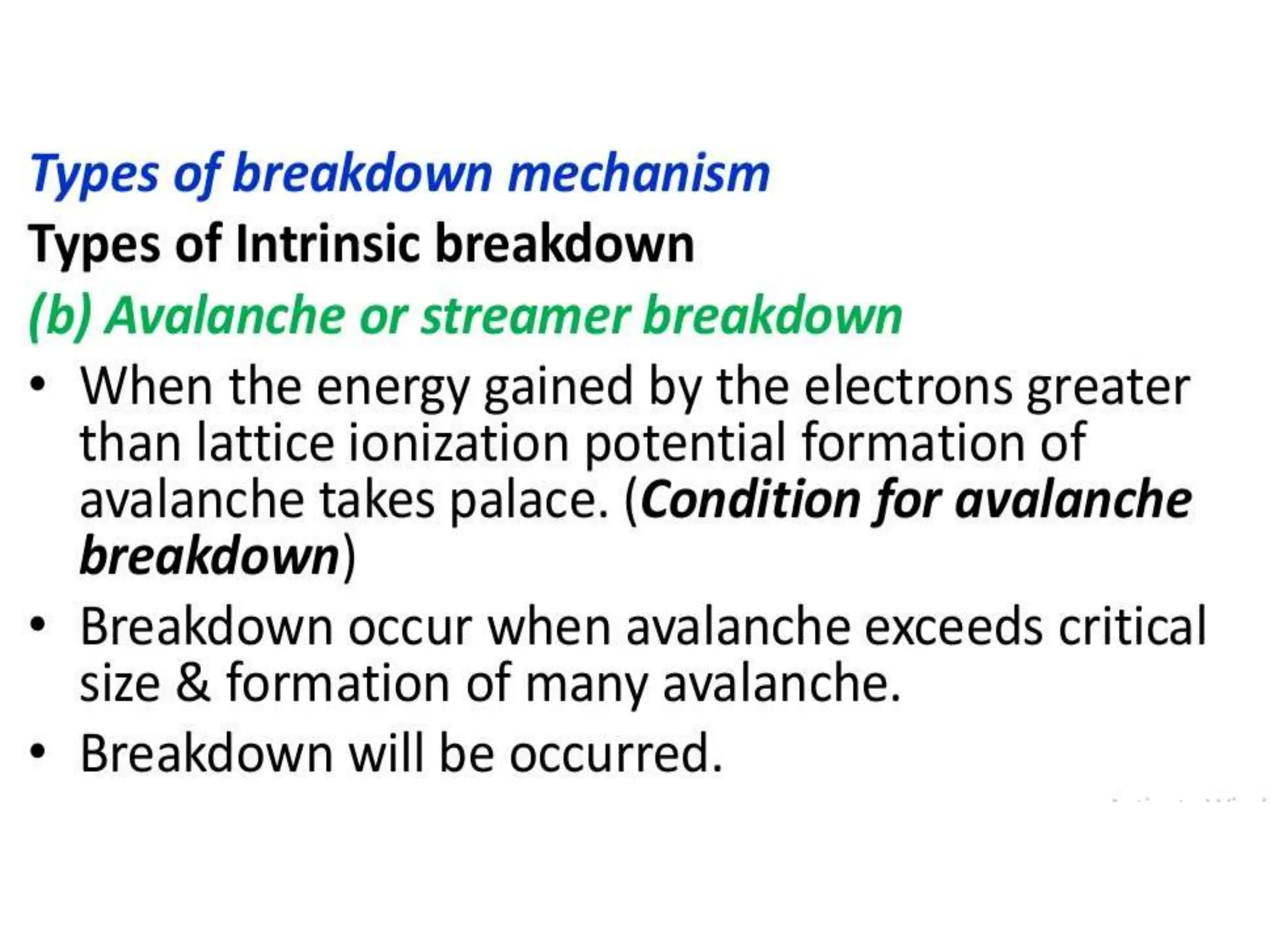
• When the energy gained by the electrons
greater than lattice ionization potential
formation of streamer takes palace. (Condition
for streamer breakdown)
• Breakdown occur when avalanche exceeds
critical size & formation of many avalanche.
• Streamer ionise the path & production of large
current.
• Breakdown will be occurred.
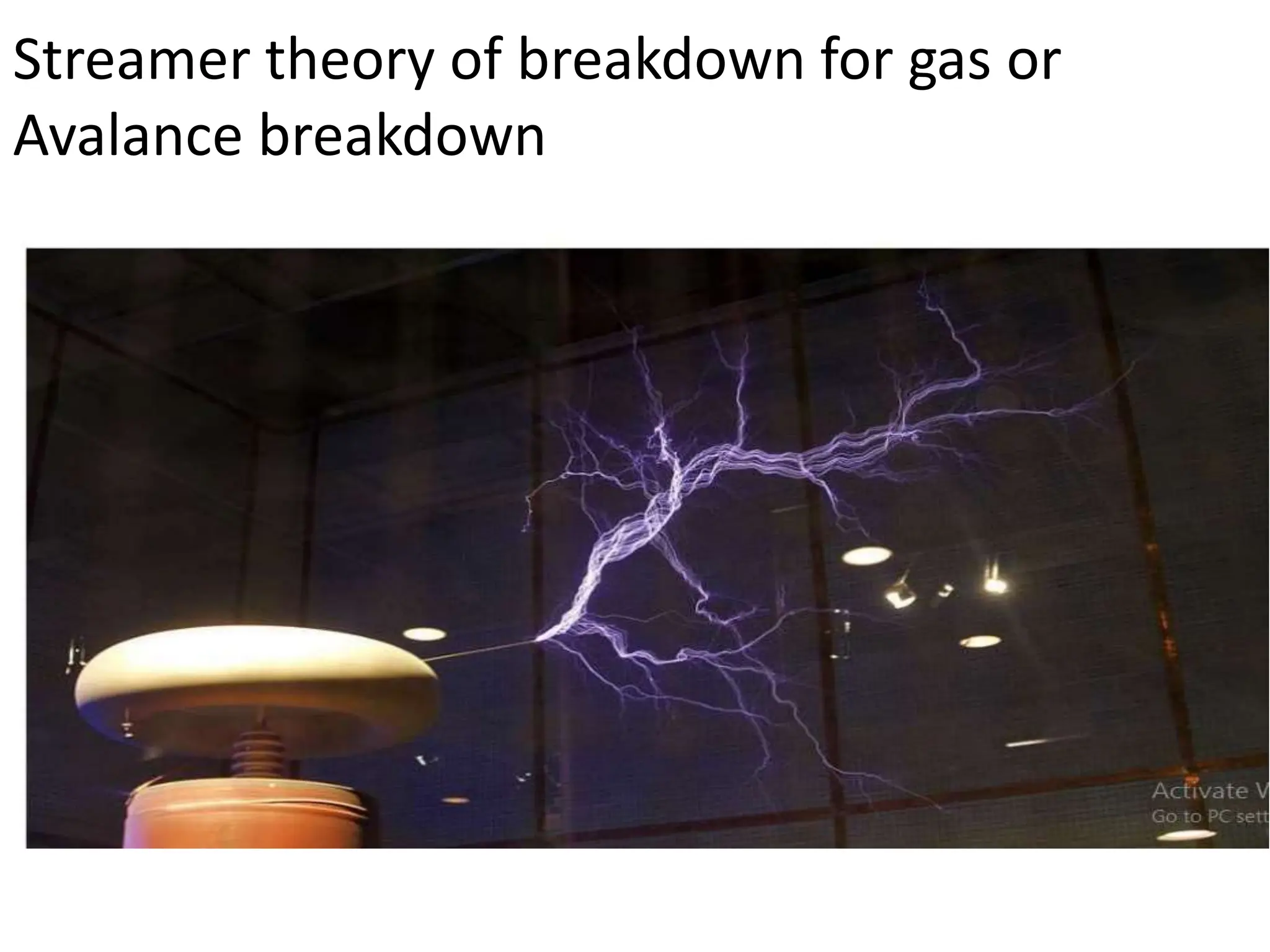
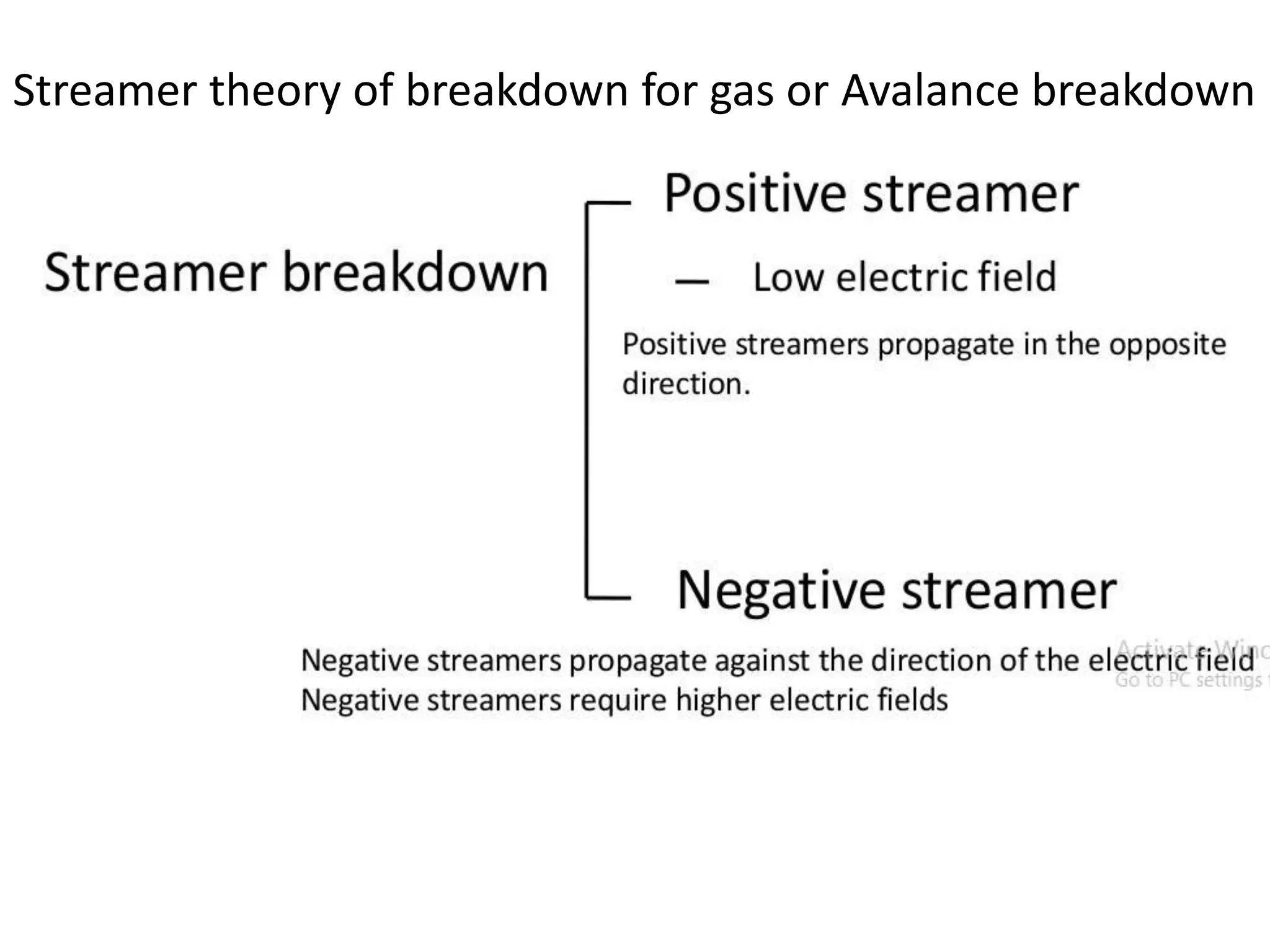
Streamer theory of breakdown for gas or Avalance breakdown
Streamer theory of breakdown for gas or
Avalance breakdown
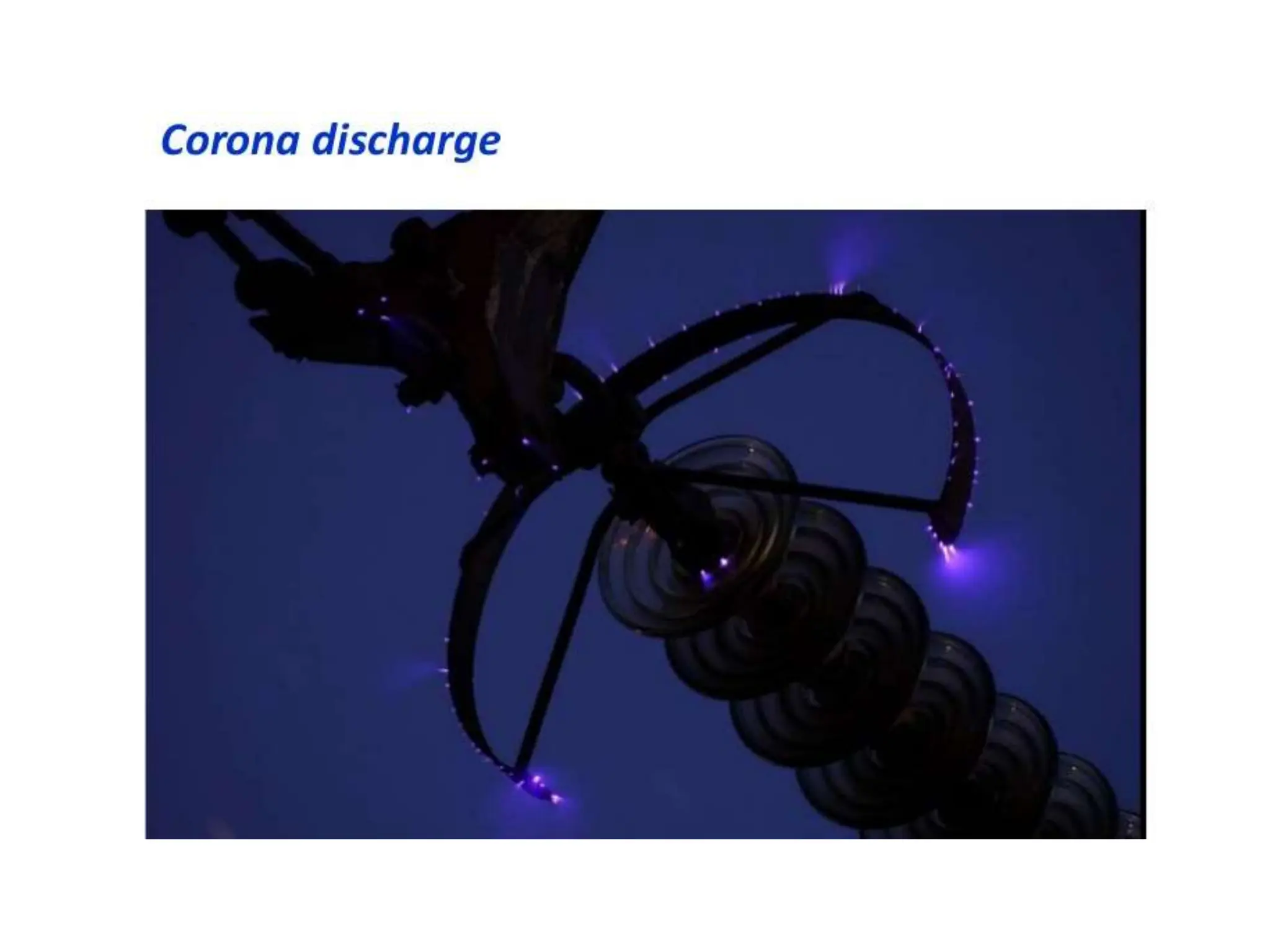
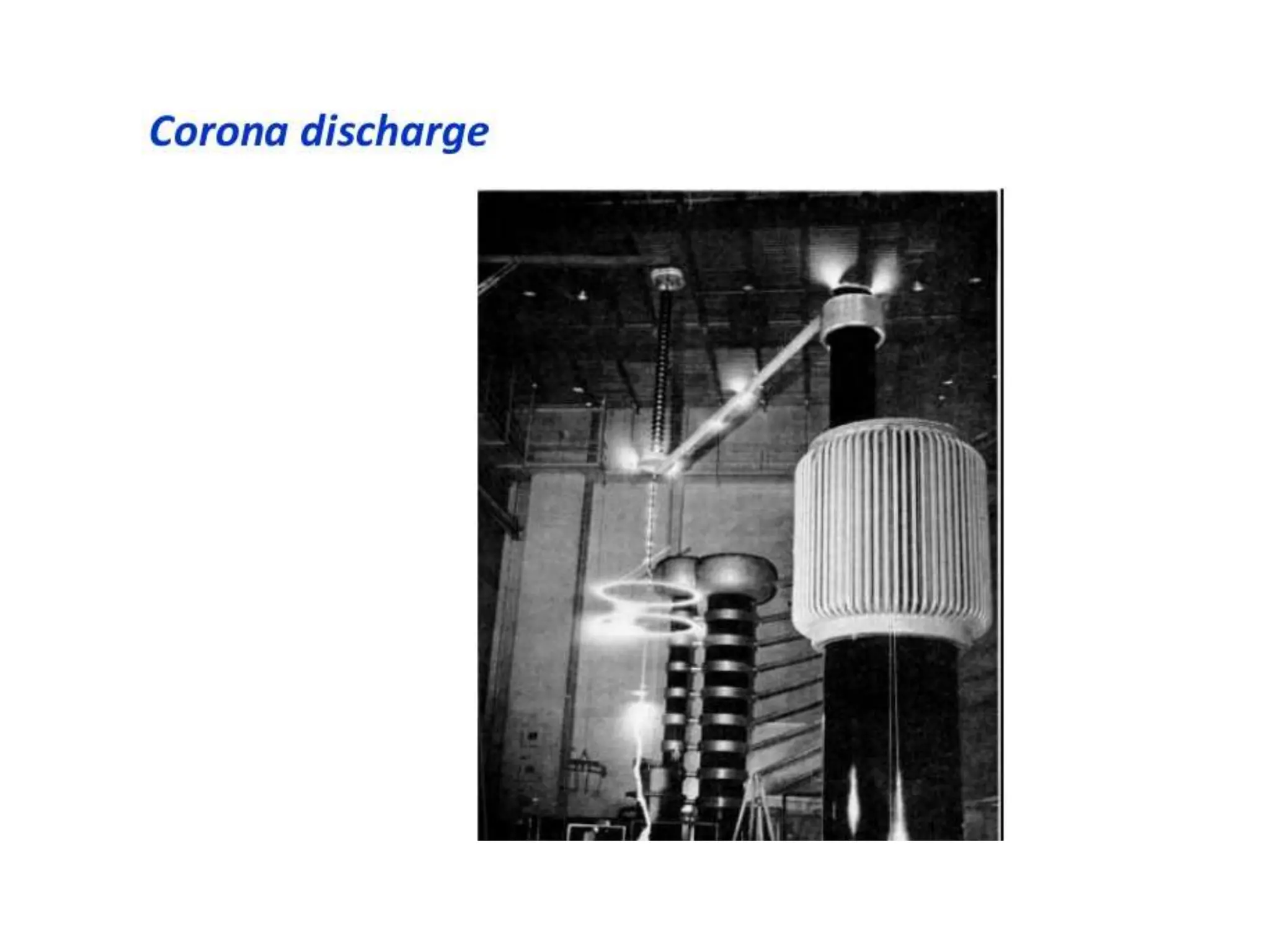
Corona discharge.....?
• It is an electric discharge mainly occuring at non
uniform electric field
• Visual and audible discharge
• The corona will occur when the strength of the
electric field around a conductor is high enough to
form a conductive region, but not high enough to
cause electrical breakdown or arcing to nearby objects.
• It is often seen as a bluish (or other color) glow in
the air adjacent to pointed metal conductors carrying
high voltages, and emits light by the same property as
a gas discharge lamp.
• Potential difference between two electrodes should
be greater than thershould value (30kV).
Results of corona
• Power loss
• Hissing noise
• Ozon formation
• Chemical activities
Factors affecting corona
• Air density & Humidity are inversely
proportional to corona.
• Surface conduction is proportional to corona.
Problems associated with corona
• Ozon (O3) , Nitric acid & Nitrogen oxide (Nox)
production
• Electromagnetic interference
• Audible noise
• Insulation losses
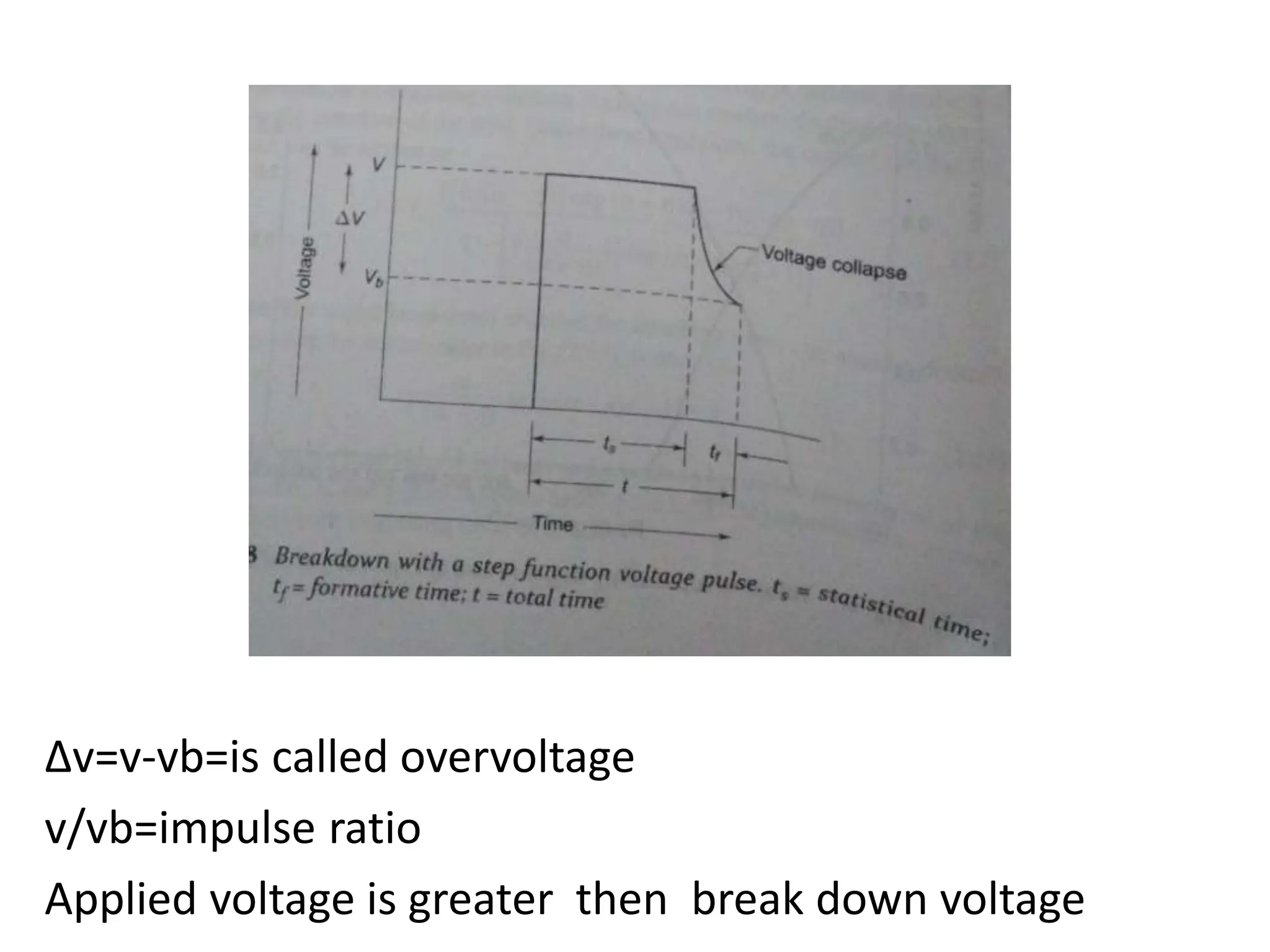
∆v=v-vb=is called overvoltage
v/vb=impulse ratio
Applied voltage is greater then break down voltage
module 1 HVE_Gases.pptx

module 1 HVE_Gases.pptx

  • 1.
    Module 1 • Conductionand Breakdown in Gases: Gases as Insulating Media, Collision Process, Ionization Processes, Townsend's Current Growth Equation, Current Growth in the Presence of Secondary Processes, Townsend's Criterion for Breakdown, Experimental Determination of Coefficients α and γ, Breakdown in Electronegative Gases, Time Lags for Breakdown, Streamer Theory of Breakdown in Gases, Paschen's Law, Breakdown in Non-Uniform Fields and Corona Discharges. • Conduction and Breakdown in Liquid Dielectrics: Liquids as Insulators, Pure Liquids and Commercial Liquids, Conduction and Breakdown in Pure Liquids, Conduction and Breakdown in Commercial Liquids. • Breakdown in Solid Dielectrics: Introduction, Intrinsic Breakdown, Electromechanical Breakdown, Thermal Breakdown.
  • 2.
    Breakdown in soliddielectrics: Intrinsic Breakdown, avalanche breakdown, thermal breakdown, and electro mechanic breakdown. Breakdown of liquid dielectrics: Suspended particle theory, electronic Breakdown, cavity breakdown (bubble’s theory), electro convection breakdown
  • 3.
    Dielectrics or Dielectricmaterial What is Dielectrics………………….? • Dielectric material is a poor conductor of electricity. • But it can be conducted by applying high electric field. • It is an efficient supporter of electric field. • Whenever we are applying electric field the position of ions get changed and support for electricity conduction. • Examples of dielectric materials are mica, glass, ceramics etc.
  • 4.
    Dielectric Strength Definition……? •The dielectric strength of an insulating material is defined as the maximum dielectric stress with the material can withstand. Factors affecting Dielectric strength • Pressure • Temperature • Humidity • Nature of applied voltage • Imperfection of material
  • 5.
    Types of Dielectrics DielectricsGas or Vacuum Dielectrics Liquid Dielectrics Solid Dielectrics Composite Dielectrics
  • 6.
    Gas or VacuumDielectrics • It has high dielectric strength (10^7 V/cm) • Breakdown occur in the gas or vacuum is due to collisional ionization. (Ionization by collision) • If the applied voltage is sufficiently large electrons are multiplied in an exponential manner & breakdown will be occurred. • Examples- Sulpher Hexa Fluoride, CO2 etc
  • 7.
    Types of LiquidDielectrics • The liquid dielectric are used in HV equipment for dual purpose of insulation & heat dissipation. • Temporary failure can be quickly re- insulated by the liquid flow to the affected area. • Highly purified liquid is more suitable to serve as a dielectric medium
  • 8.
    • Dielectric strengthis up to 1 MV/cm • Breakdown strength reduces due to impurities. • Selection of liquid dielectric is based on dielectric strength, viscosity, stability, flash point, gas constant etc • Examples- Petroleum, transformer oil (Mineral oil) etc • Applications- Area where equipments is continuously operated like Distribution Transformer
  • 9.
    Solid Dielectrics • Ithas good mechanical strength & bonding capability. • Dielectric strength – 10MV/cm • Examples- Inorganic materials (Ceramics, glass etc) , Organic materials(PVC, Polyethylene, natural rubber etc) • Application- Electrical apparatus
  • 10.
    Composite Dielectrics • Combinationof more than two kinds of insulators • Chemically stable • Long life span • But dielectric constant of two material should match • Two insulators never react together. • Examples – Oil impregnated paper, Oil impregnated metalized plastic film.
  • 11.
    Analysis on GaseousDielectrics Desirable properties of gaseous dielectric materials • A good dielectric gas should have high dielectric strength • High thermal stability • Chemical inertness • Non inflammability • Low toxicity • Low boiling point • Good heat transfer properties
  • 12.
    Gaseous Dielectrics Ionizationprocess • When a high voltage is applied in between two electrodes immersed in a gaseous medium, the gas becomes conductor & dielectric breakdown occurs. • The processes that are primarily responsible for the breakdown of gas are Primary ionization process & secondary ionization process.
  • 13.
    Ionization process 1.Primary ionizationprocess Gaseous Dielectrics Ionization by collision Photo ionization 2.Secondary Ionization Process
  • 14.
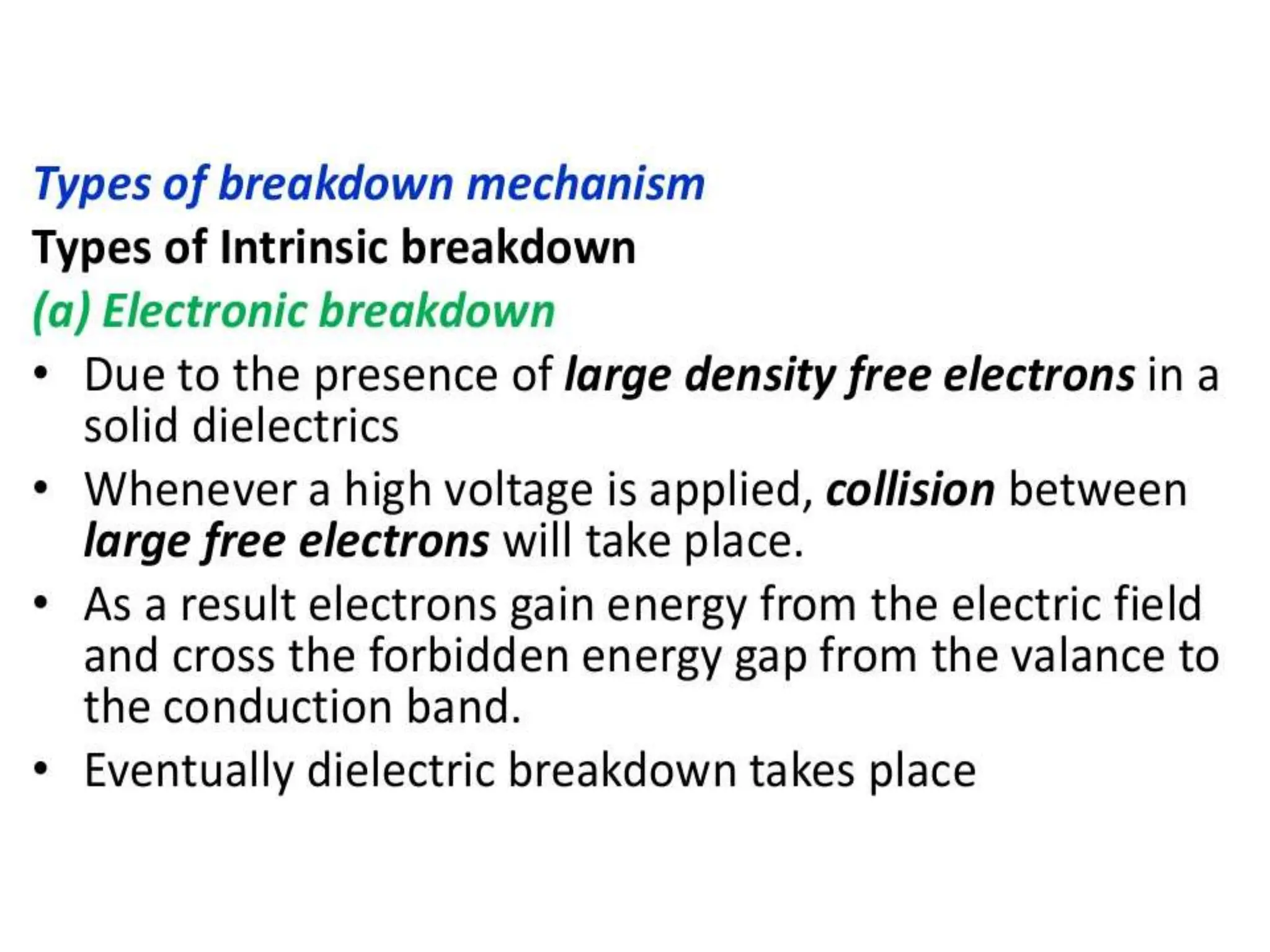
    Ionization process Ionizationby collision (Primary ionization) • The process of liberating an electron from a gas molecule with the simultaneous production of a positive ion is called ionization. • In the process of ionization by collision, a free electron collides with a neutral gas molecule and gives rise to a new electron and a positive ion. • As a result electron is moving towards anode
  • 24.
    Townsend’s theory Townsend’sfirst ionization coefficient (α) • It is defined as the average number of ionizing collisions made by an electron per centimeter travel in the direction of the field • ‘α’ depends upon Pressure (P) and Electric field in V/cm (E) • ‘ α ’proportional to (E/P)
  • 34.
    Limitation of Townsendstheory • Atmospheric pressure is not considered into account • No explanation for the relation “α” proportional to “(E/P)” • Townsends suggest that breakdown of gas dielectric is based on ionization only. Later on it is found that breakdown of gas which is depends on geometry of gap and air pressure • Applicable only in uniform electric field
  • 37.
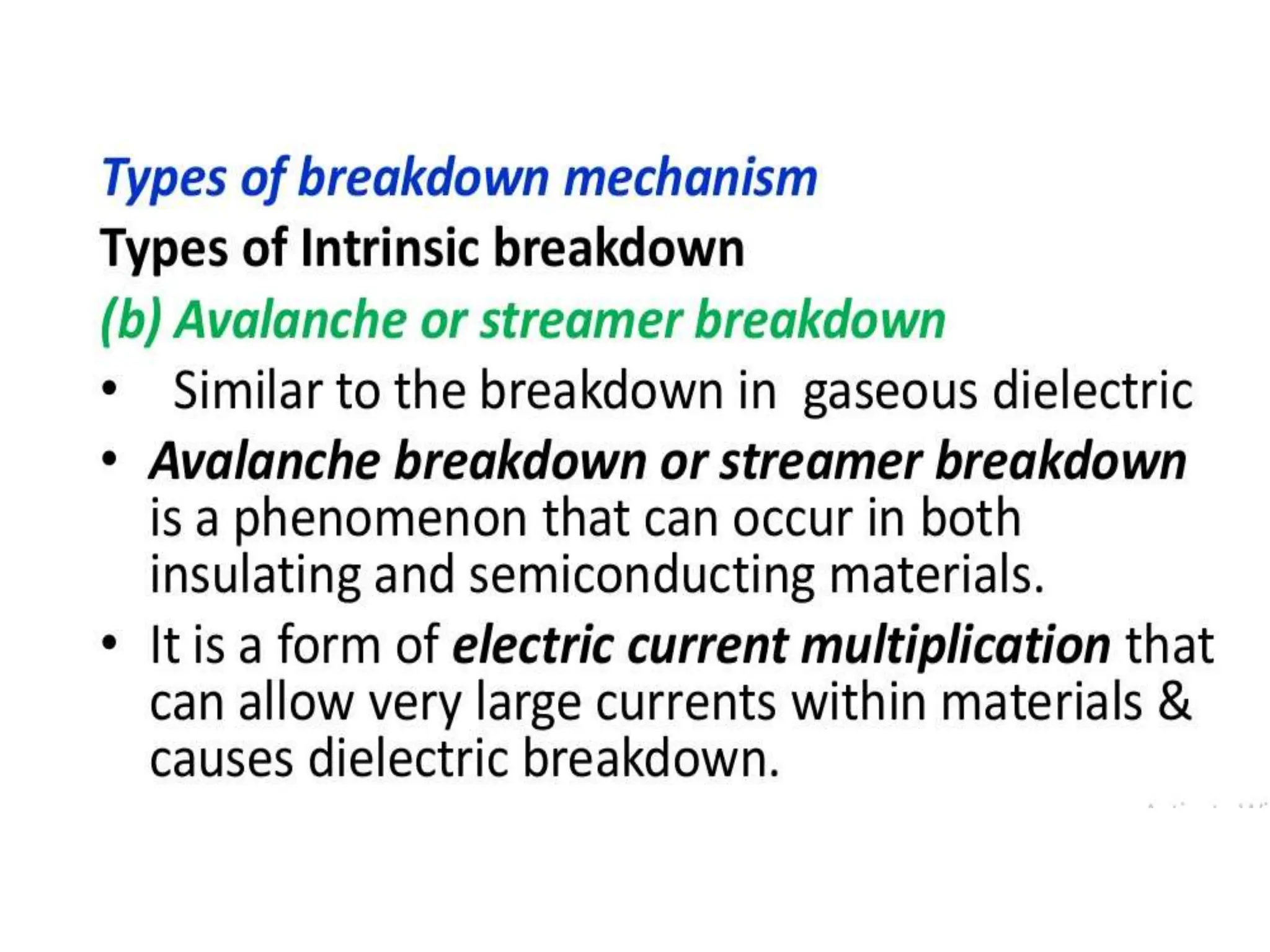
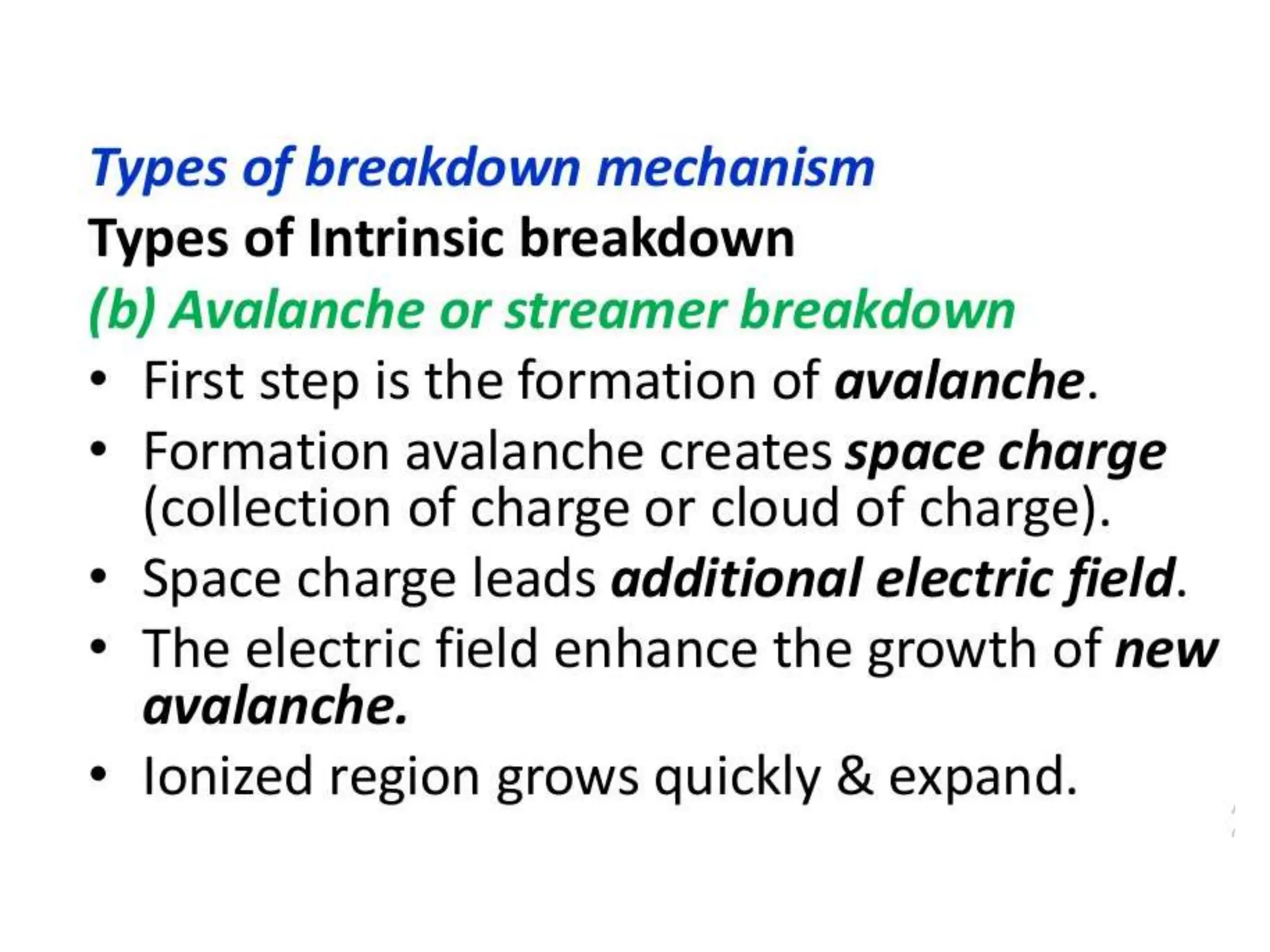
    Streamer theory ofbreakdown for gas or Avalance breakdown • Streamer breakdown occur when the dielectric medium is exposed to a high voltage difference. • First step is the formation of avalanche. • Formation avalanche creates space charge (collection of charge or cloud of charge). • Space charge leads additional electric field. • The electric field enhance the growth of new avalanche. • Ionised region grows quickly & expand.
  • 38.
    • Applicable fornon uniform electric field • When the energy gained by the electrons greater than lattice ionization potential formation of streamer takes palace. (Condition for streamer breakdown) • Breakdown occur when avalanche exceeds critical size & formation of many avalanche. • Streamer ionise the path & production of large current. • Breakdown will be occurred.
  • 39.
    Streamer theory ofbreakdown for gas or Avalance breakdown
  • 41.
    Streamer theory ofbreakdown for gas or Avalance breakdown
  • 42.
    Corona discharge.....? • Itis an electric discharge mainly occuring at non uniform electric field • Visual and audible discharge • The corona will occur when the strength of the electric field around a conductor is high enough to form a conductive region, but not high enough to cause electrical breakdown or arcing to nearby objects. • It is often seen as a bluish (or other color) glow in the air adjacent to pointed metal conductors carrying high voltages, and emits light by the same property as a gas discharge lamp. • Potential difference between two electrodes should be greater than thershould value (30kV).
  • 43.
    Results of corona •Power loss • Hissing noise • Ozon formation • Chemical activities
  • 46.
    Factors affecting corona •Air density & Humidity are inversely proportional to corona. • Surface conduction is proportional to corona. Problems associated with corona • Ozon (O3) , Nitric acid & Nitrogen oxide (Nox) production • Electromagnetic interference • Audible noise • Insulation losses
  • 56.
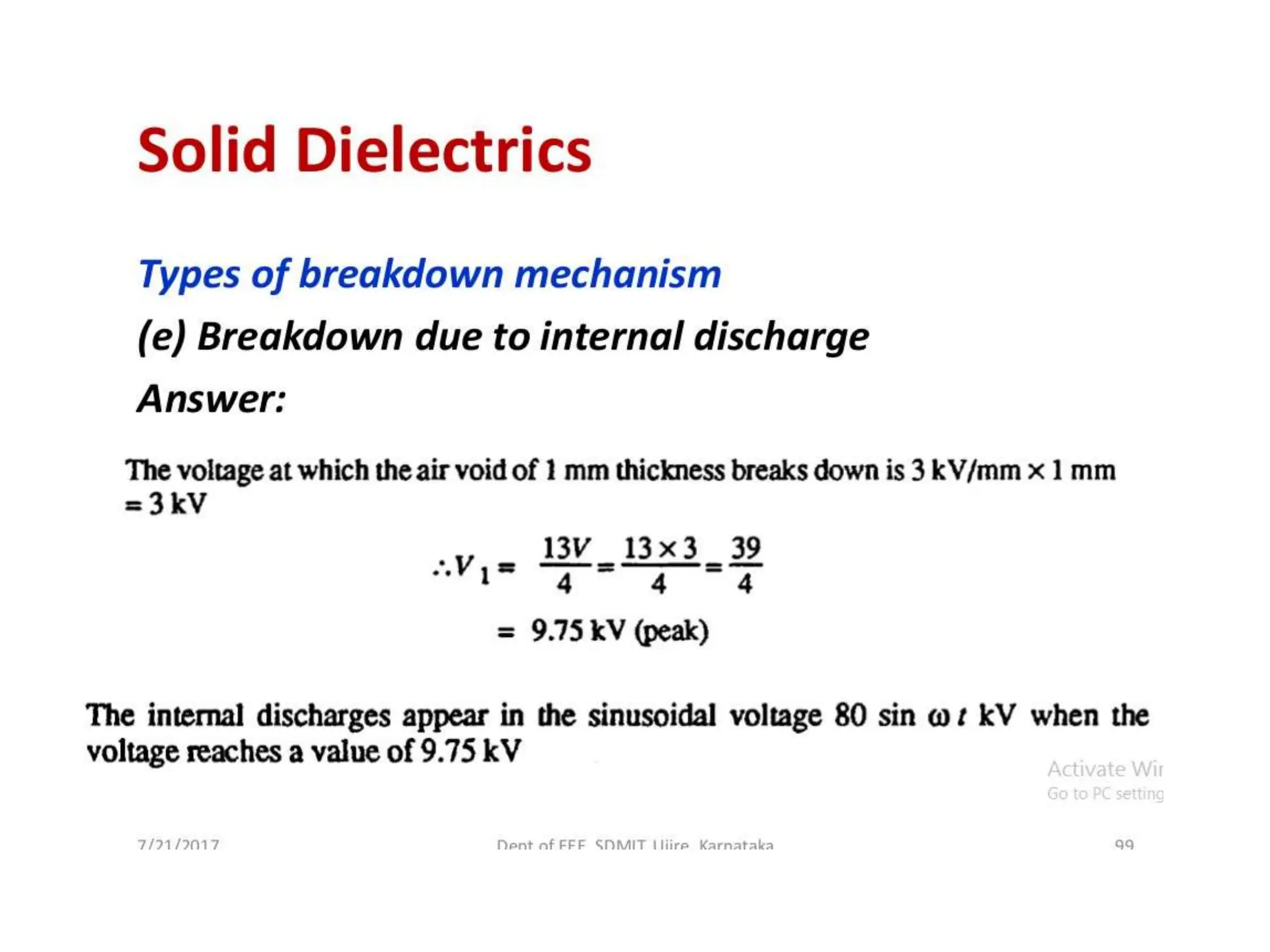
    ∆v=v-vb=is called overvoltage v/vb=impulseratio Applied voltage is greater then break down voltage