OUTLINE:
Ionization Process
Gases as Insulating Medium
Secondary Ionization
Cathode Process
Types of Cathode Processes
Ionization Process
• The process of liberating an electron
from a gas molecule with the
simultaneous production of ions.
• Gas turns into a conductor when a high
voltage is delivered between two
electrodes positioned between a
gaseous medium, leading to an
electrical breakdown.
• Ionization is divided into three parts:
primary, secondary ionization
processes and electron attachment
process.
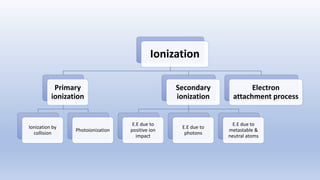
Ionization
Primary
ionization
Ionization by
collision
Photoionization
Secondary
ionization
E.E due to
positive ion
impact
E.E due to
photons
E.E due to
metastable &
neutral atoms
Electron
attachment process
Gases as Insulating
Media
• The electrical discharges in gases are of
two types
i. Non-sustaining discharges
ii. Self-sustaining discharges
• The breakdown in a gas, called spark
breakdown, is the transition of a non-
sustaining discharge into a self-
sustaining discharge.
• The build-up of high currents in a
breakdown is due to ionization process.
Gases as Insulating
Media
• At present two types of theories are
known which explain the mechanism for
breakdown under different conditions:
i. Townsend’s Theory
ii. Streamer Theory
• Examples of gas dielectric: air, nitrogen,
carbon dioxide, SF6 etc.
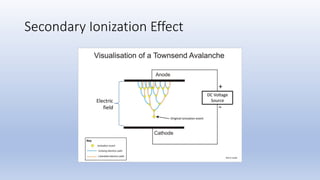
Secondary Ionization Effect
• Primary ionization effect causes discharges to occur in the gas, but these
gas discharges are not self-sustaining until provided with electrons.
• Secondary ionization processes (by which secondary electrons are
produced) are the ones which sustain a discharge after it is established due
to primary ionization processes (ionization by collision and photo-
ionization).
• Cathode plays an important role in gas discharges by supplying electrons
for the initiation, sustenance and completion of a discharge.
Secondary Ionization Effect
Cathode Processes
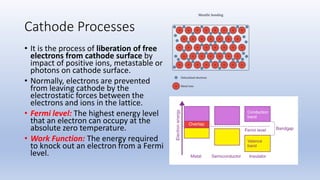
• It is the process of liberation of free
electrons from cathode surface by
impact of positive ions, metastable or
photons on cathode surface.
• Normally, electrons are prevented
from leaving cathode by the
electrostatic forces between the
electrons and ions in the lattice.
• Fermi level: The highest energy level
that an electron can occupy at the
absolute zero temperature.
• Work Function: The energy required
to knock out an electron from a Fermi
level.
Types of Cathode Processes
• There are several ways in which required energy may be supplied to
release the electrons.
1. Photoelectric Emission
2. Electron Emission by Positive Ion and Excited Atom Impact (Metastable
Atoms)
3. Thermionic Emission
4. Field Emission
Types of Cathode Processes
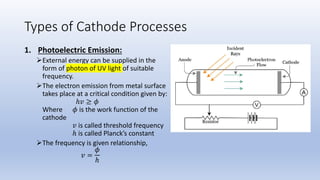
1. Photoelectric Emission:
External energy can be supplied in the
form of photon of UV light of suitable
frequency.
The electron emission from metal surface
takes place at a critical condition given by:
ℎ𝑣 ≥ 𝜙
Where 𝜙 is the work function of the
cathode
𝑣 is called threshold frequency
ℎ is called Planck’s constant
The frequency is given relationship,
𝑣 =
𝜙
ℎ
Types of Cathode Processes
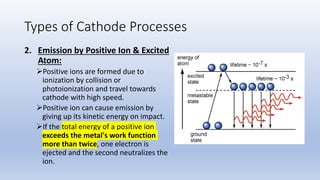
2. Emission by Positive Ion & Excited
Atom:
Positive ions are formed due to
ionization by collision or
photoionization and travel towards
cathode with high speed.
Positive ion can cause emission by
giving up its kinetic energy on impact.
If the total energy of a positive ion
exceeds the metal's work function
more than twice, one electron is
ejected and the second neutralizes the
ion.
Types of Cathode Processes
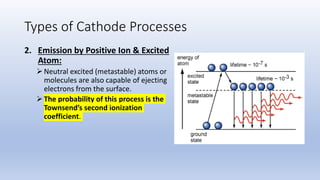
2. Emission by Positive Ion & Excited
Atom:
Neutral excited (metastable) atoms or
molecules are also capable of ejecting
electrons from the surface.
The probability of this process is the
Townsend’s second ionization
coefficient.
Types of Cathode Processes
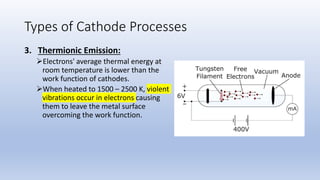
3. Thermionic Emission:
Electrons' average thermal energy at
room temperature is lower than the
work function of cathodes.
When heated to 1500 – 2500 K, violent
vibrations occur in electrons causing
them to leave the metal surface
overcoming the work function.
Types of Cathode Processes
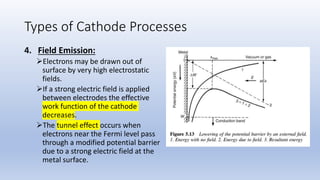
4. Field Emission:
Electrons may be drawn out of
surface by very high electrostatic
fields.
If a strong electric field is applied
between electrodes the effective
work function of the cathode
decreases.
The tunnel effect occurs when
electrons near the Fermi level pass
through a modified potential barrier
due to a strong electric field at the
metal surface.
THAN
K YOU

Cathode Processes and its Types.pptx

  • 2.
    OUTLINE: Ionization Process Gases asInsulating Medium Secondary Ionization Cathode Process Types of Cathode Processes
  • 3.
    Ionization Process • Theprocess of liberating an electron from a gas molecule with the simultaneous production of ions. • Gas turns into a conductor when a high voltage is delivered between two electrodes positioned between a gaseous medium, leading to an electrical breakdown. • Ionization is divided into three parts: primary, secondary ionization processes and electron attachment process.
  • 4.
    Ionization Primary ionization Ionization by collision Photoionization Secondary ionization E.E dueto positive ion impact E.E due to photons E.E due to metastable & neutral atoms Electron attachment process
  • 5.
    Gases as Insulating Media •The electrical discharges in gases are of two types i. Non-sustaining discharges ii. Self-sustaining discharges • The breakdown in a gas, called spark breakdown, is the transition of a non- sustaining discharge into a self- sustaining discharge. • The build-up of high currents in a breakdown is due to ionization process.
  • 6.
    Gases as Insulating Media •At present two types of theories are known which explain the mechanism for breakdown under different conditions: i. Townsend’s Theory ii. Streamer Theory • Examples of gas dielectric: air, nitrogen, carbon dioxide, SF6 etc.
  • 7.
    Secondary Ionization Effect •Primary ionization effect causes discharges to occur in the gas, but these gas discharges are not self-sustaining until provided with electrons. • Secondary ionization processes (by which secondary electrons are produced) are the ones which sustain a discharge after it is established due to primary ionization processes (ionization by collision and photo- ionization). • Cathode plays an important role in gas discharges by supplying electrons for the initiation, sustenance and completion of a discharge.
  • 8.
  • 9.
    Cathode Processes • Itis the process of liberation of free electrons from cathode surface by impact of positive ions, metastable or photons on cathode surface. • Normally, electrons are prevented from leaving cathode by the electrostatic forces between the electrons and ions in the lattice. • Fermi level: The highest energy level that an electron can occupy at the absolute zero temperature. • Work Function: The energy required to knock out an electron from a Fermi level.
  • 10.
    Types of CathodeProcesses • There are several ways in which required energy may be supplied to release the electrons. 1. Photoelectric Emission 2. Electron Emission by Positive Ion and Excited Atom Impact (Metastable Atoms) 3. Thermionic Emission 4. Field Emission
  • 11.
    Types of CathodeProcesses 1. Photoelectric Emission: External energy can be supplied in the form of photon of UV light of suitable frequency. The electron emission from metal surface takes place at a critical condition given by: ℎ𝑣 ≥ 𝜙 Where 𝜙 is the work function of the cathode 𝑣 is called threshold frequency ℎ is called Planck’s constant The frequency is given relationship, 𝑣 = 𝜙 ℎ
  • 12.
    Types of CathodeProcesses 2. Emission by Positive Ion & Excited Atom: Positive ions are formed due to ionization by collision or photoionization and travel towards cathode with high speed. Positive ion can cause emission by giving up its kinetic energy on impact. If the total energy of a positive ion exceeds the metal's work function more than twice, one electron is ejected and the second neutralizes the ion.
  • 13.
    Types of CathodeProcesses 2. Emission by Positive Ion & Excited Atom: Neutral excited (metastable) atoms or molecules are also capable of ejecting electrons from the surface. The probability of this process is the Townsend’s second ionization coefficient.
  • 14.
    Types of CathodeProcesses 3. Thermionic Emission: Electrons' average thermal energy at room temperature is lower than the work function of cathodes. When heated to 1500 – 2500 K, violent vibrations occur in electrons causing them to leave the metal surface overcoming the work function.
  • 15.
    Types of CathodeProcesses 4. Field Emission: Electrons may be drawn out of surface by very high electrostatic fields. If a strong electric field is applied between electrodes the effective work function of the cathode decreases. The tunnel effect occurs when electrons near the Fermi level pass through a modified potential barrier due to a strong electric field at the metal surface.
  • 16.

Editor's Notes

  • #12 Excess energy, when photon energy is more than work function, can be transferred to the electron in the form of kinetic energy.
  • #13 Excess energy, when photon energy is more than work function, can be transferred to the electron in the form of kinetic energy.
  • #14 Excess energy, when photon energy is more than work function, can be transferred to the electron in the form of kinetic energy.
  • #15 Excess energy, when photon energy is more than work function, can be transferred to the electron in the form of kinetic energy.
  • #16 Excess energy, when photon energy is more than work function, can be transferred to the electron in the form of kinetic energy.