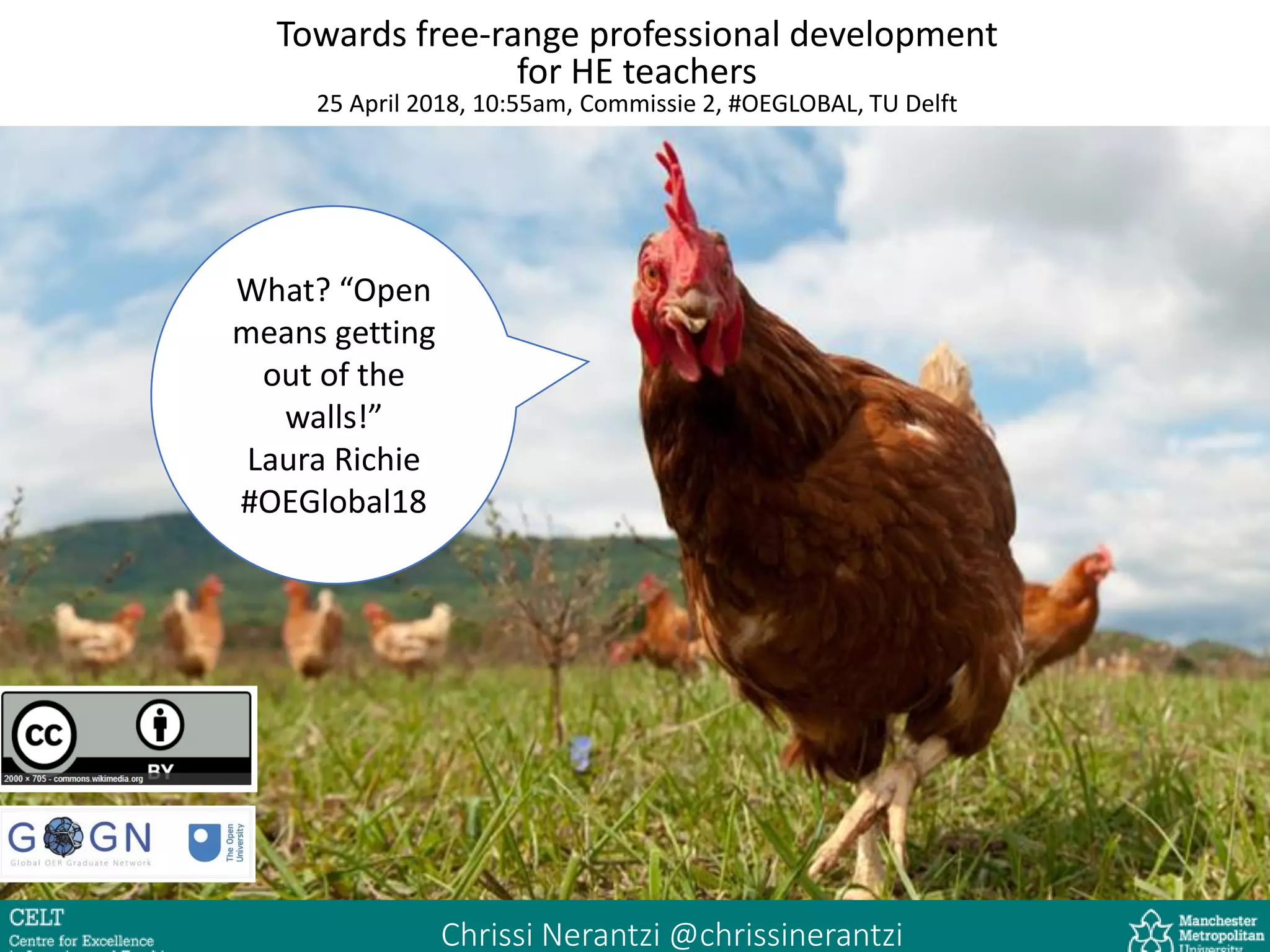
Towards free-range professional development
for HE teachers
25 April 2018, 10:55am, Commissie 2, #OEGLOBAL, TU Delft
What? “Open
means getting
out of the
walls!”
Laura Richie
#OEGlobal18
Chrissi Nerantzi @chrissinerantzi
https://www.google.co.uk/maps/@51.6110033,-
8.8601238,3416532m/data=!3m1!1e3
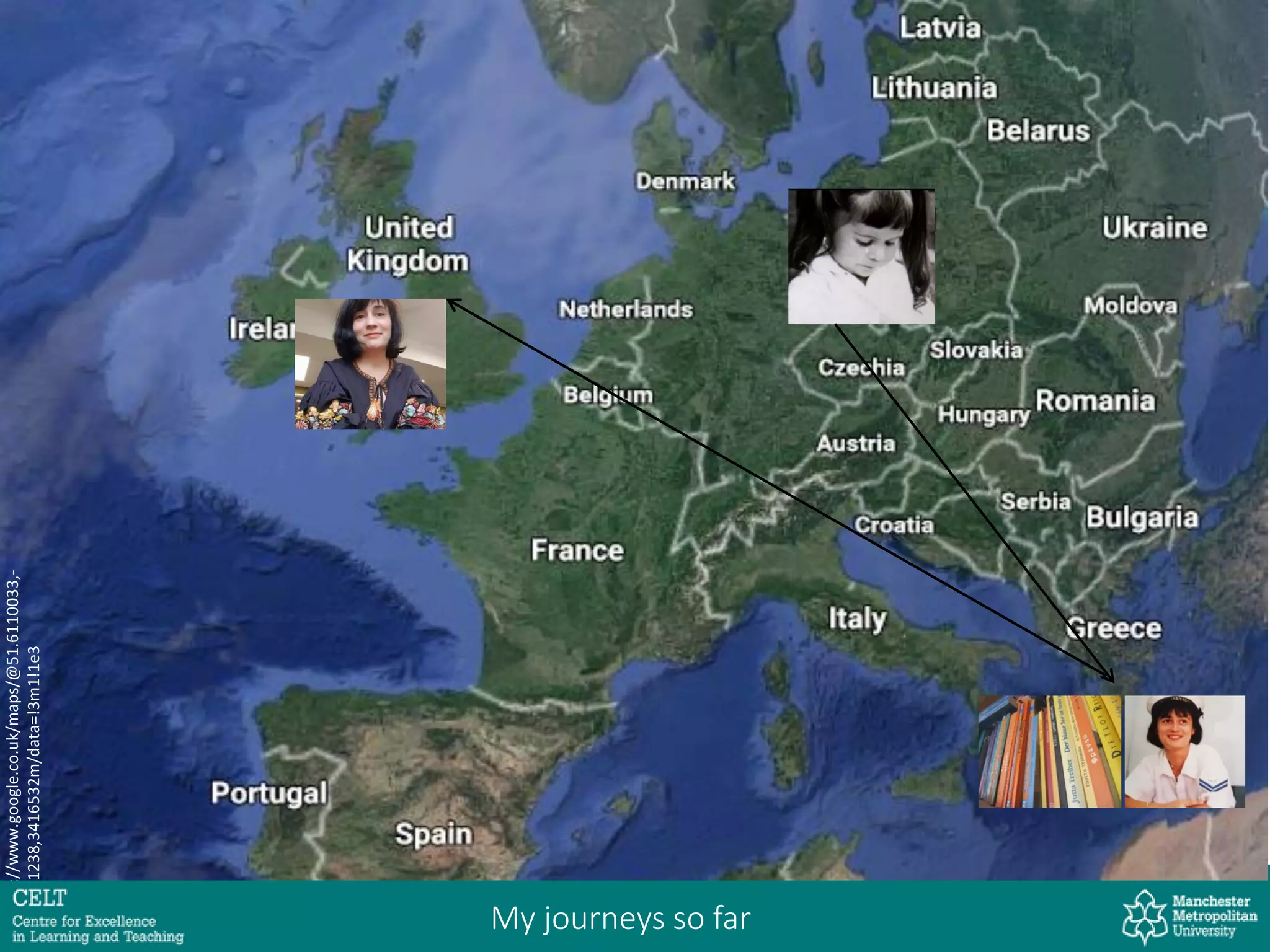
My journeys so far
Overview
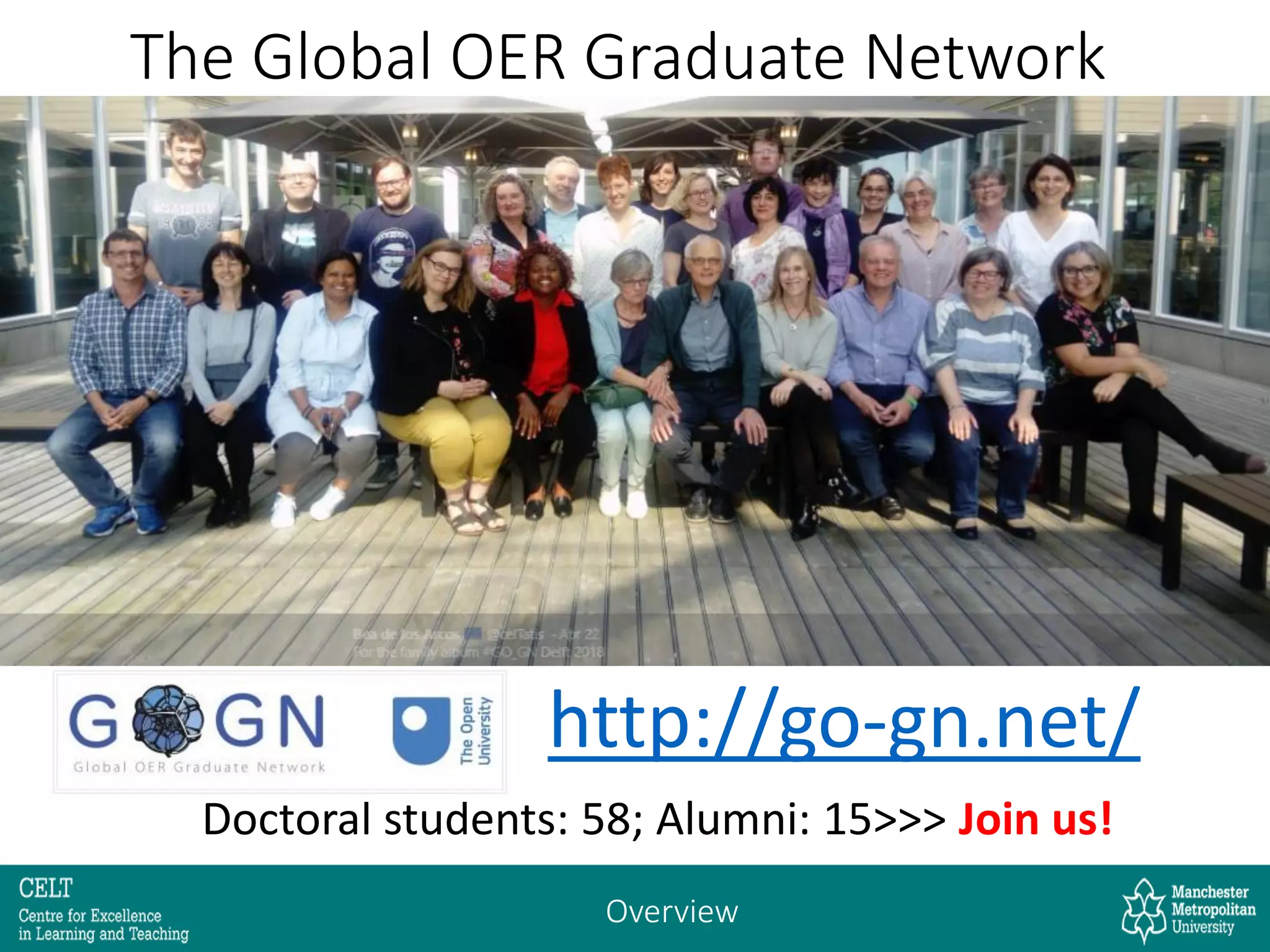
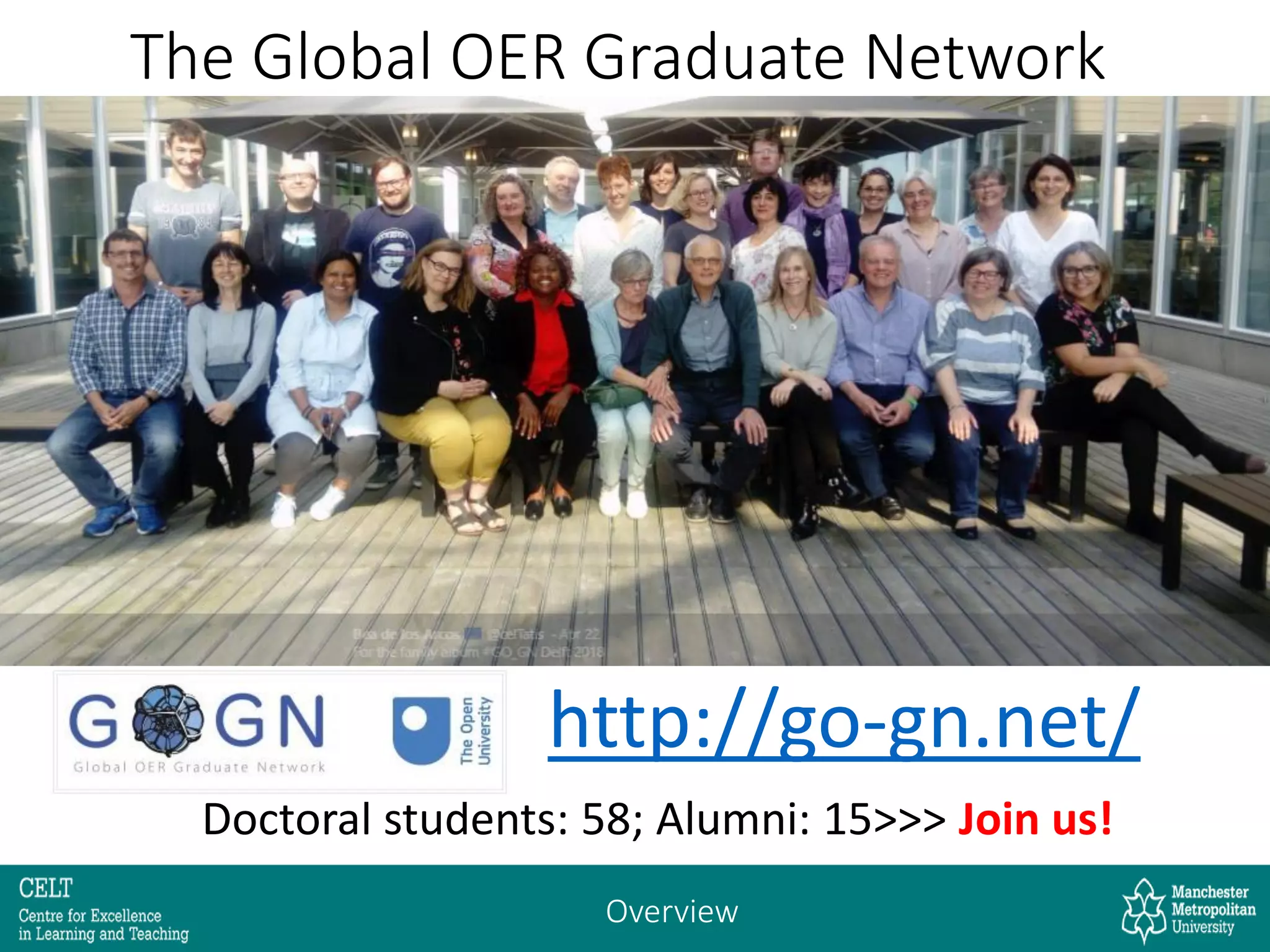
The Global OER Graduate Network
Doctoral students: 58; Alumni: 15>>> Join us!
http://go-gn.net/
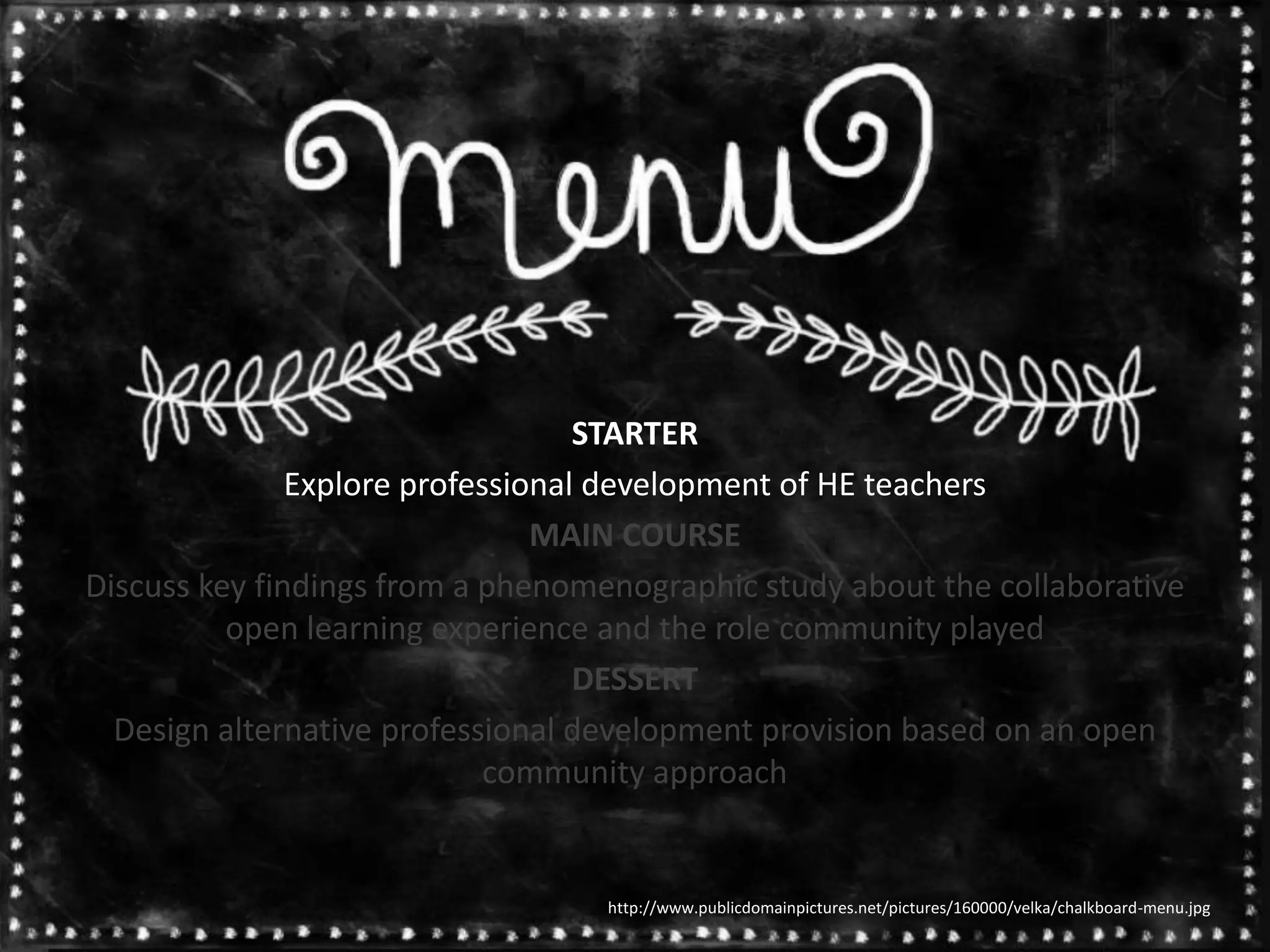
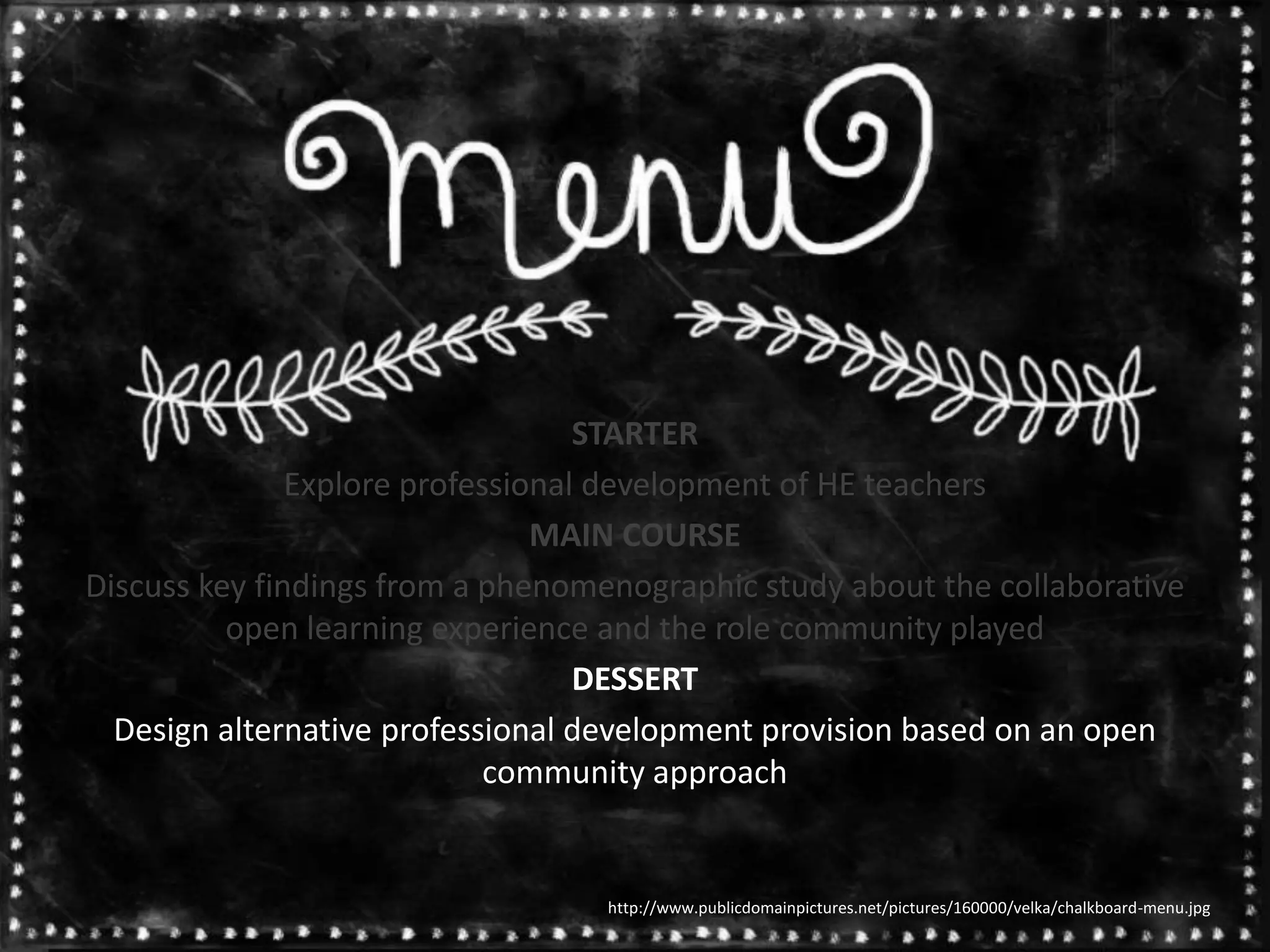
STARTER
Explore professional development of HE teachers
MAIN COURSE
Discuss key findings from a phenomenographic study about the collaborative
open learning experience and the role community played
DESSERT
Design alternative professional development provision based on an open
community approach
http://www.publicdomainpictures.net/pictures/160000/velka/chalkboard-menu.jpg
STARTER
Explore professional development of HE teachers
MAIN COURSE
Discuss key findings from a phenomenographic study about the collaborative
open learning experience and the role community played
DESSERT
Design alternative professional development provision based on an open
community approach
http://www.publicdomainpictures.net/pictures/160000/velka/chalkboard-menu.jpg
A reality?
Another reality?
• Paul Stacey >>> vision … boundaryless, he with all ed sector, other stakeholders... emphasis on
collaboration but also communities and other stakeholder, companies
• Tim van dear Hagen >>> Building bridges, connected working HE and outside
• Erin McKiernan, different open communities are still working, meeting separately, she called for
more joined up thinking
• UNESCO panel >>> we need to do cross-polinisation not just among like-minded people,
working with people who work differently than us, boundary crossing
• Erin McKiernan >>> Open communities separated... value in bringing them together
• Rob Farrow >>> diverse combinations, preferring difference over uniformity... in the context of
open society
• Laura Ritchie >>> open means getting out of the walls, locally or globally, connect with other
communities, businesses, learning with students
• Robert Schuwer > >> TU Delft project in Mathematics and Nursing project from Fontys
University of Applied Sciences, both cross-institutional collaborations, focus on building
communities
#OEGlobal18 discussions
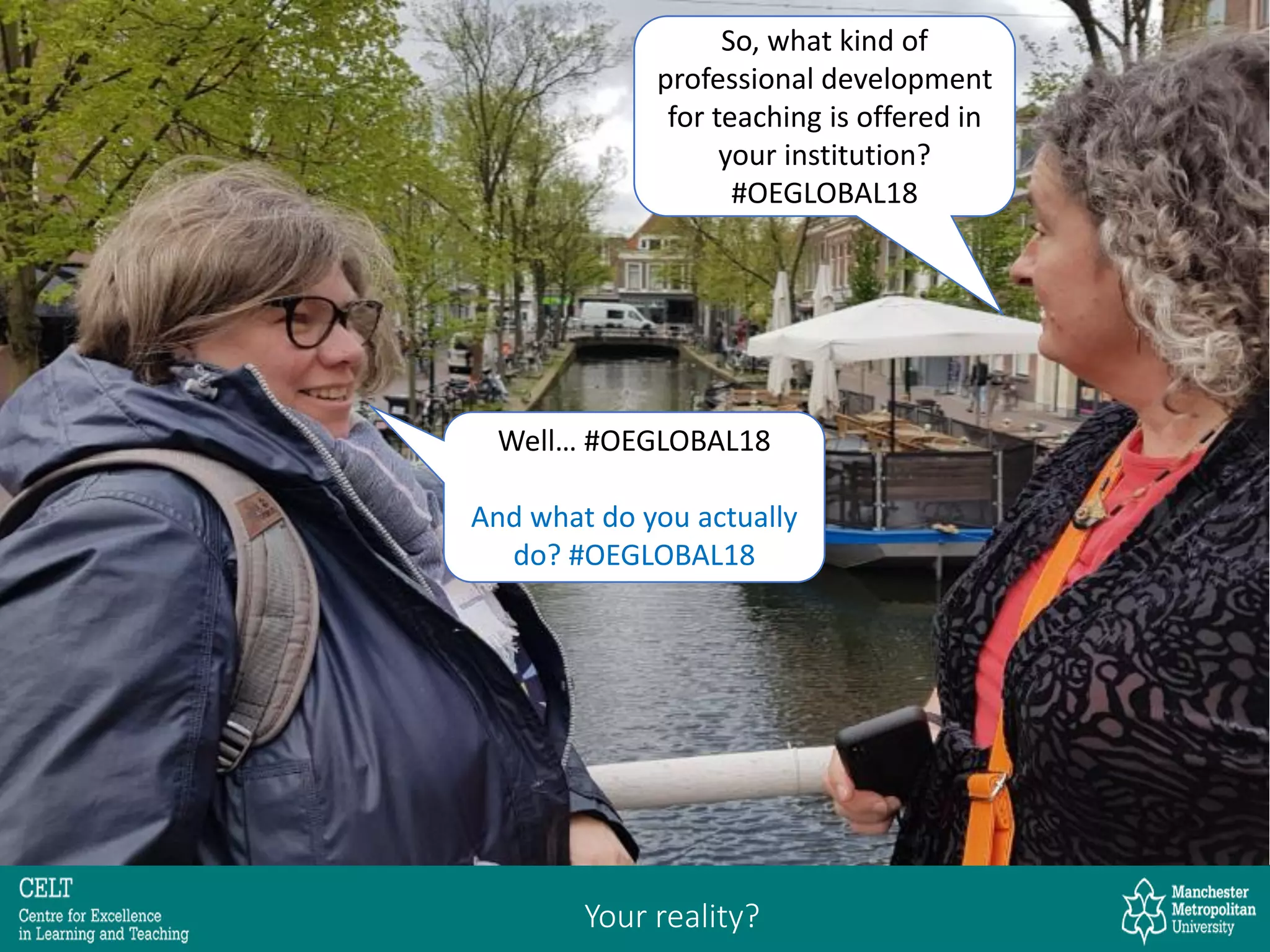
Your reality?
So, what kind of
professional development
for teaching is offered in
your institution?
#OEGLOBAL18
Well… #OEGLOBAL18
And what do you actually
do? #OEGLOBAL18
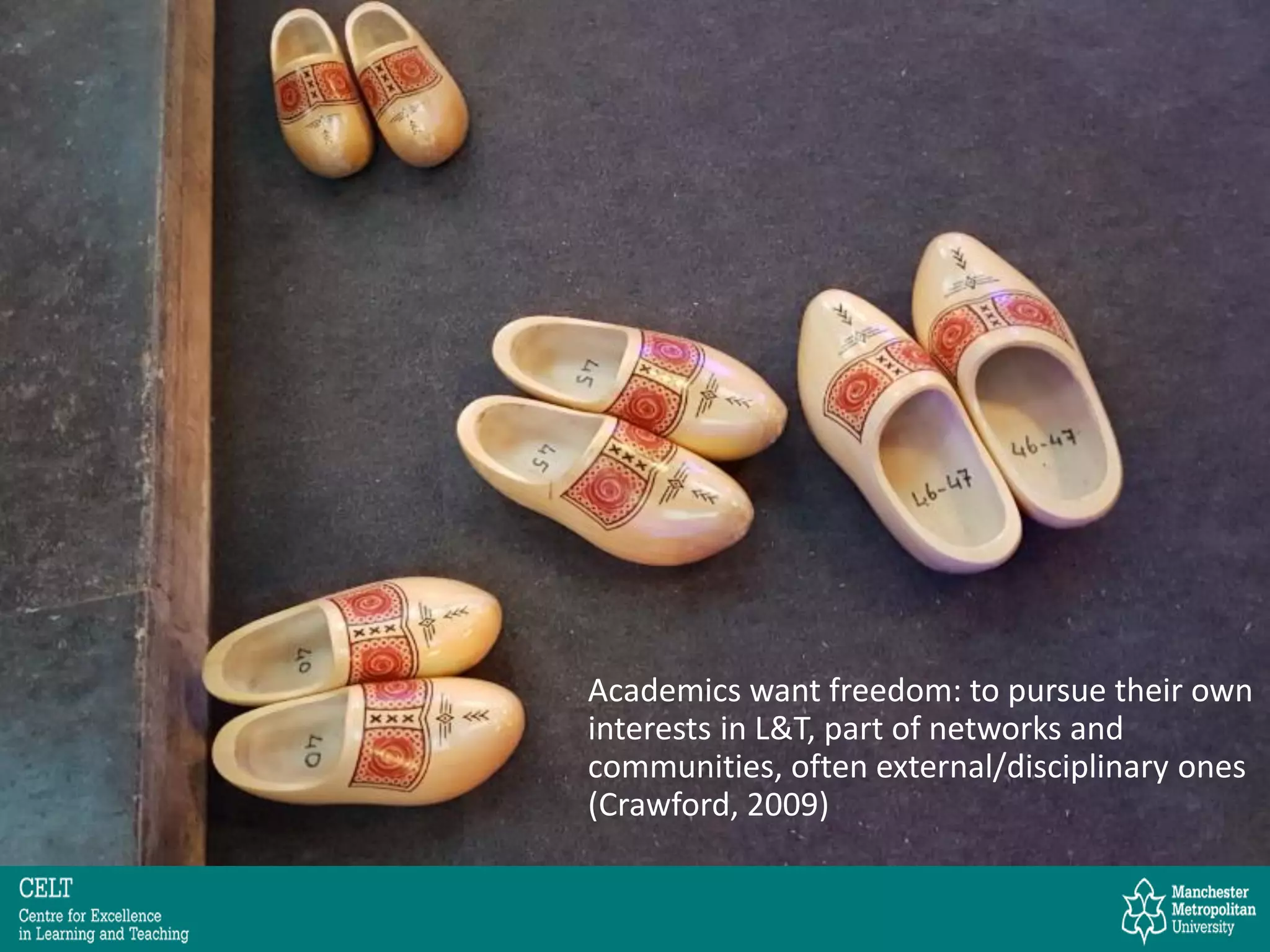
Academics want freedom: to pursue their own
interests in L&T, part of networks and
communities, often external/disciplinary ones
(Crawford, 2009)
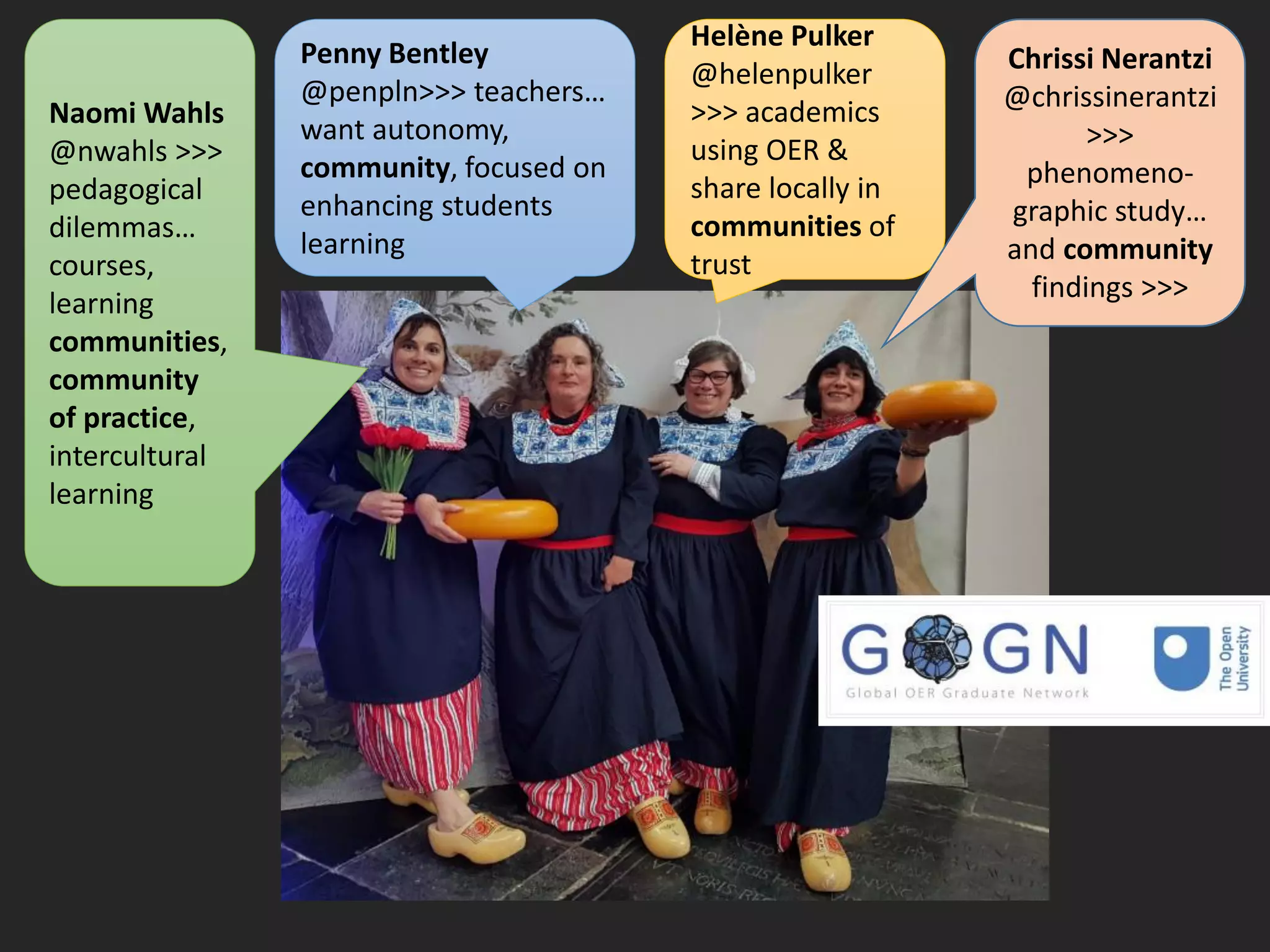
Helène Pulker
@helenpulker
>>> academics
using OER &
share locally in
communities of
trust
Penny Bentley
@penpln>>> teachers…
want autonomy,
community, focused on
enhancing students
learning
Naomi Wahls
@nwahls >>>
pedagogical
dilemmas…
courses,
learning
communities,
community
of practice,
intercultural
learning
Chrissi Nerantzi
@chrissinerantzi
>>>
phenomeno-
graphic study…
and community
findings >>>
STARTER
Explore professional development of HE teachers
MAIN COURSE
Discuss key findings from a phenomenographic study about the collaborative
open learning experience and the role community played
DESSERT
Design alternative professional development provision based on an open
community approach
http://www.publicdomainpictures.net/pictures/160000/velka/chalkboard-menu.jpg
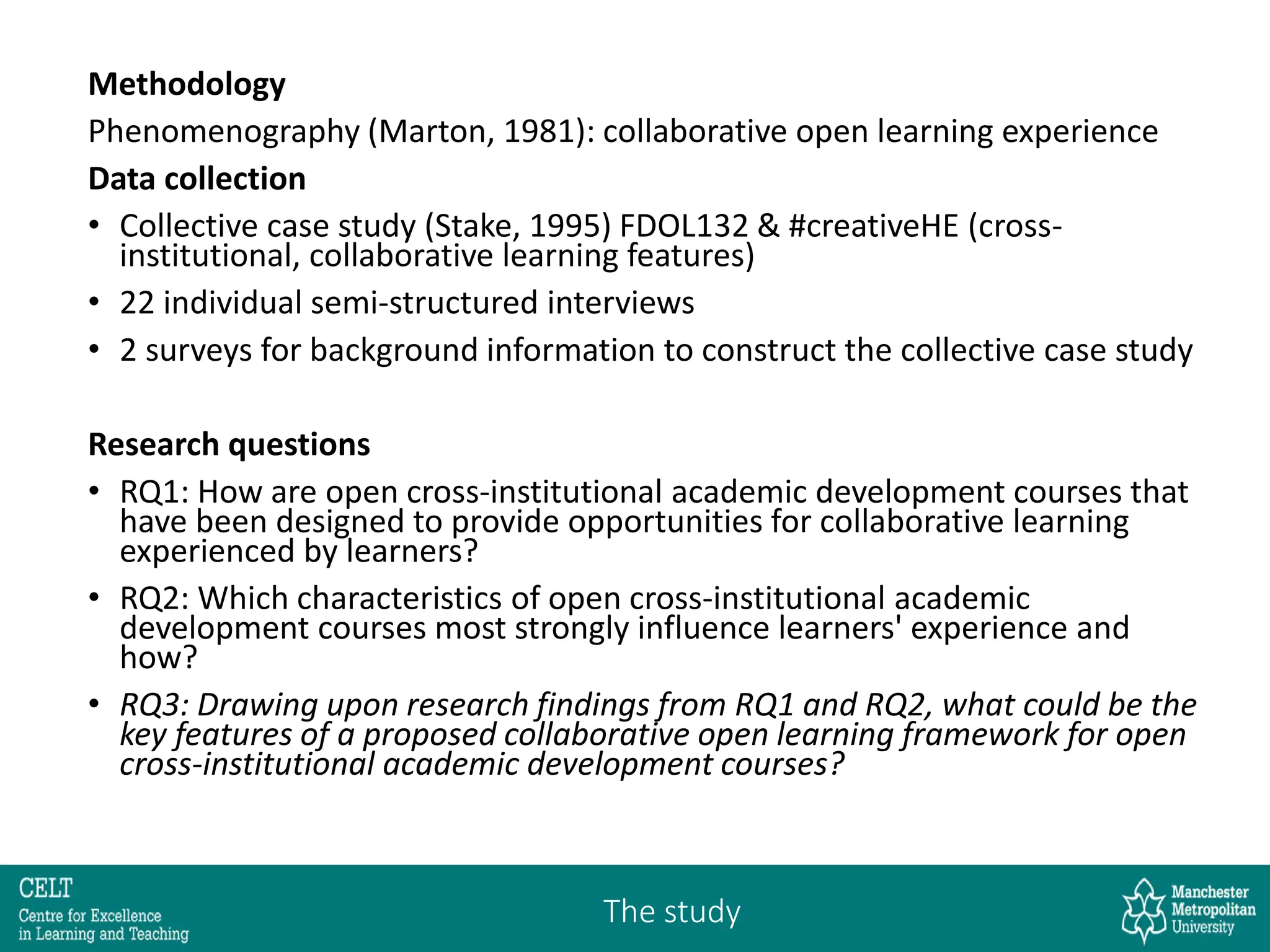
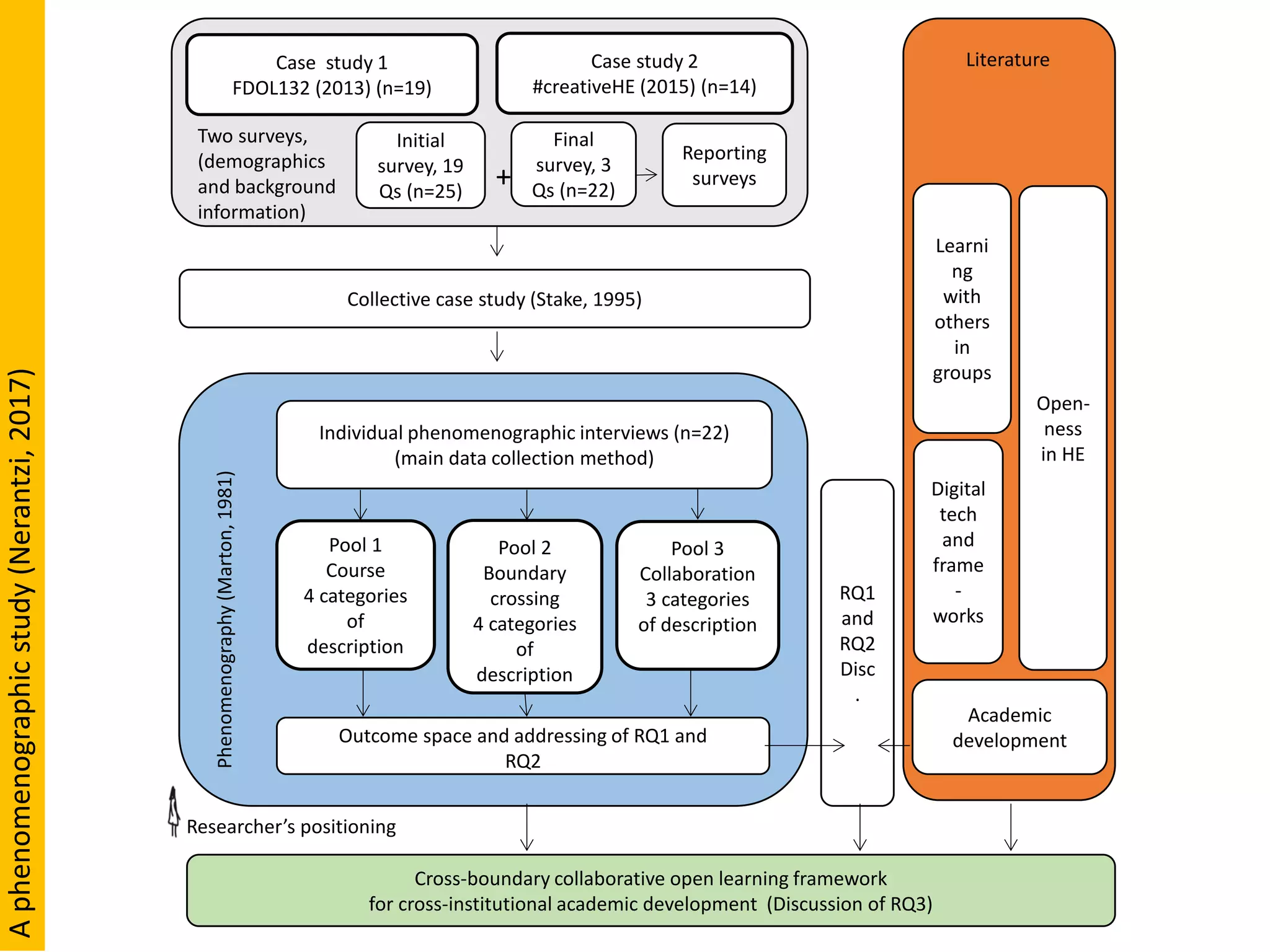
Methodology
Phenomenography (Marton, 1981): collaborative open learning experience
Data collection
• Collective case study (Stake, 1995) FDOL132 & #creativeHE (cross-
institutional, collaborative learning features)
• 22 individual semi-structured interviews
• 2 surveys for background information to construct the collective case study
Research questions
• RQ1: How are open cross-institutional academic development courses that
have been designed to provide opportunities for collaborative learning
experienced by learners?
• RQ2: Which characteristics of open cross-institutional academic
development courses most strongly influence learners' experience and
how?
• RQ3: Drawing upon research findings from RQ1 and RQ2, what could be the
key features of a proposed collaborative open learning framework for open
cross-institutional academic development courses?
The study
Individual phenomenographic interviews (n=22)
(main data collection method)
Pool 1
Course
4 categories
of
description
Initial
survey, 19
Qs (n=25)
Final
survey, 3
Qs (n=22)
Pool 3
Collaboration
3 categories
of description
Pool 2
Boundary
crossing
4 categories
of
description
Outcome space and addressing of RQ1 and
RQ2
Cross-boundary collaborative open learning framework
for cross-institutional academic development (Discussion of RQ3)
Phenomenography(Marton,1981)
Case study 1
FDOL132 (2013) (n=19)
Case study 2
#creativeHE (2015) (n=14)
+
Collective case study (Stake, 1995)
Reporting
surveys
Two surveys,
(demographics
and background
information)
RQ1
and
RQ2
Disc
.
Open-
ness
in HE
Digital
tech
and
frame
-
works
Learni
ng
with
others
in
groups
Academic
development
Literature
Researcher’s positioning
Aphenomenographicstudy(Nerantzi,2017)
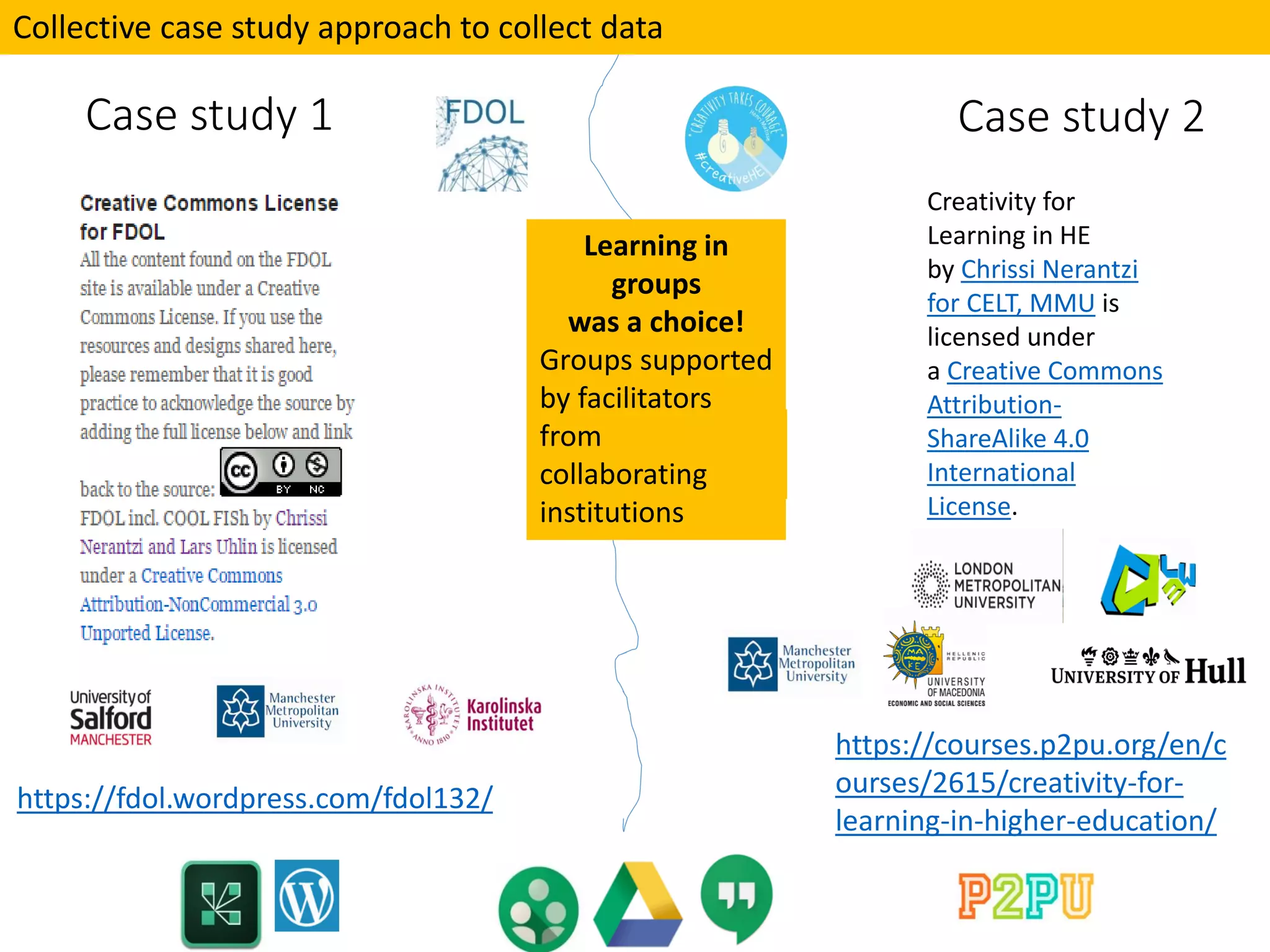
Case study 2
https://courses.p2pu.org/en/c
ourses/2615/creativity-for-
learning-in-higher-education/
Creativity for
Learning in HE
by Chrissi Nerantzi
for CELT, MMU is
licensed under
a Creative Commons
Attribution-
ShareAlike 4.0
International
License.
Case study 1
https://fdol.wordpress.com/fdol132/
Collective case study approach to collect data
PBL Negotiate
d
Learning in
groups
was a choice!
Groups supported
by facilitators
from
collaborating
institutions
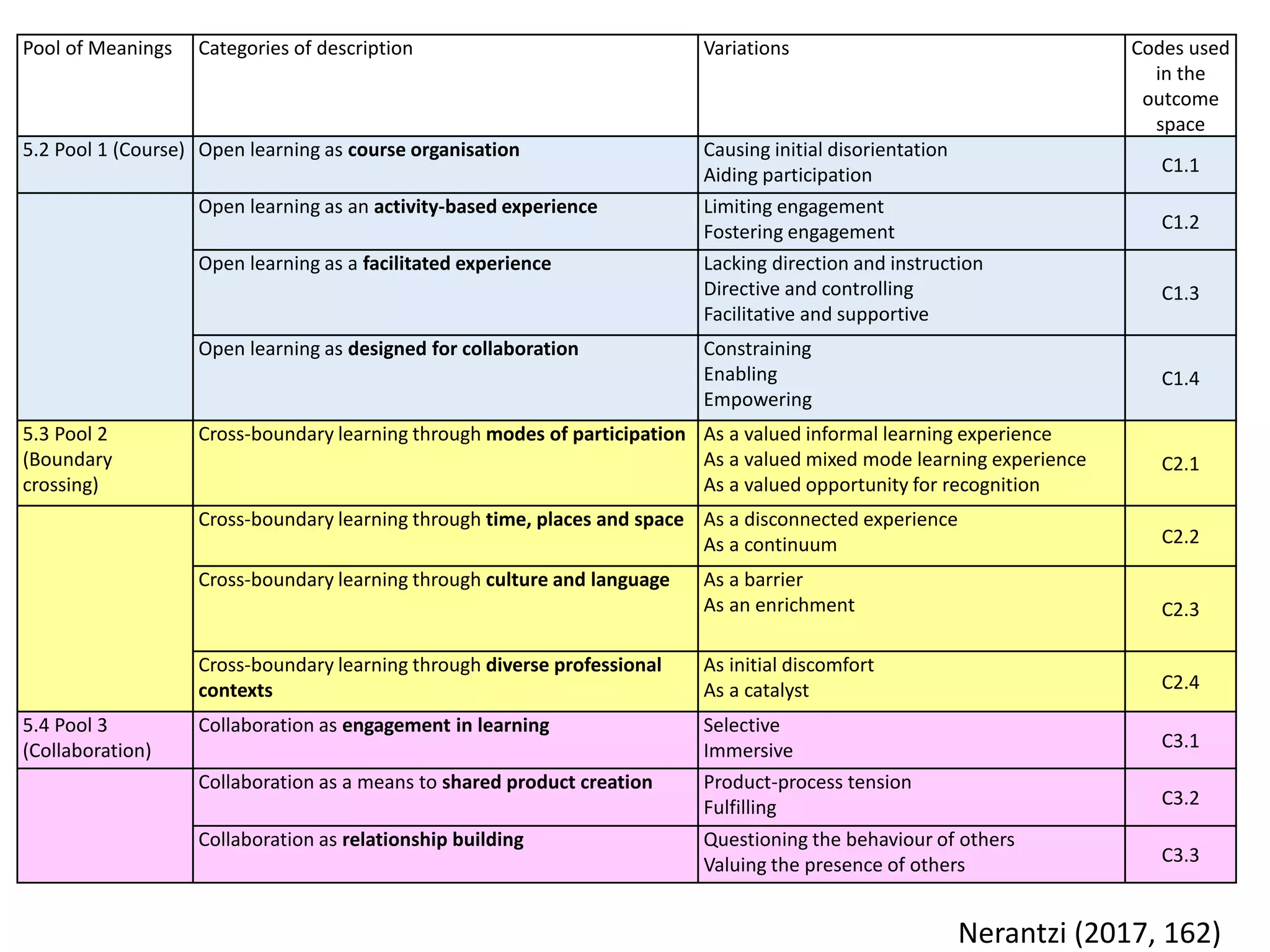
Pool of Meanings Categories of description Variations Codes used
in the
outcome
space
5.2 Pool 1 (Course) Open learning as course organisation Causing initial disorientation
Aiding participation C1.1
Open learning as an activity-based experience Limiting engagement
Fostering engagement C1.2
Open learning as a facilitated experience Lacking direction and instruction
Directive and controlling
Facilitative and supportive
C1.3
Open learning as designed for collaboration Constraining
Enabling
Empowering
C1.4
5.3 Pool 2
(Boundary
crossing)
Cross-boundary learning through modes of participation As a valued informal learning experience
As a valued mixed mode learning experience
As a valued opportunity for recognition
C2.1
Cross-boundary learning through time, places and space As a disconnected experience
As a continuum C2.2
Cross-boundary learning through culture and language As a barrier
As an enrichment C2.3
Cross-boundary learning through diverse professional
contexts
As initial discomfort
As a catalyst C2.4
5.4 Pool 3
(Collaboration)
Collaboration as engagement in learning Selective
Immersive C3.1
Collaboration as a means to shared product creation Product-process tension
Fulfilling C3.2
Collaboration as relationship building Questioning the behaviour of others
Valuing the presence of others C3.3
Nerantzi (2017, 162)
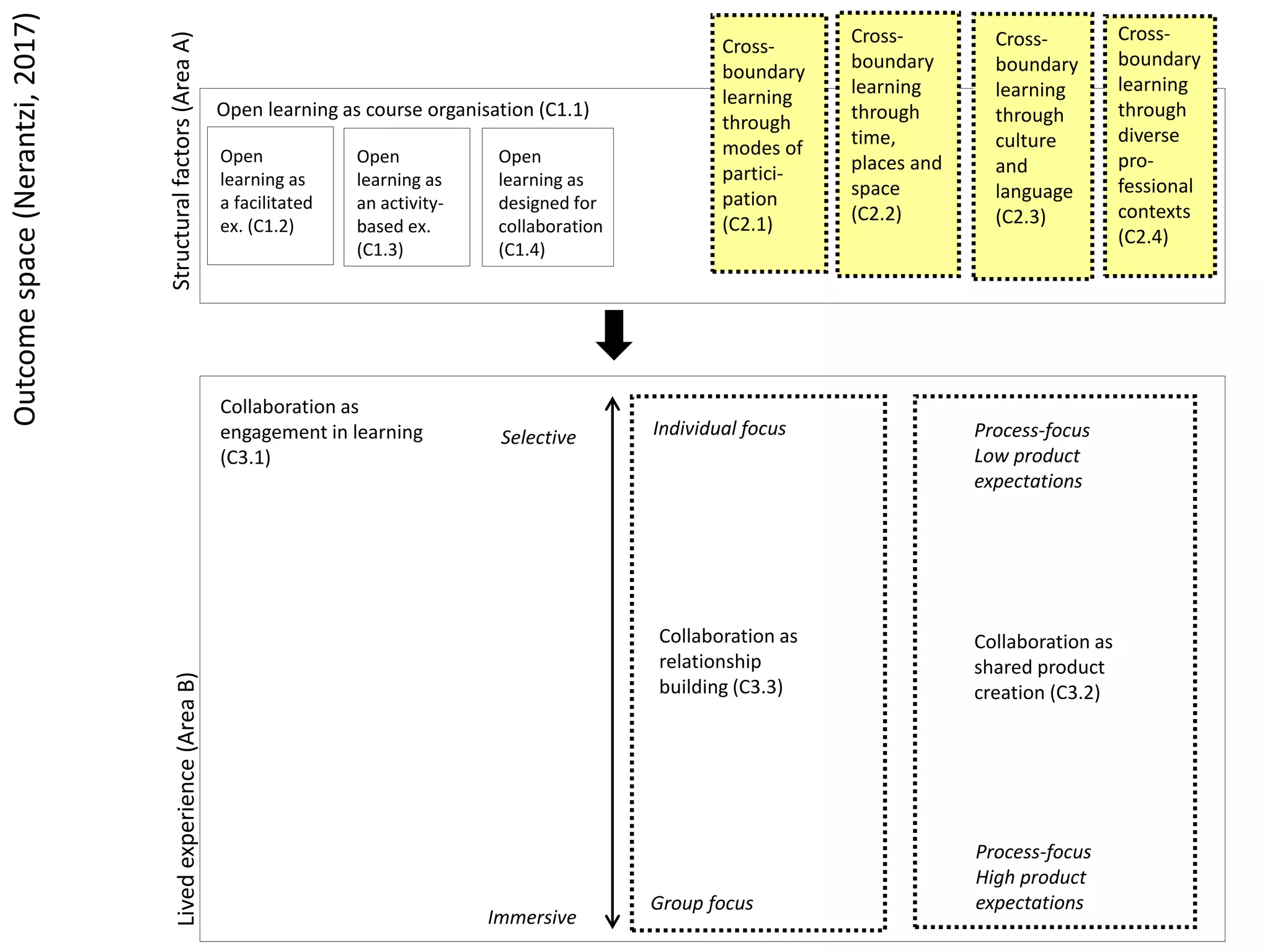
Open learning as course organisation (C1.1)
Open
learning as
an activity-
based ex.
(C1.3)
Open
learning as
designed for
collaboration
(C1.4)
Cross-
boundary
learning
through
modes of
partici-
pation
(C2.1)
Cross-
boundary
learning
through
time,
places and
space
(C2.2)
Cross-
boundary
learning
through
diverse
pro-
fessional
contexts
(C2.4)
Cross-
boundary
learning
through
culture
and
language
(C2.3)
Structuralfactors(AreaA)Livedexperience(AreaB)
Collaboration as
engagement in learning
(C3.1)
Selective
Immersive
Collaboration as
relationship
building (C3.3)
Group focus
Collaboration as
shared product
creation (C3.2)
Process-focus
High product
expectations
Individual focus Process-focus
Low product
expectations
Outcomespace(Nerantzi,2017)
Open
learning as
a facilitated
ex. (C1.2)
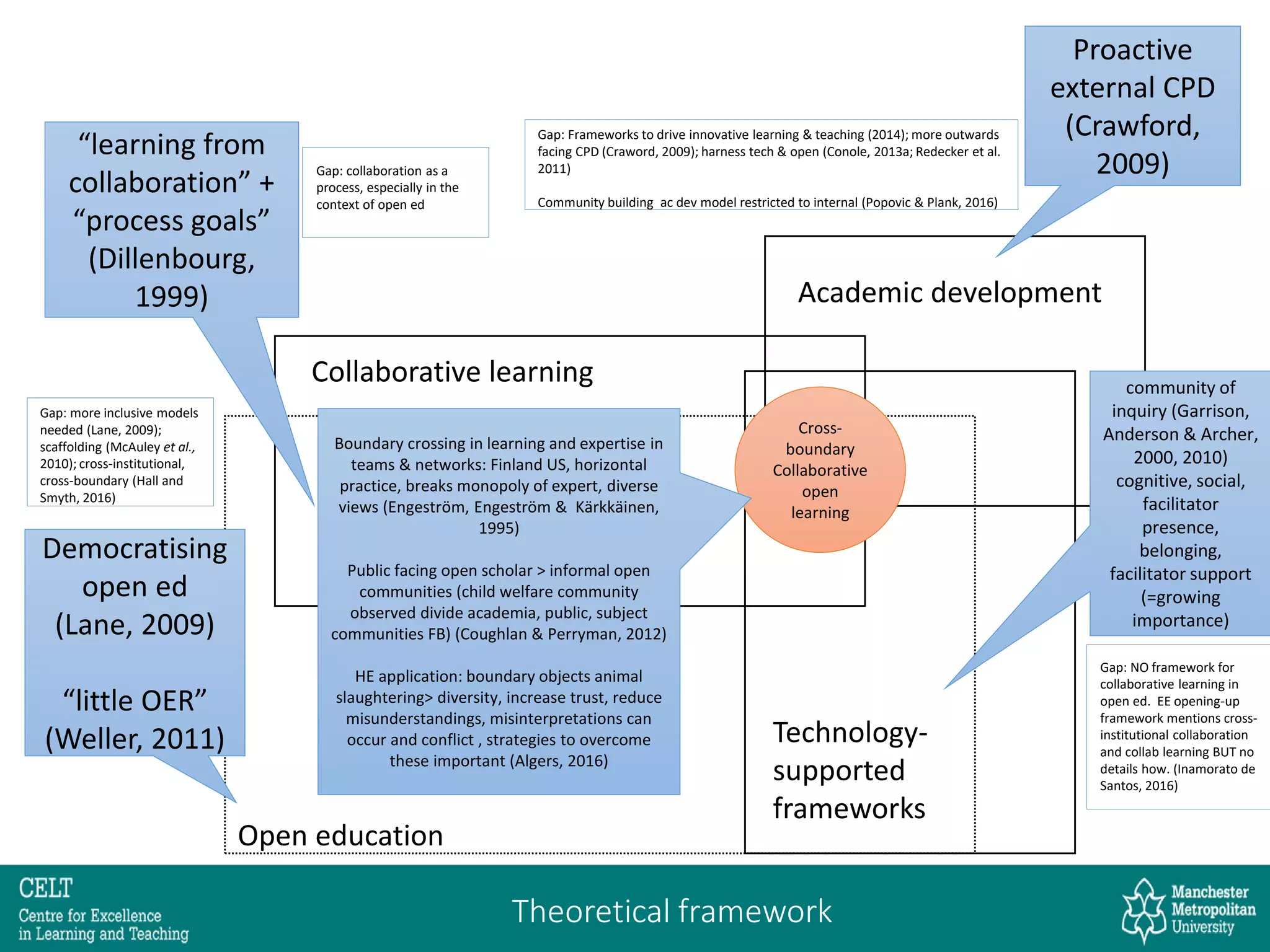
Open education
Academic development
Collaborative learning
Technology-
supported
frameworks
Cross-
boundary
Collaborative
open
learning
“learning from
collaboration” +
“process goals”
(Dillenbourg,
1999)
Democratising
open ed
(Lane, 2009)
“little OER”
(Weller, 2011)
Proactive
external CPD
(Crawford,
2009)
community of
inquiry (Garrison,
Anderson & Archer,
2000, 2010)
cognitive, social,
facilitator
presence,
belonging,
facilitator support
(=growing
importance)
Gap: collaboration as a
process, especially in the
context of open ed
Gap: more inclusive models
needed (Lane, 2009);
scaffolding (McAuley et al.,
2010); cross-institutional,
cross-boundary (Hall and
Smyth, 2016)
Gap: Frameworks to drive innovative learning & teaching (2014); more outwards
facing CPD (Craword, 2009); harness tech & open (Conole, 2013a; Redecker et al.
2011)
Community building ac dev model restricted to internal (Popovic & Plank, 2016)
Gap: NO framework for
collaborative learning in
open ed. EE opening-up
framework mentions cross-
institutional collaboration
and collab learning BUT no
details how. (Inamorato de
Santos, 2016)
Boundary crossing in learning and expertise in
teams & networks: Finland US, horizontal
practice, breaks monopoly of expert, diverse
views (Engeström, Engeström & Kärkkäinen,
1995)
Public facing open scholar > informal open
communities (child welfare community
observed divide academia, public, subject
communities FB) (Coughlan & Perryman, 2012)
HE application: boundary objects animal
slaughtering> diversity, increase trust, reduce
misunderstandings, misinterpretations can
occur and conflict , strategies to overcome
these important (Algers, 2016)
Theoretical framework
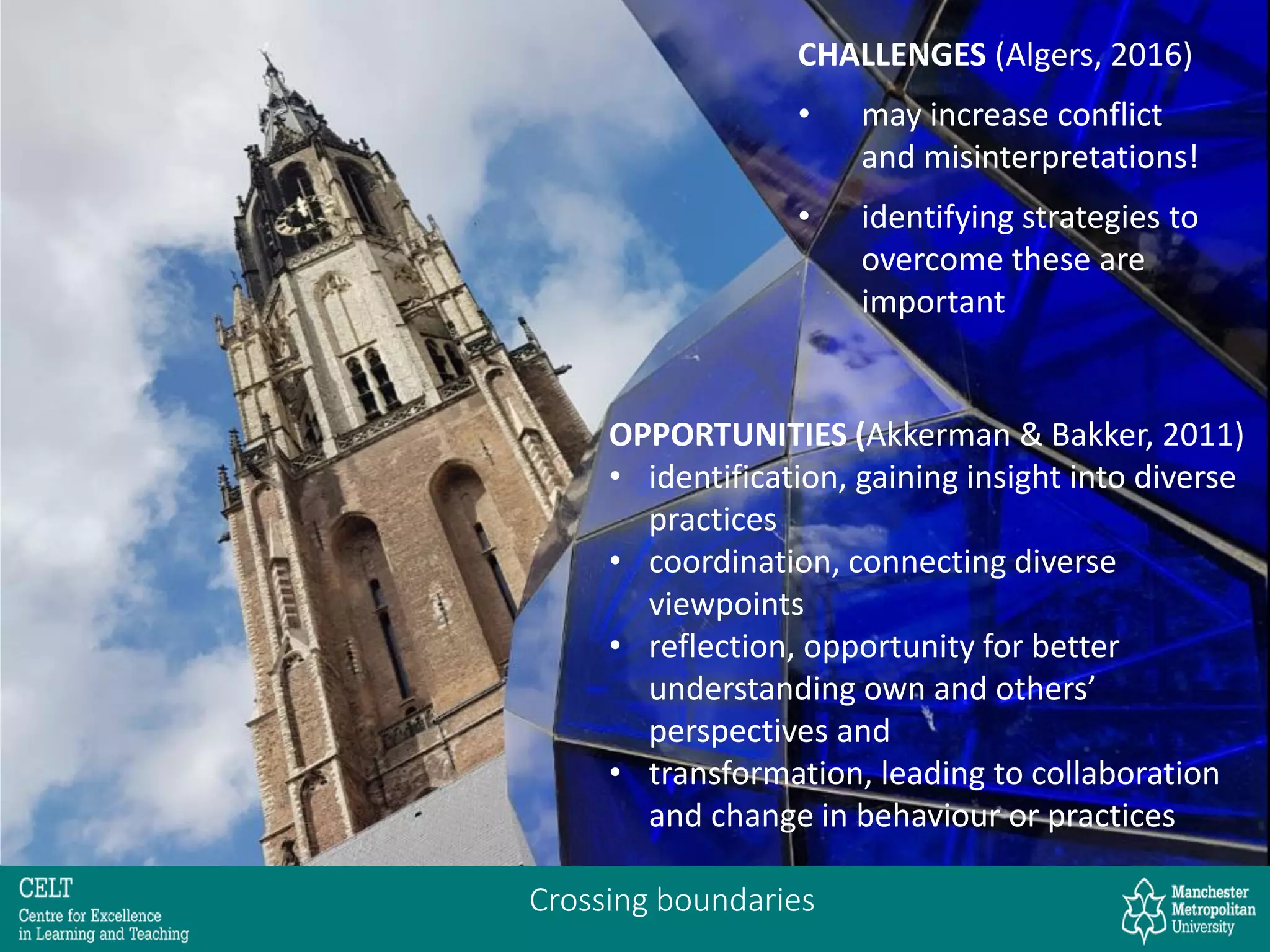
Crossing boundaries
OPPORTUNITIES (Akkerman & Bakker, 2011)
• identification, gaining insight into diverse
practices
• coordination, connecting diverse
viewpoints
• reflection, opportunity for better
understanding own and others’
perspectives and
• transformation, leading to collaboration
and change in behaviour or practices
CHALLENGES (Algers, 2016)
• may increase conflict
and misinterpretations!
• identifying strategies to
overcome these are
important
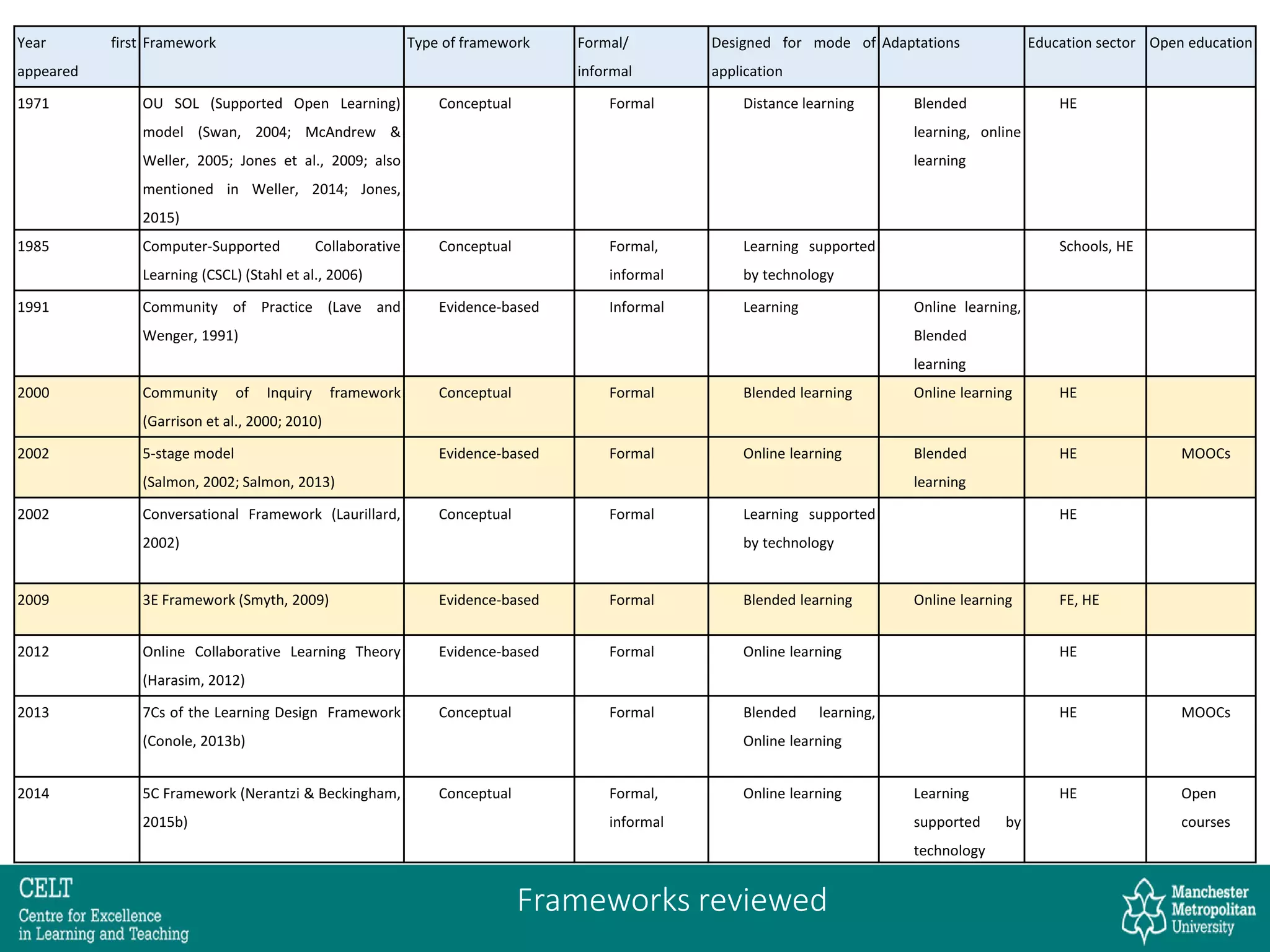
Year first
appeared
Framework Type of framework Formal/
informal
Designed for mode of
application
Adaptations Education sector Open education
1971 OU SOL (Supported Open Learning)
model (Swan, 2004; McAndrew &
Weller, 2005; Jones et al., 2009; also
mentioned in Weller, 2014; Jones,
2015)
Conceptual Formal Distance learning Blended
learning, online
learning
HE
1985 Computer-Supported Collaborative
Learning (CSCL) (Stahl et al., 2006)
Conceptual Formal,
informal
Learning supported
by technology
Schools, HE
1991 Community of Practice (Lave and
Wenger, 1991)
Evidence-based Informal Learning Online learning,
Blended
learning
2000 Community of Inquiry framework
(Garrison et al., 2000; 2010)
Conceptual Formal Blended learning Online learning HE
2002 5-stage model
(Salmon, 2002; Salmon, 2013)
Evidence-based Formal Online learning Blended
learning
HE MOOCs
2002 Conversational Framework (Laurillard,
2002)
Conceptual Formal Learning supported
by technology
HE
2009 3E Framework (Smyth, 2009) Evidence-based Formal Blended learning Online learning FE, HE
2012 Online Collaborative Learning Theory
(Harasim, 2012)
Evidence-based Formal Online learning HE
2013 7Cs of the Learning Design Framework
(Conole, 2013b)
Conceptual Formal Blended learning,
Online learning
HE MOOCs
2014 5C Framework (Nerantzi & Beckingham,
2015b)
Conceptual Formal,
informal
Online learning Learning
supported by
technology
HE Open
courses
Frameworks reviewed
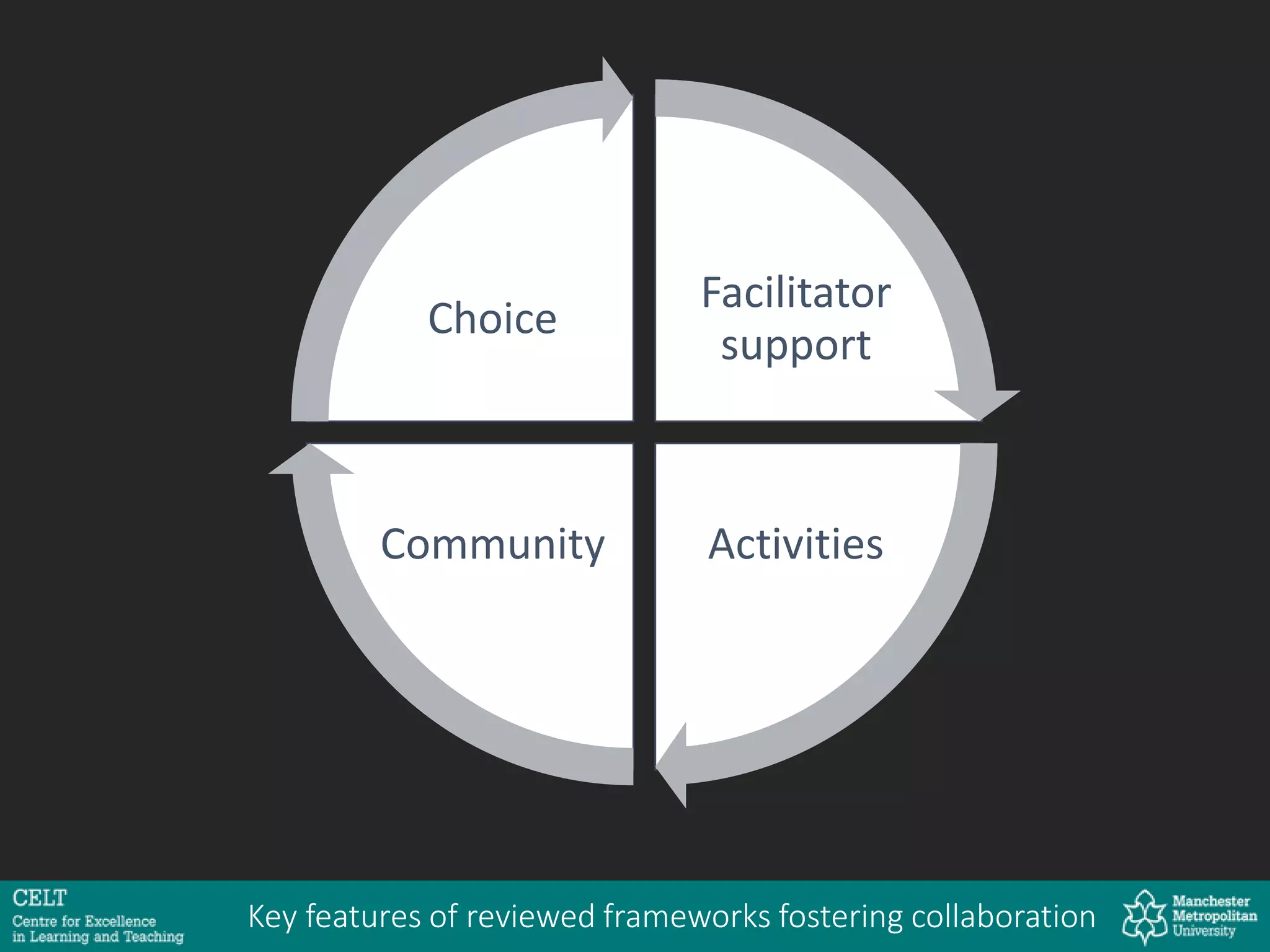
Key features of reviewed frameworks fostering collaboration
Facilitator
support
ActivitiesCommunity
Choice
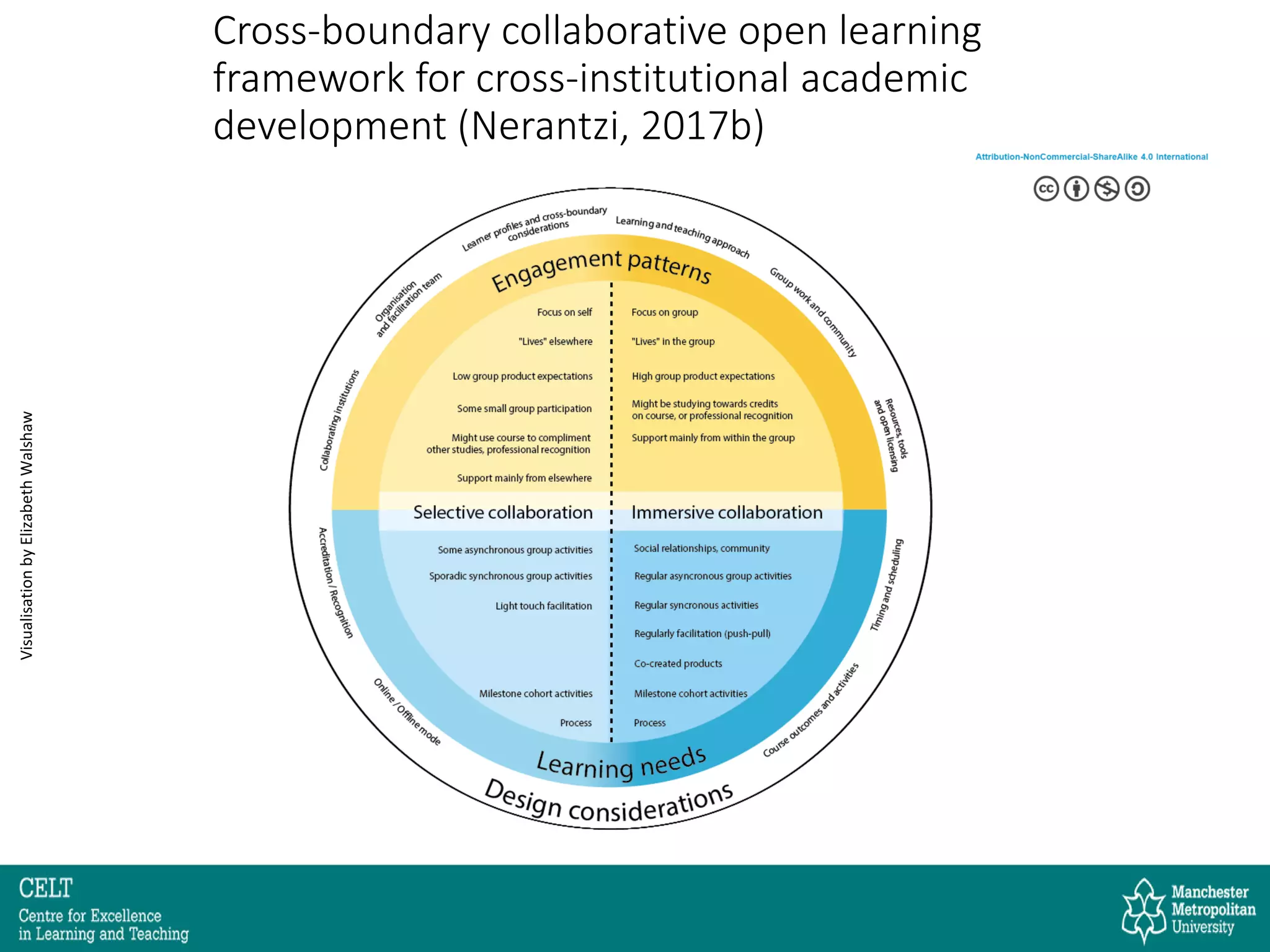
Cross-boundary collaborative open learning
framework for cross-institutional academic
development (Nerantzi, 2017b)
VisualisationbyElizabethWalshaw
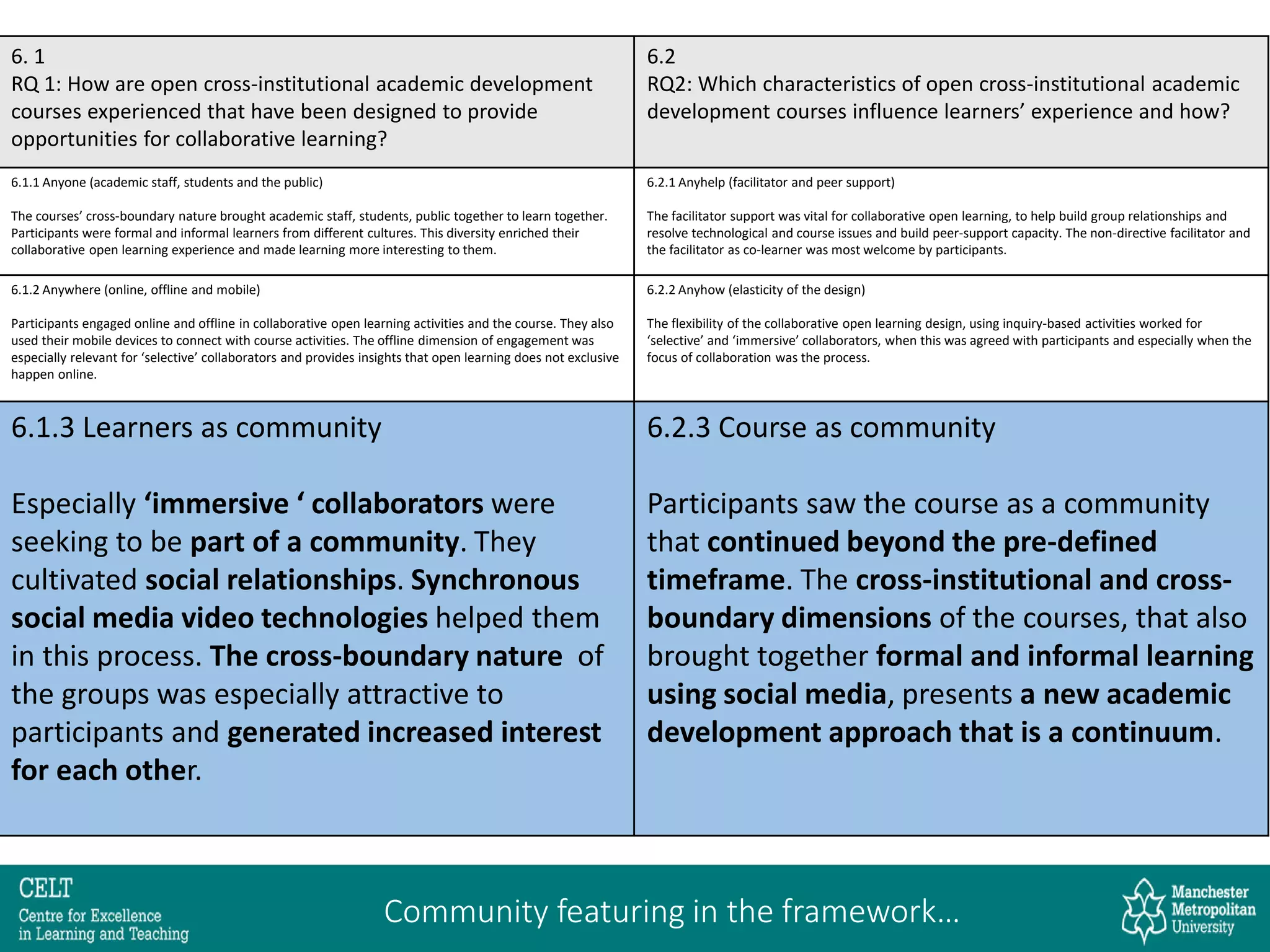
6. 1
RQ 1: How are open cross-institutional academic development
courses experienced that have been designed to provide
opportunities for collaborative learning?
6.2
RQ2: Which characteristics of open cross-institutional academic
development courses influence learners’ experience and how?
6.1.1 Anyone (academic staff, students and the public)
The courses’ cross-boundary nature brought academic staff, students, public together to learn together.
Participants were formal and informal learners from different cultures. This diversity enriched their
collaborative open learning experience and made learning more interesting to them.
6.2.1 Anyhelp (facilitator and peer support)
The facilitator support was vital for collaborative open learning, to help build group relationships and
resolve technological and course issues and build peer-support capacity. The non-directive facilitator and
the facilitator as co-learner was most welcome by participants.
6.1.2 Anywhere (online, offline and mobile)
Participants engaged online and offline in collaborative open learning activities and the course. They also
used their mobile devices to connect with course activities. The offline dimension of engagement was
especially relevant for ‘selective’ collaborators and provides insights that open learning does not exclusive
happen online.
6.2.2 Anyhow (elasticity of the design)
The flexibility of the collaborative open learning design, using inquiry-based activities worked for
‘selective’ and ‘immersive’ collaborators, when this was agreed with participants and especially when the
focus of collaboration was the process.
6.1.3 Learners as community
Especially ‘immersive ‘ collaborators were
seeking to be part of a community. They
cultivated social relationships. Synchronous
social media video technologies helped them
in this process. The cross-boundary nature of
the groups was especially attractive to
participants and generated increased interest
for each other.
6.2.3 Course as community
Participants saw the course as a community
that continued beyond the pre-defined
timeframe. The cross-institutional and cross-
boundary dimensions of the courses, that also
brought together formal and informal learning
using social media, presents a new academic
development approach that is a continuum.
Community featuring in the framework…
“When I was entering my email, I had lots and lots of emails, that informed
me for example, a member of the community posted this, or commented my
post, or my thought, or in my portfolio. And that was a little bit, that caused
me a little bit upset, because I felt that I had to keep up with the rest of the
activities and the interactions, and I was saying ‘Oh, I have to get in the
community’, and sometimes I had no time, so, when I was in the bus, or at
the university I was given through my smartphone, and if I had, for example,
five minutes free I was getting in the community and try to keep up with the
material and the thoughts that were shared in it.
But, there was an option in Google plus where I could de-activate those
notifications, but I didn’t want to do that. I, I think that I would lose my
feedback, the flow of the information and thoughts. Something that I didn't
want to do so. […]
For example, if I had seen someone commenting on my post, and I was
available at that time, I could go to the community, comment and I found this
really interesting. It was the first learning situation which was not in a
classroom, or in a university. I was in the bus and I was exchanging
opinions, thoughts. It was very interesting.” C1
Learners as community, online dimension (Nerantzi, 2017)
“I find the learning, the thinking of different ideas, hearing how other
people had dealt with it really useful. And 'cos we were from such
different backgrounds, that's quite useful. […]
So as a higher education lecturer, I have certain assumptions and
sometimes you need to sort of like, step back from those and that's
where having those people from different experiences is useful.
Because you're, thinking more, you're not just using your HE,
assumptions, you're thinking "actually that might work in my
situation, I'd never thought of that." And I've had a go at some of the
things, you know that, some of the things we talked about, some of
them work - some of them don't. Some of them you think "oh, that's
not actually for me", so I think it is useful, and I would worry, if we'd
all been HE lecturers I wonder whether it would have been the same
experience. That we wouldn't all just gone, "Oh that doesn't work!"
Participant F2
Learners as community, online dimension, diverse professional
contexts (Nerantzi, 2017)
“When I found online communities in the past a lot more useful for me
before I started this job, so the job I had before this when I was one of only
two librarians and the other librarian was my boss and she was a lot older
and worked two days a week, so I was the only librarian really so I didn't
have anyone to bounce off ideas from, so I spent a lot of time online and
built up a really good network, which I think is what the Google community
was trying to do.
But now in my new job at the university the team is really well established,
they're very supportive, there are a lot of us and we've all got different
backgrounds and so I've kind of let the online side slip a bit because my
needs are being fulfilled by my work colleagues really.” Participant C7
Learners as community, offline dimension (Nerantzi, 2017)
“The course has been a crucial eye-opener for me, in relation to my experience
with FDOL, and it relates to the way in which, it's being run across multiple
institutions.
Because, for me, there's a big risk with open learning, that if it comes badged by
a single institution, that educational developers, academic developers are
automatically inclined to be resistant to advocating that for colleagues in their
own institution. For fear of it actually, either undermining or, worse still making
them redundant. And that's not to say that those courses wouldn't be excellent for
those colleagues in that institution.
So, the differences with this course is that there's been an attempt to diffuse that
problem, by having it facilitated by colleagues in more than one institution, and
then when you look at the PBL facilitators furthermore, even more institutions
again, so leaving it open for the instruction of the course, the delivery of it to be
facilitated by multiple institutions effectively. And I think that erodes that problem
of feeling as though it belongs to another competitor. And that we would be
offering it. So there's something really nice about that. But it's more than open
learning, it's about open practice as well. It's about making sure that the model of
the course can accommodate, and invites facilitation from others in other
institutions.” Participant F5
Course as community (Nerantzi, 2017)
STARTER
Explore professional development of HE teachers
MAIN COURSE
Discuss key findings from a phenomenographic study about the collaborative
open learning experience and the role community played
DESSERT
Design alternative professional development provision based on an open
community approach
http://www.publicdomainpictures.net/pictures/160000/velka/chalkboard-menu.jpg
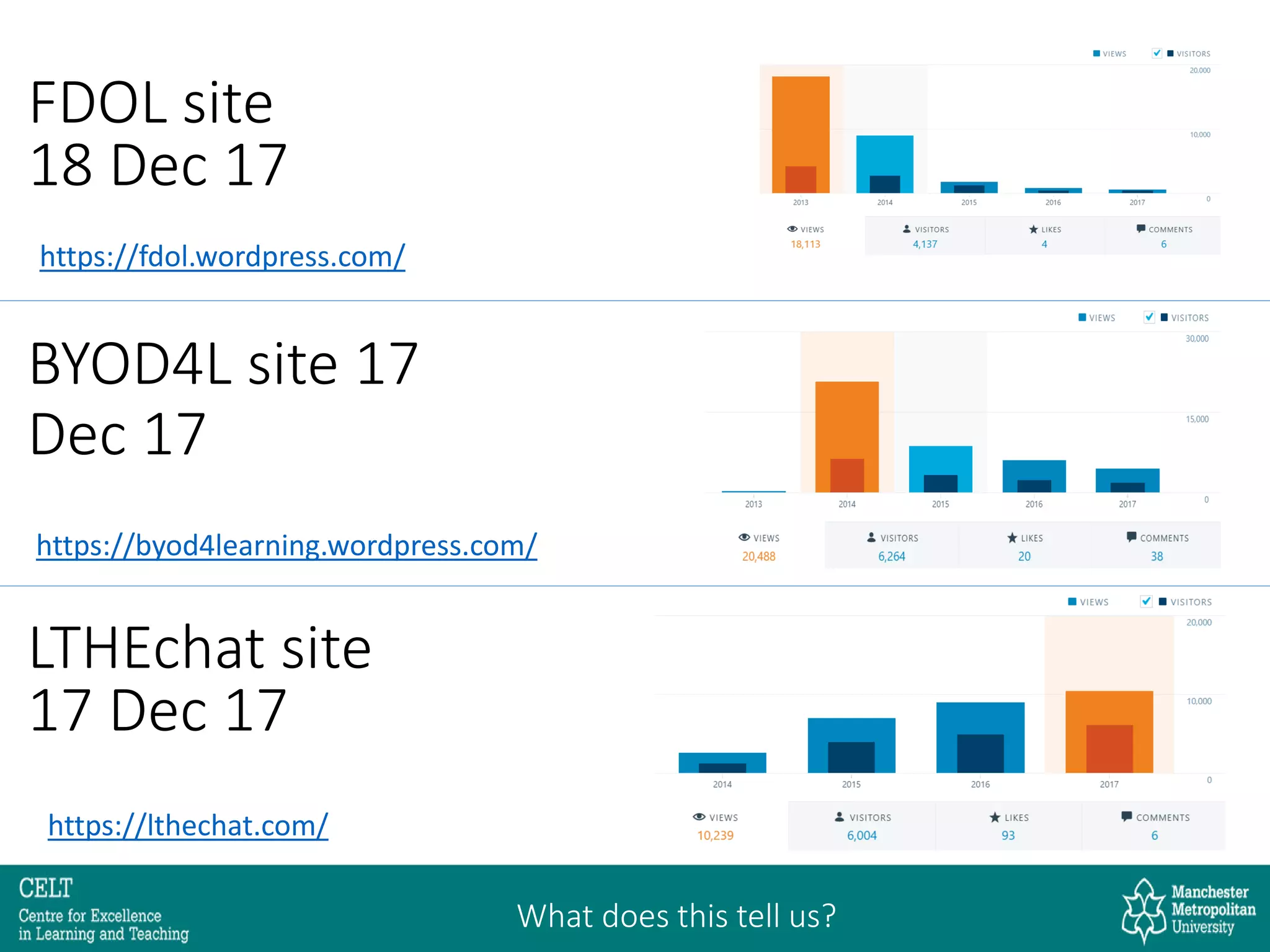
BYOD4L site 17
Dec 17
LTHEchat site
17 Dec 17
FDOL site
18 Dec 17
What does this tell us?
https://lthechat.com/
https://byod4learning.wordpress.com/
https://fdol.wordpress.com/
From practice to community?
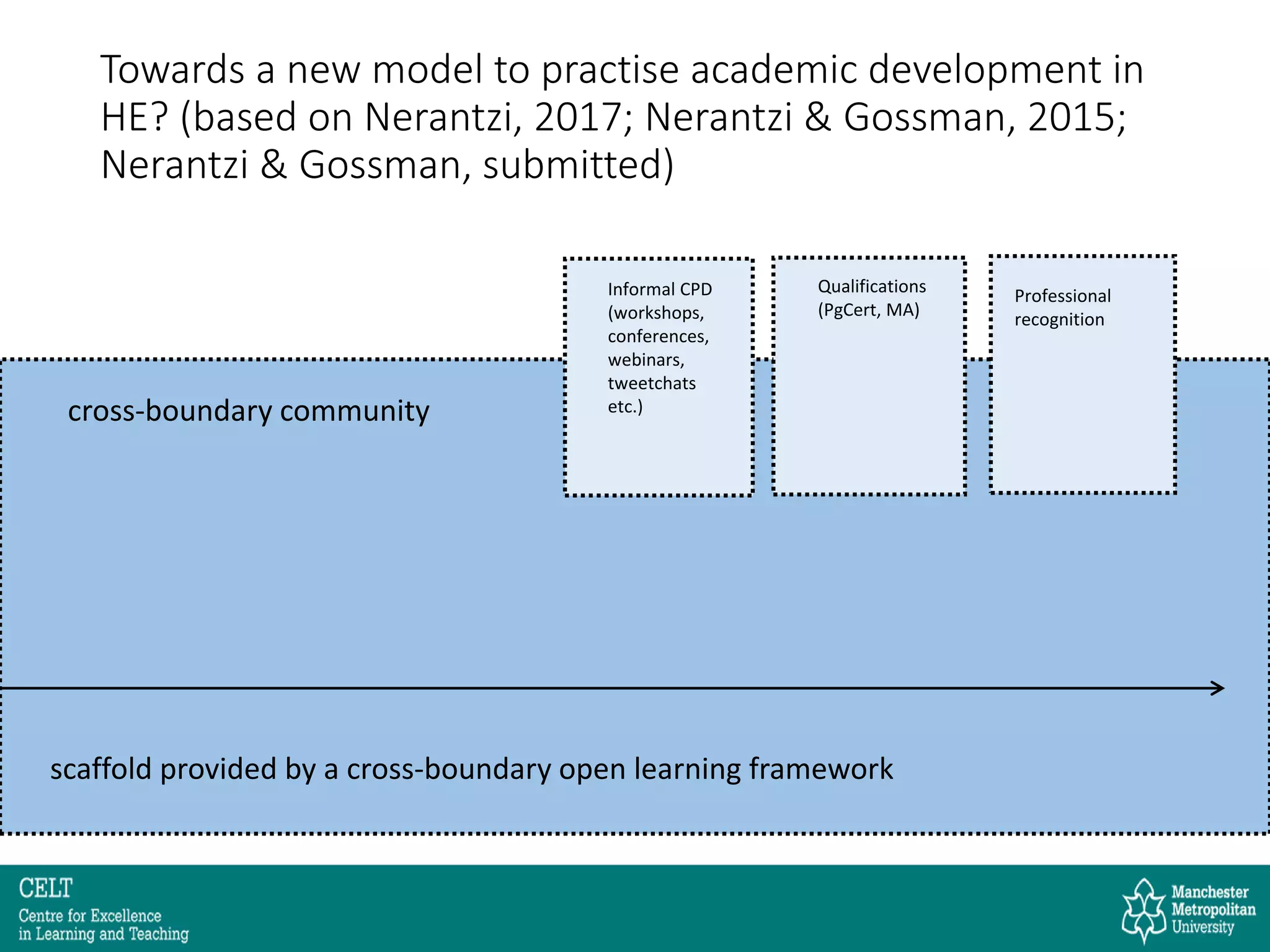
Towards a new model to practise academic development in
HE? (based on Nerantzi, 2017; Nerantzi & Gossman, 2015;
Nerantzi & Gossman, submitted)
cross-boundary community
Qualifications
(PgCert, MA)
Professional
recognition
Informal CPD
(workshops,
conferences,
webinars,
tweetchats
etc.)
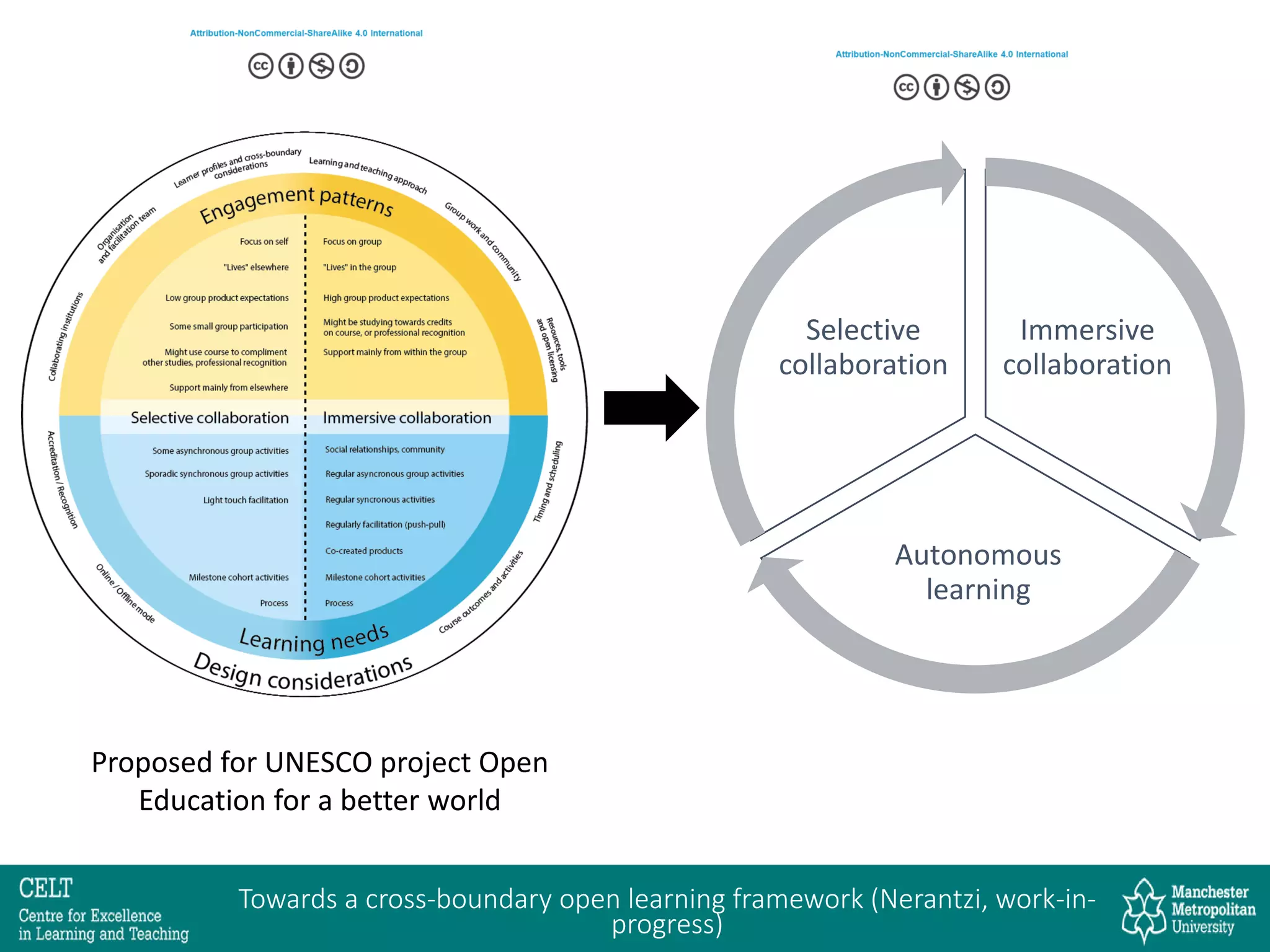
scaffold provided by a cross-boundary open learning framework
Immersive
collaboration
Autonomous
learning
Selective
collaboration
Proposed for UNESCO project Open
Education for a better world
Towards a cross-boundary open learning framework (Nerantzi, work-in-
progress)
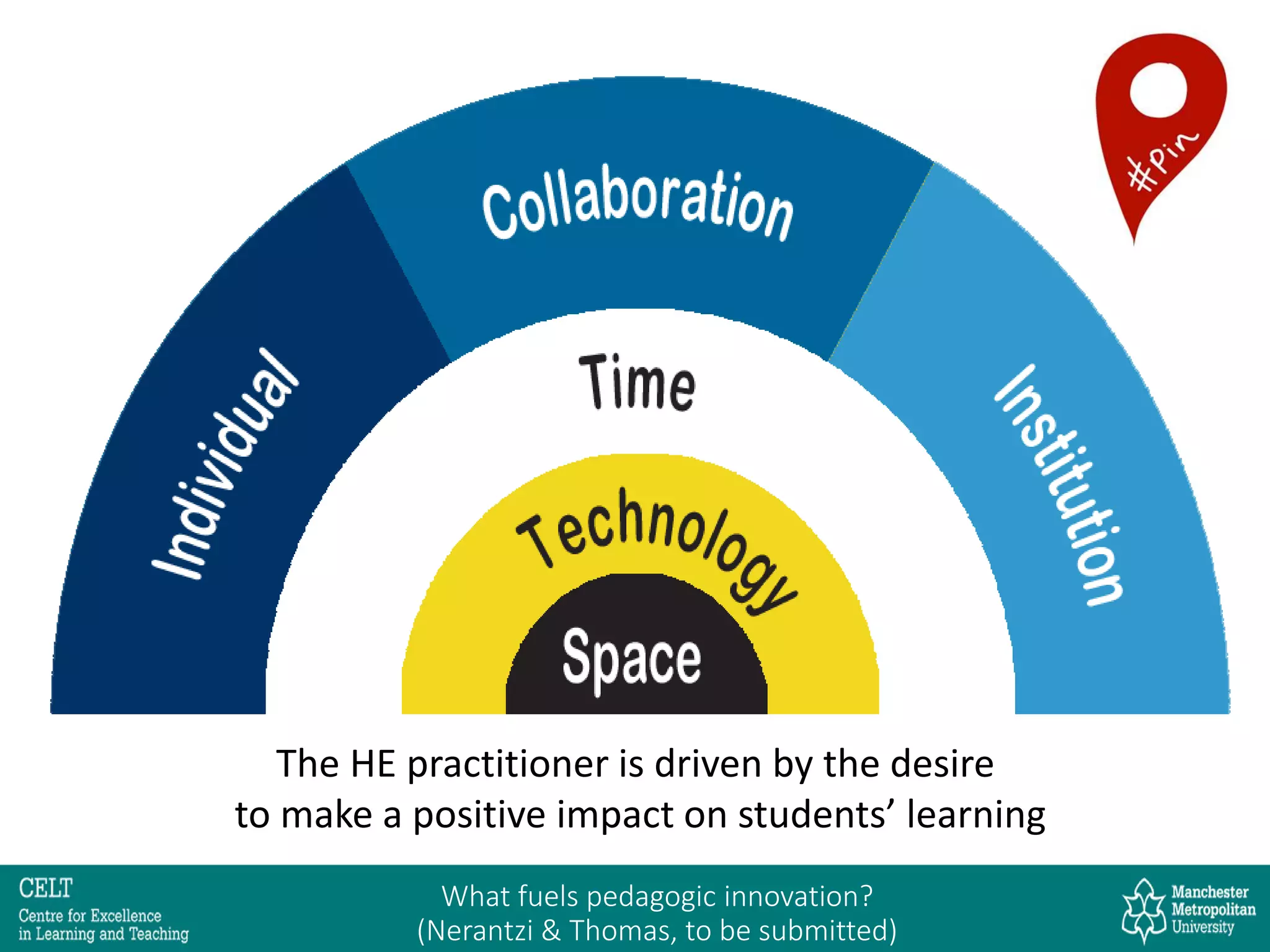
What fuels pedagogic innovation?
(Nerantzi & Thomas, to be submitted)
The HE practitioner is driven by the desire
to make a positive impact on students’ learning
Thank you!
Vielen Dank!
Ευχαριστώ
πολύ!
http://canningsfreerangebutchers.com.au/wp-content/uploads/2012/11/free-range-farms.jpg
Chrissi Nerantzi @chrissinerantzi
References
Akkerman, S. F. & Bakker, A. (2011) Boundary Crossing and Boundary Objects. Review of Educational
Research. June 2011, 81 (2). pp. 132–169.
Algers, A. (2016) OEP as boundary practices – how academy and society can inform each other. ExplOER
project webinar. Accessed from
https://connect.sunet.se/p4gxj96aglg/?launcher=false&fcsContent=true&pbMode=normal
Crawford, K. (2009) Continuing professional development in higher education: Voices from below. University
of Lincoln. [EdD thesis]. Accessed from http://eprints.lincoln.ac.uk/2146/1/Crawford-Ed%28D%29Thesis-
CPDinHE-FINAL%28Sept09%29.pdf
Hawkins, P. & Smith, N. (2013) Coaching, mentoring and organizational consultancy. Supervision, skills &
development, 2nd edition, Maidenhead: Open University Press.
Marton, F. (1981) Phenomenography – describing conceptions of the world around us. Instructional science,
10 (2), pp.177-200.
Nerantzi, C. (2017) Towards a cross-boundary collaborative open learning framework in cross-institutional
academic development, PhD thesis, Edinburgh: Edinburgh Napier University. Accessed from
https://www.napier.ac.uk/research-and-innovation/research-search/outputs/towards-a-framework-for-
cross-boundary-collaborative-open-learning-for
Nerantzi, C. & Gossman, P. (2015) Towards collaboration as learning. An evaluation of an open CPD
opportunity for HE teachers, in: Research in Learning Technology Journal, 23. Accessed from
http://www.researchinlearningtechnology.net/index.php/rlt/article/view/26967
Nerantzi, C. & Gossman, P. (submitted, Feb18) Cross-boundary communities, an alternative vision for
academic development, Compass Journal, London: University of Greenwich, in February 2018,
https://journals.gre.ac.uk/index.php/compass
Nerantzi, C. & Thomas, B. E. (to be submitted soon) Who is ‘the idiot who goes first’ or what fuels pedagogic
innovation
Stake, R.E. (1995) The art of case study research. Thousand Oaks: Sage.
Overview
The Global OER Graduate Network
Doctoral students: 58; Alumni: 15>>> Join us!
http://go-gn.net/

Towards free range professional development of HE teachers

  • 1.
    Towards free-range professionaldevelopment for HE teachers 25 April 2018, 10:55am, Commissie 2, #OEGLOBAL, TU Delft What? “Open means getting out of the walls!” Laura Richie #OEGlobal18 Chrissi Nerantzi @chrissinerantzi
  • 2.
  • 3.
    Overview The Global OERGraduate Network Doctoral students: 58; Alumni: 15>>> Join us! http://go-gn.net/
  • 4.
    STARTER Explore professional developmentof HE teachers MAIN COURSE Discuss key findings from a phenomenographic study about the collaborative open learning experience and the role community played DESSERT Design alternative professional development provision based on an open community approach http://www.publicdomainpictures.net/pictures/160000/velka/chalkboard-menu.jpg
  • 5.
    STARTER Explore professional developmentof HE teachers MAIN COURSE Discuss key findings from a phenomenographic study about the collaborative open learning experience and the role community played DESSERT Design alternative professional development provision based on an open community approach http://www.publicdomainpictures.net/pictures/160000/velka/chalkboard-menu.jpg
  • 6.
  • 7.
  • 8.
    • Paul Stacey>>> vision … boundaryless, he with all ed sector, other stakeholders... emphasis on collaboration but also communities and other stakeholder, companies • Tim van dear Hagen >>> Building bridges, connected working HE and outside • Erin McKiernan, different open communities are still working, meeting separately, she called for more joined up thinking • UNESCO panel >>> we need to do cross-polinisation not just among like-minded people, working with people who work differently than us, boundary crossing • Erin McKiernan >>> Open communities separated... value in bringing them together • Rob Farrow >>> diverse combinations, preferring difference over uniformity... in the context of open society • Laura Ritchie >>> open means getting out of the walls, locally or globally, connect with other communities, businesses, learning with students • Robert Schuwer > >> TU Delft project in Mathematics and Nursing project from Fontys University of Applied Sciences, both cross-institutional collaborations, focus on building communities #OEGlobal18 discussions
  • 9.
    Your reality? So, whatkind of professional development for teaching is offered in your institution? #OEGLOBAL18 Well… #OEGLOBAL18 And what do you actually do? #OEGLOBAL18
  • 10.
    Academics want freedom:to pursue their own interests in L&T, part of networks and communities, often external/disciplinary ones (Crawford, 2009)
  • 11.
    Helène Pulker @helenpulker >>> academics usingOER & share locally in communities of trust Penny Bentley @penpln>>> teachers… want autonomy, community, focused on enhancing students learning Naomi Wahls @nwahls >>> pedagogical dilemmas… courses, learning communities, community of practice, intercultural learning Chrissi Nerantzi @chrissinerantzi >>> phenomeno- graphic study… and community findings >>>
  • 12.
    STARTER Explore professional developmentof HE teachers MAIN COURSE Discuss key findings from a phenomenographic study about the collaborative open learning experience and the role community played DESSERT Design alternative professional development provision based on an open community approach http://www.publicdomainpictures.net/pictures/160000/velka/chalkboard-menu.jpg
  • 13.
    Methodology Phenomenography (Marton, 1981):collaborative open learning experience Data collection • Collective case study (Stake, 1995) FDOL132 & #creativeHE (cross- institutional, collaborative learning features) • 22 individual semi-structured interviews • 2 surveys for background information to construct the collective case study Research questions • RQ1: How are open cross-institutional academic development courses that have been designed to provide opportunities for collaborative learning experienced by learners? • RQ2: Which characteristics of open cross-institutional academic development courses most strongly influence learners' experience and how? • RQ3: Drawing upon research findings from RQ1 and RQ2, what could be the key features of a proposed collaborative open learning framework for open cross-institutional academic development courses? The study
  • 14.
    Individual phenomenographic interviews(n=22) (main data collection method) Pool 1 Course 4 categories of description Initial survey, 19 Qs (n=25) Final survey, 3 Qs (n=22) Pool 3 Collaboration 3 categories of description Pool 2 Boundary crossing 4 categories of description Outcome space and addressing of RQ1 and RQ2 Cross-boundary collaborative open learning framework for cross-institutional academic development (Discussion of RQ3) Phenomenography(Marton,1981) Case study 1 FDOL132 (2013) (n=19) Case study 2 #creativeHE (2015) (n=14) + Collective case study (Stake, 1995) Reporting surveys Two surveys, (demographics and background information) RQ1 and RQ2 Disc . Open- ness in HE Digital tech and frame - works Learni ng with others in groups Academic development Literature Researcher’s positioning Aphenomenographicstudy(Nerantzi,2017)
  • 15.
    Case study 2 https://courses.p2pu.org/en/c ourses/2615/creativity-for- learning-in-higher-education/ Creativityfor Learning in HE by Chrissi Nerantzi for CELT, MMU is licensed under a Creative Commons Attribution- ShareAlike 4.0 International License. Case study 1 https://fdol.wordpress.com/fdol132/ Collective case study approach to collect data PBL Negotiate d Learning in groups was a choice! Groups supported by facilitators from collaborating institutions
  • 16.
    Pool of MeaningsCategories of description Variations Codes used in the outcome space 5.2 Pool 1 (Course) Open learning as course organisation Causing initial disorientation Aiding participation C1.1 Open learning as an activity-based experience Limiting engagement Fostering engagement C1.2 Open learning as a facilitated experience Lacking direction and instruction Directive and controlling Facilitative and supportive C1.3 Open learning as designed for collaboration Constraining Enabling Empowering C1.4 5.3 Pool 2 (Boundary crossing) Cross-boundary learning through modes of participation As a valued informal learning experience As a valued mixed mode learning experience As a valued opportunity for recognition C2.1 Cross-boundary learning through time, places and space As a disconnected experience As a continuum C2.2 Cross-boundary learning through culture and language As a barrier As an enrichment C2.3 Cross-boundary learning through diverse professional contexts As initial discomfort As a catalyst C2.4 5.4 Pool 3 (Collaboration) Collaboration as engagement in learning Selective Immersive C3.1 Collaboration as a means to shared product creation Product-process tension Fulfilling C3.2 Collaboration as relationship building Questioning the behaviour of others Valuing the presence of others C3.3 Nerantzi (2017, 162)
  • 17.
    Open learning ascourse organisation (C1.1) Open learning as an activity- based ex. (C1.3) Open learning as designed for collaboration (C1.4) Cross- boundary learning through modes of partici- pation (C2.1) Cross- boundary learning through time, places and space (C2.2) Cross- boundary learning through diverse pro- fessional contexts (C2.4) Cross- boundary learning through culture and language (C2.3) Structuralfactors(AreaA)Livedexperience(AreaB) Collaboration as engagement in learning (C3.1) Selective Immersive Collaboration as relationship building (C3.3) Group focus Collaboration as shared product creation (C3.2) Process-focus High product expectations Individual focus Process-focus Low product expectations Outcomespace(Nerantzi,2017) Open learning as a facilitated ex. (C1.2)
  • 18.
    Open education Academic development Collaborativelearning Technology- supported frameworks Cross- boundary Collaborative open learning “learning from collaboration” + “process goals” (Dillenbourg, 1999) Democratising open ed (Lane, 2009) “little OER” (Weller, 2011) Proactive external CPD (Crawford, 2009) community of inquiry (Garrison, Anderson & Archer, 2000, 2010) cognitive, social, facilitator presence, belonging, facilitator support (=growing importance) Gap: collaboration as a process, especially in the context of open ed Gap: more inclusive models needed (Lane, 2009); scaffolding (McAuley et al., 2010); cross-institutional, cross-boundary (Hall and Smyth, 2016) Gap: Frameworks to drive innovative learning & teaching (2014); more outwards facing CPD (Craword, 2009); harness tech & open (Conole, 2013a; Redecker et al. 2011) Community building ac dev model restricted to internal (Popovic & Plank, 2016) Gap: NO framework for collaborative learning in open ed. EE opening-up framework mentions cross- institutional collaboration and collab learning BUT no details how. (Inamorato de Santos, 2016) Boundary crossing in learning and expertise in teams & networks: Finland US, horizontal practice, breaks monopoly of expert, diverse views (Engeström, Engeström & Kärkkäinen, 1995) Public facing open scholar > informal open communities (child welfare community observed divide academia, public, subject communities FB) (Coughlan & Perryman, 2012) HE application: boundary objects animal slaughtering> diversity, increase trust, reduce misunderstandings, misinterpretations can occur and conflict , strategies to overcome these important (Algers, 2016) Theoretical framework
  • 19.
    Crossing boundaries OPPORTUNITIES (Akkerman& Bakker, 2011) • identification, gaining insight into diverse practices • coordination, connecting diverse viewpoints • reflection, opportunity for better understanding own and others’ perspectives and • transformation, leading to collaboration and change in behaviour or practices CHALLENGES (Algers, 2016) • may increase conflict and misinterpretations! • identifying strategies to overcome these are important
  • 20.
    Year first appeared Framework Typeof framework Formal/ informal Designed for mode of application Adaptations Education sector Open education 1971 OU SOL (Supported Open Learning) model (Swan, 2004; McAndrew & Weller, 2005; Jones et al., 2009; also mentioned in Weller, 2014; Jones, 2015) Conceptual Formal Distance learning Blended learning, online learning HE 1985 Computer-Supported Collaborative Learning (CSCL) (Stahl et al., 2006) Conceptual Formal, informal Learning supported by technology Schools, HE 1991 Community of Practice (Lave and Wenger, 1991) Evidence-based Informal Learning Online learning, Blended learning 2000 Community of Inquiry framework (Garrison et al., 2000; 2010) Conceptual Formal Blended learning Online learning HE 2002 5-stage model (Salmon, 2002; Salmon, 2013) Evidence-based Formal Online learning Blended learning HE MOOCs 2002 Conversational Framework (Laurillard, 2002) Conceptual Formal Learning supported by technology HE 2009 3E Framework (Smyth, 2009) Evidence-based Formal Blended learning Online learning FE, HE 2012 Online Collaborative Learning Theory (Harasim, 2012) Evidence-based Formal Online learning HE 2013 7Cs of the Learning Design Framework (Conole, 2013b) Conceptual Formal Blended learning, Online learning HE MOOCs 2014 5C Framework (Nerantzi & Beckingham, 2015b) Conceptual Formal, informal Online learning Learning supported by technology HE Open courses Frameworks reviewed
  • 21.
    Key features ofreviewed frameworks fostering collaboration Facilitator support ActivitiesCommunity Choice
  • 22.
    Cross-boundary collaborative openlearning framework for cross-institutional academic development (Nerantzi, 2017b) VisualisationbyElizabethWalshaw
  • 23.
    6. 1 RQ 1:How are open cross-institutional academic development courses experienced that have been designed to provide opportunities for collaborative learning? 6.2 RQ2: Which characteristics of open cross-institutional academic development courses influence learners’ experience and how? 6.1.1 Anyone (academic staff, students and the public) The courses’ cross-boundary nature brought academic staff, students, public together to learn together. Participants were formal and informal learners from different cultures. This diversity enriched their collaborative open learning experience and made learning more interesting to them. 6.2.1 Anyhelp (facilitator and peer support) The facilitator support was vital for collaborative open learning, to help build group relationships and resolve technological and course issues and build peer-support capacity. The non-directive facilitator and the facilitator as co-learner was most welcome by participants. 6.1.2 Anywhere (online, offline and mobile) Participants engaged online and offline in collaborative open learning activities and the course. They also used their mobile devices to connect with course activities. The offline dimension of engagement was especially relevant for ‘selective’ collaborators and provides insights that open learning does not exclusive happen online. 6.2.2 Anyhow (elasticity of the design) The flexibility of the collaborative open learning design, using inquiry-based activities worked for ‘selective’ and ‘immersive’ collaborators, when this was agreed with participants and especially when the focus of collaboration was the process. 6.1.3 Learners as community Especially ‘immersive ‘ collaborators were seeking to be part of a community. They cultivated social relationships. Synchronous social media video technologies helped them in this process. The cross-boundary nature of the groups was especially attractive to participants and generated increased interest for each other. 6.2.3 Course as community Participants saw the course as a community that continued beyond the pre-defined timeframe. The cross-institutional and cross- boundary dimensions of the courses, that also brought together formal and informal learning using social media, presents a new academic development approach that is a continuum. Community featuring in the framework…
  • 24.
    “When I wasentering my email, I had lots and lots of emails, that informed me for example, a member of the community posted this, or commented my post, or my thought, or in my portfolio. And that was a little bit, that caused me a little bit upset, because I felt that I had to keep up with the rest of the activities and the interactions, and I was saying ‘Oh, I have to get in the community’, and sometimes I had no time, so, when I was in the bus, or at the university I was given through my smartphone, and if I had, for example, five minutes free I was getting in the community and try to keep up with the material and the thoughts that were shared in it. But, there was an option in Google plus where I could de-activate those notifications, but I didn’t want to do that. I, I think that I would lose my feedback, the flow of the information and thoughts. Something that I didn't want to do so. […] For example, if I had seen someone commenting on my post, and I was available at that time, I could go to the community, comment and I found this really interesting. It was the first learning situation which was not in a classroom, or in a university. I was in the bus and I was exchanging opinions, thoughts. It was very interesting.” C1 Learners as community, online dimension (Nerantzi, 2017)
  • 25.
    “I find thelearning, the thinking of different ideas, hearing how other people had dealt with it really useful. And 'cos we were from such different backgrounds, that's quite useful. […] So as a higher education lecturer, I have certain assumptions and sometimes you need to sort of like, step back from those and that's where having those people from different experiences is useful. Because you're, thinking more, you're not just using your HE, assumptions, you're thinking "actually that might work in my situation, I'd never thought of that." And I've had a go at some of the things, you know that, some of the things we talked about, some of them work - some of them don't. Some of them you think "oh, that's not actually for me", so I think it is useful, and I would worry, if we'd all been HE lecturers I wonder whether it would have been the same experience. That we wouldn't all just gone, "Oh that doesn't work!" Participant F2 Learners as community, online dimension, diverse professional contexts (Nerantzi, 2017)
  • 26.
    “When I foundonline communities in the past a lot more useful for me before I started this job, so the job I had before this when I was one of only two librarians and the other librarian was my boss and she was a lot older and worked two days a week, so I was the only librarian really so I didn't have anyone to bounce off ideas from, so I spent a lot of time online and built up a really good network, which I think is what the Google community was trying to do. But now in my new job at the university the team is really well established, they're very supportive, there are a lot of us and we've all got different backgrounds and so I've kind of let the online side slip a bit because my needs are being fulfilled by my work colleagues really.” Participant C7 Learners as community, offline dimension (Nerantzi, 2017)
  • 27.
    “The course hasbeen a crucial eye-opener for me, in relation to my experience with FDOL, and it relates to the way in which, it's being run across multiple institutions. Because, for me, there's a big risk with open learning, that if it comes badged by a single institution, that educational developers, academic developers are automatically inclined to be resistant to advocating that for colleagues in their own institution. For fear of it actually, either undermining or, worse still making them redundant. And that's not to say that those courses wouldn't be excellent for those colleagues in that institution. So, the differences with this course is that there's been an attempt to diffuse that problem, by having it facilitated by colleagues in more than one institution, and then when you look at the PBL facilitators furthermore, even more institutions again, so leaving it open for the instruction of the course, the delivery of it to be facilitated by multiple institutions effectively. And I think that erodes that problem of feeling as though it belongs to another competitor. And that we would be offering it. So there's something really nice about that. But it's more than open learning, it's about open practice as well. It's about making sure that the model of the course can accommodate, and invites facilitation from others in other institutions.” Participant F5 Course as community (Nerantzi, 2017)
  • 28.
    STARTER Explore professional developmentof HE teachers MAIN COURSE Discuss key findings from a phenomenographic study about the collaborative open learning experience and the role community played DESSERT Design alternative professional development provision based on an open community approach http://www.publicdomainpictures.net/pictures/160000/velka/chalkboard-menu.jpg
  • 29.
    BYOD4L site 17 Dec17 LTHEchat site 17 Dec 17 FDOL site 18 Dec 17 What does this tell us? https://lthechat.com/ https://byod4learning.wordpress.com/ https://fdol.wordpress.com/
  • 30.
    From practice tocommunity?
  • 31.
    Towards a newmodel to practise academic development in HE? (based on Nerantzi, 2017; Nerantzi & Gossman, 2015; Nerantzi & Gossman, submitted) cross-boundary community Qualifications (PgCert, MA) Professional recognition Informal CPD (workshops, conferences, webinars, tweetchats etc.) scaffold provided by a cross-boundary open learning framework
  • 32.
    Immersive collaboration Autonomous learning Selective collaboration Proposed for UNESCOproject Open Education for a better world Towards a cross-boundary open learning framework (Nerantzi, work-in- progress)
  • 33.
    What fuels pedagogicinnovation? (Nerantzi & Thomas, to be submitted) The HE practitioner is driven by the desire to make a positive impact on students’ learning
  • 34.
  • 35.
    References Akkerman, S. F.& Bakker, A. (2011) Boundary Crossing and Boundary Objects. Review of Educational Research. June 2011, 81 (2). pp. 132–169. Algers, A. (2016) OEP as boundary practices – how academy and society can inform each other. ExplOER project webinar. Accessed from https://connect.sunet.se/p4gxj96aglg/?launcher=false&fcsContent=true&pbMode=normal Crawford, K. (2009) Continuing professional development in higher education: Voices from below. University of Lincoln. [EdD thesis]. Accessed from http://eprints.lincoln.ac.uk/2146/1/Crawford-Ed%28D%29Thesis- CPDinHE-FINAL%28Sept09%29.pdf Hawkins, P. & Smith, N. (2013) Coaching, mentoring and organizational consultancy. Supervision, skills & development, 2nd edition, Maidenhead: Open University Press. Marton, F. (1981) Phenomenography – describing conceptions of the world around us. Instructional science, 10 (2), pp.177-200. Nerantzi, C. (2017) Towards a cross-boundary collaborative open learning framework in cross-institutional academic development, PhD thesis, Edinburgh: Edinburgh Napier University. Accessed from https://www.napier.ac.uk/research-and-innovation/research-search/outputs/towards-a-framework-for- cross-boundary-collaborative-open-learning-for Nerantzi, C. & Gossman, P. (2015) Towards collaboration as learning. An evaluation of an open CPD opportunity for HE teachers, in: Research in Learning Technology Journal, 23. Accessed from http://www.researchinlearningtechnology.net/index.php/rlt/article/view/26967 Nerantzi, C. & Gossman, P. (submitted, Feb18) Cross-boundary communities, an alternative vision for academic development, Compass Journal, London: University of Greenwich, in February 2018, https://journals.gre.ac.uk/index.php/compass Nerantzi, C. & Thomas, B. E. (to be submitted soon) Who is ‘the idiot who goes first’ or what fuels pedagogic innovation Stake, R.E. (1995) The art of case study research. Thousand Oaks: Sage.
  • 36.
    Overview The Global OERGraduate Network Doctoral students: 58; Alumni: 15>>> Join us! http://go-gn.net/