http://www.flickr.com/photos/almarams/3902611177/
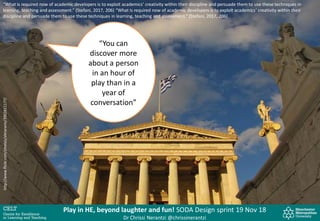
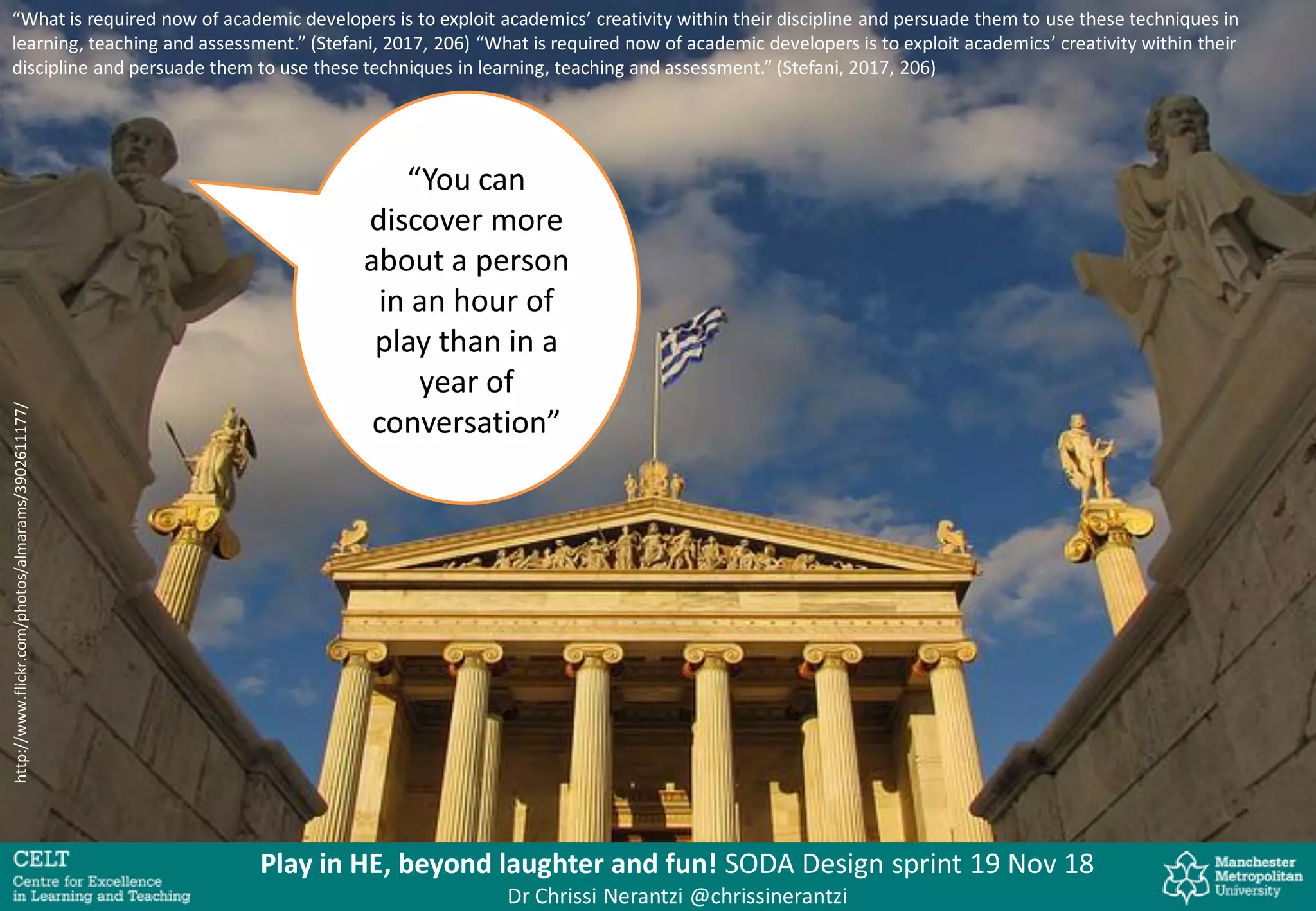
“You can
discover more
about a person
in an hour of
play than in a
year of
conversation”
Play in HE, beyond laughter and fun! SODA Design sprint 19 Nov 18
Dr Chrissi Nerantzi @chrissinerantzi
“What is required now of academic developers is to exploit academics’ creativity within their discipline and persuade them to use these techniques in
learning, teaching and assessment.” (Stefani, 2017, 206) “What is required now of academic developers is to exploit academics’ creativity within their
discipline and persuade them to use these techniques in learning, teaching and assessment.” (Stefani, 2017, 206)
A game (Sell your
bargains)
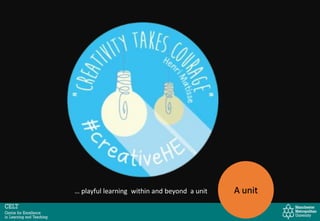
A unit
(#creativeHE)
… and a
community
Sell your bargains
An
activity
… where Problem-Based Learning meets playful learning
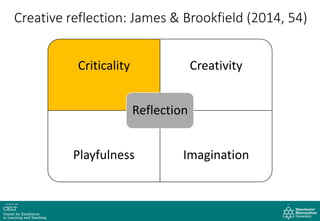
Creative reflection: James & Brookfield (2014, 54)
Criticality Creativity
Playfulness Imagination
Reflection
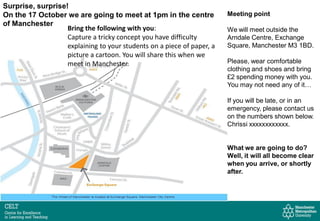
Meeting point
We will meet outside the
Arndale Centre, Exchange
Square, Manchester M3 1BD.
Please, wear comfortable
clothing and shoes and bring
£2 spending money with you.
You may not need any of it…
If you will be late, or in an
emergency, please contact us
on the numbers shown below.
Chrissi xxxxxxxxxxxx.
What we are going to do?
Well, it will all become clear
when you arrive, or shortly
after.
Surprise, surprise!
On the 17 October we are going to meet at 1pm in the centre
of Manchester
Bring the following with you:
Capture a tricky concept you have difficulty
explaining to your students on a piece of paper, a
picture a cartoon. You will share this when we
meet in Manchester.
Sell your bargains
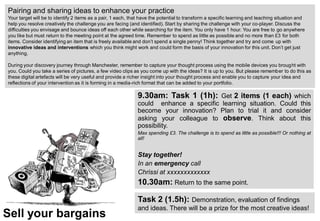
Pairing and sharing ideas to enhance your practice
Your target will be to identify 2 items as a pair, 1 each, that have the potential to transform a specific learning and teaching situation and
help you resolve creatively the challenge you are facing (and identified). Start by sharing the challenge with your co-player. Discuss the
difficulties you envisage and bounce ideas off each other while searching for the item. You only have 1 hour. You are free to go anywhere
you like but must return to the meeting point at the agreed time. Remember to spend as little as possible and no more than £3 for both
items. Consider identifying an item that is freely available and don’t spend a single penny! Think together and try and come up with
innovative ideas and interventions which you think might work and could form the basis of your innovation for this unit. Don’t get just
anything.
During your discovery journey through Manchester, remember to capture your thought process using the mobile devices you brought with
you. Could you take a series of pictures, a few video clips as you come up with the ideas? It is up to you. But please remember to do this as
these digital artefacts will be very useful and provide a richer insight into your thought process and enable you to capture your idea and
reflections of your intervention as it is forming in a media-rich format that can be added to your portfolio.
Task 2 (1.5h): Demonstration, evaluation of findings
and ideas. There will be a prize for the most creative ideas!
9.30am: Task 1 (1h): Get 2 items (1 each) which
could enhance a specific learning situation. Could this
become your innovation? Plan to trial it and consider
asking your colleague to observe. Think about this
possibility.
Max spending £3. The challenge is to spend as little as possible!!! Or nothing at
all!
Stay together!
In an emergency call
Chrissi at xxxxxxxxxxxxx
10.30am: Return to the same point.
https://c1.staticflickr.com/1/627/21767489944_515a523551_b.jpg
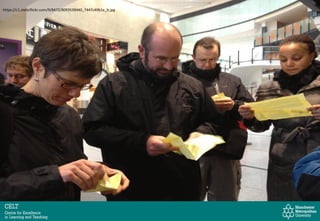
https://c1.staticflickr.com/9/8472/8093539440_7447c49b1e_b.jpg
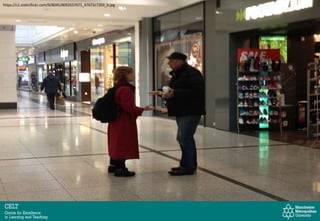
https://c1.staticflickr.com/9/8045/8093537671_47672c7203_b.jpg
https://www.flickr.com/photos/21614692@N02/15831447513/in/set-72157650429760242
https://c2.staticflickr.com/2/1678/24330865564_015498abe3_b.jpg
https://c2.staticflickr.com/8/7252/8161047046_5bcdd4e945_b.jpg
https://www.flickr.com/photos/pgcap/sets/72157627977450174
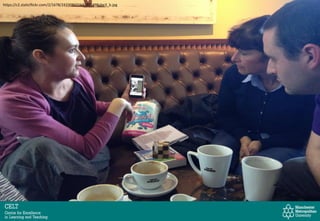
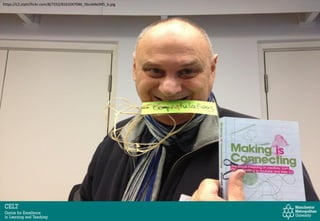
Neil and Fiona’s Journey
A unit… playful learning within and beyond a unit
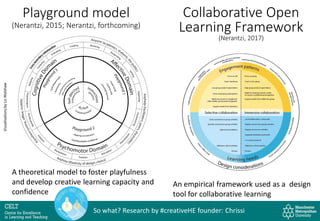
Playground model
(Nerantzi, 2015; Nerantzi, forthcoming)
A theoretical model to foster playfulness
and develop creative learning capacity and
confidence
VisualisationsbyLizWalshaw
Collaborative Open
Learning Framework
(Nerantzi, 2017)
So what? Research by #creativeHE founder: Chrissi
An empirical framework used as a design
tool for collaborative learning
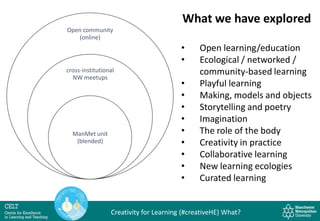
Open community
(online)
cross-institutional
NW meetups
ManMet unit
(blended)
Creativity for Learning (#creativeHE) What?
What we have explored
• Open learning/education
• Ecological / networked /
community-based learning
• Playful learning
• Making, models and objects
• Storytelling and poetry
• Imagination
• The role of the body
• Creativity in practice
• Collaborative learning
• New learning ecologies
• Curated learning
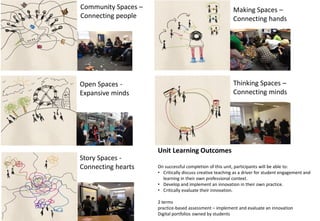
Community Spaces –
Connecting people
Open Spaces -
Expansive minds
Story Spaces -
Connecting hearts
Making Spaces –
Connecting hands
Thinking Spaces –
Connecting minds
Unit Learning Outcomes
On successful completion of this unit, participants will be able to:
• Critically discuss creative teaching as a driver for student engagement and
learning in their own professional context.
• Develop and implement an innovation in their own practice.
• Critically evaluate their innovation.
2 terms
practice-based assessment – implement and evaluate an innovation
Digital portfolios owned by students
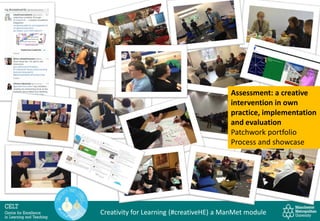
Creativity for Learning (#creativeHE) a ManMet module
Assessment: a creative
intervention in own
practice, implementation
and evaluation
Patchwork portfolio
Process and showcase
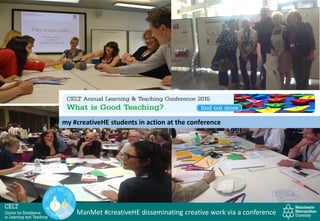
my #creativeHE students in action at the conference
ManMet #creativeHE disseminating creative work via a conference
#creativeHE NW meetups and idea
that extended the Greenhouse
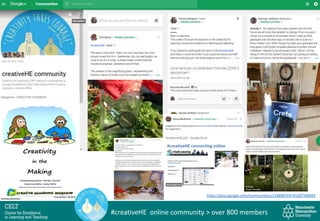
https://plus.google.com/communities/110898703741307769041
#creativeHE online community > over 800 members
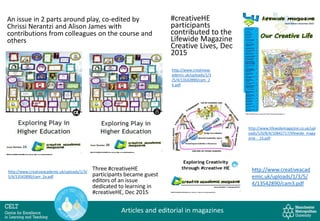
#creativeHE
participants
contributed to the
Lifewide Magazine
Creative Lives, Dec
2015
http://www.lifewidemagazine.co.uk/upl
oads/1/0/8/4/10842717/lifewide_maga
zine__15.pdf
http://www.creativeacad
emic.uk/uploads/1/3/5/
4/13542890/cam3.pdf
Three #creativeHE
participants became guest
editors of an issue
dedicated to learning in
#creativeHE, Dec 2015
An issue in 2 parts around play, co-edited by
Chrissi Nerantzi and Alison James with
contributions from colleagues on the course and
others
http://www.creativeacademic.uk/uploads/1/3/
5/4/13542890/cam_2a.pdf
http://www.creativeac
ademic.uk/uploads/1/3
/5/4/13542890/cam_2
b.pdf
Articles and editorial in magazines
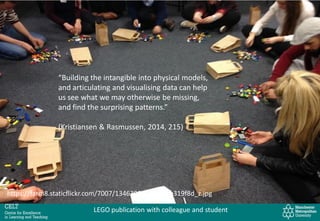
https://farm8.staticflickr.com/7007/13463088623_2bfb319f8d_z.jpg
LEGO publication with colleague and student
“Building the intangible into physical models,
and articulating and visualising data can help
us see what we may otherwise be missing,
and find the surprising patterns.”
(Kristiansen & Rasmussen, 2014, 215)
LSP, one case
• 2013/14 introducing the use of LEGO to evaluate an undergraduate unit in
Nutritional Sciences, led by Chrissi Nerantzi
• 11-12 Sept 2014 Playfulness brings openness or using a creative approach to
evaluate an undergraduate unit and move forward together, workshop with
Haleh Moravej, Floyd Johnson, RAISE Conference 2014: Student Engagement
for all: Staff, Students and Community, MMU
• Nerantzi, C., Moravej, H. and Johnson, F. (2015) Play brings openness or using
a creative approach to evaluate an undergraduate unit and move forward
together, JPAAP, Vol 3, No. 2, pp. 82-91, available at
http://jpaap.napier.ac.uk/index.php/JPAAP/article/view/141
• 2015/16, 2016/17, 2017/18 regularly used by Haleh Moravej in undergraduate
unit of Nutritional Sciences and MetMUnch activities
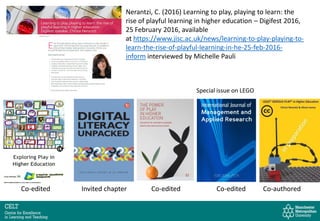
Invited chapter Co-edited Co-authoredCo-edited
Special issue on LEGO
Co-edited
Nerantzi, C. (2016) Learning to play, playing to learn: the
rise of playful learning in higher education – Digifest 2016,
25 February 2016, available
at https://www.jisc.ac.uk/news/learning-to-play-playing-to-
learn-the-rise-of-playful-learning-in-he-25-feb-2016-
inform interviewed by Michelle Pauli
“Learn the rules
like a pro, so you
can break them
like an artist.”
Pablo Picasso
“If you don’t know
the rules, you don’t
know not to break
them. The amateur
doesn’t fear
failure.” (Kessels,
2016, 43)
“People often associate play with laughter, fun, and
having a good time. It’s easy to understand why play
often involves all these things. But that description
misses what’s most important about play- and why
play is so important to creativity. Creativity doesn’t
come from laughter and fun: It comes from
experimenting, taking risks, and testing the
boundaries.” (Resnick, 2017, 128)
References
Agné, H. & Mörkenstam, U. (2018). Should first-year doctoral students be supervised collectively or individually? Effects on thesis completion and time to completion. In: Journal Higher Education and Development. pp. 1-14. Accessed from
https://www.tandfonline.com/doi/full/10.1080/07294360.2018.1453785
Coughlan, T. & Perryman, L. (2012). Reaching out with OER: the new role of public-facing open scholar. eLearning Papers, 31. Accessed from http://oro.open.ac.uk/35934/1/In-depth_31_1.pdf
Crawford, K. (2009). Continuing professional development in higher education: Voices from below. University of Lincoln. [EdD thesis]. Retrieved from http://eprints.lincoln.ac.uk/2146/1/Crawford-Ed%28D%29Thesis-CPDinHE-
FINAL%28Sept09%29.pdf
Di Napoli, R. (2014). Value gaming and political ontology: between resistance and compliance in academic development. International journal for academic development, 19 (1), 2014, pp.4-11.
Fung, D. (2017) A connected curriculum for higher education. London: UCL Press. Accessed from file:///C:/Users/55112114/Downloads/630699.pdf
Hall, R. & Smyth, K., (2016). Dismantling the curriculum in higher education. Open library of humanities, 2 (1): e11, pp.1-28. Accessed from http://doi.org/10.16995/olh.66
Inamorato dos Santos, A., Punie, Y. & Castaño-Muñoz, J. (2016). Opening up Education: A support framework for higher education institutions. JRC science for policy report. Accessed from http://ec.europa.eu/jrc/en/publication/eur-scientific-
and-technical-research-reports/opening-education-support-framework-higher-education-institutions
James, A. & Brookfield S. (2014) Engaging Imagination. Helping Students become creative and reflective thinkers, San Francisco, CA: Jossey-Bass
Kessels, E. (2016)Failed it! How to turn mistakes into ideas and other advice for successfully screwing up, London: Phaidon press.
Kristiansen, P. & Rasmussen, R. (2014)Building a better business using the LEGO® Serious Play® Method, Hooken: Wiley.
Macintyre, R. (2017) Porous, permeable, praxis, pedagogy, more P’s less HE, 28 June 2017. Accessed from https://roughbounds.wordpress.com/2017/06/28/porous-permeable-praxis-pedagogy-more-ps-less-he/
Mantai, L. (2017). Pracamedics, teaching during the PhD, 3 October 2017, Teche Maquarie University’s Learning and Teaching blog. Retrieved from http://teche.ltc.mq.edu.au/pracademics-teaching-phd/
Marton, F. (1981) Phenomenography – describing conceptions of the world around us, Instructional Science, 10, pp. 177-200.
Neame, C. (2013). Democracy or intervention? Adapting orientations to development, International journal for academic development, 18 (4), 2013, pp.331-343.
Neame, C. (2011). Exploring models of development of professional practice in learning and teaching in higher education: What can we learn from biology and marketing?, Educate, 11 (1), 2011, pp.9-19.
Nerantzi, C. (2018b) How is LEGO® SERIOUS PLAY® experienced in doctoral supervision, doctoral researchers’ and doctoral supervisors’ development?, MA dissertation, Manchester: Manchester Metropolitan University
Nerantzi, C. (2017). Towards a framework for cross-boundary collaborative open learning for cross-institutional academic development. PhD thesis, Edinburgh: Edinburgh Napier University. Retrieved
from https://www.napier.ac.uk/~/media/worktribe/output-1025583/towards-a-framework-for-cross-boundary-collaborative-open-learning-for.pdf
Resnick, M. (2017) Lifelong kindergarten. Cultivating creativity through projects, passion, peers, and play. Cambridge (MA): MIT Press
Stefani, L. (2017) Realizing the potential for creativity in teaching and learning, in: Watts, L. and Blessinger, P. (eds.) (2017), London: Routledge. pp. 196-209
Wall, G., 2015. Future thinking: Imaginative expectations for the leaky university. Journal of perspectives in applied academic practice, 3 (1), pp.6-10.
Weller, M. (2014) The battle for open. How openness won and why it doesn’t feel like victory, London: ubiquity press.
Full presentation on slideshare https://www.slideshare.net/chrissi
Blog https://chrissinerantzi.wordpress.com/
Twitter @chrissinerantzi
Email c.nerantzi@mmu.ac.uk
Dr Chrissi Nerantzi
NTF, PFHEA, FSEDA, CMALT

Play in HE, beyond laughter and fun!

  • 1.
    http://www.flickr.com/photos/almarams/3902611177/ “You can discover more abouta person in an hour of play than in a year of conversation” Play in HE, beyond laughter and fun! SODA Design sprint 19 Nov 18 Dr Chrissi Nerantzi @chrissinerantzi “What is required now of academic developers is to exploit academics’ creativity within their discipline and persuade them to use these techniques in learning, teaching and assessment.” (Stefani, 2017, 206) “What is required now of academic developers is to exploit academics’ creativity within their discipline and persuade them to use these techniques in learning, teaching and assessment.” (Stefani, 2017, 206)
  • 2.
    A game (Sellyour bargains) A unit (#creativeHE) … and a community
  • 3.
    Sell your bargains An activity …where Problem-Based Learning meets playful learning
  • 4.
    Creative reflection: James& Brookfield (2014, 54) Criticality Creativity Playfulness Imagination Reflection
  • 5.
    Meeting point We willmeet outside the Arndale Centre, Exchange Square, Manchester M3 1BD. Please, wear comfortable clothing and shoes and bring £2 spending money with you. You may not need any of it… If you will be late, or in an emergency, please contact us on the numbers shown below. Chrissi xxxxxxxxxxxx. What we are going to do? Well, it will all become clear when you arrive, or shortly after. Surprise, surprise! On the 17 October we are going to meet at 1pm in the centre of Manchester Bring the following with you: Capture a tricky concept you have difficulty explaining to your students on a piece of paper, a picture a cartoon. You will share this when we meet in Manchester.
  • 6.
    Sell your bargains Pairingand sharing ideas to enhance your practice Your target will be to identify 2 items as a pair, 1 each, that have the potential to transform a specific learning and teaching situation and help you resolve creatively the challenge you are facing (and identified). Start by sharing the challenge with your co-player. Discuss the difficulties you envisage and bounce ideas off each other while searching for the item. You only have 1 hour. You are free to go anywhere you like but must return to the meeting point at the agreed time. Remember to spend as little as possible and no more than £3 for both items. Consider identifying an item that is freely available and don’t spend a single penny! Think together and try and come up with innovative ideas and interventions which you think might work and could form the basis of your innovation for this unit. Don’t get just anything. During your discovery journey through Manchester, remember to capture your thought process using the mobile devices you brought with you. Could you take a series of pictures, a few video clips as you come up with the ideas? It is up to you. But please remember to do this as these digital artefacts will be very useful and provide a richer insight into your thought process and enable you to capture your idea and reflections of your intervention as it is forming in a media-rich format that can be added to your portfolio. Task 2 (1.5h): Demonstration, evaluation of findings and ideas. There will be a prize for the most creative ideas! 9.30am: Task 1 (1h): Get 2 items (1 each) which could enhance a specific learning situation. Could this become your innovation? Plan to trial it and consider asking your colleague to observe. Think about this possibility. Max spending £3. The challenge is to spend as little as possible!!! Or nothing at all! Stay together! In an emergency call Chrissi at xxxxxxxxxxxxx 10.30am: Return to the same point.
  • 7.
  • 8.
  • 9.
  • 10.
  • 11.
  • 12.
  • 13.
  • 14.
    A unit… playfullearning within and beyond a unit
  • 15.
    Playground model (Nerantzi, 2015;Nerantzi, forthcoming) A theoretical model to foster playfulness and develop creative learning capacity and confidence VisualisationsbyLizWalshaw Collaborative Open Learning Framework (Nerantzi, 2017) So what? Research by #creativeHE founder: Chrissi An empirical framework used as a design tool for collaborative learning
  • 16.
    Open community (online) cross-institutional NW meetups ManMetunit (blended) Creativity for Learning (#creativeHE) What? What we have explored • Open learning/education • Ecological / networked / community-based learning • Playful learning • Making, models and objects • Storytelling and poetry • Imagination • The role of the body • Creativity in practice • Collaborative learning • New learning ecologies • Curated learning
  • 17.
    Community Spaces – Connectingpeople Open Spaces - Expansive minds Story Spaces - Connecting hearts Making Spaces – Connecting hands Thinking Spaces – Connecting minds Unit Learning Outcomes On successful completion of this unit, participants will be able to: • Critically discuss creative teaching as a driver for student engagement and learning in their own professional context. • Develop and implement an innovation in their own practice. • Critically evaluate their innovation. 2 terms practice-based assessment – implement and evaluate an innovation Digital portfolios owned by students
  • 18.
    Creativity for Learning(#creativeHE) a ManMet module Assessment: a creative intervention in own practice, implementation and evaluation Patchwork portfolio Process and showcase
  • 19.
    my #creativeHE studentsin action at the conference ManMet #creativeHE disseminating creative work via a conference
  • 20.
    #creativeHE NW meetupsand idea that extended the Greenhouse
  • 21.
  • 22.
    #creativeHE participants contributed to the LifewideMagazine Creative Lives, Dec 2015 http://www.lifewidemagazine.co.uk/upl oads/1/0/8/4/10842717/lifewide_maga zine__15.pdf http://www.creativeacad emic.uk/uploads/1/3/5/ 4/13542890/cam3.pdf Three #creativeHE participants became guest editors of an issue dedicated to learning in #creativeHE, Dec 2015 An issue in 2 parts around play, co-edited by Chrissi Nerantzi and Alison James with contributions from colleagues on the course and others http://www.creativeacademic.uk/uploads/1/3/ 5/4/13542890/cam_2a.pdf http://www.creativeac ademic.uk/uploads/1/3 /5/4/13542890/cam_2 b.pdf Articles and editorial in magazines
  • 23.
    https://farm8.staticflickr.com/7007/13463088623_2bfb319f8d_z.jpg LEGO publication withcolleague and student “Building the intangible into physical models, and articulating and visualising data can help us see what we may otherwise be missing, and find the surprising patterns.” (Kristiansen & Rasmussen, 2014, 215)
  • 24.
    LSP, one case •2013/14 introducing the use of LEGO to evaluate an undergraduate unit in Nutritional Sciences, led by Chrissi Nerantzi • 11-12 Sept 2014 Playfulness brings openness or using a creative approach to evaluate an undergraduate unit and move forward together, workshop with Haleh Moravej, Floyd Johnson, RAISE Conference 2014: Student Engagement for all: Staff, Students and Community, MMU • Nerantzi, C., Moravej, H. and Johnson, F. (2015) Play brings openness or using a creative approach to evaluate an undergraduate unit and move forward together, JPAAP, Vol 3, No. 2, pp. 82-91, available at http://jpaap.napier.ac.uk/index.php/JPAAP/article/view/141 • 2015/16, 2016/17, 2017/18 regularly used by Haleh Moravej in undergraduate unit of Nutritional Sciences and MetMUnch activities
  • 25.
    Invited chapter Co-editedCo-authoredCo-edited Special issue on LEGO Co-edited Nerantzi, C. (2016) Learning to play, playing to learn: the rise of playful learning in higher education – Digifest 2016, 25 February 2016, available at https://www.jisc.ac.uk/news/learning-to-play-playing-to- learn-the-rise-of-playful-learning-in-he-25-feb-2016- inform interviewed by Michelle Pauli
  • 26.
    “Learn the rules likea pro, so you can break them like an artist.” Pablo Picasso “If you don’t know the rules, you don’t know not to break them. The amateur doesn’t fear failure.” (Kessels, 2016, 43)
  • 27.
    “People often associateplay with laughter, fun, and having a good time. It’s easy to understand why play often involves all these things. But that description misses what’s most important about play- and why play is so important to creativity. Creativity doesn’t come from laughter and fun: It comes from experimenting, taking risks, and testing the boundaries.” (Resnick, 2017, 128)
  • 28.
    References Agné, H. &Mörkenstam, U. (2018). Should first-year doctoral students be supervised collectively or individually? Effects on thesis completion and time to completion. In: Journal Higher Education and Development. pp. 1-14. Accessed from https://www.tandfonline.com/doi/full/10.1080/07294360.2018.1453785 Coughlan, T. & Perryman, L. (2012). Reaching out with OER: the new role of public-facing open scholar. eLearning Papers, 31. Accessed from http://oro.open.ac.uk/35934/1/In-depth_31_1.pdf Crawford, K. (2009). Continuing professional development in higher education: Voices from below. University of Lincoln. [EdD thesis]. Retrieved from http://eprints.lincoln.ac.uk/2146/1/Crawford-Ed%28D%29Thesis-CPDinHE- FINAL%28Sept09%29.pdf Di Napoli, R. (2014). Value gaming and political ontology: between resistance and compliance in academic development. International journal for academic development, 19 (1), 2014, pp.4-11. Fung, D. (2017) A connected curriculum for higher education. London: UCL Press. Accessed from file:///C:/Users/55112114/Downloads/630699.pdf Hall, R. & Smyth, K., (2016). Dismantling the curriculum in higher education. Open library of humanities, 2 (1): e11, pp.1-28. Accessed from http://doi.org/10.16995/olh.66 Inamorato dos Santos, A., Punie, Y. & Castaño-Muñoz, J. (2016). Opening up Education: A support framework for higher education institutions. JRC science for policy report. Accessed from http://ec.europa.eu/jrc/en/publication/eur-scientific- and-technical-research-reports/opening-education-support-framework-higher-education-institutions James, A. & Brookfield S. (2014) Engaging Imagination. Helping Students become creative and reflective thinkers, San Francisco, CA: Jossey-Bass Kessels, E. (2016)Failed it! How to turn mistakes into ideas and other advice for successfully screwing up, London: Phaidon press. Kristiansen, P. & Rasmussen, R. (2014)Building a better business using the LEGO® Serious Play® Method, Hooken: Wiley. Macintyre, R. (2017) Porous, permeable, praxis, pedagogy, more P’s less HE, 28 June 2017. Accessed from https://roughbounds.wordpress.com/2017/06/28/porous-permeable-praxis-pedagogy-more-ps-less-he/ Mantai, L. (2017). Pracamedics, teaching during the PhD, 3 October 2017, Teche Maquarie University’s Learning and Teaching blog. Retrieved from http://teche.ltc.mq.edu.au/pracademics-teaching-phd/ Marton, F. (1981) Phenomenography – describing conceptions of the world around us, Instructional Science, 10, pp. 177-200. Neame, C. (2013). Democracy or intervention? Adapting orientations to development, International journal for academic development, 18 (4), 2013, pp.331-343. Neame, C. (2011). Exploring models of development of professional practice in learning and teaching in higher education: What can we learn from biology and marketing?, Educate, 11 (1), 2011, pp.9-19. Nerantzi, C. (2018b) How is LEGO® SERIOUS PLAY® experienced in doctoral supervision, doctoral researchers’ and doctoral supervisors’ development?, MA dissertation, Manchester: Manchester Metropolitan University Nerantzi, C. (2017). Towards a framework for cross-boundary collaborative open learning for cross-institutional academic development. PhD thesis, Edinburgh: Edinburgh Napier University. Retrieved from https://www.napier.ac.uk/~/media/worktribe/output-1025583/towards-a-framework-for-cross-boundary-collaborative-open-learning-for.pdf Resnick, M. (2017) Lifelong kindergarten. Cultivating creativity through projects, passion, peers, and play. Cambridge (MA): MIT Press Stefani, L. (2017) Realizing the potential for creativity in teaching and learning, in: Watts, L. and Blessinger, P. (eds.) (2017), London: Routledge. pp. 196-209 Wall, G., 2015. Future thinking: Imaginative expectations for the leaky university. Journal of perspectives in applied academic practice, 3 (1), pp.6-10. Weller, M. (2014) The battle for open. How openness won and why it doesn’t feel like victory, London: ubiquity press.
  • 29.
    Full presentation onslideshare https://www.slideshare.net/chrissi Blog https://chrissinerantzi.wordpress.com/ Twitter @chrissinerantzi Email c.nerantzi@mmu.ac.uk Dr Chrissi Nerantzi NTF, PFHEA, FSEDA, CMALT