Conceptualizing collaborative participation and  engagement in OER communities OER10 Conference Dr Panagiota Alevizou Dr Tina Wilison Dr Patrick McAndrew Contact: p.alevizou@open.ac.uk Institute of Educational Techonlogy, Open University www.olnet.org
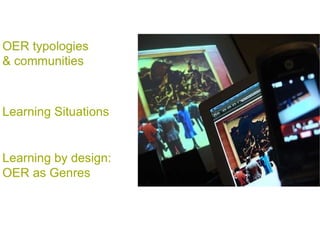
Learning Situations Learning by design: OER as Genres
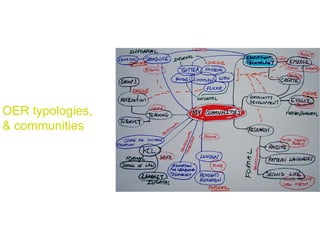
OER typologies, & communities
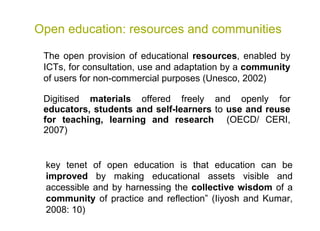
Open education: resources and communities Digitised  materials  offered freely and openly for  educators, students and self-learners  to  use and reuse for teaching, learning and research   (OECD/ CERI, 2007) The open provision of educational  resources , enabled by ICTs, for consultation, use and adaptation by a  community  of users for non-commercial purposes (Unesco, 2002) key tenet of open education is that education can be  improved  by making educational assets visible and accessible and by harnessing the  collective wisdom  of a  community  of practice and reflection” (Iiyosh and Kumar, 2008: 10)
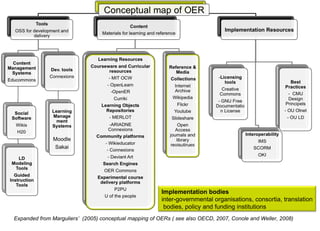
Expanded from Marguliers’  (2005) conceptual mapping of OERs ( see also OECD, 2007, Conole and Weller, 2008)  Implementation bodies inter-governmental organisations, consortia, translation bodies, policy and funding institutions
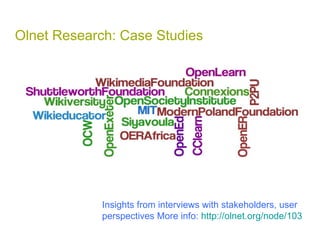
Olnet Research: Case Studies  Insights from interviews with stakeholders, user perspectives More info:  http://olnet.org/node/103
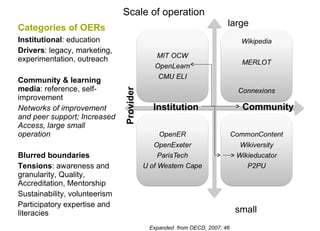
Categories of OERs Institutional : education Drivers : legacy, marketing, experimentation, outreach Community & learning media : reference, self-improvement Networks of improvement and peer support; Increased Access, large small operation Blurred boundaries  Tensions : awareness and granularity, Quality, Accreditation, Mentorship Sustainability, volunteerism  Participatory expertise and literacies Scale of operation large small Provider Community Institution Expanded  from OECD, 2007: 46
Community/connectedness Collaboration in development Stakeholders (internal or external) Expanding diversity and building cross-institutional collaborations, knowledge transfer and exchange  Social engagement around open access content/OER Faculty, Tutors & learners  Disciplinary/subject engagement & exposure Experimental pedagogies & engagement in learning De-schooling society?
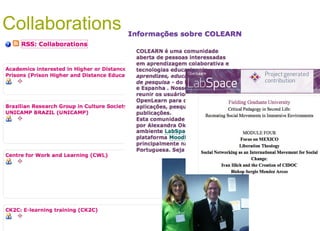
Collaborations
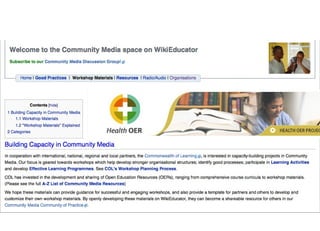
Collaborations Changing Mindsets […] OER Africa acts as a mediator for changing the mentality of an old educational system that was top down and authoritative  (Interview: CN: OER Africa)  Knowledge exchange  & student engagement  MIT OCW & MIT Science and  Tech initiative & MINSKY programmes (engagement with content) TESSA ‘ Connect scholars and practitioners   within a bounded discipline or professional community. Cultural bias is addressed when different type(s) of knowledge are exchanged transparently in the platform’  (Interview: CN on OER Africa & U Michigan Public Health: tropical diseases unit)  Crowdsourcing Cultural and ed. institutions (Wikimedia foundation) Community support services  We focus on existing CoP to facilitate support in online engagement and evaluation of content and in particular learning situations  (Interview: RF, Wikieducator)
 
Communities of improvement Dialogue on pedagogical wrappers  Build OER content in service of existing educational problems…(i.e. teaching practice)…this is the content I used with my students, these are the challenges I faced and these are the LO I achieved or didn’t, can someone help me improve my practice?  (Interview: JW, Wikimedia) If you can form these  network-improvement communities  so that they can help teachers in their practice, and generate evidence of what works…and if the success rates are higher, then I get empowred and tell my peers and they tell their peers and so we begin the viral effect  (Interview: KC, Carnegie) Teaching & learning innovations Exposure, Reflection, Reputation ‘ about 1/3 of faculty tell us that publishing courseware openly has improved both their standing in the field and their teaching ’ (Interv: SC: MIT OCW) ‘ Teachers tells us that they improve their practices and enjoy notoriety by publishing openly  (Interv.Connexions) Collaborative pedagogies & engagement in peer learning Ad hoc learning communities organising  Wikiversity  resources specifically to meet their learning goals Capture the leisure power – the wisdom of the crowds, the passion of people interested in content domains  (KC, Carnegie)
 
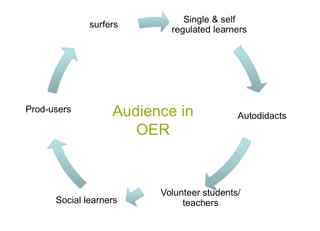
Audience in OER Social learners Prod-users
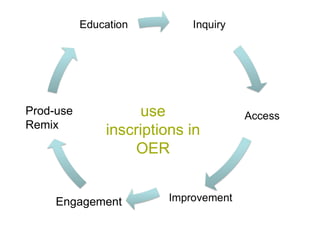
use inscriptions in OER Engagement Prod-use Remix
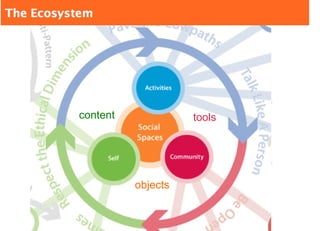
content tools objects
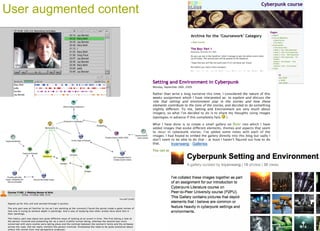
User augmented content
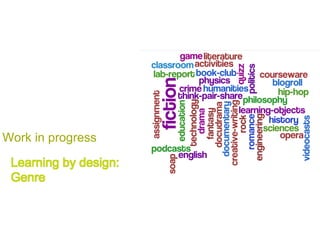
Work in progress
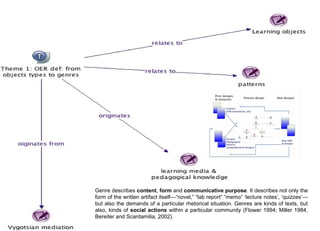
Genre describes  content ,  form  and  communicative purpose . It describes not only the form of the written artifact itself—“novel,” “lab report” “memo” ‘lecture notes’, ‘quizzes’—but also the demands of a particular rhetorical situation. Genres are kinds of texts, but also, kinds of  social actions  within a particular community (Flower 1994; Miller 1984, Bereiter and Scardamilia, 2002).
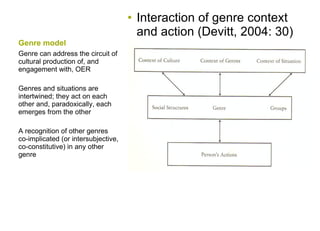
Genre model Interaction of genre context and action (Devitt, 2004: 30) Genre can address the circuit of cultural production of, and engagement with, OER Genres and situations are intertwined; they act on each other and, paradoxically, each emerges from the other A recognition of other genres co-implicated (or intersubjective, co-constitutive) in any other genre
Concluding remarks OER is the dictionary of our time; the platform to share a common language and build  knowledge. We need to look at the political implications of the choices we make around OER development: the content, the learning the innovation trajectories, the communities  (DC, U of PEI, OpenEd Community)
credits Education/collaboration: @psd  http://www.flickr.com/photos/psd/1805374441/   Mediation: Flickr @ hyperscholar  My Communities @Steven w: flickr  http://www.flickr.com/photos/stevenwarburton/3209461104/ Learning @Blunight 72*: flickr  www.flickr.com/photos/blunight72/164070593/
Thank you

Alevizou et al Oer10 Presentation

  • 1.
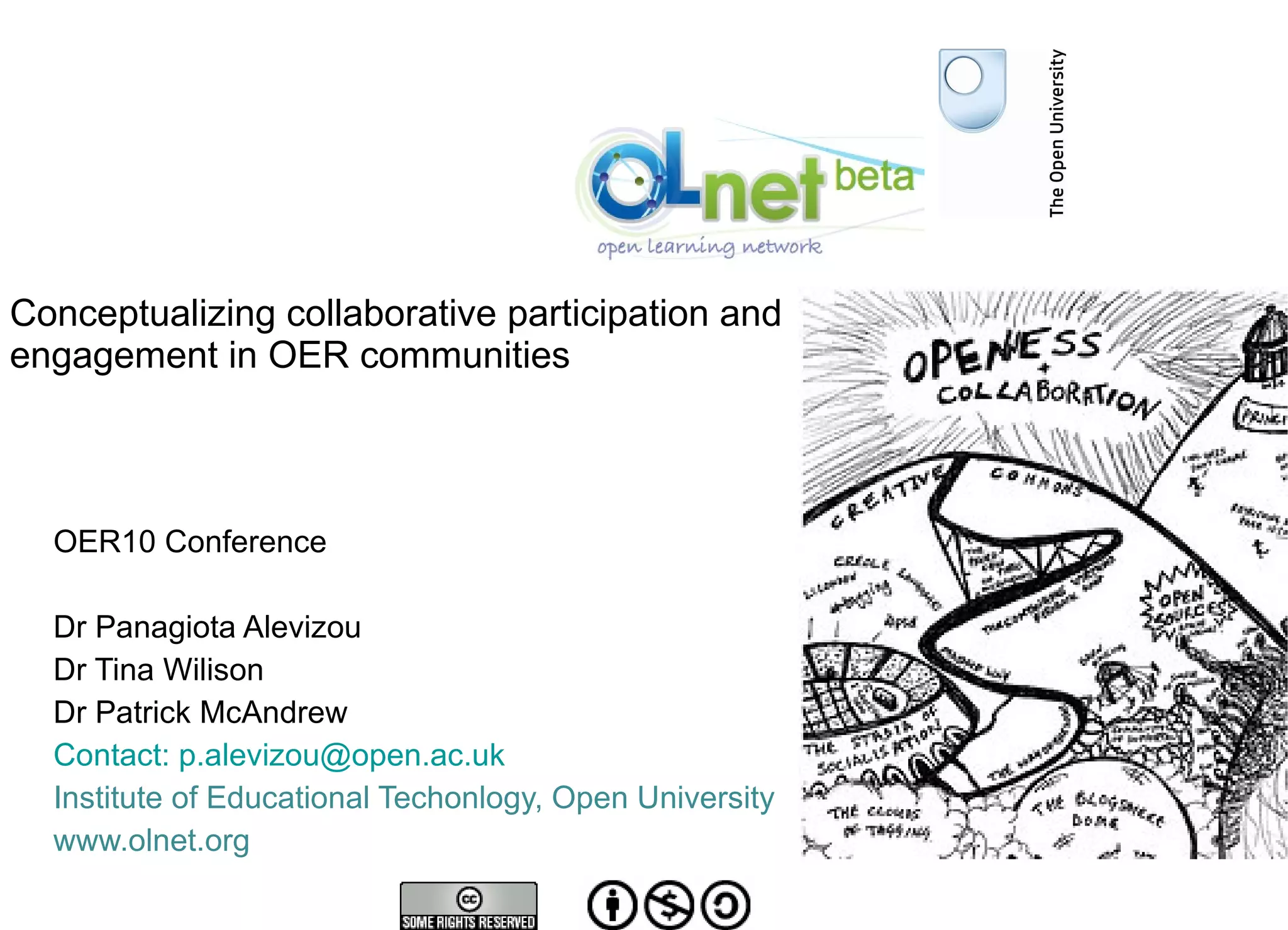
    Conceptualizing collaborative participationand engagement in OER communities OER10 Conference Dr Panagiota Alevizou Dr Tina Wilison Dr Patrick McAndrew Contact: p.alevizou@open.ac.uk Institute of Educational Techonlogy, Open University www.olnet.org
  • 2.
    Learning Situations Learningby design: OER as Genres
  • 3.
    OER typologies, &communities
  • 4.
    Open education: resourcesand communities Digitised materials offered freely and openly for educators, students and self-learners to use and reuse for teaching, learning and research (OECD/ CERI, 2007) The open provision of educational resources , enabled by ICTs, for consultation, use and adaptation by a community of users for non-commercial purposes (Unesco, 2002) key tenet of open education is that education can be improved by making educational assets visible and accessible and by harnessing the collective wisdom of a community of practice and reflection” (Iiyosh and Kumar, 2008: 10)
  • 5.
    Expanded from Marguliers’ (2005) conceptual mapping of OERs ( see also OECD, 2007, Conole and Weller, 2008) Implementation bodies inter-governmental organisations, consortia, translation bodies, policy and funding institutions
  • 6.
    Olnet Research: CaseStudies Insights from interviews with stakeholders, user perspectives More info: http://olnet.org/node/103
  • 7.
    Categories of OERsInstitutional : education Drivers : legacy, marketing, experimentation, outreach Community & learning media : reference, self-improvement Networks of improvement and peer support; Increased Access, large small operation Blurred boundaries Tensions : awareness and granularity, Quality, Accreditation, Mentorship Sustainability, volunteerism Participatory expertise and literacies Scale of operation large small Provider Community Institution Expanded from OECD, 2007: 46
  • 8.
    Community/connectedness Collaboration indevelopment Stakeholders (internal or external) Expanding diversity and building cross-institutional collaborations, knowledge transfer and exchange Social engagement around open access content/OER Faculty, Tutors & learners Disciplinary/subject engagement & exposure Experimental pedagogies & engagement in learning De-schooling society?
  • 9.
  • 10.
    Collaborations Changing Mindsets[…] OER Africa acts as a mediator for changing the mentality of an old educational system that was top down and authoritative (Interview: CN: OER Africa) Knowledge exchange & student engagement MIT OCW & MIT Science and Tech initiative & MINSKY programmes (engagement with content) TESSA ‘ Connect scholars and practitioners within a bounded discipline or professional community. Cultural bias is addressed when different type(s) of knowledge are exchanged transparently in the platform’ (Interview: CN on OER Africa & U Michigan Public Health: tropical diseases unit) Crowdsourcing Cultural and ed. institutions (Wikimedia foundation) Community support services We focus on existing CoP to facilitate support in online engagement and evaluation of content and in particular learning situations (Interview: RF, Wikieducator)
  • 11.
  • 12.
    Communities of improvementDialogue on pedagogical wrappers Build OER content in service of existing educational problems…(i.e. teaching practice)…this is the content I used with my students, these are the challenges I faced and these are the LO I achieved or didn’t, can someone help me improve my practice? (Interview: JW, Wikimedia) If you can form these network-improvement communities so that they can help teachers in their practice, and generate evidence of what works…and if the success rates are higher, then I get empowred and tell my peers and they tell their peers and so we begin the viral effect (Interview: KC, Carnegie) Teaching & learning innovations Exposure, Reflection, Reputation ‘ about 1/3 of faculty tell us that publishing courseware openly has improved both their standing in the field and their teaching ’ (Interv: SC: MIT OCW) ‘ Teachers tells us that they improve their practices and enjoy notoriety by publishing openly (Interv.Connexions) Collaborative pedagogies & engagement in peer learning Ad hoc learning communities organising Wikiversity resources specifically to meet their learning goals Capture the leisure power – the wisdom of the crowds, the passion of people interested in content domains (KC, Carnegie)
  • 13.
  • 14.
    Audience in OERSocial learners Prod-users
  • 15.
    use inscriptions inOER Engagement Prod-use Remix
  • 16.
  • 17.
  • 18.
  • 19.
    Genre describes content , form and communicative purpose . It describes not only the form of the written artifact itself—“novel,” “lab report” “memo” ‘lecture notes’, ‘quizzes’—but also the demands of a particular rhetorical situation. Genres are kinds of texts, but also, kinds of social actions within a particular community (Flower 1994; Miller 1984, Bereiter and Scardamilia, 2002).
  • 20.
    Genre model Interactionof genre context and action (Devitt, 2004: 30) Genre can address the circuit of cultural production of, and engagement with, OER Genres and situations are intertwined; they act on each other and, paradoxically, each emerges from the other A recognition of other genres co-implicated (or intersubjective, co-constitutive) in any other genre
  • 21.
    Concluding remarks OERis the dictionary of our time; the platform to share a common language and build knowledge. We need to look at the political implications of the choices we make around OER development: the content, the learning the innovation trajectories, the communities (DC, U of PEI, OpenEd Community)
  • 22.
    credits Education/collaboration: @psd http://www.flickr.com/photos/psd/1805374441/ Mediation: Flickr @ hyperscholar My Communities @Steven w: flickr http://www.flickr.com/photos/stevenwarburton/3209461104/ Learning @Blunight 72*: flickr www.flickr.com/photos/blunight72/164070593/
  • 23.

Editor's Notes

  • #3 Credit: Mediation: Flickr @ hyperscholar
  • #10 The educator
  • #13 )