On the Role of Networking in Advancing
Research in Teaching and Teacher
Education
Professor Brian Hudson
WERA Invited Symposium on ‘Building Infrastructure
and Capacity for Research Innovations Worldwide’
WERA Focal Meeting
University of Guanajuato
21st November 2013
Outline of session


On the role of networking as an activity for innovation and as a
process of innovation



Begin to address the advancement of research in relation to
teaching and teacher education by starting with the case of the
Thematic Network for Teacher Education in Europe (1996-99)



Trace the development of two current active networks in particular
up to the present day in terms of innovations, outputs and impact



Highlight the importance of collaboration within interdisciplinary and
international collaborative teams and the role of technology in
supporting this process of advancement
On networking as an activity for innovation
and as a process of innovation


A process of innovation on the part of by individuals, groups and
wider learning communities and organisations



Innovation as a process of knowledge transformation



Lam, A. (1998) The Social Embeddedness of Knowledge: Problems
of Knowledge Sharing and Organisational Learning in International
High-Technology Ventures’, Danish Research Unit for Industrial
Dynamics Working Paper No. 98-7, (DRUID), March.



Buchberger, F., Hudson, B., Laanpere, M. and El Gamal, A. (2005)
Analysis of Success Factors in Network Building: Study of the
European Research Network for ICT in Schools of Tomorrow
(eRNIST) project, European Education Research Journal, 4, 3.
Contrasting knowledge systems


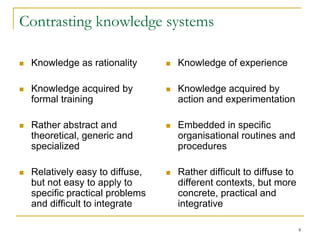
Knowledge as rationality



Knowledge of experience



Knowledge acquired by
formal training



Knowledge acquired by
action and experimentation



Rather abstract and
theoretical, generic and
specialized



Embedded in specific
organisational routines and
procedures



Relatively easy to diffuse,
but not easy to apply to
specific practical problems
and difficult to integrate



Rather difficult to diffuse to
different contexts, but more
concrete, practical and
integrative
4
Roots of these differences


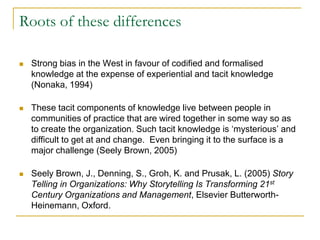
Strong bias in the West in favour of codified and formalised
knowledge at the expense of experiential and tacit knowledge
(Nonaka, 1994)



These tacit components of knowledge live between people in
communities of practice that are wired together in some way so as
to create the organization. Such tacit knowledge is ‘mysterious’ and
difficult to get at and change. Even bringing it to the surface is a
major challenge (Seely Brown, 2005)



Seely Brown, J., Denning, S., Groh, K. and Prusak, L. (2005) Story
Telling in Organizations: Why Storytelling Is Transforming 21st
Century Organizations and Management, Elsevier ButterworthHeinemann, Oxford.
Networks that alter teaching






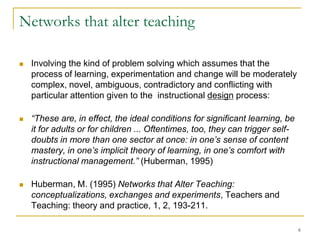
Involving the kind of problem solving which assumes that the
process of learning, experimentation and change will be moderately
complex, novel, ambiguous, contradictory and conflicting with
particular attention given to the instructional design process:
“These are, in effect, the ideal conditions for significant learning, be
it for adults or for children ... Oftentimes, too, they can trigger selfdoubts in more than one sector at once: in one’s sense of content
mastery, in one’s implicit theory of learning, in one’s comfort with
instructional management.” (Huberman, 1995)
Huberman, M. (1995) Networks that Alter Teaching:
conceptualizations, exchanges and experiments, Teachers and
Teaching: theory and practice, 1, 2, 193-211.
6
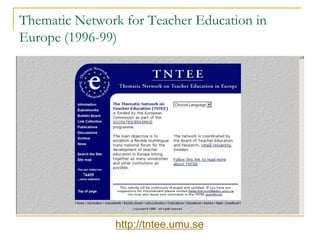
Thematic Network for Teacher Education in
Europe (1996-99)

http://tntee.umu.se
Innovation, outputs and impact from
TNTEE


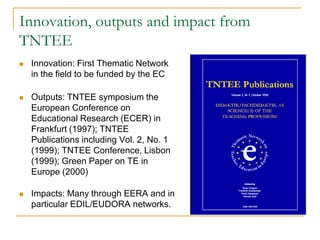
Innovation: First Thematic Network
in the field to be funded by the EC



Outputs: TNTEE symposium the
European Conference on
Educational Research (ECER) in
Frankfurt (1997); TNTEE
Publications including Vol. 2, No. 1
(1999); TNTEE Conference, Lisbon
(1999); Green Paper on TE in
Europe (2000)



Impacts: Many through EERA and in
particular EDIL/EUDORA networks.
European Doctorate in Teaching and
Teacher Education (EUDORA) (2000-05)


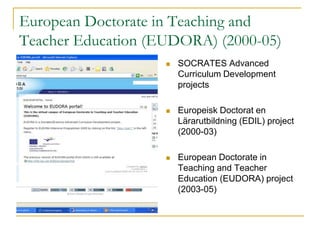
SOCRATES Advanced
Curriculum Development
projects



Europeisk Doctorat en
Lärarutbildning (EDIL) project
(2000-03)



European Doctorate in
Teaching and Teacher
Education (EUDORA) project
(2003-05)
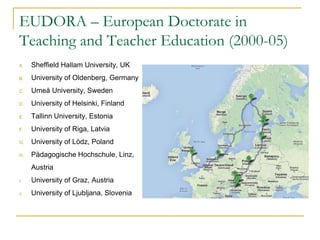
EUDORA – European Doctorate in
Teaching and Teacher Education (2000-05)
A.

Sheffield Hallam University, UK

B.

University of Oldenberg, Germany

C.

Umeå University, Sweden

D.

University of Helsinki, Finland

E.

Tallinn University, Estonia

F.

University of Riga, Latvia

G.

University of Lödz, Poland

H.

Pädagogische Hochschule, Linz,
Austria

I.

University of Graz, Austria

J.

University of Ljubljana, Slovenia
Innovation, outputs and impact from
EUDORA


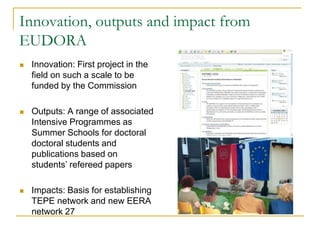
Innovation: First project in the
field on such a scale to be
funded by the Commission



Outputs: A range of associated
Intensive Programmes as
Summer Schools for doctoral
doctoral students and
publications based on
students’ refereed papers



Impacts: Basis for establishing
TEPE network and new EERA
network 27
Intensive Programmes (2002-05)


Comparative Analysis of Education Policy
(Bohinj, 2002; Kranska Gora, 2003 and Tolmin, 2004 - Slovenia)



e-Learning in Higher Education
(Linz, 2002; Riga, 2003; Tallinn, 2004 and Viljandi, 2005)



Researching Social Inclusion and Exclusion in Education
(Tolmin, 2004)



Mother Tongue Education
(Bohinj, 2002 and Tolmin, 2004)



Researching the Teaching and Learning of Mathematics
(Linz, 2003; Tolmin, 2004 and Viljandi, 2005)



Supported also through a National Teaching Fellowship project “Developing
an international open and flexible networked learning community at doctoral
level’ (2004-06), HEFCE/UK Higher Education Academy
Detailed outputs from Intensive
Programmes


Researching the Teaching and Learning of Mathematics II (MATHED 2005)
Linz: Universitätswerlag Rudolf Trauner.



Researching the Teaching and Learning of Mathematics I (MATHED 2003)
Linz: Universitätswerlag Rudolf Trauner.



eLearning in Higher Education: Proceedings of Intensive Programme
(eLEARN 2004) Linz: Universitätswerlag Rudolf Trauner.



Analysis of Educational Policies in a Comparative Perspective (EPAC 2005)
Linz: Universitätswerlag Rudolf Trauner.



European Identities in Mother Tongue Education (IMUN 2005) Linz:
Universitätswerlag Rudolf Trauner.

Open access at http://tepe.wordpress.com
Development of EERA Network 27 on
Didactics – Learning and Teaching


Grew out of TNTEE Network on Didatktik/Fachdidaktik



European Curriculum Research Network (ECUNET) Symposium on
Didaktik: an International Perspective, ECER 2000, Edinburgh, September
2000. Discussant: Ian Westbury



Hudson, B. (2002) Holding complexity and searching for meaning - teaching
as reflective practice, Journal of Curriculum Studies, 34, 1, 43-57.



Discussions with EERA President at ECER 2004 (Hamburg) and ECER
2005 (Dublin) - established at ECER 2006 in Geneva.



Innovation: First cross-national European network to address research in
this field
http://www.eera-ecer.de/networks/didactics/
Outputs from EERA Network Didactics –
Learning and Teaching


Meyer, M.A., Hellekamps, St., and Wulf, Ch. (Eds.) (2012): Didactics
in Europe. In: Zeitschrift für Erziehungswissenschaft, Vol. 15, No. 3.



Hudson, B. and Meyer, M. (2011) Beyond Fragmentation: Didactics,
Learning and Teaching in Europe, Verlag Barbara Budrich, Opladen
and Farmington Hills, 9-28.



Meyer, M. Hellekamps, S. and Prenzel, M. (2008) (Eds.)
Perspektiven der Didaktik: Zeitschrift für Erziehungswissenschaft,



Hudson, B. and Schneuwly, B. (2007) (Eds.) Special Issue of the
European Educational Research Journal (EERJ) on Didactics:
Learning and Teaching in Europe, Vol. 6, No. 2, 106-108.
Teacher Education Policy in Europe (TEPE)
Network


The Teacher Education Policy in Europe (TEPE) network is an
academic network that builds on the work and community from the
previous European collaborative projects in the field of teacher
education policy such TNTEE and EUDORA. It was formally
established at its inaugural meeting in Tallinn in February 2007 with
an overarching aim to develop Teacher Education (TE) policy
recommendations at the institutional, national and European level.



The central goals of the TEPE Network relate to:




Advancing research in and on Teacher Education
Increasing mobility and extending the European Dimension in Teacher Education
Enhancing quality through the renewal of evaluation cultures in Teacher
Education

http://tepe.wordpress.com
Innovation, outputs and impact from TEPE


Innovation: Unique in Europe as a trans-national academic network
in the field independent of any government agency.



Outputs: Annual Conferences in Tallinn (2007), Ljublana (2008),
Umeå (2009), Tallinn (2010), Vienna (2011), Warsaw (2012),
Helsinki (2013). Colloquium at Dublin City University in 2010 in
collaboration with EERA Networks on Teacher Education Research
and Didactics – Learning and Teaching with support from the
Council of the European Educational Research Association.
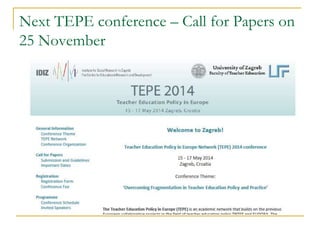
Next conference in May 2014 to be held in Zagreb, Croatia which is
the newest EU Member State.



Associated publications detailed on next slide.
Detailed outputs from TEPE network


Michalak, J., Neimi, H. and Chong, S. (Eds) (2012) Research, Policy, and Practice in
Teacher Education in Europe, University of Lödz.



Harford, J., Hudson, B. and Niemi, H. (Eds.) (2012) Quality Assurance and Teacher
Education: International Challenges and Expectations, Peter Lang (Oxford).



Harford, J., Sacilotto-Vasylenko, M. and Vizek Vidović, V. (Eds.) (2012) Special Issue
of Reflecting Education: Research-Based Teacher Education Reform: Making
Teacher Education Work, Vol 8, No 2, (2012)



Eisenschmidt, E. and Löfström, E. (2011) Developing Quality Cultures in Teacher
Education: Expanding Horizons in Relation to Quality Assurance, Tallinn University.



Hudson, B., Zgaga, P. and Åstrand, B. (Eds.) (2010) Advancing Quality Cultures for
Teacher Education in Europe: Tensions and Opportunities, University of Umeå.



Hudson, B. and Zgaga, P. (Eds.) (2008) Teacher Education Policy in Europe: A Voice
of Higher Education Institutions. University of Umeå/University of Ljubljana.

All available at or via: http://tepe.wordpress.com
Concluding remarks – some success factors
in effective network building


A view of networking as a process of innovation on the part of by
individuals, groups and wider learning communities and
organisations has been central, as has the view of innovation as a
process of knowledge transformation.



Collaboration within interdisciplinary and international collaborative
teams has focussed on outputs as described i.e. courses,
conferences and peer reviewed texts.



The role of technology has been central in supporting the processes
of communication and collaboration through the sharing of texts in
the process of creation and also in supporting open and accessible
knowledge bases/archives.
References


Buchberger, F., Hudson, B., Laanpere, M. and El Gamal, A. (2005) Analysis of
Success Factors in Network Building: Study of the European Research Network for
ICT in Schools of Tomorrow (eRNIST) project, European Education Research
Journal, 4, 3.



Lam, A. (1998) The Social Embeddedness of Knowledge: Problems of Knowledge
Sharing and Organisational Learning in International High-Technology Ventures’,
Danish Research Unit for Industrial Dynamics Working Paper No. 98-7, (DRUID),
March.



Huberman, M. (1995) Networks that Alter Teaching: conceptualizations, exchanges
and experiments, Teachers and Teaching: theory and practice, 1, 2, 193-211.



Nonaka, I. (1994) A dynamic theory of organizational knowledge creation,
Organization Science, 5, 14-37.



Seely Brown, J., Denning, S., Groh, K. and Prusak, L. (2005) Story Telling in
Organizations: Why Storytelling Is Transforming 21st Century Organizations and
Management, Elsevier Butterworth-Heinemann, Oxford.
Next TEPE conference – Call for Papers on
25 November
Thank you for your attention

Invited Symposium WERA Focal Meeting 2013

  • 1.
    On the Roleof Networking in Advancing Research in Teaching and Teacher Education Professor Brian Hudson WERA Invited Symposium on ‘Building Infrastructure and Capacity for Research Innovations Worldwide’ WERA Focal Meeting University of Guanajuato 21st November 2013
  • 2.
    Outline of session  Onthe role of networking as an activity for innovation and as a process of innovation  Begin to address the advancement of research in relation to teaching and teacher education by starting with the case of the Thematic Network for Teacher Education in Europe (1996-99)  Trace the development of two current active networks in particular up to the present day in terms of innovations, outputs and impact  Highlight the importance of collaboration within interdisciplinary and international collaborative teams and the role of technology in supporting this process of advancement
  • 3.
    On networking asan activity for innovation and as a process of innovation  A process of innovation on the part of by individuals, groups and wider learning communities and organisations  Innovation as a process of knowledge transformation  Lam, A. (1998) The Social Embeddedness of Knowledge: Problems of Knowledge Sharing and Organisational Learning in International High-Technology Ventures’, Danish Research Unit for Industrial Dynamics Working Paper No. 98-7, (DRUID), March.  Buchberger, F., Hudson, B., Laanpere, M. and El Gamal, A. (2005) Analysis of Success Factors in Network Building: Study of the European Research Network for ICT in Schools of Tomorrow (eRNIST) project, European Education Research Journal, 4, 3.
  • 4.
    Contrasting knowledge systems  Knowledgeas rationality  Knowledge of experience  Knowledge acquired by formal training  Knowledge acquired by action and experimentation  Rather abstract and theoretical, generic and specialized  Embedded in specific organisational routines and procedures  Relatively easy to diffuse, but not easy to apply to specific practical problems and difficult to integrate  Rather difficult to diffuse to different contexts, but more concrete, practical and integrative 4
  • 5.
    Roots of thesedifferences  Strong bias in the West in favour of codified and formalised knowledge at the expense of experiential and tacit knowledge (Nonaka, 1994)  These tacit components of knowledge live between people in communities of practice that are wired together in some way so as to create the organization. Such tacit knowledge is ‘mysterious’ and difficult to get at and change. Even bringing it to the surface is a major challenge (Seely Brown, 2005)  Seely Brown, J., Denning, S., Groh, K. and Prusak, L. (2005) Story Telling in Organizations: Why Storytelling Is Transforming 21st Century Organizations and Management, Elsevier ButterworthHeinemann, Oxford.
  • 6.
    Networks that alterteaching    Involving the kind of problem solving which assumes that the process of learning, experimentation and change will be moderately complex, novel, ambiguous, contradictory and conflicting with particular attention given to the instructional design process: “These are, in effect, the ideal conditions for significant learning, be it for adults or for children ... Oftentimes, too, they can trigger selfdoubts in more than one sector at once: in one’s sense of content mastery, in one’s implicit theory of learning, in one’s comfort with instructional management.” (Huberman, 1995) Huberman, M. (1995) Networks that Alter Teaching: conceptualizations, exchanges and experiments, Teachers and Teaching: theory and practice, 1, 2, 193-211. 6
  • 7.
    Thematic Network forTeacher Education in Europe (1996-99) http://tntee.umu.se
  • 8.
    Innovation, outputs andimpact from TNTEE  Innovation: First Thematic Network in the field to be funded by the EC  Outputs: TNTEE symposium the European Conference on Educational Research (ECER) in Frankfurt (1997); TNTEE Publications including Vol. 2, No. 1 (1999); TNTEE Conference, Lisbon (1999); Green Paper on TE in Europe (2000)  Impacts: Many through EERA and in particular EDIL/EUDORA networks.
  • 9.
    European Doctorate inTeaching and Teacher Education (EUDORA) (2000-05)  SOCRATES Advanced Curriculum Development projects  Europeisk Doctorat en Lärarutbildning (EDIL) project (2000-03)  European Doctorate in Teaching and Teacher Education (EUDORA) project (2003-05)
  • 10.
    EUDORA – EuropeanDoctorate in Teaching and Teacher Education (2000-05) A. Sheffield Hallam University, UK B. University of Oldenberg, Germany C. Umeå University, Sweden D. University of Helsinki, Finland E. Tallinn University, Estonia F. University of Riga, Latvia G. University of Lödz, Poland H. Pädagogische Hochschule, Linz, Austria I. University of Graz, Austria J. University of Ljubljana, Slovenia
  • 11.
    Innovation, outputs andimpact from EUDORA  Innovation: First project in the field on such a scale to be funded by the Commission  Outputs: A range of associated Intensive Programmes as Summer Schools for doctoral doctoral students and publications based on students’ refereed papers  Impacts: Basis for establishing TEPE network and new EERA network 27
  • 12.
    Intensive Programmes (2002-05)  ComparativeAnalysis of Education Policy (Bohinj, 2002; Kranska Gora, 2003 and Tolmin, 2004 - Slovenia)  e-Learning in Higher Education (Linz, 2002; Riga, 2003; Tallinn, 2004 and Viljandi, 2005)  Researching Social Inclusion and Exclusion in Education (Tolmin, 2004)  Mother Tongue Education (Bohinj, 2002 and Tolmin, 2004)  Researching the Teaching and Learning of Mathematics (Linz, 2003; Tolmin, 2004 and Viljandi, 2005)  Supported also through a National Teaching Fellowship project “Developing an international open and flexible networked learning community at doctoral level’ (2004-06), HEFCE/UK Higher Education Academy
  • 13.
    Detailed outputs fromIntensive Programmes  Researching the Teaching and Learning of Mathematics II (MATHED 2005) Linz: Universitätswerlag Rudolf Trauner.  Researching the Teaching and Learning of Mathematics I (MATHED 2003) Linz: Universitätswerlag Rudolf Trauner.  eLearning in Higher Education: Proceedings of Intensive Programme (eLEARN 2004) Linz: Universitätswerlag Rudolf Trauner.  Analysis of Educational Policies in a Comparative Perspective (EPAC 2005) Linz: Universitätswerlag Rudolf Trauner.  European Identities in Mother Tongue Education (IMUN 2005) Linz: Universitätswerlag Rudolf Trauner. Open access at http://tepe.wordpress.com
  • 14.
    Development of EERANetwork 27 on Didactics – Learning and Teaching  Grew out of TNTEE Network on Didatktik/Fachdidaktik  European Curriculum Research Network (ECUNET) Symposium on Didaktik: an International Perspective, ECER 2000, Edinburgh, September 2000. Discussant: Ian Westbury  Hudson, B. (2002) Holding complexity and searching for meaning - teaching as reflective practice, Journal of Curriculum Studies, 34, 1, 43-57.  Discussions with EERA President at ECER 2004 (Hamburg) and ECER 2005 (Dublin) - established at ECER 2006 in Geneva.  Innovation: First cross-national European network to address research in this field http://www.eera-ecer.de/networks/didactics/
  • 15.
    Outputs from EERANetwork Didactics – Learning and Teaching  Meyer, M.A., Hellekamps, St., and Wulf, Ch. (Eds.) (2012): Didactics in Europe. In: Zeitschrift für Erziehungswissenschaft, Vol. 15, No. 3.  Hudson, B. and Meyer, M. (2011) Beyond Fragmentation: Didactics, Learning and Teaching in Europe, Verlag Barbara Budrich, Opladen and Farmington Hills, 9-28.  Meyer, M. Hellekamps, S. and Prenzel, M. (2008) (Eds.) Perspektiven der Didaktik: Zeitschrift für Erziehungswissenschaft,  Hudson, B. and Schneuwly, B. (2007) (Eds.) Special Issue of the European Educational Research Journal (EERJ) on Didactics: Learning and Teaching in Europe, Vol. 6, No. 2, 106-108.
  • 16.
    Teacher Education Policyin Europe (TEPE) Network  The Teacher Education Policy in Europe (TEPE) network is an academic network that builds on the work and community from the previous European collaborative projects in the field of teacher education policy such TNTEE and EUDORA. It was formally established at its inaugural meeting in Tallinn in February 2007 with an overarching aim to develop Teacher Education (TE) policy recommendations at the institutional, national and European level.  The central goals of the TEPE Network relate to:    Advancing research in and on Teacher Education Increasing mobility and extending the European Dimension in Teacher Education Enhancing quality through the renewal of evaluation cultures in Teacher Education http://tepe.wordpress.com
  • 17.
    Innovation, outputs andimpact from TEPE  Innovation: Unique in Europe as a trans-national academic network in the field independent of any government agency.  Outputs: Annual Conferences in Tallinn (2007), Ljublana (2008), Umeå (2009), Tallinn (2010), Vienna (2011), Warsaw (2012), Helsinki (2013). Colloquium at Dublin City University in 2010 in collaboration with EERA Networks on Teacher Education Research and Didactics – Learning and Teaching with support from the Council of the European Educational Research Association. Next conference in May 2014 to be held in Zagreb, Croatia which is the newest EU Member State.  Associated publications detailed on next slide.
  • 18.
    Detailed outputs fromTEPE network  Michalak, J., Neimi, H. and Chong, S. (Eds) (2012) Research, Policy, and Practice in Teacher Education in Europe, University of Lödz.  Harford, J., Hudson, B. and Niemi, H. (Eds.) (2012) Quality Assurance and Teacher Education: International Challenges and Expectations, Peter Lang (Oxford).  Harford, J., Sacilotto-Vasylenko, M. and Vizek Vidović, V. (Eds.) (2012) Special Issue of Reflecting Education: Research-Based Teacher Education Reform: Making Teacher Education Work, Vol 8, No 2, (2012)  Eisenschmidt, E. and Löfström, E. (2011) Developing Quality Cultures in Teacher Education: Expanding Horizons in Relation to Quality Assurance, Tallinn University.  Hudson, B., Zgaga, P. and Åstrand, B. (Eds.) (2010) Advancing Quality Cultures for Teacher Education in Europe: Tensions and Opportunities, University of Umeå.  Hudson, B. and Zgaga, P. (Eds.) (2008) Teacher Education Policy in Europe: A Voice of Higher Education Institutions. University of Umeå/University of Ljubljana. All available at or via: http://tepe.wordpress.com
  • 19.
    Concluding remarks –some success factors in effective network building  A view of networking as a process of innovation on the part of by individuals, groups and wider learning communities and organisations has been central, as has the view of innovation as a process of knowledge transformation.  Collaboration within interdisciplinary and international collaborative teams has focussed on outputs as described i.e. courses, conferences and peer reviewed texts.  The role of technology has been central in supporting the processes of communication and collaboration through the sharing of texts in the process of creation and also in supporting open and accessible knowledge bases/archives.
  • 20.
    References  Buchberger, F., Hudson,B., Laanpere, M. and El Gamal, A. (2005) Analysis of Success Factors in Network Building: Study of the European Research Network for ICT in Schools of Tomorrow (eRNIST) project, European Education Research Journal, 4, 3.  Lam, A. (1998) The Social Embeddedness of Knowledge: Problems of Knowledge Sharing and Organisational Learning in International High-Technology Ventures’, Danish Research Unit for Industrial Dynamics Working Paper No. 98-7, (DRUID), March.  Huberman, M. (1995) Networks that Alter Teaching: conceptualizations, exchanges and experiments, Teachers and Teaching: theory and practice, 1, 2, 193-211.  Nonaka, I. (1994) A dynamic theory of organizational knowledge creation, Organization Science, 5, 14-37.  Seely Brown, J., Denning, S., Groh, K. and Prusak, L. (2005) Story Telling in Organizations: Why Storytelling Is Transforming 21st Century Organizations and Management, Elsevier Butterworth-Heinemann, Oxford.
  • 21.
    Next TEPE conference– Call for Papers on 25 November
  • 22.
    Thank you foryour attention