Image
CC-BY
Danny
Kingsley
Open Access policies at
Australian universities
Research Support Community Day
2-4 February 2021 (online)
12.05pm (AEDT) Thursday February 4
#rscday21
Why we are doing the study
● More than 30% of the National Health
and Medical Council’s funded articles
are not open access despite a policy
requiring OA*
● Institutional policies and their
requirements have an important role in
promoting OA publishing of research
outputs.
● Providing a ‘snapshot’ of the state of
open access policies in Australian
institutions in 2020/21.
* Kirkman, N. and Haddow, G. 2020. Compliance with the first funder open access
policy in Australia. Information Research: an international electronic journal.
https://espace.curtin.edu.au/handle/20.500.11937/79635
● Australia is comparatively
stagnant in OA progress
Huang, et al, Meta-Research: Evaluating the impact of open
access policies on research institutions, 2020
https://elifesciences.org/articles/57067
Responsibility for policy is devolved to institutions
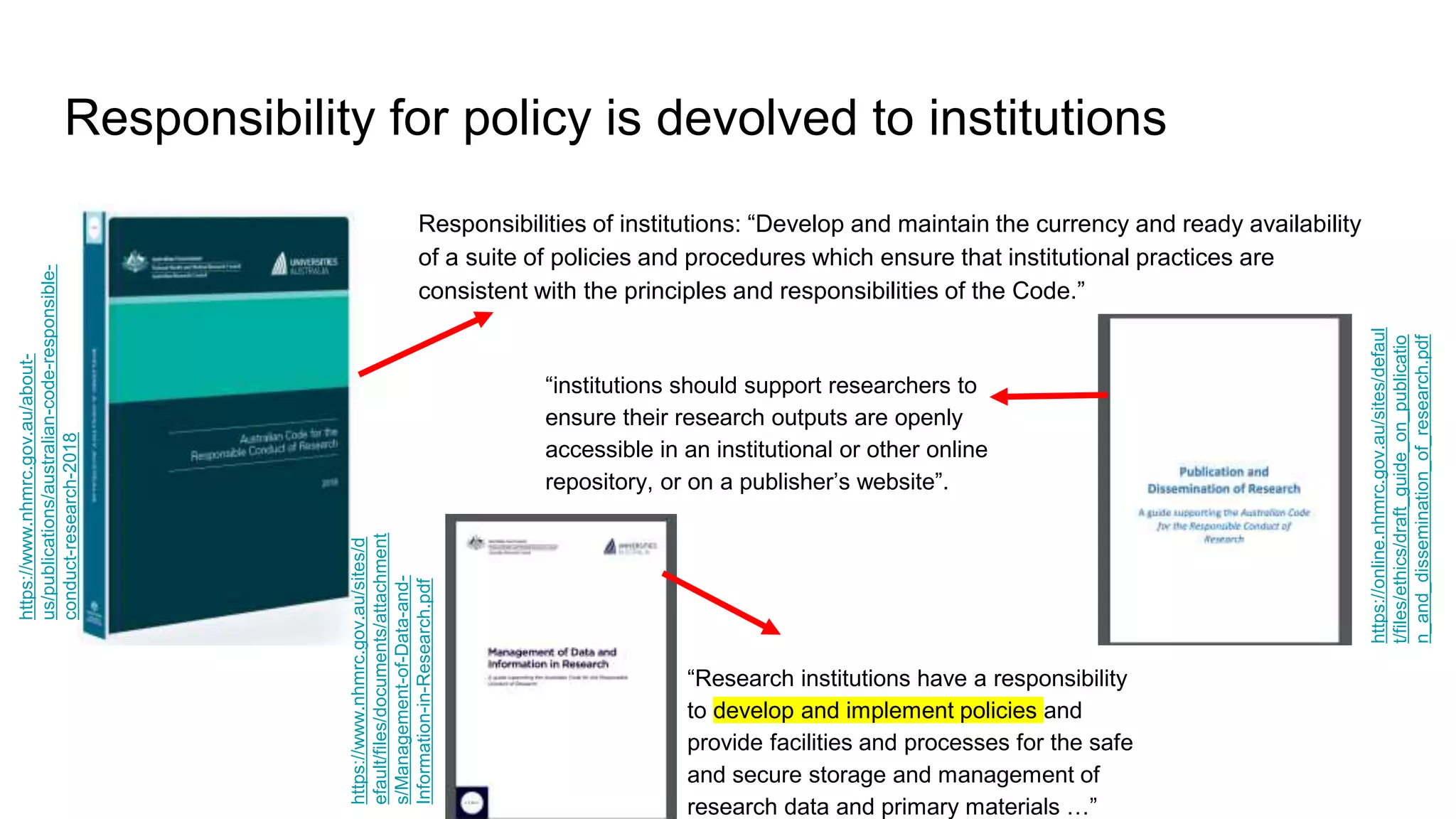
Responsibilities of institutions: “Develop and maintain the currency and ready availability
of a suite of policies and procedures which ensure that institutional practices are
consistent with the principles and responsibilities of the Code.”
https://www.nhmrc.gov.au/about-
us/publications/australian-code-responsible-
conduct-research-2018
https://online.nhmrc.gov.au/sites/defaul
t/files/ethics/draft_guide_on_publicatio
n_and_dissemination_of_research.pdf
“institutions should support researchers to
ensure their research outputs are openly
accessible in an institutional or other online
repository, or on a publisher’s website”.
“Research institutions have a responsibility
to develop and implement policies and
provide facilities and processes for the safe
and secure storage and management of
research data and primary materials …”
https://www.nhmrc.gov.au/sites/d
efault/files/documents/attachment
s/Management-of-Data-and-
Information-in-Research.pdf
What do we mean when we say ‘OA policy’?
This is harder than it seems.
Policy categorisations:
(A) Must say ‘open access policy’ AND be in the policy
library (or sitting in the online university site) AND
must ‘look like’ a policy
(B) ‘Policy’ that refers to open access as part of a
broader remit
(C) Open access is included in a guideline or other
supporting document
(D) No reference or documentation
Image by Arek Socha from Pixabay
Identifying policies
Check AOASG website + Check ROARMAP = OA Policies
Search university website for ‘policy’ to reach policy library
Check any policy using terms: ‘Academic Integrity’, ‘Research
Integrity’, ‘Authorship’, ‘Publication’ & ‘Peer Review’.
Search any Procedures and Guidelines Search university website with the
term ‘Open Access’ to identify any
other guidelines or references
Breakdown of the policies of 41 Australian universities
● Institutions with OA policies – 20
● Institutions with policies that mention OA but are
not titled ‘OA’ – 7
● Institutions that reference OA in Principles,
Procedures or Guidelines – 6
● Institutions that have no Policies, Procedures or
Guidelines referencing OA – 8
https://www.studyinaustralia.gov.au/English/Australian-Education/Universities-Higher-Education/list-of-australian-universities
Universities with OA policies = 20
● Australian Catholic University Open Access for
ACU Research Policy
● Adelaide University Open Access Policy
● Australian National University Open Access
Policy
● Bond Open Access Policy
● Central Queensland Open Access for Research
Outputs
● Charles Darwin University Open Access Policy
● Edith Cowan University Open Access to
Research Policy
● James Cook University Open Access Policy
● Macquarie University Open Access Policy
● QUT Open Access for QUT Research Policy
● Southern Cross University Open Access Policy
● Sydney University Open Access to Research
Policy
● University of New England Open Access to
UNE Research Policy
● UniSA Open Access - Policies and Procedures
● UNSW Open Access Policy
● University of Queensland Open Access for UQ
Research Publications Policy
● UTS Open Access Policy
● Victoria University Research Repository Open
Access Policy
● Western Sydney University Open Access to
Research Policy
● Wollongong University Open Access Policy
Content Analysis of Institutional OA Policies
● Dimensions of analysis:
○ Definition of OA
○ To whom the policy applies
○ Role of the library
○ Mention of ARC/NHMRC policies
○ Language used to describe the policy
directive
○ OA timescales
○ Exceptions to OA requirements
○ Compliance/consequences of policy
breaches
○ Institutional positions on APC payments
○ Discussion of copyright
○ Mention of open data requirements/FAIR
This presentation is primarily of
findings relating to the 20 Open
Access policies - these
represent focussed & explicitly
comparable attempts to
promote OA.
Why look at definitions of OA?
● Open access is a complex space and there is no widespread understanding
of what it means amongst the research community
● Definitions are useful when they reflect commonly held understandings
which are transferable between people and institutions, nationally and
internationally
● Commonly held understandings can make it easier to implement (open or
any) policies and initiatives
Accordingly we decided to examine the definitions in Australian university OA
policies
Image CC-BY
Danny Kingsley
Common OA definitions
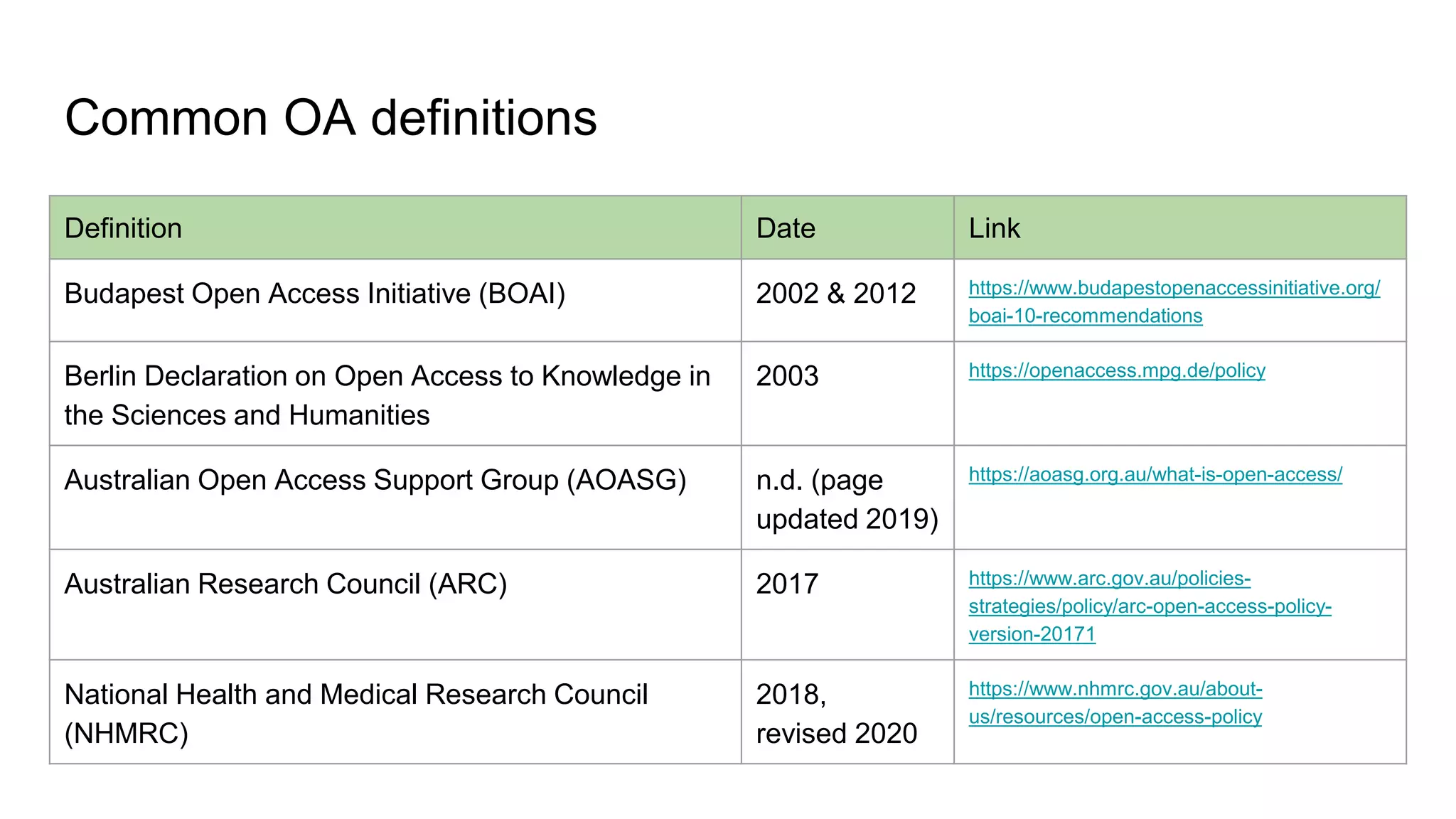
Definition Date Link
Budapest Open Access Initiative (BOAI) 2002 & 2012 https://www.budapestopenaccessinitiative.org/
boai-10-recommendations
Berlin Declaration on Open Access to Knowledge in
the Sciences and Humanities
2003 https://openaccess.mpg.de/policy
Australian Open Access Support Group (AOASG) n.d. (page
updated 2019)
https://aoasg.org.au/what-is-open-access/
Australian Research Council (ARC) 2017 https://www.arc.gov.au/policies-
strategies/policy/arc-open-access-policy-
version-20171
National Health and Medical Research Council
(NHMRC)
2018,
revised 2020
https://www.nhmrc.gov.au/about-
us/resources/open-access-policy
Universities with OA policies: What we found
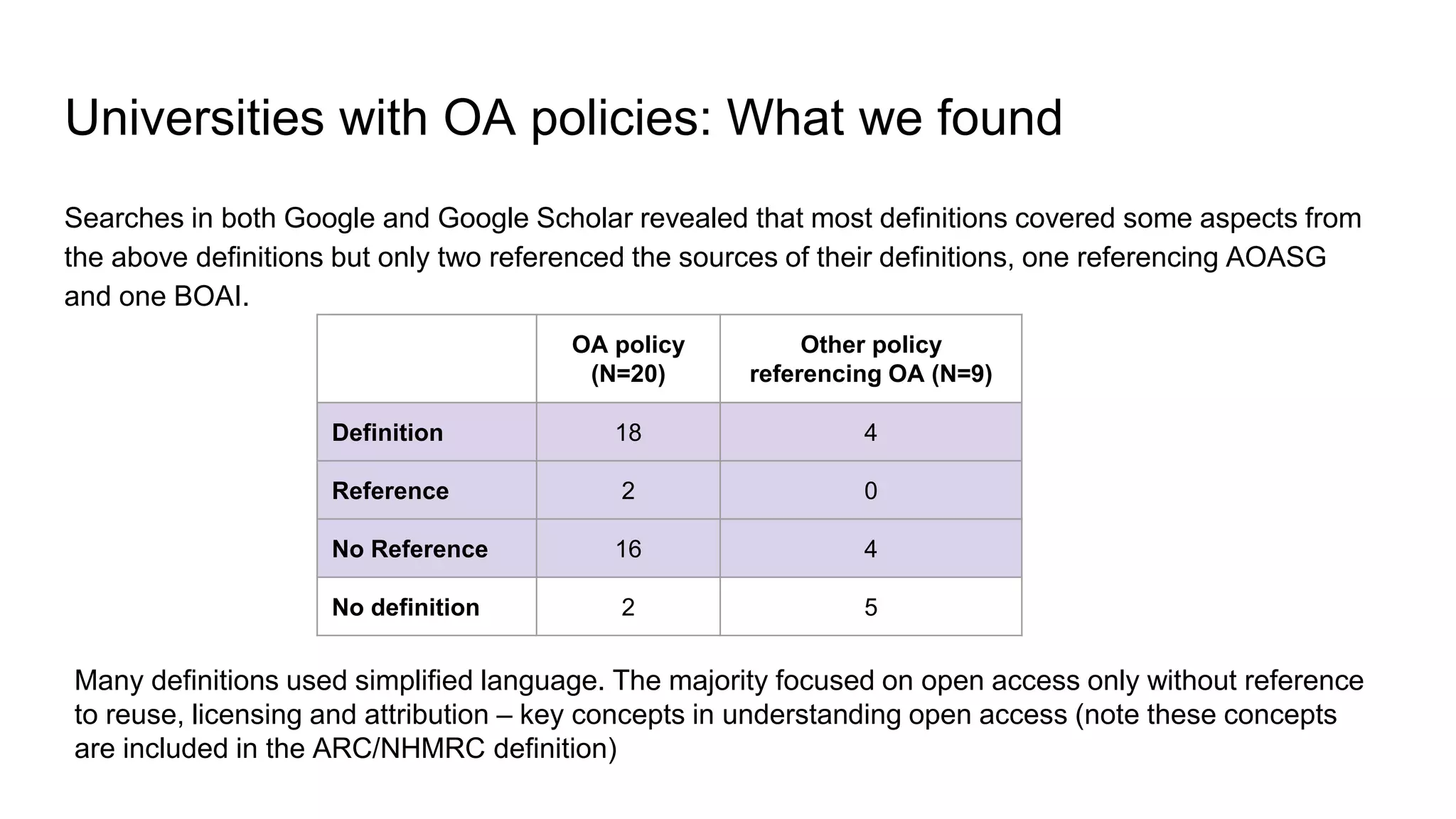
Searches in both Google and Google Scholar revealed that most definitions covered some aspects from
the above definitions but only two referenced the sources of their definitions, one referencing AOASG
and one BOAI.
OA policy
(N=20)
Other policy
referencing OA (N=9)
Definition 18 4
Reference 2 0
No Reference 16 4
No definition 2 5
Many definitions used simplified language. The majority focused on open access only without reference
to reuse, licensing and attribution – key concepts in understanding open access (note these concepts
are included in the ARC/NHMRC definition)
Library and funder references
Role of the library
● Five OA policies (25%) did not
mention the library
● For the remaining 15, the role of the
library was specified:
References to ARC/NHMRC
● Funders were mentioned in 17 of the 20 OA policies, in different contexts:.
Library role No of mentions
Repository 10 (50%)
Assistance/Help/Advice 9 (45%)
Copyright compliance 8 (40%)
Reporting 2 (10%)
Confirming
compliance
Supporting funder
policy
Basis for institutional
policy
Mentioned in
definition
10 4 2 1
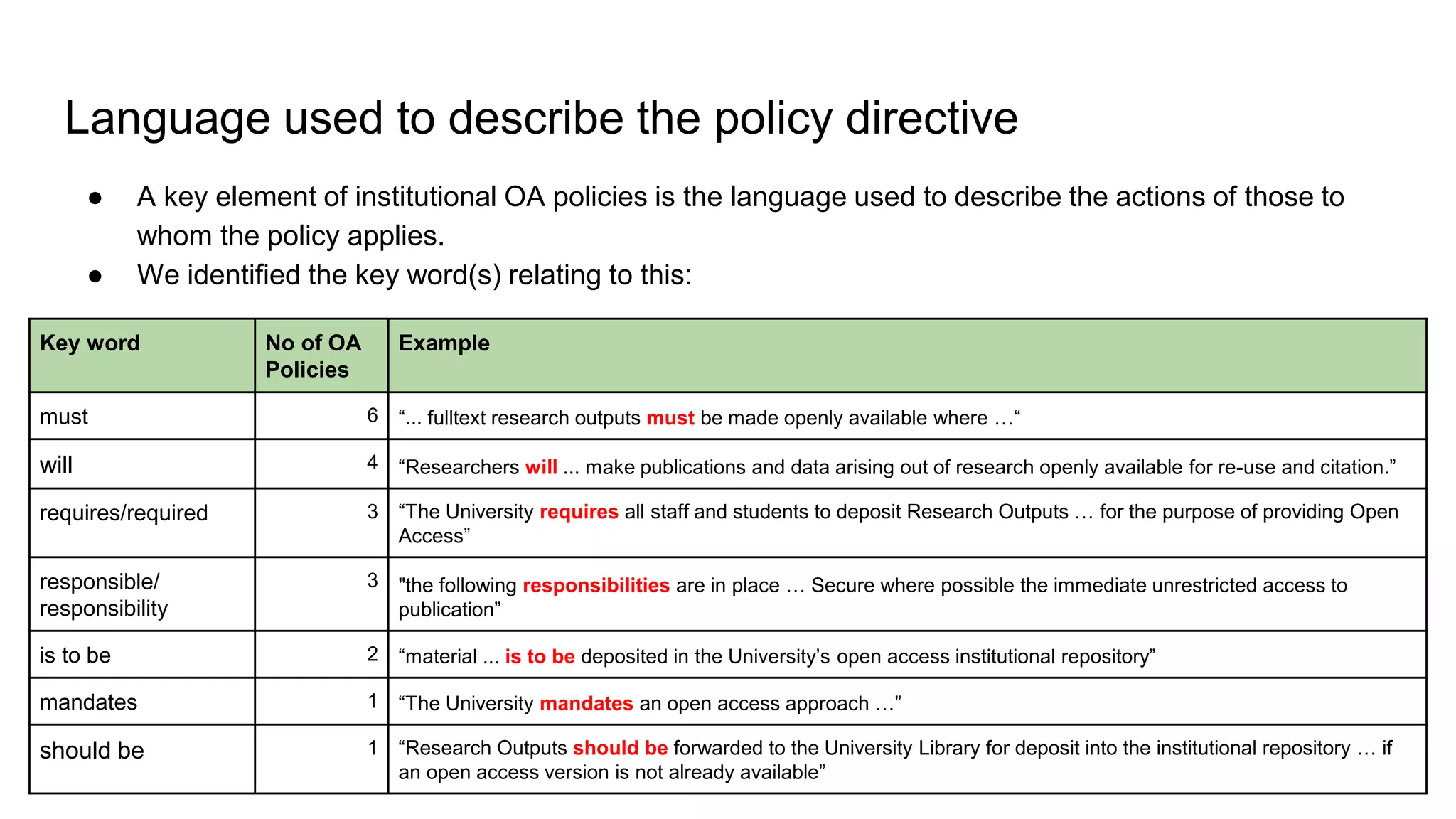
Language used to describe the policy directive
● A key element of institutional OA policies is the language used to describe the actions of those to
whom the policy applies.
● We identified the key word(s) relating to this:
Key word No of OA
Policies
Example
must 6 “... fulltext research outputs must be made openly available where …“
will 4 “Researchers will ... make publications and data arising out of research openly available for re-use and citation.”
requires/required 3 “The University requires all staff and students to deposit Research Outputs … for the purpose of providing Open
Access”
responsible/
responsibility
3 "the following responsibilities are in place … Secure where possible the immediate unrestricted access to
publication”
is to be 2 “material ... is to be deposited in the University’s open access institutional repository”
mandates 1 “The University mandates an open access approach …”
should be 1 “Research Outputs should be forwarded to the University Library for deposit into the institutional repository … if
an open access version is not already available”
Depositing time
13 of the 20 OA policies specified a timeframe by which an OA version of the research output must be
deposited in the institutional repository. In some cases more than one timeframe was specified (see selection)
“All refereed final draft research outputs will
be deposited in the institutional repository
after their acceptance for publication.
Edith Cowan University
The University supports the underlying principles
of open access by making publications freely
available online as soon as possible or within
twelve (12) months of publication.
University of Queensland
Open access to the full-text will be available as
soon as is practicable and not later than twelve
months after publication.
UniSA
Research Outputs should be forwarded to the
University Library for deposit into the institutional
repository at the time of publication, if an open
access version is not already available.
Wollongong University
for the purpose of making these outputs freely
available within twelve months of publication, or
as soon as possible in accordance with the
relevant publisher copyright, open access and
embargo policy
UNSW
as soon as possible, make
publications and data arising out of
research openly available for re-use
and citation.
Western Sydney University
no later than 12 months after the date of
publication.
University of Sydney
Researchers are expected by the University to
deposit the post peer reviewed and corrected
version of their published research (the Author’s
Accepted Manuscript) in the Institutional
Repository or an accredited subject repository
within three months of publication.
University of Melbourne
Researchers are encouraged to avoid embargoes
of greater than 12 months from date of
publication. Where agreements do not allow
outputs to be made Open Access within 12
months researchers should make reasonable
attempts to negotiate this provision with the
publisher.
University of Adelaide
Timing of deposit versus when openly accessible
In some cases the timing relates to the *deposit* of the work, in others it relates to the *availability* of the work
“All refereed final draft research outputs will
be deposited in the institutional repository
after their acceptance for publication.
Edith Cowan University
The University supports the underlying principles
of open access by making publications freely
available online as soon as possible or within
twelve (12) months of publication.
University of Queensland
Open access to the full-text will be available as
soon as is practicable and not later than twelve
months after publication.
UniSA
Research Outputs should be forwarded to the
University Library for deposit into the institutional
repository at the time of publication, if an open
access version is not already available.
Wollongong University
for the purpose of making these outputs freely
available within twelve months of publication, or
as soon as possible in accordance with the
relevant publisher copyright, open access and
embargo policy
UNSW
as soon as possible, make
publications and data arising out of
research openly available for re-use
and citation.
Western Sydney University
no later than 12 months after the date of
publication.
University of Sydney
Researchers are expected by the University to
deposit the post peer reviewed and corrected
version of their published research (the Author’s
Accepted Manuscript) in the Institutional
Repository or an accredited subject repository
within three months of publication.
University of Melbourne
Researchers are encouraged to avoid embargoes
of greater than 12 months from date of
publication. Where agreements do not allow
outputs to be made Open Access within 12
months researchers should make reasonable
attempts to negotiate this provision with the
publisher.
University of Adelaide
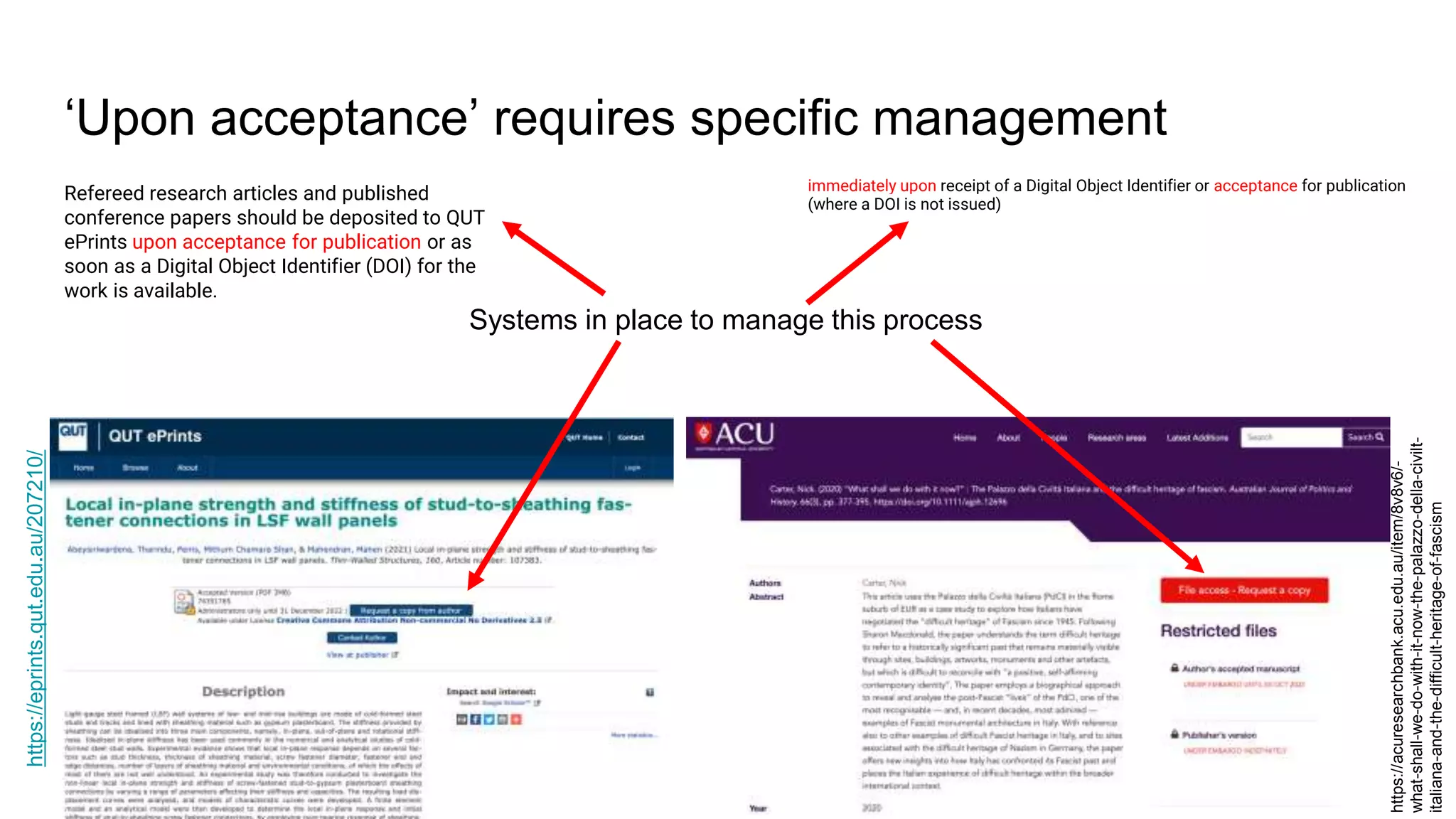
‘Upon acceptance’ requires specific management
immediately upon receipt of a Digital Object Identifier or acceptance for publication
(where a DOI is not issued)
Systems in place to manage this process
Refereed research articles and published
conference papers should be deposited to QUT
ePrints upon acceptance for publication or as
soon as a Digital Object Identifier (DOI) for the
work is available.
https://eprints.qut.edu.au/207210/
https://acuresearchbank.acu.edu.au/item/8v8v6/-
what-shall-we-do-with-it-now-the-palazzo-della-civilt-
italiana-and-the-difficult-heritage-of-fascism
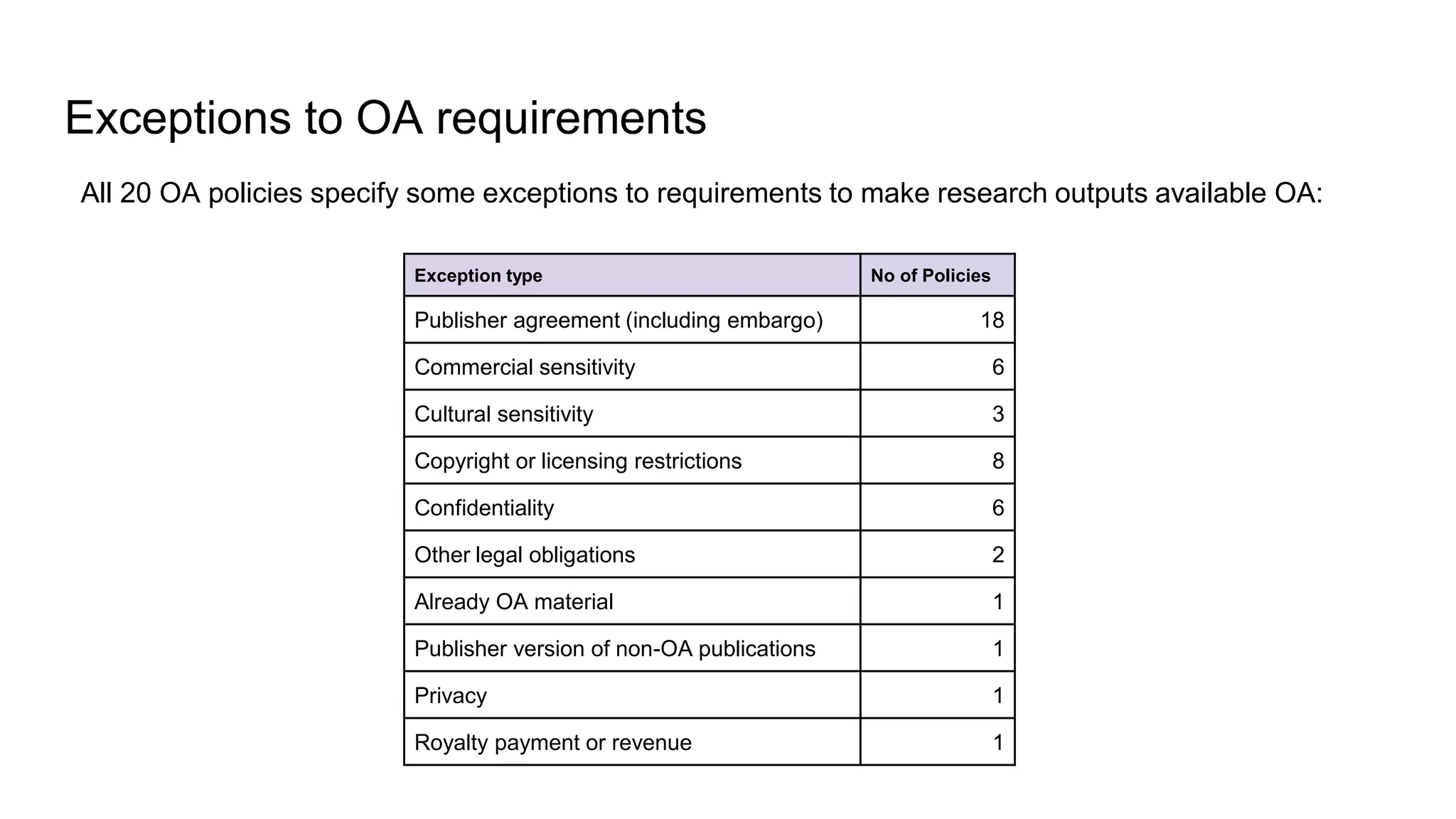
Exceptions to OA requirements
All 20 OA policies specify some exceptions to requirements to make research outputs available OA:
Exception type No of Policies
Publisher agreement (including embargo) 18
Commercial sensitivity 6
Cultural sensitivity 3
Copyright or licensing restrictions 8
Confidentiality 6
Other legal obligations 2
Already OA material 1
Publisher version of non-OA publications 1
Privacy 1
Royalty payment or revenue 1
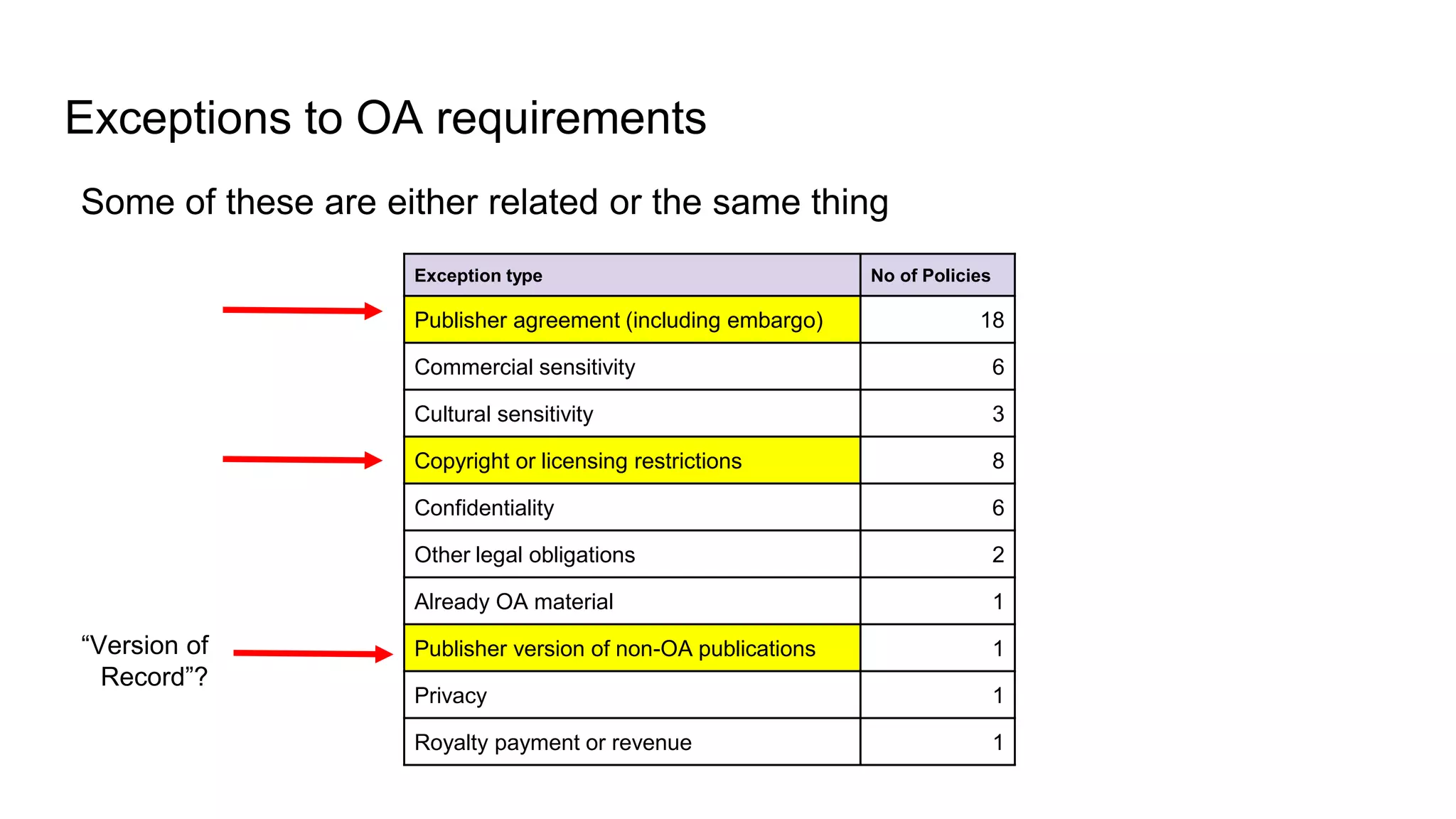
Exceptions to OA requirements
Some of these are either related or the same thing
Exception type No of Policies
Publisher agreement (including embargo) 18
Commercial sensitivity 6
Cultural sensitivity 3
Copyright or licensing restrictions 8
Confidentiality 6
Other legal obligations 2
Already OA material 1
Publisher version of non-OA publications 1
Privacy 1
Royalty payment or revenue 1
“Version of
Record”?
Compliance/consequences of breach of policy
● Only three of the twenty OA policies were found to cover the consequences of a failure to comply with
requirements:
○ “The University may commence applicable disciplinary procedures if a person to whom this policy
applies breaches this policy (or any of its related procedures)” (Macquarie University)
○ “Non-compliance with this Policy may constitute research misconduct and/or general misconduct,
which will be addressed in accordance with the University’s Enterprise Agreement and relevant
disciplinary procedures.” (University of Adelaide)
○ “Breaches of this Policy may result in action being taken in accordance with the University Code of
Conduct for Research.” (UNE)
● Are these just statements that align with employment contracts?
Paying for publication - 9/20 specifically cover this
(multiple inconsistencies)
Blog on this analysis: “It’s the ‘vibe’ of it: The complexity of open access policies in Australia”
https://librariesresearchgroup.csu.domains/blog/2021/02/03/its-the-vibe-of-it-the-complexity-of-open-access-policies-in-australia/
Takeaways from the study so far
The institutional OA policy landscape is
messy, with significant differences in:
○ Definitions of key terms
○ Responsibilities of key actors
○ Role of library
○ Compliance measures
○ Exceptions
○ Alignment with funder policies
○ Perspective on payment of APCs
○ Focus on repository vs open access as
desired outcome
○ ...
Image by Wolfgang Eckert from Pixabay
Further questions (beyond this study)
● What exactly is the *intent* of these policies?
● How are they written and maintained?
● To what extent are researchers aware of their responsibilities?
● Is there a link between policy and OA uptake?
● If so, what aspects of the policies appear to be the leveraging factors?
Image
CC-BY
Danny
Kingsley
Our research team - we welcome discussion!
Dr Hamid R. Jamali, @HRJamali hjamali@csu.edu.au
Associate Professor, Charles Sturt University
Dr Mary Anne Kennan, @MaryAnneKennan maryanne.kennan@gmail.com
Adjunct Associate Professor, Charles Sturt University
Dr Danny Kingsley, @dannykay68 danny.kingsley@anu.edu.au
Visiting Fellow, Australian National University
Dr Maryam Sarrafzadeh msarrafzadeh@gmail.com
Assistant Professor, University of Tehran
Dr Simon Wakeling, @simonwakeling swakeling@csu.edu.au
Lecturer, Charles Sturt University
Presentation abstract - https://rscday.info/rsc-day-2021-abstracts-and-bios/#wakeling

Open Access policies at Australian universities

  • 1.
    Image CC-BY Danny Kingsley Open Access policiesat Australian universities Research Support Community Day 2-4 February 2021 (online) 12.05pm (AEDT) Thursday February 4 #rscday21
  • 2.
    Why we aredoing the study ● More than 30% of the National Health and Medical Council’s funded articles are not open access despite a policy requiring OA* ● Institutional policies and their requirements have an important role in promoting OA publishing of research outputs. ● Providing a ‘snapshot’ of the state of open access policies in Australian institutions in 2020/21. * Kirkman, N. and Haddow, G. 2020. Compliance with the first funder open access policy in Australia. Information Research: an international electronic journal. https://espace.curtin.edu.au/handle/20.500.11937/79635 ● Australia is comparatively stagnant in OA progress Huang, et al, Meta-Research: Evaluating the impact of open access policies on research institutions, 2020 https://elifesciences.org/articles/57067
  • 3.
    Responsibility for policyis devolved to institutions Responsibilities of institutions: “Develop and maintain the currency and ready availability of a suite of policies and procedures which ensure that institutional practices are consistent with the principles and responsibilities of the Code.” https://www.nhmrc.gov.au/about- us/publications/australian-code-responsible- conduct-research-2018 https://online.nhmrc.gov.au/sites/defaul t/files/ethics/draft_guide_on_publicatio n_and_dissemination_of_research.pdf “institutions should support researchers to ensure their research outputs are openly accessible in an institutional or other online repository, or on a publisher’s website”. “Research institutions have a responsibility to develop and implement policies and provide facilities and processes for the safe and secure storage and management of research data and primary materials …” https://www.nhmrc.gov.au/sites/d efault/files/documents/attachment s/Management-of-Data-and- Information-in-Research.pdf
  • 4.
    What do wemean when we say ‘OA policy’? This is harder than it seems. Policy categorisations: (A) Must say ‘open access policy’ AND be in the policy library (or sitting in the online university site) AND must ‘look like’ a policy (B) ‘Policy’ that refers to open access as part of a broader remit (C) Open access is included in a guideline or other supporting document (D) No reference or documentation Image by Arek Socha from Pixabay
  • 5.
    Identifying policies Check AOASGwebsite + Check ROARMAP = OA Policies Search university website for ‘policy’ to reach policy library Check any policy using terms: ‘Academic Integrity’, ‘Research Integrity’, ‘Authorship’, ‘Publication’ & ‘Peer Review’. Search any Procedures and Guidelines Search university website with the term ‘Open Access’ to identify any other guidelines or references
  • 6.
    Breakdown of thepolicies of 41 Australian universities ● Institutions with OA policies – 20 ● Institutions with policies that mention OA but are not titled ‘OA’ – 7 ● Institutions that reference OA in Principles, Procedures or Guidelines – 6 ● Institutions that have no Policies, Procedures or Guidelines referencing OA – 8 https://www.studyinaustralia.gov.au/English/Australian-Education/Universities-Higher-Education/list-of-australian-universities
  • 7.
    Universities with OApolicies = 20 ● Australian Catholic University Open Access for ACU Research Policy ● Adelaide University Open Access Policy ● Australian National University Open Access Policy ● Bond Open Access Policy ● Central Queensland Open Access for Research Outputs ● Charles Darwin University Open Access Policy ● Edith Cowan University Open Access to Research Policy ● James Cook University Open Access Policy ● Macquarie University Open Access Policy ● QUT Open Access for QUT Research Policy ● Southern Cross University Open Access Policy ● Sydney University Open Access to Research Policy ● University of New England Open Access to UNE Research Policy ● UniSA Open Access - Policies and Procedures ● UNSW Open Access Policy ● University of Queensland Open Access for UQ Research Publications Policy ● UTS Open Access Policy ● Victoria University Research Repository Open Access Policy ● Western Sydney University Open Access to Research Policy ● Wollongong University Open Access Policy
  • 8.
    Content Analysis ofInstitutional OA Policies ● Dimensions of analysis: ○ Definition of OA ○ To whom the policy applies ○ Role of the library ○ Mention of ARC/NHMRC policies ○ Language used to describe the policy directive ○ OA timescales ○ Exceptions to OA requirements ○ Compliance/consequences of policy breaches ○ Institutional positions on APC payments ○ Discussion of copyright ○ Mention of open data requirements/FAIR This presentation is primarily of findings relating to the 20 Open Access policies - these represent focussed & explicitly comparable attempts to promote OA.
  • 9.
    Why look atdefinitions of OA? ● Open access is a complex space and there is no widespread understanding of what it means amongst the research community ● Definitions are useful when they reflect commonly held understandings which are transferable between people and institutions, nationally and internationally ● Commonly held understandings can make it easier to implement (open or any) policies and initiatives Accordingly we decided to examine the definitions in Australian university OA policies Image CC-BY Danny Kingsley
  • 10.
    Common OA definitions DefinitionDate Link Budapest Open Access Initiative (BOAI) 2002 & 2012 https://www.budapestopenaccessinitiative.org/ boai-10-recommendations Berlin Declaration on Open Access to Knowledge in the Sciences and Humanities 2003 https://openaccess.mpg.de/policy Australian Open Access Support Group (AOASG) n.d. (page updated 2019) https://aoasg.org.au/what-is-open-access/ Australian Research Council (ARC) 2017 https://www.arc.gov.au/policies- strategies/policy/arc-open-access-policy- version-20171 National Health and Medical Research Council (NHMRC) 2018, revised 2020 https://www.nhmrc.gov.au/about- us/resources/open-access-policy
  • 11.
    Universities with OApolicies: What we found Searches in both Google and Google Scholar revealed that most definitions covered some aspects from the above definitions but only two referenced the sources of their definitions, one referencing AOASG and one BOAI. OA policy (N=20) Other policy referencing OA (N=9) Definition 18 4 Reference 2 0 No Reference 16 4 No definition 2 5 Many definitions used simplified language. The majority focused on open access only without reference to reuse, licensing and attribution – key concepts in understanding open access (note these concepts are included in the ARC/NHMRC definition)
  • 12.
    Library and funderreferences Role of the library ● Five OA policies (25%) did not mention the library ● For the remaining 15, the role of the library was specified: References to ARC/NHMRC ● Funders were mentioned in 17 of the 20 OA policies, in different contexts:. Library role No of mentions Repository 10 (50%) Assistance/Help/Advice 9 (45%) Copyright compliance 8 (40%) Reporting 2 (10%) Confirming compliance Supporting funder policy Basis for institutional policy Mentioned in definition 10 4 2 1
  • 13.
    Language used todescribe the policy directive ● A key element of institutional OA policies is the language used to describe the actions of those to whom the policy applies. ● We identified the key word(s) relating to this: Key word No of OA Policies Example must 6 “... fulltext research outputs must be made openly available where …“ will 4 “Researchers will ... make publications and data arising out of research openly available for re-use and citation.” requires/required 3 “The University requires all staff and students to deposit Research Outputs … for the purpose of providing Open Access” responsible/ responsibility 3 "the following responsibilities are in place … Secure where possible the immediate unrestricted access to publication” is to be 2 “material ... is to be deposited in the University’s open access institutional repository” mandates 1 “The University mandates an open access approach …” should be 1 “Research Outputs should be forwarded to the University Library for deposit into the institutional repository … if an open access version is not already available”
  • 14.
    Depositing time 13 ofthe 20 OA policies specified a timeframe by which an OA version of the research output must be deposited in the institutional repository. In some cases more than one timeframe was specified (see selection) “All refereed final draft research outputs will be deposited in the institutional repository after their acceptance for publication. Edith Cowan University The University supports the underlying principles of open access by making publications freely available online as soon as possible or within twelve (12) months of publication. University of Queensland Open access to the full-text will be available as soon as is practicable and not later than twelve months after publication. UniSA Research Outputs should be forwarded to the University Library for deposit into the institutional repository at the time of publication, if an open access version is not already available. Wollongong University for the purpose of making these outputs freely available within twelve months of publication, or as soon as possible in accordance with the relevant publisher copyright, open access and embargo policy UNSW as soon as possible, make publications and data arising out of research openly available for re-use and citation. Western Sydney University no later than 12 months after the date of publication. University of Sydney Researchers are expected by the University to deposit the post peer reviewed and corrected version of their published research (the Author’s Accepted Manuscript) in the Institutional Repository or an accredited subject repository within three months of publication. University of Melbourne Researchers are encouraged to avoid embargoes of greater than 12 months from date of publication. Where agreements do not allow outputs to be made Open Access within 12 months researchers should make reasonable attempts to negotiate this provision with the publisher. University of Adelaide
  • 15.
    Timing of depositversus when openly accessible In some cases the timing relates to the *deposit* of the work, in others it relates to the *availability* of the work “All refereed final draft research outputs will be deposited in the institutional repository after their acceptance for publication. Edith Cowan University The University supports the underlying principles of open access by making publications freely available online as soon as possible or within twelve (12) months of publication. University of Queensland Open access to the full-text will be available as soon as is practicable and not later than twelve months after publication. UniSA Research Outputs should be forwarded to the University Library for deposit into the institutional repository at the time of publication, if an open access version is not already available. Wollongong University for the purpose of making these outputs freely available within twelve months of publication, or as soon as possible in accordance with the relevant publisher copyright, open access and embargo policy UNSW as soon as possible, make publications and data arising out of research openly available for re-use and citation. Western Sydney University no later than 12 months after the date of publication. University of Sydney Researchers are expected by the University to deposit the post peer reviewed and corrected version of their published research (the Author’s Accepted Manuscript) in the Institutional Repository or an accredited subject repository within three months of publication. University of Melbourne Researchers are encouraged to avoid embargoes of greater than 12 months from date of publication. Where agreements do not allow outputs to be made Open Access within 12 months researchers should make reasonable attempts to negotiate this provision with the publisher. University of Adelaide
  • 16.
    ‘Upon acceptance’ requiresspecific management immediately upon receipt of a Digital Object Identifier or acceptance for publication (where a DOI is not issued) Systems in place to manage this process Refereed research articles and published conference papers should be deposited to QUT ePrints upon acceptance for publication or as soon as a Digital Object Identifier (DOI) for the work is available. https://eprints.qut.edu.au/207210/ https://acuresearchbank.acu.edu.au/item/8v8v6/- what-shall-we-do-with-it-now-the-palazzo-della-civilt- italiana-and-the-difficult-heritage-of-fascism
  • 17.
    Exceptions to OArequirements All 20 OA policies specify some exceptions to requirements to make research outputs available OA: Exception type No of Policies Publisher agreement (including embargo) 18 Commercial sensitivity 6 Cultural sensitivity 3 Copyright or licensing restrictions 8 Confidentiality 6 Other legal obligations 2 Already OA material 1 Publisher version of non-OA publications 1 Privacy 1 Royalty payment or revenue 1
  • 18.
    Exceptions to OArequirements Some of these are either related or the same thing Exception type No of Policies Publisher agreement (including embargo) 18 Commercial sensitivity 6 Cultural sensitivity 3 Copyright or licensing restrictions 8 Confidentiality 6 Other legal obligations 2 Already OA material 1 Publisher version of non-OA publications 1 Privacy 1 Royalty payment or revenue 1 “Version of Record”?
  • 19.
    Compliance/consequences of breachof policy ● Only three of the twenty OA policies were found to cover the consequences of a failure to comply with requirements: ○ “The University may commence applicable disciplinary procedures if a person to whom this policy applies breaches this policy (or any of its related procedures)” (Macquarie University) ○ “Non-compliance with this Policy may constitute research misconduct and/or general misconduct, which will be addressed in accordance with the University’s Enterprise Agreement and relevant disciplinary procedures.” (University of Adelaide) ○ “Breaches of this Policy may result in action being taken in accordance with the University Code of Conduct for Research.” (UNE) ● Are these just statements that align with employment contracts?
  • 20.
    Paying for publication- 9/20 specifically cover this (multiple inconsistencies) Blog on this analysis: “It’s the ‘vibe’ of it: The complexity of open access policies in Australia” https://librariesresearchgroup.csu.domains/blog/2021/02/03/its-the-vibe-of-it-the-complexity-of-open-access-policies-in-australia/
  • 21.
    Takeaways from thestudy so far The institutional OA policy landscape is messy, with significant differences in: ○ Definitions of key terms ○ Responsibilities of key actors ○ Role of library ○ Compliance measures ○ Exceptions ○ Alignment with funder policies ○ Perspective on payment of APCs ○ Focus on repository vs open access as desired outcome ○ ... Image by Wolfgang Eckert from Pixabay
  • 22.
    Further questions (beyondthis study) ● What exactly is the *intent* of these policies? ● How are they written and maintained? ● To what extent are researchers aware of their responsibilities? ● Is there a link between policy and OA uptake? ● If so, what aspects of the policies appear to be the leveraging factors? Image CC-BY Danny Kingsley
  • 23.
    Our research team- we welcome discussion! Dr Hamid R. Jamali, @HRJamali hjamali@csu.edu.au Associate Professor, Charles Sturt University Dr Mary Anne Kennan, @MaryAnneKennan maryanne.kennan@gmail.com Adjunct Associate Professor, Charles Sturt University Dr Danny Kingsley, @dannykay68 danny.kingsley@anu.edu.au Visiting Fellow, Australian National University Dr Maryam Sarrafzadeh msarrafzadeh@gmail.com Assistant Professor, University of Tehran Dr Simon Wakeling, @simonwakeling swakeling@csu.edu.au Lecturer, Charles Sturt University Presentation abstract - https://rscday.info/rsc-day-2021-abstracts-and-bios/#wakeling

Editor's Notes

  • #3 Funders invest in research and their return in investment can be achieved through open access publishing. In recent decade research funders in USA, Europe and Australia have made it mandatory in their agreement with researchers to make their research outputs available to everyone through open access publishing. Still research shows that in Australia more than 30% of the National health and Medical Council’s funded articles are not open access. There comes a question here why despite a policy in place requiring OA, only 67.3% of research is open access. Whether it is the matter of mandating open access or just recommending or there are other issues involved. The present research is an effort to find out an answer to this question through deep analysing of OA policies in Australian universities. It will provide a snapshot of the state of open access policies in the year 2020.
  • #5 “Looks like a policy” = includes features such as identifying the responsibilities of different stakeholders, has a revision date, authorisation and ownership is identified and other related policies are identified.