A Competence-based Approach for Formalizing Learning Goals in  Work-integrated Learning Tobias Ley, Barbara Kump, Armin Ulbrich, Peter Scheir und Stefanie N. Lindstaedt  Barbara Kump
Outline A Workplace Learning Context Model Process Package Domain Knowledge Package Competency Package Modelling Learning Goals for Work-Integrated Learning Implementation of the Workplace Learning Context Approach in the APOSDLE Project Real-World Applications and a Prototype Conclusions and Outlook 20 October 2009   /
A Workplace Learning Context Model 20 October 2009   /  [adapted form Lindstaedt & Farmer, 2004] Worker Learner Expert
Domain Knowledge Package Usually: documents are stored in structured databases E.g. Ontology 20 October 2009   /  Domain Concepts Relation [e.g. Green, 1999] Domain Concepts as semantic metadata
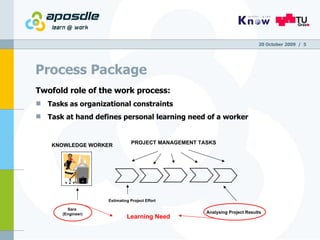
Process Package Twofold role of the work process:  Tasks as organizational constraints  Task at hand defines personal learning need of a worker 20 October 2009   /  KNOWLEDGE WORKER PROJECT MANAGEMENT TASKS Sara  (Engineer) Estimating Project Effort Analysing Project Results Learning Need
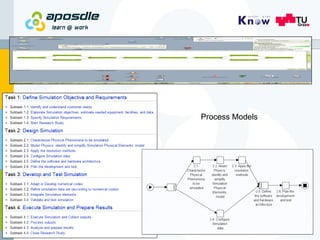
20 October 2009   /  Process Models
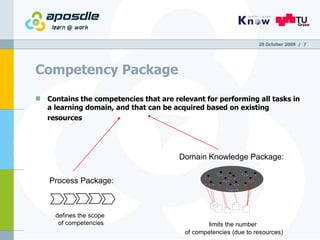
Competency Package Contains the competencies that are relevant for performing all tasks in a learning domain, and that can be acquired based on existing resources   20 October 2009   /  Process Package:  defines the scope  of competencies Domain Knowledge Package:  limits the number   of competencies (due to resources)
Focus of the Competency Package Human User 20 October 2009   /  Task Demand  (in terms of Knowledge & Skills) Competencies:  Knowledge & Skills,  Ability to perform Tasks Learning   Goals (in terms of Knowledge & Skills to acquire) Learning Opportunity [compare Schmidt, 2004; Sicilia, 2005] Competency Gap Analysis
Modeling Learning Goals for Work-integrated Learning – the APOSDLE Approach 20 October 2009   /
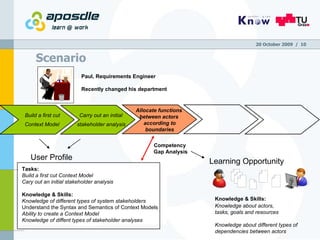
Scenario 20 October 2009   /  Paul, Requirements Engineer Recently changed his department Build a first cut  Context Model   Carry out an initial  stakeholder analysis   User Profile Tasks:  Build a first cut Context Model Cary out an initial stakeholder analysis Knowledge & Skills:   Knowledge of different types of system stakeholders   Understand the Syntax and Semantics of Context Models Ability to create a Context Model Knowledge of diffent types of stakeholder analyses Allocate functions  between actors  according to boundaries Competency  Gap Analysis Learning Opportunity Knowledge & Skills:   Knowledge about actors,  tasks, goals and resources Knowledge about different types of  dependencies between actors
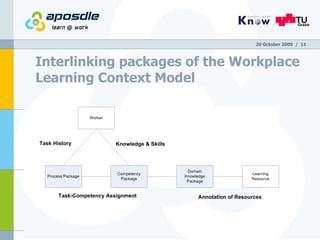
Interlinking packages of the Workplace Learning Context Model  20 October 2009   /  Task-Competency Assignment Annotation of Resources Task History Knowledge & Skills
Implementation  of the Workplace Learning Context Approach in the APOSDLE project  20 October 2009   /  [APOSDLE meta-model, Extract] Task Demand
Formal Specification of the Task Demand in APOSDLE Competence based Knowledge Space Theory Korossy, 1997; Düntsch & Gediga, 1994; based on Doignon & Falmagne, 1985, 1999   Knowledge Space Theory has been applied and tested in various fields : ALEKS (ALEKS Corp, 2003), RATH (Hockemeyer & Albert, 1999)  Workflow Processes (Stefanutti & Albert, 2002 ), Knowledge Management (Ley, 2006;  Ley & Albert, 2003) Implications for teacher education and training (Albert, 2006), Skills of Medical Trainees (Albert et al., 2007) 20 October 2009   /
Real World Applications of the APOSDLE Workplace Learning Context Approach 20 October 2009   /
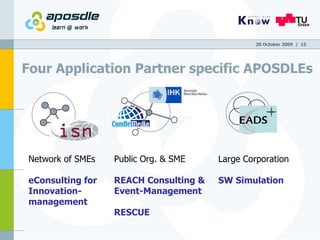
Four Application Partner specific APOSDLEs  20 October 2009   /  Network of SMEs eConsulting for Innovation-management   Large Corporation   SW Simulation   Public Org. & SME REACH Consulting &  Event-Management RESCUE
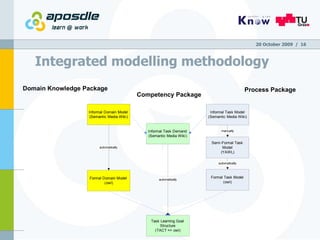
Integrated modelling methodology 20 October 2009   /  Domain Knowledge Package Process Package Competency Package
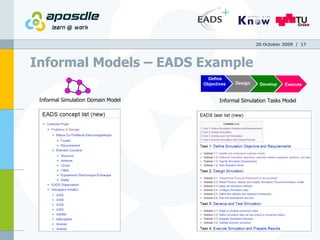
Informal Models – EADS Example 20 October 2009   /  Informal Simulation Domain Model Informal Simulation Tasks Model Define Objectives Design  Develop Execute
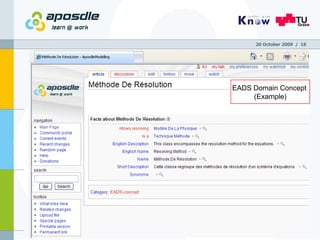
20 October 2009   /  EADS Domain Concept  (Example)
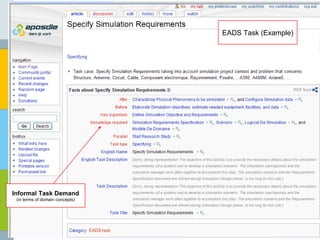
20 October 2009   /  EADS Task (Example) Informal Task Demand (in terms of domain concepts)
Modelling the Task Demand: TACT tool 20 October 2009   /  [TACT for modelling Requirements Engineering]
and a Prototype… 20 October 2009   /
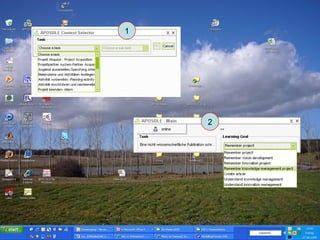
20 October 2009   /  1 2
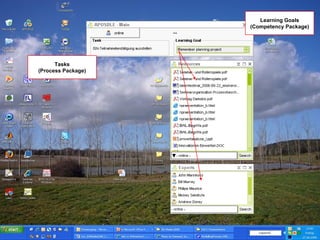
20 October 2009   /  Tasks (Process Package) Learning Goals (Competency Package)
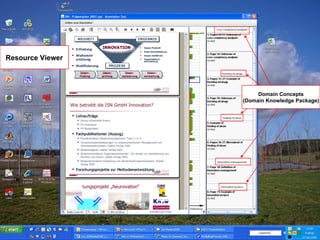
20 October 2009   /  Resource Viewer Domain Concepts (Domain Knowledge Package)
Conclusions & Outlook 20 October 2009   /
Conclusions & Outlook We have presented a Workplace Learning Context Model  Concrete implementation in 4 different application domains Allows for competency gap analysis (based on task history) Focus of further research: Additional indicatiors for skills and knowledge Differences in the application domains, due to certain characteristics of the domains Relatedness of process package and domain knowledge package Granularity of the task model and the domain model 20 October 2009   /
Conclusions & Outlook The modelling methodology was useful, but needs further revision at certain stages, e.g. It should allow for moving back and forth from informal to formal Formative evaluation and model revision at different modelling stages is indispensable => tools for evaluation support Combining the APOSDLE implementation of the Workplace Learning Context Model with existing Competency Management approaches Bi-directional (APOSDLE and existing Competency Management Approaches) Suggestions have been made, e.g. in Ley, 2007 20 October 2009   /
Thank you for your attention! Barbara Kump Graz University of Technology  Knowledge Management Institute [email_address] 20 October 2009   /
References Albert, D., Hockemeyer, C., Mayer, B., Steiner, C. M (2007). Cognitive Structure Modelling of Skills for Technology-Enhanced Learning.  Paper presented at the 7th IEEE International Conference on Advanced Learning Technologies (ICALT 2007) , July 18-20, 2007, Niigata, Japan. ALEKS Corp. (2003), ALEKS - A Better State of Knowledge, retrieved from  http://www.aleks.com . Doignon, J. and Falmagne, J. (1999), Knowledge Spaces, Springer, Heidelberg. Falmagne, J., Doignon, J., Koppen, M., Villano, M. and Johannesen, L. (1990), "Introduction to Knowledge Spaces: How to Build, Test, and Search Them", Psychological Review, Vol. 97 No. 2, pp. 201-224. Green, P.C. (1999), Building Robust Competencies: Linking Human Resource Systems to Organizational Strategies, Jossey-Bass, San Francisco. Hockemeyer, C., Held, T. and Albert, D. (1998), "RATH - A Relational Adaptive Tutoring Hypertext WWW-Environment Based on Knowledge Space Theory", in Alvegard, C. (Ed.), CALISCE`98: Proceedings of the Fourth International Conference on Computer Aided Learning in Science and Engineering, Chalmers University of Technology, Göteborg, Sweden, pp. 417-423. Korossy, K. (1997), "Extending the theory of knowledge spaces: A competence-performance approach", Zeitschrift für Psychologie, Vol. 205, pp. 53-82. Ley, T., Albert, D. and Lindstaedt, S.N. (2007), "Competency Management using the Competence Performance Approach: Modeling, Assessment, Validation and Use", in Sicilia, M. A. (Ed.), Competencies in Organizational E-Learning: Concepts and Tools, Information Science Publishing, Hershey, pp. 83-119. Ley, T., Lindstaedt, S.N. and Albert, D. (2005), "Supporting Competency Development in Informal Workplace Learning", in Althoff, K., Dengel, A., Bergmann, R., Nick, M. and Roth-Berghofer, T. (Eds.), Professional Knowledge Management, Springer, Berlin, pp. 189-202. Lindstaedt, S.N. and Farmer, J. (2004), "Kooperatives Lernen in Organisationen", in Haake, J., Schwabe, G. and Wessner, M. (Eds.), CSCL-Kompendium - Lehr- und Handbuch zum computerunterstützten kooperativen Lernen, Oldenbourg Wissenschaftsverlag, Munich, Germany, pp. 191-220. Schmidt, A. (2004), "Context-Steered Learning: The Learning in Process Approach", Proceeding of the IEEE Conference on Advanced Learning Technologies (ICALT 04) Joensuu, Finnland. Sicilia, M. (2005), "Ontology-Based Competency Management: Infrastructures for the Knowledge-intensive Learning Organization", in Lytras, M. and Naeve, A. (Eds.), Intelligent Learning Infrastructures in Knowledge Intensive Organizations: A Semantic Web perspective, Idea Group, Hershey, pp. 302-324. 20 October 2009   /
Appendix: Competence-based Knowledge Space Theory 20 October 2009   /
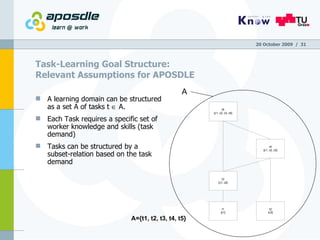
Task-Learning Goal Structure:  Relevant Assumptions for APOSDLE A learning domain can be structured as a set A of tasks t      A.  Each Task requires a specific set of worker knowledge and skills (task demand) Tasks can be structured by a subset-relation based on the task demand 20 October 2009   /  A A={t1, t2, t3, t4, t5}
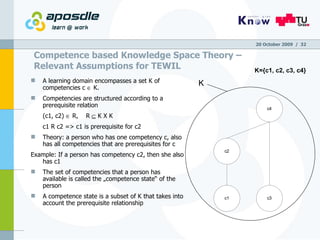
Competence based Knowledge Space Theory –  Relevant Assumptions for TEWIL A learning domain encompasses a set K of competencies c    K.  Competencies are structured according to a prerequisite relation (c1, c2)    R,  R   K X K c1 R c2 => c1 is prerequisite for c2 Theory: a person who has one competency c, also has all competencies that are prerequisites for c Example: If a person has competency c2, then she also has c1 The set of competencies that a person has available is called the „competence state“ of the person A competence state is a subset of K that takes into account the prerequisite relationship 20 October 2009   /  K K={c1, c2, c3, c4}
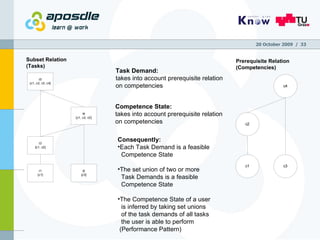
20 October 2009   /  Prerequisite Relation (Competencies) Subset Relation (Tasks) Task Demand: takes into account prerequisite relation  on competencies Competence State: takes into account prerequisite relation  on competencies Consequently:  Each Task Demand is a feasible Competence State The set union of two or more  Task Demands is a feasible  Competence State The Competence State of a user  is inferred by taking set unions of the task demands of all tasks  the user is able to perform  (Performance Pattern)
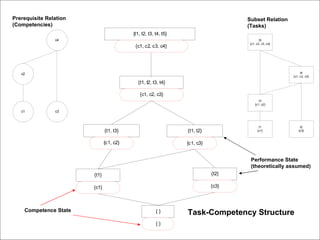
20 October 2009   /  Prerequisite Relation (Competencies) Subset Relation (Tasks) Competence State Task-Competency Structure Performance State (theoretically assumed)
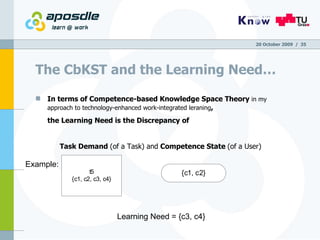
The CbKST and the Learning Need…  In terms of Competence-based Knowledge Space Theory  in my approach to technology-enhanced work-integrated leraning ,  the Learning Need is the Discrepancy of  Task Demand  (of a Task) and  Competence State  (of a User) 20 October 2009   /  Learning Need = {c3, c4} Example:

Bkump Ed Media 20080627

  • 1.
    A Competence-based Approachfor Formalizing Learning Goals in Work-integrated Learning Tobias Ley, Barbara Kump, Armin Ulbrich, Peter Scheir und Stefanie N. Lindstaedt Barbara Kump
  • 2.
    Outline A WorkplaceLearning Context Model Process Package Domain Knowledge Package Competency Package Modelling Learning Goals for Work-Integrated Learning Implementation of the Workplace Learning Context Approach in the APOSDLE Project Real-World Applications and a Prototype Conclusions and Outlook 20 October 2009 /
  • 3.
    A Workplace LearningContext Model 20 October 2009 / [adapted form Lindstaedt & Farmer, 2004] Worker Learner Expert
  • 4.
    Domain Knowledge PackageUsually: documents are stored in structured databases E.g. Ontology 20 October 2009 / Domain Concepts Relation [e.g. Green, 1999] Domain Concepts as semantic metadata
  • 5.
    Process Package Twofoldrole of the work process: Tasks as organizational constraints Task at hand defines personal learning need of a worker 20 October 2009 / KNOWLEDGE WORKER PROJECT MANAGEMENT TASKS Sara (Engineer) Estimating Project Effort Analysing Project Results Learning Need
  • 6.
    20 October 2009 / Process Models
  • 7.
    Competency Package Containsthe competencies that are relevant for performing all tasks in a learning domain, and that can be acquired based on existing resources 20 October 2009 / Process Package: defines the scope of competencies Domain Knowledge Package: limits the number of competencies (due to resources)
  • 8.
    Focus of theCompetency Package Human User 20 October 2009 / Task Demand (in terms of Knowledge & Skills) Competencies: Knowledge & Skills, Ability to perform Tasks Learning Goals (in terms of Knowledge & Skills to acquire) Learning Opportunity [compare Schmidt, 2004; Sicilia, 2005] Competency Gap Analysis
  • 9.
    Modeling Learning Goalsfor Work-integrated Learning – the APOSDLE Approach 20 October 2009 /
  • 10.
    Scenario 20 October2009 / Paul, Requirements Engineer Recently changed his department Build a first cut Context Model Carry out an initial stakeholder analysis User Profile Tasks: Build a first cut Context Model Cary out an initial stakeholder analysis Knowledge & Skills: Knowledge of different types of system stakeholders Understand the Syntax and Semantics of Context Models Ability to create a Context Model Knowledge of diffent types of stakeholder analyses Allocate functions between actors according to boundaries Competency Gap Analysis Learning Opportunity Knowledge & Skills: Knowledge about actors, tasks, goals and resources Knowledge about different types of dependencies between actors
  • 11.
    Interlinking packages ofthe Workplace Learning Context Model 20 October 2009 / Task-Competency Assignment Annotation of Resources Task History Knowledge & Skills
  • 12.
    Implementation ofthe Workplace Learning Context Approach in the APOSDLE project 20 October 2009 / [APOSDLE meta-model, Extract] Task Demand
  • 13.
    Formal Specification ofthe Task Demand in APOSDLE Competence based Knowledge Space Theory Korossy, 1997; Düntsch & Gediga, 1994; based on Doignon & Falmagne, 1985, 1999 Knowledge Space Theory has been applied and tested in various fields : ALEKS (ALEKS Corp, 2003), RATH (Hockemeyer & Albert, 1999) Workflow Processes (Stefanutti & Albert, 2002 ), Knowledge Management (Ley, 2006; Ley & Albert, 2003) Implications for teacher education and training (Albert, 2006), Skills of Medical Trainees (Albert et al., 2007) 20 October 2009 /
  • 14.
    Real World Applicationsof the APOSDLE Workplace Learning Context Approach 20 October 2009 /
  • 15.
    Four Application Partnerspecific APOSDLEs 20 October 2009 / Network of SMEs eConsulting for Innovation-management Large Corporation SW Simulation Public Org. & SME REACH Consulting & Event-Management RESCUE
  • 16.
    Integrated modelling methodology20 October 2009 / Domain Knowledge Package Process Package Competency Package
  • 17.
    Informal Models –EADS Example 20 October 2009 / Informal Simulation Domain Model Informal Simulation Tasks Model Define Objectives Design Develop Execute
  • 18.
    20 October 2009 / EADS Domain Concept (Example)
  • 19.
    20 October 2009 / EADS Task (Example) Informal Task Demand (in terms of domain concepts)
  • 20.
    Modelling the TaskDemand: TACT tool 20 October 2009 / [TACT for modelling Requirements Engineering]
  • 21.
    and a Prototype…20 October 2009 /
  • 22.
  • 23.
    20 October 2009 / Tasks (Process Package) Learning Goals (Competency Package)
  • 24.
    20 October 2009 / Resource Viewer Domain Concepts (Domain Knowledge Package)
  • 25.
    Conclusions & Outlook20 October 2009 /
  • 26.
    Conclusions & OutlookWe have presented a Workplace Learning Context Model Concrete implementation in 4 different application domains Allows for competency gap analysis (based on task history) Focus of further research: Additional indicatiors for skills and knowledge Differences in the application domains, due to certain characteristics of the domains Relatedness of process package and domain knowledge package Granularity of the task model and the domain model 20 October 2009 /
  • 27.
    Conclusions & OutlookThe modelling methodology was useful, but needs further revision at certain stages, e.g. It should allow for moving back and forth from informal to formal Formative evaluation and model revision at different modelling stages is indispensable => tools for evaluation support Combining the APOSDLE implementation of the Workplace Learning Context Model with existing Competency Management approaches Bi-directional (APOSDLE and existing Competency Management Approaches) Suggestions have been made, e.g. in Ley, 2007 20 October 2009 /
  • 28.
    Thank you foryour attention! Barbara Kump Graz University of Technology Knowledge Management Institute [email_address] 20 October 2009 /
  • 29.
    References Albert, D.,Hockemeyer, C., Mayer, B., Steiner, C. M (2007). Cognitive Structure Modelling of Skills for Technology-Enhanced Learning. Paper presented at the 7th IEEE International Conference on Advanced Learning Technologies (ICALT 2007) , July 18-20, 2007, Niigata, Japan. ALEKS Corp. (2003), ALEKS - A Better State of Knowledge, retrieved from http://www.aleks.com . Doignon, J. and Falmagne, J. (1999), Knowledge Spaces, Springer, Heidelberg. Falmagne, J., Doignon, J., Koppen, M., Villano, M. and Johannesen, L. (1990), "Introduction to Knowledge Spaces: How to Build, Test, and Search Them", Psychological Review, Vol. 97 No. 2, pp. 201-224. Green, P.C. (1999), Building Robust Competencies: Linking Human Resource Systems to Organizational Strategies, Jossey-Bass, San Francisco. Hockemeyer, C., Held, T. and Albert, D. (1998), "RATH - A Relational Adaptive Tutoring Hypertext WWW-Environment Based on Knowledge Space Theory", in Alvegard, C. (Ed.), CALISCE`98: Proceedings of the Fourth International Conference on Computer Aided Learning in Science and Engineering, Chalmers University of Technology, Göteborg, Sweden, pp. 417-423. Korossy, K. (1997), "Extending the theory of knowledge spaces: A competence-performance approach", Zeitschrift für Psychologie, Vol. 205, pp. 53-82. Ley, T., Albert, D. and Lindstaedt, S.N. (2007), "Competency Management using the Competence Performance Approach: Modeling, Assessment, Validation and Use", in Sicilia, M. A. (Ed.), Competencies in Organizational E-Learning: Concepts and Tools, Information Science Publishing, Hershey, pp. 83-119. Ley, T., Lindstaedt, S.N. and Albert, D. (2005), "Supporting Competency Development in Informal Workplace Learning", in Althoff, K., Dengel, A., Bergmann, R., Nick, M. and Roth-Berghofer, T. (Eds.), Professional Knowledge Management, Springer, Berlin, pp. 189-202. Lindstaedt, S.N. and Farmer, J. (2004), "Kooperatives Lernen in Organisationen", in Haake, J., Schwabe, G. and Wessner, M. (Eds.), CSCL-Kompendium - Lehr- und Handbuch zum computerunterstützten kooperativen Lernen, Oldenbourg Wissenschaftsverlag, Munich, Germany, pp. 191-220. Schmidt, A. (2004), "Context-Steered Learning: The Learning in Process Approach", Proceeding of the IEEE Conference on Advanced Learning Technologies (ICALT 04) Joensuu, Finnland. Sicilia, M. (2005), "Ontology-Based Competency Management: Infrastructures for the Knowledge-intensive Learning Organization", in Lytras, M. and Naeve, A. (Eds.), Intelligent Learning Infrastructures in Knowledge Intensive Organizations: A Semantic Web perspective, Idea Group, Hershey, pp. 302-324. 20 October 2009 /
  • 30.
    Appendix: Competence-based KnowledgeSpace Theory 20 October 2009 /
  • 31.
    Task-Learning Goal Structure: Relevant Assumptions for APOSDLE A learning domain can be structured as a set A of tasks t  A. Each Task requires a specific set of worker knowledge and skills (task demand) Tasks can be structured by a subset-relation based on the task demand 20 October 2009 / A A={t1, t2, t3, t4, t5}
  • 32.
    Competence based KnowledgeSpace Theory – Relevant Assumptions for TEWIL A learning domain encompasses a set K of competencies c  K. Competencies are structured according to a prerequisite relation (c1, c2)  R, R  K X K c1 R c2 => c1 is prerequisite for c2 Theory: a person who has one competency c, also has all competencies that are prerequisites for c Example: If a person has competency c2, then she also has c1 The set of competencies that a person has available is called the „competence state“ of the person A competence state is a subset of K that takes into account the prerequisite relationship 20 October 2009 / K K={c1, c2, c3, c4}
  • 33.
    20 October 2009 / Prerequisite Relation (Competencies) Subset Relation (Tasks) Task Demand: takes into account prerequisite relation on competencies Competence State: takes into account prerequisite relation on competencies Consequently: Each Task Demand is a feasible Competence State The set union of two or more Task Demands is a feasible Competence State The Competence State of a user is inferred by taking set unions of the task demands of all tasks the user is able to perform (Performance Pattern)
  • 34.
    20 October 2009 / Prerequisite Relation (Competencies) Subset Relation (Tasks) Competence State Task-Competency Structure Performance State (theoretically assumed)
  • 35.
    The CbKST andthe Learning Need… In terms of Competence-based Knowledge Space Theory in my approach to technology-enhanced work-integrated leraning , the Learning Need is the Discrepancy of Task Demand (of a Task) and Competence State (of a User) 20 October 2009 / Learning Need = {c3, c4} Example: