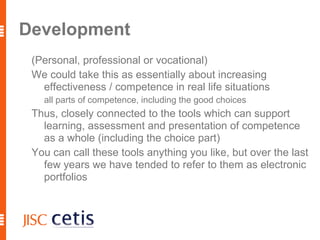
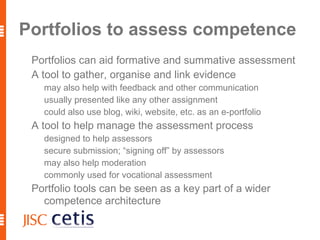
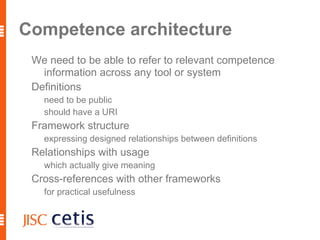
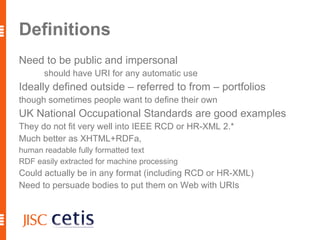
Competence & portfolios: how can we relate them? Simon Grant JISC Centre for Educational Technology and Interoperability Standards (CETIS) NORDLET 2009-09-18
Overview “This presentation traces the connections between competence and portfolio across learning, development, assessment and presentation, and suggests some consequences for interoperable and portable representation of skills, competences and frameworks of them.”
Needs a workable concept of competence, which comes first.
Starting points We are talking about learning, education and training
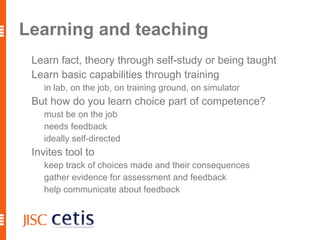
Different areas are often distinguished: learning and teaching
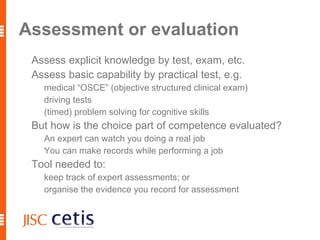
assessment or evaluation
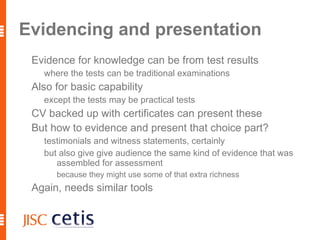
evidence assembly and presentation towards next stage
personal and professional development The different aspects of what is learned: explicit, verbalisable knowledge
basic capabilities of the individual across contexts
competence – contextual, above knowledge and capability
Explicit, verbalisable knowledge “Do you know...” e.g. do you know about the world; people; society
can you say how to do things (explicit “know-how”)
can you describe causes and effects in the world Easily testable quizzes, multiple choice tests
a traditional aspect of examinations Knowledge can be  about  competence but that knowledge is not the same as being competent
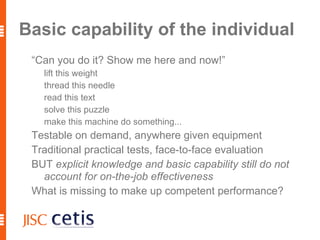
Basic capability of the individual “Can you do it? Show me here and now!” lift this weight
thread this needle
read this text
solve this puzzle
make this machine do something... Testable on demand, anywhere given equipment
Traditional practical tests, face-to-face evaluation
BUT  explicit knowledge and basic capability still do not account for on-the-job effectiveness
What is missing to make up competent performance?
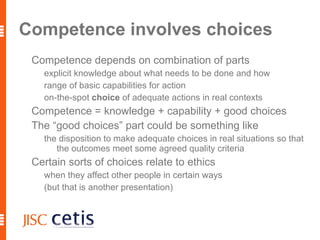
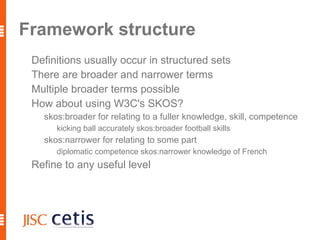
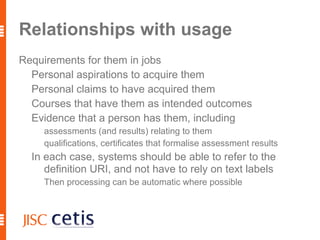
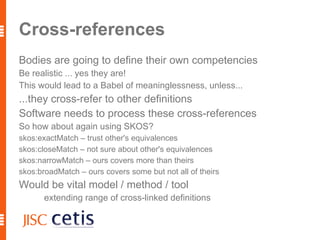
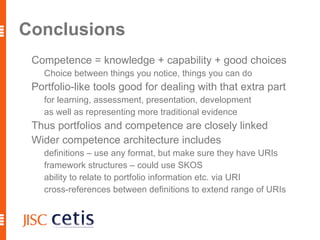
Competence involves choices Competence depends on combination of parts explicit knowledge about what needs to be done and how
range of basic capabilities for action
on-the-spot  choice  of adequate actions in real contexts Competence = knowledge + capability + good choices
The “good choices” part could be something like the disposition to make adequate choices in real situations so that the outcomes meet some agreed quality criteria Certain sorts of choices relate to ethics when they affect other people in certain ways
(but that is another presentation)

Competence and portfolios - OpenOffice

Editor's Notes

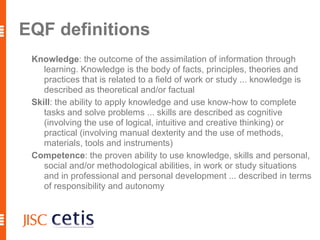
  • #7 Many people have tried out different ways of analysing competence and competency. Knowledge, skills, attitudes is one, but the definition of attitudes is not very helpful. The European e-Competence Framework uses the following definitions: ‱ Competence is defined as “a demonstrated ability to apply knowledge, skills and attitudes for achieving observable results”. Consequently, the related e-Competence descriptions embed and integrate knowledge, skills and attitudes. ‱ Skill is defined as “ability to carry out managerial or technical tasks”. Managerial and technical skills are the components of competences and specify some core abilities which form a competence. ‱ Attitude means in this context the “cognitive and relational capacity” (e.g. analysis capacity, synthesis capacity, flexibility, pragmatism...). If skills and knowledge are the components, attitudes are the glue, which keeps them together. ‱ Knowledge represents the “set of know-what” (e.g. programming languages, design tools...) and can be described by operational descriptions.
  • #8 And perhaps you can sense how the choice questions can easily range between choices with no ethical implications and ones with clear ethical implications.
  • #9 Or maybe add bribery at the bottom. Again we can imagine choices ranging between non-ethical to deeply ethical.