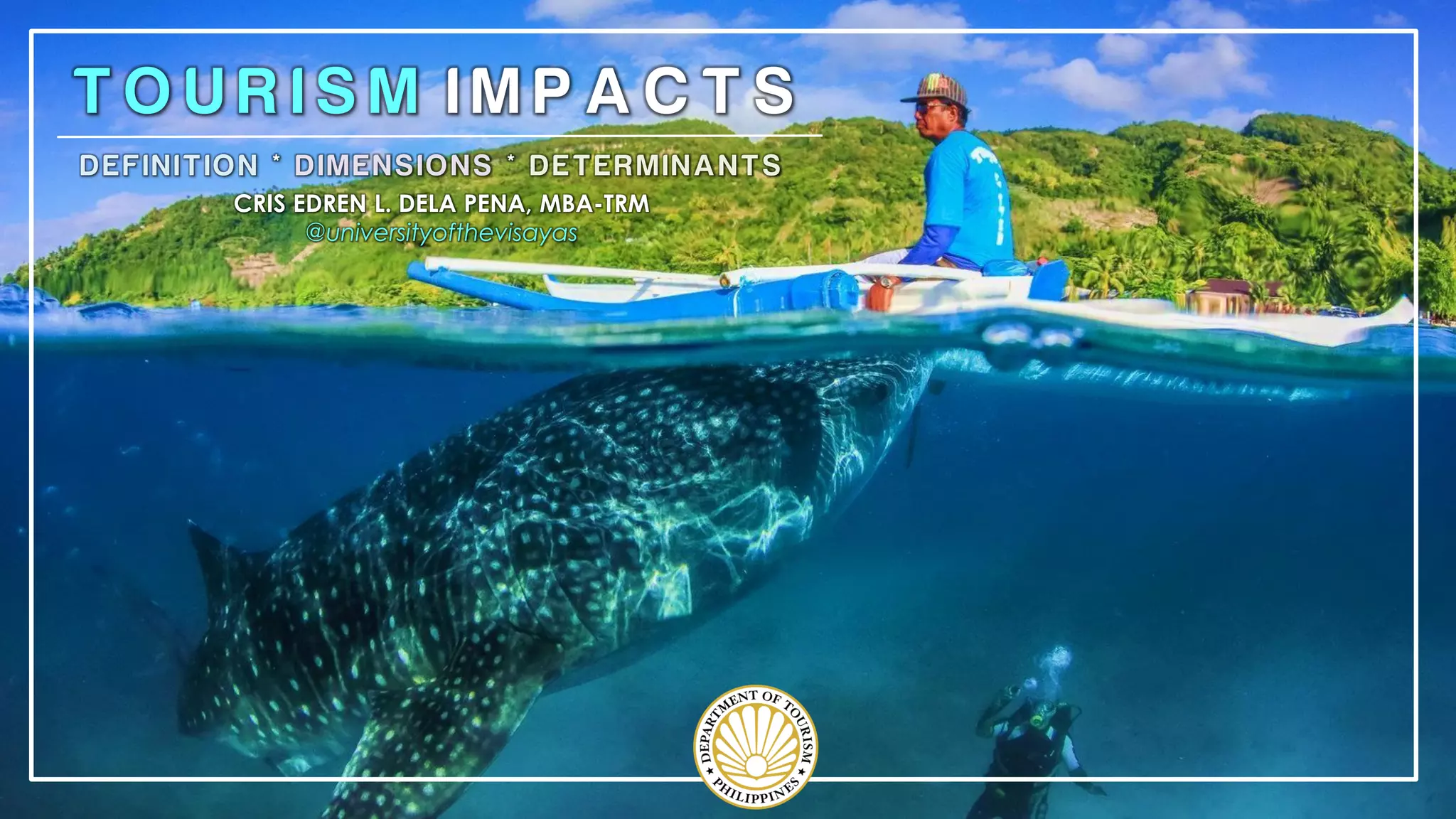
T O U R I S M I M P A C T S
DEFINITION * DIMENSIONS * DETERMINANTS
CRIS EDREN L. DELA PENA, MBA-TRM
@universityofthevisayas
D E F I N I T I O N
of Tourism Impact
• “a change in a given state over time as the result of
an external stimulus.”
- Hall and Lew (2009)
• External stimulus – TOURISM
• TOURISM IMPACT
- may be defined as an effect brought about by
directly or indirectly by tourism policies, tourism-related
establishments and infrastructure, and tourist behavior.
D I M E N S I O N S
of Tourism Impacts
• Tourism impacts may be categorized in terms of their
scope, the direction of change and type of impact,
and the scale, distribution, and duration of the effects.
• The scope of tourism impact may be
 economic
 environmental
 social
 cultural
 political
• Impacts are seldom uni-dimensional
• A focus on tourism may make governments
overzealous in protecting nature at the expense
of indigenous people, creating a conflict between
environmental and cultural concerns.
D I M E N S I O N S
of Tourism Impacts
• Type of impact in many ways:
 actual (objective)
 perceived (subjective)
 quantitative
 qualitative
 direct
 indirect
• Tourism impacts may also be seen in terms of
temporal dimension:
 cumulative
 immediate
 long-term
 short-term
D I M E N S I O N S
of Tourism Impacts
• Tourism impacts in terms of distribution among
stakeholders, or geographical coverage:
• Most of the income is said to accrue mostly to
only the local elites
• Poor people are not able to take advantage of
the opportunities
• Tourism impacts will also be felt at varying levels
in the different areas where tourism activity could
take place
• In Leiper’s Tourism Attraction System model,
identified these as:
1. Tourist generating region
2. The transit route region
3. Tourist destination region
D I M E N S I O N S
of Tourism Impacts
• The tourism-induced impacts may be reversible or
irreversible.
• The impact from tourism may have a chain reaction
or just an isolated effect.
DETERMINANTS
of Tourism Impacts
LEVEL OF DEVELOPMENT OF THE TOURISM INDUSTRY
• The more developed the tourism industry, the more
the destination stands to gain economically from
tourism.
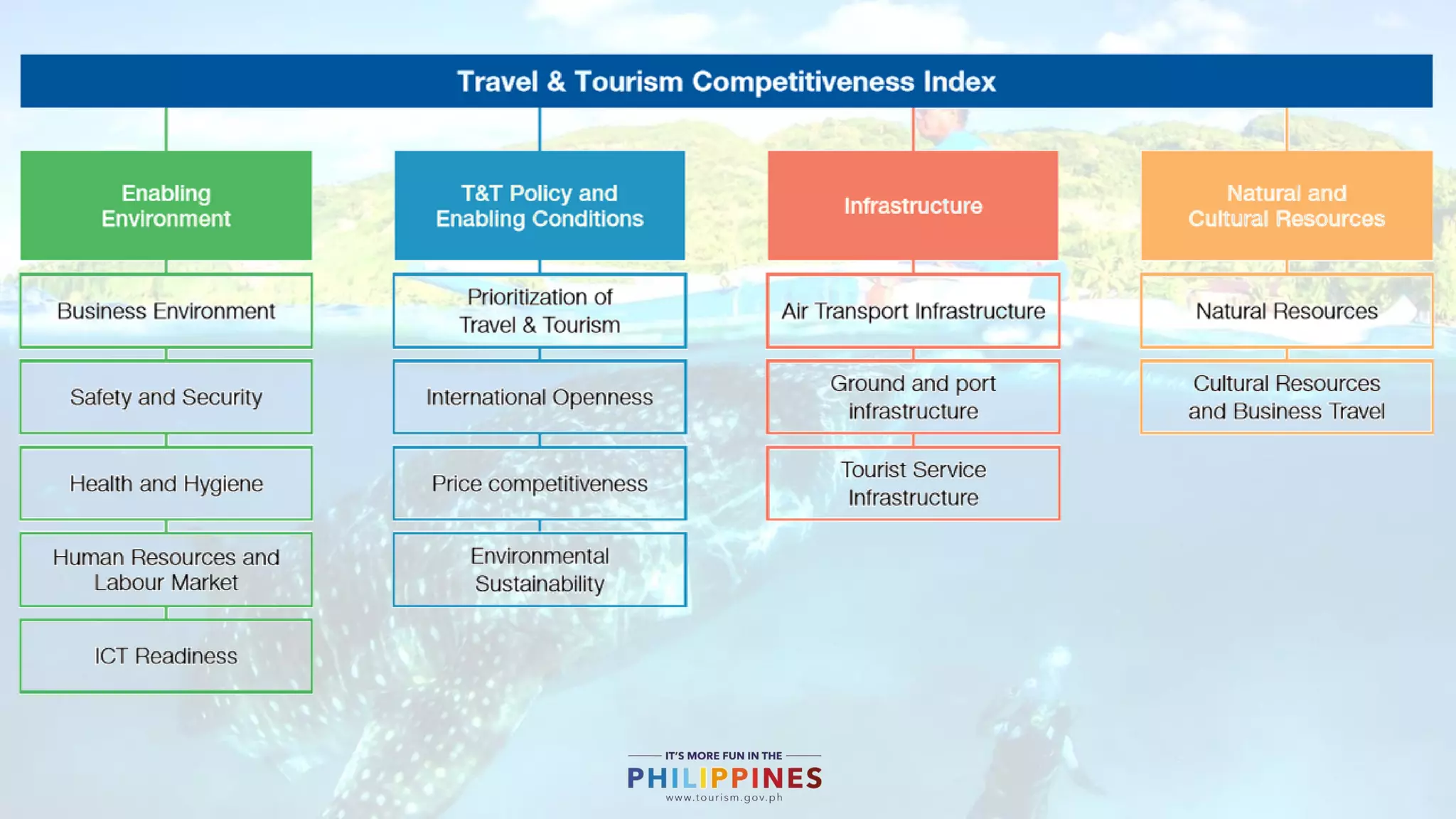
• The Travel and Tourism Competitiveness Index (TTCI)
of the World Economic Forum is a measure of the
level of tourism development in a country.
• The TTCI is based on four broad sub-indices, with a
total of 14 pillar components.
• One assumption is that countries which score highly
on the TTCI are also likely to attract more tourists and
thus gain economic benefits.
DETERMINANTS
of Tourism Impacts
LEVEL OF DEVELOPMENT OF THE TOURISM INDUSTRY
• A similar framework for assessing a place’s potential
for tourism is the As framework suggested by Cruz
(2009)
• Access
• Accommodation
• Activities
• Attractions
• Amenities
• Atmosphere
• Attitude
• Administration
• Assistance
• Awareness
DETERMINANTS
of Tourism Impacts
STRENGTH OF THE ECONOMY AND LINKAGES
• The net economic impact of tourism depends on the
proportion of income that is retained in the local
economy.
• Leakage – happens when we import products or
pay for expatriate managerial expertise.
How do we minimize leakage?
Buy local products and managerial services.
DETERMINANTS
of Tourism Impacts
STAKEHOLDER’S POWER AND CAPACITY
• One of the key issues in tourism development is the
extent by which the benefits and opportunities are
shared by the stakeholders.
• Social representation – refers to the way people
construct knowledge about tourism an its impacts.
• Social representations theory – holds that “where
there is limited knowledge of tourism, a destination
community must either develop its own social
representation of tourism or adopt an existing one.”
DETERMINANTS
of Tourism Impacts
STAKEHOLDER’S POWER AND CAPACITY
• Environmental discrimination – is the result of, and
process by which, environmental policies create
intended or unintended consequences, especially those
which have disproportionate impacts on individuals,
populations, or communities, minority populations or
races, women and lower-income groups.
• Environmental racism – any policy, practice, or directive
that differentially affects or disadvantages (whether
intend or unintended) individuals, groups, or
communities based on race or color.
DETERMINANTS
of Tourism Impacts
TOURISM POLICY
• Tourism policy as embodied in republic acts, presidential
decrees, or local ordinances.
• It defines the country’s prioritization of tourism in relation
to overall development strategy and spells out the
objects of tourism development and the key strategies
for attaining them.
DETERMINANTS
of Tourism Impacts
TOURISM VOLUME, DENSITY, OR RATIO
• Tourism density – refers to the number of tourists at a
given time in relation to the area of the destination.
• Tourism ratio – refers to the volume of tourists in relation
to the local population.
DETERMINANTS
of Tourism Impacts
TOURIST MARKETS SERVED
• The tourist markets served determine the kind of impacts
that are exerted on the host destination as well as those
experience by the tourists themselves.
• Institutionalized Tourists
• Organized mass tourist
• Individual mass tourist
• Non-institutionalized Tourists
• Explorers
• Drifters
DETERMINANTS
of Tourism Impacts
TOURIST MARKETS SERVED
• The Canadian Tourism Commission categorizes people
by their explorer quotient (EQ). EQ breaks down markets
into nine psychographic group called explorer types
Visit this website
https://quiz.canada.travel/caen/all-traveller-types
What type of explorer are you?
• We can surmise that institutionalized tourist exert more
cultural influence on the residents of a destination
mainly through demonstration effect.
DETERMINANTS
of Tourism Impacts
TOURIST MARKETS SERVED
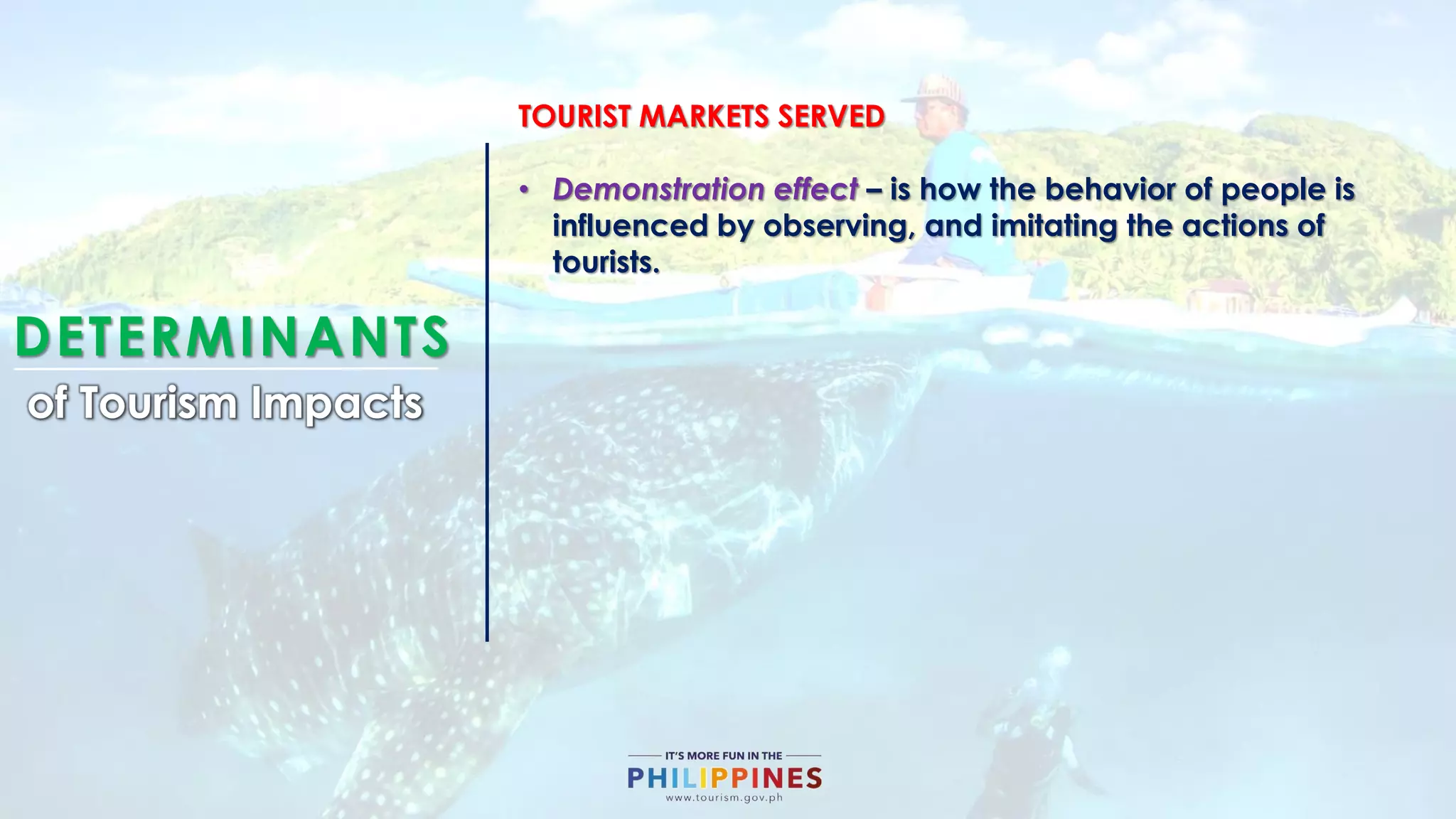
• Demonstration effect – is how the behavior of people is
influenced by observing, and imitating the actions of
tourists.
DETERMINANTS
of Tourism Impacts
TECHNOLOGY
• Noise and greenhouse gas emissions from aircraft, which
is the primary mode of long-haul travel, have been
significantly reduced with the deployment of the newest
generation of aircraft.
• Water pollution may be abated by installing wastewater
treatment facility.
• Tourist resorts may install solar panels to reduce their
reliance on commercial electricity.
DETERMINANTS
of Tourism Impacts
TOURISM CARRYING CAPACITY
• The level of human activity an area can accommodate
without the area deteriorating, the resident community
being adversely affected, or the quality of visitors
experience declining. (Middleton & Hawkins 1998)
• The maximum number of people that may visit a tourist
destination at the same time, without causing destruction
of the physical, economic, socio-cultural environment,
and an unacceptable decrease in the quality of visitors’
satisfaction. (WTO)
DETERMINANTS
of Tourism Impacts
OTHER FACTORS
• Besides the factors mentioned, Ryan (2003) added the
emergence of bureaucrats, the rise of unlivable industrial
cities which drove people to escape the physical
crowding of the cities, and women’s liberation as driving
force for tourism development.
RESEARCH
• Research on the characteristics of baby boomers, Gen
X, and the Millenials. How do such characteristics
influence the kind of impacts they exert on destinations
and the impacts they are likely to experience
themselves?
Print your answers on a short bondpaper.
Submit on Dec. 11, 2017.
T O U R I S M I M P A C T S
DEFINITION * DIMENSIONS * DETERMINANTS
CRIS EDREN L. DELA PENA, MBA-TRM
@universityofthevisayas

Introduction to Tourism Impacts

  • 1.
    T O UR I S M I M P A C T S DEFINITION * DIMENSIONS * DETERMINANTS CRIS EDREN L. DELA PENA, MBA-TRM @universityofthevisayas
  • 2.
    D E FI N I T I O N of Tourism Impact • “a change in a given state over time as the result of an external stimulus.” - Hall and Lew (2009) • External stimulus – TOURISM • TOURISM IMPACT - may be defined as an effect brought about by directly or indirectly by tourism policies, tourism-related establishments and infrastructure, and tourist behavior.
  • 3.
    D I ME N S I O N S of Tourism Impacts • Tourism impacts may be categorized in terms of their scope, the direction of change and type of impact, and the scale, distribution, and duration of the effects. • The scope of tourism impact may be  economic  environmental  social  cultural  political • Impacts are seldom uni-dimensional • A focus on tourism may make governments overzealous in protecting nature at the expense of indigenous people, creating a conflict between environmental and cultural concerns.
  • 4.
    D I ME N S I O N S of Tourism Impacts • Type of impact in many ways:  actual (objective)  perceived (subjective)  quantitative  qualitative  direct  indirect • Tourism impacts may also be seen in terms of temporal dimension:  cumulative  immediate  long-term  short-term
  • 5.
    D I ME N S I O N S of Tourism Impacts • Tourism impacts in terms of distribution among stakeholders, or geographical coverage: • Most of the income is said to accrue mostly to only the local elites • Poor people are not able to take advantage of the opportunities • Tourism impacts will also be felt at varying levels in the different areas where tourism activity could take place • In Leiper’s Tourism Attraction System model, identified these as: 1. Tourist generating region 2. The transit route region 3. Tourist destination region
  • 6.
    D I ME N S I O N S of Tourism Impacts • The tourism-induced impacts may be reversible or irreversible. • The impact from tourism may have a chain reaction or just an isolated effect.
  • 7.
    DETERMINANTS of Tourism Impacts LEVELOF DEVELOPMENT OF THE TOURISM INDUSTRY • The more developed the tourism industry, the more the destination stands to gain economically from tourism. • The Travel and Tourism Competitiveness Index (TTCI) of the World Economic Forum is a measure of the level of tourism development in a country. • The TTCI is based on four broad sub-indices, with a total of 14 pillar components. • One assumption is that countries which score highly on the TTCI are also likely to attract more tourists and thus gain economic benefits.
  • 9.
    DETERMINANTS of Tourism Impacts LEVELOF DEVELOPMENT OF THE TOURISM INDUSTRY • A similar framework for assessing a place’s potential for tourism is the As framework suggested by Cruz (2009) • Access • Accommodation • Activities • Attractions • Amenities • Atmosphere • Attitude • Administration • Assistance • Awareness
  • 10.
    DETERMINANTS of Tourism Impacts STRENGTHOF THE ECONOMY AND LINKAGES • The net economic impact of tourism depends on the proportion of income that is retained in the local economy. • Leakage – happens when we import products or pay for expatriate managerial expertise. How do we minimize leakage? Buy local products and managerial services.
  • 11.
    DETERMINANTS of Tourism Impacts STAKEHOLDER’SPOWER AND CAPACITY • One of the key issues in tourism development is the extent by which the benefits and opportunities are shared by the stakeholders. • Social representation – refers to the way people construct knowledge about tourism an its impacts. • Social representations theory – holds that “where there is limited knowledge of tourism, a destination community must either develop its own social representation of tourism or adopt an existing one.”
  • 12.
    DETERMINANTS of Tourism Impacts STAKEHOLDER’SPOWER AND CAPACITY • Environmental discrimination – is the result of, and process by which, environmental policies create intended or unintended consequences, especially those which have disproportionate impacts on individuals, populations, or communities, minority populations or races, women and lower-income groups. • Environmental racism – any policy, practice, or directive that differentially affects or disadvantages (whether intend or unintended) individuals, groups, or communities based on race or color.
  • 13.
    DETERMINANTS of Tourism Impacts TOURISMPOLICY • Tourism policy as embodied in republic acts, presidential decrees, or local ordinances. • It defines the country’s prioritization of tourism in relation to overall development strategy and spells out the objects of tourism development and the key strategies for attaining them.
  • 14.
    DETERMINANTS of Tourism Impacts TOURISMVOLUME, DENSITY, OR RATIO • Tourism density – refers to the number of tourists at a given time in relation to the area of the destination. • Tourism ratio – refers to the volume of tourists in relation to the local population.
  • 15.
    DETERMINANTS of Tourism Impacts TOURISTMARKETS SERVED • The tourist markets served determine the kind of impacts that are exerted on the host destination as well as those experience by the tourists themselves. • Institutionalized Tourists • Organized mass tourist • Individual mass tourist • Non-institutionalized Tourists • Explorers • Drifters
  • 16.
    DETERMINANTS of Tourism Impacts TOURISTMARKETS SERVED • The Canadian Tourism Commission categorizes people by their explorer quotient (EQ). EQ breaks down markets into nine psychographic group called explorer types Visit this website https://quiz.canada.travel/caen/all-traveller-types What type of explorer are you? • We can surmise that institutionalized tourist exert more cultural influence on the residents of a destination mainly through demonstration effect.
  • 17.
    DETERMINANTS of Tourism Impacts TOURISTMARKETS SERVED • Demonstration effect – is how the behavior of people is influenced by observing, and imitating the actions of tourists.
  • 18.
    DETERMINANTS of Tourism Impacts TECHNOLOGY •Noise and greenhouse gas emissions from aircraft, which is the primary mode of long-haul travel, have been significantly reduced with the deployment of the newest generation of aircraft. • Water pollution may be abated by installing wastewater treatment facility. • Tourist resorts may install solar panels to reduce their reliance on commercial electricity.
  • 19.
    DETERMINANTS of Tourism Impacts TOURISMCARRYING CAPACITY • The level of human activity an area can accommodate without the area deteriorating, the resident community being adversely affected, or the quality of visitors experience declining. (Middleton & Hawkins 1998) • The maximum number of people that may visit a tourist destination at the same time, without causing destruction of the physical, economic, socio-cultural environment, and an unacceptable decrease in the quality of visitors’ satisfaction. (WTO)
  • 20.
    DETERMINANTS of Tourism Impacts OTHERFACTORS • Besides the factors mentioned, Ryan (2003) added the emergence of bureaucrats, the rise of unlivable industrial cities which drove people to escape the physical crowding of the cities, and women’s liberation as driving force for tourism development.
  • 21.
    RESEARCH • Research onthe characteristics of baby boomers, Gen X, and the Millenials. How do such characteristics influence the kind of impacts they exert on destinations and the impacts they are likely to experience themselves? Print your answers on a short bondpaper. Submit on Dec. 11, 2017.
  • 22.
    T O UR I S M I M P A C T S DEFINITION * DIMENSIONS * DETERMINANTS CRIS EDREN L. DELA PENA, MBA-TRM @universityofthevisayas