The Tourism System
Presented by: ABDUL Rehman (M6822086)


SUBMITTED TO: Dr. VIJAY
Introduction
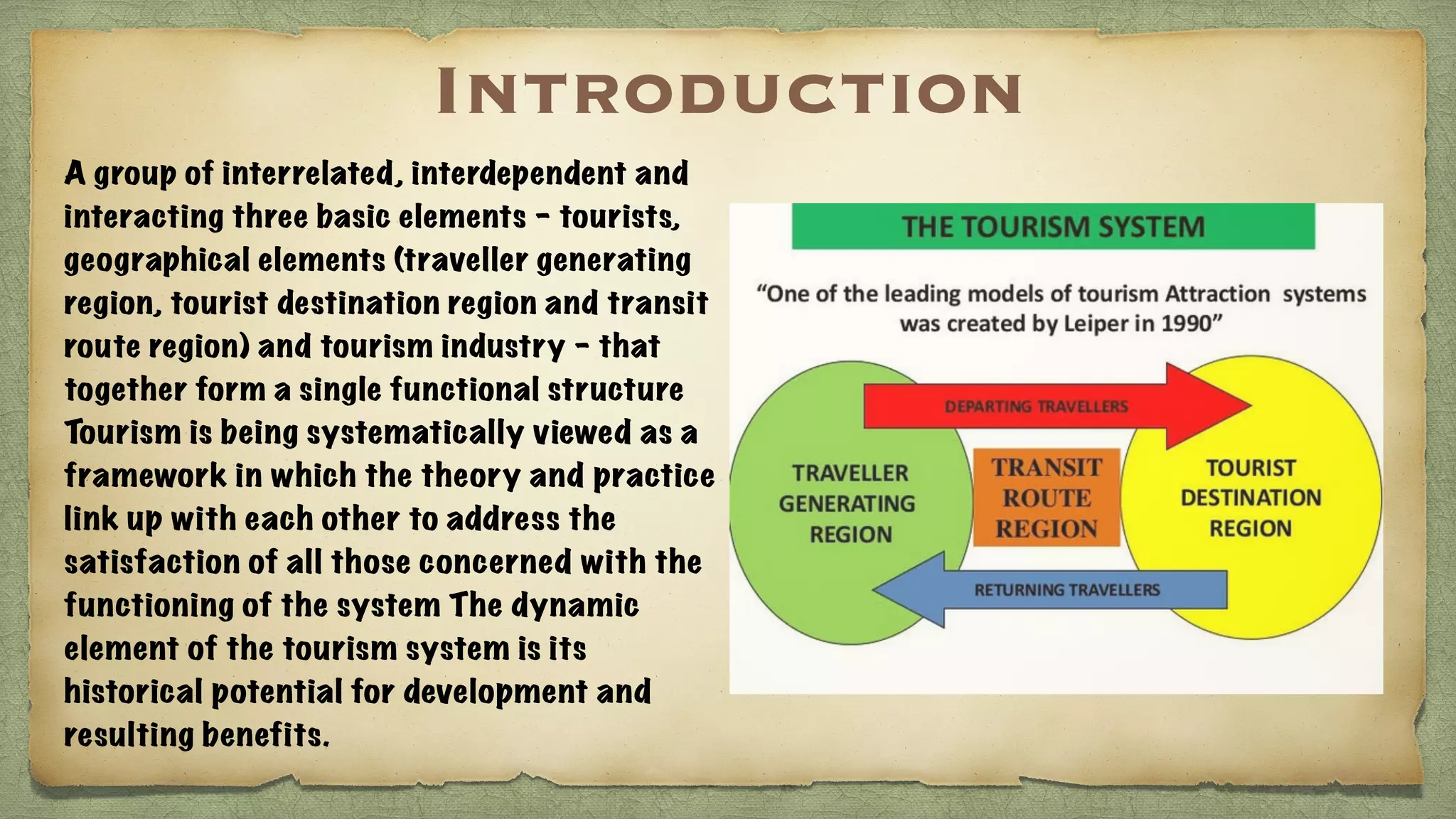
A group of interrelated, interdependent and
interacting three basic elements – tourists,
geographical elements (traveller generating
region, tourist destination region and transit
route region) and tourism industry – that
together form a single functional structure


Tourism is being systematically viewed as a
framework in which the theory and practice
link up with each other to address the
satisfaction of all those concerned with the
functioning of the system The dynamic
element of the tourism system is its
historical potential for development and
resulting benefits.
However the system operates within a global economic environment
along with national priorities. These are often not understood in a
common perspective. The different perceptions can act as constraints on
the development potential of a destination.


Today, the tourism debate centres on the dynamic of the tourism
phenomena where perceptions of the receivers are somewhat different to
that of the tourist. The consumers are not always sensitive to the host,
nor are they of major importance to the host. Often we have seen people
in our bazaars or other public places say the foreigner is nobody’s friend,
or that they are very free with our hospitality but very careful with their
dollars similarly, many a times tourist abuse symbols local pride and
standards of local services. Tourist generally assume that they are being
cheated because they know that bazaars are an on bargaining.
People and Their Environment


The following issues emerge within a Tourism System in relation to
the people and their environment.


1) FINITE RESOURCES-both time and money determine opportunity
and are generally not unlimited.


2) ACTION-the potential for discretion in the use of time and money
exists and yet obligations act as constraints.
3) FACILITATION -is an aid to discretionary action but within the
possibilities offered by travel/journey components and support services.


4) RESULT-both pleasure and utility are desired in all life-world
situations, including tourism.


5) BENEFICIARIES -both host and guest, since the process of tourism
demands the participation of both groups for its success even In the most
controlled and contrived touristic sites and events.


Each of these issues create problems which have to be resolved and taken
care off.
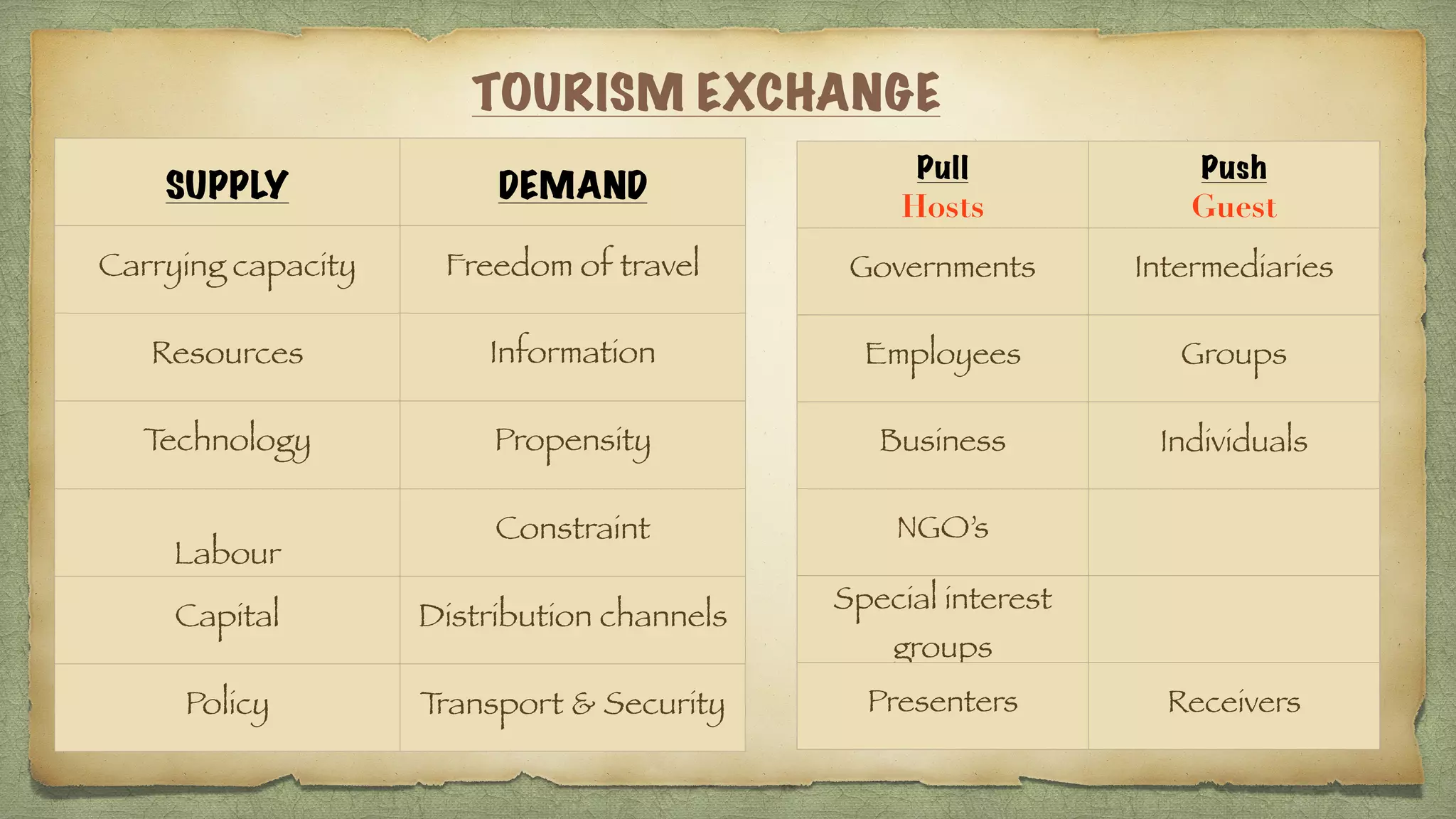
PUSH AND PULL
The resolution of these problems is
achieved through what are called the 'pull'
and 'push' factors in the Tourism System.


The Tourism System influences
governments, industry, business and even
the households of common people. That is
why tourism is no longer ignored by policy
makers or in the economic and social
policy debates. In this connection it is
important to understand the present
global Tourism System.
SUPPLY DEMAND
Carrying capacity Freedom of travel
Resources Information
T
echnology Propensity


Labour


Constraint
Capital Distribution channels
Policy T
ransport & Security
TOURISM EXCHANGE
Pull


Hosts
Push


Guest
Governments Intermediaries
Employees Groups
Business Individuals
NGO’s
Special interest
groups
Presenters Receivers
The system then introduces push factors that ensure
that the problem of land use will be . effectively resolved
by employment and evaluating a job in tourism services
as of more value than in self-employment in any
traditional sector. This evaluation in the name of


progress and development has critiques as well as
supporters.
Lei per’s Tourism System Model


According to Leiper (1990) a tourist attraction system is defined as an
empirical connection of tourist, nucleus, and marker with tourists being
travellers or visitors seeking leisure- related experiences, which involve
nuclear and marker elements. Lei per in his model, has taken tourism as
a system with five interrelated components which must occur in a
consecutive manner for tourism to occur.


Human components (tourists)


Industrial components (Tourism industry)


Geographical components (Traveller generating region, transit route
region and tourist destination region)


The above elements are likely to be affected by their external
environment(environmental, social, legal and political).
Human element comprises of tourists. UNWTO has defined tourists as “a temporary
visitor, intending to spend overnight at a destination, away from his usual place of
residence for purposes such as leisure, business or recreation.”A key difference between
tourist and visitor is that in the case of former, the length of stay cannot exceed a
period of 12 months.


According to Gunn, a tourist must be motivated to undertake travel. Those who do not
have the interest, incline or desire would not be counted as tourists.


People who arrive at a destination to


engage in any business activity,


undertake education


or any traveller traversing a country or region, without having


any intent to stay there will not be considered as tourists. Another category is
excursionist, who are temporary visitors for a period of less than 24


hours in the country visited (including travellers on the cruises)
Human components
Industrial Component:
Tourism industry is fundamentally a synergy between its four sectors


a. Transportation:


Transportation is a crucial element of Tourism Industry. Transportation has made travel possible. It is also
noteworthy to mention that advances in transportation have made travel quicker and comfortable.


Transport is divided into


- Air


- Land (Roadways and Railways)


- Water


Tourists require travel at three destination points. Firstly, to and fro the point of origin and destination region.
Secondly, to travel in between two destinations (in case of tourists travelling to more than one destination) and
lastly, within a destination.


b. Accommodation:


Accommodation sector comprises of establishments providing lodging facilities to the tourists at a particular
price. This includes hotels, Bed and breakfast inns, motels, resorts, homestays and the like. The accommodation
varies in terms of amenities (Budget hotel or resort), location (city centre or airport hotels) and many more.


c. Ancillary Services


A destination’s ancillary services include activities and attractions. Besides this, shopping, F&B services and
WiFi facilities are also included. Some of the ancillary services have been explained as below:
- Tourist Publication (Online and Of
fl
ine): Knowledge about destination both before and during the visit is pivotal
in tourism phenomenon. The information should give details about the dos and donts at the destination, lodging
facilities, attractions (both natural and man-made), local community (their language, culture, food, traditions,
et al) and many more. This will help in familiarising tourists with the destination beforehand.


- Public Services and Amenities: A destination’s infrastructure should suf
fi
ce the requirements of the tourists. It
includes well built roads with accurate signage, sewage facilities, availability of potable water, communication
facilities (Phone booths, secured network) medical facilities (hospitals, dispensaries, etc.) and many more.


-Financial Services: Tourists require funds to arrange for their travel. Foreign exchange becomes important in
case of inbound tourism. Besides this, availability of ATMs and banks at various locations in a destination is
very important.


-Entertainment: It includes facilities for recreation and enjoyment such as gaming arenas, theatres, casinos, et
al.


d. Sales and Distribution:


Tourism product, similar to other products is separated from its customers owing to some geographical
constraints. Thus, Sales distribution system was developed to bridge the gap between the two. Tourism sales
distribution, similar to its counterparts is carried out through service providers like hotels, airlines, travel
agents, tour operators, etc.
Geographical component is composed of three elements:


a. Traveller Generating Region: Traveller Generating Regions (TGR) represents that part of
tourism system from where human beings undertake journey to any other area of their choice.
It is the generating market for tourism and acts as a push force to stimulate and inspire
journey. It is from here that the traveller searches for information, makes reservations and
departs from.


b. Transit Route Region: Evidently, there is a distance between the TGR and TDR. This region is
called as Transit route region. It comprises of lodging facilities (like motels), F&B services
(restaurants) etc. It may also include intermediate attractions which may be visited en- route
the final destination.


c. Tourist destination Region: Tourist destination region is the place which traveller ultimately
seeks to visit. It acts as a pull force for the tourists, offering variety of attractions,
rejuvenation and leisure opportunities. It is at the Tourist Destination Region that the
ultimate impact of tourism is felt. Thus, a systematic approach towards development of
tourism is a requisite.
Geographical component
Thank You

Tourism System

  • 1.
    The Tourism System Presentedby: ABDUL Rehman (M6822086) SUBMITTED TO: Dr. VIJAY
  • 2.
    Introduction A group ofinterrelated, interdependent and interacting three basic elements – tourists, geographical elements (traveller generating region, tourist destination region and transit route region) and tourism industry – that together form a single functional structure Tourism is being systematically viewed as a framework in which the theory and practice link up with each other to address the satisfaction of all those concerned with the functioning of the system The dynamic element of the tourism system is its historical potential for development and resulting benefits.
  • 3.
    However the systemoperates within a global economic environment along with national priorities. These are often not understood in a common perspective. The different perceptions can act as constraints on the development potential of a destination. Today, the tourism debate centres on the dynamic of the tourism phenomena where perceptions of the receivers are somewhat different to that of the tourist. The consumers are not always sensitive to the host, nor are they of major importance to the host. Often we have seen people in our bazaars or other public places say the foreigner is nobody’s friend, or that they are very free with our hospitality but very careful with their dollars similarly, many a times tourist abuse symbols local pride and standards of local services. Tourist generally assume that they are being cheated because they know that bazaars are an on bargaining.
  • 4.
    People and TheirEnvironment The following issues emerge within a Tourism System in relation to the people and their environment. 1) FINITE RESOURCES-both time and money determine opportunity and are generally not unlimited. 2) ACTION-the potential for discretion in the use of time and money exists and yet obligations act as constraints.
  • 5.
    3) FACILITATION -isan aid to discretionary action but within the possibilities offered by travel/journey components and support services. 4) RESULT-both pleasure and utility are desired in all life-world situations, including tourism. 5) BENEFICIARIES -both host and guest, since the process of tourism demands the participation of both groups for its success even In the most controlled and contrived touristic sites and events. Each of these issues create problems which have to be resolved and taken care off.
  • 6.
    PUSH AND PULL Theresolution of these problems is achieved through what are called the 'pull' and 'push' factors in the Tourism System. The Tourism System influences governments, industry, business and even the households of common people. That is why tourism is no longer ignored by policy makers or in the economic and social policy debates. In this connection it is important to understand the present global Tourism System.
  • 7.
    SUPPLY DEMAND Carrying capacityFreedom of travel Resources Information T echnology Propensity Labour Constraint Capital Distribution channels Policy T ransport & Security TOURISM EXCHANGE Pull Hosts Push Guest Governments Intermediaries Employees Groups Business Individuals NGO’s Special interest groups Presenters Receivers
  • 8.
    The system thenintroduces push factors that ensure that the problem of land use will be . effectively resolved by employment and evaluating a job in tourism services as of more value than in self-employment in any traditional sector. This evaluation in the name of progress and development has critiques as well as supporters.
  • 9.
    Lei per’s TourismSystem Model According to Leiper (1990) a tourist attraction system is defined as an empirical connection of tourist, nucleus, and marker with tourists being travellers or visitors seeking leisure- related experiences, which involve nuclear and marker elements. Lei per in his model, has taken tourism as a system with five interrelated components which must occur in a consecutive manner for tourism to occur. Human components (tourists) Industrial components (Tourism industry) Geographical components (Traveller generating region, transit route region and tourist destination region) The above elements are likely to be affected by their external environment(environmental, social, legal and political).
  • 11.
    Human element comprisesof tourists. UNWTO has defined tourists as “a temporary visitor, intending to spend overnight at a destination, away from his usual place of residence for purposes such as leisure, business or recreation.”A key difference between tourist and visitor is that in the case of former, the length of stay cannot exceed a period of 12 months. According to Gunn, a tourist must be motivated to undertake travel. Those who do not have the interest, incline or desire would not be counted as tourists. People who arrive at a destination to engage in any business activity, undertake education or any traveller traversing a country or region, without having any intent to stay there will not be considered as tourists. Another category is excursionist, who are temporary visitors for a period of less than 24 hours in the country visited (including travellers on the cruises) Human components
  • 12.
    Industrial Component: Tourism industryis fundamentally a synergy between its four sectors a. Transportation: Transportation is a crucial element of Tourism Industry. Transportation has made travel possible. It is also noteworthy to mention that advances in transportation have made travel quicker and comfortable. Transport is divided into - Air - Land (Roadways and Railways) - Water Tourists require travel at three destination points. Firstly, to and fro the point of origin and destination region. Secondly, to travel in between two destinations (in case of tourists travelling to more than one destination) and lastly, within a destination. b. Accommodation: Accommodation sector comprises of establishments providing lodging facilities to the tourists at a particular price. This includes hotels, Bed and breakfast inns, motels, resorts, homestays and the like. The accommodation varies in terms of amenities (Budget hotel or resort), location (city centre or airport hotels) and many more. c. Ancillary Services A destination’s ancillary services include activities and attractions. Besides this, shopping, F&B services and WiFi facilities are also included. Some of the ancillary services have been explained as below:
  • 13.
    - Tourist Publication(Online and Of fl ine): Knowledge about destination both before and during the visit is pivotal in tourism phenomenon. The information should give details about the dos and donts at the destination, lodging facilities, attractions (both natural and man-made), local community (their language, culture, food, traditions, et al) and many more. This will help in familiarising tourists with the destination beforehand. - Public Services and Amenities: A destination’s infrastructure should suf fi ce the requirements of the tourists. It includes well built roads with accurate signage, sewage facilities, availability of potable water, communication facilities (Phone booths, secured network) medical facilities (hospitals, dispensaries, etc.) and many more. -Financial Services: Tourists require funds to arrange for their travel. Foreign exchange becomes important in case of inbound tourism. Besides this, availability of ATMs and banks at various locations in a destination is very important. -Entertainment: It includes facilities for recreation and enjoyment such as gaming arenas, theatres, casinos, et al. d. Sales and Distribution: Tourism product, similar to other products is separated from its customers owing to some geographical constraints. Thus, Sales distribution system was developed to bridge the gap between the two. Tourism sales distribution, similar to its counterparts is carried out through service providers like hotels, airlines, travel agents, tour operators, etc.
  • 14.
    Geographical component iscomposed of three elements: a. Traveller Generating Region: Traveller Generating Regions (TGR) represents that part of tourism system from where human beings undertake journey to any other area of their choice. It is the generating market for tourism and acts as a push force to stimulate and inspire journey. It is from here that the traveller searches for information, makes reservations and departs from. b. Transit Route Region: Evidently, there is a distance between the TGR and TDR. This region is called as Transit route region. It comprises of lodging facilities (like motels), F&B services (restaurants) etc. It may also include intermediate attractions which may be visited en- route the final destination. c. Tourist destination Region: Tourist destination region is the place which traveller ultimately seeks to visit. It acts as a pull force for the tourists, offering variety of attractions, rejuvenation and leisure opportunities. It is at the Tourist Destination Region that the ultimate impact of tourism is felt. Thus, a systematic approach towards development of tourism is a requisite. Geographical component
  • 15.