Screening parameters in water analysis
31.08.2015
Ralf Dunsbach
Webinar
The elementargroup – About us
Elementar Webinar 2015
• The technology leader in
• Elemental Analysis (EA)
• Isotope Ratio Mass Spectrometry (IRMS)
• Offers an unmatched combination of
• innovative technologies,
• tailor-made solutions and
• comprehensive support.
The elementargroup – Key Markets
Elementar Webinar 2015
AgricultureChemicals EnvironmentalEnergy MaterialsForensics
Tailor-Made to Customer Needs
• Elemental analyzer optimized for different analytical tasks
• vario Series - Industry-leading versatility in elemental analysis
• rapid Series - Dedicated instruments serving today’s customer needs
• trace Series - Trace-level detection of elements
• TOC Series - Fast and easy determination of total organic carbon
Elementar Webinar 2015
Screening parameters in water analysis
Elementar Webinar 2015
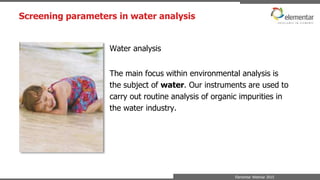
Water analysis
The main focus within environmental analysis is
the subject of water. Our instruments are used to
carry out routine analysis of organic impurities in
the water industry.
Introduction
Elementar Webinar 2015
H2O
Contains
• Inorganic compounds (salts like NaCl)
• Organic compounds (humic substances + man-made
waste)
Only 0,3% of the global water resources is availble as drinking water
Water protection, technology and analysis
gain more and more importance!
One of the most important quality criteria for
water is Pollution with organic compounds
How to determine organic pollutants
Pollution with organic compounds - how to determine?
Elementar Webinar 2015
Single compound analysis
by chromatographic methods?
Drawback:
Nearly impossible due to the huge
number of possible compounds –
applicable only for certain classes of
substances (e.g. polycyclic aromatic
hydrocarbons)
Screening parameter analysis
for all organic compounds
- BODx - biological oxygen demand
- COD - chemical oxygen demand
- TOC -total organic carbon
How to determine organic pollutants
BODx and CSB are indirect methods to determine the amount of organic
carbon by the determination of the biological and chemical oxygen demand
during the decomposition of its compounds.
Disadvantage:
• slow
• insufficient or wrong oxidation
• depending from biological activity
• heavy metal containing reagents
• no automation
Elementar Webinar 2015
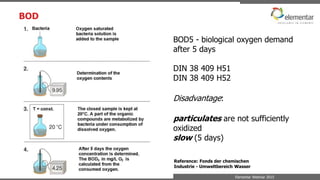
BOD5 - biological oxygen demand
after 5 days
DIN 38 409 H51
DIN 38 409 H52
Disadvantage:
particulates are not sufficiently
oxidized
slow (5 days)
Elementar Webinar 2015
Reference: Fonds der chemischen
Industrie - Umweltbereich Wasser
BOD
DIN 38 409 H41
Disadvantage:
higher or fluctuating results,
if dichromate is consumed due to the
oxidation of sulfur containing compounds
Reagents:
concentrated sulfuric acid H2SO4 – corrosive!
potassium dichromate K2Cr2O7 - toxic!
mercury substance (masking of chloride) –
toxic!
Analysis time: > 2 hours,
automation very difficult
Dichromate out of use in EU
latest 2017!!
Elementar Webinar 2015
Reference: Fonds der chemischen
Industrie - Umweltbereich Wasser
COD
Recovery rates COD
According to Janicke (WaBoLu report 1/1983):
n-hexane 2% Urea 82%
Cyclohexane 5% benzene 63%
Chloromethane 8% EDTA 78%
Trimethylamine 1% starch 91%
Nicotinic acid 12% stearic acid 60%
Poor recovery for alcanes, amines
Elementar Webinar 2015
False COD readings
• High false readings by chlorides, bromides, iodides, certain sulfur
compounds, nitrites and certain metal compounds
• False low readings by chromium (VI)-compounds, nitrates, peroxides
Elementar Webinar 2015
TOC
EN 1484 - European Standard
Water analysis -
Guidlines for the determination of the total organic carbon (TOC) and
dissolved organic carbon (DOC)
The EN 1484 approves the determination of TOC and DOC as appropriate
method to determine the contamination of water with organic compounds.
Elementar Webinar 2015
R-C + O2  CO2 + H2O + further products
TC
TC [total Carbon] = TIC [total inorganic carbon] + TOC [total organic carbon]
TOC = POC [purgable organic carbon] + NPOC [non-purgable organic carbon]
TOC + TIC
POC + NPOC
Elementar Webinar 2015
TOC
TC [total Carbon]
Oxidation Detection
Sample [R-C-R + CO3
2-] + O2  CO2 + H2O +
...
Total carbon can be determined by oxidation and decomposition
of the sample and detection of the deriving CO2
Elementar Webinar 2015
How to determine TC
Detection
Acidified Sample: CO3
2- + 3 H+  CO2 + H3O+
TIC
Total inorganic carbon can be determined by degradation of the
carbonates by acid, purging and detection of the deriving CO2
Gas
Elementar Webinar 2015
How to determine TIC
NPOC [total Carbon]
Oxidation Detection
Acidified and purged Sample [R-C-R ]
Non-Purgable Organic Carbon can be determined by purging
the acidified sample in advance to remove TIC and POC,
oxidation of the remaining components and detection of the
deriving CO2
Oxidation:
R-C-R(non vol.) + O2  CO2 + H2O + ...
Purging:
[R-C-R (volatile and non volatile) + CO3
2-] + 3 H+  CO2 + H3O+ + R-C-R
(vol.)
if POC = 0

NPOC = TOC
Elementar Webinar 2015
How to determine NPOC
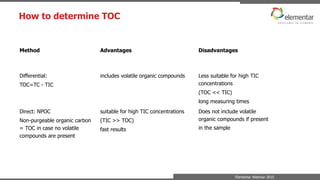
Method Advantages Disadvantages
Differential:
TOC=TC - TIC
includes volatile organic compounds Less suitable for high TIC
concentrations
(TOC << TIC)
long measuring times
Direct: NPOC
Non-purgeable organic carbon
= TOC in case no volatile
compounds are present
suitable for high TIC concentrations
(TIC >> TOC)
fast results
Does not include volatile
organic compounds if present
in the sample
Elementar Webinar 2015
How to determine TOC
EN 1484 - European Standard
Elementar Webinar 2015
Determination of TOC and DOC by:
• Wet chemical - UV-persulfat method (DOC only)
• Combustion method
How to determine TOC
Elementar Webinar 2015
Wet chemical - UV-persulfat method
Quelle: Deutschen Bundesstiftung Umwelt (DBU)
R-C + O2 CO2 + H2O + further products
UV-light +
oxidation agent
Advantage:
• large sample volume (up to 20mL)
• high sensitivity
Disadvantage:
• insufficient oxidation of particulates
• not applicable for electrolytes or
chlorine containing samples
• not for highly contaminated samples
• not for solid samples
• not for nitrogen
Elementar Webinar 2015
Combustion method
R-C + O2 CO2 + H2O + further products
Advantage:
• quantitative oxidation of all carbon
containing compounds
• low matrix influence
• applicable for waste water and solids
• applicable for TNb as additional parameter
Disadvantage:
• lower injection volume
• problematically with salts
• lower sensitivity
High temperature in
presence of catalyst
How to determine TOC
State-of-the-art TOC analyzer
Elementar Webinar 2015
The Concept
Elementar Webinar 2015
Easy maintenance
Elementar Webinar 2015
• Temperatur programmable up to 1100°C
• Matrix separation (patent pending) to keep salt
away from the catalyst
• Multiway valve on top of the combustion tube for
fast and easy injection
• All maintenance parts easily accessible
Solids analysis
Elementar Webinar 2015
• Only TOC in water analyzer worldwide with
automatic sample feeder for solids
• Sample feeding by reliable ball valve technique
• Sample carousel with 80-120 positions
• Solids expansion kit for carbon amounts up to
20mg C abs.
Drinking water: 0.5 ppm – 2 ppm TOC
Surface waters: 0.5 ppm – 10 ppm TOC
Waste waters: 5 ppm – 10,000 ppm TOC
Waste and soil: upper ppm to percentage range of TOC
Waters in pharmacy: 0.05 – 0.5 ppm TOC
Waters in power plants: 0.05 – 1 ppm TOC
Waters in semiconductor industries: 0.005 – 0.5 ppm TOC
Elementar Webinar 2015
Typical TOC contents
Correlation TOC/COD
Elementar Webinar 2015
Oxalic
acid
Ethanol
Both compounds have the same TOC (in
mol/l), but COD is 5* higher than oxalic acid.
COD/TOC of certain compounds
Elementar Webinar 2015
COD/TOC in different samples I
Origin COD/TOC SD
Influent MWWTP <1000 r 3,23 0,42
Influent MWWTP 1000-5000 r 3,16 0,41
Influent MWWTP 5000-10000 r 2,99 0,37
Influent MWWTP 10000-100000 r 2,99 0,37
Influent MWWTP >100000 r 2,92 0,39
Edible oil refinery 3,64 0,70
Fish processing 3,51 0,45
Meat industry 3,26 0,41
Glue production 4,28 1,62
Elementar Webinar 2015
MWWTP: municipal waste water treatment plant
COD/TOC in different samples II
Origin COD/TOC SD
Ore processing 4,05 0,15
Sugar production 2,92 0,36
Paper production 2,75 0,18
Iron+steel production 3,78 1,02
Textile production 3,05 0,27
Glas and inorganic fiber production 2,62 0,25
Chemical cleaning 3,64 0,24
Waste deposit 3,04 0,2
Oil refineries 3,32 0,25
Elementar Webinar 2015
Source: Verbesserung der Einleiterüberwachung durch die Einführung der Meßgrößen TOC, TNb and Pges., Wasserwirtschaft
Forschungsbericht 296-22-322
Summary
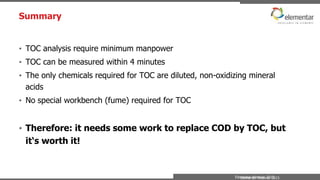
• TOC analysis require minimum manpower
• TOC can be measured within 4 minutes
• The only chemicals required for TOC are diluted, non-oxidizing mineral
acids
• No special workbench (fume) required for TOC
• Therefore: it needs some work to replace COD by TOC, but
it‘s worth it!
Elementar Webinar 2015Elementar Webinar 2015
Elementar thanks for your attention!
Elementar Webinar 2015

Screening parameters in water analysis

  • 1.
    Screening parameters inwater analysis 31.08.2015 Ralf Dunsbach Webinar
  • 2.
    The elementargroup –About us Elementar Webinar 2015 • The technology leader in • Elemental Analysis (EA) • Isotope Ratio Mass Spectrometry (IRMS) • Offers an unmatched combination of • innovative technologies, • tailor-made solutions and • comprehensive support.
  • 3.
    The elementargroup –Key Markets Elementar Webinar 2015 AgricultureChemicals EnvironmentalEnergy MaterialsForensics
  • 4.
    Tailor-Made to CustomerNeeds • Elemental analyzer optimized for different analytical tasks • vario Series - Industry-leading versatility in elemental analysis • rapid Series - Dedicated instruments serving today’s customer needs • trace Series - Trace-level detection of elements • TOC Series - Fast and easy determination of total organic carbon Elementar Webinar 2015
  • 5.
    Screening parameters inwater analysis Elementar Webinar 2015 Water analysis The main focus within environmental analysis is the subject of water. Our instruments are used to carry out routine analysis of organic impurities in the water industry.
  • 6.
    Introduction Elementar Webinar 2015 H2O Contains •Inorganic compounds (salts like NaCl) • Organic compounds (humic substances + man-made waste) Only 0,3% of the global water resources is availble as drinking water Water protection, technology and analysis gain more and more importance! One of the most important quality criteria for water is Pollution with organic compounds
  • 7.
    How to determineorganic pollutants Pollution with organic compounds - how to determine? Elementar Webinar 2015 Single compound analysis by chromatographic methods? Drawback: Nearly impossible due to the huge number of possible compounds – applicable only for certain classes of substances (e.g. polycyclic aromatic hydrocarbons) Screening parameter analysis for all organic compounds - BODx - biological oxygen demand - COD - chemical oxygen demand - TOC -total organic carbon
  • 8.
    How to determineorganic pollutants BODx and CSB are indirect methods to determine the amount of organic carbon by the determination of the biological and chemical oxygen demand during the decomposition of its compounds. Disadvantage: • slow • insufficient or wrong oxidation • depending from biological activity • heavy metal containing reagents • no automation Elementar Webinar 2015
  • 9.
    BOD5 - biologicaloxygen demand after 5 days DIN 38 409 H51 DIN 38 409 H52 Disadvantage: particulates are not sufficiently oxidized slow (5 days) Elementar Webinar 2015 Reference: Fonds der chemischen Industrie - Umweltbereich Wasser BOD
  • 10.
    DIN 38 409H41 Disadvantage: higher or fluctuating results, if dichromate is consumed due to the oxidation of sulfur containing compounds Reagents: concentrated sulfuric acid H2SO4 – corrosive! potassium dichromate K2Cr2O7 - toxic! mercury substance (masking of chloride) – toxic! Analysis time: > 2 hours, automation very difficult Dichromate out of use in EU latest 2017!! Elementar Webinar 2015 Reference: Fonds der chemischen Industrie - Umweltbereich Wasser COD
  • 11.
    Recovery rates COD Accordingto Janicke (WaBoLu report 1/1983): n-hexane 2% Urea 82% Cyclohexane 5% benzene 63% Chloromethane 8% EDTA 78% Trimethylamine 1% starch 91% Nicotinic acid 12% stearic acid 60% Poor recovery for alcanes, amines Elementar Webinar 2015
  • 12.
    False COD readings •High false readings by chlorides, bromides, iodides, certain sulfur compounds, nitrites and certain metal compounds • False low readings by chromium (VI)-compounds, nitrates, peroxides Elementar Webinar 2015
  • 13.
    TOC EN 1484 -European Standard Water analysis - Guidlines for the determination of the total organic carbon (TOC) and dissolved organic carbon (DOC) The EN 1484 approves the determination of TOC and DOC as appropriate method to determine the contamination of water with organic compounds. Elementar Webinar 2015 R-C + O2  CO2 + H2O + further products
  • 14.
    TC TC [total Carbon]= TIC [total inorganic carbon] + TOC [total organic carbon] TOC = POC [purgable organic carbon] + NPOC [non-purgable organic carbon] TOC + TIC POC + NPOC Elementar Webinar 2015 TOC
  • 15.
    TC [total Carbon] OxidationDetection Sample [R-C-R + CO3 2-] + O2  CO2 + H2O + ... Total carbon can be determined by oxidation and decomposition of the sample and detection of the deriving CO2 Elementar Webinar 2015 How to determine TC
  • 16.
    Detection Acidified Sample: CO3 2-+ 3 H+  CO2 + H3O+ TIC Total inorganic carbon can be determined by degradation of the carbonates by acid, purging and detection of the deriving CO2 Gas Elementar Webinar 2015 How to determine TIC
  • 17.
    NPOC [total Carbon] OxidationDetection Acidified and purged Sample [R-C-R ] Non-Purgable Organic Carbon can be determined by purging the acidified sample in advance to remove TIC and POC, oxidation of the remaining components and detection of the deriving CO2 Oxidation: R-C-R(non vol.) + O2  CO2 + H2O + ... Purging: [R-C-R (volatile and non volatile) + CO3 2-] + 3 H+  CO2 + H3O+ + R-C-R (vol.) if POC = 0  NPOC = TOC Elementar Webinar 2015 How to determine NPOC
  • 18.
    Method Advantages Disadvantages Differential: TOC=TC- TIC includes volatile organic compounds Less suitable for high TIC concentrations (TOC << TIC) long measuring times Direct: NPOC Non-purgeable organic carbon = TOC in case no volatile compounds are present suitable for high TIC concentrations (TIC >> TOC) fast results Does not include volatile organic compounds if present in the sample Elementar Webinar 2015 How to determine TOC
  • 19.
    EN 1484 -European Standard Elementar Webinar 2015 Determination of TOC and DOC by: • Wet chemical - UV-persulfat method (DOC only) • Combustion method How to determine TOC
  • 20.
    How to determineTOC Elementar Webinar 2015 Wet chemical - UV-persulfat method Quelle: Deutschen Bundesstiftung Umwelt (DBU) R-C + O2 CO2 + H2O + further products UV-light + oxidation agent Advantage: • large sample volume (up to 20mL) • high sensitivity Disadvantage: • insufficient oxidation of particulates • not applicable for electrolytes or chlorine containing samples • not for highly contaminated samples • not for solid samples • not for nitrogen
  • 21.
    Elementar Webinar 2015 Combustionmethod R-C + O2 CO2 + H2O + further products Advantage: • quantitative oxidation of all carbon containing compounds • low matrix influence • applicable for waste water and solids • applicable for TNb as additional parameter Disadvantage: • lower injection volume • problematically with salts • lower sensitivity High temperature in presence of catalyst How to determine TOC
  • 22.
  • 23.
  • 24.
    Easy maintenance Elementar Webinar2015 • Temperatur programmable up to 1100°C • Matrix separation (patent pending) to keep salt away from the catalyst • Multiway valve on top of the combustion tube for fast and easy injection • All maintenance parts easily accessible
  • 25.
    Solids analysis Elementar Webinar2015 • Only TOC in water analyzer worldwide with automatic sample feeder for solids • Sample feeding by reliable ball valve technique • Sample carousel with 80-120 positions • Solids expansion kit for carbon amounts up to 20mg C abs.
  • 26.
    Drinking water: 0.5ppm – 2 ppm TOC Surface waters: 0.5 ppm – 10 ppm TOC Waste waters: 5 ppm – 10,000 ppm TOC Waste and soil: upper ppm to percentage range of TOC Waters in pharmacy: 0.05 – 0.5 ppm TOC Waters in power plants: 0.05 – 1 ppm TOC Waters in semiconductor industries: 0.005 – 0.5 ppm TOC Elementar Webinar 2015 Typical TOC contents
  • 27.
    Correlation TOC/COD Elementar Webinar2015 Oxalic acid Ethanol Both compounds have the same TOC (in mol/l), but COD is 5* higher than oxalic acid.
  • 28.
    COD/TOC of certaincompounds Elementar Webinar 2015
  • 29.
    COD/TOC in differentsamples I Origin COD/TOC SD Influent MWWTP <1000 r 3,23 0,42 Influent MWWTP 1000-5000 r 3,16 0,41 Influent MWWTP 5000-10000 r 2,99 0,37 Influent MWWTP 10000-100000 r 2,99 0,37 Influent MWWTP >100000 r 2,92 0,39 Edible oil refinery 3,64 0,70 Fish processing 3,51 0,45 Meat industry 3,26 0,41 Glue production 4,28 1,62 Elementar Webinar 2015 MWWTP: municipal waste water treatment plant
  • 30.
    COD/TOC in differentsamples II Origin COD/TOC SD Ore processing 4,05 0,15 Sugar production 2,92 0,36 Paper production 2,75 0,18 Iron+steel production 3,78 1,02 Textile production 3,05 0,27 Glas and inorganic fiber production 2,62 0,25 Chemical cleaning 3,64 0,24 Waste deposit 3,04 0,2 Oil refineries 3,32 0,25 Elementar Webinar 2015 Source: Verbesserung der Einleiterüberwachung durch die Einführung der Meßgrößen TOC, TNb and Pges., Wasserwirtschaft Forschungsbericht 296-22-322
  • 31.
    Summary • TOC analysisrequire minimum manpower • TOC can be measured within 4 minutes • The only chemicals required for TOC are diluted, non-oxidizing mineral acids • No special workbench (fume) required for TOC • Therefore: it needs some work to replace COD by TOC, but it‘s worth it! Elementar Webinar 2015Elementar Webinar 2015
  • 32.
    Elementar thanks foryour attention! Elementar Webinar 2015