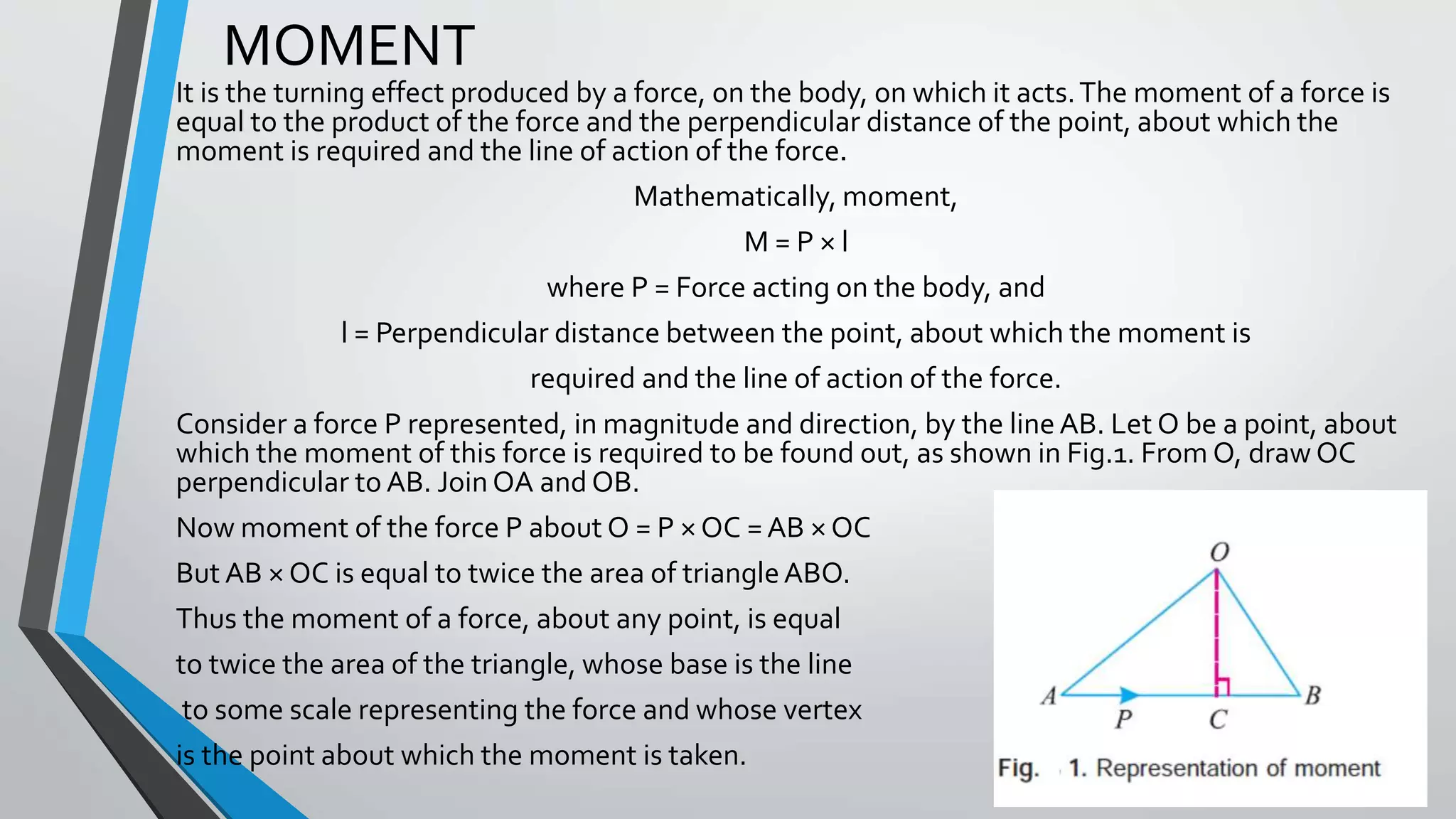
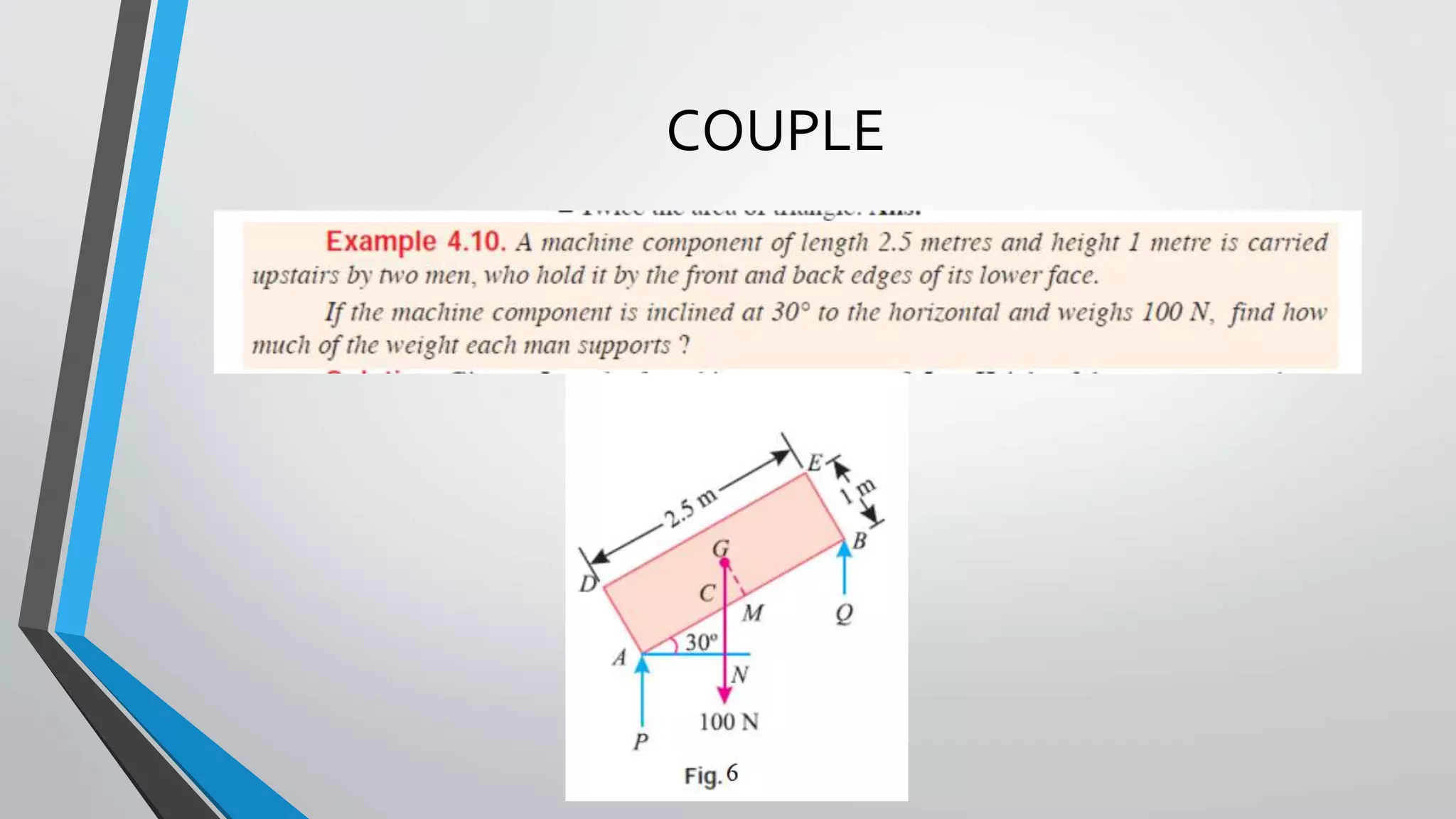
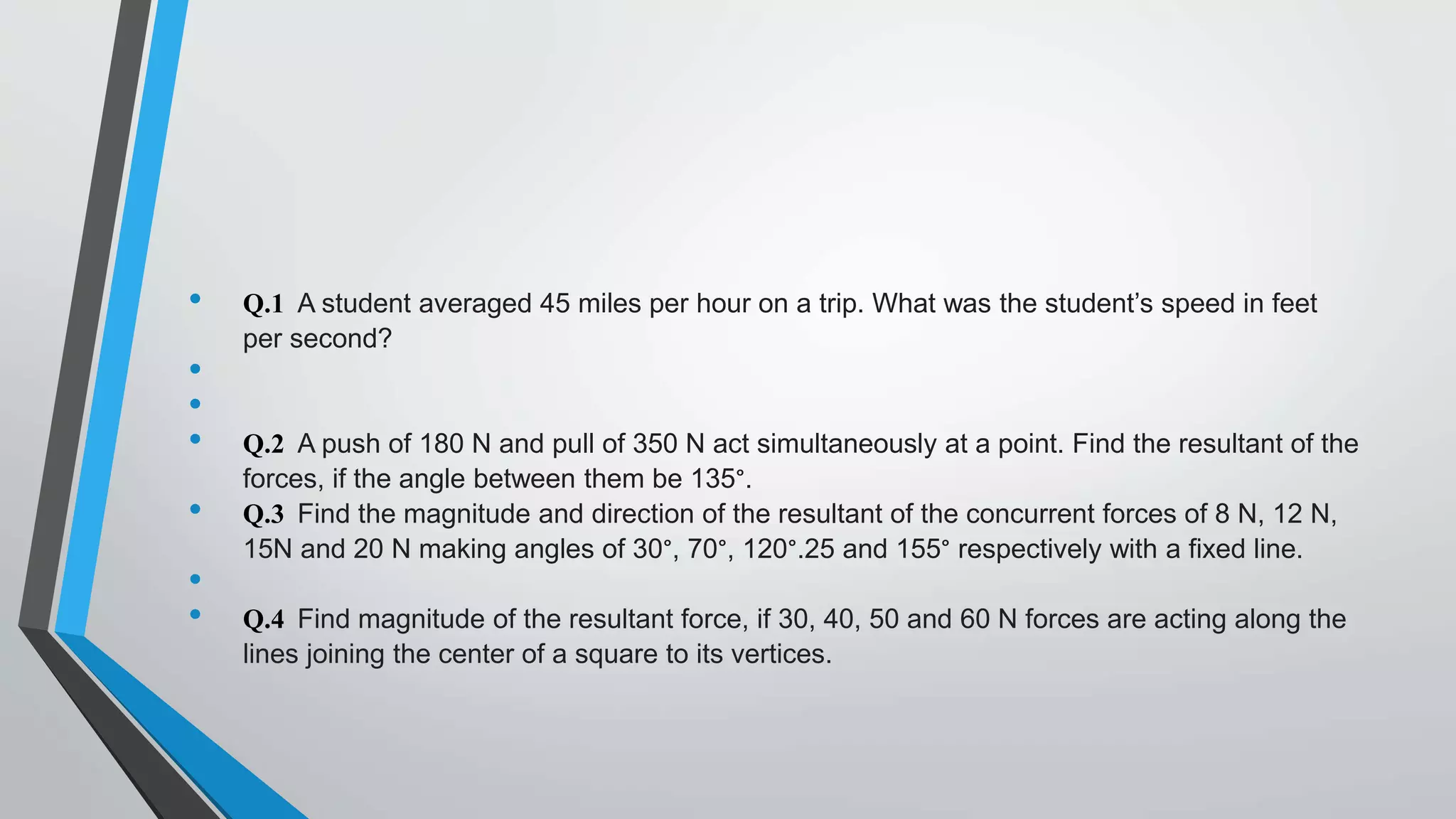
The document defines moment as the turning effect of a force about a point, and provides the mathematical formula for moment as M = P x l, where P is the force and l is the perpendicular distance to the point. It then explains Varignon's Principle of Moments, which states that the algebraic sum of moments of all forces about any point equals the moment of the resultant force about the same point. The document goes on to discuss parallel forces and couples, defining a couple as two equal and parallel forces acting in opposite directions, and provides examples of couples in real life. It compares torque and moment to a couple. Finally, it provides example problems calculating resultants and moments.





![Sec.3&4 newton's laws-of_motion[1]](https://cdn.slidesharecdn.com/ss_thumbnails/sec-34-newtonslawsofmotion1-111115150745-phpapp01-thumbnail.jpg?width=640&height=640&fit=bounds)


