BASICS IN
AUTOMOTIVE
ENGINEERING
Prepared By: Engrt Raheel Khan
Safety Protocols:
1. Safety glasses, or appropriate goggles/face shields are required in the lab, whether working or
not! All safety and personal protection equipment can be made available upon request from the
Lab Manager.
2. Shoes must be worn in any lab area. No one wearing sandals will be allowed to enter any lab
area. The minimum footwear must cover the entire foot.
3. Do not operate any item of test equipment unless you are familiar with its operation and have
been authorized by the Lab Manager to operate it. If you have any questions regarding the use
of any test equipment ALWAYS ask the Lab Manager.
4. Avoid using compressed air to blow dirt or chips from test equipment and tools. Never use
compressed air guns to clean clothing, or hair, or aim at another person.
5. In case of ANY injury, no matter how slight, you must report it to the Lab Manager
6. Do not attempt to remove foreign objects from the eye or body. If chemicals get in the eye(s),
wash eye(s) for 15 minutes in the provided eye wash station before proceeding for medical
treatment. Notify the Lab Manager immediately.
Safety Protocols:
7. Machines and test equipment must be shut off when cleaning, repairing, or oiling.
8. Do not wear ties, loose clothing, long sleeves, jewelry, gloves, etc. around moving or rotating
machinery, test equipment, and tools. Long hair must be tied back or covered to keep it away
from moving parts.
9. Hand protection in the form of suitable gloves should be used for handling hot objects, glass or
sharp-edged items.
10. Do not work in the lab if tired, or in a hurry. Do not rush or take chances.
11. Never indulge in horseplay in the lab areas.
12. All machines and test equipment must be operated with all required guards and shields in place.
13. Practice cleanliness and orderliness in the lab areas. Never leave a dirty piece of test equipment
and clean all tools before returning them to their storage location.
14. Keep the floor around machines and test equipment clean, dry and free from trip hazards.
15. Food and drinks are allowed in the automotive systems lab, but only in the general working
area or open lab space and well away from any chemicals or contaminants. No food or drinks
are allowed inside the lab.
Safety Protocols:
16.If you have not worked with a particular material or chemical before, check the hazardous
materials data sheets for any specific precautions to be taken while working with the material.
17.Heavy sanding and painting should only be done in well ventilated areas, preferably outside.
18.Follow all appropriate precautions when working with solvents, paints, adhesives or other
chemicals. Use appropriate personal protective equipment.
19.Check the power cords and plugs on portable tools before using them.
20.Always store oily rags in an approved metal container.
21.OBEY ALL POSTED SIGNS, WARNINGS, POSTERS AND SPECIAL INSTRUCTIONS.
22. OBEY ALL SAFETY RULES AT ALL TIMES.
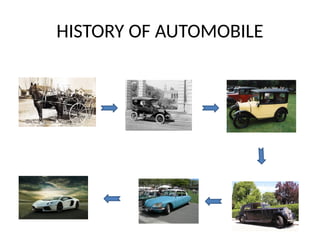
HISTORY OF AUTOMOBILE
SPARK PLUG
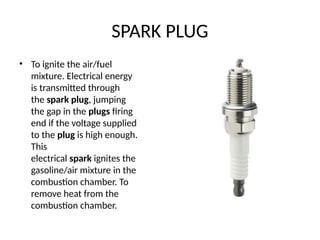
• To ignite the air/fuel
mixture. Electrical energy
is transmitted through
the spark plug, jumping
the gap in the plugs firing
end if the voltage supplied
to the plug is high enough.
This
electrical spark ignites the
gasoline/air mixture in the
combustion chamber. To
remove heat from the
combustion chamber.
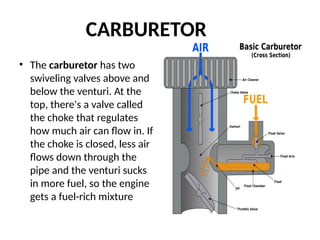
• The carburetor has two
swiveling valves above and
below the venturi. At the
top, there's a valve called
the choke that regulates
how much air can flow in. If
the choke is closed, less air
flows down through the
pipe and the venturi sucks
in more fuel, so the engine
gets a fuel-rich mixture
CARBURETOR
FUEL INJECTOR
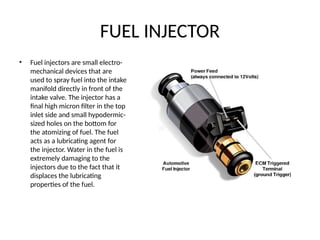
• Fuel injectors are small electro-
mechanical devices that are
used to spray fuel into the intake
manifold directly in front of the
intake valve. The injector has a
final high micron filter in the top
inlet side and small hypodermic-
sized holes on the bottom for
the atomizing of fuel. The fuel
acts as a lubricating agent for
the injector. Water in the fuel is
extremely damaging to the
injectors due to the fact that it
displaces the lubricating
properties of the fuel.
CLUTCH
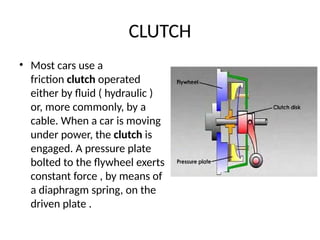
• Most cars use a
friction clutch operated
either by fluid ( hydraulic )
or, more commonly, by a
cable. When a car is moving
under power, the clutch is
engaged. A pressure plate
bolted to the flywheel exerts
constant force , by means of
a diaphragm spring, on the
driven plate .
FLYWHEEL
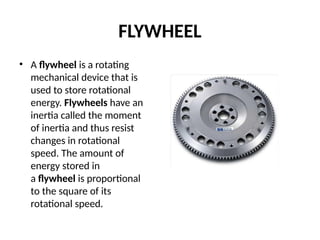
• A flywheel is a rotating
mechanical device that is
used to store rotational
energy. Flywheels have an
inertia called the moment
of inertia and thus resist
changes in rotational
speed. The amount of
energy stored in
a flywheel is proportional
to the square of its
rotational speed.
DIFFERENTIAL
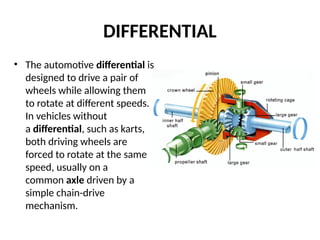
• The automotive differential is
designed to drive a pair of
wheels while allowing them
to rotate at different speeds.
In vehicles without
a differential, such as karts,
both driving wheels are
forced to rotate at the same
speed, usually on a
common axle driven by a
simple chain-drive
mechanism.
BRAKES
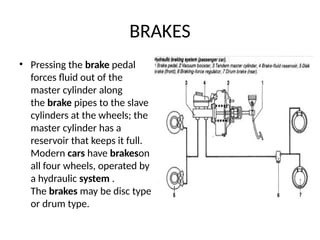
• Pressing the brake pedal
forces fluid out of the
master cylinder along
the brake pipes to the slave
cylinders at the wheels; the
master cylinder has a
reservoir that keeps it full.
Modern cars have brakeson
all four wheels, operated by
a hydraulic system .
The brakes may be disc type
or drum type.
TRANSMISSION
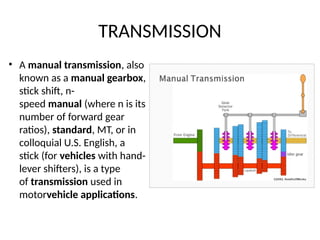
• A manual transmission, also
known as a manual gearbox,
stick shift, n-
speed manual (where n is its
number of forward gear
ratios), standard, MT, or in
colloquial U.S. English, a
stick (for vehicles with hand-
lever shifters), is a type
of transmission used in
motorvehicle applications.
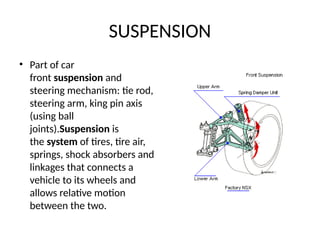
SUSPENSION
• Part of car
front suspension and
steering mechanism: tie rod,
steering arm, king pin axis
(using ball
joints).Suspension is
the system of tires, tire air,
springs, shock absorbers and
linkages that connects a
vehicle to its wheels and
allows relative motion
between the two.
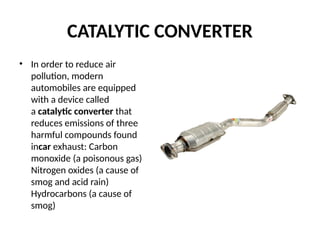
CATALYTIC CONVERTER
• In order to reduce air
pollution, modern
automobiles are equipped
with a device called
a catalytic converter that
reduces emissions of three
harmful compounds found
incar exhaust: Carbon
monoxide (a poisonous gas)
Nitrogen oxides (a cause of
smog and acid rain)
Hydrocarbons (a cause of
smog)
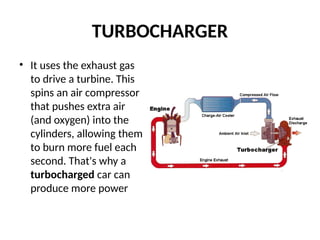
TURBOCHARGER
• It uses the exhaust gas
to drive a turbine. This
spins an air compressor
that pushes extra air
(and oxygen) into the
cylinders, allowing them
to burn more fuel each
second. That's why a
turbocharged car can
produce more power
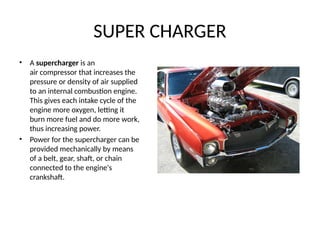
SUPER CHARGER
• A supercharger is an
air compressor that increases the
pressure or density of air supplied
to an internal combustion engine.
This gives each intake cycle of the
engine more oxygen, letting it
burn more fuel and do more work,
thus increasing power.
• Power for the supercharger can be
provided mechanically by means
of a belt, gear, shaft, or chain
connected to the engine's
crankshaft.
AERODYNAMICS OF A CAR
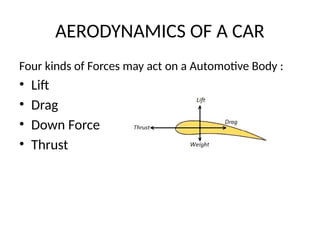
Four kinds of Forces may act on a Automotive Body :
• Lift
• Drag
• Down Force
• Thrust
LIFT
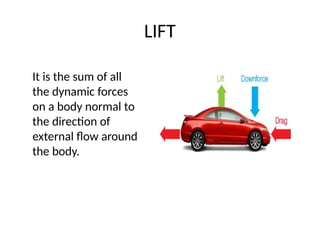
It is the sum of all
the dynamic forces
on a body normal to
the direction of
external flow around
the body.
DRAG
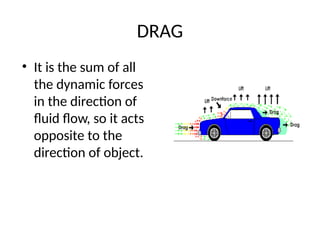
• It is the sum of all
the dynamic forces
in the direction of
fluid flow, so it acts
opposite to the
direction of object.
DOWNFORCE
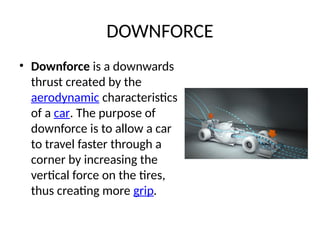
• Downforce is a downwards
thrust created by the
aerodynamic characteristics
of a car. The purpose of
downforce is to allow a car
to travel faster through a
corner by increasing the
vertical force on the tires,
thus creating more grip.
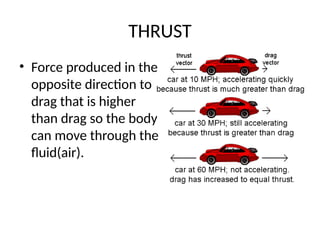
THRUST
• Force produced in the
opposite direction to
drag that is higher
than drag so the body
can move through the
fluid(air).

Introduction To Automotive Engineering.pptx

  • 1.
  • 2.
    Safety Protocols: 1. Safetyglasses, or appropriate goggles/face shields are required in the lab, whether working or not! All safety and personal protection equipment can be made available upon request from the Lab Manager. 2. Shoes must be worn in any lab area. No one wearing sandals will be allowed to enter any lab area. The minimum footwear must cover the entire foot. 3. Do not operate any item of test equipment unless you are familiar with its operation and have been authorized by the Lab Manager to operate it. If you have any questions regarding the use of any test equipment ALWAYS ask the Lab Manager. 4. Avoid using compressed air to blow dirt or chips from test equipment and tools. Never use compressed air guns to clean clothing, or hair, or aim at another person. 5. In case of ANY injury, no matter how slight, you must report it to the Lab Manager 6. Do not attempt to remove foreign objects from the eye or body. If chemicals get in the eye(s), wash eye(s) for 15 minutes in the provided eye wash station before proceeding for medical treatment. Notify the Lab Manager immediately.
  • 3.
    Safety Protocols: 7. Machinesand test equipment must be shut off when cleaning, repairing, or oiling. 8. Do not wear ties, loose clothing, long sleeves, jewelry, gloves, etc. around moving or rotating machinery, test equipment, and tools. Long hair must be tied back or covered to keep it away from moving parts. 9. Hand protection in the form of suitable gloves should be used for handling hot objects, glass or sharp-edged items. 10. Do not work in the lab if tired, or in a hurry. Do not rush or take chances. 11. Never indulge in horseplay in the lab areas. 12. All machines and test equipment must be operated with all required guards and shields in place. 13. Practice cleanliness and orderliness in the lab areas. Never leave a dirty piece of test equipment and clean all tools before returning them to their storage location. 14. Keep the floor around machines and test equipment clean, dry and free from trip hazards. 15. Food and drinks are allowed in the automotive systems lab, but only in the general working area or open lab space and well away from any chemicals or contaminants. No food or drinks are allowed inside the lab.
  • 4.
    Safety Protocols: 16.If youhave not worked with a particular material or chemical before, check the hazardous materials data sheets for any specific precautions to be taken while working with the material. 17.Heavy sanding and painting should only be done in well ventilated areas, preferably outside. 18.Follow all appropriate precautions when working with solvents, paints, adhesives or other chemicals. Use appropriate personal protective equipment. 19.Check the power cords and plugs on portable tools before using them. 20.Always store oily rags in an approved metal container. 21.OBEY ALL POSTED SIGNS, WARNINGS, POSTERS AND SPECIAL INSTRUCTIONS. 22. OBEY ALL SAFETY RULES AT ALL TIMES.
  • 5.
  • 10.
    SPARK PLUG • Toignite the air/fuel mixture. Electrical energy is transmitted through the spark plug, jumping the gap in the plugs firing end if the voltage supplied to the plug is high enough. This electrical spark ignites the gasoline/air mixture in the combustion chamber. To remove heat from the combustion chamber.
  • 11.
    • The carburetorhas two swiveling valves above and below the venturi. At the top, there's a valve called the choke that regulates how much air can flow in. If the choke is closed, less air flows down through the pipe and the venturi sucks in more fuel, so the engine gets a fuel-rich mixture CARBURETOR
  • 12.
    FUEL INJECTOR • Fuelinjectors are small electro- mechanical devices that are used to spray fuel into the intake manifold directly in front of the intake valve. The injector has a final high micron filter in the top inlet side and small hypodermic- sized holes on the bottom for the atomizing of fuel. The fuel acts as a lubricating agent for the injector. Water in the fuel is extremely damaging to the injectors due to the fact that it displaces the lubricating properties of the fuel.
  • 13.
    CLUTCH • Most carsuse a friction clutch operated either by fluid ( hydraulic ) or, more commonly, by a cable. When a car is moving under power, the clutch is engaged. A pressure plate bolted to the flywheel exerts constant force , by means of a diaphragm spring, on the driven plate .
  • 14.
    FLYWHEEL • A flywheelis a rotating mechanical device that is used to store rotational energy. Flywheels have an inertia called the moment of inertia and thus resist changes in rotational speed. The amount of energy stored in a flywheel is proportional to the square of its rotational speed.
  • 15.
    DIFFERENTIAL • The automotivedifferential is designed to drive a pair of wheels while allowing them to rotate at different speeds. In vehicles without a differential, such as karts, both driving wheels are forced to rotate at the same speed, usually on a common axle driven by a simple chain-drive mechanism.
  • 16.
    BRAKES • Pressing thebrake pedal forces fluid out of the master cylinder along the brake pipes to the slave cylinders at the wheels; the master cylinder has a reservoir that keeps it full. Modern cars have brakeson all four wheels, operated by a hydraulic system . The brakes may be disc type or drum type.
  • 17.
    TRANSMISSION • A manualtransmission, also known as a manual gearbox, stick shift, n- speed manual (where n is its number of forward gear ratios), standard, MT, or in colloquial U.S. English, a stick (for vehicles with hand- lever shifters), is a type of transmission used in motorvehicle applications.
  • 18.
    SUSPENSION • Part ofcar front suspension and steering mechanism: tie rod, steering arm, king pin axis (using ball joints).Suspension is the system of tires, tire air, springs, shock absorbers and linkages that connects a vehicle to its wheels and allows relative motion between the two.
  • 19.
    CATALYTIC CONVERTER • Inorder to reduce air pollution, modern automobiles are equipped with a device called a catalytic converter that reduces emissions of three harmful compounds found incar exhaust: Carbon monoxide (a poisonous gas) Nitrogen oxides (a cause of smog and acid rain) Hydrocarbons (a cause of smog)
  • 20.
    TURBOCHARGER • It usesthe exhaust gas to drive a turbine. This spins an air compressor that pushes extra air (and oxygen) into the cylinders, allowing them to burn more fuel each second. That's why a turbocharged car can produce more power
  • 21.
    SUPER CHARGER • Asupercharger is an air compressor that increases the pressure or density of air supplied to an internal combustion engine. This gives each intake cycle of the engine more oxygen, letting it burn more fuel and do more work, thus increasing power. • Power for the supercharger can be provided mechanically by means of a belt, gear, shaft, or chain connected to the engine's crankshaft.
  • 22.
    AERODYNAMICS OF ACAR Four kinds of Forces may act on a Automotive Body : • Lift • Drag • Down Force • Thrust
  • 23.
    LIFT It is thesum of all the dynamic forces on a body normal to the direction of external flow around the body.
  • 24.
    DRAG • It isthe sum of all the dynamic forces in the direction of fluid flow, so it acts opposite to the direction of object.
  • 25.
    DOWNFORCE • Downforce isa downwards thrust created by the aerodynamic characteristics of a car. The purpose of downforce is to allow a car to travel faster through a corner by increasing the vertical force on the tires, thus creating more grip.
  • 26.
    THRUST • Force producedin the opposite direction to drag that is higher than drag so the body can move through the fluid(air).