ARZOO SOROUT
Assistant Professor (CSE)
Advanced Educational Institutionswww.advanced.edu.in
INTODUCTION
TO
TOPOLOGIES
Objectives
 Describe the basic and hybrid LAN physical
topologies, and their uses, advantages and
disadvantages
 Describe the backbone structures that form the
foundation for most LANs
www.advanced.edu.in
Topology
 The physical topology of a network refers to the
configuration of cables, computers and other
peripherals.
 The main types of network topologies are:
– Linear Bus
– Star
– Ring
– Tree or Hybrid
www.advanced.edu.in
Bus topology
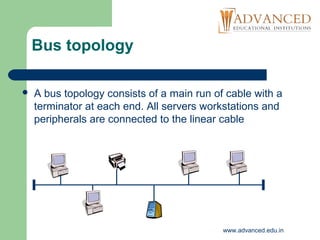
 A bus topology consists of a main run of cable with a
terminator at each end. All servers workstations and
peripherals are connected to the linear cable
www.advanced.edu.in
Advantages of Bus Topology
 Works well for small networks
 Relatively inexpensive to implement
 Easy to add to it
www.advanced.edu.in
Disadvantages of Bus Topology
 Management costs can be high
 Potential for congestion with network traffic
www.advanced.edu.in
Star topology
 A star network is
designed with each
node (file server,
workstation,
peripheral) connected
directly to a central
network hub or server
www.advanced.edu.in
Advantages Star topology
 Good option for modern networks
 Low startup costs
 Easy to manage
 Offers opportunities for expansion
 Most popular topology in use; wide variety of
equipment available
www.advanced.edu.in
Disadvantages of Star topology
 Hub is a single point of failure
 Requires more cable than the bus
www.advanced.edu.in
Ring topology
 A ring network is one
where all workstations
and other devices are
connected in a
continuous loop. There
is no central server
www.advanced.edu.in
Advantages of Ring Topology
 Easier to manage; easier to locate a defective
node or cable problem
 Well-suited for transmitting signals over long
distances on a LAN
 Handles high-volume network traffic
 Enables reliable communication
www.advanced.edu.in
Disadvantages of Ring Topology
 Expensive
 Requires more cable and network
equipment at the start
 Not used as widely as bus topology
– Fewer equipment options
– Fewer options for expansion to high-speed
communication
www.advanced.edu.in
Tree or hybrid topology
 A tree or hybrid
topology combines
characteristics of linear
bus and star and/or
ring topologies.
 It consists of groups of
star-configured
workstations connected
to a linear bus
backbone cable
www.advanced.edu.in
www.advanced.edu.in
Network Operating Software
 Network operating systems co-
ordinate the activities of
multiple computers across a
network
 The two major types of
network OS are:
– Peer-to-peer
– Client/server
www.advanced.edu.in
Peer to peer network OS
– In peer to peer network OS, there is no
file server or central management source;
all computers are considered equal
– Peer to peer networks are design
primarily for small to medium LANS
– AppleShare and Windows for
Workgroups are examples of programs
that can function as peer to peer
www.advanced.edu.in
Client/Server network OS
– Client/server network OS
centralise functions and
applications in one or more
dedicated file servers.
– The file server provides access to
resources and provides security
– Novel Netware and Windows NT
Server are examples of
client/server network operating
systems
www.advanced.edu.in
www.advanced.edu.in
Arzoo Sorout
Assistant Professor( CSE)
Advanced Educational Institutions,
70 km Milestone,
Delhi-Mathura Road, Dist. Palwal,
Haryana-121105
+91–1275–398400, 302222
Email:- arzoo.sorout30@gmail.com
website:- www.advance.edu.in

Topologies

  • 1.
    ARZOO SOROUT Assistant Professor(CSE) Advanced Educational Institutionswww.advanced.edu.in INTODUCTION TO TOPOLOGIES
  • 2.
    Objectives  Describe thebasic and hybrid LAN physical topologies, and their uses, advantages and disadvantages  Describe the backbone structures that form the foundation for most LANs www.advanced.edu.in
  • 3.
    Topology  The physicaltopology of a network refers to the configuration of cables, computers and other peripherals.  The main types of network topologies are: – Linear Bus – Star – Ring – Tree or Hybrid www.advanced.edu.in
  • 4.
    Bus topology  Abus topology consists of a main run of cable with a terminator at each end. All servers workstations and peripherals are connected to the linear cable www.advanced.edu.in
  • 5.
    Advantages of BusTopology  Works well for small networks  Relatively inexpensive to implement  Easy to add to it www.advanced.edu.in
  • 6.
    Disadvantages of BusTopology  Management costs can be high  Potential for congestion with network traffic www.advanced.edu.in
  • 7.
    Star topology  Astar network is designed with each node (file server, workstation, peripheral) connected directly to a central network hub or server www.advanced.edu.in
  • 8.
    Advantages Star topology Good option for modern networks  Low startup costs  Easy to manage  Offers opportunities for expansion  Most popular topology in use; wide variety of equipment available www.advanced.edu.in
  • 9.
    Disadvantages of Startopology  Hub is a single point of failure  Requires more cable than the bus www.advanced.edu.in
  • 10.
    Ring topology  Aring network is one where all workstations and other devices are connected in a continuous loop. There is no central server www.advanced.edu.in
  • 11.
    Advantages of RingTopology  Easier to manage; easier to locate a defective node or cable problem  Well-suited for transmitting signals over long distances on a LAN  Handles high-volume network traffic  Enables reliable communication www.advanced.edu.in
  • 12.
    Disadvantages of RingTopology  Expensive  Requires more cable and network equipment at the start  Not used as widely as bus topology – Fewer equipment options – Fewer options for expansion to high-speed communication www.advanced.edu.in
  • 13.
    Tree or hybridtopology  A tree or hybrid topology combines characteristics of linear bus and star and/or ring topologies.  It consists of groups of star-configured workstations connected to a linear bus backbone cable www.advanced.edu.in
  • 14.
  • 15.
    Network Operating Software Network operating systems co- ordinate the activities of multiple computers across a network  The two major types of network OS are: – Peer-to-peer – Client/server www.advanced.edu.in
  • 16.
    Peer to peernetwork OS – In peer to peer network OS, there is no file server or central management source; all computers are considered equal – Peer to peer networks are design primarily for small to medium LANS – AppleShare and Windows for Workgroups are examples of programs that can function as peer to peer www.advanced.edu.in
  • 17.
    Client/Server network OS –Client/server network OS centralise functions and applications in one or more dedicated file servers. – The file server provides access to resources and provides security – Novel Netware and Windows NT Server are examples of client/server network operating systems www.advanced.edu.in
  • 18.
    www.advanced.edu.in Arzoo Sorout Assistant Professor(CSE) Advanced Educational Institutions, 70 km Milestone, Delhi-Mathura Road, Dist. Palwal, Haryana-121105 +91–1275–398400, 302222 Email:- arzoo.sorout30@gmail.com website:- www.advance.edu.in