Introduction to Network
Topologies
Reg No ~ 2018PS26
What is Network Topology?
Types Of Topologies
Advantages and Disadvantages Of
Topologies
Table of content
What is Network Topology?
Network topology refers to the physical or logical
arrangement of devices, nodes, and links in a
computer network.
It determines how devices are connected to each
other and how data flows between them.
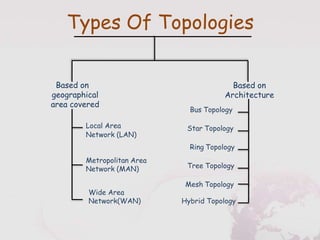
Types Of Topologies
Based on
geographical
area covered
Based on
Architecture
Local Area
Network (LAN)
Metropolitan Area
Network (MAN)
Wide Area
Network(WAN)
Bus Topology
Star Topology
Ring Topology
Tree Topology
Mesh Topology
Hybrid Topology
Types Of Topology
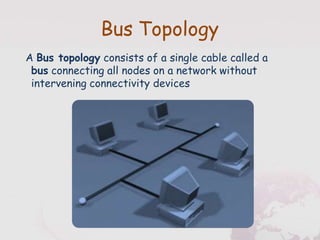
Bus Topology
A Bus topology consists of a single cable called a
bus connecting all nodes on a network without
intervening connectivity devices
Advantages of Bus Topology
Works well for small networks.
Relatively inexpensive to implement.
Easy to expand joining two cables together.
Disadvantages of
Bus Topology
Management costs can be high
Cables fails then whole network fails.
Cables has a limited length.
Coaxial
cable
Network Card
Star Topology
A star network is designed with each node (file server,
workstation, peripheral) connected directly to a central
network hub or server.
Advantages of Star Topology
Good option for modern
networks
Low startup costs
Easy to manage
Offers opportunities for
expansion
Most popular topology in use
wide variety of equipment
available
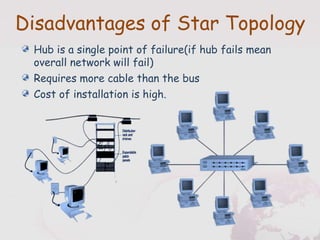
Disadvantages of Star Topology
Hub is a single point of failure(if hub fails mean
overall network will fail)
Requires more cable than the bus
Cost of installation is high.
Ring topology
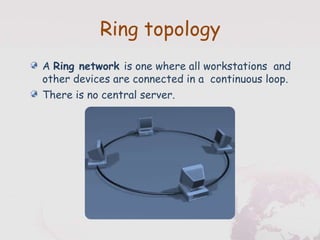
A Ring network is one where all workstations and
other devices are connected in a continuous loop.
There is no central server.
Advantages of Ring Topology
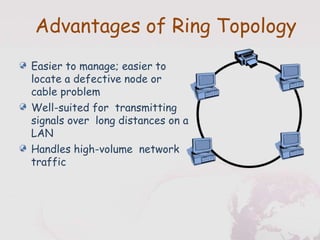
Easier to manage; easier to
locate a defective node or
cable problem
Well-suited for transmitting
signals over long distances on a
LAN
Handles high-volume network
traffic
Disadvantages of Ring Topology
Expensive
Requires more cable and network equipment at the
start
Not used a widely as bus topology
Tree topology
It has a root node and all other nodes are connected
to it forming a hierarchy.
It is also called Hierarchical Topology.
Advantages Of Tree Topology
Extension of Bus and Star Topology.
Expansion of nodes is possible and easy.
Easily managed and maintained.
Disadvantages Of Tree Topology
Heavily cabled.
Costly.
If more nodes are added maintenance is
difficult.
Central hub fails, network fails.
Mesh Topology
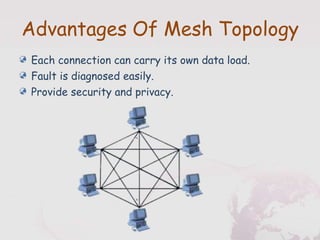
It is a point-to-point connection to other nodes or
devices.
Traffic is carried only between two devices or nodes
to which it is connected.
Advantages Of Mesh Topology
Each connection can carry its own data load.
Fault is diagnosed easily.
Provide security and privacy.
Disadvantage of mesh topology
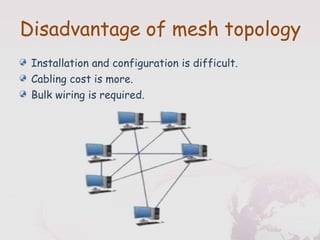
Installation and configuration is difficult.
Cabling cost is more.
Bulk wiring is required.
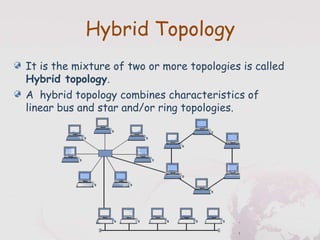
Hybrid Topology
It is the mixture of two or more topologies is called
Hybrid topology.
A hybrid topology combines characteristics of
linear bus and star and/or ring topologies.
Advantages of hybrid topology
Reliable as error detecting and trouble shooting is easy.
Effective.
Scalable as size can be increased easily.
Flexible.
Disadvantages Of
Hybrid Topology
Complex in design.
Costly.
Prepared by : S . Joel

Network Topology.pptx

  • 1.
  • 2.
    What is NetworkTopology? Types Of Topologies Advantages and Disadvantages Of Topologies Table of content
  • 3.
    What is NetworkTopology? Network topology refers to the physical or logical arrangement of devices, nodes, and links in a computer network. It determines how devices are connected to each other and how data flows between them.
  • 4.
    Types Of Topologies Basedon geographical area covered Based on Architecture Local Area Network (LAN) Metropolitan Area Network (MAN) Wide Area Network(WAN) Bus Topology Star Topology Ring Topology Tree Topology Mesh Topology Hybrid Topology
  • 5.
  • 6.
    Bus Topology A Bustopology consists of a single cable called a bus connecting all nodes on a network without intervening connectivity devices
  • 7.
    Advantages of BusTopology Works well for small networks. Relatively inexpensive to implement. Easy to expand joining two cables together.
  • 8.
    Disadvantages of Bus Topology Managementcosts can be high Cables fails then whole network fails. Cables has a limited length. Coaxial cable Network Card
  • 9.
    Star Topology A starnetwork is designed with each node (file server, workstation, peripheral) connected directly to a central network hub or server.
  • 10.
    Advantages of StarTopology Good option for modern networks Low startup costs Easy to manage Offers opportunities for expansion Most popular topology in use wide variety of equipment available
  • 11.
    Disadvantages of StarTopology Hub is a single point of failure(if hub fails mean overall network will fail) Requires more cable than the bus Cost of installation is high.
  • 12.
    Ring topology A Ringnetwork is one where all workstations and other devices are connected in a continuous loop. There is no central server.
  • 13.
    Advantages of RingTopology Easier to manage; easier to locate a defective node or cable problem Well-suited for transmitting signals over long distances on a LAN Handles high-volume network traffic
  • 14.
    Disadvantages of RingTopology Expensive Requires more cable and network equipment at the start Not used a widely as bus topology
  • 15.
    Tree topology It hasa root node and all other nodes are connected to it forming a hierarchy. It is also called Hierarchical Topology.
  • 16.
    Advantages Of TreeTopology Extension of Bus and Star Topology. Expansion of nodes is possible and easy. Easily managed and maintained.
  • 17.
    Disadvantages Of TreeTopology Heavily cabled. Costly. If more nodes are added maintenance is difficult. Central hub fails, network fails.
  • 18.
    Mesh Topology It isa point-to-point connection to other nodes or devices. Traffic is carried only between two devices or nodes to which it is connected.
  • 19.
    Advantages Of MeshTopology Each connection can carry its own data load. Fault is diagnosed easily. Provide security and privacy.
  • 20.
    Disadvantage of meshtopology Installation and configuration is difficult. Cabling cost is more. Bulk wiring is required.
  • 21.
    Hybrid Topology It isthe mixture of two or more topologies is called Hybrid topology. A hybrid topology combines characteristics of linear bus and star and/or ring topologies.
  • 22.
    Advantages of hybridtopology Reliable as error detecting and trouble shooting is easy. Effective. Scalable as size can be increased easily. Flexible.
  • 23.
  • 24.
    Prepared by :S . Joel