Miss Rajdeo Archana Vitthal
M.Pharm
Lecturer
PRES’S Institute of Pharmacy Loni
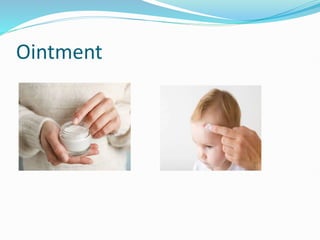
TOPICALPREPARATIONS
Topical Preparations
 ointments, creams, pastes, gels,
 liniments and lotions, suppositories, and pessaries
Ointment
Ointments
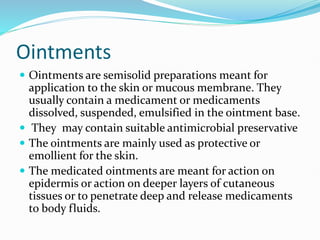
 Ointments are semisolid preparations meant for
application to the skin or mucous membrane. They
usually contain a medicament or medicaments
dissolved, suspended, emulsified in the ointment base.
 They may contain suitable antimicrobial preservative
 The ointments are mainly used as protective or
emollient for the skin.
 The medicated ointments are meant for action on
epidermis or action on deeper layers of cutaneous
tissues or to penetrate deep and release medicaments
to body fluids.
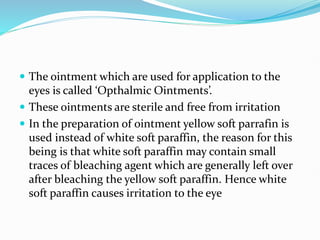
 The ointment which are used for application to the
eyes is called ‘Opthalmic Ointments’.
 These ointments are sterile and free from irritation
 In the preparation of ointment yellow soft parrafin is
used instead of white soft paraffin, the reason for this
being is that white soft paraffin may contain small
traces of bleaching agent which are generally left over
after bleaching the yellow soft paraffin. Hence white
soft paraffin causes irritation to the eye
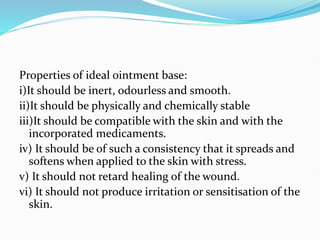
Properties of ideal ointment base:
i)It should be inert, odourless and smooth.
ii)It should be physically and chemically stable
iii)It should be compatible with the skin and with the
incorporated medicaments.
iv) It should be of such a consistency that it spreads and
softens when applied to the skin with stress.
v) It should not retard healing of the wound.
vi) It should not produce irritation or sensitisation of the
skin.
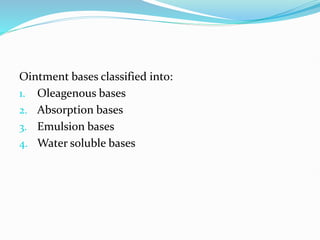
Ointment bases classified into:
1. Oleagenous bases
2. Absorption bases
3. Emulsion bases
4. Water soluble bases
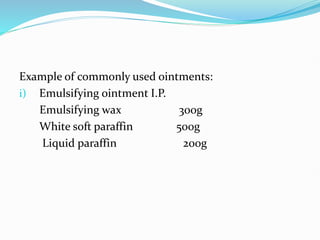
Example of commonly used ointments:
i) Emulsifying ointment I.P.
Emulsifying wax 300g
White soft paraffin 500g
Liquid paraffin 200g
Creams
 These are viscous semisolid emulsions which are
meant for external use
 Creams are of two types: i) Aqueous creams
ii)oily creams
i)In case of Aqueous creams the emulsion is of o/w type,
it is non greasy
ii)In case of oily creams emulsion is w/o type
Creams
 Emulsifying agents used in aqueous creams are anionic
cationic and non-ionic waxes, polysorbates and
triethanolamine soaps
 Emulsifying agents used in oily creams are wool fat,
wool alcohols, beeswax and calcium soaps.
 A suitable preservative is generally added in aqueous
creams which have the tendency to bacterial and
fungal growth.
 Storage of creams: should be stored in well-closed
containers which prevent evaporation and
contamination.
 Example of cream
1. Hydrocortisone cream B.P.C.
2. Neomycin cream B.P.C.
Pastes
Pastes
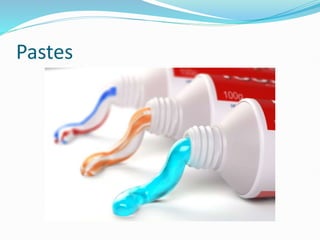
 Pastes are semisolid preparations intended for external
application to the skin.
 They differ from ointment as they contain a high
proportion of finely powdered medicaments, such as zinc
oxide, calcium carbonate, starch etc.
 These substances makes the cream very thick and stiff
 Pastes are less greasy than ointments
 The stiffness property of pastes makes them useful as
protective coating.
 Use- as antiseptic, protective or soothing dressings which
are often spread on lint before being applied
 Storage of pastes: should be stored and supplied in
containers made of materials which do not allow
absorption or diffusion of the contents.
Gels
Gels
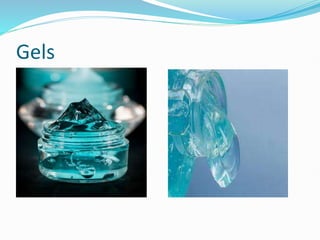
 Gels are transparent or translucent, non –greasy,
semisolid preparations mainly used for external
application to the skin.
 These are also used for lubricating catheters, surgical
gloves, and rectal thermometers.
 The substances like gelatin, starch, tragacanth, sodium
alginate and cellulose derivatives are used in
preparations of gellies.
Liniments
Liniments
 Liniments are liquid and semi-liquid preparations
meant for application to the skin.
 Liniments are generally applied to the skin with
friction and rubbing of the skin.
 The liniments may be alcoholic or oily solutions or
emulsion.
 Alcohol helps in the penetration of medicament into
the skin and also increases its counterirritant or
rubefacient action.
 Arachis oil is used in some liniments which spread
more easily on the skin.
 Soap is also included as ingredients in some of the
liniments which helps in easy application of liniment
on the skin.
 Generally liniments contain medicaments possessing
analgesic, rubefacient, soothing and counter-irritant
or stimulating properties.
 Liniments should not be applied to broken skin it
causes excessive irritation
 Examples of Liniments
Camphor Liniment
Camphor 200g
Arachis oil 800g
 Turpentine Liniment
Soft soap 90g
Camphor 50g
Turpentine oil 650ml
Purified water, sufficient to produce 1000ml
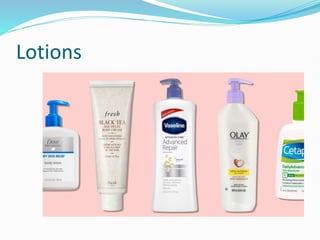
Lotions
Lotions
 Lotions are liquid preparations meant for external
application without friction.
 They are applied direct to the skin with the help of
some absorbent material, such as cotton wool or gauze
soaked in it.
 Lotions may be used for local action as cooling,
soothing or protective purposes.
 They are generally prescribed for antiseptic action e.g.
Calamine lotion
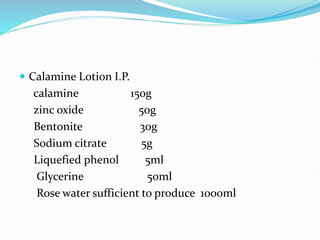
 Calamine Lotion I.P.
calamine 150g
zinc oxide 50g
Bentonite 30g
Sodium citrate 5g
Liquefied phenol 5ml
Glycerine 50ml
Rose water sufficient to produce 1000ml
Suppositories
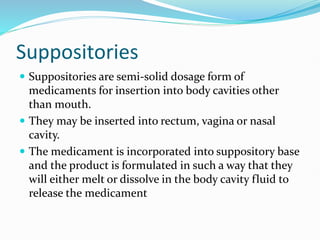
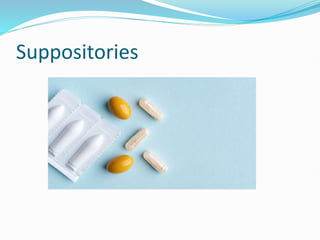
 Suppositories are semi-solid dosage form of
medicaments for insertion into body cavities other
than mouth.
 They may be inserted into rectum, vagina or nasal
cavity.
 The medicament is incorporated into suppository base
and the product is formulated in such a way that they
will either melt or dissolve in the body cavity fluid to
release the medicament
Suppositories
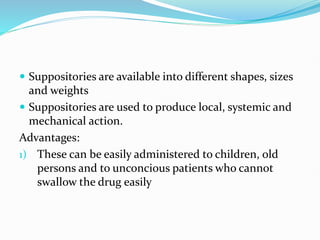
 Suppositories are available into different shapes, sizes
and weights
 Suppositories are used to produce local, systemic and
mechanical action.
Advantages:
1) These can be easily administered to children, old
persons and to unconcious patients who cannot
swallow the drug easily
2) These are inserted into body cavity to produce local
effect of medicament
3)These are inserted into rectum to exert a direct and
rapid action on the rectum
4) These are inserted into rectum to cause evacuation of
bowel
5)Suppositories are unit dosage form of drugs
6) These are convenient mode of administration of srugs
which irritate GIT, causes vomiting and destroyed in
the acidic Ph of the gastric juice of stomach.
 Disadvantages:
i) The irritant drugs cant be administered by this
route.
ii) The suppositories are required to be stored at low
temperature (10˚ to 20˚C)
iii) Suppositories cannot be prepared easily.
Types of suppositories
1. Rectal suppositories
2. Vaginal suppositories
3. Nasal Suppositories
4. Urethral suppositories
5. Ear cones
Pessaries
Pessaries
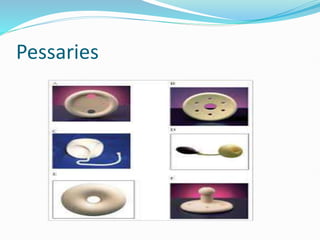
 Pessaries are meant for introduction into the vagina.
They are larger than rectal suppository and vary in
weight from 4 to 8 grams or more.
 Pessaries may be conical, wedge shaped or rod shaped
 Nowadays special shaped suppositories are
manufactured and are supplied with applicators to
facilitate insertion into vagina.
 The pessaries are also availabe as tablets and capsules
and are known as vaginal tablets and capsules
respectively.
 Example : lactic acid pessaries B.P.C.
2
21
35

Topical Preparations (1) (1).pptx pharmaceutics

  • 1.
    Miss Rajdeo ArchanaVitthal M.Pharm Lecturer PRES’S Institute of Pharmacy Loni TOPICALPREPARATIONS
  • 2.
    Topical Preparations  ointments,creams, pastes, gels,  liniments and lotions, suppositories, and pessaries
  • 3.
  • 4.
    Ointments  Ointments aresemisolid preparations meant for application to the skin or mucous membrane. They usually contain a medicament or medicaments dissolved, suspended, emulsified in the ointment base.  They may contain suitable antimicrobial preservative  The ointments are mainly used as protective or emollient for the skin.  The medicated ointments are meant for action on epidermis or action on deeper layers of cutaneous tissues or to penetrate deep and release medicaments to body fluids.
  • 5.
     The ointmentwhich are used for application to the eyes is called ‘Opthalmic Ointments’.  These ointments are sterile and free from irritation  In the preparation of ointment yellow soft parrafin is used instead of white soft paraffin, the reason for this being is that white soft paraffin may contain small traces of bleaching agent which are generally left over after bleaching the yellow soft paraffin. Hence white soft paraffin causes irritation to the eye
  • 6.
    Properties of idealointment base: i)It should be inert, odourless and smooth. ii)It should be physically and chemically stable iii)It should be compatible with the skin and with the incorporated medicaments. iv) It should be of such a consistency that it spreads and softens when applied to the skin with stress. v) It should not retard healing of the wound. vi) It should not produce irritation or sensitisation of the skin.
  • 7.
    Ointment bases classifiedinto: 1. Oleagenous bases 2. Absorption bases 3. Emulsion bases 4. Water soluble bases
  • 8.
    Example of commonlyused ointments: i) Emulsifying ointment I.P. Emulsifying wax 300g White soft paraffin 500g Liquid paraffin 200g
  • 9.
    Creams  These areviscous semisolid emulsions which are meant for external use  Creams are of two types: i) Aqueous creams ii)oily creams i)In case of Aqueous creams the emulsion is of o/w type, it is non greasy ii)In case of oily creams emulsion is w/o type
  • 10.
  • 11.
     Emulsifying agentsused in aqueous creams are anionic cationic and non-ionic waxes, polysorbates and triethanolamine soaps  Emulsifying agents used in oily creams are wool fat, wool alcohols, beeswax and calcium soaps.  A suitable preservative is generally added in aqueous creams which have the tendency to bacterial and fungal growth.
  • 12.
     Storage ofcreams: should be stored in well-closed containers which prevent evaporation and contamination.  Example of cream 1. Hydrocortisone cream B.P.C. 2. Neomycin cream B.P.C.
  • 13.
  • 14.
    Pastes  Pastes aresemisolid preparations intended for external application to the skin.  They differ from ointment as they contain a high proportion of finely powdered medicaments, such as zinc oxide, calcium carbonate, starch etc.  These substances makes the cream very thick and stiff  Pastes are less greasy than ointments  The stiffness property of pastes makes them useful as protective coating.  Use- as antiseptic, protective or soothing dressings which are often spread on lint before being applied
  • 15.
     Storage ofpastes: should be stored and supplied in containers made of materials which do not allow absorption or diffusion of the contents.
  • 16.
  • 17.
    Gels  Gels aretransparent or translucent, non –greasy, semisolid preparations mainly used for external application to the skin.  These are also used for lubricating catheters, surgical gloves, and rectal thermometers.  The substances like gelatin, starch, tragacanth, sodium alginate and cellulose derivatives are used in preparations of gellies.
  • 18.
  • 19.
    Liniments  Liniments areliquid and semi-liquid preparations meant for application to the skin.  Liniments are generally applied to the skin with friction and rubbing of the skin.  The liniments may be alcoholic or oily solutions or emulsion.  Alcohol helps in the penetration of medicament into the skin and also increases its counterirritant or rubefacient action.
  • 20.
     Arachis oilis used in some liniments which spread more easily on the skin.  Soap is also included as ingredients in some of the liniments which helps in easy application of liniment on the skin.  Generally liniments contain medicaments possessing analgesic, rubefacient, soothing and counter-irritant or stimulating properties.
  • 21.
     Liniments shouldnot be applied to broken skin it causes excessive irritation  Examples of Liniments Camphor Liniment Camphor 200g Arachis oil 800g
  • 22.
     Turpentine Liniment Softsoap 90g Camphor 50g Turpentine oil 650ml Purified water, sufficient to produce 1000ml
  • 23.
  • 24.
    Lotions  Lotions areliquid preparations meant for external application without friction.  They are applied direct to the skin with the help of some absorbent material, such as cotton wool or gauze soaked in it.  Lotions may be used for local action as cooling, soothing or protective purposes.  They are generally prescribed for antiseptic action e.g. Calamine lotion
  • 25.
     Calamine LotionI.P. calamine 150g zinc oxide 50g Bentonite 30g Sodium citrate 5g Liquefied phenol 5ml Glycerine 50ml Rose water sufficient to produce 1000ml
  • 26.
    Suppositories  Suppositories aresemi-solid dosage form of medicaments for insertion into body cavities other than mouth.  They may be inserted into rectum, vagina or nasal cavity.  The medicament is incorporated into suppository base and the product is formulated in such a way that they will either melt or dissolve in the body cavity fluid to release the medicament
  • 27.
  • 28.
     Suppositories areavailable into different shapes, sizes and weights  Suppositories are used to produce local, systemic and mechanical action. Advantages: 1) These can be easily administered to children, old persons and to unconcious patients who cannot swallow the drug easily
  • 29.
    2) These areinserted into body cavity to produce local effect of medicament 3)These are inserted into rectum to exert a direct and rapid action on the rectum 4) These are inserted into rectum to cause evacuation of bowel 5)Suppositories are unit dosage form of drugs 6) These are convenient mode of administration of srugs which irritate GIT, causes vomiting and destroyed in the acidic Ph of the gastric juice of stomach.
  • 30.
     Disadvantages: i) Theirritant drugs cant be administered by this route. ii) The suppositories are required to be stored at low temperature (10˚ to 20˚C) iii) Suppositories cannot be prepared easily.
  • 31.
    Types of suppositories 1.Rectal suppositories 2. Vaginal suppositories 3. Nasal Suppositories 4. Urethral suppositories 5. Ear cones
  • 32.
  • 33.
    Pessaries  Pessaries aremeant for introduction into the vagina. They are larger than rectal suppository and vary in weight from 4 to 8 grams or more.  Pessaries may be conical, wedge shaped or rod shaped  Nowadays special shaped suppositories are manufactured and are supplied with applicators to facilitate insertion into vagina.
  • 34.
     The pessariesare also availabe as tablets and capsules and are known as vaginal tablets and capsules respectively.  Example : lactic acid pessaries B.P.C.
  • 35.