FEMA 451B Topic 5a Handouts Seismic Hazard Analysis 1
Instructional Material Complementing FEMA 451, Design Examples Seismic Hazard Analysis 5a - 1
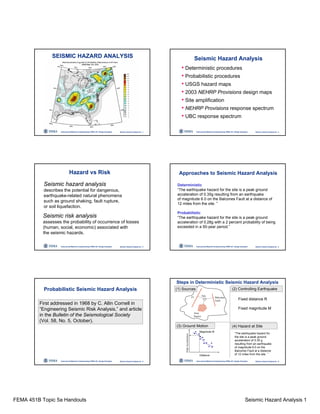
SEISMIC HAZARD ANALYSIS
Instructional Material Complementing FEMA 451, Design Examples Seismic Hazard Analysis 5a - 2
Seismic Hazard Analysis
• Deterministic procedures
• Probabilistic procedures
• USGS hazard maps
• 2003 NEHRP Provisions design maps
• Site amplification
• NEHRP Provisions response spectrum
• UBC response spectrum
Instructional Material Complementing FEMA 451, Design Examples Seismic Hazard Analysis 5a - 3
Seismic hazard analysis
describes the potential for dangerous,
earthquake-related natural phenomena
such as ground shaking, fault rupture,
or soil liquefaction.
Seismic risk analysis
assesses the probability of occurrence of losses
(human, social, economic) associated with
the seismic hazards.
Hazard vs Risk
Instructional Material Complementing FEMA 451, Design Examples Seismic Hazard Analysis 5a - 4
Approaches to Seismic Hazard Analysis
Deterministic
“The earthquake hazard for the site is a peak ground
acceleration of 0.35g resulting from an earthquake
of magnitude 6.0 on the Balcones Fault at a distance of
12 miles from the site. ”
Probabilistic
“The earthquake hazard for the site is a peak ground
acceleration of 0.28g with a 2 percent probability of being
exceeded in a 50-year period.”
Instructional Material Complementing FEMA 451, Design Examples Seismic Hazard Analysis 5a - 5
Probabilistic Seismic Hazard Analysis
First addressed in 1968 by C. Allin Cornell in
“Engineering Seismic Risk Analysis,” and article
in the Bulletin of the Seismological Society
(Vol. 58, No. 5, October).
Instructional Material Complementing FEMA 451, Design Examples Seismic Hazard Analysis 5a - 6
F1 Balcones
Fault
Area
Source
Site
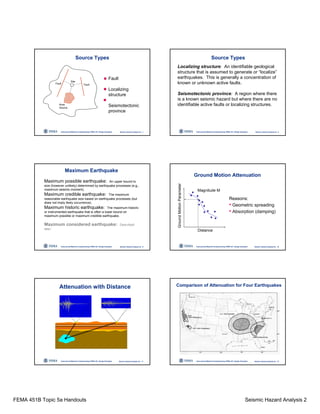
Fixed distance R
Fixed magnitude M
“The earthquake hazard for
the site is a peak ground
acceleration of 0.35 g
resulting from an earthquake
of magnitude 6.0 on the
Balcones Fault at a distance
of 12 miles from the site. ”
Magnitude M
Distance
PeakAcceleration
(2) Controlling Earthquake
Steps in Deterministic Seismic Hazard Analysis
(1) Sources
(4) Hazard at Site(3) Ground Motion
FEMA 451B Topic 5a Handouts Seismic Hazard Analysis 2
Instructional Material Complementing FEMA 451, Design Examples Seismic Hazard Analysis 5a - 7
Fault Fault
Area
Source
Site
Fault
Localizing
structure
Seismotectonic
province
Source Types
Instructional Material Complementing FEMA 451, Design Examples Seismic Hazard Analysis 5a - 8
Localizing structure: An identifiable geological
structure that is assumed to generate or “localize”
earthquakes. This is generally a concentration of
known or unknown active faults.
Seismotectonic province: A region where there
is a known seismic hazard but where there are no
identifiable active faults or localizing structures.
Source Types
Instructional Material Complementing FEMA 451, Design Examples Seismic Hazard Analysis 5a - 9
Maximum Earthquake
Maximum possible earthquake: An upper bound to
size (however unlikely) determined by earthquake processes (e.g.,
maximum seismic moment).
Maximum credible earthquake: The maximum
reasonable earthquake size based on earthquake processes (but
does not imply likely occurrence).
Maximum historic earthquake: The maximum historic
or instrumented earthquake that is often a lower bound on
maximum possible or maximum credible earthquake.
Maximum considered earthquake: Described
later.
Instructional Material Complementing FEMA 451, Design Examples Seismic Hazard Analysis 5a - 10
Ground Motion Attenuation
Reasons:
• Geometric spreading
• Absorption (damping)
Magnitude M
Distance
GroundMotionParameter
Instructional Material Complementing FEMA 451, Design Examples Seismic Hazard Analysis 5a - 11
Attenuation with Distance
Instructional Material Complementing FEMA 451, Design Examples Seismic Hazard Analysis 5a - 12
Comparison of Attenuation for Four Earthquakes
FEMA 451B Topic 5a Handouts Seismic Hazard Analysis 3
Instructional Material Complementing FEMA 451, Design Examples Seismic Hazard Analysis 5a - 13
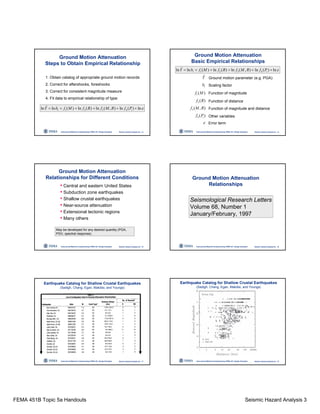
Ground Motion Attenuation
Steps to Obtain Empirical Relationship
1. Obtain catalog of appropriate ground motion records
2. Correct for aftershocks, foreshocks
3. Correct for consistent magnitude measure
4. Fit data to empirical relationship of type:
εln)(ln),(ln)(ln)(lnˆln 43211 +++++= iPfRMfRfMfbY
Instructional Material Complementing FEMA 451, Design Examples Seismic Hazard Analysis 5a - 14
Ground Motion Attenuation
Basic Empirical Relationships
εln)(ln),(ln)(ln)(lnˆln 43211 +++++= iPfRMfRfMfbY
1b
)(1 Mf
)(2 Rf
),(3 RMf
)(4 iPf
ε
Scaling factor
Function of magnitude
Function of distance
Function of magnitude and distance
Other variables
Error term
Yˆ Ground motion parameter (e.g. PGA)
Instructional Material Complementing FEMA 451, Design Examples Seismic Hazard Analysis 5a - 15
Ground Motion Attenuation
Relationships for Different Conditions
• Central and eastern United States
• Subduction zone earthquakes
• Shallow crustal earthquakes
• Near-source attenuation
• Extensional tectonic regions
• Many others
May be developed for any desired quantity (PGA,
PGV, spectral response).
Instructional Material Complementing FEMA 451, Design Examples Seismic Hazard Analysis 5a - 16
Ground Motion Attenuation
Relationships
Seismological Research Letters
Volume 68, Number 1
January/February, 1997
Instructional Material Complementing FEMA 451, Design Examples Seismic Hazard Analysis 5a - 17
Earthquake Catalog for Shallow Crustal Earthquakes
(Sadigh, Chang, Egan, Makdisi, and Youngs)
Instructional Material Complementing FEMA 451, Design Examples Seismic Hazard Analysis 5a - 18
Earthquake Catalog for Shallow Crustal Earthquakes
(Sadigh, Chang, Egan, Makdisi, and Youngs)
FEMA 451B Topic 5a Handouts Seismic Hazard Analysis 4
Instructional Material Complementing FEMA 451, Design Examples Seismic Hazard Analysis 5a - 19
Attenuation Relation for Shallow Crustal Earthquakes
(Sadigh, Chang, Egan, Makdisi, and Youngs)
Instructional Material Complementing FEMA 451, Design Examples Seismic Hazard Analysis 5a - 20
)2())exp(ln()5.8()ln( 7654321 +++++−++= ruprup rCMCCrCMCMCCy
T C1 C2 C3 C4 C5 C6 C7
PGA -0.624 1.000 0.000 -2.100 1.296 0.250 0.000
0.07 0.110 1.000 0.006 -2.128 1.296 0.250 -0.082
0.1 0.275 1.000 0.006 -2.148 1.296 0.250 -0.041
0.2 0.153 1.000 -0.004 -2.080 1.296 0.250 0.000
0.3 -0.057 1.000 -0.017 -2.028 1.296 0.250 0.000
0.4 -0.298 1.000 -0.028 -1.990 1.296 0.250 0.000
0.5 -0.588 1.000 -0.040 -1.945 1.296 0.250 0.000
0.75 -1.208 1.000 -0.050 -1.865 1.296 0.250 0.000
1 -1.705 1.000 -0.055 -1.800 1.296 0.250 0.000
1.5 -2.407 1.000 -0.065 -1.725 1.296 0.250 0.000
2 -2.945 1.000 -0.070 -1.670 1.296 0.250 0.000
3 -3.700 1.000 -0.080 -1.610 1.296 0.250 0.000
4 -4.230 1.000 -0.100 -1.570 1.296 0.250 0.000
Attenuation Relation for Shallow Crustal Earthquakes
(Sadigh, Chang, Egan, Makdisi, and Youngs)
Table for Magnitude <= 6.5
Instructional Material Complementing FEMA 451, Design Examples Seismic Hazard Analysis 5a - 21
Attenuation Relation for Shallow Crustal Earthquakes
(Sadigh, Chang, Egan, Makdisi, and Youngs)
0.001
0.01
0.1
1
1 10 100 1000
Distance, KM
PeakGroundAcceleration,G
4
5
6
7
8
Magnitude
Instructional Material Complementing FEMA 451, Design Examples Seismic Hazard Analysis 5a - 22
0.001
0.01
0.1
1
10
1 10 100 1000
Distance, KM
0.2Sec.SpectralAcceleration,G
4
5
6
7
8
0.001
0.01
0.1
1
10
1 10 100 1000
Distance, KM
1.0Sec.SpectralAcceleration,G
4
5
6
7
8
Attenuation Relation for Shallow Crustal Earthquakes
(Sadigh, Chang, Egan, Makdisi, and Youngs)
Magnitude Magnitude
0.2 Second Acceleration 1.0 Second Acceleration
Instructional Material Complementing FEMA 451, Design Examples Seismic Hazard Analysis 5a - 23
Source 1
Source 2
Source 3
Site Source M D PGA
(km) (g)
1 7.3 23.7 0.42
2 7.7 25.0 0.57
3 5.0 60.0 0.02
Example Deterministic Analysis (Kramer)
D1
D2
D3
From attenuation relationship
Closest distance
Maximum on source
Instructional Material Complementing FEMA 451, Design Examples Seismic Hazard Analysis 5a - 24
F1 Balcones
Fault
Area
Source
Site
M1
Distance
PeakAcceleration
Steps in Probabilistic Seismic Hazard Analysis
(1) Sources
(4) Probability of Exceedance(3) Ground Motion
Magnitude M
Log#Quakes>M
(2) Recurrence
M2
M3
Uncertainty
ProbabilityofExceedance
Ground Motion Parameter
FEMA 451B Topic 5a Handouts Seismic Hazard Analysis 5
Instructional Material Complementing FEMA 451, Design Examples Seismic Hazard Analysis 5a - 25
0.0001
0.001
0.01
0.1
1
10
100
1000
0 2 4 6 8 10
Magnitude
MeanAnnualRateofExceedance
Empirical Gutenberg-Richter
Recurrence Relationship
bmam −=λlog
mλ = mean rate of
recurrence
(events/year)
a and b to be deter-
mined from data
λm
mλ/1 = return period
Instructional Material Complementing FEMA 451, Design Examples Seismic Hazard Analysis 5a - 26
0.000001
0.00001
0.0001
0.001
0.01
0.1
1
10
100
1000
0 2 4 6 8 10
Magnitude
MeanAnnualRateofExceedance
Unbounded
Bounded
Bounded vs Unbounded
Recurrence Relationship
Instructional Material Complementing FEMA 451, Design Examples Seismic Hazard Analysis 5a - 27
Uncertainties Included in
Probabilistic Analysis
Attenuation laws
Recurrence relationship
Distance to site
][][],*[
1 1 1
* kjkj
N
i
N
j
N
k
iy rRPmMPrmyYPv
S M R
==>= ∑∑∑= = =
λ
Instructional Material Complementing FEMA 451, Design Examples Seismic Hazard Analysis 5a - 28
Source 1
Source 2
Source 3
Site
D1=?
D2=?D3
Source 1
Source 2
Source 3
Site
Example Probabilistic Analysis (Kramer)
M2=?
M3=?
M1=?
A1=?
A3=?
A2=?
Instructional Material Complementing FEMA 451, Design Examples Seismic Hazard Analysis 5a - 29
Source 1
Source 2
Source 3
Site
0.0 0.2 0.4 0.6 0.8
10-6
10-4
10-2
10-0
10-7
10-5
10-3
10-1
10-1
10-8
Peak Horizontal Acceleration (g)
MeanAnnualRateofExceedance
Source 1
Source 2
Source 3
All Source Zones
SEISMIC HAZARD CURVE
Result of Probabilistic Hazard Analysis
Instructional Material Complementing FEMA 451, Design Examples Seismic Hazard Analysis 5a - 30
1
10
100
1000
10000
0 20 40 60 80 100
Period of Interest (years)
ReturnPeriod(years)
2%
10%
20%
30%
40%
50%
2475
474
50
Relationship Between Return Period, Period of Interest,
and Probability of Exceedance
Return period = -T/ln(1-P(Z>z))
FEMA 451B Topic 5a Handouts Seismic Hazard Analysis 6
Instructional Material Complementing FEMA 451, Design Examples Seismic Hazard Analysis 5a - 31
0.0 0.2 0.4 0.6 0.8
10-6
10-4
10-2
10-0
10-7
10-5
10-3
10-1
10-1
10-8
Peak Horizontal Acceleration (g)
MeanAnnualRateofExceedance
SEISMIC HAZARD CURVE
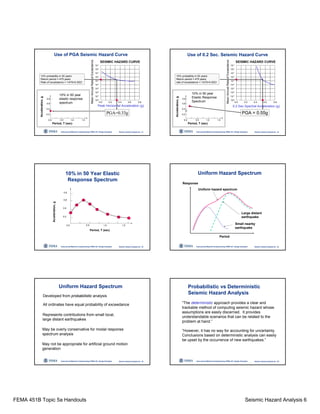
PGA=0.33g
10% probability in 50 years
Return period = 475 years
Rate of exceedance = 1/475=0.0021
Use of PGA Seismic Hazard Curve
Period, T (sec)
Acceleration,g
0.0 0.5 1.0 1.5
0.2
0.4
0.6
0.8
10% in 50 year
elastic response
spectrum
Instructional Material Complementing FEMA 451, Design Examples Seismic Hazard Analysis 5a - 32
0.0 0.2 0.4 0.6 0.8
10-6
10-4
10-2
10-0
10-7
10-5
10-3
10-1
10-1
10-8
0.2 Sec Spectral Acceleration (g)
MeanAnnualRateofExceedance
SEISMIC HAZARD CURVE
PGA = 0.55g
10% probability in 50 years
Return period = 475 years
rate of exceedance = 1/475=0.0021
Use of 0.2 Sec. Seismic Hazard Curve
Period, T (sec)
Acceleration,g
0.0 0.5 1.0 1.5
0.2
0.4
0.6
0.8
10% in 50 year
Elastic Response
Spectrum
Instructional Material Complementing FEMA 451, Design Examples Seismic Hazard Analysis 5a - 33
Period, T (sec)
Acceleration,g
0.0 0.5 1.0 1.5
0.2
0.4
0.6
0.8
10% in 50 Year Elastic
Response Spectrum
Instructional Material Complementing FEMA 451, Design Examples Seismic Hazard Analysis 5a - 34
Uniform Hazard Spectrum
Large distant
earthquake
Small nearby
earthquake
Uniform hazard spectrum
Period
Response
Instructional Material Complementing FEMA 451, Design Examples Seismic Hazard Analysis 5a - 35
Uniform Hazard Spectrum
All ordinates have equal probability of exceedance
Developed from probabilistic analysis
Represents contributions from small local,
large distant earthquakes
May be overly conservative for modal response
spectrum analysis
May not be appropriate for artificial ground motion
generation
Instructional Material Complementing FEMA 451, Design Examples Seismic Hazard Analysis 5a - 36
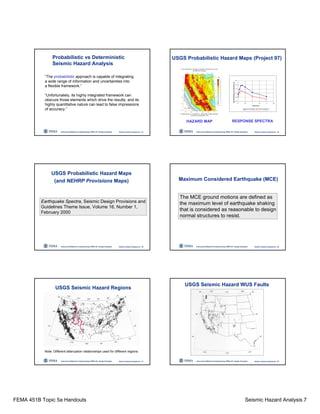
Probabilistic vs Deterministic
Seismic Hazard Analysis
“The deterministic approach provides a clear and
trackable method of computing seismic hazard whose
assumptions are easily discerned. It provides
understandable scenarios that can be related to the
problem at hand.”
“However, it has no way for accounting for uncertainty.
Conclusions based on deterministic analysis can easily
be upset by the occurrence of new earthquakes.”
FEMA 451B Topic 5a Handouts Seismic Hazard Analysis 7
Instructional Material Complementing FEMA 451, Design Examples Seismic Hazard Analysis 5a - 37
Probabilistic vs Deterministic
Seismic Hazard Analysis
“The probabilistic approach is capable of integrating
a wide range of information and uncertainties into
a flexible framework.”
“Unfortunately, its highly integrated framework can
obscure those elements which drive the results, and its
highly quantitative nature can lead to false impressions
of accuracy.”
Instructional Material Complementing FEMA 451, Design Examples Seismic Hazard Analysis 5a - 38
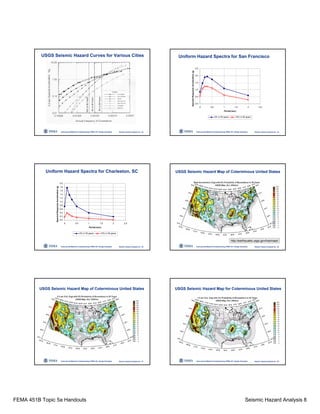
USGS Probabilistic Hazard Maps (Project 97)
0.0
0.5
1.0
1.5
2.0
2.5
0 0.5 1 1.5 2 2.5
Period (sec)
SpectralResponseAcceleration(g)
2% in 50 years 10% in 50 years
HAZARD MAP RESPONSE SPECTRA
Instructional Material Complementing FEMA 451, Design Examples Seismic Hazard Analysis 5a - 39
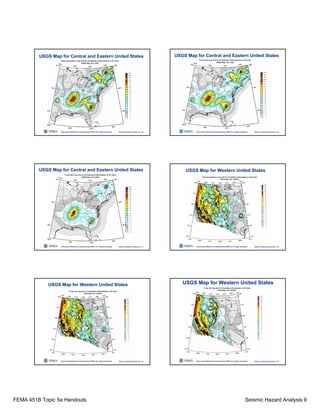
USGS Probabilistic Hazard Maps
(and NEHRP Provisions Maps)
Earthquake Spectra, Seismic Design Provisions and
Guidelines Theme Issue, Volume 16, Number 1,
February 2000
Instructional Material Complementing FEMA 451, Design Examples Seismic Hazard Analysis 5a - 40
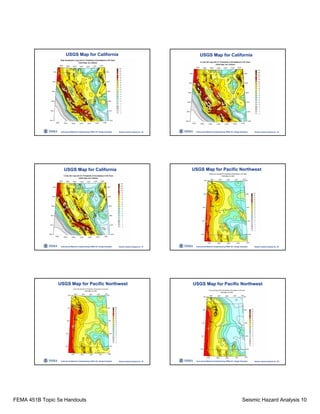
Maximum Considered Earthquake (MCE)
The MCE ground motions are defined as
the maximum level of earthquake shaking
that is considered as reasonable to design
normal structures to resist.
Instructional Material Complementing FEMA 451, Design Examples Seismic Hazard Analysis 5a - 41
USGS Seismic Hazard Regions
Note: Different attenuation relationships used for different regions.
Instructional Material Complementing FEMA 451, Design Examples Seismic Hazard Analysis 5a - 42
USGS Seismic Hazard WUS Faults
FEMA 451B Topic 5a Handouts Seismic Hazard Analysis 8
Instructional Material Complementing FEMA 451, Design Examples Seismic Hazard Analysis 5a - 43
USGS Seismic Hazard Curves for Various Cities
Instructional Material Complementing FEMA 451, Design Examples Seismic Hazard Analysis 5a - 44
Uniform Hazard Spectra for San Francisco
0.0
0.5
1.0
1.5
2.0
2.5
0 0.5 1 1.5 2 2.5
Period (sec)
SpectralResponseAcceleration(g)
2% in 50 years 10% in 50 years
Instructional Material Complementing FEMA 451, Design Examples Seismic Hazard Analysis 5a - 45
Uniform Hazard Spectra for Charleston, SC
0.0
0.2
0.4
0.6
0.8
1.0
1.2
1.4
1.6
1.8
2.0
0 0.5 1 1.5 2 2.5
Period (sec)
SpectralResponseAcceleration(g)
2% in 50 years 10% in 50 years
Instructional Material Complementing FEMA 451, Design Examples Seismic Hazard Analysis 5a - 46
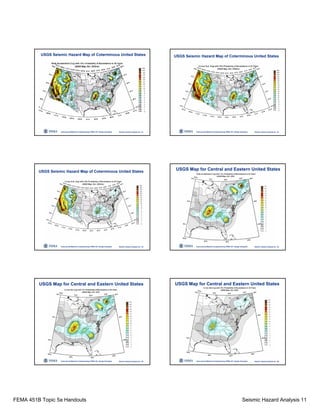
USGS Seismic Hazard Map of Coterminous United States
http://earthquake.usgs.gov/hazmaps/
Instructional Material Complementing FEMA 451, Design Examples Seismic Hazard Analysis 5a - 47
USGS Seismic Hazard Map of Coterminous United States
Instructional Material Complementing FEMA 451, Design Examples Seismic Hazard Analysis 5a - 48
USGS Seismic Hazard Map for Coterminous United States
FEMA 451B Topic 5a Handouts Seismic Hazard Analysis 9
Instructional Material Complementing FEMA 451, Design Examples Seismic Hazard Analysis 5a - 49
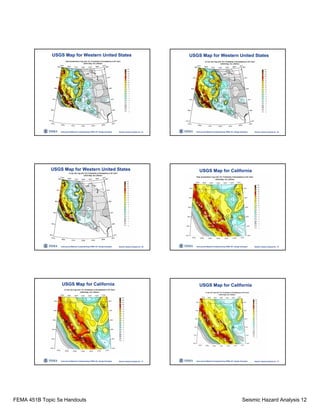
USGS Map for Central and Eastern United States
Instructional Material Complementing FEMA 451, Design Examples Seismic Hazard Analysis 5a - 50
USGS Map for Central and Eastern United States
Instructional Material Complementing FEMA 451, Design Examples Seismic Hazard Analysis 5a - 51
USGS Map for Central and Eastern United States
Instructional Material Complementing FEMA 451, Design Examples Seismic Hazard Analysis 5a - 52
USGS Map for Western United States
Instructional Material Complementing FEMA 451, Design Examples Seismic Hazard Analysis 5a - 53
USGS Map for Western United States
Instructional Material Complementing FEMA 451, Design Examples Seismic Hazard Analysis 5a - 54
USGS Map for Western United States
FEMA 451B Topic 5a Handouts Seismic Hazard Analysis 10
Instructional Material Complementing FEMA 451, Design Examples Seismic Hazard Analysis 5a - 55
USGS Map for California
Instructional Material Complementing FEMA 451, Design Examples Seismic Hazard Analysis 5a - 56
USGS Map for California
Instructional Material Complementing FEMA 451, Design Examples Seismic Hazard Analysis 5a - 57
USGS Map for California
Instructional Material Complementing FEMA 451, Design Examples Seismic Hazard Analysis 5a - 58
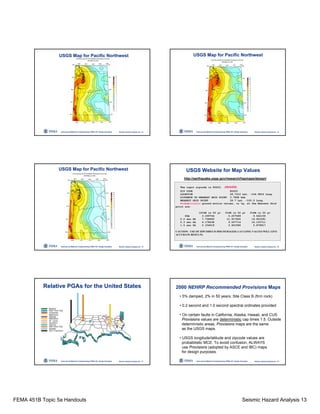
USGS Map for Pacific Northwest
Instructional Material Complementing FEMA 451, Design Examples Seismic Hazard Analysis 5a - 59
USGS Map for Pacific Northwest
Instructional Material Complementing FEMA 451, Design Examples Seismic Hazard Analysis 5a - 60
USGS Map for Pacific Northwest
FEMA 451B Topic 5a Handouts Seismic Hazard Analysis 11
Instructional Material Complementing FEMA 451, Design Examples Seismic Hazard Analysis 5a - 61
USGS Seismic Hazard Map of Coterminous United States
Instructional Material Complementing FEMA 451, Design Examples Seismic Hazard Analysis 5a - 62
USGS Seismic Hazard Map of Coterminous United States
Instructional Material Complementing FEMA 451, Design Examples Seismic Hazard Analysis 5a - 63
USGS Seismic Hazard Map of Coterminous United States
Instructional Material Complementing FEMA 451, Design Examples Seismic Hazard Analysis 5a - 64
USGS Map for Central and Eastern United States
Instructional Material Complementing FEMA 451, Design Examples Seismic Hazard Analysis 5a - 65
USGS Map for Central and Eastern United States
Instructional Material Complementing FEMA 451, Design Examples Seismic Hazard Analysis 5a - 66
USGS Map for Central and Eastern United States
FEMA 451B Topic 5a Handouts Seismic Hazard Analysis 12
Instructional Material Complementing FEMA 451, Design Examples Seismic Hazard Analysis 5a - 67
USGS Map for Western United States
Instructional Material Complementing FEMA 451, Design Examples Seismic Hazard Analysis 5a - 68
USGS Map for Western United States
Instructional Material Complementing FEMA 451, Design Examples Seismic Hazard Analysis 5a - 69
USGS Map for Western United States
Instructional Material Complementing FEMA 451, Design Examples Seismic Hazard Analysis 5a - 70
USGS Map for California
Instructional Material Complementing FEMA 451, Design Examples Seismic Hazard Analysis 5a - 71
USGS Map for California
Instructional Material Complementing FEMA 451, Design Examples Seismic Hazard Analysis 5a - 72
USGS Map for California
FEMA 451B Topic 5a Handouts Seismic Hazard Analysis 13
Instructional Material Complementing FEMA 451, Design Examples Seismic Hazard Analysis 5a - 73
USGS Map for Pacific Northwest
Instructional Material Complementing FEMA 451, Design Examples Seismic Hazard Analysis 5a - 74
USGS Map for Pacific Northwest
Instructional Material Complementing FEMA 451, Design Examples Seismic Hazard Analysis 5a - 75
USGS Map for Pacific Northwest
Instructional Material Complementing FEMA 451, Design Examples Seismic Hazard Analysis 5a - 76
USGS Website for Map Values
http://earthquake.usgs.gov/research/hazmaps/design/
The input zipcode is 80203. (DENVER)
ZIP CODE 80203
LOCATION 39.7310 Lat. -104.9815 Long.
DISTANCE TO NEAREST GRID POINT 3.7898 kms
NEAREST GRID POINT 39.7 Lat. -105.0 Long.
Probabilistic ground motion values, in %g, at the Nearest Grid
point are:
10%PE in 50 yr 5%PE in 50 yr 2%PE in 50 yr
PGA 3.299764 5.207589 9.642159
0.2 sec SA 7.728900 11.917400 19.921591
0.3 sec SA 6.178438 9.507714 16.133711
1.0 sec SA 2.334019 3.601994 5.879917
CAUTION: USE OF ZIPCODES IS DISCOURAGED; LAT-LONG VALUES WILL GIVE
ACCURATE RESULTS.
Instructional Material Complementing FEMA 451, Design Examples Seismic Hazard Analysis 5a - 77
Relative PGAs for the United States
Instructional Material Complementing FEMA 451, Design Examples Seismic Hazard Analysis 5a - 78
2000 NEHRP Recommended Provisions Maps
• 5% damped, 2% in 50 years, Site Class B (firm rock)
• 0.2 second and 1.0 second spectral ordinates provided
• On certain faults in California, Alaska, Hawaii, and CUS
Provisions values are deterministic cap times 1.5. Outside
deterministic areas, Provisions maps are the same
as the USGS maps.
• USGS longitude/latitude and zipcode values are
probabilistic MCE. To avoid confusion, ALWAYS
use Provisions (adopted by ASCE and IBC) maps
for design purposes.
FEMA 451B Topic 5a Handouts Seismic Hazard Analysis 14
Instructional Material Complementing FEMA 451, Design Examples Seismic Hazard Analysis 5a - 79
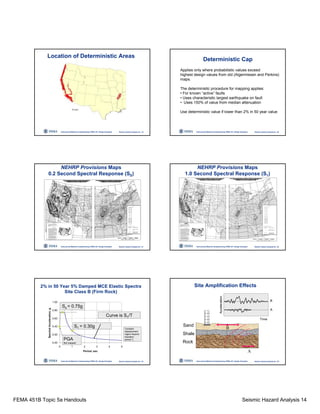
Location of Deterministic Areas
Instructional Material Complementing FEMA 451, Design Examples Seismic Hazard Analysis 5a - 80
Deterministic Cap
Applies only where probabilistic values exceed
highest design values from old (Algermissen and Perkins)
maps.
The deterministic procedure for mapping applies:
• For known “active” faults
• Uses characteristic largest earthquake on fault
• Uses 150% of value from median attenuation
Use deterministic value if lower than 2% in 50 year value
Instructional Material Complementing FEMA 451, Design Examples Seismic Hazard Analysis 5a - 81
NEHRP Provisions Maps
0.2 Second Spectral Response (SS)
Instructional Material Complementing FEMA 451, Design Examples Seismic Hazard Analysis 5a - 82
NEHRP Provisions Maps
1.0 Second Spectral Response (S1)
Instructional Material Complementing FEMA 451, Design Examples Seismic Hazard Analysis 5a - 83
0.00
0.20
0.40
0.60
0.80
1.00
0 1 2 3 4 5
Period, sec.
SpectralAcceleration,g.
2% in 50 Year 5% Damped MCE Elastic Spectra
Site Class B (Firm Rock)
S1 = 0.30g
Ss = 0.75g
Curve is S1/T
PGA
Not mapped
Constant
displacement
region beyond
transition
period TL
Instructional Material Complementing FEMA 451, Design Examples Seismic Hazard Analysis 5a - 84
A
B
A
B
Time
Acceleration
Rock
Shale
Sand
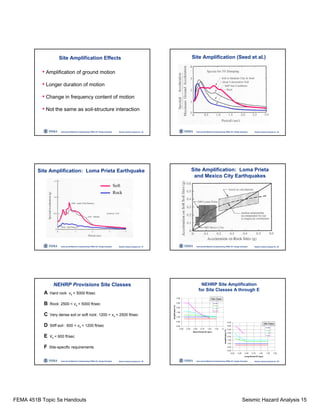
Site Amplification Effects
FEMA 451B Topic 5a Handouts Seismic Hazard Analysis 15
Instructional Material Complementing FEMA 451, Design Examples Seismic Hazard Analysis 5a - 85
Site Amplification Effects
• Amplification of ground motion
• Longer duration of motion
• Change in frequency content of motion
• Not the same as soil-structure interaction
Instructional Material Complementing FEMA 451, Design Examples Seismic Hazard Analysis 5a - 86
Site Amplification (Seed et al.)
Instructional Material Complementing FEMA 451, Design Examples Seismic Hazard Analysis 5a - 87
Site Amplification: Loma Prieta Earthquake
Soft
Rock
Instructional Material Complementing FEMA 451, Design Examples Seismic Hazard Analysis 5a - 88
Site Amplification: Loma Prieta
and Mexico City Earthquakes
Instructional Material Complementing FEMA 451, Design Examples Seismic Hazard Analysis 5a - 89
A Hard rock vs > 5000 ft/sec
B Rock: 2500 < vs < 5000 ft/sec
C Very dense soil or soft rock: 1200 < vs < 2500 ft/sec
D Stiff soil : 600 < vs < 1200 ft/sec
E Vs < 600 ft/sec
F Site-specific requirements
NEHRP Provisions Site Classes
Instructional Material Complementing FEMA 451, Design Examples Seismic Hazard Analysis 5a - 90
NEHRP Site Amplification
for Site Classes A through E
0.00
0.50
1.00
1.50
2.00
2.50
3.00
0.00 0.25 0.50 0.75 1.00 1.25 1.50
Short Period Ss (sec)
AmplificationFa
A
B
C
D
E
Site Class
0.00
0.50
1.00
1.50
2.00
2.50
3.00
3.50
4.00
0.00 0.25 0.50 0.75 1.00 1.25 1.50
Long Period S1 (sec)
AmplificationFv
A
B
C
D
E
Site Class
FEMA 451B Topic 5a Handouts Seismic Hazard Analysis 16
Instructional Material Complementing FEMA 451, Design Examples Seismic Hazard Analysis 5a - 91
0.00
0.21
0.42
0.63
0.84
1.05
0 1 2 3 4 5
Period, sec.
SpectralAcceleration,g.
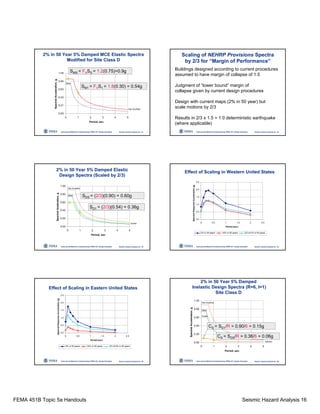
SMS = FASS = 1.2(0.75)=0.9g
SM1 = FVS1 = 1.8(0.30) = 0.54g
2% in 50 Year 5% Damped MCE Elastic Spectra
Modified for Site Class D
Basic
Site Amplified
Instructional Material Complementing FEMA 451, Design Examples Seismic Hazard Analysis 5a - 92
Buildings designed according to current procedures
assumed to have margin of collapse of 1.5
Judgment of “lower bound” margin of
collapse given by current design procedures
Design with current maps (2% in 50 year) but
scale motions by 2/3
Results in 2/3 x 1.5 = 1.0 deterministic earthquake
(where applicable)
Scaling of NEHRP Provisions Spectra
by 2/3 for “Margin of Performance”
Instructional Material Complementing FEMA 451, Design Examples Seismic Hazard Analysis 5a - 93
0.00
0.20
0.40
0.60
0.80
1.00
0 1 2 3 4 5
Period, sec.
SpectralAceleration,g.
2% in 50 Year 5% Damped Elastic
Design Spectra (Scaled by 2/3)
SDS = (2/3)(0.90) = 0.60g
SD1 = (2/3)(0.54) = 0.36g
Basic
Site Amplified
Scaled
Instructional Material Complementing FEMA 451, Design Examples Seismic Hazard Analysis 5a - 94
0.0
0.5
1.0
1.5
2.0
2.5
0 0.5 1 1.5 2 2.5
Period (sec)
SpectralResponseAcceleration(g)
2% in 50 years 10% in 50 years 2/3 of 2% in 50 years
Effect of Scaling in Western United States
Instructional Material Complementing FEMA 451, Design Examples Seismic Hazard Analysis 5a - 95
0.0
0.5
1.0
1.5
2.0
2.5
0 0.5 1 1.5 2 2.5
Period (sec)
SpectralResponseAcceleration(g)
2% in 50 years 10% in 50 years 2/3 of 2% in 50 years
Effect of Scaling in Eastern United States
Instructional Material Complementing FEMA 451, Design Examples Seismic Hazard Analysis 5a - 96
0.00
0.20
0.40
0.60
0.80
1.00
0 1 2 3 4 5
Period, sec.
SpectralAcceleration,g.
2% in 50 Year 5% Damped
Inelastic Design Spectra (R=6, I=1)
Site Class D
CS = SD1/R = 0.90/6 = 0.15g
CS = SDS/R = 0.36/6 = 0.06g
Basic
Site Amplified
Scaled
Inelastic
FEMA 451B Topic 5a Handouts Seismic Hazard Analysis 17
Instructional Material Complementing FEMA 451, Design Examples Seismic Hazard Analysis 5a - 97
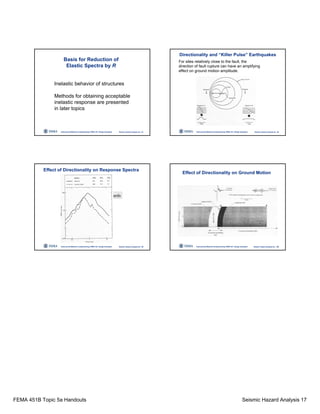
Basis for Reduction of
Elastic Spectra by R
Inelastic behavior of structures
Methods for obtaining acceptable
inelastic response are presented
in later topics
Instructional Material Complementing FEMA 451, Design Examples Seismic Hazard Analysis 5a - 98
Directionality and “Killer Pulse” Earthquakes
For sites relatively close to the fault, the
direction of fault rupture can have an amplifying
effect on ground motion amplitude.
Instructional Material Complementing FEMA 451, Design Examples Seismic Hazard Analysis 5a - 99
Towards
Away
Effect of Directionality on Response Spectra
Instructional Material Complementing FEMA 451, Design Examples Seismic Hazard Analysis 5a - 100
Effect of Directionality on Ground Motion

Topic05a seismic hazardanalysishandouts

  • 1.
    FEMA 451B Topic5a Handouts Seismic Hazard Analysis 1 Instructional Material Complementing FEMA 451, Design Examples Seismic Hazard Analysis 5a - 1 SEISMIC HAZARD ANALYSIS Instructional Material Complementing FEMA 451, Design Examples Seismic Hazard Analysis 5a - 2 Seismic Hazard Analysis • Deterministic procedures • Probabilistic procedures • USGS hazard maps • 2003 NEHRP Provisions design maps • Site amplification • NEHRP Provisions response spectrum • UBC response spectrum Instructional Material Complementing FEMA 451, Design Examples Seismic Hazard Analysis 5a - 3 Seismic hazard analysis describes the potential for dangerous, earthquake-related natural phenomena such as ground shaking, fault rupture, or soil liquefaction. Seismic risk analysis assesses the probability of occurrence of losses (human, social, economic) associated with the seismic hazards. Hazard vs Risk Instructional Material Complementing FEMA 451, Design Examples Seismic Hazard Analysis 5a - 4 Approaches to Seismic Hazard Analysis Deterministic “The earthquake hazard for the site is a peak ground acceleration of 0.35g resulting from an earthquake of magnitude 6.0 on the Balcones Fault at a distance of 12 miles from the site. ” Probabilistic “The earthquake hazard for the site is a peak ground acceleration of 0.28g with a 2 percent probability of being exceeded in a 50-year period.” Instructional Material Complementing FEMA 451, Design Examples Seismic Hazard Analysis 5a - 5 Probabilistic Seismic Hazard Analysis First addressed in 1968 by C. Allin Cornell in “Engineering Seismic Risk Analysis,” and article in the Bulletin of the Seismological Society (Vol. 58, No. 5, October). Instructional Material Complementing FEMA 451, Design Examples Seismic Hazard Analysis 5a - 6 F1 Balcones Fault Area Source Site Fixed distance R Fixed magnitude M “The earthquake hazard for the site is a peak ground acceleration of 0.35 g resulting from an earthquake of magnitude 6.0 on the Balcones Fault at a distance of 12 miles from the site. ” Magnitude M Distance PeakAcceleration (2) Controlling Earthquake Steps in Deterministic Seismic Hazard Analysis (1) Sources (4) Hazard at Site(3) Ground Motion
  • 2.
    FEMA 451B Topic5a Handouts Seismic Hazard Analysis 2 Instructional Material Complementing FEMA 451, Design Examples Seismic Hazard Analysis 5a - 7 Fault Fault Area Source Site Fault Localizing structure Seismotectonic province Source Types Instructional Material Complementing FEMA 451, Design Examples Seismic Hazard Analysis 5a - 8 Localizing structure: An identifiable geological structure that is assumed to generate or “localize” earthquakes. This is generally a concentration of known or unknown active faults. Seismotectonic province: A region where there is a known seismic hazard but where there are no identifiable active faults or localizing structures. Source Types Instructional Material Complementing FEMA 451, Design Examples Seismic Hazard Analysis 5a - 9 Maximum Earthquake Maximum possible earthquake: An upper bound to size (however unlikely) determined by earthquake processes (e.g., maximum seismic moment). Maximum credible earthquake: The maximum reasonable earthquake size based on earthquake processes (but does not imply likely occurrence). Maximum historic earthquake: The maximum historic or instrumented earthquake that is often a lower bound on maximum possible or maximum credible earthquake. Maximum considered earthquake: Described later. Instructional Material Complementing FEMA 451, Design Examples Seismic Hazard Analysis 5a - 10 Ground Motion Attenuation Reasons: • Geometric spreading • Absorption (damping) Magnitude M Distance GroundMotionParameter Instructional Material Complementing FEMA 451, Design Examples Seismic Hazard Analysis 5a - 11 Attenuation with Distance Instructional Material Complementing FEMA 451, Design Examples Seismic Hazard Analysis 5a - 12 Comparison of Attenuation for Four Earthquakes
  • 3.
    FEMA 451B Topic5a Handouts Seismic Hazard Analysis 3 Instructional Material Complementing FEMA 451, Design Examples Seismic Hazard Analysis 5a - 13 Ground Motion Attenuation Steps to Obtain Empirical Relationship 1. Obtain catalog of appropriate ground motion records 2. Correct for aftershocks, foreshocks 3. Correct for consistent magnitude measure 4. Fit data to empirical relationship of type: εln)(ln),(ln)(ln)(lnˆln 43211 +++++= iPfRMfRfMfbY Instructional Material Complementing FEMA 451, Design Examples Seismic Hazard Analysis 5a - 14 Ground Motion Attenuation Basic Empirical Relationships εln)(ln),(ln)(ln)(lnˆln 43211 +++++= iPfRMfRfMfbY 1b )(1 Mf )(2 Rf ),(3 RMf )(4 iPf ε Scaling factor Function of magnitude Function of distance Function of magnitude and distance Other variables Error term Yˆ Ground motion parameter (e.g. PGA) Instructional Material Complementing FEMA 451, Design Examples Seismic Hazard Analysis 5a - 15 Ground Motion Attenuation Relationships for Different Conditions • Central and eastern United States • Subduction zone earthquakes • Shallow crustal earthquakes • Near-source attenuation • Extensional tectonic regions • Many others May be developed for any desired quantity (PGA, PGV, spectral response). Instructional Material Complementing FEMA 451, Design Examples Seismic Hazard Analysis 5a - 16 Ground Motion Attenuation Relationships Seismological Research Letters Volume 68, Number 1 January/February, 1997 Instructional Material Complementing FEMA 451, Design Examples Seismic Hazard Analysis 5a - 17 Earthquake Catalog for Shallow Crustal Earthquakes (Sadigh, Chang, Egan, Makdisi, and Youngs) Instructional Material Complementing FEMA 451, Design Examples Seismic Hazard Analysis 5a - 18 Earthquake Catalog for Shallow Crustal Earthquakes (Sadigh, Chang, Egan, Makdisi, and Youngs)
  • 4.
    FEMA 451B Topic5a Handouts Seismic Hazard Analysis 4 Instructional Material Complementing FEMA 451, Design Examples Seismic Hazard Analysis 5a - 19 Attenuation Relation for Shallow Crustal Earthquakes (Sadigh, Chang, Egan, Makdisi, and Youngs) Instructional Material Complementing FEMA 451, Design Examples Seismic Hazard Analysis 5a - 20 )2())exp(ln()5.8()ln( 7654321 +++++−++= ruprup rCMCCrCMCMCCy T C1 C2 C3 C4 C5 C6 C7 PGA -0.624 1.000 0.000 -2.100 1.296 0.250 0.000 0.07 0.110 1.000 0.006 -2.128 1.296 0.250 -0.082 0.1 0.275 1.000 0.006 -2.148 1.296 0.250 -0.041 0.2 0.153 1.000 -0.004 -2.080 1.296 0.250 0.000 0.3 -0.057 1.000 -0.017 -2.028 1.296 0.250 0.000 0.4 -0.298 1.000 -0.028 -1.990 1.296 0.250 0.000 0.5 -0.588 1.000 -0.040 -1.945 1.296 0.250 0.000 0.75 -1.208 1.000 -0.050 -1.865 1.296 0.250 0.000 1 -1.705 1.000 -0.055 -1.800 1.296 0.250 0.000 1.5 -2.407 1.000 -0.065 -1.725 1.296 0.250 0.000 2 -2.945 1.000 -0.070 -1.670 1.296 0.250 0.000 3 -3.700 1.000 -0.080 -1.610 1.296 0.250 0.000 4 -4.230 1.000 -0.100 -1.570 1.296 0.250 0.000 Attenuation Relation for Shallow Crustal Earthquakes (Sadigh, Chang, Egan, Makdisi, and Youngs) Table for Magnitude <= 6.5 Instructional Material Complementing FEMA 451, Design Examples Seismic Hazard Analysis 5a - 21 Attenuation Relation for Shallow Crustal Earthquakes (Sadigh, Chang, Egan, Makdisi, and Youngs) 0.001 0.01 0.1 1 1 10 100 1000 Distance, KM PeakGroundAcceleration,G 4 5 6 7 8 Magnitude Instructional Material Complementing FEMA 451, Design Examples Seismic Hazard Analysis 5a - 22 0.001 0.01 0.1 1 10 1 10 100 1000 Distance, KM 0.2Sec.SpectralAcceleration,G 4 5 6 7 8 0.001 0.01 0.1 1 10 1 10 100 1000 Distance, KM 1.0Sec.SpectralAcceleration,G 4 5 6 7 8 Attenuation Relation for Shallow Crustal Earthquakes (Sadigh, Chang, Egan, Makdisi, and Youngs) Magnitude Magnitude 0.2 Second Acceleration 1.0 Second Acceleration Instructional Material Complementing FEMA 451, Design Examples Seismic Hazard Analysis 5a - 23 Source 1 Source 2 Source 3 Site Source M D PGA (km) (g) 1 7.3 23.7 0.42 2 7.7 25.0 0.57 3 5.0 60.0 0.02 Example Deterministic Analysis (Kramer) D1 D2 D3 From attenuation relationship Closest distance Maximum on source Instructional Material Complementing FEMA 451, Design Examples Seismic Hazard Analysis 5a - 24 F1 Balcones Fault Area Source Site M1 Distance PeakAcceleration Steps in Probabilistic Seismic Hazard Analysis (1) Sources (4) Probability of Exceedance(3) Ground Motion Magnitude M Log#Quakes>M (2) Recurrence M2 M3 Uncertainty ProbabilityofExceedance Ground Motion Parameter
  • 5.
    FEMA 451B Topic5a Handouts Seismic Hazard Analysis 5 Instructional Material Complementing FEMA 451, Design Examples Seismic Hazard Analysis 5a - 25 0.0001 0.001 0.01 0.1 1 10 100 1000 0 2 4 6 8 10 Magnitude MeanAnnualRateofExceedance Empirical Gutenberg-Richter Recurrence Relationship bmam −=λlog mλ = mean rate of recurrence (events/year) a and b to be deter- mined from data λm mλ/1 = return period Instructional Material Complementing FEMA 451, Design Examples Seismic Hazard Analysis 5a - 26 0.000001 0.00001 0.0001 0.001 0.01 0.1 1 10 100 1000 0 2 4 6 8 10 Magnitude MeanAnnualRateofExceedance Unbounded Bounded Bounded vs Unbounded Recurrence Relationship Instructional Material Complementing FEMA 451, Design Examples Seismic Hazard Analysis 5a - 27 Uncertainties Included in Probabilistic Analysis Attenuation laws Recurrence relationship Distance to site ][][],*[ 1 1 1 * kjkj N i N j N k iy rRPmMPrmyYPv S M R ==>= ∑∑∑= = = λ Instructional Material Complementing FEMA 451, Design Examples Seismic Hazard Analysis 5a - 28 Source 1 Source 2 Source 3 Site D1=? D2=?D3 Source 1 Source 2 Source 3 Site Example Probabilistic Analysis (Kramer) M2=? M3=? M1=? A1=? A3=? A2=? Instructional Material Complementing FEMA 451, Design Examples Seismic Hazard Analysis 5a - 29 Source 1 Source 2 Source 3 Site 0.0 0.2 0.4 0.6 0.8 10-6 10-4 10-2 10-0 10-7 10-5 10-3 10-1 10-1 10-8 Peak Horizontal Acceleration (g) MeanAnnualRateofExceedance Source 1 Source 2 Source 3 All Source Zones SEISMIC HAZARD CURVE Result of Probabilistic Hazard Analysis Instructional Material Complementing FEMA 451, Design Examples Seismic Hazard Analysis 5a - 30 1 10 100 1000 10000 0 20 40 60 80 100 Period of Interest (years) ReturnPeriod(years) 2% 10% 20% 30% 40% 50% 2475 474 50 Relationship Between Return Period, Period of Interest, and Probability of Exceedance Return period = -T/ln(1-P(Z>z))
  • 6.
    FEMA 451B Topic5a Handouts Seismic Hazard Analysis 6 Instructional Material Complementing FEMA 451, Design Examples Seismic Hazard Analysis 5a - 31 0.0 0.2 0.4 0.6 0.8 10-6 10-4 10-2 10-0 10-7 10-5 10-3 10-1 10-1 10-8 Peak Horizontal Acceleration (g) MeanAnnualRateofExceedance SEISMIC HAZARD CURVE PGA=0.33g 10% probability in 50 years Return period = 475 years Rate of exceedance = 1/475=0.0021 Use of PGA Seismic Hazard Curve Period, T (sec) Acceleration,g 0.0 0.5 1.0 1.5 0.2 0.4 0.6 0.8 10% in 50 year elastic response spectrum Instructional Material Complementing FEMA 451, Design Examples Seismic Hazard Analysis 5a - 32 0.0 0.2 0.4 0.6 0.8 10-6 10-4 10-2 10-0 10-7 10-5 10-3 10-1 10-1 10-8 0.2 Sec Spectral Acceleration (g) MeanAnnualRateofExceedance SEISMIC HAZARD CURVE PGA = 0.55g 10% probability in 50 years Return period = 475 years rate of exceedance = 1/475=0.0021 Use of 0.2 Sec. Seismic Hazard Curve Period, T (sec) Acceleration,g 0.0 0.5 1.0 1.5 0.2 0.4 0.6 0.8 10% in 50 year Elastic Response Spectrum Instructional Material Complementing FEMA 451, Design Examples Seismic Hazard Analysis 5a - 33 Period, T (sec) Acceleration,g 0.0 0.5 1.0 1.5 0.2 0.4 0.6 0.8 10% in 50 Year Elastic Response Spectrum Instructional Material Complementing FEMA 451, Design Examples Seismic Hazard Analysis 5a - 34 Uniform Hazard Spectrum Large distant earthquake Small nearby earthquake Uniform hazard spectrum Period Response Instructional Material Complementing FEMA 451, Design Examples Seismic Hazard Analysis 5a - 35 Uniform Hazard Spectrum All ordinates have equal probability of exceedance Developed from probabilistic analysis Represents contributions from small local, large distant earthquakes May be overly conservative for modal response spectrum analysis May not be appropriate for artificial ground motion generation Instructional Material Complementing FEMA 451, Design Examples Seismic Hazard Analysis 5a - 36 Probabilistic vs Deterministic Seismic Hazard Analysis “The deterministic approach provides a clear and trackable method of computing seismic hazard whose assumptions are easily discerned. It provides understandable scenarios that can be related to the problem at hand.” “However, it has no way for accounting for uncertainty. Conclusions based on deterministic analysis can easily be upset by the occurrence of new earthquakes.”
  • 7.
    FEMA 451B Topic5a Handouts Seismic Hazard Analysis 7 Instructional Material Complementing FEMA 451, Design Examples Seismic Hazard Analysis 5a - 37 Probabilistic vs Deterministic Seismic Hazard Analysis “The probabilistic approach is capable of integrating a wide range of information and uncertainties into a flexible framework.” “Unfortunately, its highly integrated framework can obscure those elements which drive the results, and its highly quantitative nature can lead to false impressions of accuracy.” Instructional Material Complementing FEMA 451, Design Examples Seismic Hazard Analysis 5a - 38 USGS Probabilistic Hazard Maps (Project 97) 0.0 0.5 1.0 1.5 2.0 2.5 0 0.5 1 1.5 2 2.5 Period (sec) SpectralResponseAcceleration(g) 2% in 50 years 10% in 50 years HAZARD MAP RESPONSE SPECTRA Instructional Material Complementing FEMA 451, Design Examples Seismic Hazard Analysis 5a - 39 USGS Probabilistic Hazard Maps (and NEHRP Provisions Maps) Earthquake Spectra, Seismic Design Provisions and Guidelines Theme Issue, Volume 16, Number 1, February 2000 Instructional Material Complementing FEMA 451, Design Examples Seismic Hazard Analysis 5a - 40 Maximum Considered Earthquake (MCE) The MCE ground motions are defined as the maximum level of earthquake shaking that is considered as reasonable to design normal structures to resist. Instructional Material Complementing FEMA 451, Design Examples Seismic Hazard Analysis 5a - 41 USGS Seismic Hazard Regions Note: Different attenuation relationships used for different regions. Instructional Material Complementing FEMA 451, Design Examples Seismic Hazard Analysis 5a - 42 USGS Seismic Hazard WUS Faults
  • 8.
    FEMA 451B Topic5a Handouts Seismic Hazard Analysis 8 Instructional Material Complementing FEMA 451, Design Examples Seismic Hazard Analysis 5a - 43 USGS Seismic Hazard Curves for Various Cities Instructional Material Complementing FEMA 451, Design Examples Seismic Hazard Analysis 5a - 44 Uniform Hazard Spectra for San Francisco 0.0 0.5 1.0 1.5 2.0 2.5 0 0.5 1 1.5 2 2.5 Period (sec) SpectralResponseAcceleration(g) 2% in 50 years 10% in 50 years Instructional Material Complementing FEMA 451, Design Examples Seismic Hazard Analysis 5a - 45 Uniform Hazard Spectra for Charleston, SC 0.0 0.2 0.4 0.6 0.8 1.0 1.2 1.4 1.6 1.8 2.0 0 0.5 1 1.5 2 2.5 Period (sec) SpectralResponseAcceleration(g) 2% in 50 years 10% in 50 years Instructional Material Complementing FEMA 451, Design Examples Seismic Hazard Analysis 5a - 46 USGS Seismic Hazard Map of Coterminous United States http://earthquake.usgs.gov/hazmaps/ Instructional Material Complementing FEMA 451, Design Examples Seismic Hazard Analysis 5a - 47 USGS Seismic Hazard Map of Coterminous United States Instructional Material Complementing FEMA 451, Design Examples Seismic Hazard Analysis 5a - 48 USGS Seismic Hazard Map for Coterminous United States
  • 9.
    FEMA 451B Topic5a Handouts Seismic Hazard Analysis 9 Instructional Material Complementing FEMA 451, Design Examples Seismic Hazard Analysis 5a - 49 USGS Map for Central and Eastern United States Instructional Material Complementing FEMA 451, Design Examples Seismic Hazard Analysis 5a - 50 USGS Map for Central and Eastern United States Instructional Material Complementing FEMA 451, Design Examples Seismic Hazard Analysis 5a - 51 USGS Map for Central and Eastern United States Instructional Material Complementing FEMA 451, Design Examples Seismic Hazard Analysis 5a - 52 USGS Map for Western United States Instructional Material Complementing FEMA 451, Design Examples Seismic Hazard Analysis 5a - 53 USGS Map for Western United States Instructional Material Complementing FEMA 451, Design Examples Seismic Hazard Analysis 5a - 54 USGS Map for Western United States
  • 10.
    FEMA 451B Topic5a Handouts Seismic Hazard Analysis 10 Instructional Material Complementing FEMA 451, Design Examples Seismic Hazard Analysis 5a - 55 USGS Map for California Instructional Material Complementing FEMA 451, Design Examples Seismic Hazard Analysis 5a - 56 USGS Map for California Instructional Material Complementing FEMA 451, Design Examples Seismic Hazard Analysis 5a - 57 USGS Map for California Instructional Material Complementing FEMA 451, Design Examples Seismic Hazard Analysis 5a - 58 USGS Map for Pacific Northwest Instructional Material Complementing FEMA 451, Design Examples Seismic Hazard Analysis 5a - 59 USGS Map for Pacific Northwest Instructional Material Complementing FEMA 451, Design Examples Seismic Hazard Analysis 5a - 60 USGS Map for Pacific Northwest
  • 11.
    FEMA 451B Topic5a Handouts Seismic Hazard Analysis 11 Instructional Material Complementing FEMA 451, Design Examples Seismic Hazard Analysis 5a - 61 USGS Seismic Hazard Map of Coterminous United States Instructional Material Complementing FEMA 451, Design Examples Seismic Hazard Analysis 5a - 62 USGS Seismic Hazard Map of Coterminous United States Instructional Material Complementing FEMA 451, Design Examples Seismic Hazard Analysis 5a - 63 USGS Seismic Hazard Map of Coterminous United States Instructional Material Complementing FEMA 451, Design Examples Seismic Hazard Analysis 5a - 64 USGS Map for Central and Eastern United States Instructional Material Complementing FEMA 451, Design Examples Seismic Hazard Analysis 5a - 65 USGS Map for Central and Eastern United States Instructional Material Complementing FEMA 451, Design Examples Seismic Hazard Analysis 5a - 66 USGS Map for Central and Eastern United States
  • 12.
    FEMA 451B Topic5a Handouts Seismic Hazard Analysis 12 Instructional Material Complementing FEMA 451, Design Examples Seismic Hazard Analysis 5a - 67 USGS Map for Western United States Instructional Material Complementing FEMA 451, Design Examples Seismic Hazard Analysis 5a - 68 USGS Map for Western United States Instructional Material Complementing FEMA 451, Design Examples Seismic Hazard Analysis 5a - 69 USGS Map for Western United States Instructional Material Complementing FEMA 451, Design Examples Seismic Hazard Analysis 5a - 70 USGS Map for California Instructional Material Complementing FEMA 451, Design Examples Seismic Hazard Analysis 5a - 71 USGS Map for California Instructional Material Complementing FEMA 451, Design Examples Seismic Hazard Analysis 5a - 72 USGS Map for California
  • 13.
    FEMA 451B Topic5a Handouts Seismic Hazard Analysis 13 Instructional Material Complementing FEMA 451, Design Examples Seismic Hazard Analysis 5a - 73 USGS Map for Pacific Northwest Instructional Material Complementing FEMA 451, Design Examples Seismic Hazard Analysis 5a - 74 USGS Map for Pacific Northwest Instructional Material Complementing FEMA 451, Design Examples Seismic Hazard Analysis 5a - 75 USGS Map for Pacific Northwest Instructional Material Complementing FEMA 451, Design Examples Seismic Hazard Analysis 5a - 76 USGS Website for Map Values http://earthquake.usgs.gov/research/hazmaps/design/ The input zipcode is 80203. (DENVER) ZIP CODE 80203 LOCATION 39.7310 Lat. -104.9815 Long. DISTANCE TO NEAREST GRID POINT 3.7898 kms NEAREST GRID POINT 39.7 Lat. -105.0 Long. Probabilistic ground motion values, in %g, at the Nearest Grid point are: 10%PE in 50 yr 5%PE in 50 yr 2%PE in 50 yr PGA 3.299764 5.207589 9.642159 0.2 sec SA 7.728900 11.917400 19.921591 0.3 sec SA 6.178438 9.507714 16.133711 1.0 sec SA 2.334019 3.601994 5.879917 CAUTION: USE OF ZIPCODES IS DISCOURAGED; LAT-LONG VALUES WILL GIVE ACCURATE RESULTS. Instructional Material Complementing FEMA 451, Design Examples Seismic Hazard Analysis 5a - 77 Relative PGAs for the United States Instructional Material Complementing FEMA 451, Design Examples Seismic Hazard Analysis 5a - 78 2000 NEHRP Recommended Provisions Maps • 5% damped, 2% in 50 years, Site Class B (firm rock) • 0.2 second and 1.0 second spectral ordinates provided • On certain faults in California, Alaska, Hawaii, and CUS Provisions values are deterministic cap times 1.5. Outside deterministic areas, Provisions maps are the same as the USGS maps. • USGS longitude/latitude and zipcode values are probabilistic MCE. To avoid confusion, ALWAYS use Provisions (adopted by ASCE and IBC) maps for design purposes.
  • 14.
    FEMA 451B Topic5a Handouts Seismic Hazard Analysis 14 Instructional Material Complementing FEMA 451, Design Examples Seismic Hazard Analysis 5a - 79 Location of Deterministic Areas Instructional Material Complementing FEMA 451, Design Examples Seismic Hazard Analysis 5a - 80 Deterministic Cap Applies only where probabilistic values exceed highest design values from old (Algermissen and Perkins) maps. The deterministic procedure for mapping applies: • For known “active” faults • Uses characteristic largest earthquake on fault • Uses 150% of value from median attenuation Use deterministic value if lower than 2% in 50 year value Instructional Material Complementing FEMA 451, Design Examples Seismic Hazard Analysis 5a - 81 NEHRP Provisions Maps 0.2 Second Spectral Response (SS) Instructional Material Complementing FEMA 451, Design Examples Seismic Hazard Analysis 5a - 82 NEHRP Provisions Maps 1.0 Second Spectral Response (S1) Instructional Material Complementing FEMA 451, Design Examples Seismic Hazard Analysis 5a - 83 0.00 0.20 0.40 0.60 0.80 1.00 0 1 2 3 4 5 Period, sec. SpectralAcceleration,g. 2% in 50 Year 5% Damped MCE Elastic Spectra Site Class B (Firm Rock) S1 = 0.30g Ss = 0.75g Curve is S1/T PGA Not mapped Constant displacement region beyond transition period TL Instructional Material Complementing FEMA 451, Design Examples Seismic Hazard Analysis 5a - 84 A B A B Time Acceleration Rock Shale Sand Site Amplification Effects
  • 15.
    FEMA 451B Topic5a Handouts Seismic Hazard Analysis 15 Instructional Material Complementing FEMA 451, Design Examples Seismic Hazard Analysis 5a - 85 Site Amplification Effects • Amplification of ground motion • Longer duration of motion • Change in frequency content of motion • Not the same as soil-structure interaction Instructional Material Complementing FEMA 451, Design Examples Seismic Hazard Analysis 5a - 86 Site Amplification (Seed et al.) Instructional Material Complementing FEMA 451, Design Examples Seismic Hazard Analysis 5a - 87 Site Amplification: Loma Prieta Earthquake Soft Rock Instructional Material Complementing FEMA 451, Design Examples Seismic Hazard Analysis 5a - 88 Site Amplification: Loma Prieta and Mexico City Earthquakes Instructional Material Complementing FEMA 451, Design Examples Seismic Hazard Analysis 5a - 89 A Hard rock vs > 5000 ft/sec B Rock: 2500 < vs < 5000 ft/sec C Very dense soil or soft rock: 1200 < vs < 2500 ft/sec D Stiff soil : 600 < vs < 1200 ft/sec E Vs < 600 ft/sec F Site-specific requirements NEHRP Provisions Site Classes Instructional Material Complementing FEMA 451, Design Examples Seismic Hazard Analysis 5a - 90 NEHRP Site Amplification for Site Classes A through E 0.00 0.50 1.00 1.50 2.00 2.50 3.00 0.00 0.25 0.50 0.75 1.00 1.25 1.50 Short Period Ss (sec) AmplificationFa A B C D E Site Class 0.00 0.50 1.00 1.50 2.00 2.50 3.00 3.50 4.00 0.00 0.25 0.50 0.75 1.00 1.25 1.50 Long Period S1 (sec) AmplificationFv A B C D E Site Class
  • 16.
    FEMA 451B Topic5a Handouts Seismic Hazard Analysis 16 Instructional Material Complementing FEMA 451, Design Examples Seismic Hazard Analysis 5a - 91 0.00 0.21 0.42 0.63 0.84 1.05 0 1 2 3 4 5 Period, sec. SpectralAcceleration,g. SMS = FASS = 1.2(0.75)=0.9g SM1 = FVS1 = 1.8(0.30) = 0.54g 2% in 50 Year 5% Damped MCE Elastic Spectra Modified for Site Class D Basic Site Amplified Instructional Material Complementing FEMA 451, Design Examples Seismic Hazard Analysis 5a - 92 Buildings designed according to current procedures assumed to have margin of collapse of 1.5 Judgment of “lower bound” margin of collapse given by current design procedures Design with current maps (2% in 50 year) but scale motions by 2/3 Results in 2/3 x 1.5 = 1.0 deterministic earthquake (where applicable) Scaling of NEHRP Provisions Spectra by 2/3 for “Margin of Performance” Instructional Material Complementing FEMA 451, Design Examples Seismic Hazard Analysis 5a - 93 0.00 0.20 0.40 0.60 0.80 1.00 0 1 2 3 4 5 Period, sec. SpectralAceleration,g. 2% in 50 Year 5% Damped Elastic Design Spectra (Scaled by 2/3) SDS = (2/3)(0.90) = 0.60g SD1 = (2/3)(0.54) = 0.36g Basic Site Amplified Scaled Instructional Material Complementing FEMA 451, Design Examples Seismic Hazard Analysis 5a - 94 0.0 0.5 1.0 1.5 2.0 2.5 0 0.5 1 1.5 2 2.5 Period (sec) SpectralResponseAcceleration(g) 2% in 50 years 10% in 50 years 2/3 of 2% in 50 years Effect of Scaling in Western United States Instructional Material Complementing FEMA 451, Design Examples Seismic Hazard Analysis 5a - 95 0.0 0.5 1.0 1.5 2.0 2.5 0 0.5 1 1.5 2 2.5 Period (sec) SpectralResponseAcceleration(g) 2% in 50 years 10% in 50 years 2/3 of 2% in 50 years Effect of Scaling in Eastern United States Instructional Material Complementing FEMA 451, Design Examples Seismic Hazard Analysis 5a - 96 0.00 0.20 0.40 0.60 0.80 1.00 0 1 2 3 4 5 Period, sec. SpectralAcceleration,g. 2% in 50 Year 5% Damped Inelastic Design Spectra (R=6, I=1) Site Class D CS = SD1/R = 0.90/6 = 0.15g CS = SDS/R = 0.36/6 = 0.06g Basic Site Amplified Scaled Inelastic
  • 17.
    FEMA 451B Topic5a Handouts Seismic Hazard Analysis 17 Instructional Material Complementing FEMA 451, Design Examples Seismic Hazard Analysis 5a - 97 Basis for Reduction of Elastic Spectra by R Inelastic behavior of structures Methods for obtaining acceptable inelastic response are presented in later topics Instructional Material Complementing FEMA 451, Design Examples Seismic Hazard Analysis 5a - 98 Directionality and “Killer Pulse” Earthquakes For sites relatively close to the fault, the direction of fault rupture can have an amplifying effect on ground motion amplitude. Instructional Material Complementing FEMA 451, Design Examples Seismic Hazard Analysis 5a - 99 Towards Away Effect of Directionality on Response Spectra Instructional Material Complementing FEMA 451, Design Examples Seismic Hazard Analysis 5a - 100 Effect of Directionality on Ground Motion