Topic: Feedback Mechanism.
Aim: How do organisms use the
feedback mechanism to maintain
homeostasis?

 Do  now: Read P 150 & ans.
 Why do organisms use the feedback
  mechanism?
 Organisms use the feedback mechanism to
  detect changes from the normal conditions &
  correct them returning the body to normal
  state. (homeostasis).
What is the feedback mechanism ?

    Read p. 150 2nd Para.& ans.
    What is the feedback mechanism?
    It is a self- regulating system.
    Give an example to explain this system.
    An increase in body temperature is sensed by the
     brain.
    The brain will send a message to the sweat glands
     of the skin to produce sweat.
     Evaporation of the sweat from the body will lower
     body temperature.
Have you heard of the Negative
feedback mechanism?

   Read P150 3rd Para, & ans.
   Write two facts about the negative feedback
    mechanism.
   The secretion of hormones by the
    endocrine system is regulated by the negative
    feedback mechanism.
   The level of one hormone in the blood stimulates or
    inhibits the production of another.
   Study Fig. 17-5 summarize what you learned.
What are other examples of feedback
mechanisms that maintain
homeostasis? Check P150 3rd Para.

 Changes   in heart rate or respiratory rate in
 response to increased activity in muscle
 cells.
 The maintenance of blood sugar levels by
 insulin from the pancreas.
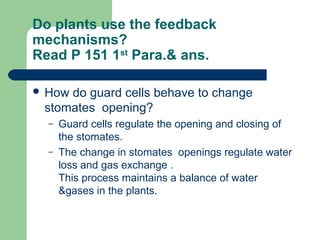
Do plants use the feedback
mechanisms?
Read P 151 1st Para.& ans.

 Howdo guard cells behave to change
 stomates opening?
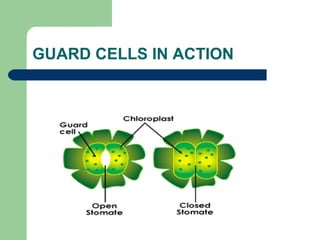
  –   Guard cells regulate the opening and closing of
      the stomates.
  –   The change in stomates openings regulate water
      loss and gas exchange .
      This process maintains a balance of water
      &gases in the plants.
GUARD CELLS IN ACTION

Topic feedback mechanism

  • 1.
    Topic: Feedback Mechanism. Aim:How do organisms use the feedback mechanism to maintain homeostasis?  Do now: Read P 150 & ans.  Why do organisms use the feedback mechanism?  Organisms use the feedback mechanism to detect changes from the normal conditions & correct them returning the body to normal state. (homeostasis).
  • 2.
    What is thefeedback mechanism ?  Read p. 150 2nd Para.& ans. What is the feedback mechanism? It is a self- regulating system.  Give an example to explain this system. An increase in body temperature is sensed by the brain. The brain will send a message to the sweat glands of the skin to produce sweat. Evaporation of the sweat from the body will lower body temperature.
  • 3.
    Have you heardof the Negative feedback mechanism?  Read P150 3rd Para, & ans.  Write two facts about the negative feedback mechanism.  The secretion of hormones by the endocrine system is regulated by the negative feedback mechanism.  The level of one hormone in the blood stimulates or inhibits the production of another.  Study Fig. 17-5 summarize what you learned.
  • 4.
    What are otherexamples of feedback mechanisms that maintain homeostasis? Check P150 3rd Para.  Changes in heart rate or respiratory rate in response to increased activity in muscle cells.  The maintenance of blood sugar levels by insulin from the pancreas.
  • 5.
    Do plants usethe feedback mechanisms? Read P 151 1st Para.& ans.  Howdo guard cells behave to change stomates opening? – Guard cells regulate the opening and closing of the stomates. – The change in stomates openings regulate water loss and gas exchange . This process maintains a balance of water &gases in the plants.
  • 6.