STRUCTURAL
FUNCTIONALSIM
MR. DANILO F. MARIBAO
Paliparan III Senior High School
Dasmarinas City, Cavite
REVIEW
1. Study of ancient societies
and their cultural traditions.
2. Also called as biological
anthropology – studies the
biological evolution of
man.
3. The branch of anthropology
concerned with the study of
human societies and cultures
and their development.
4. Which deals with the place
of language in its wider social
and cultural context, and its
role in making and maintaining
cultural practices and societal
structures.
5. The study of the
characteristics of various
people and the differences
and relationships between
them.
ANSWERS:
1. Anthropology
2. Physical anthropology
3. Cultural anthropology
4. Anthropological Linguistics
5. Ethnology
ACTIVITY
In groups, you are tasked to organize a
community .
On a piece of cartolina or manila paper,
draw a community comprised of different
institutions.
Be ready to explain your answer why you
choose the institutions and how do they
function in the community
ANALYSIS
How did you find the activity?
How did you feel while doing the activity?
How did you structure your community?
What did you prioritize in your choice of
institution?
How did the structures “function” in the society?
Have you heard of the Structural Functionalism
Theory?
ABSTRACTION
Focus: The organization of society and the relationships
between broad social units, such as Institutions. The group
is the unit of analysis.
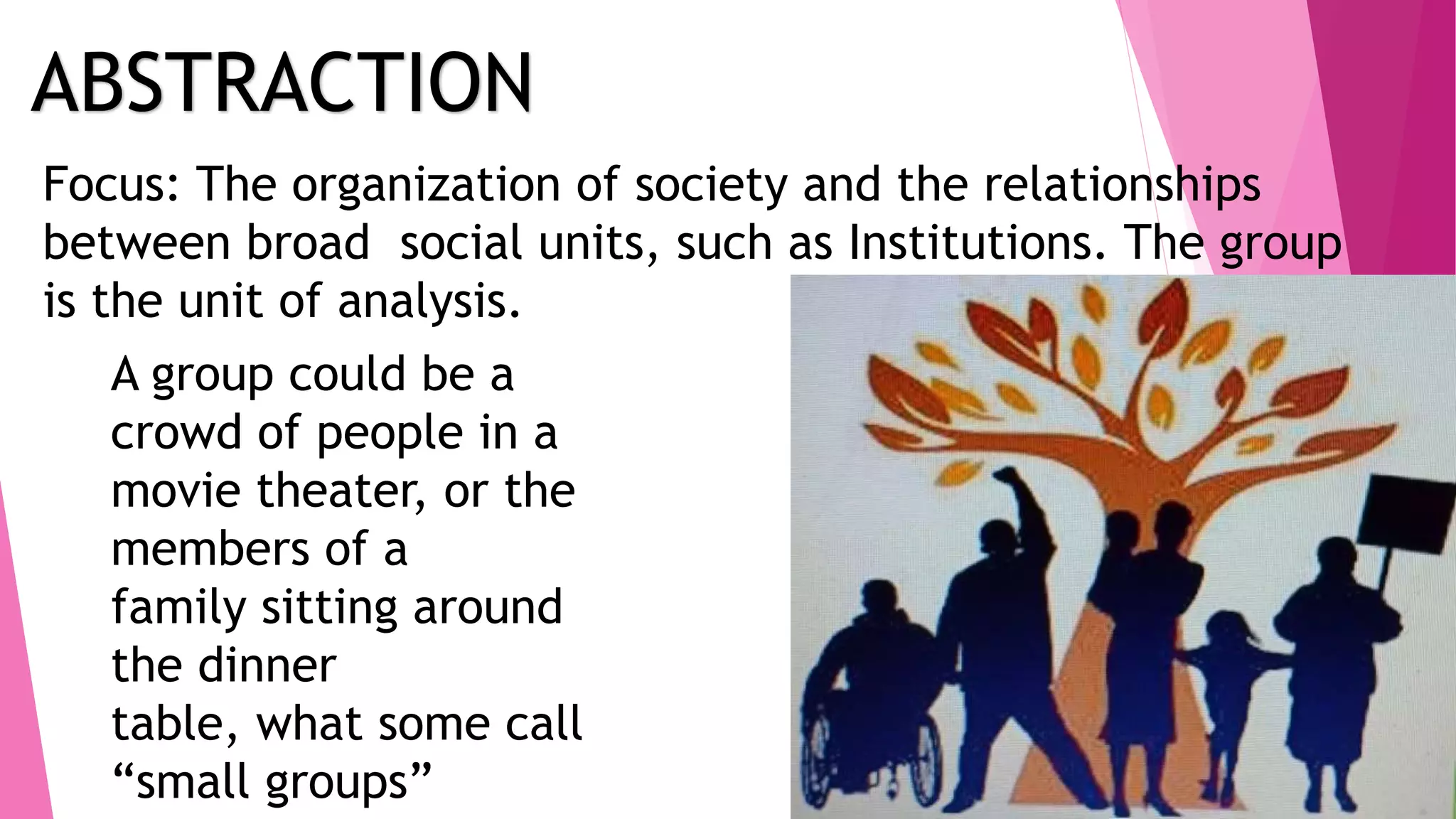
A group could be a
crowd of people in a
movie theater, or the
members of a
family sitting around
the dinner
table, what some call
“small groups”
Structural -Functionalism
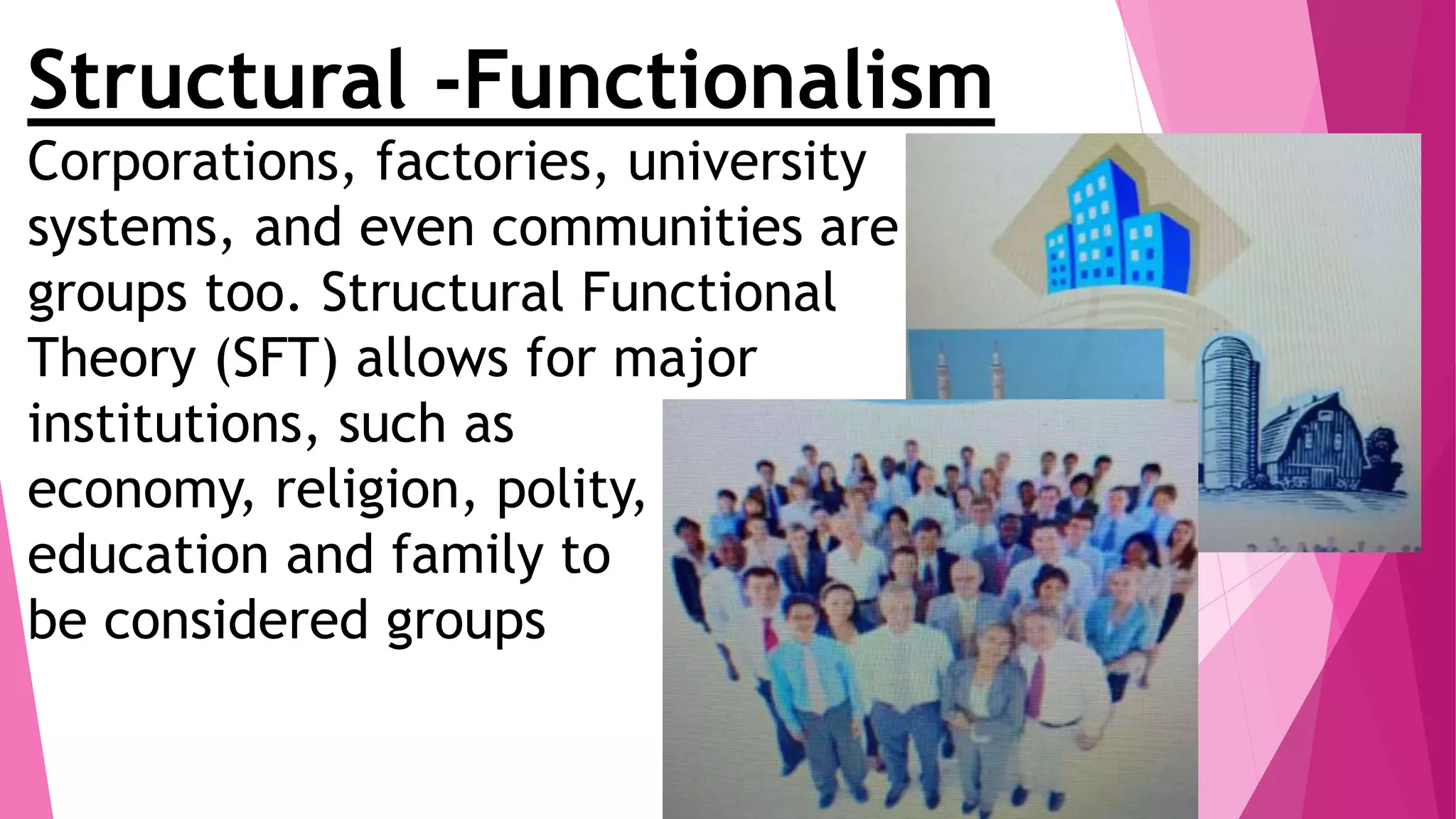
Corporations, factories, university
systems, and even communities are
groups too. Structural Functional
Theory (SFT) allows for major
institutions, such as
economy, religion, polity,
education and family to
be considered groups
Structural- Functionalism
Background and History
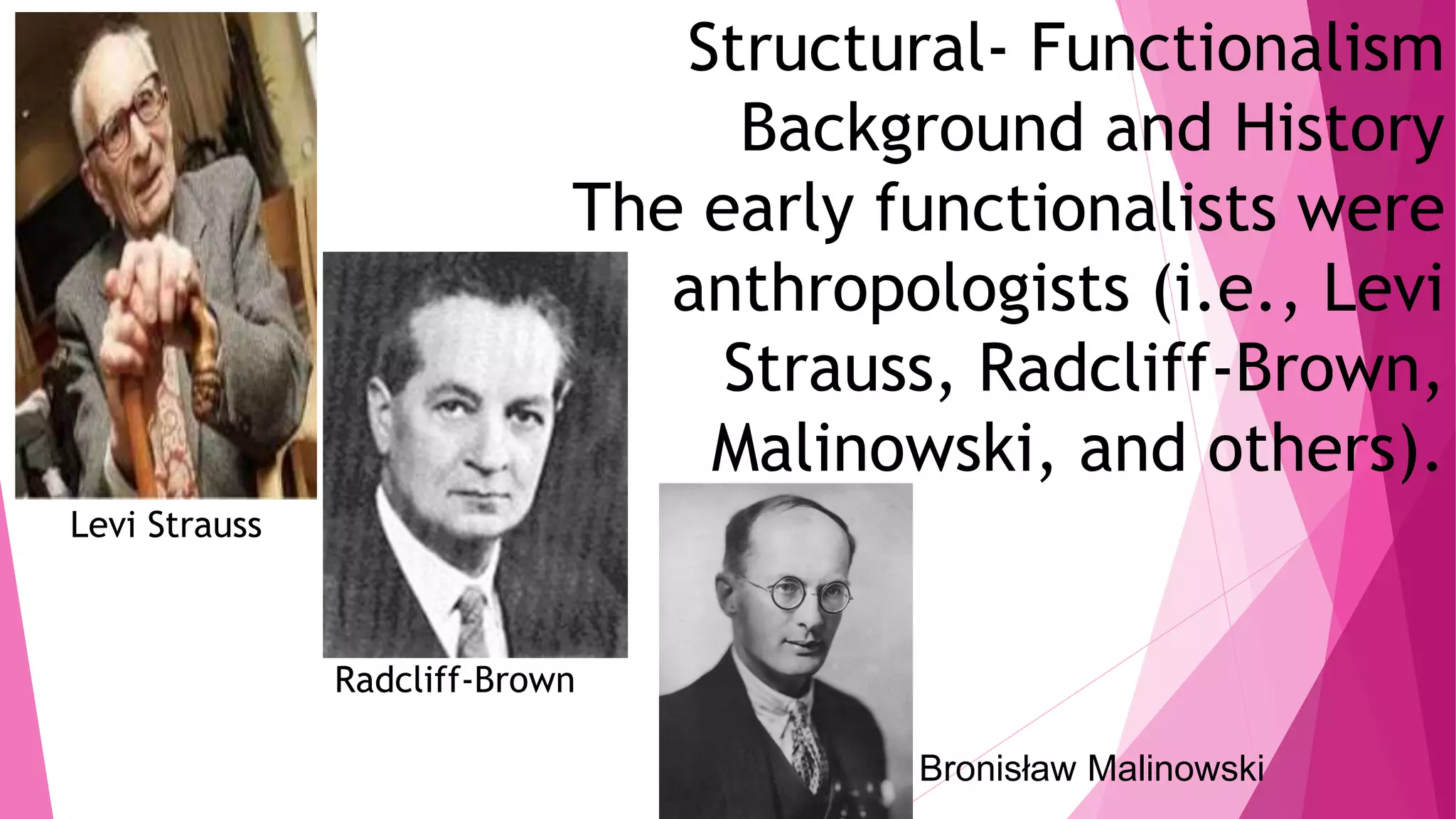
The early functionalists were
anthropologists (i.e., Levi
Strauss, Radcliff-Brown,
Malinowski, and others).
Levi Strauss
Radcliff-Brown
Bronisław Malinowski
They were seminal thinkers
of the middle 1800s who
made direct observations
of primitive cultures, theorizing
about the organization of these
folk in relation to Western society.
Their theories were often quite
simple and required only a few assumptions. The
point they were making was this: Individual and
group behaviour, more often than not, serves a
FUNCTION for the larger society.
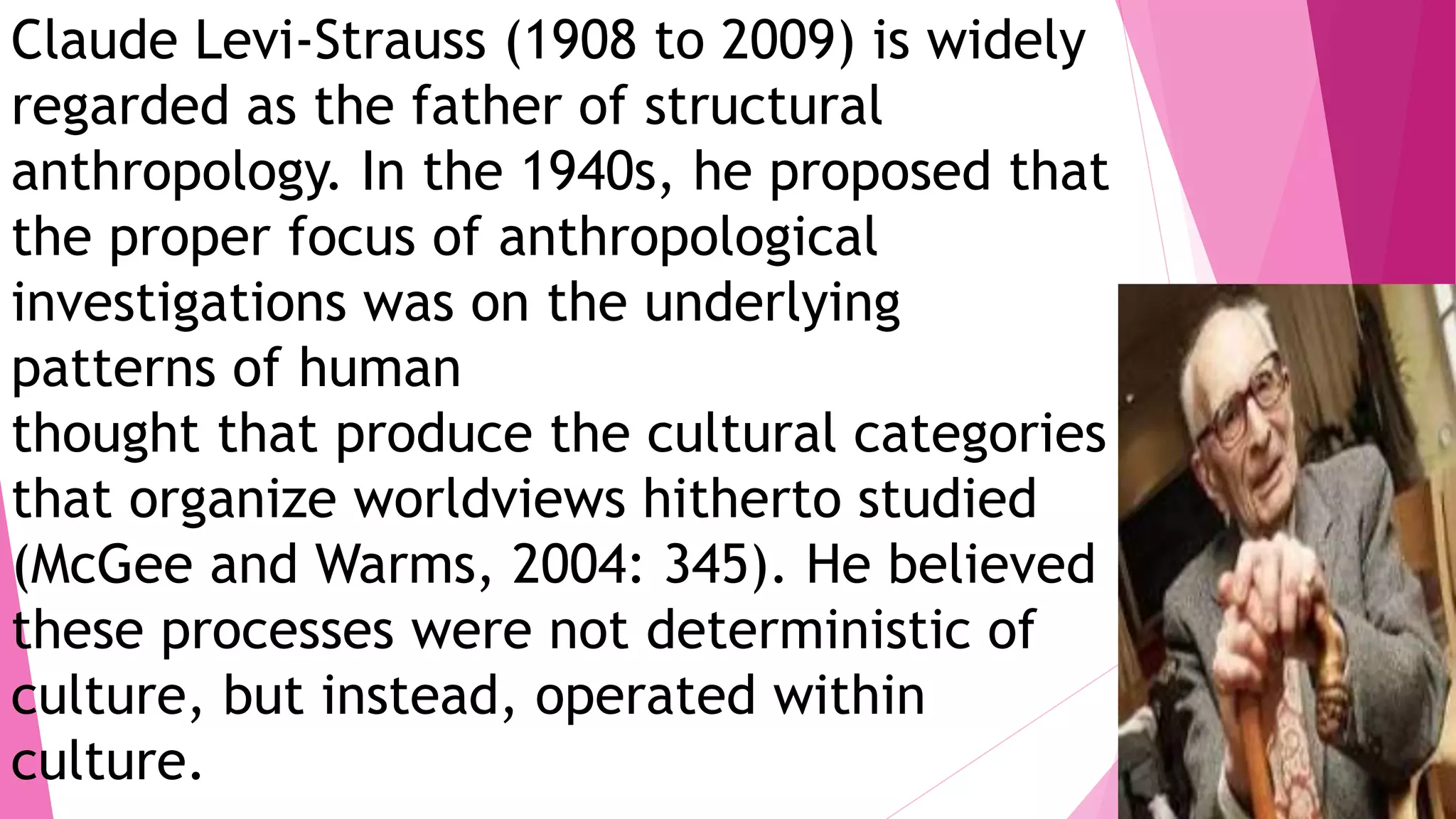
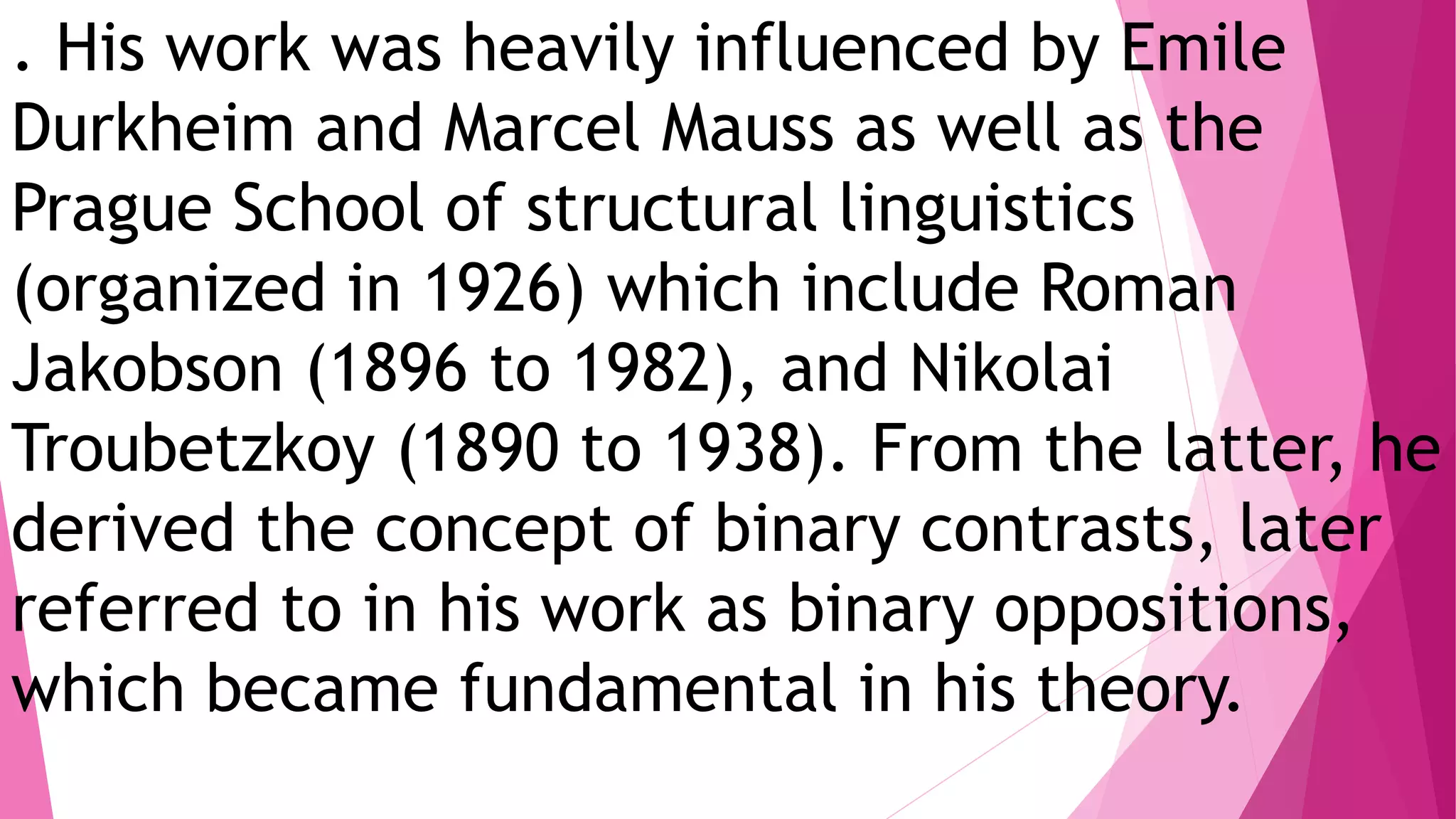
Claude Levi-Strauss (1908 to 2009) is widely
regarded as the father of structural
anthropology. In the 1940s, he proposed that
the proper focus of anthropological
investigations was on the underlying
patterns of human
thought that produce the cultural categories
that organize worldviews hitherto studied
(McGee and Warms, 2004: 345). He believed
these processes were not deterministic of
culture, but instead, operated within
culture.
. His work was heavily influenced by Emile
Durkheim and Marcel Mauss as well as the
Prague School of structural linguistics
(organized in 1926) which include Roman
Jakobson (1896 to 1982), and Nikolai
Troubetzkoy (1890 to 1938). From the latter, he
derived the concept of binary contrasts, later
referred to in his work as binary oppositions,
which became fundamental in his theory.
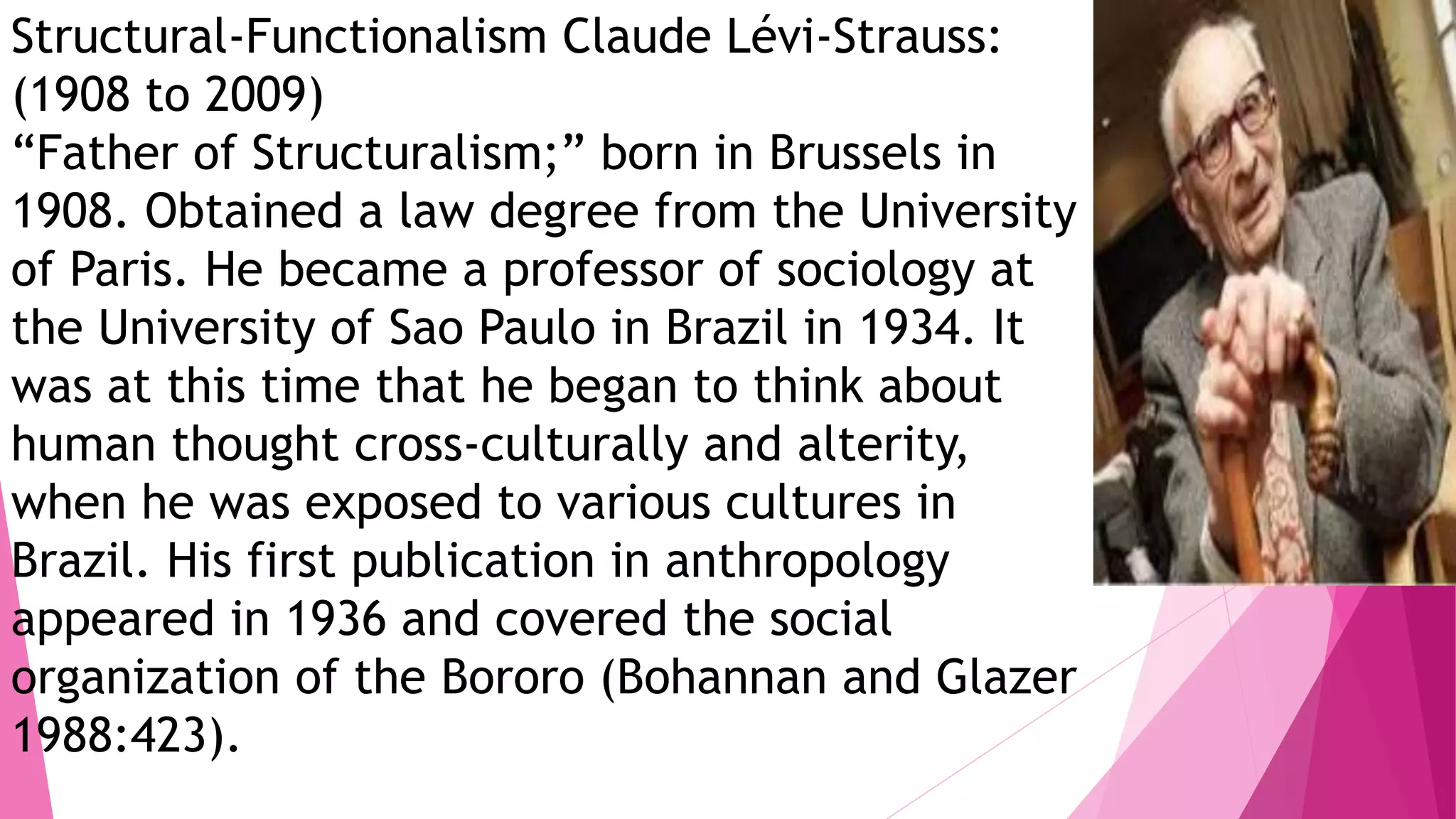
Structural-Functionalism Claude Lévi-Strauss:
(1908 to 2009)
“Father of Structuralism;” born in Brussels in
1908. Obtained a law degree from the University
of Paris. He became a professor of sociology at
the University of Sao Paulo in Brazil in 1934. It
was at this time that he began to think about
human thought cross-culturally and alterity,
when he was exposed to various cultures in
Brazil. His first publication in anthropology
appeared in 1936 and covered the social
organization of the Bororo (Bohannan and Glazer
1988:423).
After WWII, he taught at the New
School for Social Research in New
York. There he met Roman Jakobson,
from whom he took the structural
linguistics model and applied its
framework to culture (Bohannan and
Glazer 1988:423). Lévi-Strauss has
been noted as singly associated for
the elaboration of the structuralist
paradigm in anthropology (Winthrop
1991).
Structural-Functionalism
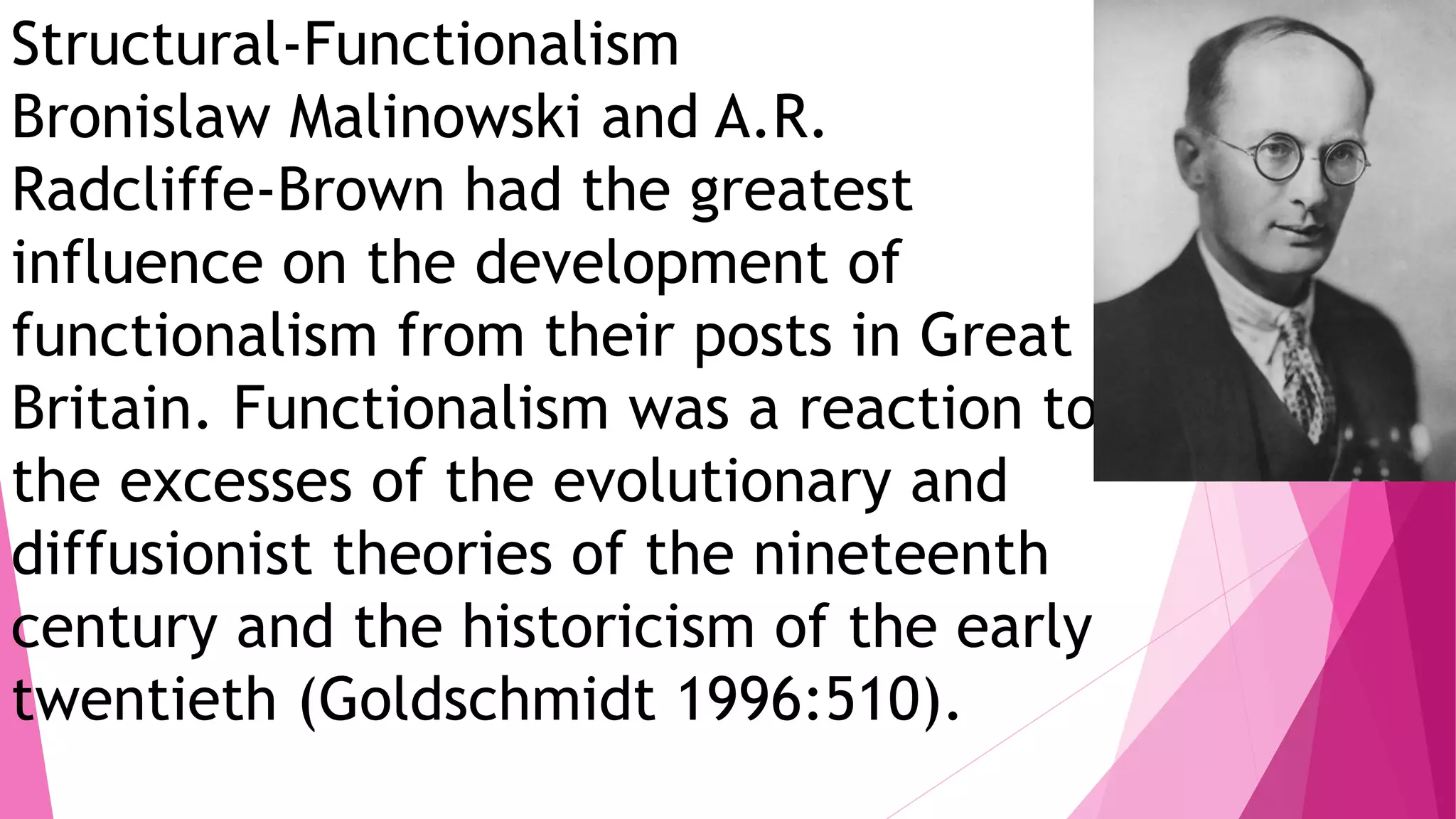
Bronislaw Malinowski and A.R.
Radcliffe-Brown had the greatest
influence on the development of
functionalism from their posts in Great
Britain. Functionalism was a reaction to
the excesses of the evolutionary and
diffusionist theories of the nineteenth
century and the historicism of the early
twentieth (Goldschmidt 1996:510).
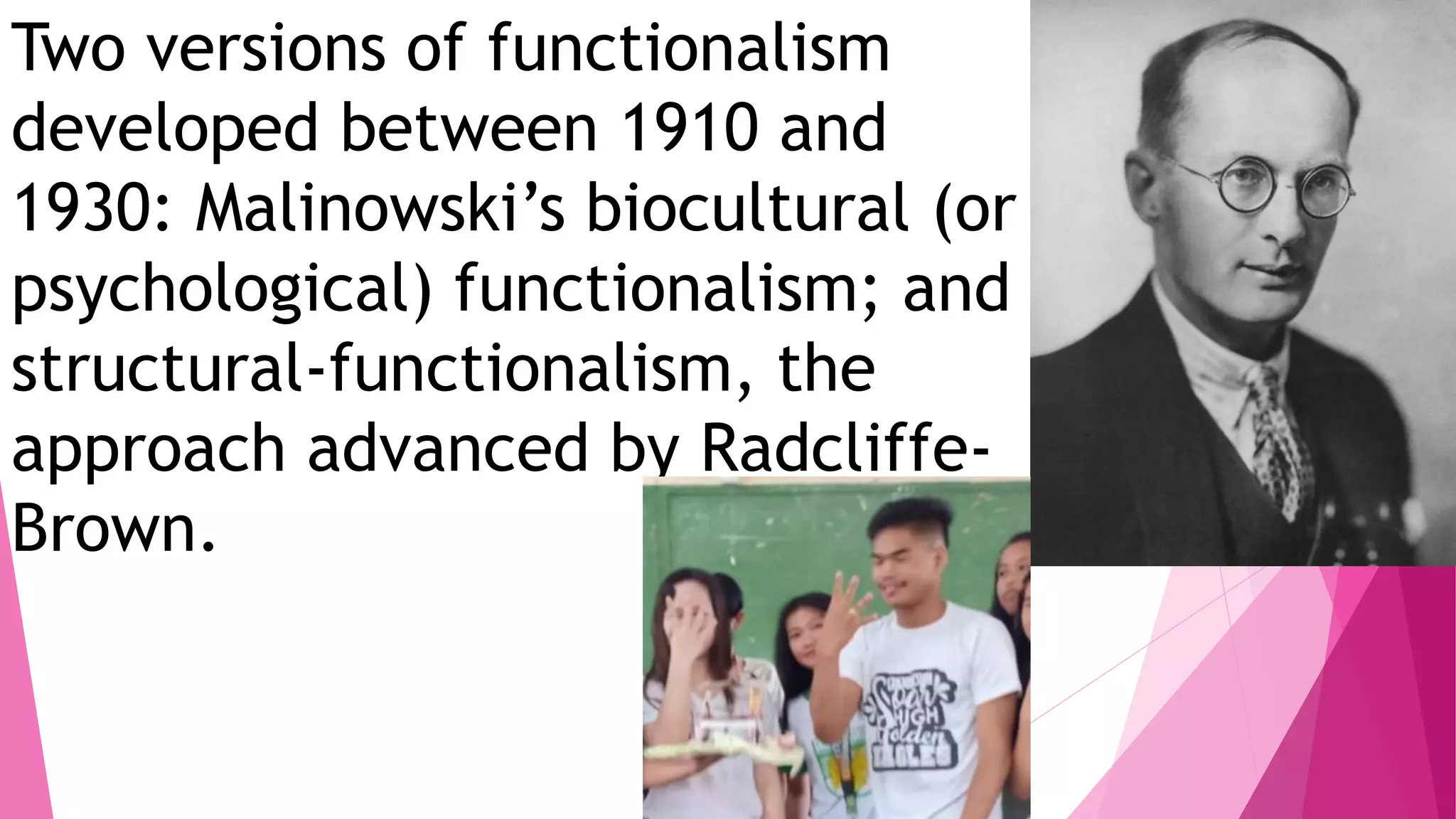
Two versions of functionalism
developed between 1910 and
1930: Malinowski’s biocultural (or
psychological) functionalism; and
structural-functionalism, the
approach advanced by Radcliffe-
Brown.
Malinowski suggested that
individuals
have physiological needs
(reproduction, food, shelter) and
that social Institutions exist to
meet these needs. There are also culturally
derived needs and four basic "instrumental needs"
(economics, social control, education, and political
organization), that require institutional devices. Each
institution has personnel, a charter, a set of norms or rules,
activities, material apparatus (technology), and a function.
Structural-Functionalism
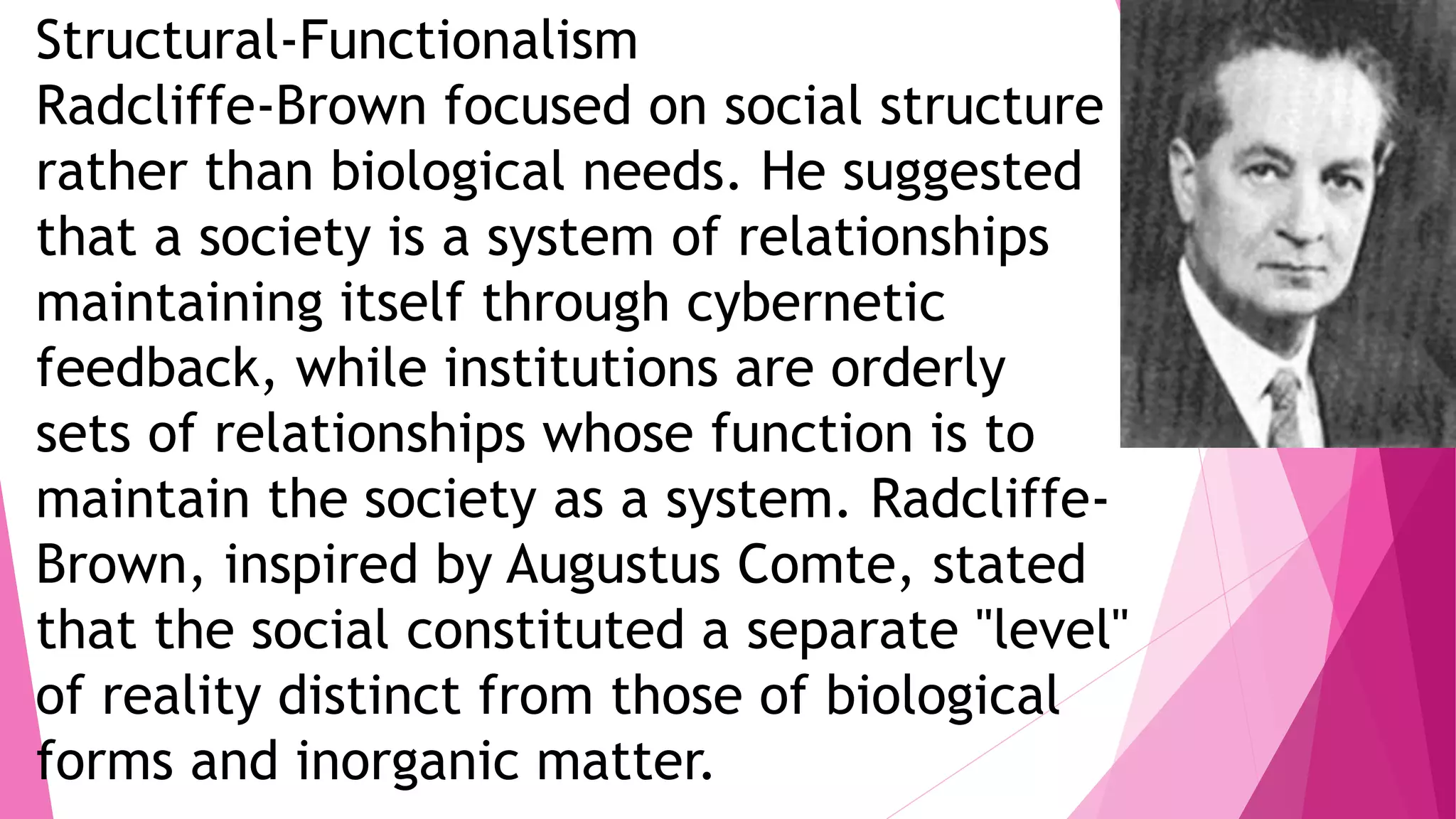
Radcliffe-Brown focused on social structure
rather than biological needs. He suggested
that a society is a system of relationships
maintaining itself through cybernetic
feedback, while institutions are orderly
sets of relationships whose function is to
maintain the society as a system. Radcliffe-
Brown, inspired by Augustus Comte, stated
that the social constituted a separate "level"
of reality distinct from those of biological
forms and inorganic matter.
Structural-Functionalism
Radcliffe-Brown argued that explanations
of social phenomena had to be
constructed within the social level. Thus,
individuals were replaceable, transient
occupants of social roles. Unlike
Malinowski's emphasis on individuals,
Radcliffe Brown considered individuals
irrelevant (Goldschmidt 1996:510).
Structural Functionalism
The Functionalists Perspectives
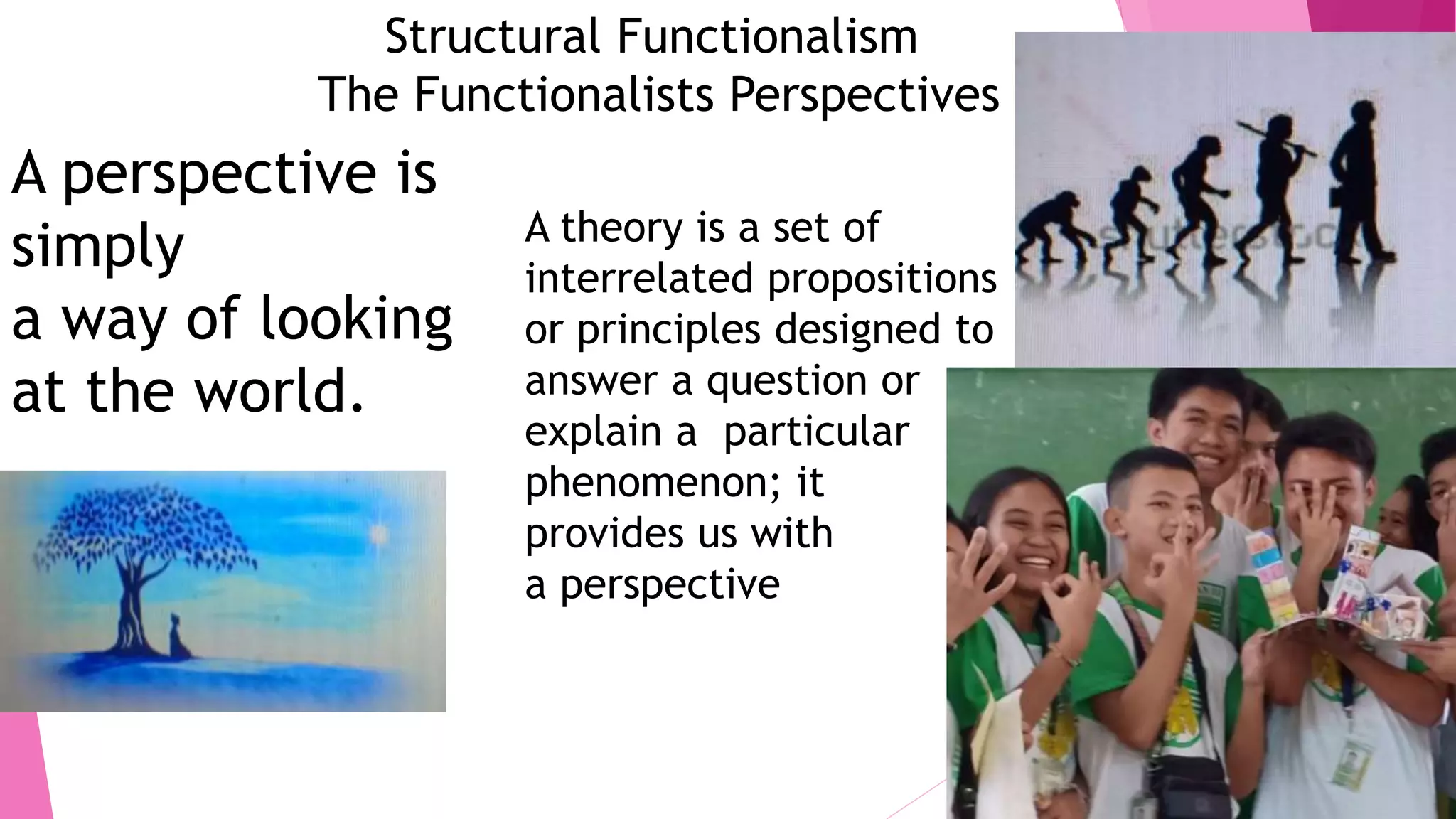
A perspective is
simply
a way of looking
at the world.
A theory is a set of
interrelated propositions
or principles designed to
answer a question or
explain a particular
phenomenon; it
provides us with
a perspective
The Functionalists Perspectives
Sociological theories - help us to explain and
predict the social world in which we live in.
The Functionalists Perspectives is based largely on
the works of Herbert Spencer, Emile Durkheim,
Talcott Parsons, and Robert Merton. According to
Functionalism, society is a system of
interconnected parts that work together in
harmony to maintain a state of balance and social
equilibrium for the whole.
The Functionalists Perspectives
For example: Each of the social institutions contributes
important functions for society: family provides a
context for reproducing, nurturing, and socializing
children. Education offers a way to transmit a society’s
skills, knowledge, and culture to its youth. Politics
provides a means of governing members of society.
Economics provides for the production, distribution, and
consumption of goods and services. And religion provides
moral guidance and an outlet for worship of a higher
power.
The Functionalists perspectives
emphasizes the interconnectedness
of society by focusing on how each
part influences and is influenced by
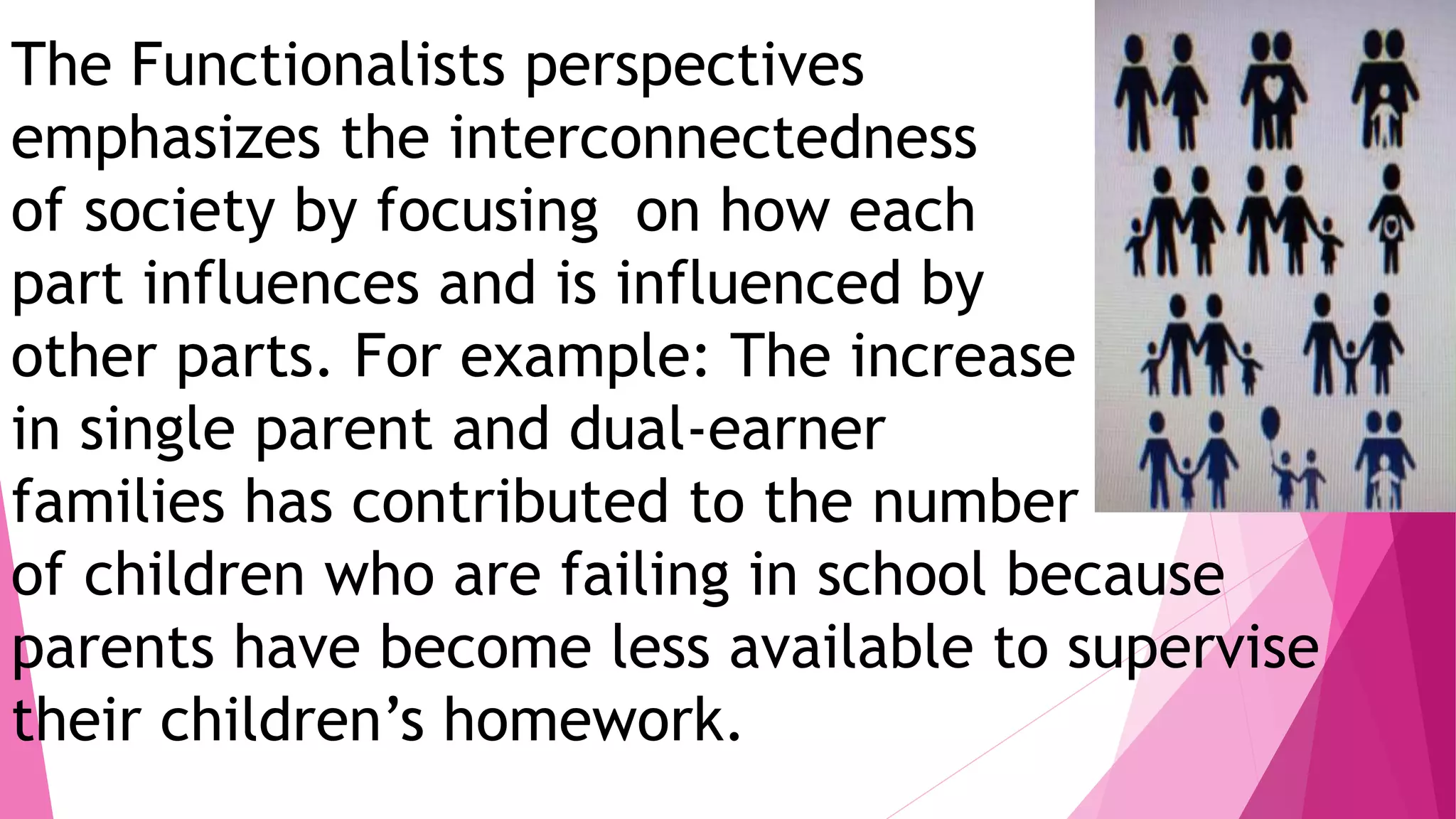
other parts. For example: The increase
in single parent and dual-earner
families has contributed to the number
of children who are failing in school because
parents have become less available to supervise
their children’s homework.
The Functionalists Perspectives
For example: As a result of changes in technology,
colleges are offering more technical programs, and
many adults are returning to school to learn new skills
that are required in the workplace.
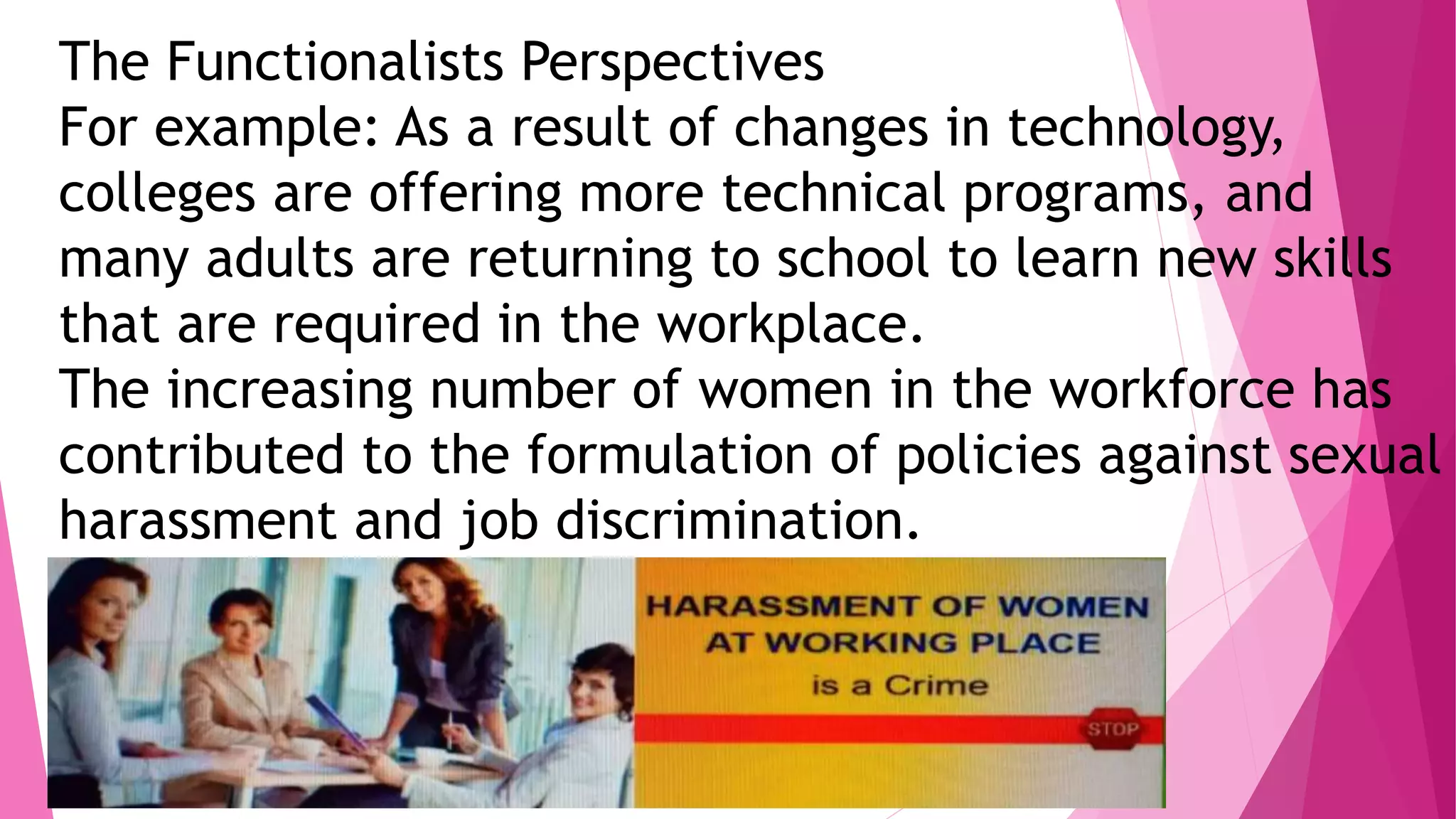
The increasing number of women in the workforce has
contributed to the formulation of policies against sexual
harassment and job discrimination.
Structural Functionalism The
Functionalists Perspectives Functionalists
use the terms functional and
dysfunctional to describe the effects of
social elements on society. or Elements of
society are functional if they contribute
to social stability.
o They are dysfunctional if they disrupt
social stability.
The Functionalists Perspectives
Some aspects of society can be both functional
and dysfunctional. For example, crime is
dysfunctional in that it is associated with physical
violence, loss of property, and fear. But according
to Durkheim and other functionalists, crime is also
functional for society because it leads to
heightened awareness of shared moral bonds and
increased social cohesion. Sociologists have
identified two types of functions: manifest and
latent (Merton 1968).
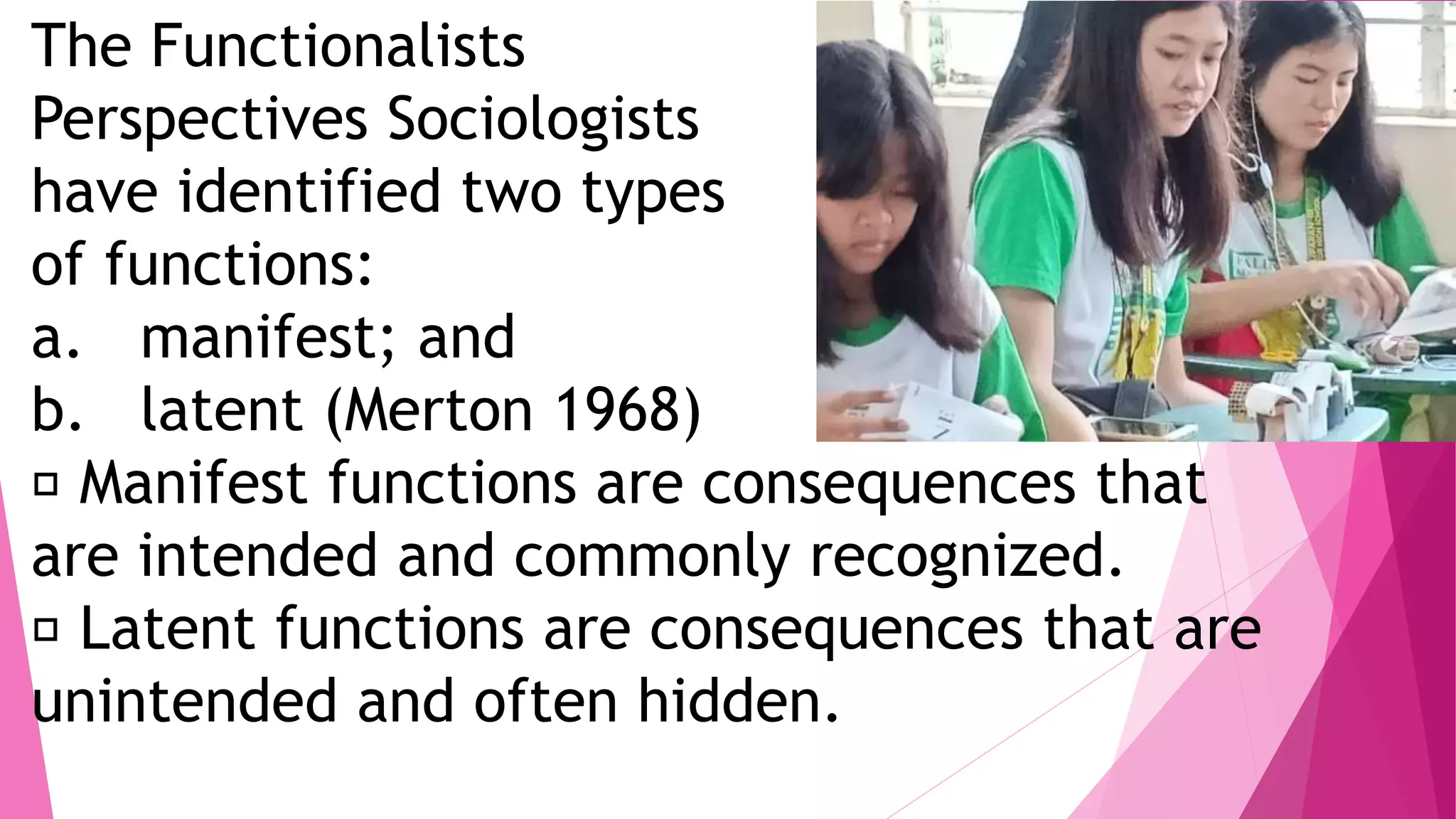
The Functionalists
Perspectives Sociologists
have identified two types
of functions:
a. manifest; and
b. latent (Merton 1968)
Manifest functions are consequences that
are intended and commonly recognized.
Latent functions are consequences that are
unintended and often hidden.
The Functionalists Perspectives
For example: The manifest function of education
is to transmit knowledge and skills to society’s
youth. But public elementary schools also serve as
babysitters for employed parents, and colleges
offer a place for young adults to meet potential
mates. The baby-sitting and mate-selection
functions are not the intended or commonly
recognized functions of education; hence they are
latent functions
Structural Functionalism
For sociology, many of these functional anthropological
notions were drawn together by Talcott Parsons, a young
professor at Harvard University around 1950, with
considerable input from early social philosophers Max
Weber, Herbert Spencer, and Emile Durkheim. Parsons'
work was further extended by subsequent sociologists of
the time and after. Structural-functional theory became
the paradigm theory in sociology for about twenty years
or so, because it saliently defined society as a system
with checks and balances.
Discuss Merton’s concept of Manifest and
Latent Functions and Dysfunctions of
sociocultural phenomena
APPLICATION

Topic 4 structural functionalism

  • 1.
    STRUCTURAL FUNCTIONALSIM MR. DANILO F.MARIBAO Paliparan III Senior High School Dasmarinas City, Cavite
  • 2.
  • 3.
    1. Study ofancient societies and their cultural traditions.
  • 4.
    2. Also calledas biological anthropology – studies the biological evolution of man.
  • 5.
    3. The branchof anthropology concerned with the study of human societies and cultures and their development.
  • 6.
    4. Which dealswith the place of language in its wider social and cultural context, and its role in making and maintaining cultural practices and societal structures.
  • 7.
    5. The studyof the characteristics of various people and the differences and relationships between them.
  • 8.
    ANSWERS: 1. Anthropology 2. Physicalanthropology 3. Cultural anthropology 4. Anthropological Linguistics 5. Ethnology
  • 9.
    ACTIVITY In groups, youare tasked to organize a community . On a piece of cartolina or manila paper, draw a community comprised of different institutions. Be ready to explain your answer why you choose the institutions and how do they function in the community
  • 10.
    ANALYSIS How did youfind the activity? How did you feel while doing the activity? How did you structure your community? What did you prioritize in your choice of institution? How did the structures “function” in the society? Have you heard of the Structural Functionalism Theory?
  • 11.
    ABSTRACTION Focus: The organizationof society and the relationships between broad social units, such as Institutions. The group is the unit of analysis. A group could be a crowd of people in a movie theater, or the members of a family sitting around the dinner table, what some call “small groups”
  • 12.
    Structural -Functionalism Corporations, factories,university systems, and even communities are groups too. Structural Functional Theory (SFT) allows for major institutions, such as economy, religion, polity, education and family to be considered groups
  • 13.
    Structural- Functionalism Background andHistory The early functionalists were anthropologists (i.e., Levi Strauss, Radcliff-Brown, Malinowski, and others). Levi Strauss Radcliff-Brown Bronisław Malinowski
  • 14.
    They were seminalthinkers of the middle 1800s who made direct observations of primitive cultures, theorizing about the organization of these folk in relation to Western society. Their theories were often quite simple and required only a few assumptions. The point they were making was this: Individual and group behaviour, more often than not, serves a FUNCTION for the larger society.
  • 15.
    Claude Levi-Strauss (1908to 2009) is widely regarded as the father of structural anthropology. In the 1940s, he proposed that the proper focus of anthropological investigations was on the underlying patterns of human thought that produce the cultural categories that organize worldviews hitherto studied (McGee and Warms, 2004: 345). He believed these processes were not deterministic of culture, but instead, operated within culture.
  • 16.
    . His workwas heavily influenced by Emile Durkheim and Marcel Mauss as well as the Prague School of structural linguistics (organized in 1926) which include Roman Jakobson (1896 to 1982), and Nikolai Troubetzkoy (1890 to 1938). From the latter, he derived the concept of binary contrasts, later referred to in his work as binary oppositions, which became fundamental in his theory.
  • 17.
    Structural-Functionalism Claude Lévi-Strauss: (1908to 2009) “Father of Structuralism;” born in Brussels in 1908. Obtained a law degree from the University of Paris. He became a professor of sociology at the University of Sao Paulo in Brazil in 1934. It was at this time that he began to think about human thought cross-culturally and alterity, when he was exposed to various cultures in Brazil. His first publication in anthropology appeared in 1936 and covered the social organization of the Bororo (Bohannan and Glazer 1988:423).
  • 18.
    After WWII, hetaught at the New School for Social Research in New York. There he met Roman Jakobson, from whom he took the structural linguistics model and applied its framework to culture (Bohannan and Glazer 1988:423). Lévi-Strauss has been noted as singly associated for the elaboration of the structuralist paradigm in anthropology (Winthrop 1991).
  • 19.
    Structural-Functionalism Bronislaw Malinowski andA.R. Radcliffe-Brown had the greatest influence on the development of functionalism from their posts in Great Britain. Functionalism was a reaction to the excesses of the evolutionary and diffusionist theories of the nineteenth century and the historicism of the early twentieth (Goldschmidt 1996:510).
  • 20.
    Two versions offunctionalism developed between 1910 and 1930: Malinowski’s biocultural (or psychological) functionalism; and structural-functionalism, the approach advanced by Radcliffe- Brown.
  • 21.
    Malinowski suggested that individuals havephysiological needs (reproduction, food, shelter) and that social Institutions exist to meet these needs. There are also culturally derived needs and four basic "instrumental needs" (economics, social control, education, and political organization), that require institutional devices. Each institution has personnel, a charter, a set of norms or rules, activities, material apparatus (technology), and a function.
  • 22.
    Structural-Functionalism Radcliffe-Brown focused onsocial structure rather than biological needs. He suggested that a society is a system of relationships maintaining itself through cybernetic feedback, while institutions are orderly sets of relationships whose function is to maintain the society as a system. Radcliffe- Brown, inspired by Augustus Comte, stated that the social constituted a separate "level" of reality distinct from those of biological forms and inorganic matter.
  • 23.
    Structural-Functionalism Radcliffe-Brown argued thatexplanations of social phenomena had to be constructed within the social level. Thus, individuals were replaceable, transient occupants of social roles. Unlike Malinowski's emphasis on individuals, Radcliffe Brown considered individuals irrelevant (Goldschmidt 1996:510).
  • 24.
    Structural Functionalism The FunctionalistsPerspectives A perspective is simply a way of looking at the world. A theory is a set of interrelated propositions or principles designed to answer a question or explain a particular phenomenon; it provides us with a perspective
  • 25.
    The Functionalists Perspectives Sociologicaltheories - help us to explain and predict the social world in which we live in. The Functionalists Perspectives is based largely on the works of Herbert Spencer, Emile Durkheim, Talcott Parsons, and Robert Merton. According to Functionalism, society is a system of interconnected parts that work together in harmony to maintain a state of balance and social equilibrium for the whole.
  • 26.
    The Functionalists Perspectives Forexample: Each of the social institutions contributes important functions for society: family provides a context for reproducing, nurturing, and socializing children. Education offers a way to transmit a society’s skills, knowledge, and culture to its youth. Politics provides a means of governing members of society. Economics provides for the production, distribution, and consumption of goods and services. And religion provides moral guidance and an outlet for worship of a higher power.
  • 27.
    The Functionalists perspectives emphasizesthe interconnectedness of society by focusing on how each part influences and is influenced by other parts. For example: The increase in single parent and dual-earner families has contributed to the number of children who are failing in school because parents have become less available to supervise their children’s homework.
  • 28.
    The Functionalists Perspectives Forexample: As a result of changes in technology, colleges are offering more technical programs, and many adults are returning to school to learn new skills that are required in the workplace. The increasing number of women in the workforce has contributed to the formulation of policies against sexual harassment and job discrimination.
  • 29.
    Structural Functionalism The FunctionalistsPerspectives Functionalists use the terms functional and dysfunctional to describe the effects of social elements on society. or Elements of society are functional if they contribute to social stability. o They are dysfunctional if they disrupt social stability.
  • 30.
    The Functionalists Perspectives Someaspects of society can be both functional and dysfunctional. For example, crime is dysfunctional in that it is associated with physical violence, loss of property, and fear. But according to Durkheim and other functionalists, crime is also functional for society because it leads to heightened awareness of shared moral bonds and increased social cohesion. Sociologists have identified two types of functions: manifest and latent (Merton 1968).
  • 31.
    The Functionalists Perspectives Sociologists haveidentified two types of functions: a. manifest; and b. latent (Merton 1968) Manifest functions are consequences that are intended and commonly recognized. Latent functions are consequences that are unintended and often hidden.
  • 32.
    The Functionalists Perspectives Forexample: The manifest function of education is to transmit knowledge and skills to society’s youth. But public elementary schools also serve as babysitters for employed parents, and colleges offer a place for young adults to meet potential mates. The baby-sitting and mate-selection functions are not the intended or commonly recognized functions of education; hence they are latent functions
  • 33.
    Structural Functionalism For sociology,many of these functional anthropological notions were drawn together by Talcott Parsons, a young professor at Harvard University around 1950, with considerable input from early social philosophers Max Weber, Herbert Spencer, and Emile Durkheim. Parsons' work was further extended by subsequent sociologists of the time and after. Structural-functional theory became the paradigm theory in sociology for about twenty years or so, because it saliently defined society as a system with checks and balances.
  • 34.
    Discuss Merton’s conceptof Manifest and Latent Functions and Dysfunctions of sociocultural phenomena APPLICATION