Good Morning Class
Here is where your presentation begins
WHAT WE HAVE LEARNED LAST
MEETIN?
INSTITUTIONALIS
M
Institutions are patterns, norms rules and
schemes that govern and direct social thought
and action.
Institutionalism, therefore, is an approach that
aims to understand and analyze how actions,
thoughts, and meanings penetrate into the
social consciousness deeply enough to embed
themselves into social psyche.
Institutions provide social legitimacy and
survival through Isomorphism. Isomorphism
refers to the similarity in form, shape or
structure. Institutions arise, change, and persist
due to their regulative, normative and cognitive
functions. These functions are isomorphic in
nature as they adopt in form, shape or structure
to provide social legitimacy, survival or both.
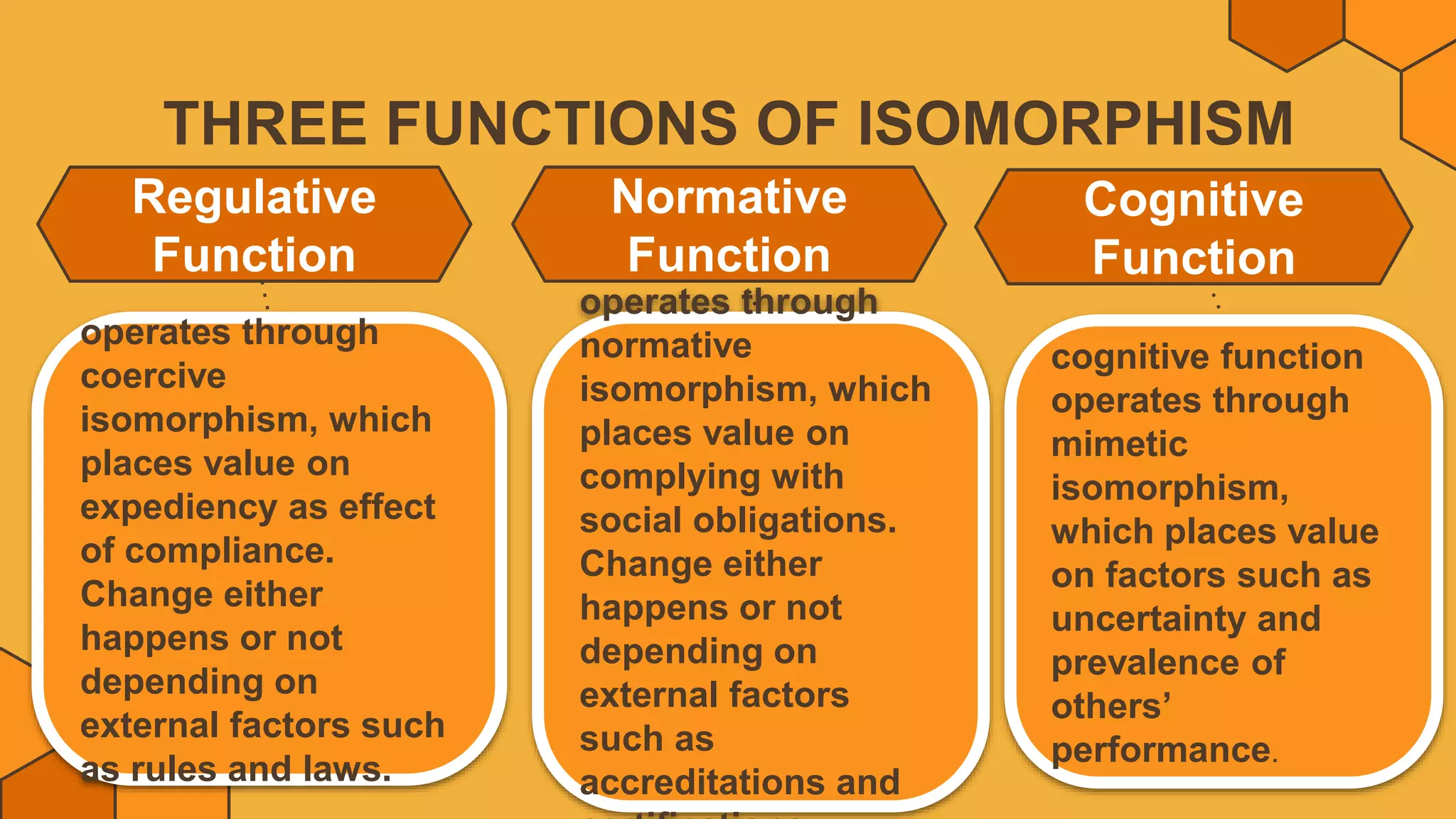
THREE FUNCTIONS OF ISOMORPHISM
operates through
coercive
isomorphism, which
places value on
expediency as effect
of compliance.
Change either
happens or not
depending on
external factors such
as rules and laws.
operates through
normative
isomorphism, which
places value on
complying with
social obligations.
Change either
happens or not
depending on
external factors
such as
accreditations and
cognitive function
operates through
mimetic
isomorphism,
which places value
on factors such as
uncertainty and
prevalence of
others’
performance.
Regulative
Function
Normative
Function
Cognitive
Function
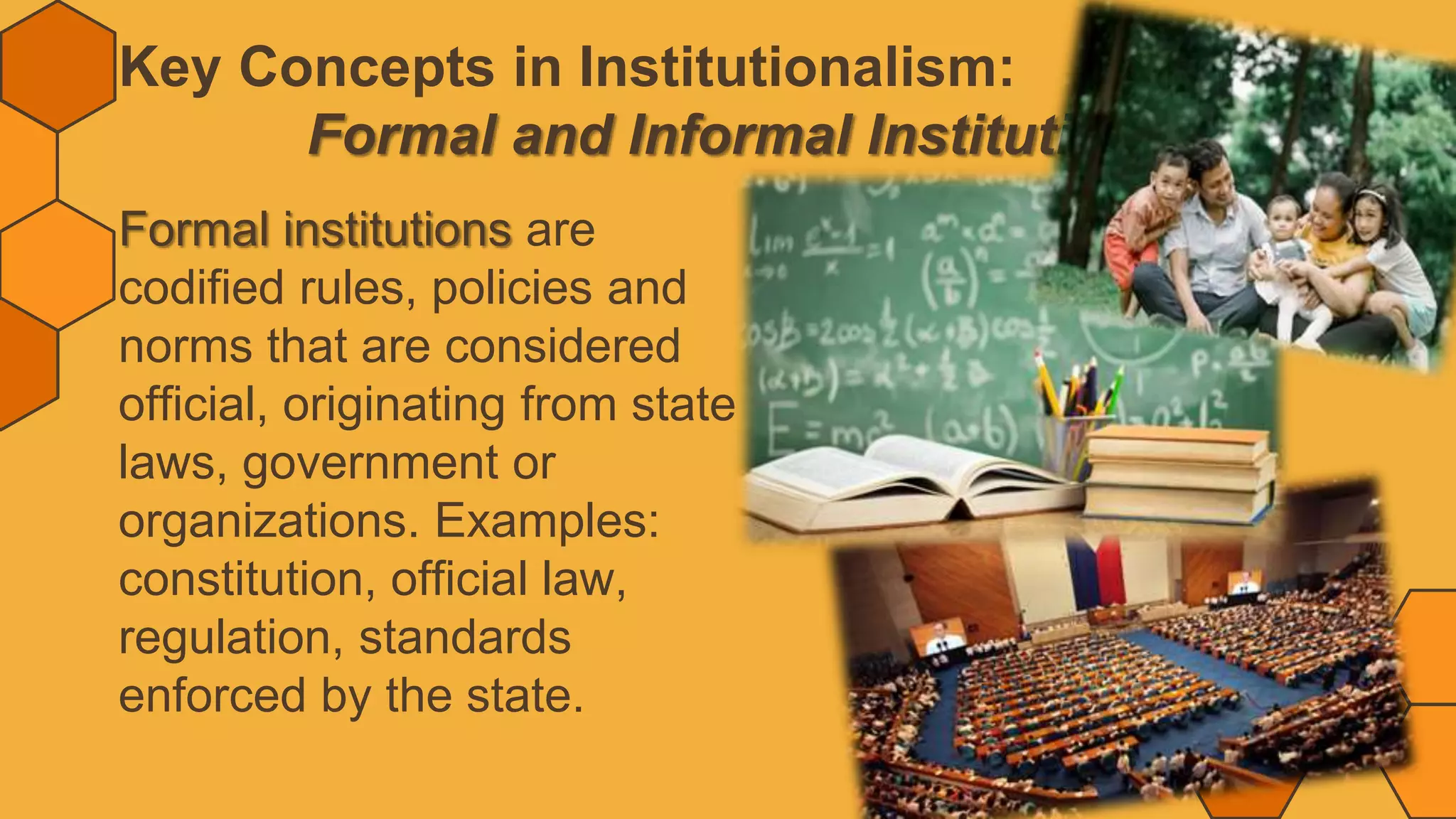
Key Concepts in Institutionalism:
Formal and Informal Institutions
Formal institutions are
codified rules, policies and
norms that are considered
official, originating from state
laws, government or
organizations. Examples:
constitution, official law,
regulation, standards
enforced by the state.
Key Concepts in Institutionalism:
Formal and Informal Institutions
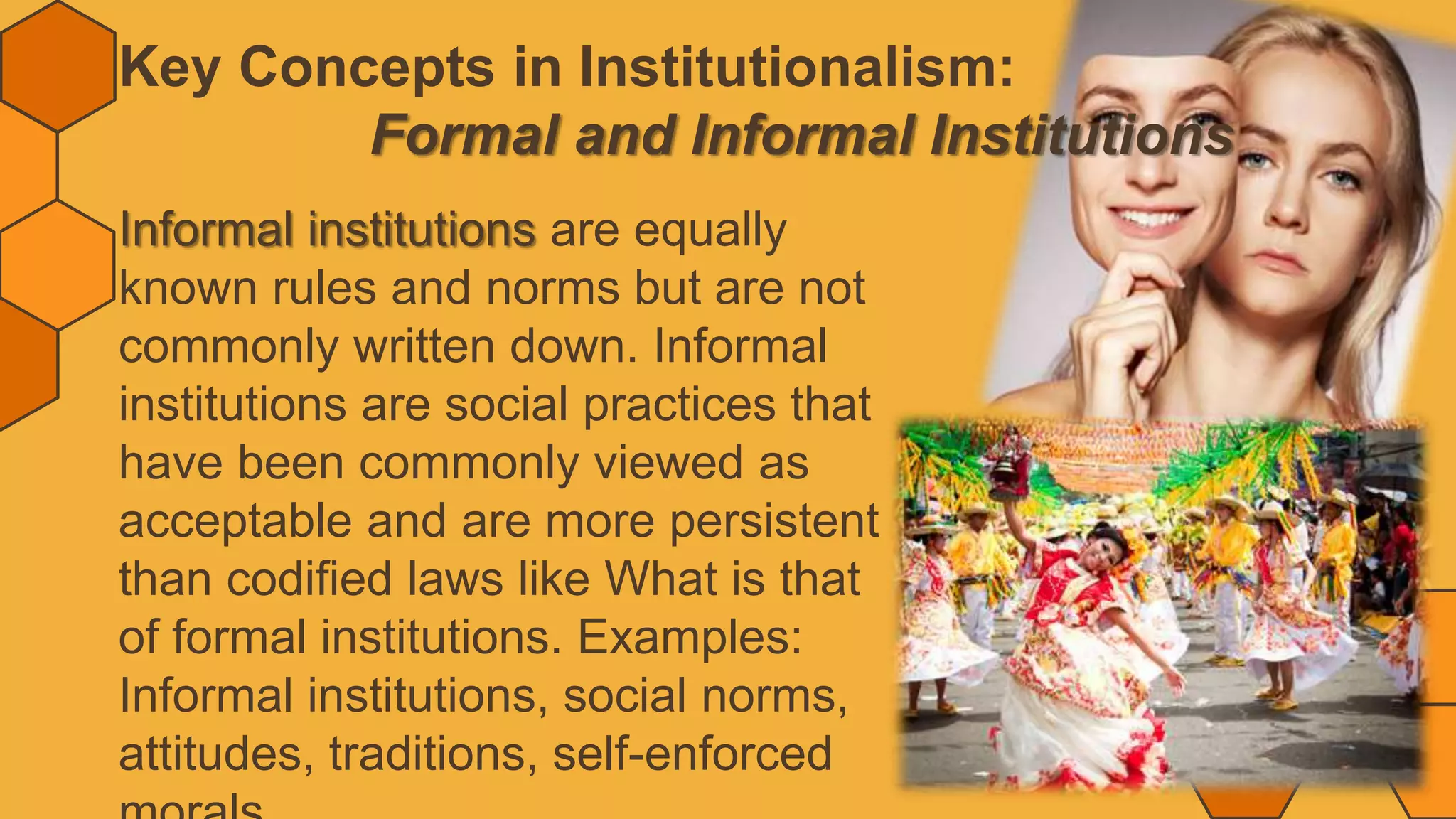
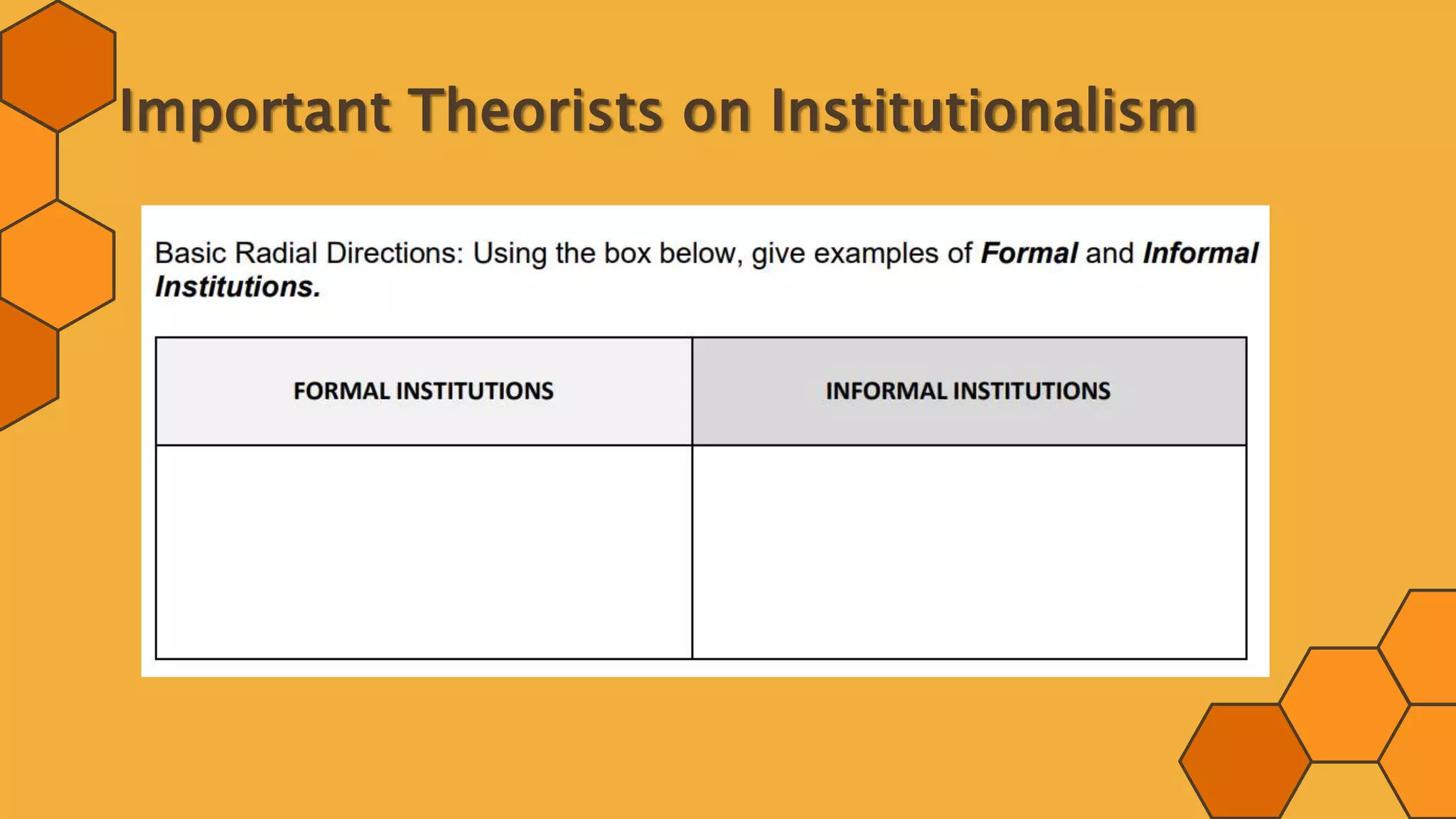
Informal institutions are equally
known rules and norms but are not
commonly written down. Informal
institutions are social practices that
have been commonly viewed as
acceptable and are more persistent
than codified laws like What is that
of formal institutions. Examples:
Informal institutions, social norms,
attitudes, traditions, self-enforced
Group yourselves according to
your field of interest.
Get one whole sheet of bond
paper.
If you were to create your own
institution what would it be.
Explain it in a 2 paragraphs with
illustrations.
You have 10 minutes to do the
TIMER STARTS NOW
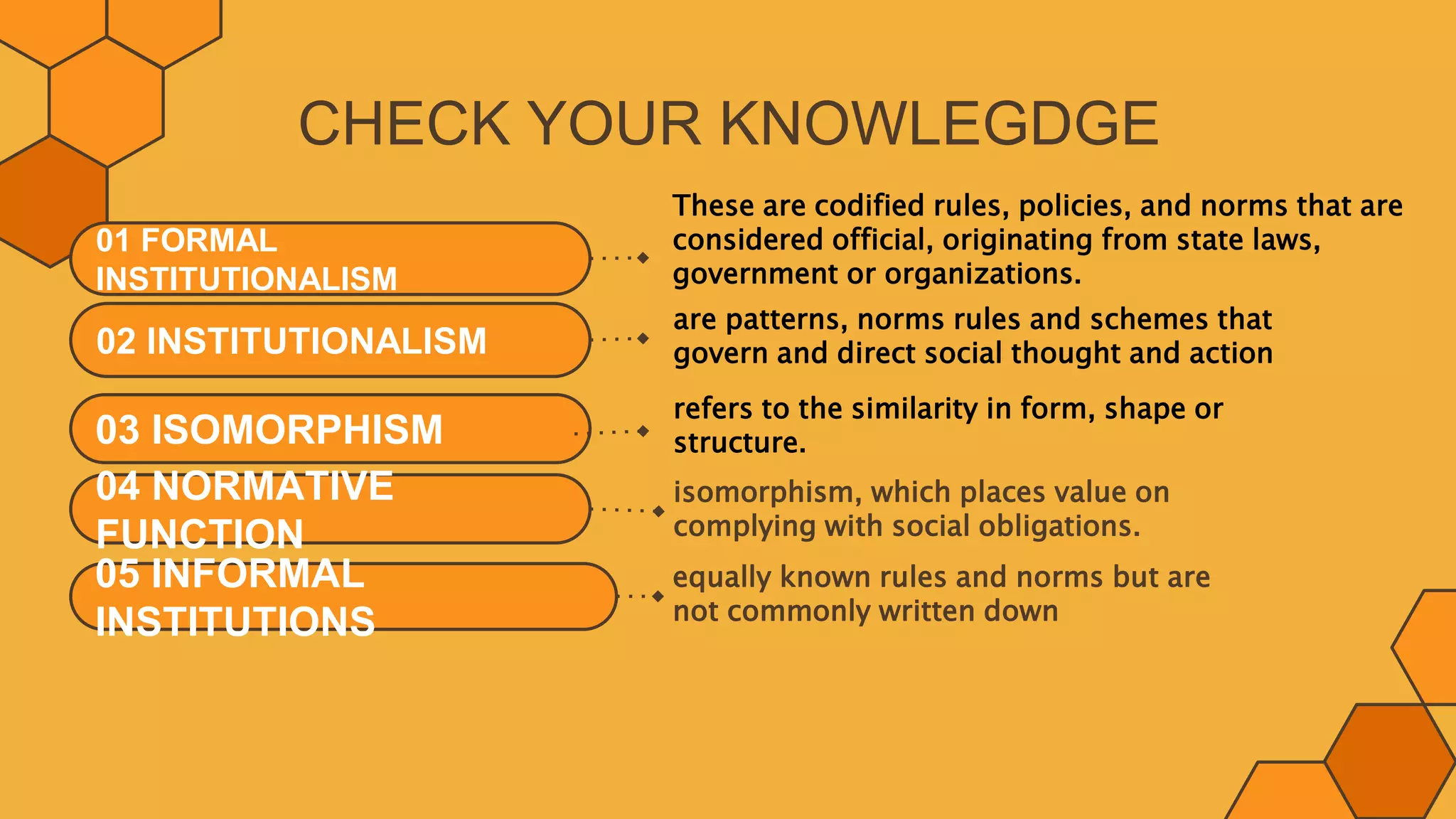
Important Theorists on Institutionalism
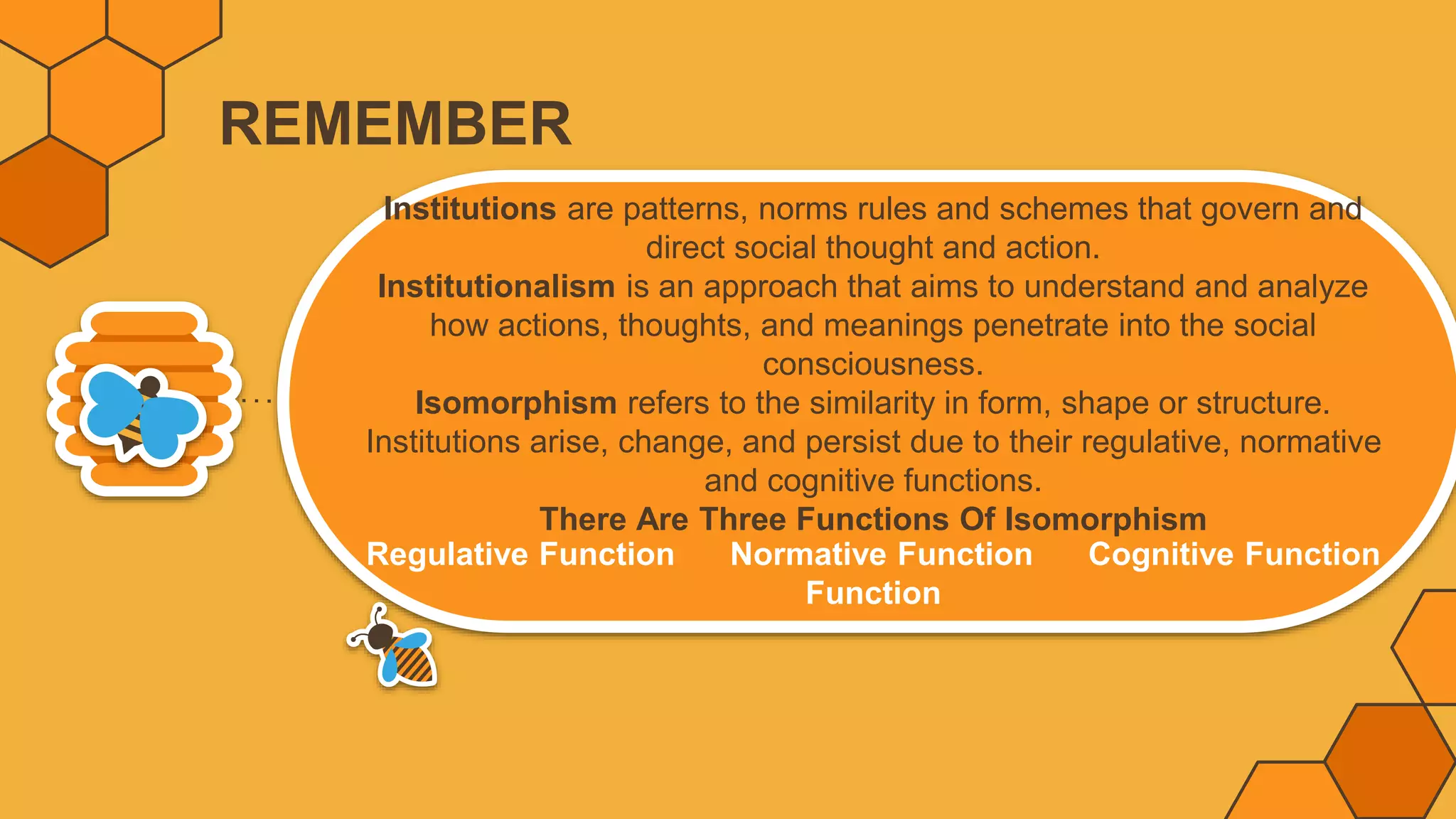
CHECK YOUR KNOWLEGDGE
01 FORMAL
INSTITUTIONALISM
02 INSTITUTIONALISM
03 ISOMORPHISM
04 NORMATIVE
FUNCTION
05 INFORMAL
INSTITUTIONS
These are codified rules, policies, and norms that are
considered official, originating from state laws,
government or organizations.
are patterns, norms rules and schemes that
govern and direct social thought and action
refers to the similarity in form, shape or
structure.
isomorphism, which places value on
complying with social obligations.
equally known rules and norms but are
not commonly written down
Institutions are patterns, norms rules and schemes that govern and
direct social thought and action.
Institutionalism is an approach that aims to understand and analyze
how actions, thoughts, and meanings penetrate into the social
consciousness.
Isomorphism refers to the similarity in form, shape or structure.
Institutions arise, change, and persist due to their regulative, normative
and cognitive functions.
There Are Three Functions Of Isomorphism
Regulative Function Normative Function Cognitive Function
Function
REMEMBER
INSTITUTIONAL
ISM
Important Theorists on Institutionalism
David Mitrany (1888-1975) was a
Romanian-born British scholar,
historian, and political theorist.
Mitrany is considered as the father of
functionalism in international relations,
which is classified under liberal
institutionalism. Functionalism explains
that a state’s authority lies in functions and
needs, and the ability to provide for those
needs. Its sees scientific knowledge and
technological advancements assources of
authority from which the state can derive its
Important Theorists on Institutionalism
Jean Monnet (1888-1979) was a French
political economist and diplomat. As one
of the originators of the European Union, he
saw how the needs of the state are to be
achieved through the principle of
supranationalism. As Mitrany argued
against territory being the source of
authority, Monnet used the argument to
erase country borderlines.
.
Important Theorists on Institutionalism
Stephen Krasner (born 1942) is an
American professor of international
relations. Krasner argues that the
American government and
nongovernment organizations should
prioritize the stabilization of weakened
states so that American interests would be
protected. In order to address the
continued deterioration of weaker
states, he suggested creation
of institutions that will allow the weaker
states to enter a market democracy.
1. Normative institutionalism- is a sociological
interpretation of institutions and holds that a “logic of
appropriateness” guides the behavior of actors within an
institution. It predicts that the norms and formal rules of
institutions will shape the actions of those acting within
them.
2. Choice Institutionalism- is a theoretical approach to the
study of institutions arguing that actors use institutions to
maximize their utility. However, actors face rule-based
constraints which influence their behavior.
TYPES OF INSTITUTIONALISM
3. Historical institutionalism – is a new institutionalist
social science approach that emphasizes how timing,
sequences and path dependence affect institutions, and
shape social, political, economic behavior and change.
4. Sociological institutionalism – is a form of new
institutionalism that concerns “the way in which
institutions create meaning for individuals, providing
important
theoretical building blocks for normative institutionalism
within political science”..
TYPES OF INSTITUTIONALISM
5. Institutional Economics – focuses on understanding
the role of the evolutionary process and the role of
institutions in shaping economic behavior.
6. Discursive institutionalism – is an umbrella concept for
approaches that concern themselves with the substantive
content of ideas and the interactive processes of
discourse in institutional context.
TYPES OF INSTITUTIONALISM
7. Constructivist institutionalism – According to multiple
theorists, this is so whether the field in question is
directly denoted as or has to do more with bringing
constructivist ideas into some other field, or with
bringing ideas back into the theory in contrast against
structuralist and/or system.
8. Feminist institutionalism – is a new institutionalist
approach that looks at how gender norms operate within
institutions and how institutional processes construct and
maintain gender power dynamic
TYPES OF INSTITUTIONALISM
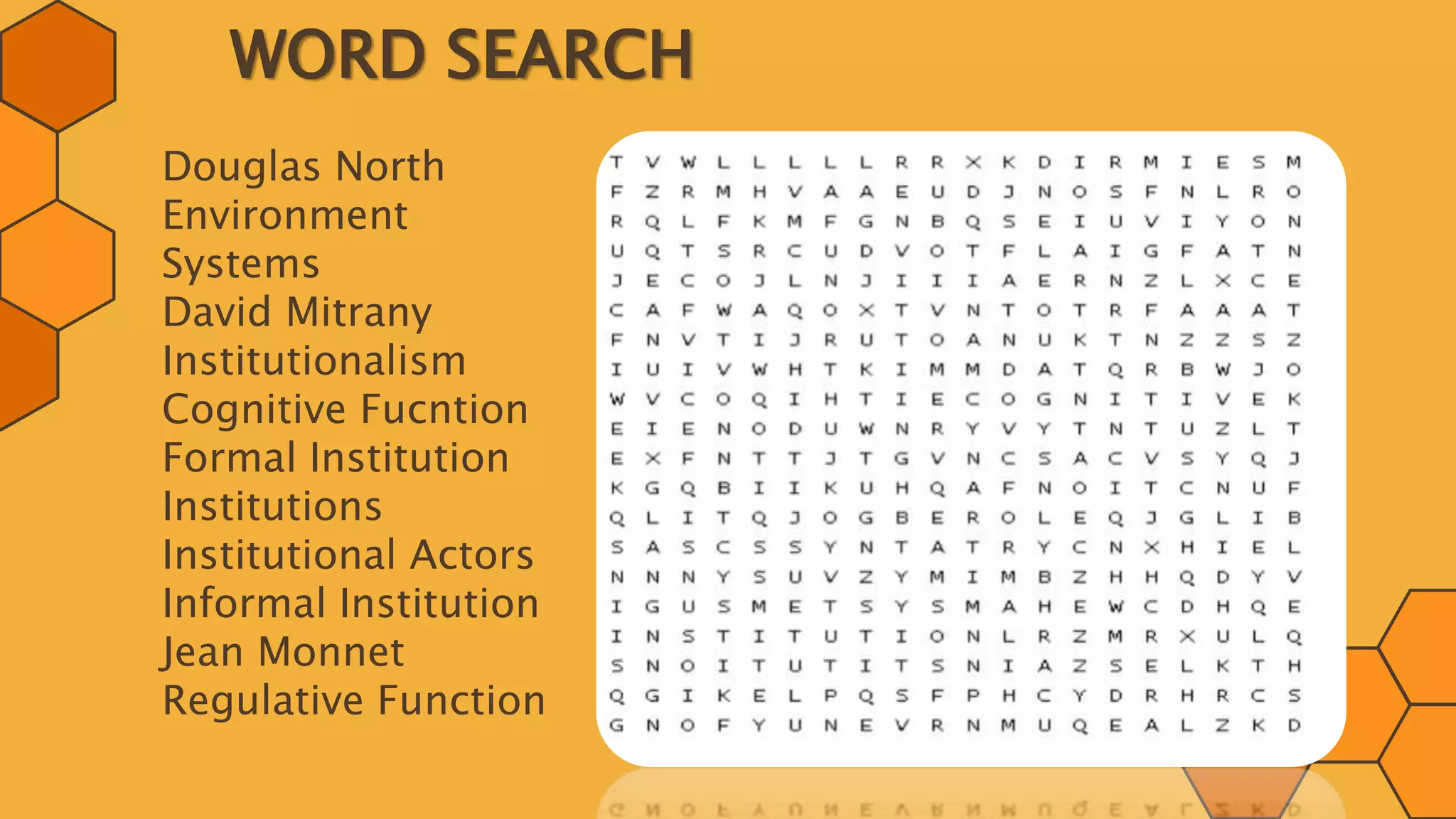
WORD SEARCH
Douglas North
Environment
Systems
David Mitrany
Institutionalism
Cognitive Fucntion
Formal Institution
Institutions
Institutional Actors
Informal Institution
Jean Monnet
Regulative Function
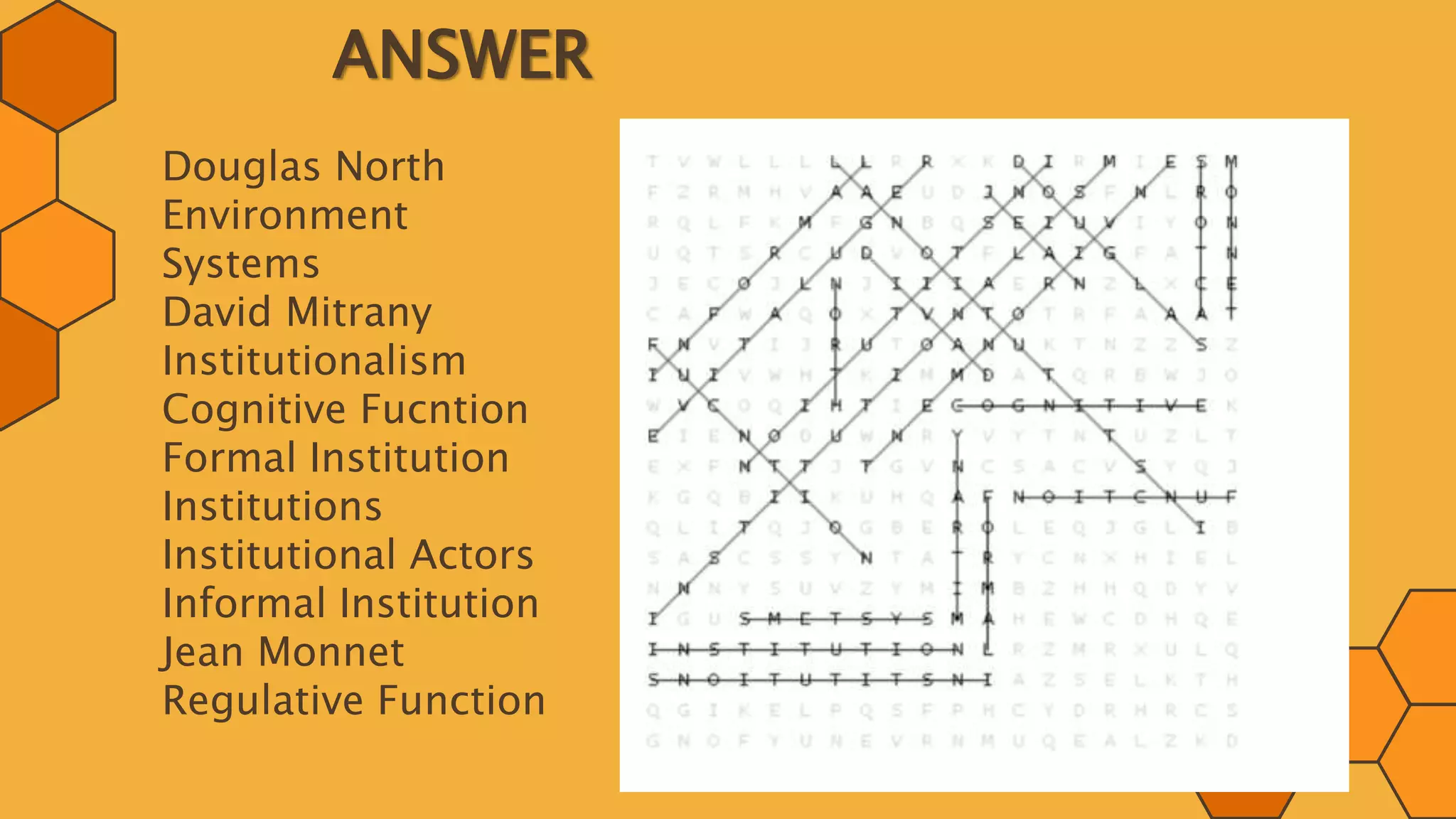
ANSWER
Douglas North
Environment
Systems
David Mitrany
Institutionalism
Cognitive Fucntion
Formal Institution
Institutions
Institutional Actors
Informal Institution
Jean Monnet
Regulative Function
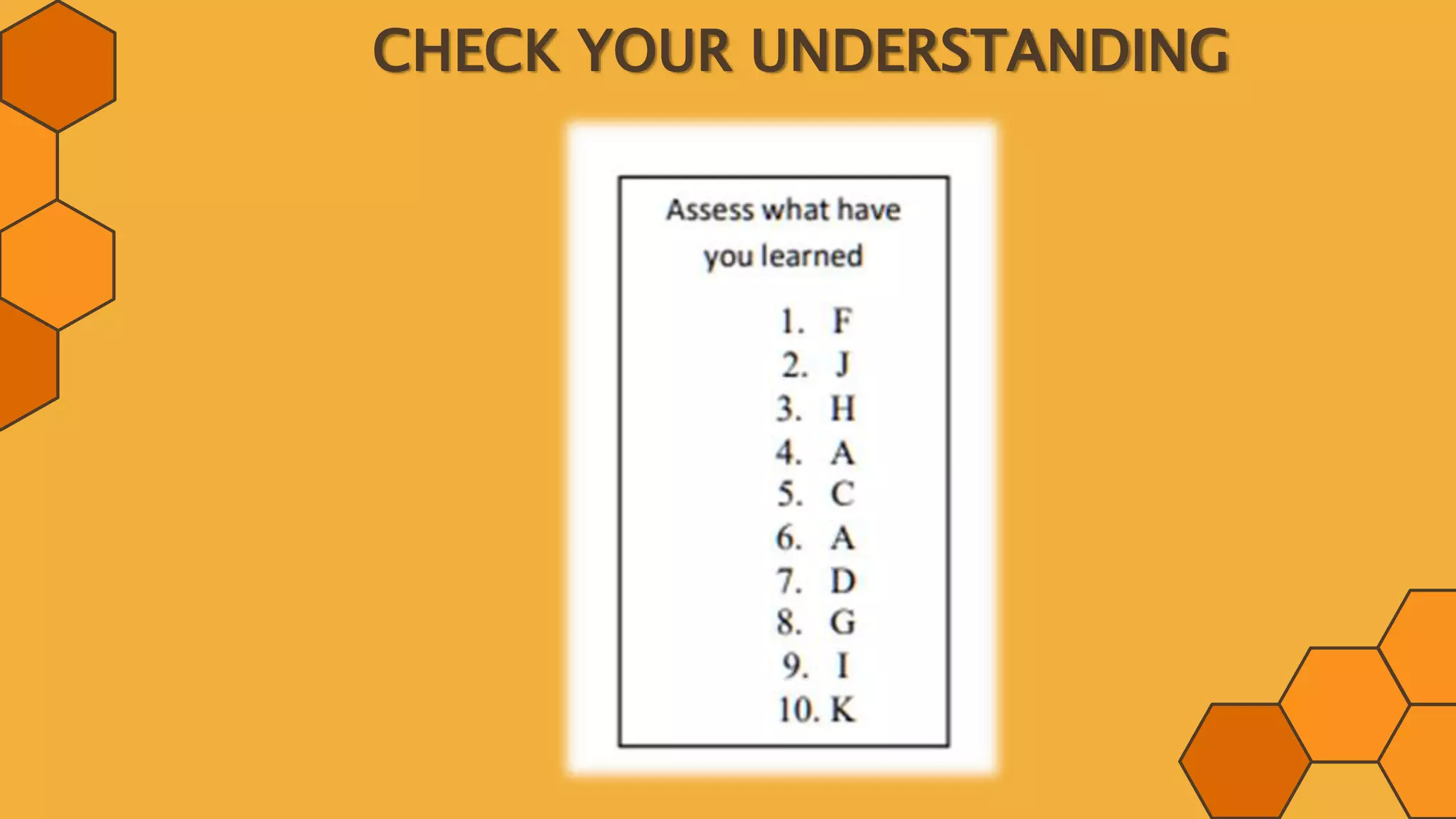
CHECK YOUR UNDERSTANDING
THANK YOU FOR LISTENING

module 9 ppt diss.pptx

  • 1.
    Good Morning Class Hereis where your presentation begins
  • 2.
    WHAT WE HAVELEARNED LAST MEETIN?
  • 4.
  • 5.
    Institutions are patterns,norms rules and schemes that govern and direct social thought and action. Institutionalism, therefore, is an approach that aims to understand and analyze how actions, thoughts, and meanings penetrate into the social consciousness deeply enough to embed themselves into social psyche.
  • 6.
    Institutions provide sociallegitimacy and survival through Isomorphism. Isomorphism refers to the similarity in form, shape or structure. Institutions arise, change, and persist due to their regulative, normative and cognitive functions. These functions are isomorphic in nature as they adopt in form, shape or structure to provide social legitimacy, survival or both.
  • 7.
    THREE FUNCTIONS OFISOMORPHISM operates through coercive isomorphism, which places value on expediency as effect of compliance. Change either happens or not depending on external factors such as rules and laws. operates through normative isomorphism, which places value on complying with social obligations. Change either happens or not depending on external factors such as accreditations and cognitive function operates through mimetic isomorphism, which places value on factors such as uncertainty and prevalence of others’ performance. Regulative Function Normative Function Cognitive Function
  • 8.
    Key Concepts inInstitutionalism: Formal and Informal Institutions Formal institutions are codified rules, policies and norms that are considered official, originating from state laws, government or organizations. Examples: constitution, official law, regulation, standards enforced by the state.
  • 9.
    Key Concepts inInstitutionalism: Formal and Informal Institutions Informal institutions are equally known rules and norms but are not commonly written down. Informal institutions are social practices that have been commonly viewed as acceptable and are more persistent than codified laws like What is that of formal institutions. Examples: Informal institutions, social norms, attitudes, traditions, self-enforced
  • 10.
    Group yourselves accordingto your field of interest. Get one whole sheet of bond paper. If you were to create your own institution what would it be. Explain it in a 2 paragraphs with illustrations. You have 10 minutes to do the
  • 11.
  • 12.
    Important Theorists onInstitutionalism
  • 13.
    CHECK YOUR KNOWLEGDGE 01FORMAL INSTITUTIONALISM 02 INSTITUTIONALISM 03 ISOMORPHISM 04 NORMATIVE FUNCTION 05 INFORMAL INSTITUTIONS These are codified rules, policies, and norms that are considered official, originating from state laws, government or organizations. are patterns, norms rules and schemes that govern and direct social thought and action refers to the similarity in form, shape or structure. isomorphism, which places value on complying with social obligations. equally known rules and norms but are not commonly written down
  • 14.
    Institutions are patterns,norms rules and schemes that govern and direct social thought and action. Institutionalism is an approach that aims to understand and analyze how actions, thoughts, and meanings penetrate into the social consciousness. Isomorphism refers to the similarity in form, shape or structure. Institutions arise, change, and persist due to their regulative, normative and cognitive functions. There Are Three Functions Of Isomorphism Regulative Function Normative Function Cognitive Function Function REMEMBER
  • 15.
  • 16.
    Important Theorists onInstitutionalism David Mitrany (1888-1975) was a Romanian-born British scholar, historian, and political theorist. Mitrany is considered as the father of functionalism in international relations, which is classified under liberal institutionalism. Functionalism explains that a state’s authority lies in functions and needs, and the ability to provide for those needs. Its sees scientific knowledge and technological advancements assources of authority from which the state can derive its
  • 17.
    Important Theorists onInstitutionalism Jean Monnet (1888-1979) was a French political economist and diplomat. As one of the originators of the European Union, he saw how the needs of the state are to be achieved through the principle of supranationalism. As Mitrany argued against territory being the source of authority, Monnet used the argument to erase country borderlines. .
  • 18.
    Important Theorists onInstitutionalism Stephen Krasner (born 1942) is an American professor of international relations. Krasner argues that the American government and nongovernment organizations should prioritize the stabilization of weakened states so that American interests would be protected. In order to address the continued deterioration of weaker states, he suggested creation of institutions that will allow the weaker states to enter a market democracy.
  • 19.
    1. Normative institutionalism-is a sociological interpretation of institutions and holds that a “logic of appropriateness” guides the behavior of actors within an institution. It predicts that the norms and formal rules of institutions will shape the actions of those acting within them. 2. Choice Institutionalism- is a theoretical approach to the study of institutions arguing that actors use institutions to maximize their utility. However, actors face rule-based constraints which influence their behavior. TYPES OF INSTITUTIONALISM
  • 20.
    3. Historical institutionalism– is a new institutionalist social science approach that emphasizes how timing, sequences and path dependence affect institutions, and shape social, political, economic behavior and change. 4. Sociological institutionalism – is a form of new institutionalism that concerns “the way in which institutions create meaning for individuals, providing important theoretical building blocks for normative institutionalism within political science”.. TYPES OF INSTITUTIONALISM
  • 21.
    5. Institutional Economics– focuses on understanding the role of the evolutionary process and the role of institutions in shaping economic behavior. 6. Discursive institutionalism – is an umbrella concept for approaches that concern themselves with the substantive content of ideas and the interactive processes of discourse in institutional context. TYPES OF INSTITUTIONALISM
  • 22.
    7. Constructivist institutionalism– According to multiple theorists, this is so whether the field in question is directly denoted as or has to do more with bringing constructivist ideas into some other field, or with bringing ideas back into the theory in contrast against structuralist and/or system. 8. Feminist institutionalism – is a new institutionalist approach that looks at how gender norms operate within institutions and how institutional processes construct and maintain gender power dynamic TYPES OF INSTITUTIONALISM
  • 23.
    WORD SEARCH Douglas North Environment Systems DavidMitrany Institutionalism Cognitive Fucntion Formal Institution Institutions Institutional Actors Informal Institution Jean Monnet Regulative Function
  • 24.
    ANSWER Douglas North Environment Systems David Mitrany Institutionalism CognitiveFucntion Formal Institution Institutions Institutional Actors Informal Institution Jean Monnet Regulative Function
  • 25.
  • 26.
  • 27.
    THANK YOU FORLISTENING

Editor's Notes

  • #6 There are different types of institutionalism, but their common concern is to find out the effects of these institutions and determine how these affect the manner by which the society functions
  • #9 Formal and Informal institutions can be distinguished by what rules, practices and norms they derive authority from.