Business Model Canvas: Developing 
and Testing the Business Concept 
Entrepreneurship – 
New Venture Creation
2 
Topic Objectives 
 What is a business model canvas? How is it 
used? 
 Why is value creation and capture so important? 
 How do I use a canvas to “document my plan A”? 
What are the key questions I should pay 
attention to?
What is a business 
model canvas? 
Why is it 
important?
A business model describes the rationale 
of how a [startup] creates, delivers, and 
captures value. 
~from Osterwalder, A. and Pigneur, Y. 2010. Business Model Generation: 
A Handbook for Visionaries, Game Changers, and Challengers. John 
Wiley & Sons Inc., Hoboken, New Jersey 
4 
What is a business model?
Value creation and value capture: 
5 
A conceptual foundation 
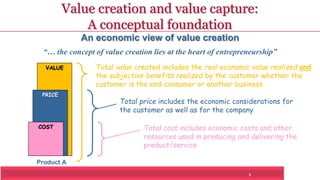
An economic view of value creation 
“… the concept of value creation lies at the heart of entrepreneurship” 
VALUE 
Product A 
Total value created includes the real economic value realized and 
the subjective benefits realized by the customer whether the 
customer is the end-consumer or another business 
PRICE 
Total price includes the economic considerations for 
the customer as well as for the company 
COST Total cost includes economic costs and other 
resources used in producing and delivering the 
product/service
Value creation and value capture: 
A conceptual foundation (cont.) 
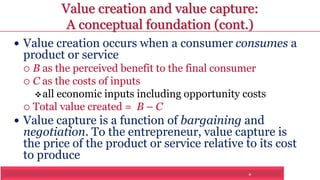
 Value creation occurs when a consumer consumes a 
product or service 
 B as the perceived benefit to the final consumer 
6 
 C as the costs of inputs 
all economic inputs including opportunity costs 
 Total value created = B – C 
 Value capture is a function of bargaining and 
negotiation. To the entrepreneur, value capture is 
the price of the product or service relative to its cost 
to produce
Value creation and value capture: 
A conceptual foundation (cont.) 
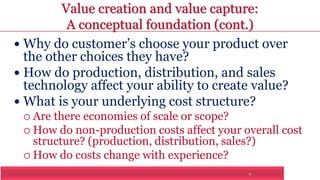
 Why do customer’s choose your product over 
the other choices they have? 
 How do production, distribution, and sales 
technology affect your ability to create value? 
 What is your underlying cost structure? 
7 
 Are there economies of scale or scope? 
 How do non-production costs affect your overall cost 
structure? (production, distribution, sales?) 
 How do costs change with experience?
Value creation and value capture: 
A conceptual foundation (cont.) 
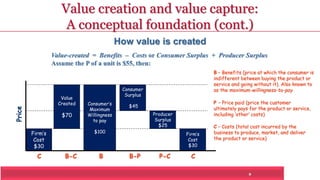
Value-created = Benefits – Costs or Consumer Surplus + Producer Surplus 
Assume the P of a unit is $55, then: 
8 
Firm’s 
Cost 
$30 
C 
Consumer’s 
Maximum 
Willingness 
to pay 
$100 
B 
Firm’s 
Cost 
$30 
C 
Consumer 
Surplus 
$45 
B-P 
Producer 
Surplus 
$25 
P-C 
Value 
Created 
$70 
B-C 
B – Benefits (price at which the consumer is 
indifferent between buying the product or 
service and going without it). Also known to 
as the maximum-willingness-to-pay 
P – Price paid (price the customer 
ultimately pays for the product or service, 
including ‘other’ costs) 
C – Costs (total cost incurred by the 
business to produce, market, and deliver 
the product or service) 
How value is created
Value creation and value capture: 
A conceptual foundation (cont.) 
 Value is split into consumer surplus + producer 
surplus 
 Producer surplus is contribution margin or profit 
9 
 Consumer surplus is 
the difference between what the consumer pays for 
a product and the perceived benefits by the 
consumer 
consumers buy products which maximize their 
consumer surplus
Value creation and value capture: 
A conceptual foundation (cont.) 
10 
 What factors affect customers’ 
value (benefits) perceptions? 
 price/performance 
 cost reduction/risk reduction 
 reliability/durability/usability 
 design/functionality 
 convenience/accessibility 
 brand/image/status 
 others? 
 In addition to price, what costs 
affect the consumer surplus? 
 installation costs 
 learning costs 
 operations costs 
 maintenance costs 
 disposal costs 
 others?
What is a business model canvas? 
A business model canvas is a simple graphical 
template describing the building blocks of 
business models. The individual elements 
prompt consideration of a business’ full scope, 
while the layout encourages thought about 
how the pieces fit together … 
~from Forbes, January 31, 2012 
11
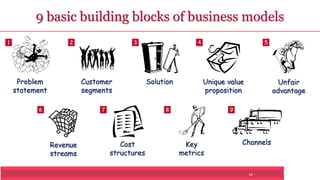
9 basic building blocks of business models 
12 
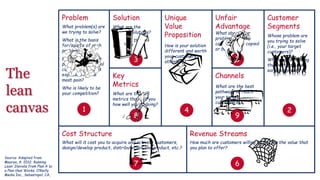
Problem 
statement 
1 
Solution 
3 
Unique value 
proposition 
4 
Unfair 
advantage 
5 
Revenue 
streams 
6 
Cost 
structures 
7 
Key 
metrics 
8 
Customer 
segments 
2 
9 
Channels
Problem Solution 
3 5 
Key 
Metrics 
Unique 
Value 
Proposition 
Customer 
Segments 
Unfair 
Advantage 
Channels 
What are the key 
metrics that tell you 
how well you’re doing? 
1 4 
2 
8 9 
Cost Structure Revenue Streams 
7 6 
What problem(s) are 
we trying to solve? 
What is the basis 
for/source of each 
problem? 
How painful is each 
problem to potential 
customers? Who is 
experiencing the 
most pain? 
Who is likely to be 
your competition? 
Whose problem are 
you trying to solve 
(i.e., your target 
customers)? 
Who is experiencing 
the most pain (i.e., 
early adopters)? 
What are the 
possible solutions? 
What are the 
features? How is your solution 
different and worth 
your customers’ 
attention? 
What about your 
problem/solution 
can’t be easily copied 
or bought? 
How much are customers willing to pay for the value that 
you plan to offer? 
What will it cost you to acquire and activate customers, 
design/develop product, distribute/sell the product, etc.? 
What are the best 
pathways to reach 
your target 
customer(s)? 
The 
lean 
canvas 
Source: Adapted from 
Maurya, A. 2012. Running 
Lean: Iterate from Plan A to 
a Plan that Works. O’Reilly 
Media Inc., Sebastopol, CA,
The lean canvas: Customer segments 
14 
Problem Solution 
Key 
Metrics 
Unique 
Value Proposition Customer 
Segments 
Unfair Advantage 
Channels 
Cost Structure Revenue Streams 
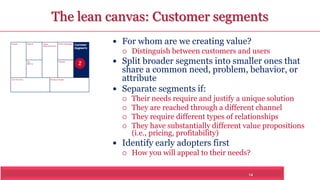
 For whom are we creating value? 
 Distinguish between customers and users 
 Split broader segments into smaller ones that 
share a common need, problem, behavior, or 
attribute 
 Separate segments if: 
 Their needs require and justify a unique solution 
 They are reached through a different channel 
 They require different types of relationships 
 They have substantially different value propositions 
(i.e., pricing, profitability) 
 Identify early adopters first 
 How you will appeal to their needs? 
2
The lean canvas: Customer segments (cont.) 
Craft a Unique 
Value Proposition 
15 
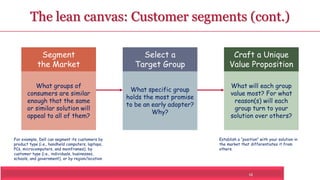
Segment 
the Market 
What groups of 
consumers are similar 
enough that the same 
or similar solution will 
appeal to all of them? 
Select a 
Target Group 
What specific group 
holds the most promise 
to be an early adopter? 
Why? 
What will each group 
value most? For what 
reason(s) will each 
group turn to your 
solution over others? 
For example, Dell can segment its customers by 
product type (i.e., handheld computers, laptops, 
PCs, microcomputers, and mainframes), by 
customer type (i.e., individuals, businesses, 
schools, and government), or by region/location 
Establish a “position” with your solution in 
the market that differentiates it from 
others.
The lean canvas: Unique value position 
16 
Problem Solution 
Key 
Metrics 
Unique 
Value 
Proposition 
Customer 
Segments 
Unfair Advantage 
Channels 
Cost Structure Revenue Streams 
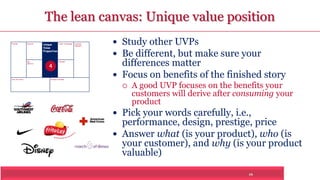
 Study other UVPs 
 Be different, but make sure your 
differences matter 
 Focus on benefits of the finished story 
 A good UVP focuses on the benefits your 
customers will derive after consuming your 
product 
 Pick your words carefully, i.e., 
performance, design, prestige, price 
 Answer what (is your product), who (is 
your customer), and why (is your product 
valuable) 
4
The lean canvas: Revenue streams 
17 
Problem Solution 
Key 
Metrics 
Unique 
Value Proposition 
Customer 
Segments 
Unfair Advantage 
Channels 
Cost Structure Revenue Streams 
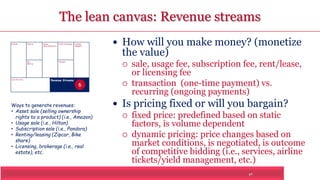
 How will you make money? (monetize 
the value) 
 sale, usage fee, subscription fee, rent/lease, 
or licensing fee 
 transaction (one-time payment) vs. 
recurring (ongoing payments) 
 Is pricing fixed or will you bargain? 
 fixed price: predefined based on static 
factors, is volume dependent 
 dynamic pricing: price changes based on 
market conditions, is negotiated, is outcome 
of competitive bidding (i.e., services, airline 
tickets/yield management, etc.) 
6 
Ways to generate revenues: 
• Asset sale (selling ownership 
rights to a product) (i.e., Amazon) 
• Usage sale (i.e., Hilton) 
• Subscription sale (i.e., Pandora) 
• Renting/leasing (Zipcar, Bike 
share) 
• Licensing, brokerage (i.e., real 
estate), etc.
18 
The lean canvas: Channels 
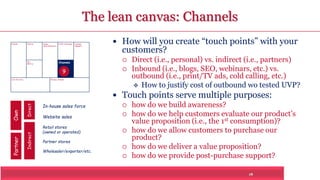
 How will you create “touch points” with your 
customers? 
 Direct (i.e., personal) vs. indirect (i.e., partners) 
 Inbound (i.e., blogs, SEO, webinars, etc.) vs. 
outbound (i.e., print/TV ads, cold calling, etc.) 
 How to justify cost of outbound wo tested UVP? 
 Touch points serve multiple purposes: 
 how do we build awareness? 
 how do we help customers evaluate our product’s 
value proposition (i.e., the 1st consumption)? 
 how do we allow customers to purchase our 
product? 
 how do we deliver a value proposition? 
 how do we provide post-purchase support? 
Problem Solution 
Key 
Metrics 
Unique 
Value Proposition 
Customer 
Segments 
Unfair Advantage 
Channels 
9 
Cost Structure Revenue Streams 
Partner Own 
Indirect Direct 
In-house sales force 
Website sales 
Retail stores 
(owned or operated) 
Partner stores 
Wholesaler/exporter/etc.
19 
Where do I start? 
 Focus on the customer pain you intend to solve (problem) 
 Prioritize customers that you believe need your product most; look for early 
adopters 
 Develop/test features of your product that address the pain 
 Clearly identify what makes you unique (value proposition) 
 Assess the ease of reach (channels) 
 Determine how you will make money 
 Pick a segment that allows you to maximize your margins; the more money 
you keep, the fewer customers you have to reach 
 Revise solution assumptions and test feasibility 
 Now, sketch an initial canvas 
 It’s ok to leave sections blank!

Business Model Canvas: Developing and Testing the Business Concept

  • 1.
    Business Model Canvas:Developing and Testing the Business Concept Entrepreneurship – New Venture Creation
  • 2.
    2 Topic Objectives  What is a business model canvas? How is it used?  Why is value creation and capture so important?  How do I use a canvas to “document my plan A”? What are the key questions I should pay attention to?
  • 3.
    What is abusiness model canvas? Why is it important?
  • 4.
    A business modeldescribes the rationale of how a [startup] creates, delivers, and captures value. ~from Osterwalder, A. and Pigneur, Y. 2010. Business Model Generation: A Handbook for Visionaries, Game Changers, and Challengers. John Wiley & Sons Inc., Hoboken, New Jersey 4 What is a business model?
  • 5.
    Value creation andvalue capture: 5 A conceptual foundation An economic view of value creation “… the concept of value creation lies at the heart of entrepreneurship” VALUE Product A Total value created includes the real economic value realized and the subjective benefits realized by the customer whether the customer is the end-consumer or another business PRICE Total price includes the economic considerations for the customer as well as for the company COST Total cost includes economic costs and other resources used in producing and delivering the product/service
  • 6.
    Value creation andvalue capture: A conceptual foundation (cont.)  Value creation occurs when a consumer consumes a product or service  B as the perceived benefit to the final consumer 6  C as the costs of inputs all economic inputs including opportunity costs  Total value created = B – C  Value capture is a function of bargaining and negotiation. To the entrepreneur, value capture is the price of the product or service relative to its cost to produce
  • 7.
    Value creation andvalue capture: A conceptual foundation (cont.)  Why do customer’s choose your product over the other choices they have?  How do production, distribution, and sales technology affect your ability to create value?  What is your underlying cost structure? 7  Are there economies of scale or scope?  How do non-production costs affect your overall cost structure? (production, distribution, sales?)  How do costs change with experience?
  • 8.
    Value creation andvalue capture: A conceptual foundation (cont.) Value-created = Benefits – Costs or Consumer Surplus + Producer Surplus Assume the P of a unit is $55, then: 8 Firm’s Cost $30 C Consumer’s Maximum Willingness to pay $100 B Firm’s Cost $30 C Consumer Surplus $45 B-P Producer Surplus $25 P-C Value Created $70 B-C B – Benefits (price at which the consumer is indifferent between buying the product or service and going without it). Also known to as the maximum-willingness-to-pay P – Price paid (price the customer ultimately pays for the product or service, including ‘other’ costs) C – Costs (total cost incurred by the business to produce, market, and deliver the product or service) How value is created
  • 9.
    Value creation andvalue capture: A conceptual foundation (cont.)  Value is split into consumer surplus + producer surplus  Producer surplus is contribution margin or profit 9  Consumer surplus is the difference between what the consumer pays for a product and the perceived benefits by the consumer consumers buy products which maximize their consumer surplus
  • 10.
    Value creation andvalue capture: A conceptual foundation (cont.) 10  What factors affect customers’ value (benefits) perceptions?  price/performance  cost reduction/risk reduction  reliability/durability/usability  design/functionality  convenience/accessibility  brand/image/status  others?  In addition to price, what costs affect the consumer surplus?  installation costs  learning costs  operations costs  maintenance costs  disposal costs  others?
  • 11.
    What is abusiness model canvas? A business model canvas is a simple graphical template describing the building blocks of business models. The individual elements prompt consideration of a business’ full scope, while the layout encourages thought about how the pieces fit together … ~from Forbes, January 31, 2012 11
  • 12.
    9 basic buildingblocks of business models 12 Problem statement 1 Solution 3 Unique value proposition 4 Unfair advantage 5 Revenue streams 6 Cost structures 7 Key metrics 8 Customer segments 2 9 Channels
  • 13.
    Problem Solution 35 Key Metrics Unique Value Proposition Customer Segments Unfair Advantage Channels What are the key metrics that tell you how well you’re doing? 1 4 2 8 9 Cost Structure Revenue Streams 7 6 What problem(s) are we trying to solve? What is the basis for/source of each problem? How painful is each problem to potential customers? Who is experiencing the most pain? Who is likely to be your competition? Whose problem are you trying to solve (i.e., your target customers)? Who is experiencing the most pain (i.e., early adopters)? What are the possible solutions? What are the features? How is your solution different and worth your customers’ attention? What about your problem/solution can’t be easily copied or bought? How much are customers willing to pay for the value that you plan to offer? What will it cost you to acquire and activate customers, design/develop product, distribute/sell the product, etc.? What are the best pathways to reach your target customer(s)? The lean canvas Source: Adapted from Maurya, A. 2012. Running Lean: Iterate from Plan A to a Plan that Works. O’Reilly Media Inc., Sebastopol, CA,
  • 14.
    The lean canvas:Customer segments 14 Problem Solution Key Metrics Unique Value Proposition Customer Segments Unfair Advantage Channels Cost Structure Revenue Streams  For whom are we creating value?  Distinguish between customers and users  Split broader segments into smaller ones that share a common need, problem, behavior, or attribute  Separate segments if:  Their needs require and justify a unique solution  They are reached through a different channel  They require different types of relationships  They have substantially different value propositions (i.e., pricing, profitability)  Identify early adopters first  How you will appeal to their needs? 2
  • 15.
    The lean canvas:Customer segments (cont.) Craft a Unique Value Proposition 15 Segment the Market What groups of consumers are similar enough that the same or similar solution will appeal to all of them? Select a Target Group What specific group holds the most promise to be an early adopter? Why? What will each group value most? For what reason(s) will each group turn to your solution over others? For example, Dell can segment its customers by product type (i.e., handheld computers, laptops, PCs, microcomputers, and mainframes), by customer type (i.e., individuals, businesses, schools, and government), or by region/location Establish a “position” with your solution in the market that differentiates it from others.
  • 16.
    The lean canvas:Unique value position 16 Problem Solution Key Metrics Unique Value Proposition Customer Segments Unfair Advantage Channels Cost Structure Revenue Streams  Study other UVPs  Be different, but make sure your differences matter  Focus on benefits of the finished story  A good UVP focuses on the benefits your customers will derive after consuming your product  Pick your words carefully, i.e., performance, design, prestige, price  Answer what (is your product), who (is your customer), and why (is your product valuable) 4
  • 17.
    The lean canvas:Revenue streams 17 Problem Solution Key Metrics Unique Value Proposition Customer Segments Unfair Advantage Channels Cost Structure Revenue Streams  How will you make money? (monetize the value)  sale, usage fee, subscription fee, rent/lease, or licensing fee  transaction (one-time payment) vs. recurring (ongoing payments)  Is pricing fixed or will you bargain?  fixed price: predefined based on static factors, is volume dependent  dynamic pricing: price changes based on market conditions, is negotiated, is outcome of competitive bidding (i.e., services, airline tickets/yield management, etc.) 6 Ways to generate revenues: • Asset sale (selling ownership rights to a product) (i.e., Amazon) • Usage sale (i.e., Hilton) • Subscription sale (i.e., Pandora) • Renting/leasing (Zipcar, Bike share) • Licensing, brokerage (i.e., real estate), etc.
  • 18.
    18 The leancanvas: Channels  How will you create “touch points” with your customers?  Direct (i.e., personal) vs. indirect (i.e., partners)  Inbound (i.e., blogs, SEO, webinars, etc.) vs. outbound (i.e., print/TV ads, cold calling, etc.)  How to justify cost of outbound wo tested UVP?  Touch points serve multiple purposes:  how do we build awareness?  how do we help customers evaluate our product’s value proposition (i.e., the 1st consumption)?  how do we allow customers to purchase our product?  how do we deliver a value proposition?  how do we provide post-purchase support? Problem Solution Key Metrics Unique Value Proposition Customer Segments Unfair Advantage Channels 9 Cost Structure Revenue Streams Partner Own Indirect Direct In-house sales force Website sales Retail stores (owned or operated) Partner stores Wholesaler/exporter/etc.
  • 19.
    19 Where doI start?  Focus on the customer pain you intend to solve (problem)  Prioritize customers that you believe need your product most; look for early adopters  Develop/test features of your product that address the pain  Clearly identify what makes you unique (value proposition)  Assess the ease of reach (channels)  Determine how you will make money  Pick a segment that allows you to maximize your margins; the more money you keep, the fewer customers you have to reach  Revise solution assumptions and test feasibility  Now, sketch an initial canvas  It’s ok to leave sections blank!