Problem/solution fit
Lean Canvas &
Value Prop Canvas
2
Your startup is not your product!
A customer buys a solution to a problem
3
Why Lean Canvas
• Business Plan waste of time until later
• The need of a communication tool
• Improves learning in a structured way
• Helps focus on the ”right” stuff
4
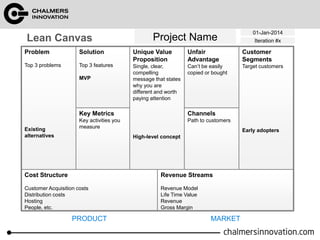
Lean Canvas Project Name
01-Jan-2014
Iteration #x
Cost Structure
Customer Acquisition costs
Distribution costs
Hosting
People, etc.
Revenue Streams
Revenue Model
Life Time Value
Revenue
Gross Margin
Problem
Top 3 problems
Existing
alternatives
Solution
Top 3 features
MVP
Key Metrics
Key activities you
measure
Unique Value
Proposition
Single, clear,
compelling
message that states
why you are
different and worth
paying attention
High-level concept
Unfair
Advantage
Can’t be easily
copied or bought
Channels
Path to customers
Customer
Segments
Target customers
Early adopters
PRODUCT MARKET
6
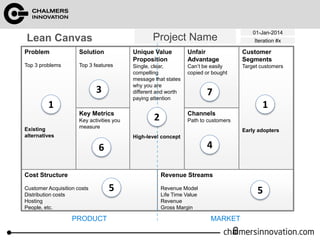
Lean Canvas Project Name
01-Jan-2014
Iteration #x
Cost Structure
Customer Acquisition costs
Distribution costs
Hosting
People, etc.
Revenue Streams
Revenue Model
Life Time Value
Revenue
Gross Margin
Problem
Top 3 problems
Existing
alternatives
Solution
Top 3 features
Key Metrics
Key activities you
measure
Unique Value
Proposition
Single, clear,
compelling
message that states
why you are
different and worth
paying attention
High-level concept
Unfair
Advantage
Can’t be easily
copied or bought
Channels
Path to customers
Customer
Segments
Target customers
Early adopters
PRODUCT MARKET
1 1
2
3
4
5 5
7
6
PROBLEM, SOLUTION, VALUE PROP
8
You really need to understand your customer
(and user)
9
Customers and problems
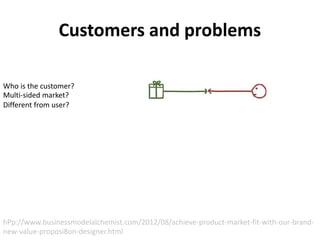
Who is the customer?
Multi-sided market?
Different from user?
hPp://www.businessmodelalchemist.com/2012/08/achieve-product-market-fit-with-our-brand-
new-value-proposi8on-designer.html
Customers and problems
- jobs to be done
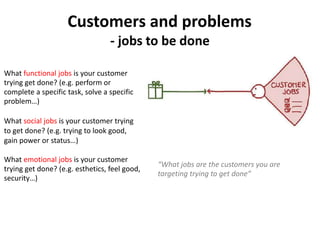
What functional jobs is your customer
trying get done? (e.g. perform or
complete a specific task, solve a specific
problem…)
What social jobs is your customer trying
to get done? (e.g. trying to look good,
gain power or status…)
What emotional jobs is your customer
trying get done? (e.g. esthetics, feel good,
security…)
“What jobs are the customers you are
targeting trying to get done”
Customers and problems
- customer pains
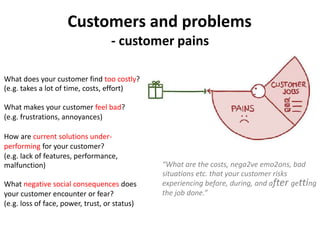
What does your customer find too costly?
(e.g. takes a lot of time, costs, effort)
What makes your customer feel bad?
(e.g. frustrations, annoyances)
How are current solutions under-
performing for your customer?
(e.g. lack of features, performance,
malfunction)
What negative social consequences does
your customer encounter or fear?
(e.g. loss of face, power, trust, or status)
“What are the costs, nega2ve emo2ons, bad
situations etc. that your customer risks
experiencing before, during, and after getting
the job done.”
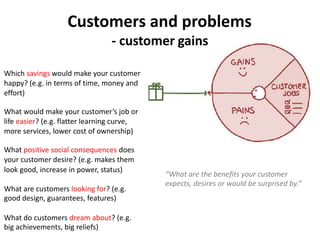
Customers and problems
- customer gains
Which savings would make your customer
happy? (e.g. in terms of time, money and
effort)
What would make your customer’s job or
life easier? (e.g. flatter learning curve,
more services, lower cost of ownership)
What positive social consequences does
your customer desire? (e.g. makes them
look good, increase in power, status)
What are customers looking for? (e.g.
good design, guarantees, features)
What do customers dream about? (e.g.
big achievements, big reliefs)
“What are the benefits your customer
expects, desires or would be surprised by.”
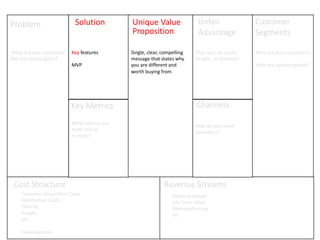
Problem
What are you customers’
key jobs/pains/gains?
Solution Unique Value
Proposition
Key features Single, clear, compelling
message that states why
MVP you are different and
worth buying from
Key Metrics
What metrics are
most critical
to track?
Unfair Customer
Advantage Segments
That can’t be easily Who are your customers?
bought, or imitated?
Who are earlyvangelists?
Channels
How do you reach
customers?
Cost Structure
Customer Acquisition Costs
Distribution Costs
Hosting
People
etc.
Fixed/variable
Revenue Streams
Revenue Model
Life Time Value
Revenue/pricing
etc.
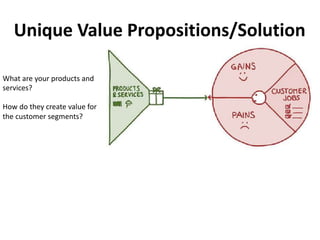
Unique Value Propositions/Solution
What are your products and
services?
How do they create value for
the customer segments?
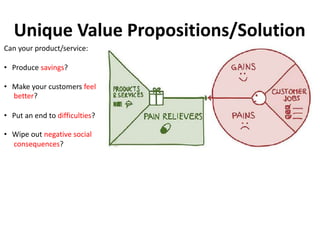
Unique Value Propositions/Solution
Can your product/service:
• Produce savings?
• Make your customers feel
better?
• Put an end to difficulties?
• Wipe out negative social
consequences?
Unique Value Propositions/Solution
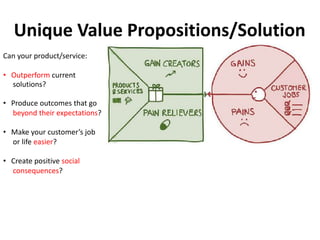
Can your product/service:
• Outperform current
solutions?
• Produce outcomes that go
beyond their expectations?
• Make your customer’s job
or life easier?
• Create positive social
consequences?
Examples
• Skype’s value proposition
– Free internet based chat, audio and video calls.
– Cheap calls to mobile and landline phones.
– Additional premium features like group video for
personal or business calls,
Examples
• Netflix's value proposition
– A low fixed price and unlimited viewing from its
large content collection.
– Netflix can be viewed from most devices with an
Internet connection.
– Netflix doesn't have any commercial interruptions
Examples
• Instagram
– ”Free”
– Real-time, mobile photo friend-following
– Egocasting
• Shopify
– simple, well-designed shops and setup
– scalable server farms (flexible volume pricing)
– freakish control over external look & feel.
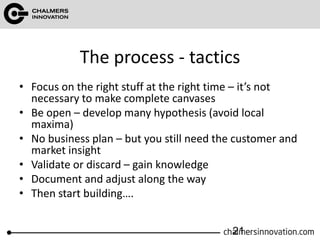
The process - tactics
• Focus on the right stuff at the right time – it’s not
necessary to make complete canvases
• Be open – develop many hypothesis (avoid local
maxima)
• No business plan – but you still need the customer and
market insight
• Validate or discard – gain knowledge
• Document and adjust along the way
• Then start building….
21
WORKSHOP
22
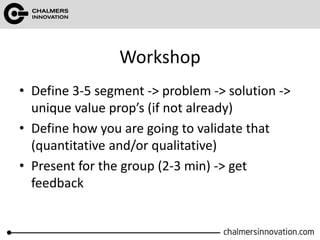
Workshop
• Define 3-5 segment -> problem -> solution ->
unique value prop’s (if not already)
• Define how you are going to validate that
(quantitative and/or qualitative)
• Present for the group (2-3 min) -> get
feedback
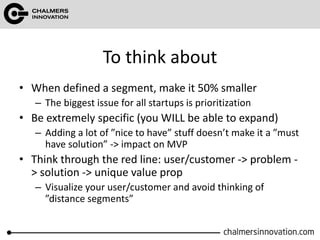
To think about
• When defined a segment, make it 50% smaller
– The biggest issue for all startups is prioritization
• Be extremely specific (you WILL be able to expand)
– Adding a lot of ”nice to have” stuff doesn’t make it a ”must
have solution” -> impact on MVP
• Think through the red line: user/customer -> problem -
> solution -> unique value prop
– Visualize your user/customer and avoid thinking of
”distance segments”
VALIDATION
25
How are you planning to validate?
26
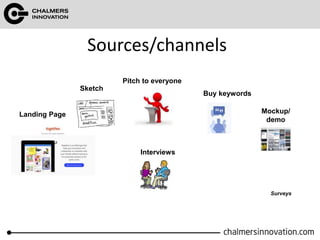
Sources/channels
Landing Page
Buy keywords
Pitch to everyone
Mockup/
demo
Surveys
Sketch
Interviews
28
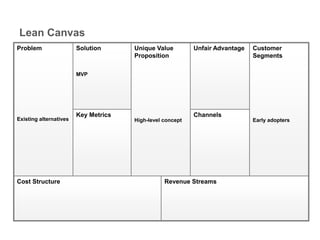
Lean Canvas
Cost Structure Revenue Streams
Problem
Existing alternatives
Solution
MVP
Key Metrics
Unique Value
Proposition
High-level concept
Unfair Advantage
Channels
Customer
Segments
Early adopters

Session 2 fall 2014

  • 1.
  • 2.
  • 3.
    Your startup isnot your product! A customer buys a solution to a problem 3
  • 4.
    Why Lean Canvas •Business Plan waste of time until later • The need of a communication tool • Improves learning in a structured way • Helps focus on the ”right” stuff 4
  • 5.
    Lean Canvas ProjectName 01-Jan-2014 Iteration #x Cost Structure Customer Acquisition costs Distribution costs Hosting People, etc. Revenue Streams Revenue Model Life Time Value Revenue Gross Margin Problem Top 3 problems Existing alternatives Solution Top 3 features MVP Key Metrics Key activities you measure Unique Value Proposition Single, clear, compelling message that states why you are different and worth paying attention High-level concept Unfair Advantage Can’t be easily copied or bought Channels Path to customers Customer Segments Target customers Early adopters PRODUCT MARKET
  • 6.
    6 Lean Canvas ProjectName 01-Jan-2014 Iteration #x Cost Structure Customer Acquisition costs Distribution costs Hosting People, etc. Revenue Streams Revenue Model Life Time Value Revenue Gross Margin Problem Top 3 problems Existing alternatives Solution Top 3 features Key Metrics Key activities you measure Unique Value Proposition Single, clear, compelling message that states why you are different and worth paying attention High-level concept Unfair Advantage Can’t be easily copied or bought Channels Path to customers Customer Segments Target customers Early adopters PRODUCT MARKET 1 1 2 3 4 5 5 7 6
  • 8.
  • 9.
    You really needto understand your customer (and user) 9
  • 10.
    Customers and problems Whois the customer? Multi-sided market? Different from user? hPp://www.businessmodelalchemist.com/2012/08/achieve-product-market-fit-with-our-brand- new-value-proposi8on-designer.html
  • 11.
    Customers and problems -jobs to be done What functional jobs is your customer trying get done? (e.g. perform or complete a specific task, solve a specific problem…) What social jobs is your customer trying to get done? (e.g. trying to look good, gain power or status…) What emotional jobs is your customer trying get done? (e.g. esthetics, feel good, security…) “What jobs are the customers you are targeting trying to get done”
  • 12.
    Customers and problems -customer pains What does your customer find too costly? (e.g. takes a lot of time, costs, effort) What makes your customer feel bad? (e.g. frustrations, annoyances) How are current solutions under- performing for your customer? (e.g. lack of features, performance, malfunction) What negative social consequences does your customer encounter or fear? (e.g. loss of face, power, trust, or status) “What are the costs, nega2ve emo2ons, bad situations etc. that your customer risks experiencing before, during, and after getting the job done.”
  • 13.
    Customers and problems -customer gains Which savings would make your customer happy? (e.g. in terms of time, money and effort) What would make your customer’s job or life easier? (e.g. flatter learning curve, more services, lower cost of ownership) What positive social consequences does your customer desire? (e.g. makes them look good, increase in power, status) What are customers looking for? (e.g. good design, guarantees, features) What do customers dream about? (e.g. big achievements, big reliefs) “What are the benefits your customer expects, desires or would be surprised by.”
  • 14.
    Problem What are youcustomers’ key jobs/pains/gains? Solution Unique Value Proposition Key features Single, clear, compelling message that states why MVP you are different and worth buying from Key Metrics What metrics are most critical to track? Unfair Customer Advantage Segments That can’t be easily Who are your customers? bought, or imitated? Who are earlyvangelists? Channels How do you reach customers? Cost Structure Customer Acquisition Costs Distribution Costs Hosting People etc. Fixed/variable Revenue Streams Revenue Model Life Time Value Revenue/pricing etc.
  • 15.
    Unique Value Propositions/Solution Whatare your products and services? How do they create value for the customer segments?
  • 16.
    Unique Value Propositions/Solution Canyour product/service: • Produce savings? • Make your customers feel better? • Put an end to difficulties? • Wipe out negative social consequences?
  • 17.
    Unique Value Propositions/Solution Canyour product/service: • Outperform current solutions? • Produce outcomes that go beyond their expectations? • Make your customer’s job or life easier? • Create positive social consequences?
  • 18.
    Examples • Skype’s valueproposition – Free internet based chat, audio and video calls. – Cheap calls to mobile and landline phones. – Additional premium features like group video for personal or business calls,
  • 19.
    Examples • Netflix's valueproposition – A low fixed price and unlimited viewing from its large content collection. – Netflix can be viewed from most devices with an Internet connection. – Netflix doesn't have any commercial interruptions
  • 20.
    Examples • Instagram – ”Free” –Real-time, mobile photo friend-following – Egocasting • Shopify – simple, well-designed shops and setup – scalable server farms (flexible volume pricing) – freakish control over external look & feel.
  • 21.
    The process -tactics • Focus on the right stuff at the right time – it’s not necessary to make complete canvases • Be open – develop many hypothesis (avoid local maxima) • No business plan – but you still need the customer and market insight • Validate or discard – gain knowledge • Document and adjust along the way • Then start building…. 21
  • 22.
  • 23.
    Workshop • Define 3-5segment -> problem -> solution -> unique value prop’s (if not already) • Define how you are going to validate that (quantitative and/or qualitative) • Present for the group (2-3 min) -> get feedback
  • 24.
    To think about •When defined a segment, make it 50% smaller – The biggest issue for all startups is prioritization • Be extremely specific (you WILL be able to expand) – Adding a lot of ”nice to have” stuff doesn’t make it a ”must have solution” -> impact on MVP • Think through the red line: user/customer -> problem - > solution -> unique value prop – Visualize your user/customer and avoid thinking of ”distance segments”
  • 25.
  • 26.
    How are youplanning to validate? 26
  • 27.
    Sources/channels Landing Page Buy keywords Pitchto everyone Mockup/ demo Surveys Sketch Interviews
  • 28.
  • 29.
    Lean Canvas Cost StructureRevenue Streams Problem Existing alternatives Solution MVP Key Metrics Unique Value Proposition High-level concept Unfair Advantage Channels Customer Segments Early adopters