E-Learning & E-Content Startup Weekend
Feb 2018
Lean Canvas Workshop
Mohammad Gerveyi
University of Tehran, Science & Technology Park
About Me: Bsc Mechanical Engineer
MA Urban Affairs Management
University of Tehran Graduated
2014 Urban Affairs Management Top Student
“Designing Business Model for Accelerators
in the Field of Urban Management”
Ex-CEO & Co-Founder of Fantasima
Entrepreneurial Ecosystem Researcher
Communication Lead at Axell Accelerator
10 Startup Weekends, +100 Teams, +1000 Participants
(Tehran, Karaj, Mashhad, Shiraz, Ardabil, Qazvin, Babolsar)
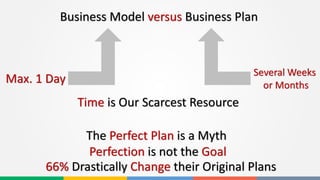
Business Model versus Business Plan
Max. 1 Day
Several Weeks
or Months
Time is Our Scarcest Resource
66% Drastically Change their Original Plans
The Perfect Plan is a Myth
Perfection is not the Goal
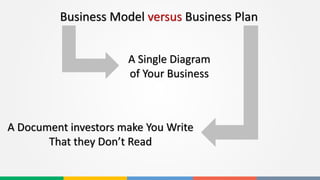
Business Model versus Business Plan
A Document investors make You Write
That they Don’t Read
A Single Diagram
of Your Business
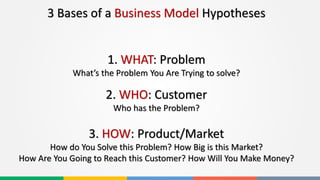
3 Bases of a Business Model Hypotheses
2. WHO: Customer
Who has the Problem?
1. WHAT: Problem
What’s the Problem You Are Trying to solve?
3. HOW: Product/Market
How do You Solve this Problem? How Big is this Market?
How Are You Going to Reach this Customer? How Will You Make Money?
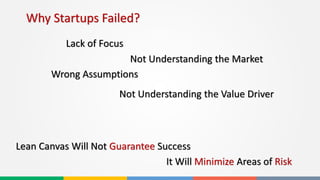
Why Startups Failed?
Lean Canvas Will Not Guarantee Success
It Will Minimize Areas of Risk
Lack of Focus
Not Understanding the Market
Wrong Assumptions
Not Understanding the Value Driver
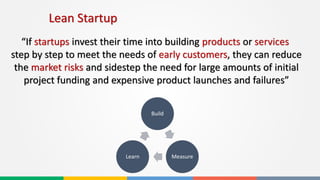
Lean Startup
“If startups invest their time into building products or services
step by step to meet the needs of early customers, they can reduce
the market risks and sidestep the need for large amounts of initial
project funding and expensive product launches and failures”
Build
MeasureLearn
Lean Startup
- Build-Measure-Learn
- Customer Development
- Minimum Viable Product
- Actionable Metrics
- Agile Development
- Lean Canvas
What is Lean Canvas?
Lean Canvas Created By Ash Maurya, Which in Itself is a morphication
from Alex Osterwalder’s Business Model Canvas
The Question is not “Can this Product be Built?”
But “Should this Product be Built?”
“Can We Build a Sustainable Business Around
This Set of Products/Services?”
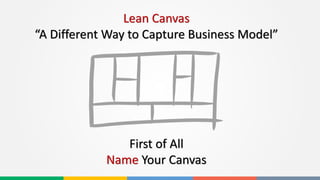
First of All
Name Your Canvas
Lean Canvas
“A Different Way to Capture Business Model”
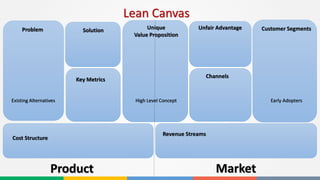
Lean Canvas
Problem
Existing Alternatives
Customer Segments
Early AdoptersHigh Level Concept
Unique
Value Proposition
Solution
Channels
Key Metrics
Revenue Streams
Product
Unfair Advantage
Cost Structure
Market
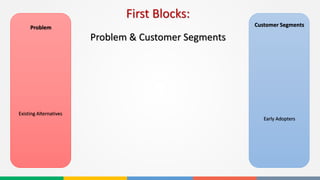
First Blocks:
Problem & Customer Segments
Problem Customer Segments
Early Adopters
Existing Alternatives
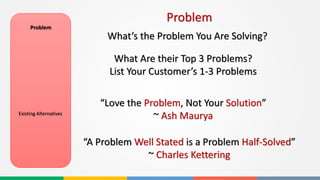
What Are their Top 3 Problems?
List Your Customer’s 1-3 Problems
Problem
Problem
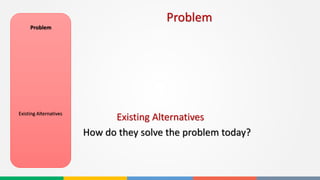
Existing Alternatives
What’s the Problem You Are Solving?
“A Problem Well Stated is a Problem Half-Solved”
~ Charles Kettering
“Love the Problem, Not Your Solution”
~ Ash Maurya
How do they solve the problem today?
Problem
Existing AlternativesExisting Alternatives
Problem
Customer Segments
Early Adopters
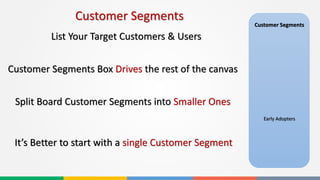
Customer Segments Box Drives the rest of the canvas
Split Board Customer Segments into Smaller Ones
It’s Better to start with a single Customer Segment
Customer Segments
List Your Target Customers & Users
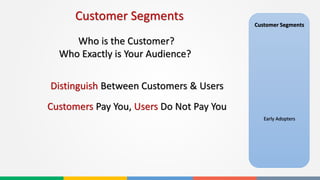
Distinguish Between Customers & Users
Customers Pay You, Users Do Not Pay You
Customer Segments
Early Adopters
Customer Segments
Who is the Customer?
Who Exactly is Your Audience?
Customer Segments
Early Adopters
Customer Segments
Early Adopters
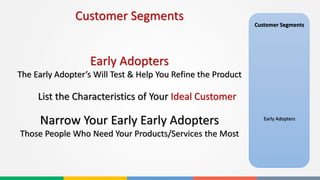
The Early Adopter’s Will Test & Help You Refine the Product
Narrow Your Early Early Adopters
Those People Who Need Your Products/Services the Most
List the Characteristics of Your Ideal Customer
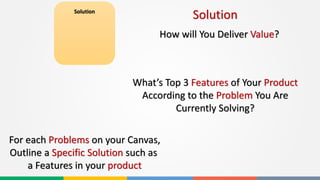
Solution
For each Problems on your Canvas,
Outline a Specific Solution such as
a Features in your product
Solution
How will You Deliver Value?
What’s Top 3 Features of Your Product
According to the Problem You Are
Currently Solving?
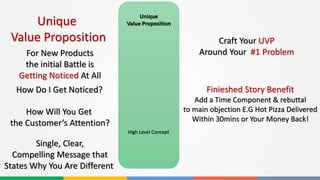
High Level Concept
Unique
Value PropositionUnique
Value Proposition
For New Products
the initial Battle is
Getting Noticed At All
How Will You Get
the Customer’s Attention?
Craft Your UVP
Around Your #1 Problem
Single, Clear,
Compelling Message that
States Why You Are Different
How Do I Get Noticed? Finieshed Story Benefit
Add a Time Component & rebuttal
to main objection E.G Hot Pizza Delivered
Within 30mins or Your Money Back!
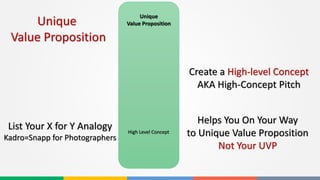
High Level Concept
Unique
Value PropositionUnique
Value Proposition
Create a High-level Concept
AKA High-Concept Pitch
List Your X for Y Analogy
Kadro=Snapp for Photographers
Helps You On Your Way
to Unique Value Proposition
Not Your UVP
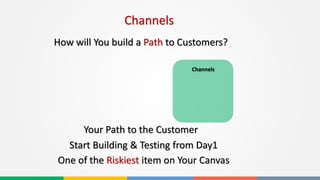
Channels
Channels
One of the Riskiest item on Your Canvas
Start Building & Testing from Day1
How will You build a Path to Customers?
Your Path to the Customer
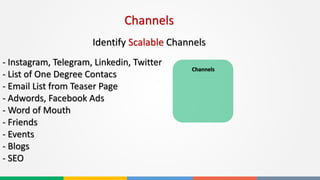
Channels
Channels
- Instagram, Telegram, Linkedin, Twitter
- List of One Degree Contacs
- Email List from Teaser Page
- Adwords, Facebook Ads
- Word of Mouth
- Friends
- Events
- Blogs
- SEO
Identify Scalable Channels
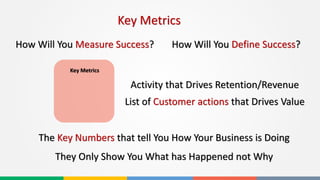
Key Metrics
Key Metrics
The Key Numbers that tell You How Your Business is Doing
How Will You Measure Success?
Activity that Drives Retention/Revenue
They Only Show You What has Happened not Why
How Will You Define Success?
List of Customer actions that Drives Value
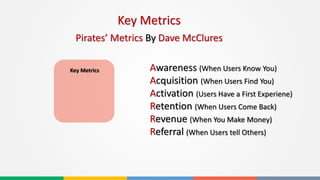
Key Metrics
Key Metrics
Awareness (When Users Know You)
Acquisition (When Users Find You)
Activation (Users Have a First Experiene)
Retention (When Users Come Back)
Revenue (When You Make Money)
Referral (When Users tell Others)
Pirates’ Metrics By Dave McClures
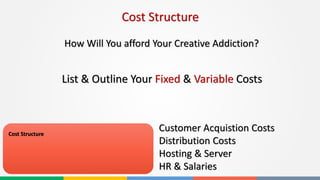
Cost Structure
Cost Structure
Customer Acquistion Costs
Distribution Costs
Hosting & Server
HR & Salaries
How Will You afford Your Creative Addiction?
List & Outline Your Fixed & Variable Costs
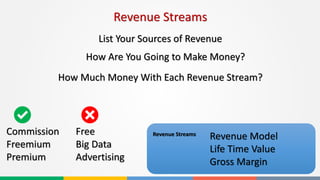
Revenue Streams
Revenue Streams
Revenue Model
Life Time Value
Gross Margin
List Your Sources of Revenue
Commission
Freemium
Premium
Free
Big Data
Advertising
How Are You Going to Make Money?
How Much Money With Each Revenue Stream?
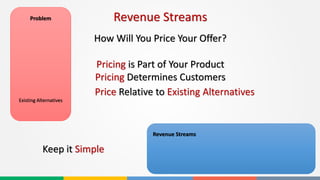
Revenue Streams
Revenue Streams
Price Relative to Existing Alternatives
Problem
Pricing is Part of Your Product
Pricing Determines Customers
Existing Alternatives
Keep it Simple
How Will You Price Your Offer?
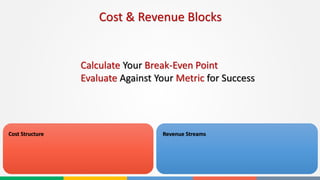
Revenue Streams
Cost & Revenue Blocks
Cost Structure
Calculate Your Break-Even Point
Evaluate Against Your Metric for Success
How Will You Defend Against Competition?
How Do You Defend Against Attacks?
What About First to Market?
1st to Market is Cited as a Barrier. It’s Not
Facebook & Apple Were Not 1st Movers!
What About More Features? Better Design? & ...
Unfair Advantage Unfair Advantage
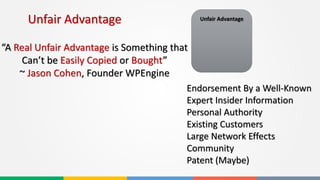
Unfair Advantage
“A Real Unfair Advantage is Something that
Can’t be Easily Copied or Bought”
~ Jason Cohen, Founder WPEngine
Unfair Advantage
Endorsement By a Well-Known
Expert Insider Information
Personal Authority
Existing Customers
Large Network Effects
Community
Patent (Maybe)
Now Complete Your Canvas
It’s Time To Share & Discuss
Time to Get FeedBack
Time to Get FeedBack Again
Sources:
The Lean Startup By Eric Ries
Running Lean By Ash Maurya
Business Model Generation By Alex Osterwalder
Thanks!
Any Question?
Find & Follow Me
At @imithrandir
Gerveyi@ut.ac.ir

Lean Canvas Workshop

  • 1.
    E-Learning & E-ContentStartup Weekend Feb 2018 Lean Canvas Workshop Mohammad Gerveyi University of Tehran, Science & Technology Park
  • 2.
    About Me: BscMechanical Engineer MA Urban Affairs Management University of Tehran Graduated 2014 Urban Affairs Management Top Student “Designing Business Model for Accelerators in the Field of Urban Management” Ex-CEO & Co-Founder of Fantasima Entrepreneurial Ecosystem Researcher Communication Lead at Axell Accelerator 10 Startup Weekends, +100 Teams, +1000 Participants (Tehran, Karaj, Mashhad, Shiraz, Ardabil, Qazvin, Babolsar)
  • 3.
    Business Model versusBusiness Plan Max. 1 Day Several Weeks or Months Time is Our Scarcest Resource 66% Drastically Change their Original Plans The Perfect Plan is a Myth Perfection is not the Goal
  • 4.
    Business Model versusBusiness Plan A Document investors make You Write That they Don’t Read A Single Diagram of Your Business
  • 5.
    3 Bases ofa Business Model Hypotheses 2. WHO: Customer Who has the Problem? 1. WHAT: Problem What’s the Problem You Are Trying to solve? 3. HOW: Product/Market How do You Solve this Problem? How Big is this Market? How Are You Going to Reach this Customer? How Will You Make Money?
  • 6.
    Why Startups Failed? LeanCanvas Will Not Guarantee Success It Will Minimize Areas of Risk Lack of Focus Not Understanding the Market Wrong Assumptions Not Understanding the Value Driver
  • 7.
    Lean Startup “If startupsinvest their time into building products or services step by step to meet the needs of early customers, they can reduce the market risks and sidestep the need for large amounts of initial project funding and expensive product launches and failures” Build MeasureLearn
  • 8.
    Lean Startup - Build-Measure-Learn -Customer Development - Minimum Viable Product - Actionable Metrics - Agile Development - Lean Canvas
  • 9.
    What is LeanCanvas? Lean Canvas Created By Ash Maurya, Which in Itself is a morphication from Alex Osterwalder’s Business Model Canvas The Question is not “Can this Product be Built?” But “Should this Product be Built?” “Can We Build a Sustainable Business Around This Set of Products/Services?”
  • 10.
    First of All NameYour Canvas Lean Canvas “A Different Way to Capture Business Model”
  • 11.
    Lean Canvas Problem Existing Alternatives CustomerSegments Early AdoptersHigh Level Concept Unique Value Proposition Solution Channels Key Metrics Revenue Streams Product Unfair Advantage Cost Structure Market
  • 12.
    First Blocks: Problem &Customer Segments Problem Customer Segments Early Adopters Existing Alternatives
  • 13.
    What Are theirTop 3 Problems? List Your Customer’s 1-3 Problems Problem Problem Existing Alternatives What’s the Problem You Are Solving? “A Problem Well Stated is a Problem Half-Solved” ~ Charles Kettering “Love the Problem, Not Your Solution” ~ Ash Maurya
  • 14.
    How do theysolve the problem today? Problem Existing AlternativesExisting Alternatives Problem
  • 15.
    Customer Segments Early Adopters CustomerSegments Box Drives the rest of the canvas Split Board Customer Segments into Smaller Ones It’s Better to start with a single Customer Segment Customer Segments List Your Target Customers & Users
  • 16.
    Distinguish Between Customers& Users Customers Pay You, Users Do Not Pay You Customer Segments Early Adopters Customer Segments Who is the Customer? Who Exactly is Your Audience?
  • 17.
    Customer Segments Early Adopters CustomerSegments Early Adopters The Early Adopter’s Will Test & Help You Refine the Product Narrow Your Early Early Adopters Those People Who Need Your Products/Services the Most List the Characteristics of Your Ideal Customer
  • 18.
    Solution For each Problemson your Canvas, Outline a Specific Solution such as a Features in your product Solution How will You Deliver Value? What’s Top 3 Features of Your Product According to the Problem You Are Currently Solving?
  • 19.
    High Level Concept Unique ValuePropositionUnique Value Proposition For New Products the initial Battle is Getting Noticed At All How Will You Get the Customer’s Attention? Craft Your UVP Around Your #1 Problem Single, Clear, Compelling Message that States Why You Are Different How Do I Get Noticed? Finieshed Story Benefit Add a Time Component & rebuttal to main objection E.G Hot Pizza Delivered Within 30mins or Your Money Back!
  • 20.
    High Level Concept Unique ValuePropositionUnique Value Proposition Create a High-level Concept AKA High-Concept Pitch List Your X for Y Analogy Kadro=Snapp for Photographers Helps You On Your Way to Unique Value Proposition Not Your UVP
  • 21.
    Channels Channels One of theRiskiest item on Your Canvas Start Building & Testing from Day1 How will You build a Path to Customers? Your Path to the Customer
  • 22.
    Channels Channels - Instagram, Telegram,Linkedin, Twitter - List of One Degree Contacs - Email List from Teaser Page - Adwords, Facebook Ads - Word of Mouth - Friends - Events - Blogs - SEO Identify Scalable Channels
  • 23.
    Key Metrics Key Metrics TheKey Numbers that tell You How Your Business is Doing How Will You Measure Success? Activity that Drives Retention/Revenue They Only Show You What has Happened not Why How Will You Define Success? List of Customer actions that Drives Value
  • 24.
    Key Metrics Key Metrics Awareness(When Users Know You) Acquisition (When Users Find You) Activation (Users Have a First Experiene) Retention (When Users Come Back) Revenue (When You Make Money) Referral (When Users tell Others) Pirates’ Metrics By Dave McClures
  • 25.
    Cost Structure Cost Structure CustomerAcquistion Costs Distribution Costs Hosting & Server HR & Salaries How Will You afford Your Creative Addiction? List & Outline Your Fixed & Variable Costs
  • 26.
    Revenue Streams Revenue Streams RevenueModel Life Time Value Gross Margin List Your Sources of Revenue Commission Freemium Premium Free Big Data Advertising How Are You Going to Make Money? How Much Money With Each Revenue Stream?
  • 27.
    Revenue Streams Revenue Streams PriceRelative to Existing Alternatives Problem Pricing is Part of Your Product Pricing Determines Customers Existing Alternatives Keep it Simple How Will You Price Your Offer?
  • 28.
    Revenue Streams Cost &Revenue Blocks Cost Structure Calculate Your Break-Even Point Evaluate Against Your Metric for Success
  • 29.
    How Will YouDefend Against Competition? How Do You Defend Against Attacks? What About First to Market? 1st to Market is Cited as a Barrier. It’s Not Facebook & Apple Were Not 1st Movers! What About More Features? Better Design? & ... Unfair Advantage Unfair Advantage
  • 30.
    Unfair Advantage “A RealUnfair Advantage is Something that Can’t be Easily Copied or Bought” ~ Jason Cohen, Founder WPEngine Unfair Advantage Endorsement By a Well-Known Expert Insider Information Personal Authority Existing Customers Large Network Effects Community Patent (Maybe)
  • 31.
    Now Complete YourCanvas It’s Time To Share & Discuss Time to Get FeedBack Time to Get FeedBack Again
  • 32.
    Sources: The Lean StartupBy Eric Ries Running Lean By Ash Maurya Business Model Generation By Alex Osterwalder
  • 33.
    Thanks! Any Question? Find &Follow Me At @imithrandir Gerveyi@ut.ac.ir