Presentation ProPresentation Pro
© 2001 by Prentice Hall, Inc.© 2001 by Prentice Hall, Inc.
MagruderMagruder’’ss
American GovernmentAmerican Government
C H A P T E R 10
Congress
11 22 33Go ToGo To
Section:Section: 44
C H A P T E R 10
CongressCongress
SECTION 1The National Legislature
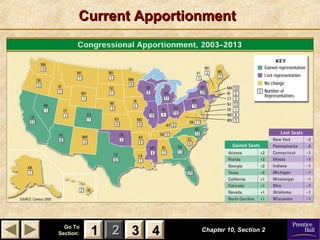
SECTION 2The House of Representatives
SECTION 3The Senate
SECTION 4The Members of Congress
Chapter 10Chapter 10
22 33 4411
11 22 33Go ToGo To
Section:Section: 44 Chapter 10 Section 1Chapter 10 Section 1
S E C T I O N 1
The National LegislatureThe National Legislature
• Why does the Constitution divide power
between the two houses of Congress?
• What is a term of Congress?
• How have sessions of Congress changed
over time?
22 33 44
11 22 33Go ToGo To
Section:Section: 44
The Constitution creates a bicameral
legislature for three reasons:
Two Houses of CongressTwo Houses of Congress
Historical: The British Parliament consisted of two
houses since the 1300s, and many colonial assemblies
were similar in form.
Practical: A bicameral legislature was necessary to
compromise the Virginia and New Jersey plans of
representation.
Theoretical: The Framers favored a bicameral
Congress in order that one house might act as a check
on the other.
Chapter 10, Section 1Chapter 10, Section 1
22 33 44
11 22 33Go ToGo To
Section:Section: 44
TermsTerms
A term is the length of time that
officials serve after an election, as
in a two- or six-year term.
Chapter 10, Section 1Chapter 10, Section 1
22 33 44
The date for the start of each new term has
been set by the Twentieth Amendment
(1933) as “noon of the 3d day of January”
of every odd-numbered year.
11 22 33Go ToGo To
Section:Section: 44
Sessions of CongressSessions of Congress
Chapter 10, Section 1Chapter 10, Section 1
A session is the regular period of time
during which Congress conducts business.
22 33 44
• Congress adjourns, or suspends until the next session,
each regular session as it sees fit.
• If necessary, the President has the power to prorogue, or
adjourn, a session, but only when the two houses cannot
agree on a date for adjournment.
• Only the President may call Congress into a special
session—a meeting to deal with some emergency
situation.
11 22 33Go ToGo To
Section:Section: 44
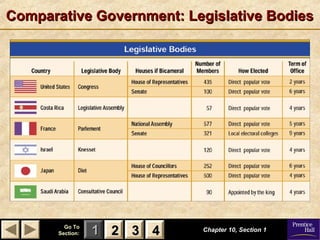
Comparative Government: Legislative BodiesComparative Government: Legislative Bodies
Chapter 10, Section 1Chapter 10, Section 1
22 33 44
11 22 33Go ToGo To
Section:Section: 44
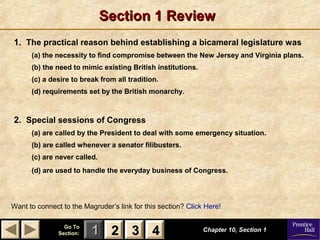
Section 1 ReviewSection 1 Review
1. The practical reason behind establishing a bicameral legislature was
(a) the necessity to find compromise between the New Jersey and Virginia plans.
(b) the need to mimic existing British institutions.
(c) a desire to break from all tradition.
(d) requirements set by the British monarchy.
2. Special sessions of Congress
(a) are called by the President to deal with some emergency situation.
(b) are called whenever a senator filibusters.
(c) are never called.
(d) are used to handle the everyday business of Congress.
Chapter 10, Section 1Chapter 10, Section 1
Want to connect to the Magruder’s link for this section? Click Here!
22 33 44
11 22 33Go ToGo To
Section:Section: 44
S E C T I O N 2
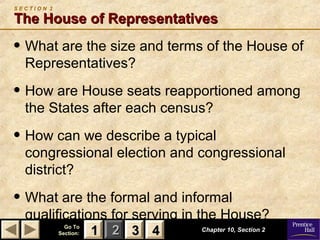
The House of RepresentativesThe House of Representatives
• What are the size and terms of the House of
Representatives?
• How are House seats reapportioned among
the States after each census?
• How can we describe a typical
congressional election and congressional
district?
• What are the formal and informal
qualifications for serving in the House?
Chapter 10, Section 2Chapter 10, Section 2
33 4411
11 22 33Go ToGo To
Section:Section: 44 Chapter 10, Section 2Chapter 10, Section 2
33 4411
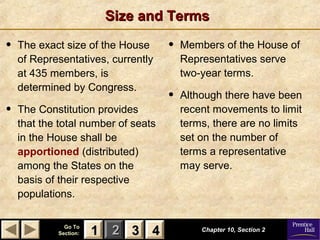
Size and TermsSize and Terms
• The exact size of the House
of Representatives, currently
at 435 members, is
determined by Congress.
• The Constitution provides
that the total number of seats
in the House shall be
apportioned (distributed)
among the States on the
basis of their respective
populations.
• Members of the House of
Representatives serve
two-year terms.
• Although there have been
recent movements to limit
terms, there are no limits
set on the number of
terms a representative
may serve.
11 22 33Go ToGo To
Section:Section: 44
ReapportionmentReapportionment
Article I of the Constitution directs Congress to
reapportion—redistribute—the seats in the
House after each decennial census.
Chapter 10, Section 2Chapter 10, Section 2
33 4411
• As the United States grew in population, the number
of representatives in the House also grew.
• The Reapportionment Act of 1929 set the
“permanent” size of the House at 435 members, and
provided for “automatic reapportionment.”
11 22 33Go ToGo To
Section:Section: 44
Current ApportionmentCurrent Apportionment
Chapter 10, Section 2Chapter 10, Section 2
33 4411
11 22 33Go ToGo To
Section:Section: 44
Congressional ElectionsCongressional Elections
•Congressional elections are
held on the Tuesday following
the first Monday in November of
each even-numbered year.
•Off-year elections are those
congressional elections held
between presidential elections.
Chapter 10, Section 2Chapter 10, Section 2
33 4411
11 22 33Go ToGo To
Section:Section: 44
Districts and GerrymanderingDistricts and Gerrymandering
• Under the single-
member district
arrangement, the voter’s
in each district elect one
of the State’s
representatives.
• The general-ticket
system, no longer in use,
provided that all of a
State’s seats were filled
at-large.
• Districts that have
unusual shapes or even
defy description have
sometimes been
gerrymandered.
• Gerrymandering refers to
the act of drawing
congressional districts to
the advantage of the
political party that
controls the State
legislature.
Chapter 10, Section 2Chapter 10, Section 2
33 4411
11 22 33Go ToGo To
Section:Section: 44
Qualifications for House MembersQualifications for House Members
Chapter 10, Section 2Chapter 10, Section 2
33 4411
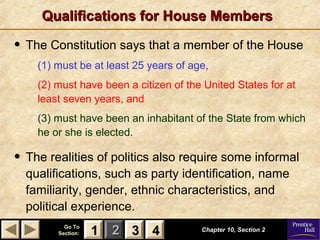
• The Constitution says that a member of the House
(1) must be at least 25 years of age,
(2) must have been a citizen of the United States for at
least seven years, and
(3) must have been an inhabitant of the State from which
he or she is elected.
• The realities of politics also require some informal
qualifications, such as party identification, name
familiarity, gender, ethnic characteristics, and
political experience.
11 22 33Go ToGo To
Section:Section: 44
Section 2 ReviewSection 2 Review
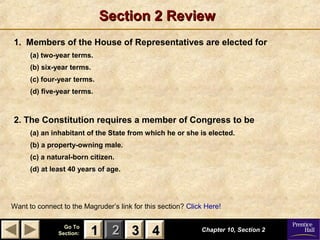
1. Members of the House of Representatives are elected for
(a) two-year terms.
(b) six-year terms.
(c) four-year terms.
(d) five-year terms.
2. The Constitution requires a member of Congress to be
(a) an inhabitant of the State from which he or she is elected.
(b) a property-owning male.
(c) a natural-born citizen.
(d) at least 40 years of age.
Chapter 10, Section 2Chapter 10, Section 2
Want to connect to the Magruder’s link for this section? Click Here!
33 4411
11 22 33Go ToGo To
Section:Section: 44 Chapter 10, Section 3Chapter 10, Section 3
S E C T I O N 3
The SenateThe Senate
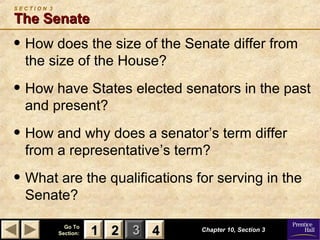
• How does the size of the Senate differ from
the size of the House?
• How have States elected senators in the past
and present?
• How and why does a senator’s term differ
from a representative’s term?
• What are the qualifications for serving in the
Senate?
22 4411
11 22 33Go ToGo To
Section:Section: 44 Chapter 10, Section 3Chapter 10, Section 3
22 4411
Size, Election, and TermsSize, Election, and Terms
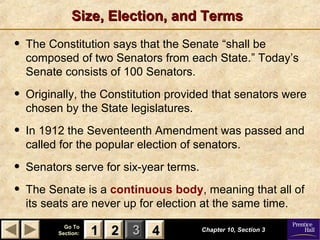
• The Constitution says that the Senate “shall be
composed of two Senators from each State.” Today’s
Senate consists of 100 Senators.
• Originally, the Constitution provided that senators were
chosen by the State legislatures.
• In 1912 the Seventeenth Amendment was passed and
called for the popular election of senators.
• Senators serve for six-year terms.
• The Senate is a continuous body, meaning that all of
its seats are never up for election at the same time.
11 22 33Go ToGo To
Section:Section: 44 Chapter 10, Section 3Chapter 10, Section 3
22 4411 55
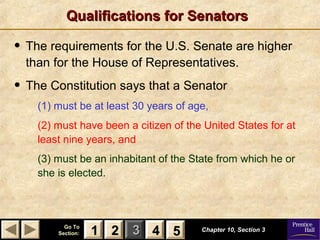
Qualifications for SenatorsQualifications for Senators
• The requirements for the U.S. Senate are higher
than for the House of Representatives.
• The Constitution says that a Senator
(1) must be at least 30 years of age,
(2) must have been a citizen of the United States for at
least nine years, and
(3) must be an inhabitant of the State from which he or
she is elected.
11 22 33Go ToGo To
Section:Section: 44
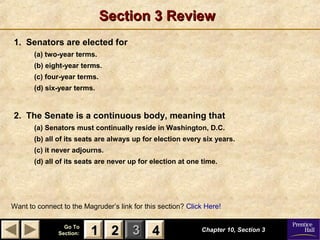
Section 3 ReviewSection 3 Review
1. Senators are elected for
(a) two-year terms.
(b) eight-year terms.
(c) four-year terms.
(d) six-year terms.
2. The Senate is a continuous body, meaning that
(a) Senators must continually reside in Washington, D.C.
(b) all of its seats are always up for election every six years.
(c) it never adjourns.
(d) all of its seats are never up for election at one time.
Chapter 10, Section 3Chapter 10, Section 3
Want to connect to the Magruder’s link for this section? Click Here!
22 4411
11 22 33Go ToGo To
Section:Section: 44
S E C T I O N 4
The Members of CongressThe Members of Congress
• What are the personal and political
backgrounds of the current members of
Congress?
• What are the duties of the job of serving in
Congress?
• How are members of Congress compensated,
and what privileges do they have?
Chapter 10, Section 4Chapter 10, Section 4
22 3311
11 22 33Go ToGo To
Section:Section: 44
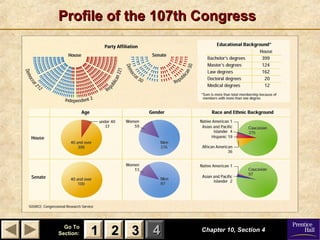
Profile of the 107th CongressProfile of the 107th Congress
Chapter 10, Section 4Chapter 10, Section 4
22 3311
11 22 33Go ToGo To
Section:Section: 44
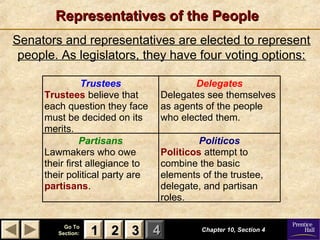
Representatives of the PeopleRepresentatives of the People
Chapter 10, Section 4Chapter 10, Section 4
22 3311
Trustees
Trustees believe that
each question they face
must be decided on its
merits.
Delegates
Delegates see themselves
as agents of the people
who elected them.
Partisans
Lawmakers who owe
their first allegiance to
their political party are
partisans.
Politicos
Politicos attempt to
combine the basic
elements of the trustee,
delegate, and partisan
roles.
Senators and representatives are elected to represent
people. As legislators, they have four voting options:
11 22 33Go ToGo To
Section:Section: 44
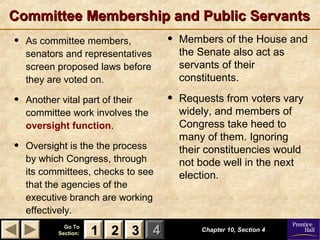
Committee Membership and Public ServantsCommittee Membership and Public Servants
• As committee members,
senators and representatives
screen proposed laws before
they are voted on.
• Another vital part of their
committee work involves the
oversight function.
• Oversight is the the process
by which Congress, through
its committees, checks to see
that the agencies of the
executive branch are working
effectively.
Chapter 10, Section 4Chapter 10, Section 4
22 3311
• Members of the House and
the Senate also act as
servants of their
constituents.
• Requests from voters vary
widely, and members of
Congress take heed to
many of them. Ignoring
their constituencies would
not bode well in the next
election.
11 22 33Go ToGo To
Section:Section: 44
CompensationCompensation
• Today, senators and representatives are paid a salary
of $141,300 a year. Certain members, such as the
Speaker of the House and the Senate’s president pro
tem, are paid more.
• The franking privilege allows members of Congress
to mail letters and other materials postage-free by
substituting their facsimile signature (frank) for the
postage.
• The Constitution says that Congress fixes its own
“compensation.” Therefore, the only real limits to
congressional pay are the President’s veto and fear of
voter backlash against a pay increase.
Chapter 10, Section 4Chapter 10, Section 4
22 3311
11 22 33Go ToGo To
Section:Section: 44
Membership PrivilegesMembership Privileges
• Members of
Congress are
immune from arrest
for noncriminal
offenses while
engaged in
congressional
business.
Chapter 10, Section 4Chapter 10, Section 4
22 3311
• More importantly,
the Speech and
Debate Clause
(Article I, Section 6,
Clause 1) protects
representatives and
senators from suits
for libel or slander
arising from their
official conduct.
11 22 33Go ToGo To
Section:Section: 44
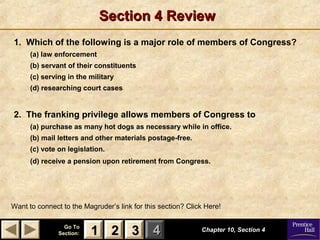
Section 4 ReviewSection 4 Review
1. Which of the following is a major role of members of Congress?
(a) law enforcement
(b) servant of their constituents
(c) serving in the military
(d) researching court cases
2. The franking privilege allows members of Congress to
(a) purchase as many hot dogs as necessary while in office.
(b) mail letters and other materials postage-free.
(c) vote on legislation.
(d) receive a pension upon retirement from Congress.
Chapter 10, Section 4Chapter 10, Section 4
Want to connect to the Magruder’s link for this section? Click Here!
22 3311

Chapter 10

  • 1.
    Presentation ProPresentation Pro ©2001 by Prentice Hall, Inc.© 2001 by Prentice Hall, Inc. MagruderMagruder’’ss American GovernmentAmerican Government C H A P T E R 10 Congress
  • 2.
    11 22 33GoToGo To Section:Section: 44 C H A P T E R 10 CongressCongress SECTION 1The National Legislature SECTION 2The House of Representatives SECTION 3The Senate SECTION 4The Members of Congress Chapter 10Chapter 10 22 33 4411
  • 3.
    11 22 33GoToGo To Section:Section: 44 Chapter 10 Section 1Chapter 10 Section 1 S E C T I O N 1 The National LegislatureThe National Legislature • Why does the Constitution divide power between the two houses of Congress? • What is a term of Congress? • How have sessions of Congress changed over time? 22 33 44
  • 4.
    11 22 33GoToGo To Section:Section: 44 The Constitution creates a bicameral legislature for three reasons: Two Houses of CongressTwo Houses of Congress Historical: The British Parliament consisted of two houses since the 1300s, and many colonial assemblies were similar in form. Practical: A bicameral legislature was necessary to compromise the Virginia and New Jersey plans of representation. Theoretical: The Framers favored a bicameral Congress in order that one house might act as a check on the other. Chapter 10, Section 1Chapter 10, Section 1 22 33 44
  • 5.
    11 22 33GoToGo To Section:Section: 44 TermsTerms A term is the length of time that officials serve after an election, as in a two- or six-year term. Chapter 10, Section 1Chapter 10, Section 1 22 33 44 The date for the start of each new term has been set by the Twentieth Amendment (1933) as “noon of the 3d day of January” of every odd-numbered year.
  • 6.
    11 22 33GoToGo To Section:Section: 44 Sessions of CongressSessions of Congress Chapter 10, Section 1Chapter 10, Section 1 A session is the regular period of time during which Congress conducts business. 22 33 44 • Congress adjourns, or suspends until the next session, each regular session as it sees fit. • If necessary, the President has the power to prorogue, or adjourn, a session, but only when the two houses cannot agree on a date for adjournment. • Only the President may call Congress into a special session—a meeting to deal with some emergency situation.
  • 7.
    11 22 33GoToGo To Section:Section: 44 Comparative Government: Legislative BodiesComparative Government: Legislative Bodies Chapter 10, Section 1Chapter 10, Section 1 22 33 44
  • 8.
    11 22 33GoToGo To Section:Section: 44 Section 1 ReviewSection 1 Review 1. The practical reason behind establishing a bicameral legislature was (a) the necessity to find compromise between the New Jersey and Virginia plans. (b) the need to mimic existing British institutions. (c) a desire to break from all tradition. (d) requirements set by the British monarchy. 2. Special sessions of Congress (a) are called by the President to deal with some emergency situation. (b) are called whenever a senator filibusters. (c) are never called. (d) are used to handle the everyday business of Congress. Chapter 10, Section 1Chapter 10, Section 1 Want to connect to the Magruder’s link for this section? Click Here! 22 33 44
  • 9.
    11 22 33GoToGo To Section:Section: 44 S E C T I O N 2 The House of RepresentativesThe House of Representatives • What are the size and terms of the House of Representatives? • How are House seats reapportioned among the States after each census? • How can we describe a typical congressional election and congressional district? • What are the formal and informal qualifications for serving in the House? Chapter 10, Section 2Chapter 10, Section 2 33 4411
  • 10.
    11 22 33GoToGo To Section:Section: 44 Chapter 10, Section 2Chapter 10, Section 2 33 4411 Size and TermsSize and Terms • The exact size of the House of Representatives, currently at 435 members, is determined by Congress. • The Constitution provides that the total number of seats in the House shall be apportioned (distributed) among the States on the basis of their respective populations. • Members of the House of Representatives serve two-year terms. • Although there have been recent movements to limit terms, there are no limits set on the number of terms a representative may serve.
  • 11.
    11 22 33GoToGo To Section:Section: 44 ReapportionmentReapportionment Article I of the Constitution directs Congress to reapportion—redistribute—the seats in the House after each decennial census. Chapter 10, Section 2Chapter 10, Section 2 33 4411 • As the United States grew in population, the number of representatives in the House also grew. • The Reapportionment Act of 1929 set the “permanent” size of the House at 435 members, and provided for “automatic reapportionment.”
  • 12.
    11 22 33GoToGo To Section:Section: 44 Current ApportionmentCurrent Apportionment Chapter 10, Section 2Chapter 10, Section 2 33 4411
  • 13.
    11 22 33GoToGo To Section:Section: 44 Congressional ElectionsCongressional Elections •Congressional elections are held on the Tuesday following the first Monday in November of each even-numbered year. •Off-year elections are those congressional elections held between presidential elections. Chapter 10, Section 2Chapter 10, Section 2 33 4411
  • 14.
    11 22 33GoToGo To Section:Section: 44 Districts and GerrymanderingDistricts and Gerrymandering • Under the single- member district arrangement, the voter’s in each district elect one of the State’s representatives. • The general-ticket system, no longer in use, provided that all of a State’s seats were filled at-large. • Districts that have unusual shapes or even defy description have sometimes been gerrymandered. • Gerrymandering refers to the act of drawing congressional districts to the advantage of the political party that controls the State legislature. Chapter 10, Section 2Chapter 10, Section 2 33 4411
  • 15.
    11 22 33GoToGo To Section:Section: 44 Qualifications for House MembersQualifications for House Members Chapter 10, Section 2Chapter 10, Section 2 33 4411 • The Constitution says that a member of the House (1) must be at least 25 years of age, (2) must have been a citizen of the United States for at least seven years, and (3) must have been an inhabitant of the State from which he or she is elected. • The realities of politics also require some informal qualifications, such as party identification, name familiarity, gender, ethnic characteristics, and political experience.
  • 16.
    11 22 33GoToGo To Section:Section: 44 Section 2 ReviewSection 2 Review 1. Members of the House of Representatives are elected for (a) two-year terms. (b) six-year terms. (c) four-year terms. (d) five-year terms. 2. The Constitution requires a member of Congress to be (a) an inhabitant of the State from which he or she is elected. (b) a property-owning male. (c) a natural-born citizen. (d) at least 40 years of age. Chapter 10, Section 2Chapter 10, Section 2 Want to connect to the Magruder’s link for this section? Click Here! 33 4411
  • 17.
    11 22 33GoToGo To Section:Section: 44 Chapter 10, Section 3Chapter 10, Section 3 S E C T I O N 3 The SenateThe Senate • How does the size of the Senate differ from the size of the House? • How have States elected senators in the past and present? • How and why does a senator’s term differ from a representative’s term? • What are the qualifications for serving in the Senate? 22 4411
  • 18.
    11 22 33GoToGo To Section:Section: 44 Chapter 10, Section 3Chapter 10, Section 3 22 4411 Size, Election, and TermsSize, Election, and Terms • The Constitution says that the Senate “shall be composed of two Senators from each State.” Today’s Senate consists of 100 Senators. • Originally, the Constitution provided that senators were chosen by the State legislatures. • In 1912 the Seventeenth Amendment was passed and called for the popular election of senators. • Senators serve for six-year terms. • The Senate is a continuous body, meaning that all of its seats are never up for election at the same time.
  • 19.
    11 22 33GoToGo To Section:Section: 44 Chapter 10, Section 3Chapter 10, Section 3 22 4411 55 Qualifications for SenatorsQualifications for Senators • The requirements for the U.S. Senate are higher than for the House of Representatives. • The Constitution says that a Senator (1) must be at least 30 years of age, (2) must have been a citizen of the United States for at least nine years, and (3) must be an inhabitant of the State from which he or she is elected.
  • 20.
    11 22 33GoToGo To Section:Section: 44 Section 3 ReviewSection 3 Review 1. Senators are elected for (a) two-year terms. (b) eight-year terms. (c) four-year terms. (d) six-year terms. 2. The Senate is a continuous body, meaning that (a) Senators must continually reside in Washington, D.C. (b) all of its seats are always up for election every six years. (c) it never adjourns. (d) all of its seats are never up for election at one time. Chapter 10, Section 3Chapter 10, Section 3 Want to connect to the Magruder’s link for this section? Click Here! 22 4411
  • 21.
    11 22 33GoToGo To Section:Section: 44 S E C T I O N 4 The Members of CongressThe Members of Congress • What are the personal and political backgrounds of the current members of Congress? • What are the duties of the job of serving in Congress? • How are members of Congress compensated, and what privileges do they have? Chapter 10, Section 4Chapter 10, Section 4 22 3311
  • 22.
    11 22 33GoToGo To Section:Section: 44 Profile of the 107th CongressProfile of the 107th Congress Chapter 10, Section 4Chapter 10, Section 4 22 3311
  • 23.
    11 22 33GoToGo To Section:Section: 44 Representatives of the PeopleRepresentatives of the People Chapter 10, Section 4Chapter 10, Section 4 22 3311 Trustees Trustees believe that each question they face must be decided on its merits. Delegates Delegates see themselves as agents of the people who elected them. Partisans Lawmakers who owe their first allegiance to their political party are partisans. Politicos Politicos attempt to combine the basic elements of the trustee, delegate, and partisan roles. Senators and representatives are elected to represent people. As legislators, they have four voting options:
  • 24.
    11 22 33GoToGo To Section:Section: 44 Committee Membership and Public ServantsCommittee Membership and Public Servants • As committee members, senators and representatives screen proposed laws before they are voted on. • Another vital part of their committee work involves the oversight function. • Oversight is the the process by which Congress, through its committees, checks to see that the agencies of the executive branch are working effectively. Chapter 10, Section 4Chapter 10, Section 4 22 3311 • Members of the House and the Senate also act as servants of their constituents. • Requests from voters vary widely, and members of Congress take heed to many of them. Ignoring their constituencies would not bode well in the next election.
  • 25.
    11 22 33GoToGo To Section:Section: 44 CompensationCompensation • Today, senators and representatives are paid a salary of $141,300 a year. Certain members, such as the Speaker of the House and the Senate’s president pro tem, are paid more. • The franking privilege allows members of Congress to mail letters and other materials postage-free by substituting their facsimile signature (frank) for the postage. • The Constitution says that Congress fixes its own “compensation.” Therefore, the only real limits to congressional pay are the President’s veto and fear of voter backlash against a pay increase. Chapter 10, Section 4Chapter 10, Section 4 22 3311
  • 26.
    11 22 33GoToGo To Section:Section: 44 Membership PrivilegesMembership Privileges • Members of Congress are immune from arrest for noncriminal offenses while engaged in congressional business. Chapter 10, Section 4Chapter 10, Section 4 22 3311 • More importantly, the Speech and Debate Clause (Article I, Section 6, Clause 1) protects representatives and senators from suits for libel or slander arising from their official conduct.
  • 27.
    11 22 33GoToGo To Section:Section: 44 Section 4 ReviewSection 4 Review 1. Which of the following is a major role of members of Congress? (a) law enforcement (b) servant of their constituents (c) serving in the military (d) researching court cases 2. The franking privilege allows members of Congress to (a) purchase as many hot dogs as necessary while in office. (b) mail letters and other materials postage-free. (c) vote on legislation. (d) receive a pension upon retirement from Congress. Chapter 10, Section 4Chapter 10, Section 4 Want to connect to the Magruder’s link for this section? Click Here! 22 3311