Introduction to
Philosophy
DANILO F. MARIBAO
FACULTY
Paliparan 3 Senior High School
Paliparan III, Dasmarinas City, Cavite
Course objectives: At the end of the course, the student should
be able to:
1. Reflect on their daily experiences from a holistic
point of view
2. Acquire Critical and Analytical Thinking skills
3. Apply their critical and analytical thinking skills
to the affairs of daily life
4. Become truthful, environment-friendly and
service-oriented
5. Actively committed to the development of a
more humane society
6. Articulate their own philosophy of life
What is philosophy?
• Oldest discipline (if you want to call it a discipline)
• Love for wisdom
• “Man’s search for meaning” –Vitaliano R. Gorospe, SJ (in Bernardo,
2016, p.6)
• Man (x)
• People (sexist!)
• Asking questions (the manner and act as sometimes more important
than the answer)
Sangkatutak ang tanong natin
sa buhay…
• Bakit natalo si Pacman?
• Bakit mukang addict si
Lady Gaga?
• Bakit kailangan ng
Algebra?
• Bakit mahal kita?
Seryosong mga tanong…
• Bakit may
kahirapan?
• Saan nagmula
ang lahat?
• Sino ako?
• Anong kahulugan
ng buhay ko?
What is philosophy?
• Philosophy as a science: study of the processes governing
thought and conduct (Zulueta et al., 2000, p. 2)
• Philosophy is the art of rational thought
• It teaches not what to think, but how to think
• Better world view
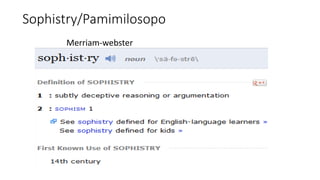
Sophistry/Pamimilosopo
Merriam-webster
ACTIVITY:
1. Divide the class into 5 groups
2. Each group will formulate one
philosophy in life.
3. Give meaning to it.
4. Present to the class.
Read and analyze the following conversation between a
high school teacher ad her student in class:
Teacher: “Junjun , what would you like to be when you
grow up?”
Junjun: “Ma’am, I wan to be happy”
Teacher: “Junjun, you did not understand my question,”
Junjun: “Ma’am, you do not understand what life is all
about”
ANALYSIS:
1. Do you think that Junjun answered his teacher’s question
correctly?
2. What do you think was Junjun’s interpretation of his
teacher’s question?
3. Based on his responses, what kind of student do you
imagine junjun to be?
4. If you were junjun’s teacher, how would you respond to
him?
5. How is Philosophy related to this situation?
Who should study Philosophy?
• Who needs it? We are
all philosophers.
–Aynd Rand
ABSTRACTION:
Why engage in philosophy?
• Encounter with friends or people close to us
• Beauty of nature / the world
• Challenges in the everyday life
• Diverse human experiences
(Bernardo, 2016, p.1)
Holistic philosophy
Recall objective number 1
• Not necessarily dualistic but holistic
• An embodied subject
• Existential phenomenological approach (the person as a
whole and undivided)
• Love for wisdom
• Wisdom is not divorced from the being of the truth-seeker
• “Everything becomes and that everything is in constant change” -
Heraclitus
• However, this and the CG is debatable
(Bernardo, 2016, p.2)
Holistic philosophy
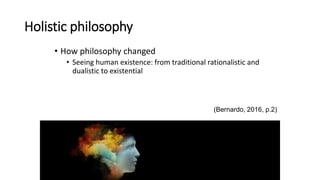
• How philosophy changed
• Seeing human existence: from traditional rationalistic and
dualistic to existential
(Bernardo, 2016, p.2)
Holistic philosophy
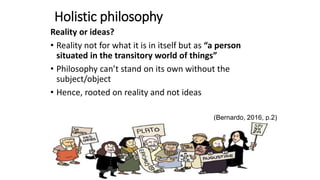
Reality or ideas?
• Reality not for what it is in itself but as “a person
situated in the transitory world of things”
• Philosophy can’t stand on its own without the
subject/object
• Hence, rooted on reality and not ideas
(Bernardo, 2016, p.2)
More of holistic philosophy
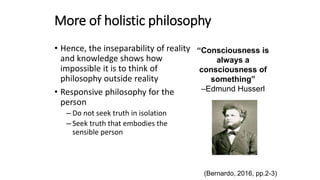
• Hence, the inseparability of reality
and knowledge shows how
impossible it is to think of
philosophy outside reality
• Responsive philosophy for the
person
– Do not seek truth in isolation
– Seek truth that embodies the
sensible person
(Bernardo, 2016, pp.2-3)
“Consciousness is
always a
consciousness of
something”
–Edmund Husserl
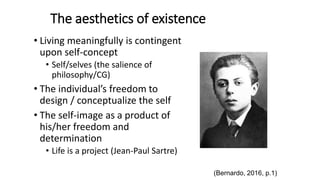
The aesthetics of existence
• Living meaningfully is contingent
upon self-concept
• Self/selves (the salience of
philosophy/CG)
• The individual’s freedom to
design / conceptualize the self
• The self-image as a product of
his/her freedom and
determination
• Life is a project (Jean-Paul Sartre)
(Bernardo, 2016, p.1)
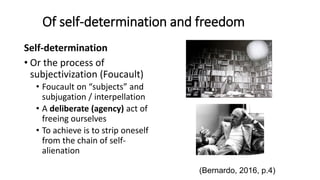
Of self-determination and freedom
Self-determination
• Or the process of
subjectivization (Foucault)
• Foucault on “subjects” and
subjugation / interpellation
• A deliberate (agency) act of
freeing ourselves
• To achieve is to strip oneself
from the chain of self-
alienation
(Bernardo, 2016, p.4)
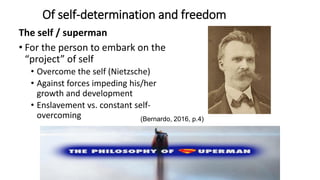
Of self-determination and freedom
The self / superman
• For the person to embark on the
“project” of self
• Overcome the self (Nietzsche)
• Against forces impeding his/her
growth and development
• Enslavement vs. constant self-
overcoming (Bernardo, 2016, p.4)
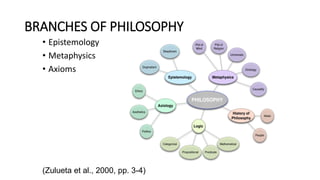
BRANCHES OF PHILOSOPHY
• Epistemology
• Metaphysics
• Axioms
(Zulueta et al., 2000, pp. 3-4)
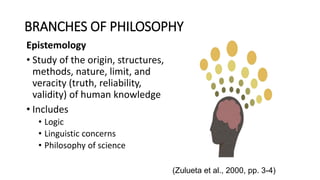
BRANCHES OF PHILOSOPHY
Epistemology
• Study of the origin, structures,
methods, nature, limit, and
veracity (truth, reliability,
validity) of human knowledge
• Includes
• Logic
• Linguistic concerns
• Philosophy of science
(Zulueta et al., 2000, pp. 3-4)
BRANCHES OF PHILOSOPHY
Epistemology
• From Greek words “episteme” (knowledge) and
logos
• Theory of knowledge
• Asks fundamental questions about knowledge,
forms, formulation, application, how they are
expressed and communicated
• Sense of experience and how knowledge is
acquired
(Zulueta et al., 2000, pp. 3-4)
BRANCHES OF
PHILOSOPHY
Metaphysics
• Deals with reality
• Its nature, meaning, and existence
• From Greek word “meta” (beyond) and “physikon”
nature
• Nature of mind, self consciousness, nature of
religion (existence of God as metaphysical
question), the soul
• Examination of time, space, cause, and chance
(Zulueta et al., 2000, pp. 3-4)
Axioms
• Study of values
• Analyzes the origins,
types, and characteristics,
criteria, and knowledge
of values
• Hard, relativity (what may
be ethical for you may not
be…)
(Zulueta et al., 2000, pp. 3-4)
BRANCHES OF
PHILOSOPHY
BRANCHES OF PHILOSOPHY
Axioms
• Includes the analysis of human
conduct, the nature and justification
of social structures and political
systems
• The question of value is so
pronounced and important also for
ordinary people and the everyday life
(Zulueta et al., 2000, pp. 3-4)
The Trolley Problem
APPLICATION:
GROUP ACTIVITY
•Verbally present your answers (preferably three
different people from the group)
•You have 15 minutes to brainstorm as a group
•Each group gets 3-5 minutes to present
GROUP ACTIVITY
Reflect on the following:
1. Explain why you agree or do not agree with the
assumptions of “holistic philosophy”
2. How can you best integrate / frame the lesson using
holistic philosophy?
3. Choose one branch of philosophy (epistemology,
metaphysics, axiom) and explain its practical
importance to the everyday lives as a students
AGREEMENT/ASSIGNMENT:
REFERENCES
• Bernardo J.V. (2016). Introduction to the Philosophy of
the Human Person. JFS Publishing Services,
Philippines, Pasay City
• Zulueta, F. et al. (2000). Philosophy Made Easy.
National Book Store, Philippines, Mandaluyong City.

Topic 1. introduction to philosophy

  • 1.
    Introduction to Philosophy DANILO F.MARIBAO FACULTY Paliparan 3 Senior High School Paliparan III, Dasmarinas City, Cavite
  • 2.
    Course objectives: Atthe end of the course, the student should be able to: 1. Reflect on their daily experiences from a holistic point of view 2. Acquire Critical and Analytical Thinking skills 3. Apply their critical and analytical thinking skills to the affairs of daily life 4. Become truthful, environment-friendly and service-oriented 5. Actively committed to the development of a more humane society 6. Articulate their own philosophy of life
  • 3.
    What is philosophy? •Oldest discipline (if you want to call it a discipline) • Love for wisdom • “Man’s search for meaning” –Vitaliano R. Gorospe, SJ (in Bernardo, 2016, p.6) • Man (x) • People (sexist!) • Asking questions (the manner and act as sometimes more important than the answer)
  • 4.
    Sangkatutak ang tanongnatin sa buhay… • Bakit natalo si Pacman? • Bakit mukang addict si Lady Gaga? • Bakit kailangan ng Algebra? • Bakit mahal kita?
  • 5.
    Seryosong mga tanong… •Bakit may kahirapan? • Saan nagmula ang lahat? • Sino ako? • Anong kahulugan ng buhay ko?
  • 6.
    What is philosophy? •Philosophy as a science: study of the processes governing thought and conduct (Zulueta et al., 2000, p. 2) • Philosophy is the art of rational thought • It teaches not what to think, but how to think • Better world view
  • 7.
  • 8.
    ACTIVITY: 1. Divide theclass into 5 groups 2. Each group will formulate one philosophy in life. 3. Give meaning to it. 4. Present to the class.
  • 10.
    Read and analyzethe following conversation between a high school teacher ad her student in class: Teacher: “Junjun , what would you like to be when you grow up?” Junjun: “Ma’am, I wan to be happy” Teacher: “Junjun, you did not understand my question,” Junjun: “Ma’am, you do not understand what life is all about” ANALYSIS:
  • 11.
    1. Do youthink that Junjun answered his teacher’s question correctly? 2. What do you think was Junjun’s interpretation of his teacher’s question? 3. Based on his responses, what kind of student do you imagine junjun to be? 4. If you were junjun’s teacher, how would you respond to him? 5. How is Philosophy related to this situation?
  • 12.
    Who should studyPhilosophy? • Who needs it? We are all philosophers. –Aynd Rand ABSTRACTION:
  • 13.
    Why engage inphilosophy? • Encounter with friends or people close to us • Beauty of nature / the world • Challenges in the everyday life • Diverse human experiences (Bernardo, 2016, p.1)
  • 14.
    Holistic philosophy Recall objectivenumber 1 • Not necessarily dualistic but holistic • An embodied subject • Existential phenomenological approach (the person as a whole and undivided) • Love for wisdom • Wisdom is not divorced from the being of the truth-seeker • “Everything becomes and that everything is in constant change” - Heraclitus • However, this and the CG is debatable (Bernardo, 2016, p.2)
  • 15.
    Holistic philosophy • Howphilosophy changed • Seeing human existence: from traditional rationalistic and dualistic to existential (Bernardo, 2016, p.2)
  • 16.
    Holistic philosophy Reality orideas? • Reality not for what it is in itself but as “a person situated in the transitory world of things” • Philosophy can’t stand on its own without the subject/object • Hence, rooted on reality and not ideas (Bernardo, 2016, p.2)
  • 17.
    More of holisticphilosophy • Hence, the inseparability of reality and knowledge shows how impossible it is to think of philosophy outside reality • Responsive philosophy for the person – Do not seek truth in isolation – Seek truth that embodies the sensible person (Bernardo, 2016, pp.2-3) “Consciousness is always a consciousness of something” –Edmund Husserl
  • 18.
    The aesthetics ofexistence • Living meaningfully is contingent upon self-concept • Self/selves (the salience of philosophy/CG) • The individual’s freedom to design / conceptualize the self • The self-image as a product of his/her freedom and determination • Life is a project (Jean-Paul Sartre) (Bernardo, 2016, p.1)
  • 19.
    Of self-determination andfreedom Self-determination • Or the process of subjectivization (Foucault) • Foucault on “subjects” and subjugation / interpellation • A deliberate (agency) act of freeing ourselves • To achieve is to strip oneself from the chain of self- alienation (Bernardo, 2016, p.4)
  • 20.
    Of self-determination andfreedom The self / superman • For the person to embark on the “project” of self • Overcome the self (Nietzsche) • Against forces impeding his/her growth and development • Enslavement vs. constant self- overcoming (Bernardo, 2016, p.4)
  • 21.
    BRANCHES OF PHILOSOPHY •Epistemology • Metaphysics • Axioms (Zulueta et al., 2000, pp. 3-4)
  • 22.
    BRANCHES OF PHILOSOPHY Epistemology •Study of the origin, structures, methods, nature, limit, and veracity (truth, reliability, validity) of human knowledge • Includes • Logic • Linguistic concerns • Philosophy of science (Zulueta et al., 2000, pp. 3-4)
  • 23.
    BRANCHES OF PHILOSOPHY Epistemology •From Greek words “episteme” (knowledge) and logos • Theory of knowledge • Asks fundamental questions about knowledge, forms, formulation, application, how they are expressed and communicated • Sense of experience and how knowledge is acquired (Zulueta et al., 2000, pp. 3-4)
  • 24.
    BRANCHES OF PHILOSOPHY Metaphysics • Dealswith reality • Its nature, meaning, and existence • From Greek word “meta” (beyond) and “physikon” nature • Nature of mind, self consciousness, nature of religion (existence of God as metaphysical question), the soul • Examination of time, space, cause, and chance (Zulueta et al., 2000, pp. 3-4)
  • 25.
    Axioms • Study ofvalues • Analyzes the origins, types, and characteristics, criteria, and knowledge of values • Hard, relativity (what may be ethical for you may not be…) (Zulueta et al., 2000, pp. 3-4) BRANCHES OF PHILOSOPHY
  • 26.
    BRANCHES OF PHILOSOPHY Axioms •Includes the analysis of human conduct, the nature and justification of social structures and political systems • The question of value is so pronounced and important also for ordinary people and the everyday life (Zulueta et al., 2000, pp. 3-4)
  • 27.
  • 28.
    GROUP ACTIVITY •Verbally presentyour answers (preferably three different people from the group) •You have 15 minutes to brainstorm as a group •Each group gets 3-5 minutes to present
  • 29.
    GROUP ACTIVITY Reflect onthe following: 1. Explain why you agree or do not agree with the assumptions of “holistic philosophy” 2. How can you best integrate / frame the lesson using holistic philosophy? 3. Choose one branch of philosophy (epistemology, metaphysics, axiom) and explain its practical importance to the everyday lives as a students AGREEMENT/ASSIGNMENT:
  • 30.
    REFERENCES • Bernardo J.V.(2016). Introduction to the Philosophy of the Human Person. JFS Publishing Services, Philippines, Pasay City • Zulueta, F. et al. (2000). Philosophy Made Easy. National Book Store, Philippines, Mandaluyong City.