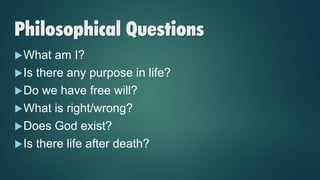
Philosophical Questions
What am I?
Is there any purpose in life?
Do we have free will?
What is right/wrong?
Does God exist?
Is there life after death?
Philosophical Questions
Philosophical questions are questions that do not
have one clear correct answer and they cannot be
answered fairly decisively by examining the evidence
of the senses.
“the academic study of anything”
PHILOSOPHY
Philosophy is critical thinking about thinking, the
proximate goal of which is to get in touch with the
truth about reality, the ultimate goal being to better
see the Big Picture (Christian, 2012).
PHILOSOPHY
Philosophy is the experience of asking and seeking
to answer grand questions about life, about what we
know, about what we ought to do or believe in.
It is the process of getting to the bottom of things,
questioning ideas that, most of the time, we simply
take for granted and probably never put into words
(Solomon and Higgins, 2014).
PHILOSOPHY
It comes from the Greek words “philos” and “sophia”,
which means “love” and “wisdom”
“Love of wisdom”
Skill
Intelligence
Knowledge
Wisdom
Skill
An ability and capacity acquired through deliberate,
systematic, and sustained effort to smoothly and
adaptively carry out complex activities or job
functions involving ideas (cognitive skills), things
(technical skills), and/or people (interpersonal skills).
Intelligence
Intelligence refers to intellectual functioning.
Knowledge
the fact or condition of knowing something with
familiarity gained through experience or association
Wisdom
Is the ability to use and apply knowledge with great
intelligence
Skill
Intelligence
Knowledge
Wisdom
Branches of Philosophy
 Metaphysics – study of reality, being or existence
 Epistemology – study of the nature of knowledge
 Ethics – moral philosophy; study of right and wrong
 Social philosophy - philosophical study of society
 Political philosophy - focuses on the state
 Logic – study of reasoning
 Aesthetics - philosophical study of art and beauty
Primary Features of Philosophy
Articulation: putting your ideas in clear, concise,
readily understandable language.
Argument: supporting your ideas with reasons from
other ideas, principles, and observations to establish
your conclusions and overcome objections.
Primary Features of Philosophy
Analysis: understanding an idea by distinguishing
and clarifying its various components.
Synthesis: gathering together different ideas into a
single, unified vision.
Importance of Studying Philosophy
Philosophy provides us with the motivation and the
intellectual abilities required to explore life’s most
challenging issues.
Importance of Studying Philosophy
Studying philosophy in a serious and reflective way
will change you as a person.
Importance of Studying Philosophy
Studying philosophy will help you develop the
understanding and insight you will need to make
intelligent choices and fulfill your potential as an
individual.
“Focus on the things that matter the
most in your life and the big picture
will begin to come into view.“
- Susan Gale
"And if you graduate from college
with straight A’s, you have to do some
serious soul-searching as to why you
chose to spend your time doing that.“
- Seth Godin
1. Chaffee, J. (2016). The Philosopher’s Way: A Text
with Readings. New York: Pearson. pp. 2 – 4
2. Solomon, C., & Higgins, K. (2014). The Big
Questions: A Short Introduction to Philosophy,
Ninth Edition. Belmont, CA: Wadsworth, Cengage
Learning. pp. 3 – 7

Doing Philosophy

  • 7.
    Philosophical Questions What amI? Is there any purpose in life? Do we have free will? What is right/wrong? Does God exist? Is there life after death?
  • 8.
    Philosophical Questions Philosophical questionsare questions that do not have one clear correct answer and they cannot be answered fairly decisively by examining the evidence of the senses.
  • 13.
    “the academic studyof anything”
  • 14.
    PHILOSOPHY Philosophy is criticalthinking about thinking, the proximate goal of which is to get in touch with the truth about reality, the ultimate goal being to better see the Big Picture (Christian, 2012).
  • 15.
    PHILOSOPHY Philosophy is theexperience of asking and seeking to answer grand questions about life, about what we know, about what we ought to do or believe in. It is the process of getting to the bottom of things, questioning ideas that, most of the time, we simply take for granted and probably never put into words (Solomon and Higgins, 2014).
  • 16.
    PHILOSOPHY It comes fromthe Greek words “philos” and “sophia”, which means “love” and “wisdom” “Love of wisdom”
  • 19.
  • 20.
    Skill An ability andcapacity acquired through deliberate, systematic, and sustained effort to smoothly and adaptively carry out complex activities or job functions involving ideas (cognitive skills), things (technical skills), and/or people (interpersonal skills).
  • 27.
    Intelligence Intelligence refers tointellectual functioning.
  • 30.
    Knowledge the fact orcondition of knowing something with familiarity gained through experience or association
  • 32.
    Wisdom Is the abilityto use and apply knowledge with great intelligence
  • 37.
  • 39.
    Branches of Philosophy Metaphysics – study of reality, being or existence  Epistemology – study of the nature of knowledge  Ethics – moral philosophy; study of right and wrong  Social philosophy - philosophical study of society  Political philosophy - focuses on the state  Logic – study of reasoning  Aesthetics - philosophical study of art and beauty
  • 41.
    Primary Features ofPhilosophy Articulation: putting your ideas in clear, concise, readily understandable language. Argument: supporting your ideas with reasons from other ideas, principles, and observations to establish your conclusions and overcome objections.
  • 42.
    Primary Features ofPhilosophy Analysis: understanding an idea by distinguishing and clarifying its various components. Synthesis: gathering together different ideas into a single, unified vision.
  • 46.
    Importance of StudyingPhilosophy Philosophy provides us with the motivation and the intellectual abilities required to explore life’s most challenging issues.
  • 48.
    Importance of StudyingPhilosophy Studying philosophy in a serious and reflective way will change you as a person.
  • 50.
    Importance of StudyingPhilosophy Studying philosophy will help you develop the understanding and insight you will need to make intelligent choices and fulfill your potential as an individual.
  • 51.
    “Focus on thethings that matter the most in your life and the big picture will begin to come into view.“ - Susan Gale
  • 53.
    "And if yougraduate from college with straight A’s, you have to do some serious soul-searching as to why you chose to spend your time doing that.“ - Seth Godin
  • 59.
    1. Chaffee, J.(2016). The Philosopher’s Way: A Text with Readings. New York: Pearson. pp. 2 – 4 2. Solomon, C., & Higgins, K. (2014). The Big Questions: A Short Introduction to Philosophy, Ninth Edition. Belmont, CA: Wadsworth, Cengage Learning. pp. 3 – 7