Top 10 Security Vulnerabilities
Susam Pal
Based on OWASP Top Ten Project (2006)
http://www.owasp.org/index.php/OWASP_Top_Ten_Project
Content is available under Creative Commons Attribution-ShareAlike 2.5 License
Agenda
 Unvalidated Input
 Broken Access Control
 Broken Authentication
 Cross Site Scripting
 Buffer Overflows
 Injection Flaws
 Improper Error Handling
 Insecure Storage
 Denial of Service
 Insecure Configuration
Unvalidated Input
All input is evil ….
.... until proven otherwise.
Types of Input:
 HTTP Requests
 Commands
 Network packets (TCP/IP, UDP, etc.)
Unvalidated Input
Common Input Tampering Attacks:
 Forced Browsing
 Command Insertion
 Cross Site Scripting
 Buffer Overflows
 SQL Injection
 Hidden Field Manipulation
Unvalidated Input
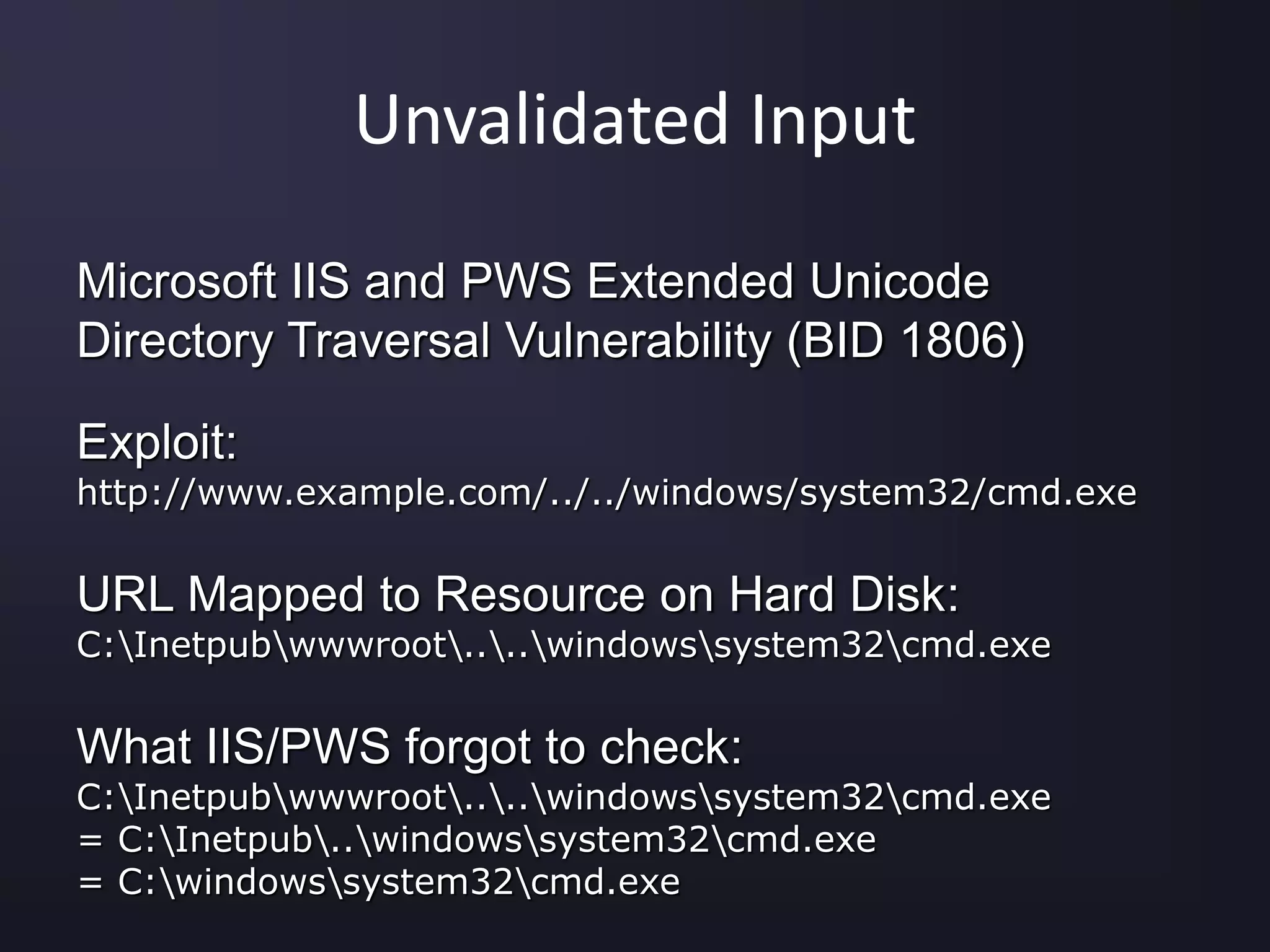
Microsoft IIS and PWS Extended Unicode
Directory Traversal Vulnerability (BID 1806)
Web Root: C:Inetpubwwwroot
Unsafe Procedure:
map [URL] to [path of the resource] on the hard disk;
if [path of the resource] starts with [C:Inetpubwwwroot]
then
allow access;
else
deny access;
Unvalidated Input
Microsoft IIS and PWS Extended Unicode
Directory Traversal Vulnerability (BID 1806)
Exploit:
http://www.example.com/../../windows/system32/cmd.exe
URL Mapped to Resource on Hard Disk:
C:Inetpubwwwroot....windowssystem32cmd.exe
What IIS/PWS forgot to check:
C:Inetpubwwwroot....windowssystem32cmd.exe
= C:Inetpub..windowssystem32cmd.exe
= C:windowssystem32cmd.exe
Unvalidated Input
Microsoft IIS and PWS Extended Unicode
Directory Traversal Vulnerability (BID 1806)
Safe Procedure:
map [URL] to [path of the resource] on the hard disk;
canonicalize [path of the resource];
if [path of the resource] starts with [C:Inetpubwwwroot]
then
allow access;
else
deny access;
Reference:
http://www.securityfocus.com/bid/1806
Unvalidated Input
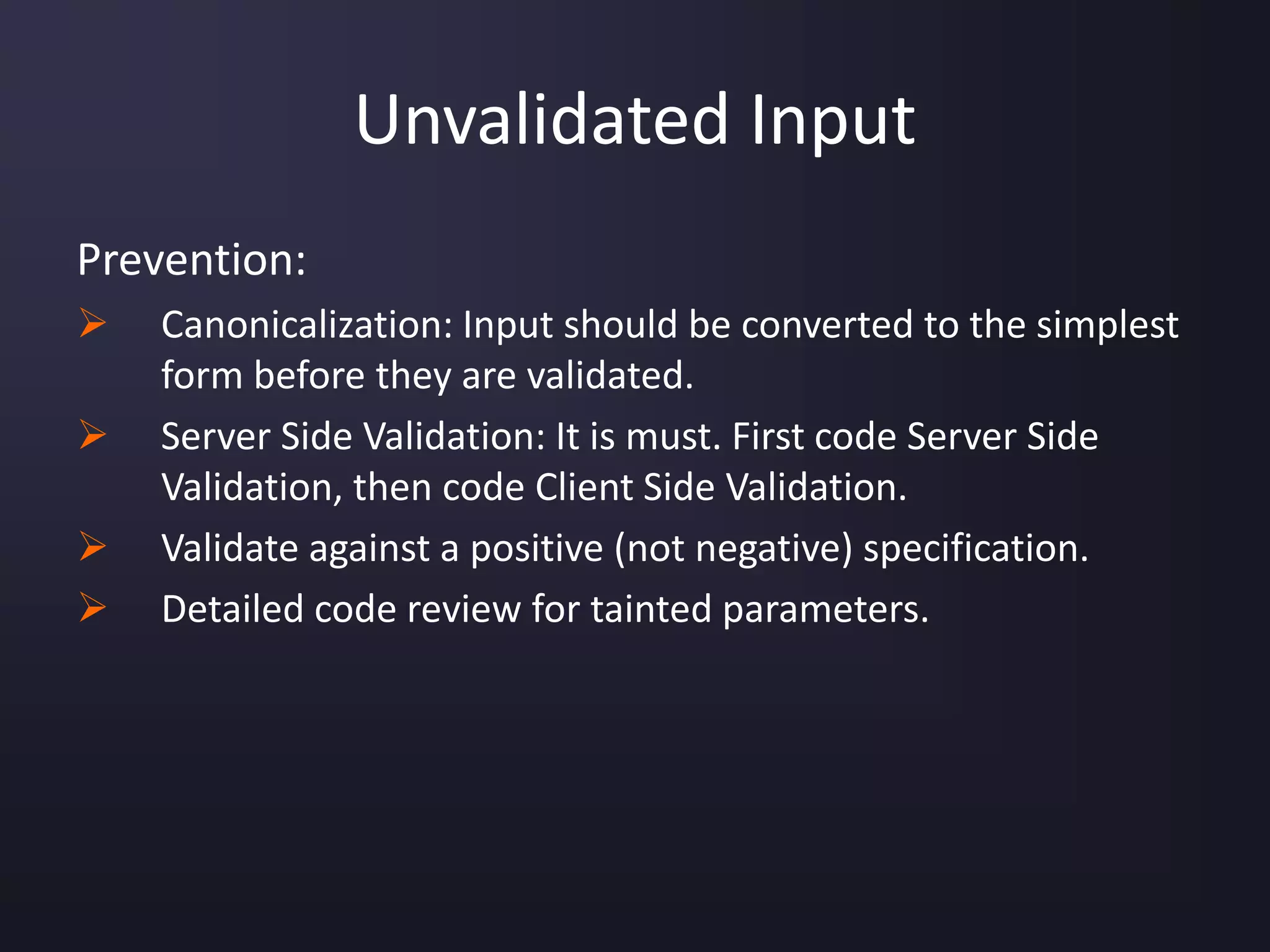
Prevention:
 Canonicalization: Input should be converted to the simplest
form before they are validated.
 Server Side Validation: It is must. First code Server Side
Validation, then code Client Side Validation.
 Validate against a positive (not negative) specification.
 Detailed code review for tainted parameters.
Broken Access Control
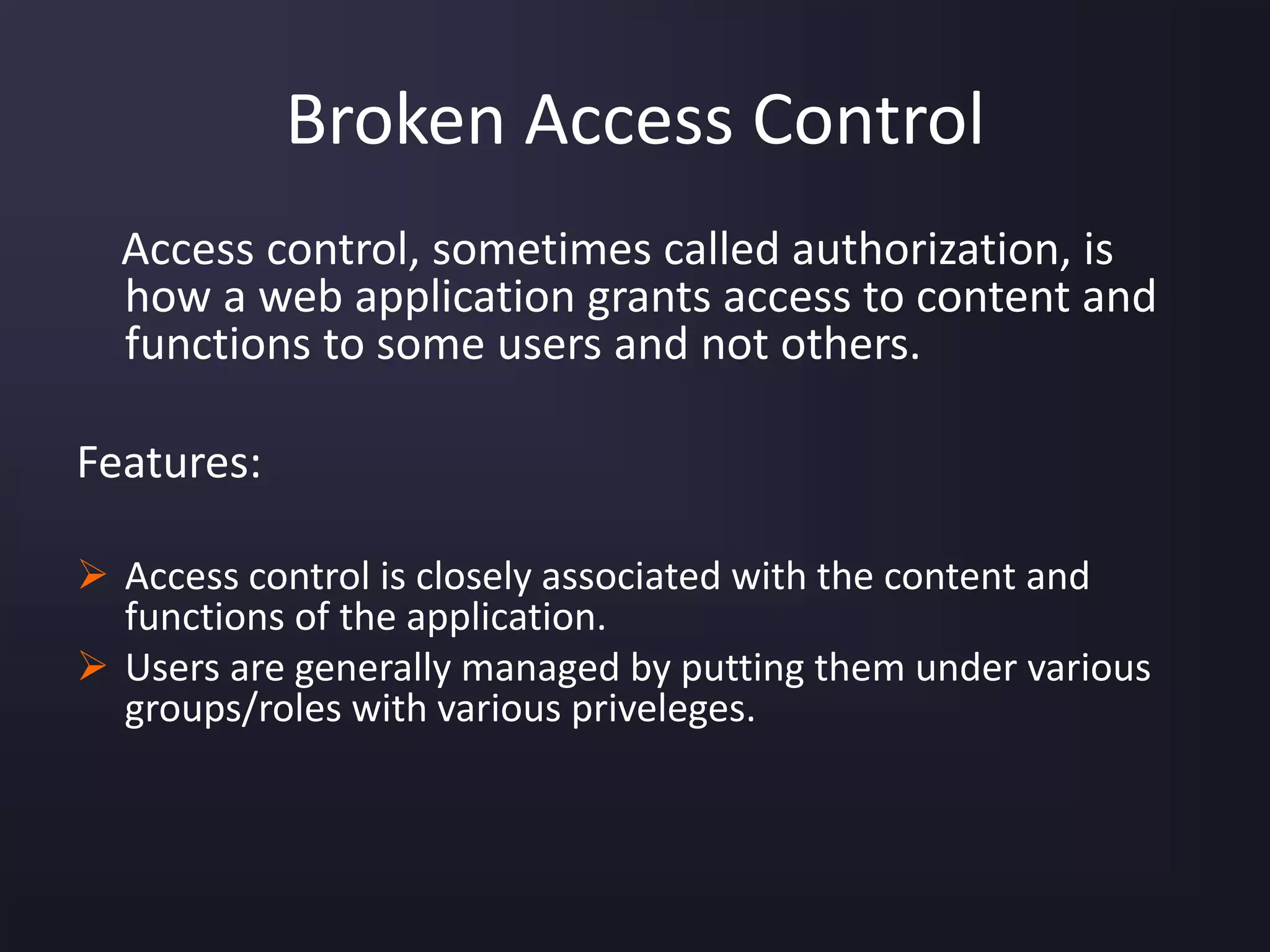
Access control, sometimes called authorization, is
how a web application grants access to content and
functions to some users and not others.
Features:
 Access control is closely associated with the content and
functions of the application.
 Users are generally managed by putting them under various
groups/roles with various priveleges.
Broken Access Control
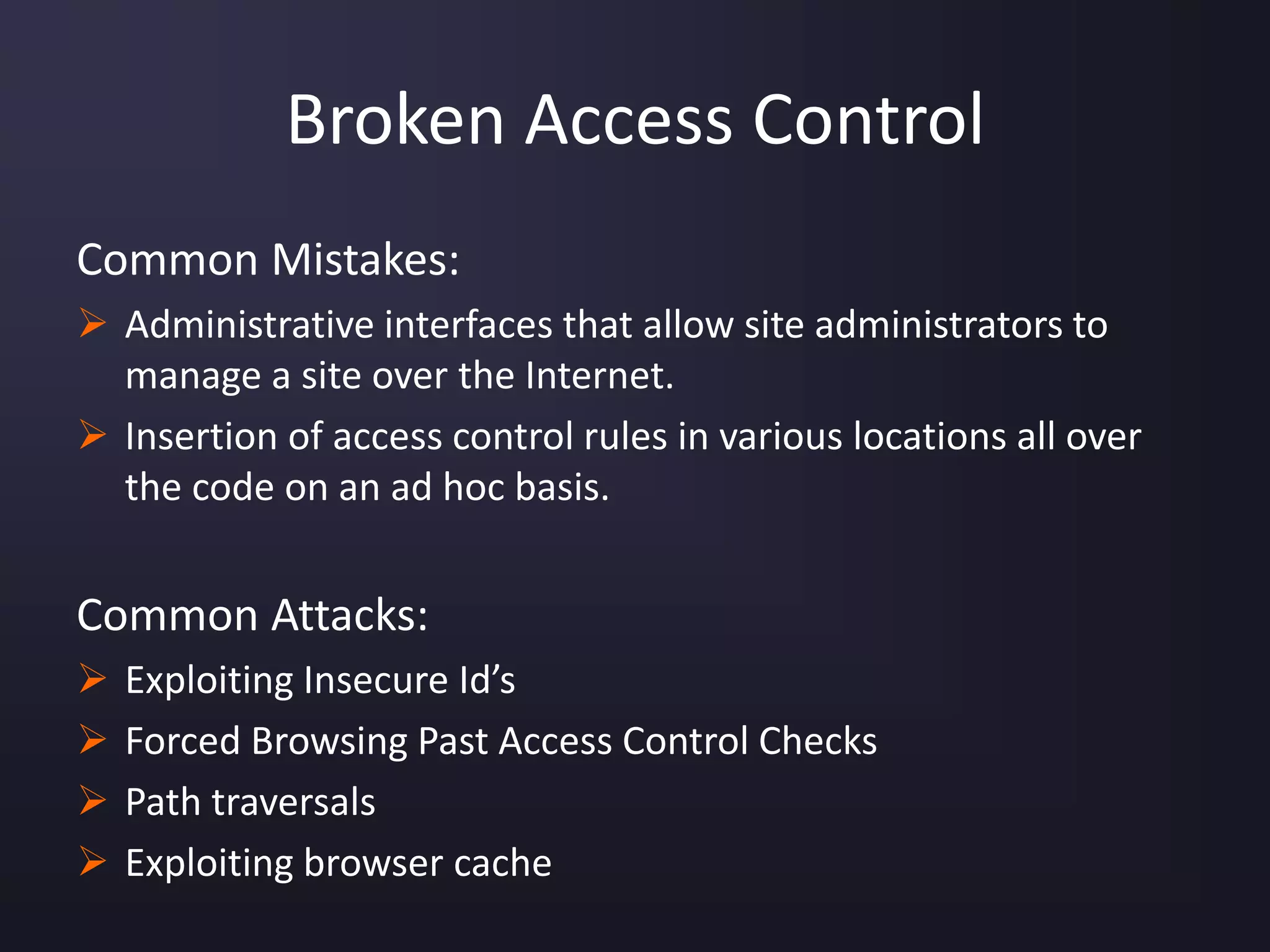
Common Mistakes:
 Administrative interfaces that allow site administrators to
manage a site over the Internet.
 Insertion of access control rules in various locations all over
the code on an ad hoc basis.
Common Attacks:
 Exploiting Insecure Id’s
 Forced Browsing Past Access Control Checks
 Path traversals
 Exploiting browser cache
Broken Access Control
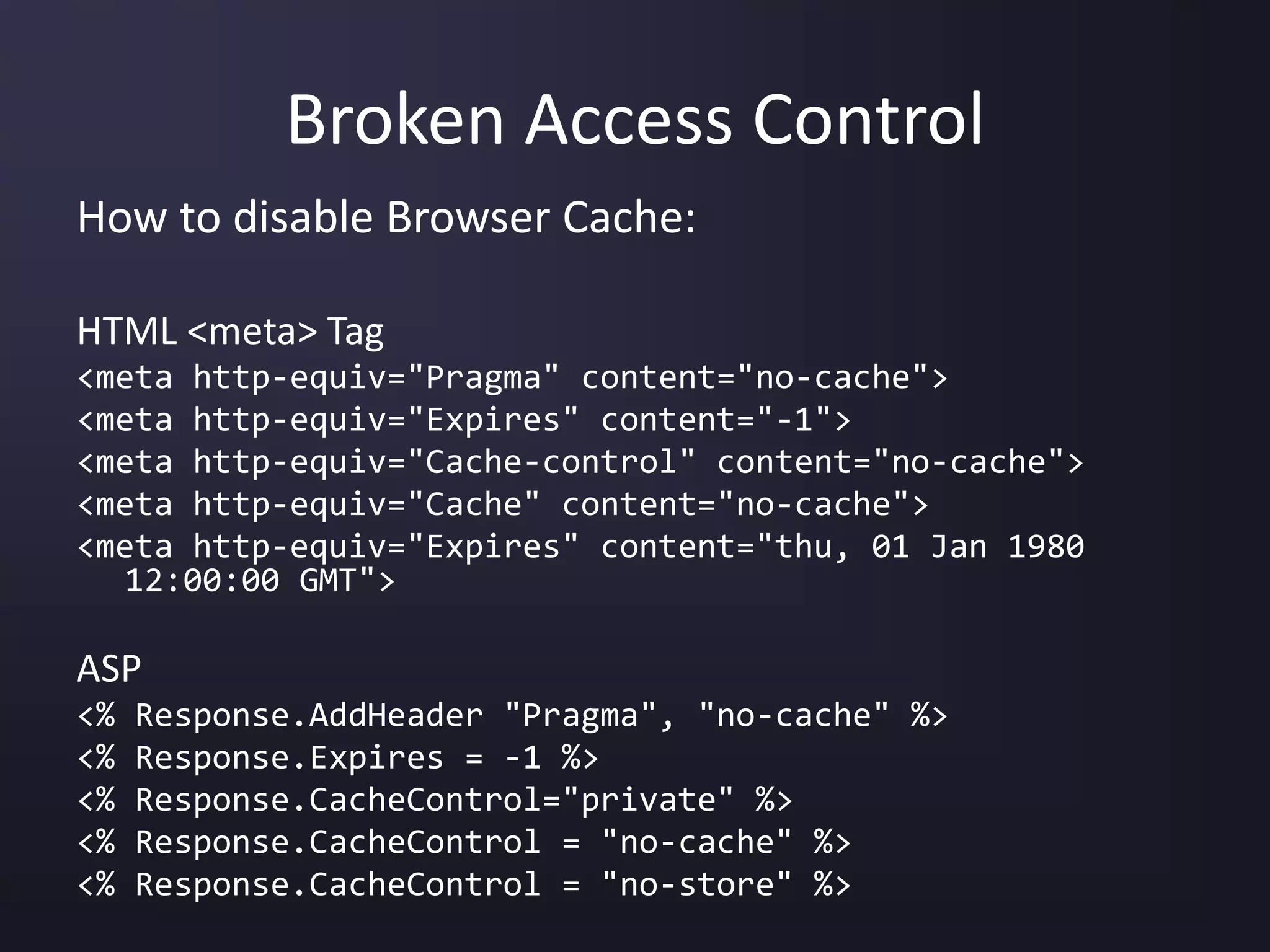
How to disable Browser Cache:
HTML <meta> Tag
<meta http-equiv="Pragma" content="no-cache">
<meta http-equiv="Expires" content="-1">
<meta http-equiv="Cache-control" content="no-cache">
<meta http-equiv="Cache" content="no-cache">
<meta http-equiv="Expires" content="thu, 01 Jan 1980
12:00:00 GMT">
ASP
<% Response.AddHeader "Pragma", "no-cache" %>
<% Response.Expires = -1 %>
<% Response.CacheControl="private" %>
<% Response.CacheControl = "no-cache" %>
<% Response.CacheControl = "no-store" %>
Broken Access Control
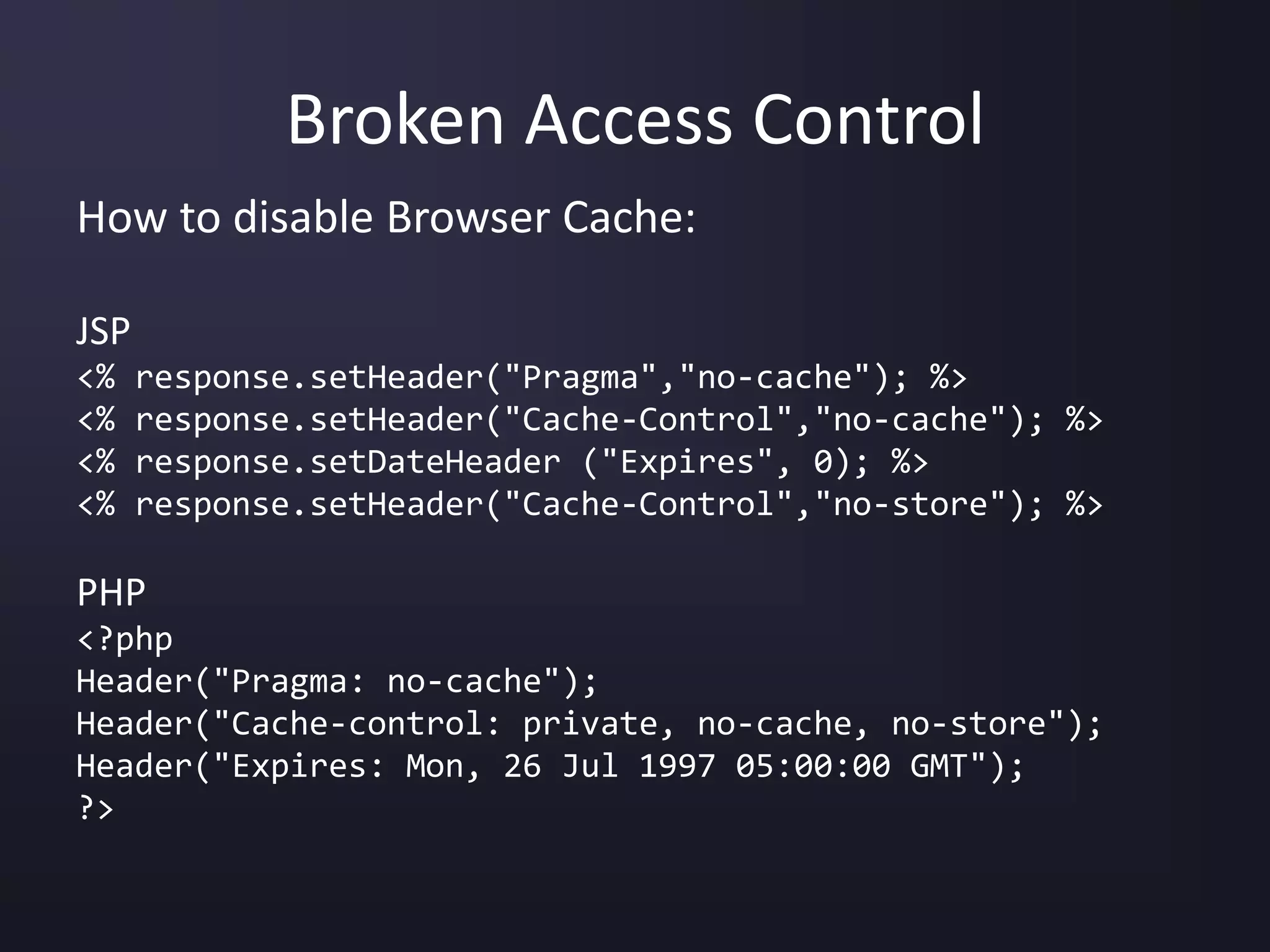
How to disable Browser Cache:
JSP
<% response.setHeader("Pragma","no-cache"); %>
<% response.setHeader("Cache-Control","no-cache"); %>
<% response.setDateHeader ("Expires", 0); %>
<% response.setHeader("Cache-Control","no-store"); %>
PHP
<?php
Header("Pragma: no-cache");
Header("Cache-control: private, no-cache, no-store");
Header("Expires: Mon, 26 Jul 1997 05:00:00 GMT");
?>
Broken Authentication
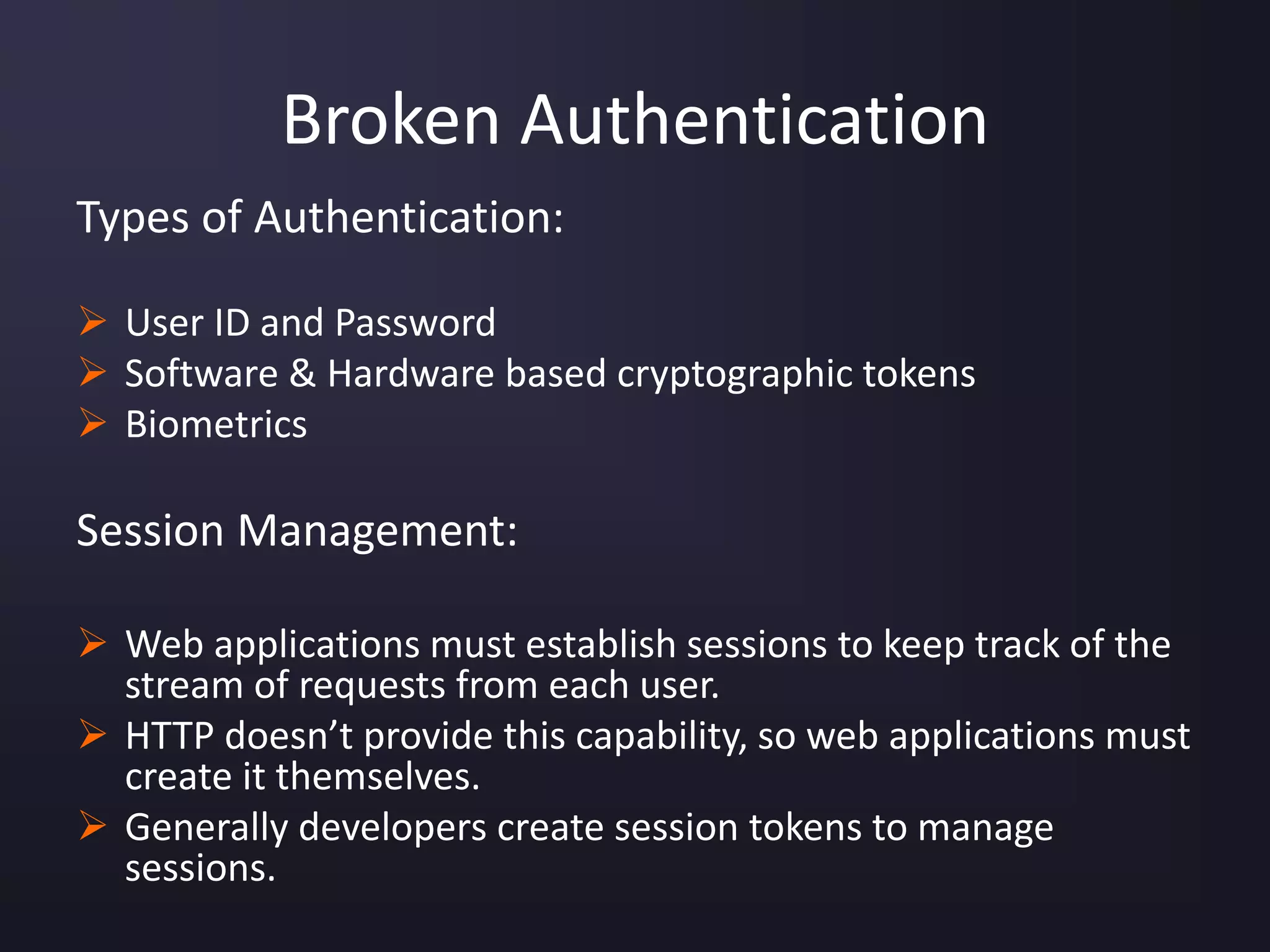
Types of Authentication:
 User ID and Password
 Software & Hardware based cryptographic tokens
 Biometrics
Session Management:
 Web applications must establish sessions to keep track of the
stream of requests from each user.
 HTTP doesn’t provide this capability, so web applications must
create it themselves.
 Generally developers create session tokens to manage
sessions.
Broken Authentication
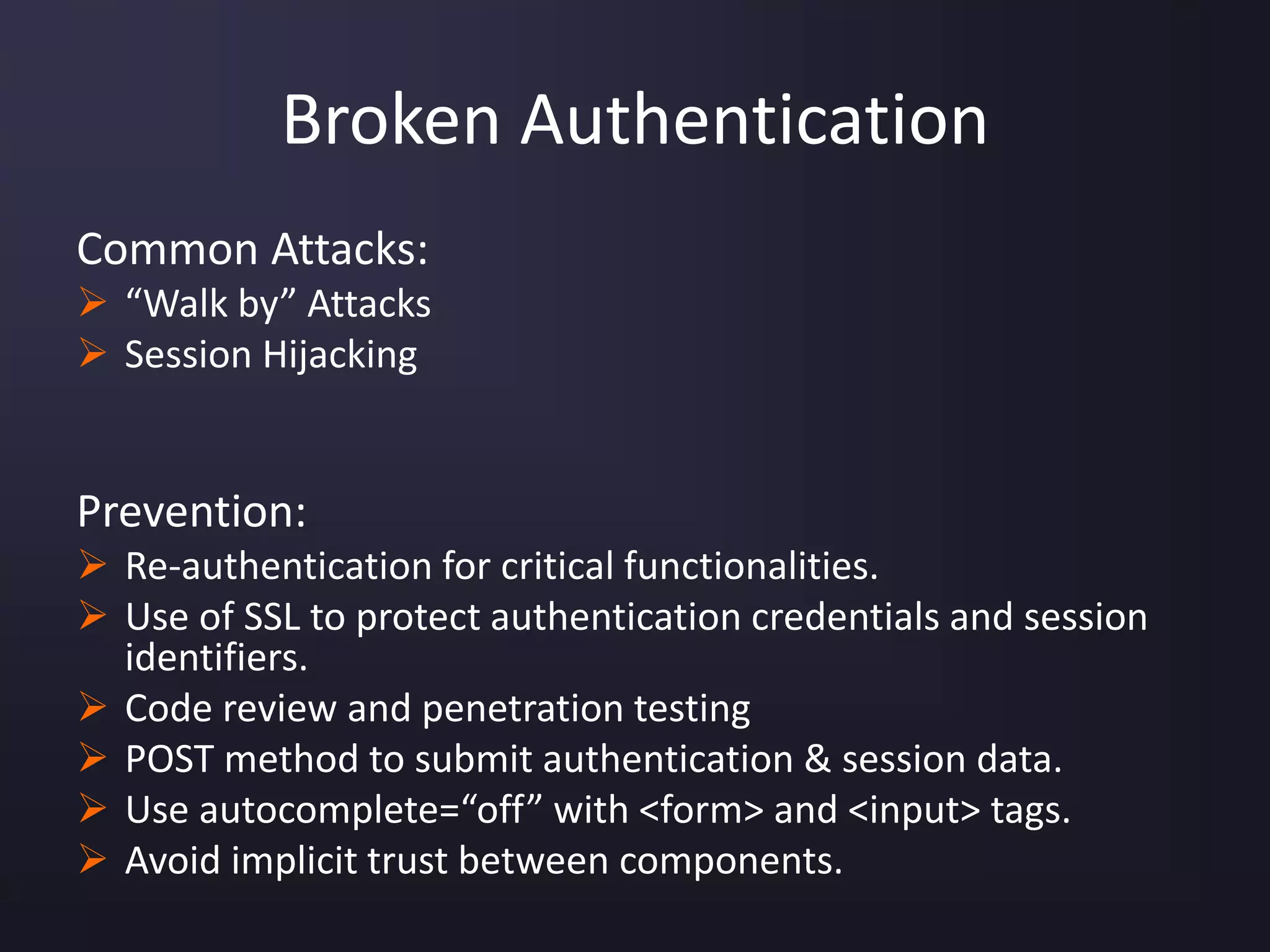
Common Attacks:
 “Walk by” Attacks
 Session Hijacking
Prevention:
 Re-authentication for critical functionalities.
 Use of SSL to protect authentication credentials and session
identifiers.
 Code review and penetration testing
 POST method to submit authentication & session data.
 Use autocomplete=“off” with <form> and <input> tags.
 Avoid implicit trust between components.
Cross Site Scripting
XSS occurs when an attacker uses a web
application to send malicious code, generally in the
form of a script, to a different end user.
Types of XSS attacks:
 Stored - Injected code is permanently stored on the target
servers, such as in a database, forum, visitor log, comment
field, etc.
 Reflected – Injected code is reflected off the web server,
such as in an error message, search result, or any other
response that includes some or all of the input sent to the
server as part of the request.
Cross Site Scripting
Common Attacks:
 Annoyance to the end user.
 Redirecting the user to some other page or site
 Disclosure of the user’s session cookie.
 Session hijacking.
Prevention:
 Code review of all places where input from an HTTP request
could possibly make its way into the HTML output.
 Validate all headers, cookies, query strings, form fields and
all such inputs against a rigorous positive specification.
Cross Site Scripting
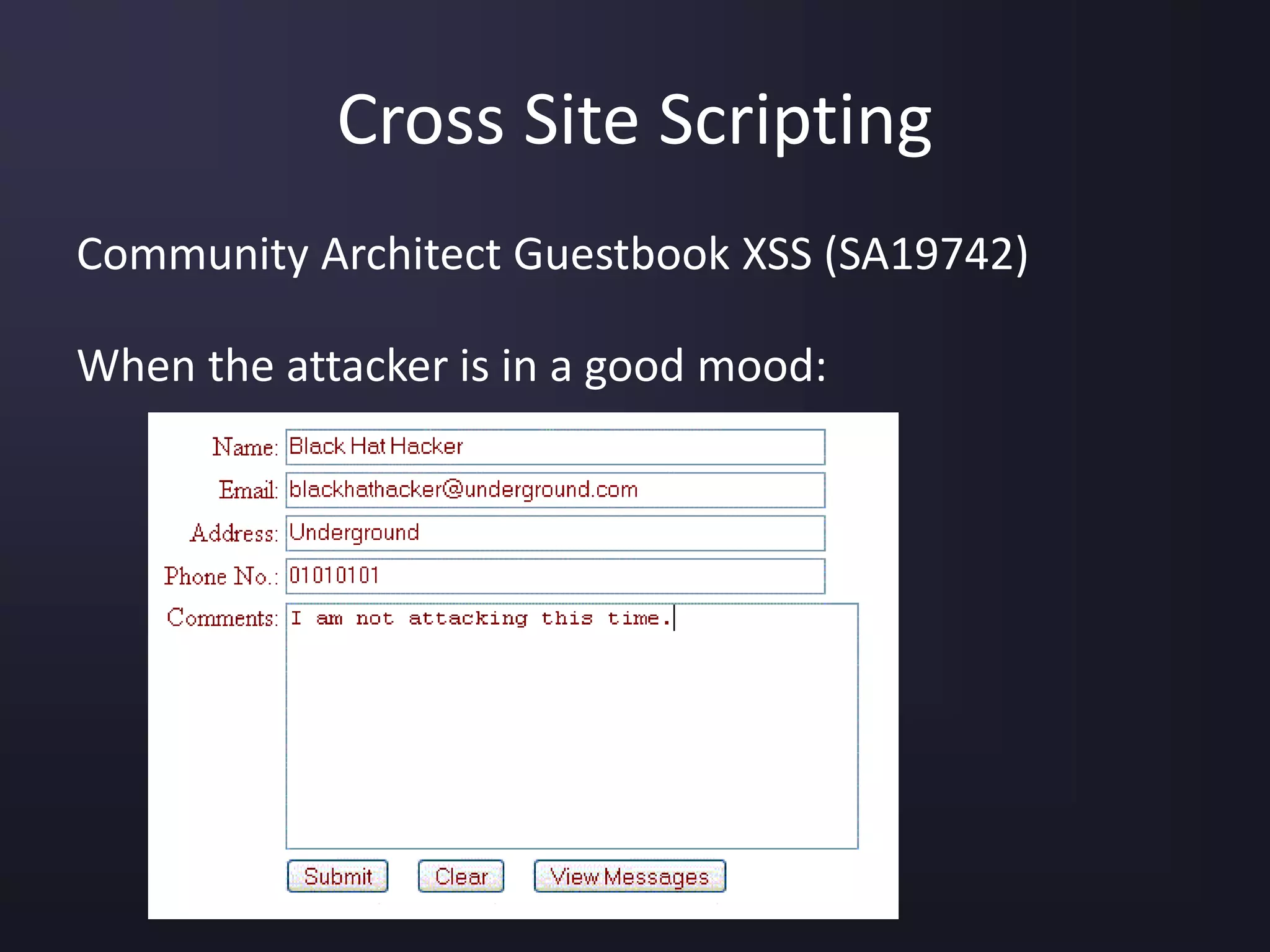
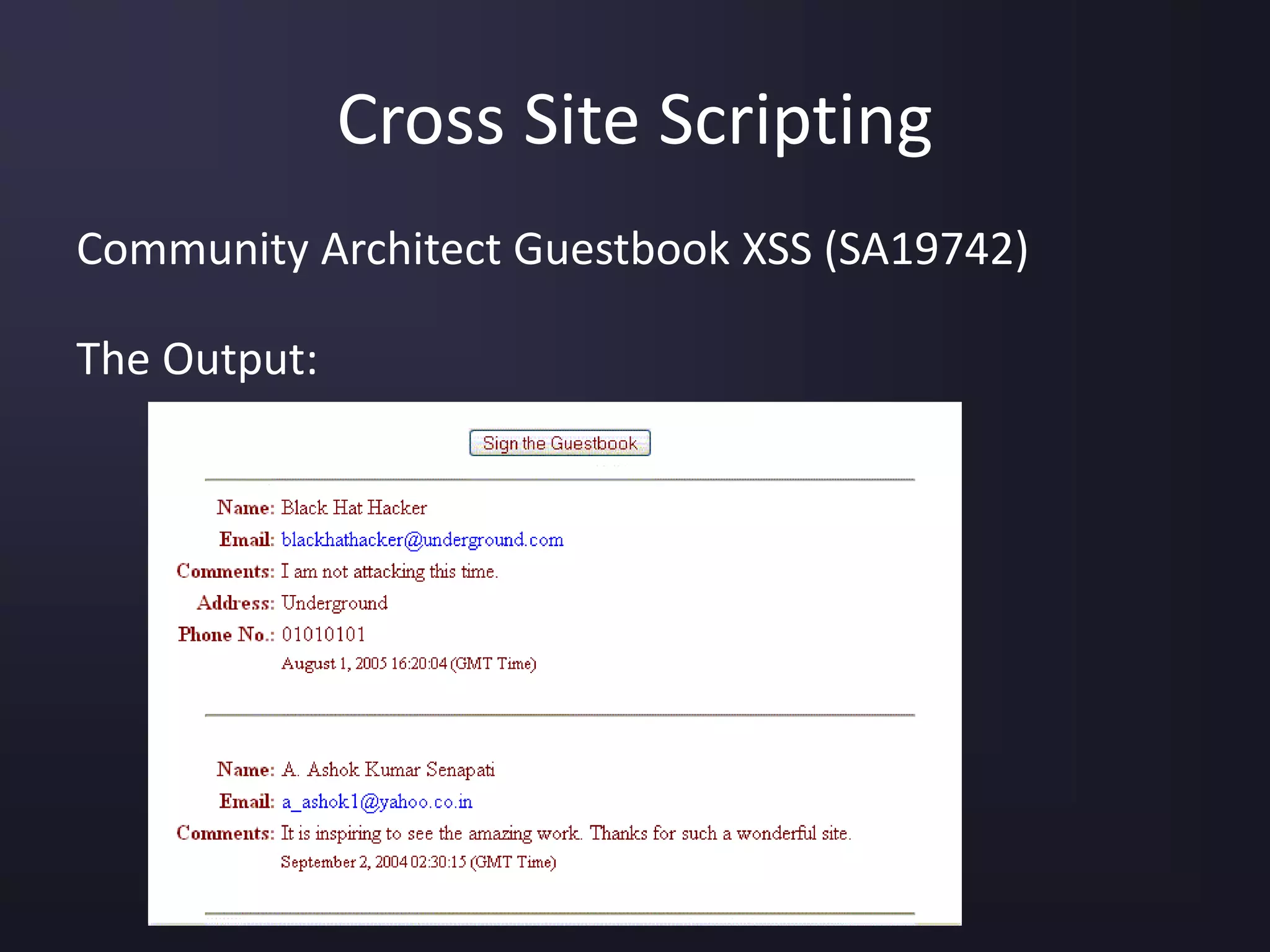
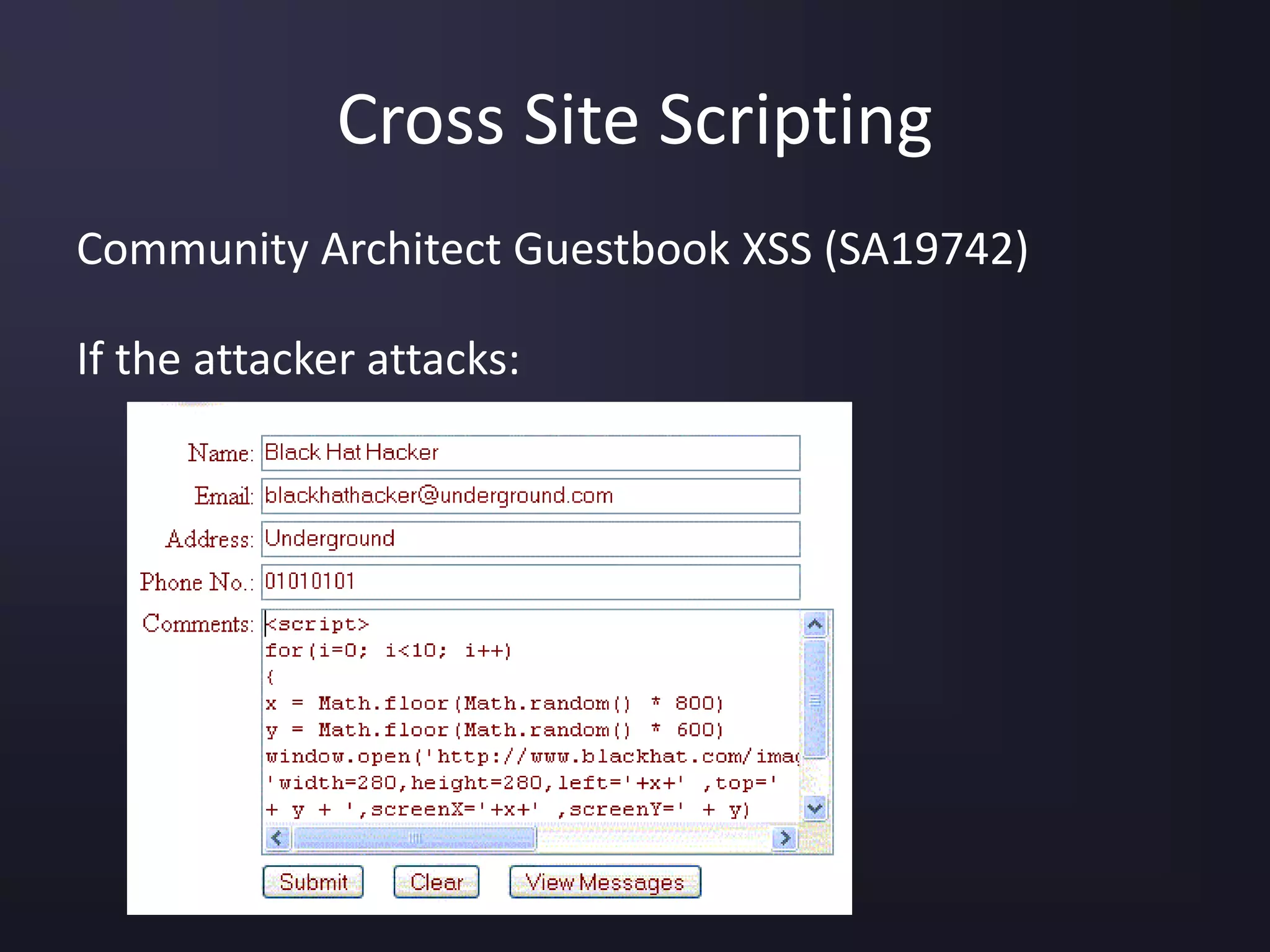
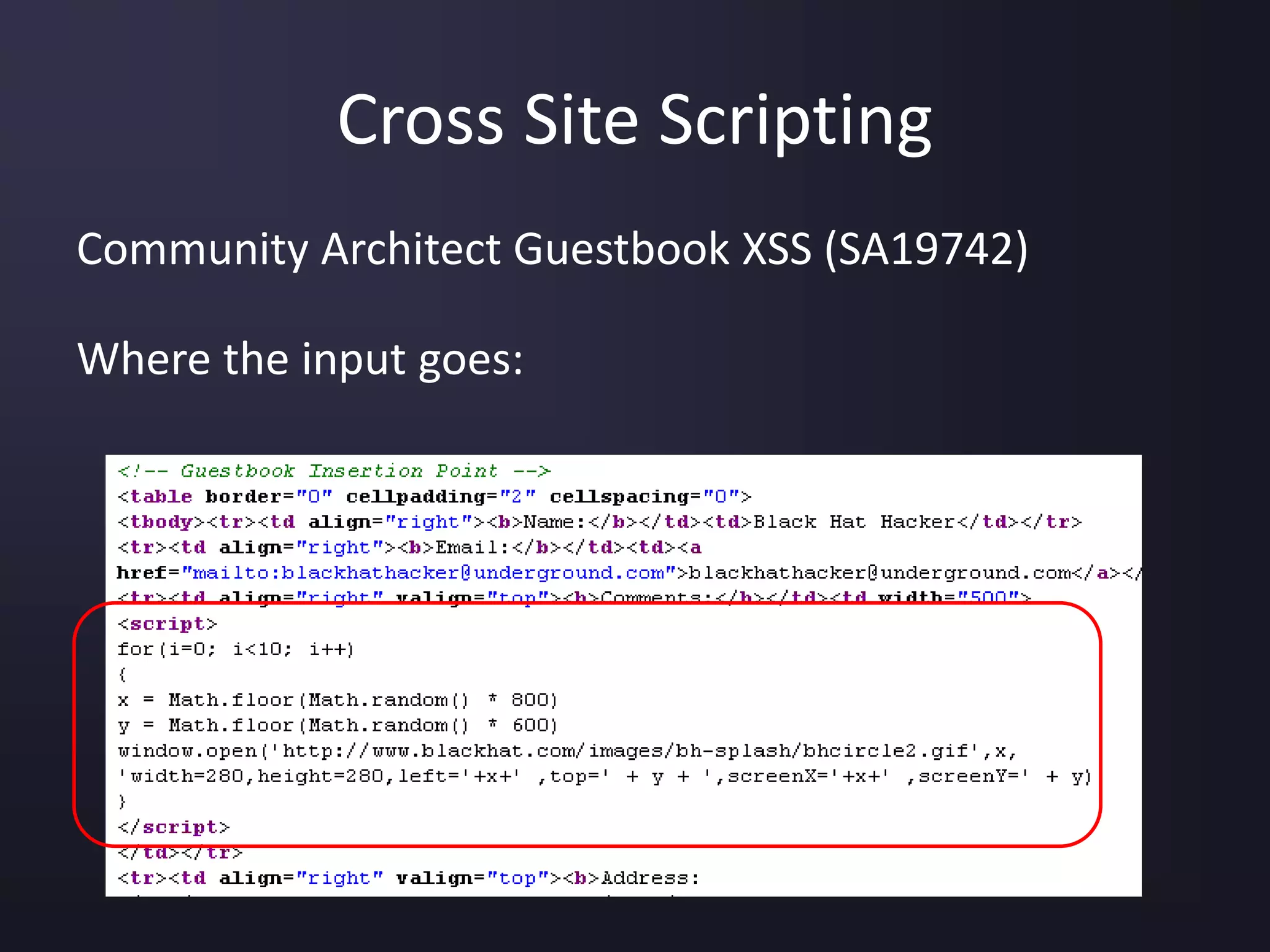
Community Architect Guestbook XSS (SA19742)
When the attacker is in a good mood:
Cross Site Scripting
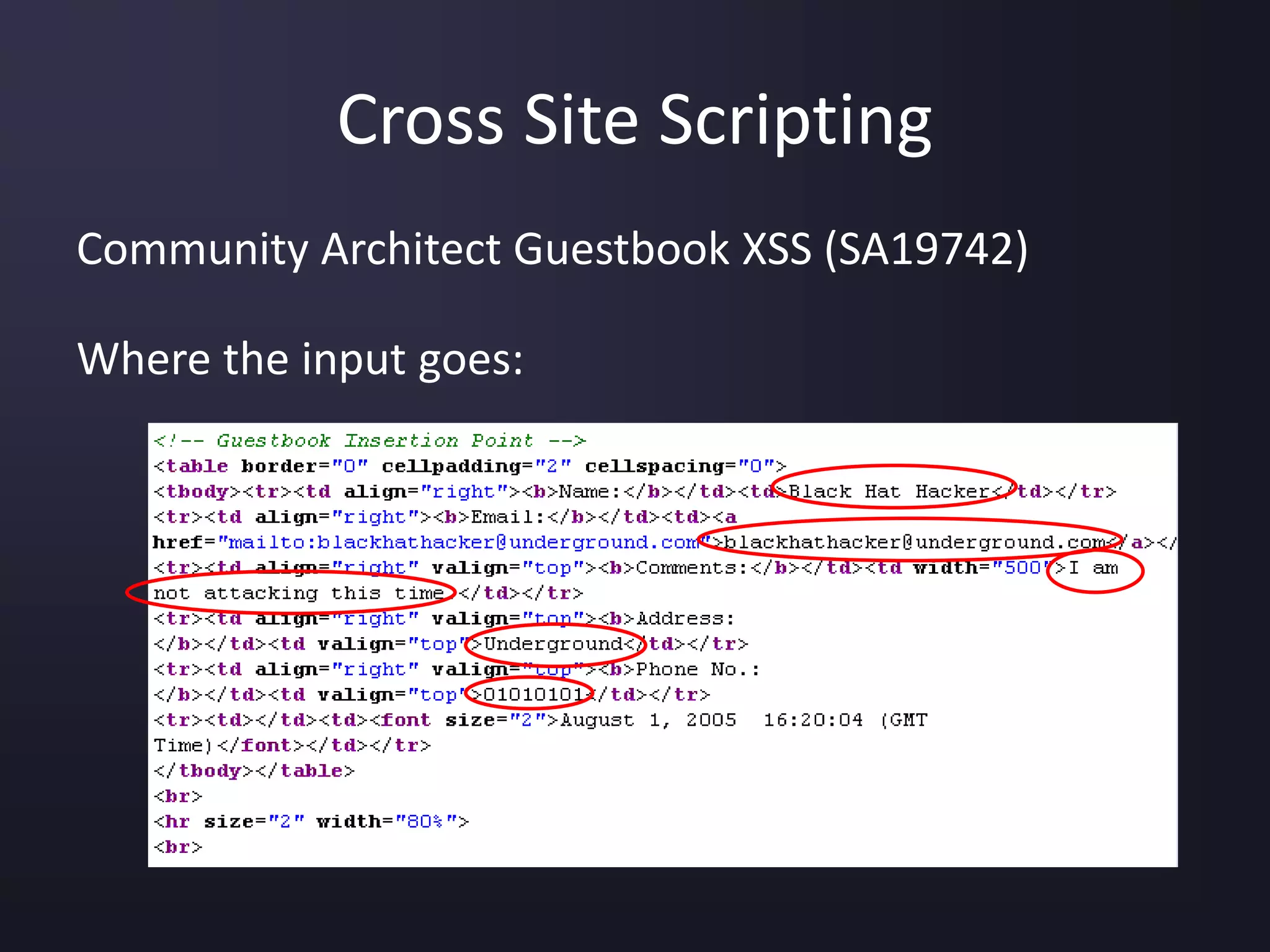
Community Architect Guestbook XSS (SA19742)
Where the input goes:
Cross Site Scripting
Community Architect Guestbook XSS (SA19742)
The Output:
Cross Site Scripting
Community Architect Guestbook XSS (SA19742)
If the attacker attacks:
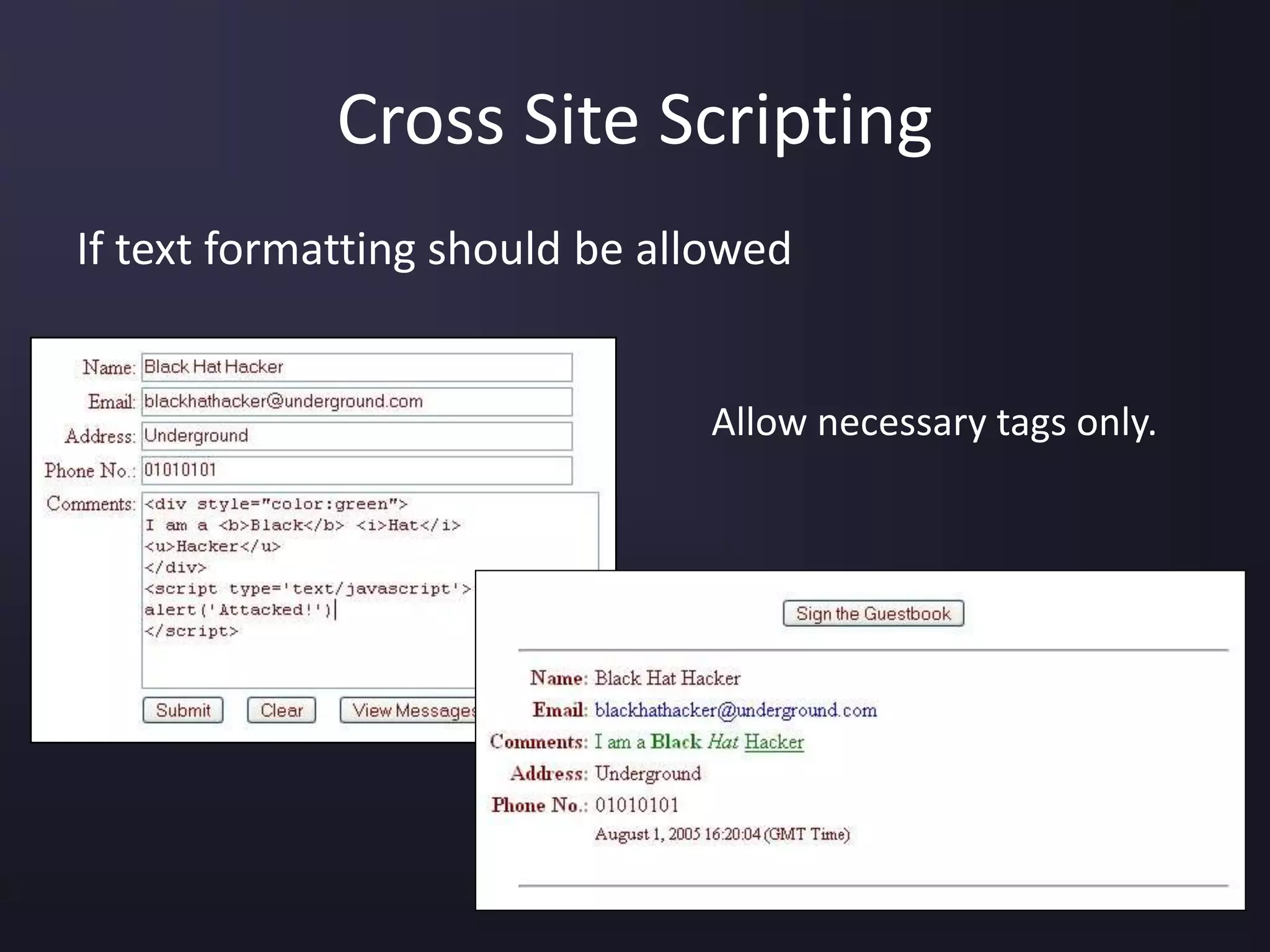
Cross Site Scripting
Community Architect Guestbook XSS (SA19742)
Where the input goes:
Cross Site Scripting
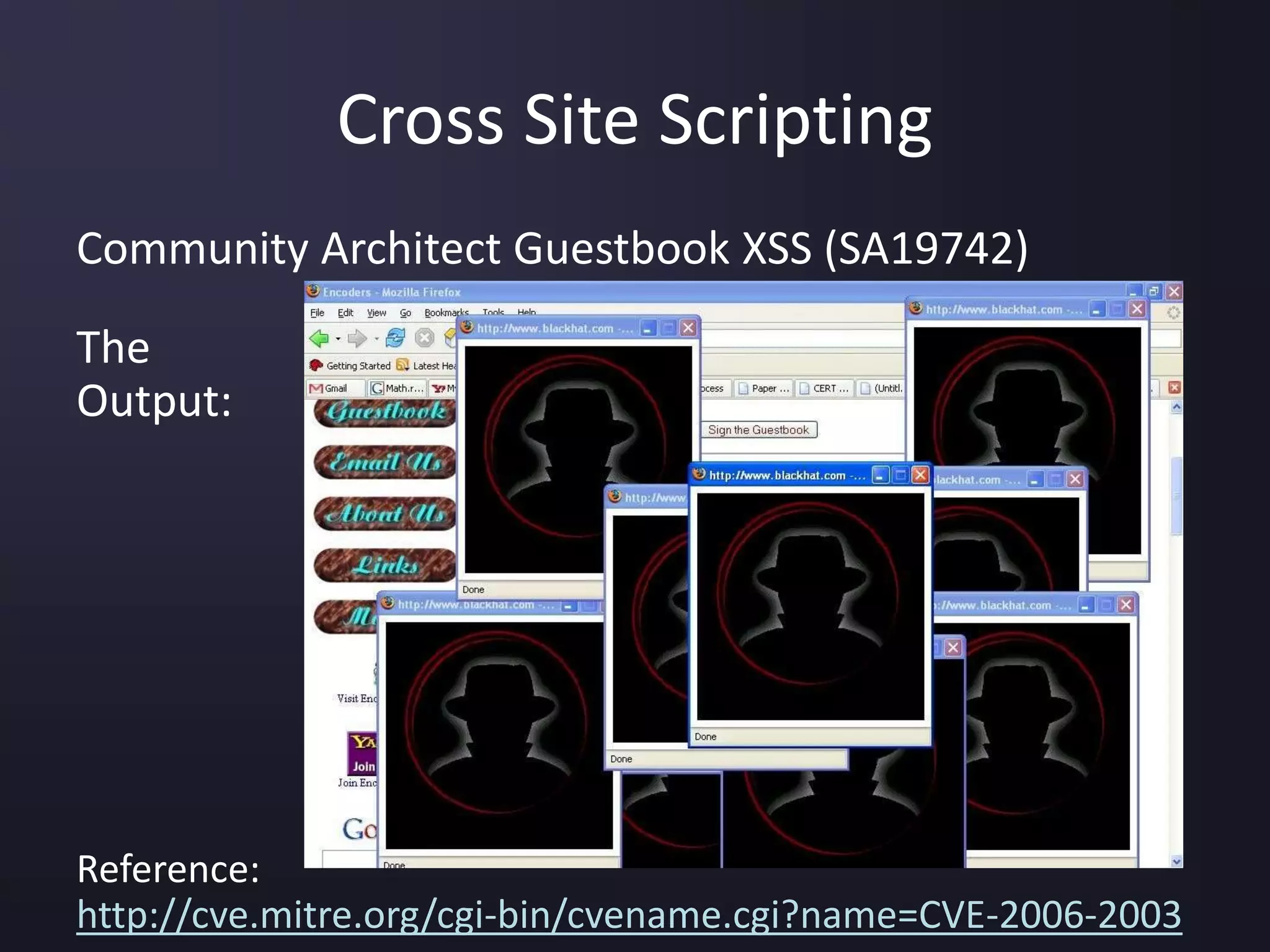
Community Architect Guestbook XSS (SA19742)
The
Output:
Reference:
http://cve.mitre.org/cgi-bin/cvename.cgi?name=CVE-2006-2003
Cross Site Scripting
Potential Harmful Tags:
<script>
<object>
<embed>
<applet>
<form>
Decision to be taken for XSS prevention:
 Whether tags should appear in the output as a tags.
 Whether tags should not appear in the output at all.
 Whether text formatting is to be allowed.
Cross Site Scripting
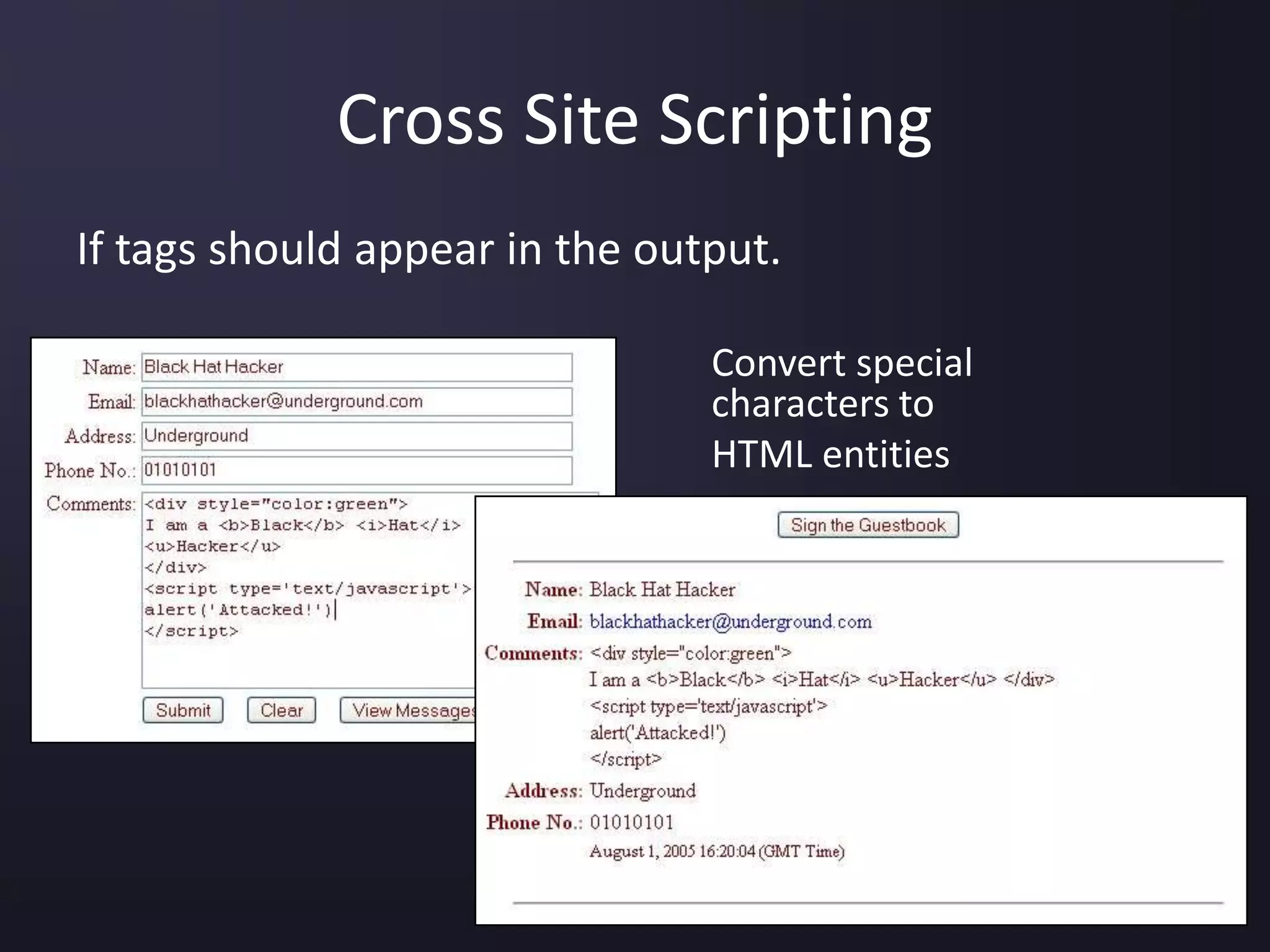
If tags should appear in the output.
Convert special
characters to
HTML entities
Cross Site Scripting
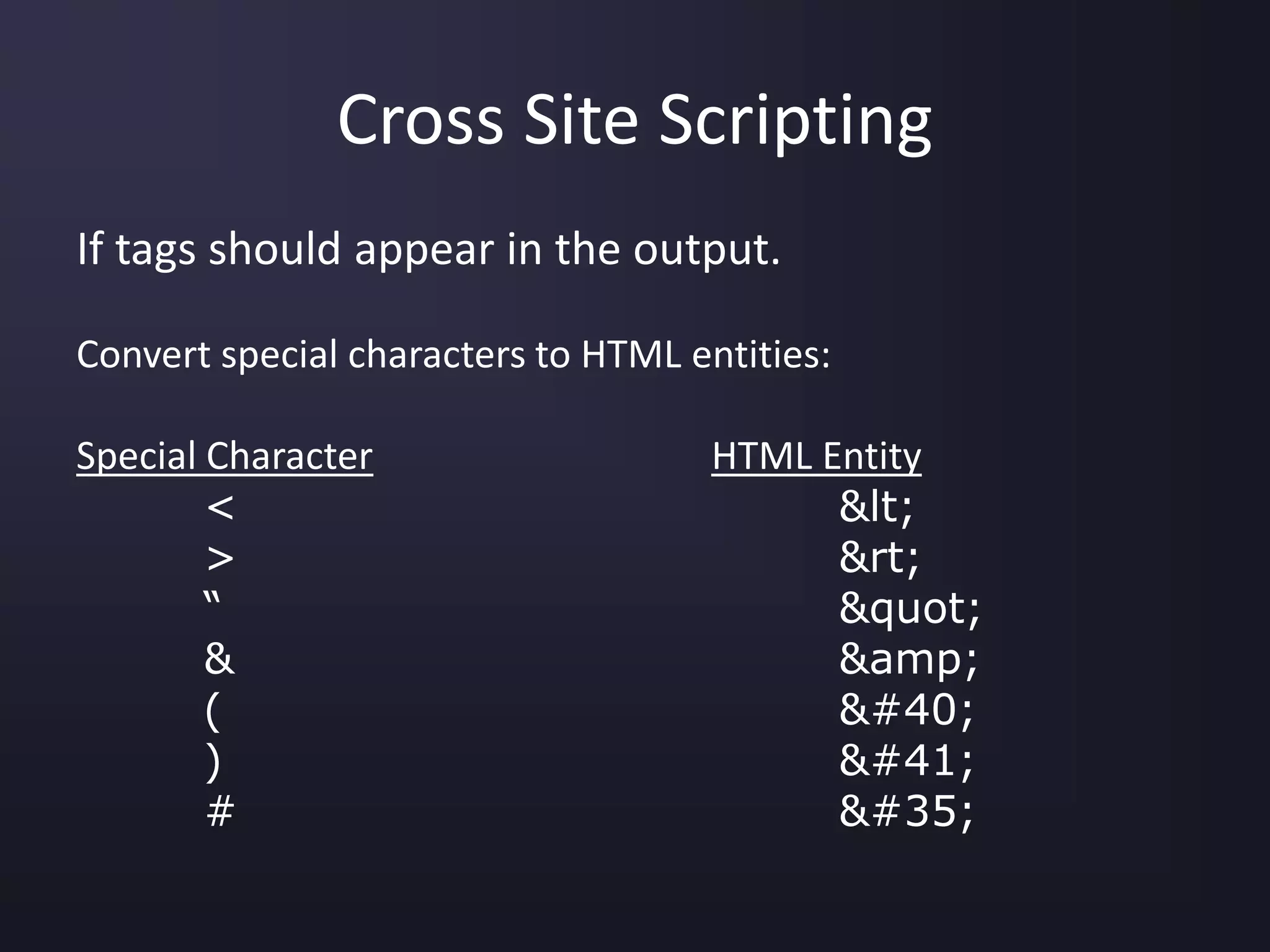
If tags should appear in the output.
Convert special characters to HTML entities:
Special Character HTML Entity
< &lt;
> &rt;
“ &quot;
& &amp;
( &#40;
) &#41;
# &#35;
Cross Site Scripting
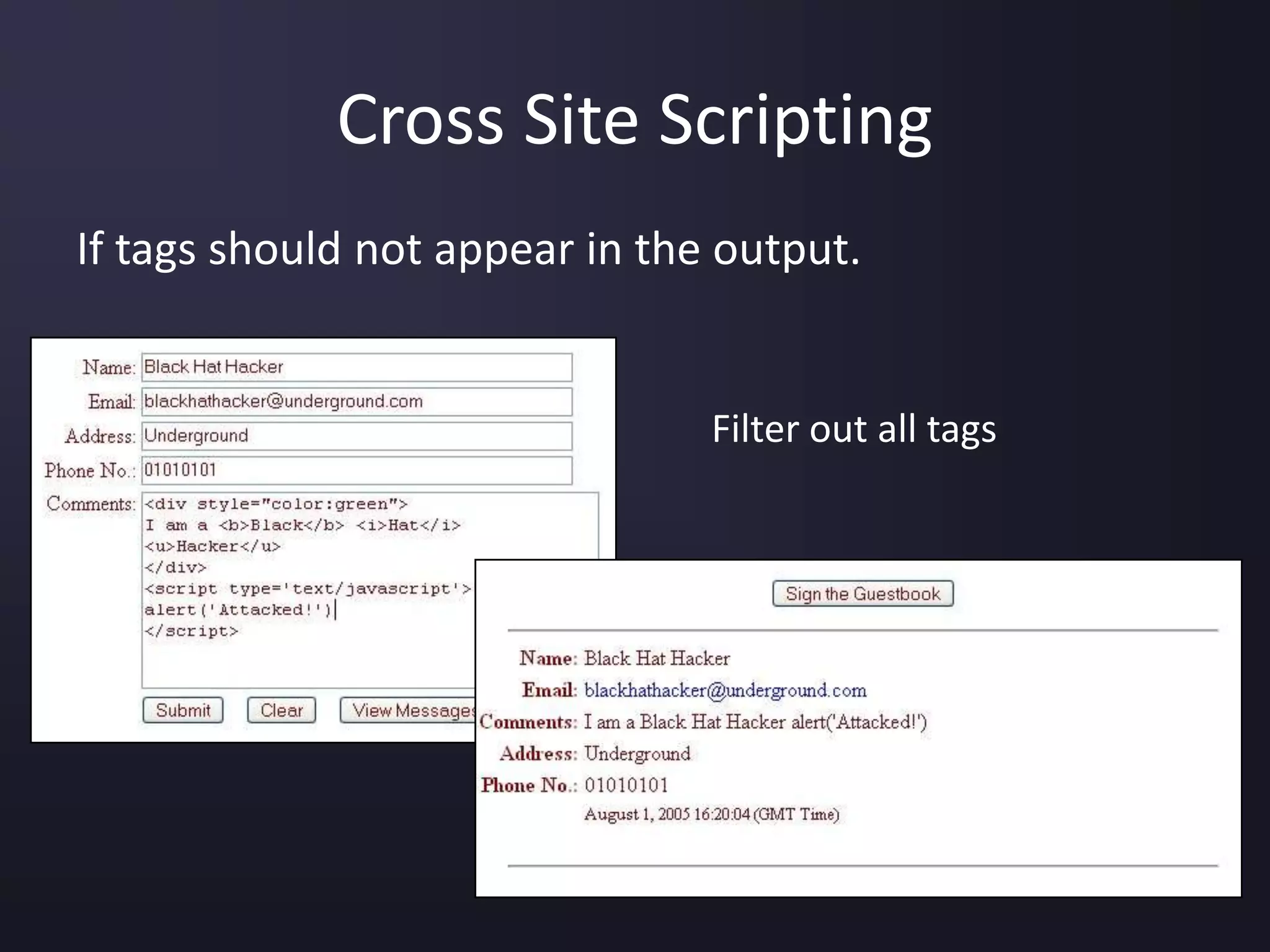
If tags should not appear in the output.
Filter out all tags
Cross Site Scripting
If text formatting should be allowed
Allow necessary tags only.
Cross Site Scripting
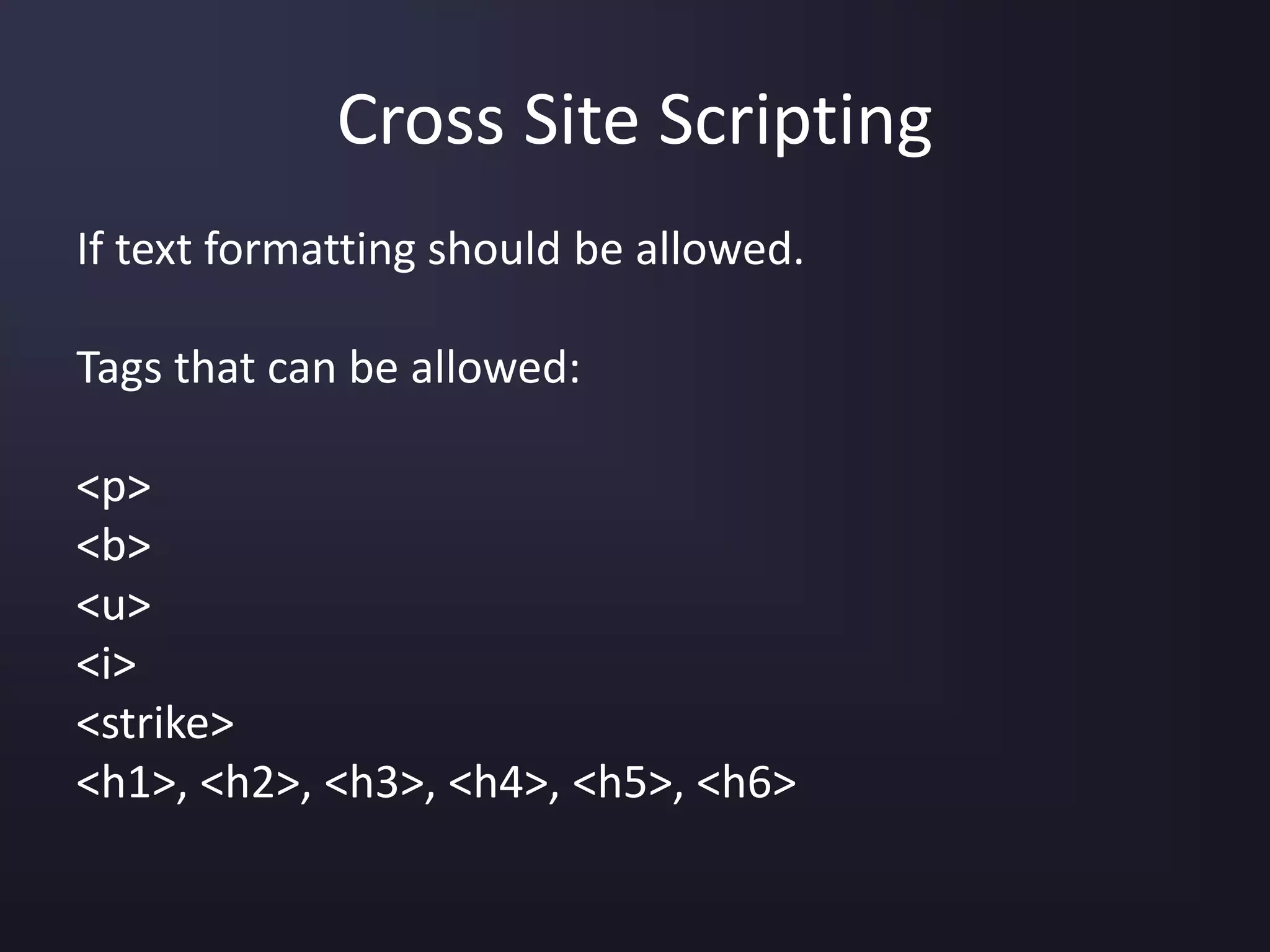
If text formatting should be allowed.
Tags that can be allowed:
<p>
<b>
<u>
<i>
<strike>
<h1>, <h2>, <h3>, <h4>, <h5>, <h6>
Buffer Overflows
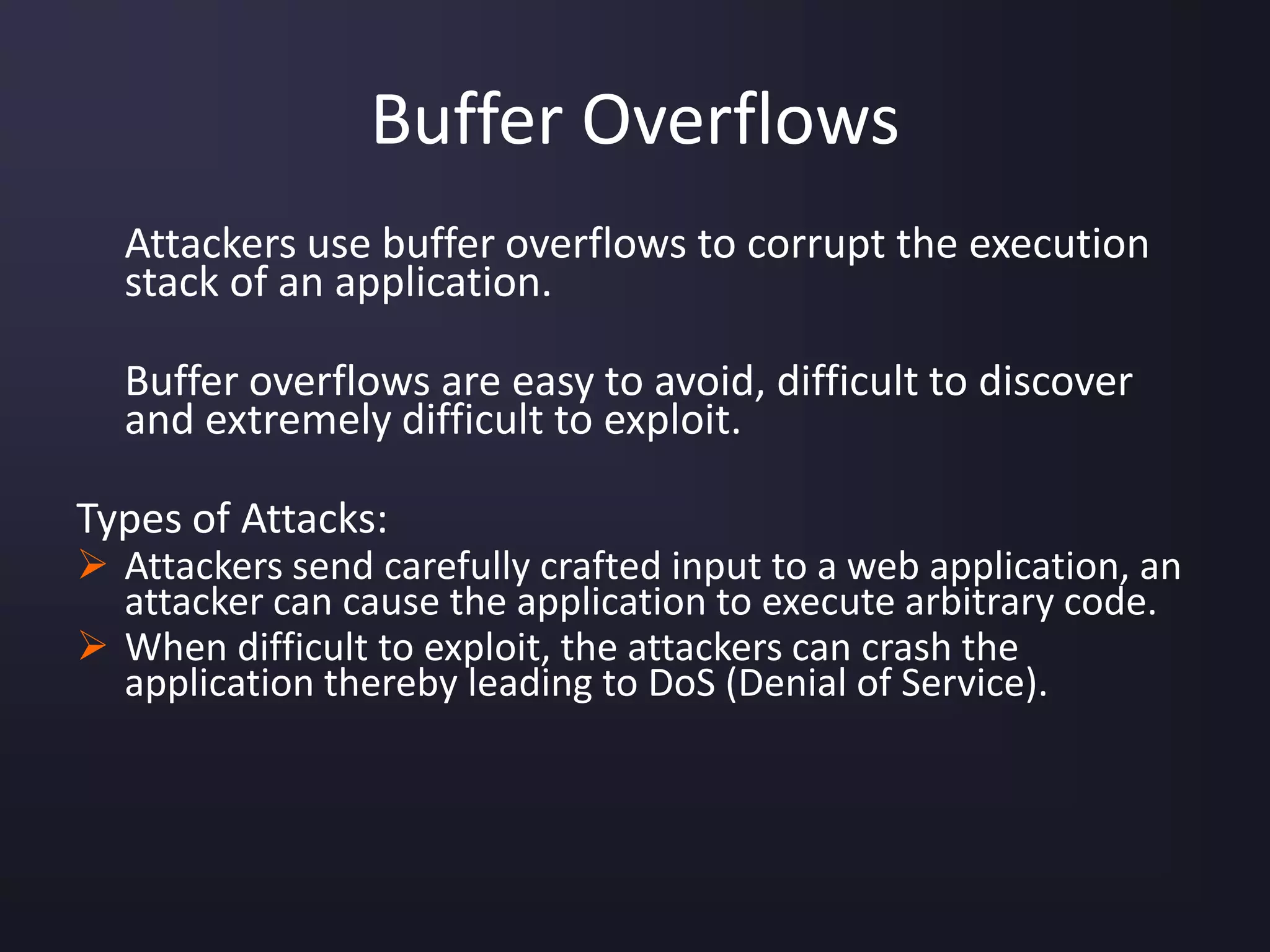
Attackers use buffer overflows to corrupt the execution
stack of an application.
Buffer overflows are easy to avoid, difficult to discover
and extremely difficult to exploit.
Types of Attacks:
 Attackers send carefully crafted input to a web application, an
attacker can cause the application to execute arbitrary code.
 When difficult to exploit, the attackers can crash the
application thereby leading to DoS (Denial of Service).
#include <string.h>
void function(char *str)
{
char buffer[4];
strcpy(buffer, str);
}
main()
{
char string[]="Hi!";
function(string);
}
Buffer Overflows
*str – 4th Byte
*str – 3rd Byte
*str – 2nd Byte
*str – 1st Byte
EIP – 4th Byte
EIP – 3rd Byte
EIP – 2nd Byte
EIP – 1st Byte
EBP – 4th Byte
EBP – 3rd Byte
EBP – 2nd Byte
EBP – 1st Byte
Return Address
indicates what ESP is pointing to
indicates what EBP is pointing to
#include <string.h>
void function(char *str)
{
char buffer[4];
strcpy(buffer, str);
}
main()
{
char string[]="Hi!";
function(string);
}
Buffer Overflows
*str – 4th Byte
*str – 3rd Byte
*str – 2nd Byte
*str – 1st Byte
EIP – 4th Byte
EIP – 3rd Byte
EIP – 2nd Byte
EIP – 1st Byte
EBP – 4th Byte
EBP – 3rd Byte
EBP – 2nd Byte
EBP – 1st Byte
buffer[3]
buffer[2]
buffer[1]
buffer[0]
Return Address
indicates what ESP is pointing to
indicates what EBP is pointing to
#include <string.h>
void function(char *str)
{
char buffer[4];
strcpy(buffer, str);
}
main()
{
char string[]="Hi!";
function(string);
}
Buffer Overflows
*str – 4th Byte
*str – 3rd Byte
*str – 2nd Byte
*str – 1st Byte
EIP – 4th Byte
EIP – 3rd Byte
EIP – 2nd Byte
EIP – 1st Byte
EBP – 4th Byte
EBP – 3rd Byte
EBP – 2nd Byte
EBP – 1st Byte
‘0’
‘!’
‘i’
‘H’
Return Address
indicates what ESP is pointing to
indicates what EBP is pointing to
#include <string.h>
void function(char *str)
{
char buffer[4];
strcpy(buffer, str);
}
main()
{
char string[]="Good Morning!";
function(string);
}
Buffer Overflows
*str – 4th Byte
*str – 3rd Byte
*str – 2nd Byte
*str – 1st Byte
EIP – 4th Byte
EIP – 3rd Byte
EIP – 2nd Byte
EIP – 1st Byte
EBP – 4th Byte
EBP – 3rd Byte
EBP – 2nd Byte
EBP – 1st Byte
buffer[3]
buffer[2]
buffer[1]
buffer[0]
Return Address
indicates what ESP is pointing to
indicates what EBP is pointing to
#include <string.h>
void function(char *str)
{
char buffer[4];
strcpy(buffer, str);
}
main()
{
char string[]="Good Morning!";
function(string);
}
Buffer Overflows
*str – 4th byte
*str – 3rd byte
0
!
g
n
i
n
r
o
M
d
o
o
G
Return Address
indicates what ESP is pointing to
indicates what EBP is pointing to
#include <string.h>
void function(char *str)
{
char buffer[4];
strcpy(buffer, str);
}
main()
{
char string[]="Good Morning!";
function(string);
}
Buffer Overflows
*str - 4th byte
*str - 3rd byte
0 00H
! 21H
g 67H
n 6EH
i 69H
n 6EH
r 72H
o 6FH
M 4DH
20H
d 64H
o 6FH
o 6FH
G 47H
Return Address
Returns to offset
676E696EH
indicates what ESP is pointing to
indicates what EBP is pointing to
Buffer Overflows
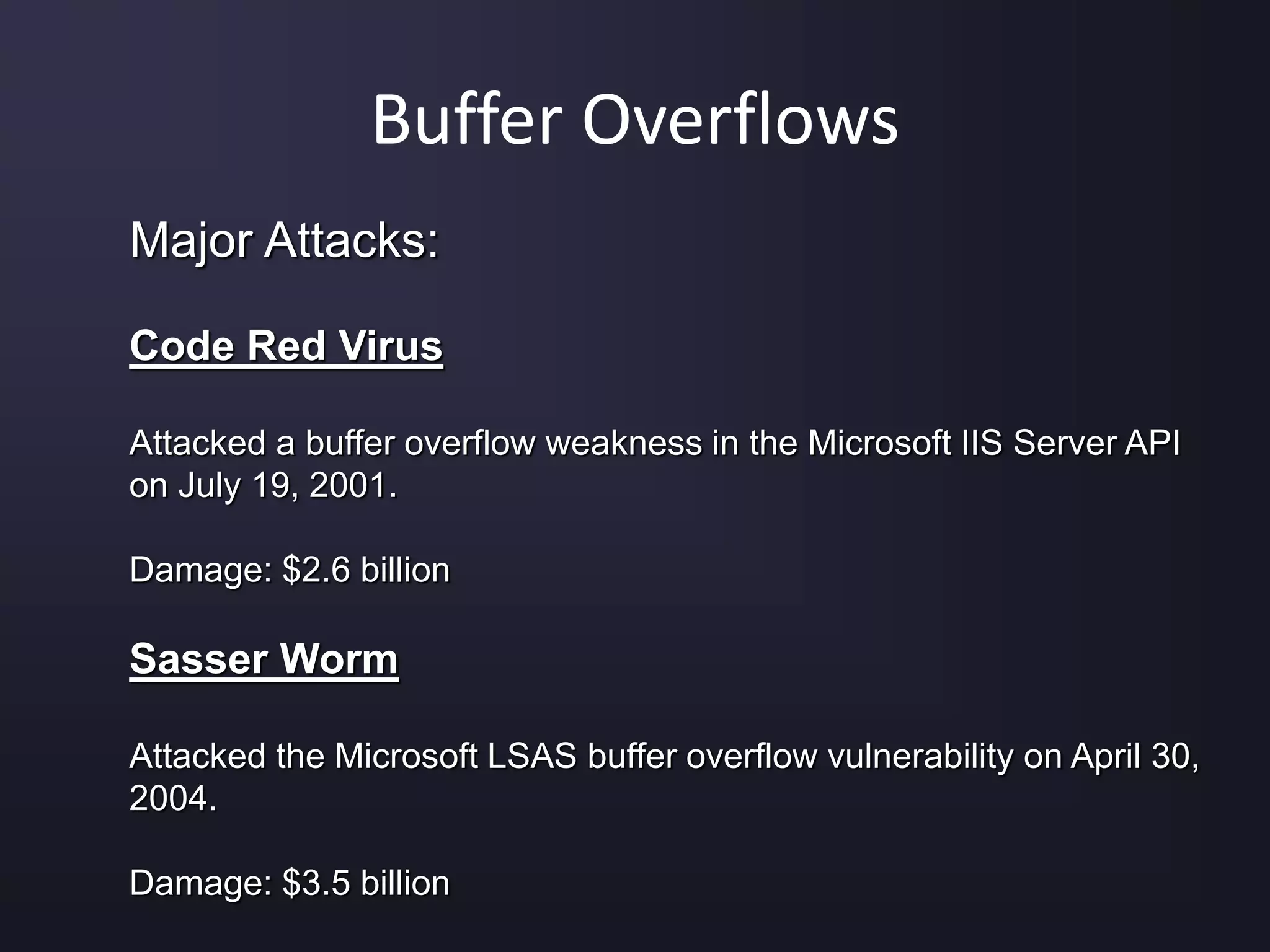
Major Attacks:
Code Red Virus
Attacked a buffer overflow weakness in the Microsoft IIS Server API
on July 19, 2001.
Damage: $2.6 billion
Sasser Worm
Attacked the Microsoft LSAS buffer overflow vulnerability on April 30,
2004.
Damage: $3.5 billion
Buffer Overflows
Prevention:
 C Programmers now refrain from using strcpy(), strcat() in
their programs. They use strncpy(), strncat() instead which
perform bound checking. Never use gets().
 Programmers now write their applications in languages like
Java, Visual Basic which has better stack and memory
management features.
 Sun Microsystems is trying to make their Sparc processor
immune to stack overflow attack by introducing new feature
to protect the return address during a subroutine call.
Injection Flaws
Injection flaw lets you inject executable code at
places where it is not allowed in a secure system
which might lead to execution of the code and
compromise of the system.
Common Attacks:
 Relay malicious through a web application to another
system.
 Calls to operating system via system calls.
 Use of external programs via shell commands.
 Calls to backend databases via SQL.
 Complete script injection into web applications.
Injection Flaws
SQL Injection:
 SQL injection is particularly widespread and dangerous
form of injection.
 SQL Injection is possible if the value of any parameter is
used in SQL queries and the parameter is not sanitised
properly.
 The attacker can retrieve, modify, corrupt or destroy
database contents.
Injection Flaws
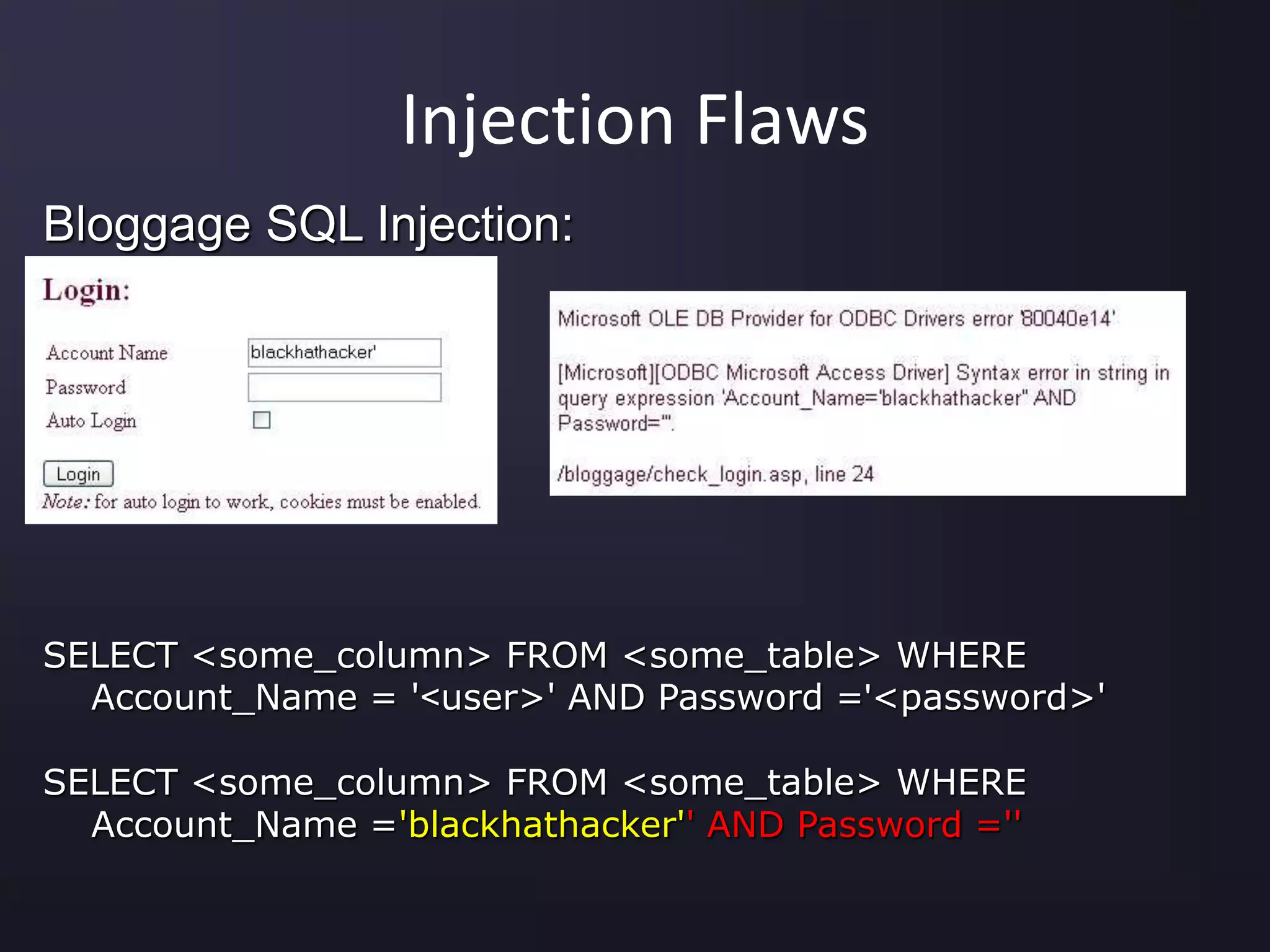
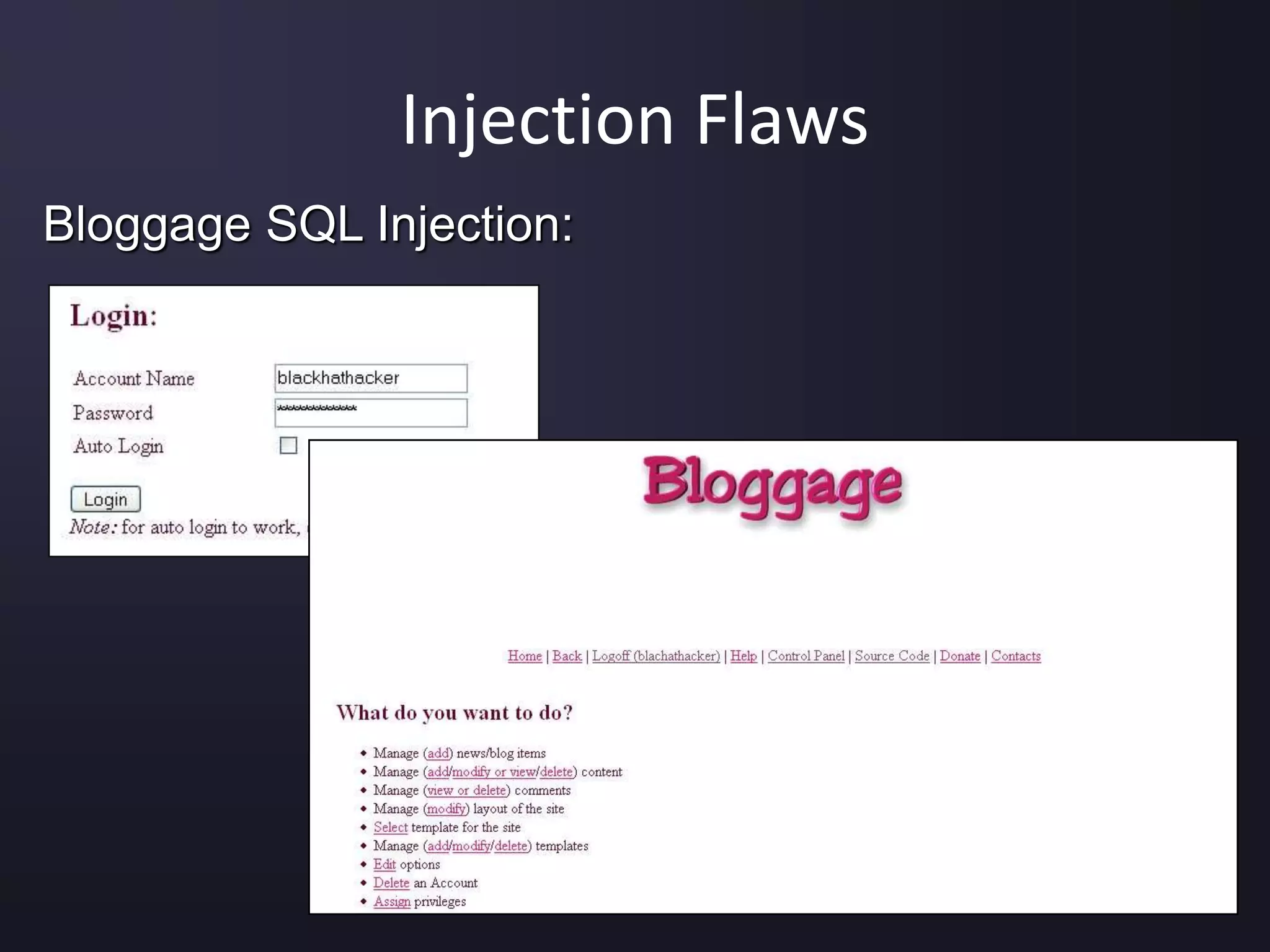
Bloggage SQL Injection:
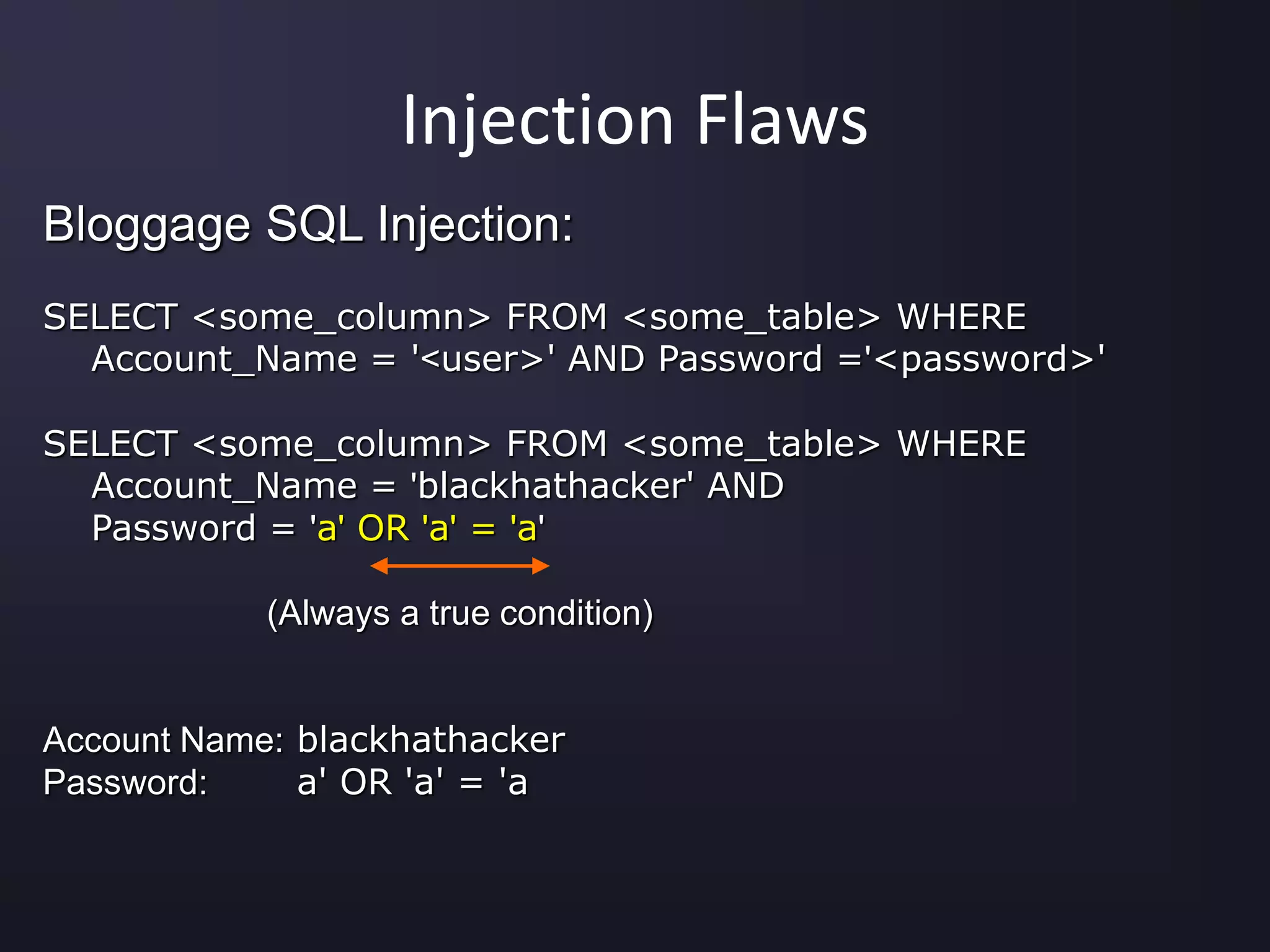
SELECT <some_column> FROM <some_table> WHERE
Account_Name = '<user>' AND Password ='<password>'
SELECT <some_column> FROM <some_table> WHERE
Account_Name ='blackhathacker'' AND Password =''
Injection Flaws
Bloggage SQL Injection:
SELECT <some_column> FROM <some_table> WHERE
Account_Name = '<user>' AND Password ='<password>'
SELECT <some_column> FROM <some_table> WHERE
Account_Name = 'blackhathacker' AND
Password = 'a' OR 'a' = 'a'
(Always a true condition)
Account Name: blackhathacker
Password: a' OR 'a' = 'a
Injection Flaws
Bloggage SQL Injection:
Injection Flaws
Prevention:
 Avoid accessing external interpreters wherever possible.
 For calls to backend databases, carefully validate the data
provided to ensure that it does not contain any malicious
content.
 Structure requests in a manner that ensures that all
supplied parameters are treated as data, rather than
potentially executable content.
 Convert special characters to the correct form.
 Run the application with minimum priveleges required.
Improper Error Handling
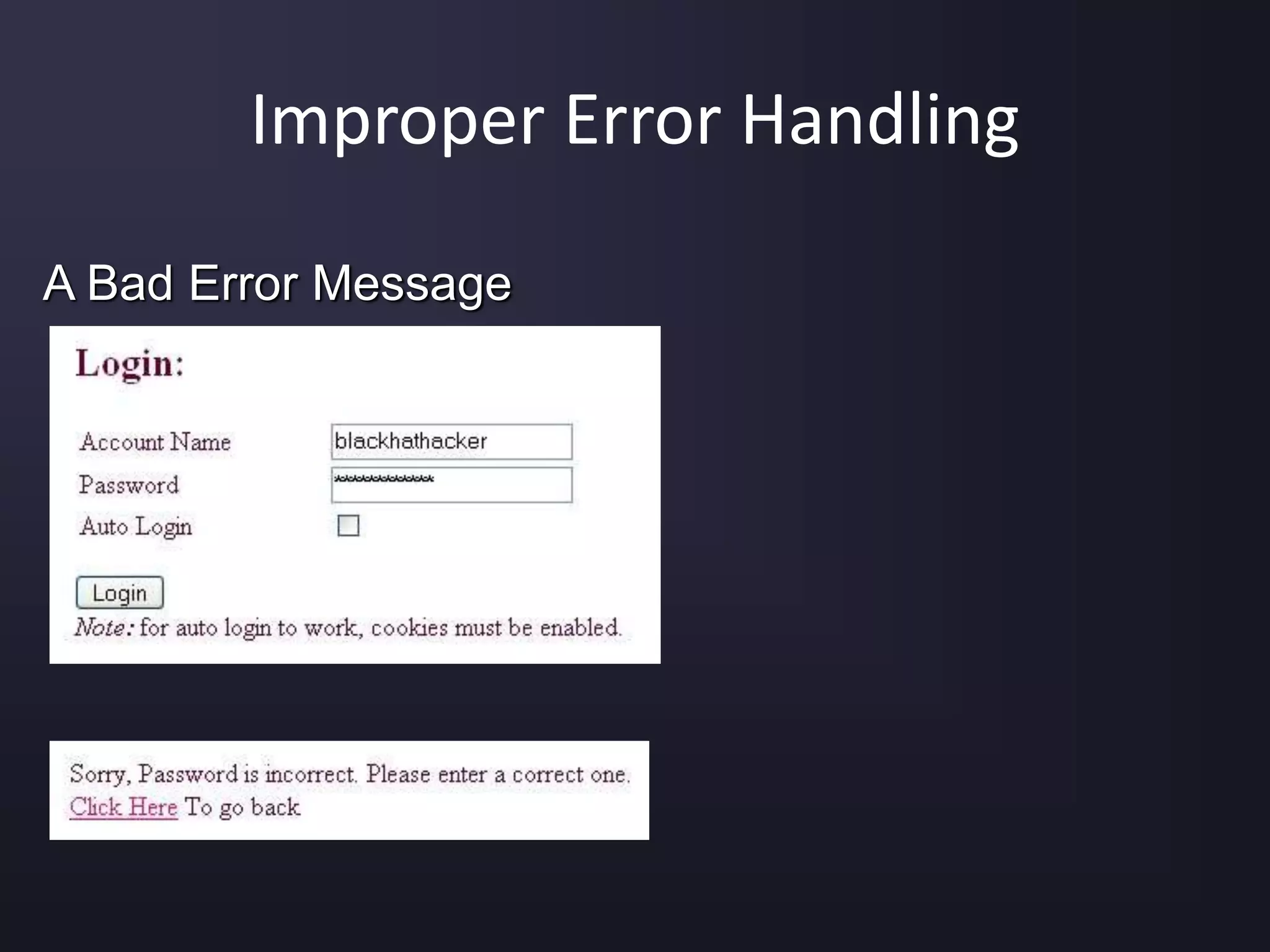
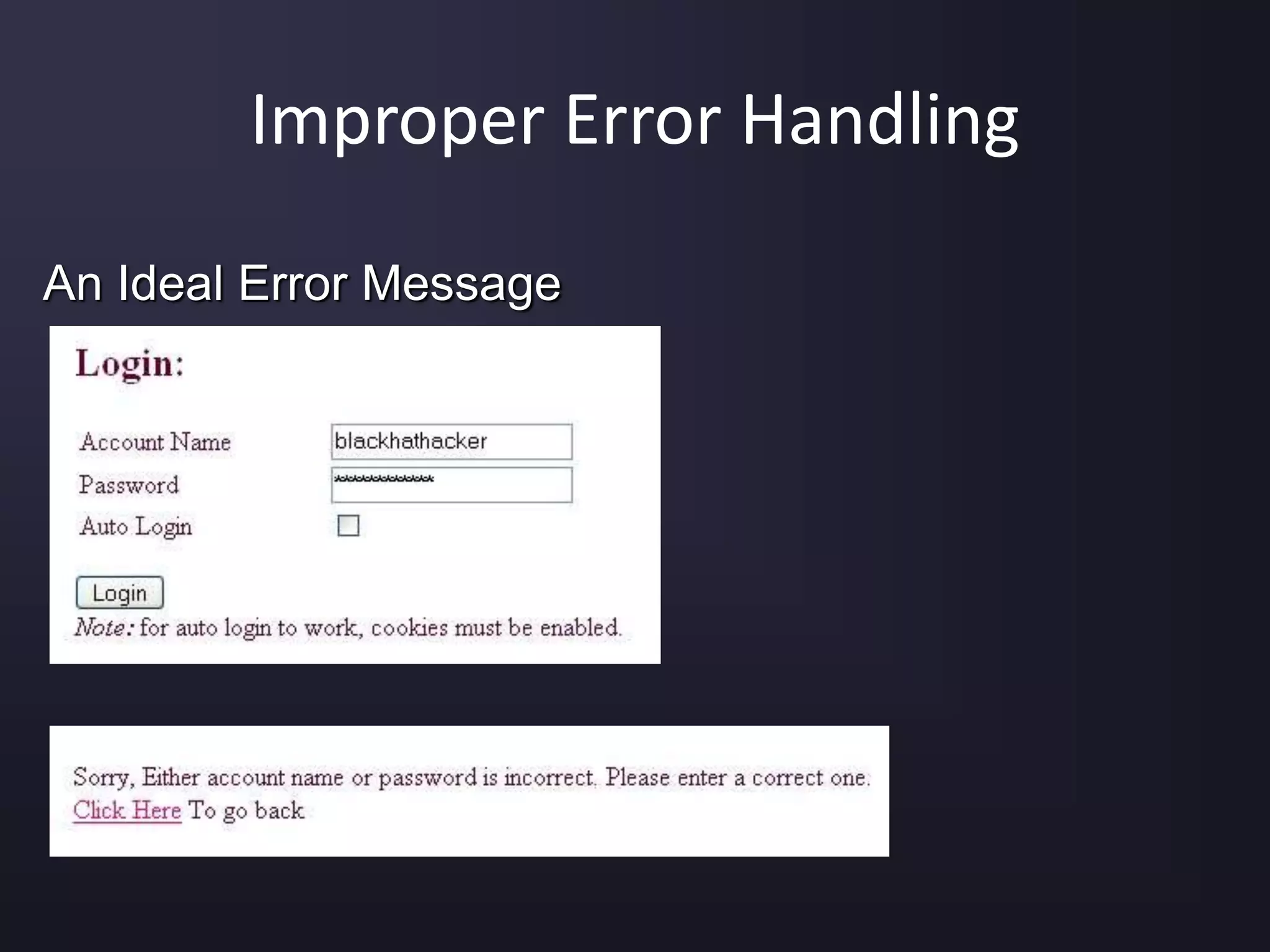
Improper handling of errors can introduce a variety
of security problems.
Common Problems:
 Inconsistencies in error messages which can reveal
important clues on how the system works.
 Stack traces, database dumps and error codes are
displayed on error.
 Syntax errors are displayed along with portions of the
codes.
Improper Error Handling
A Bad Error Message
Improper Error Handling
An Ideal Error Message
Improper Error Handling
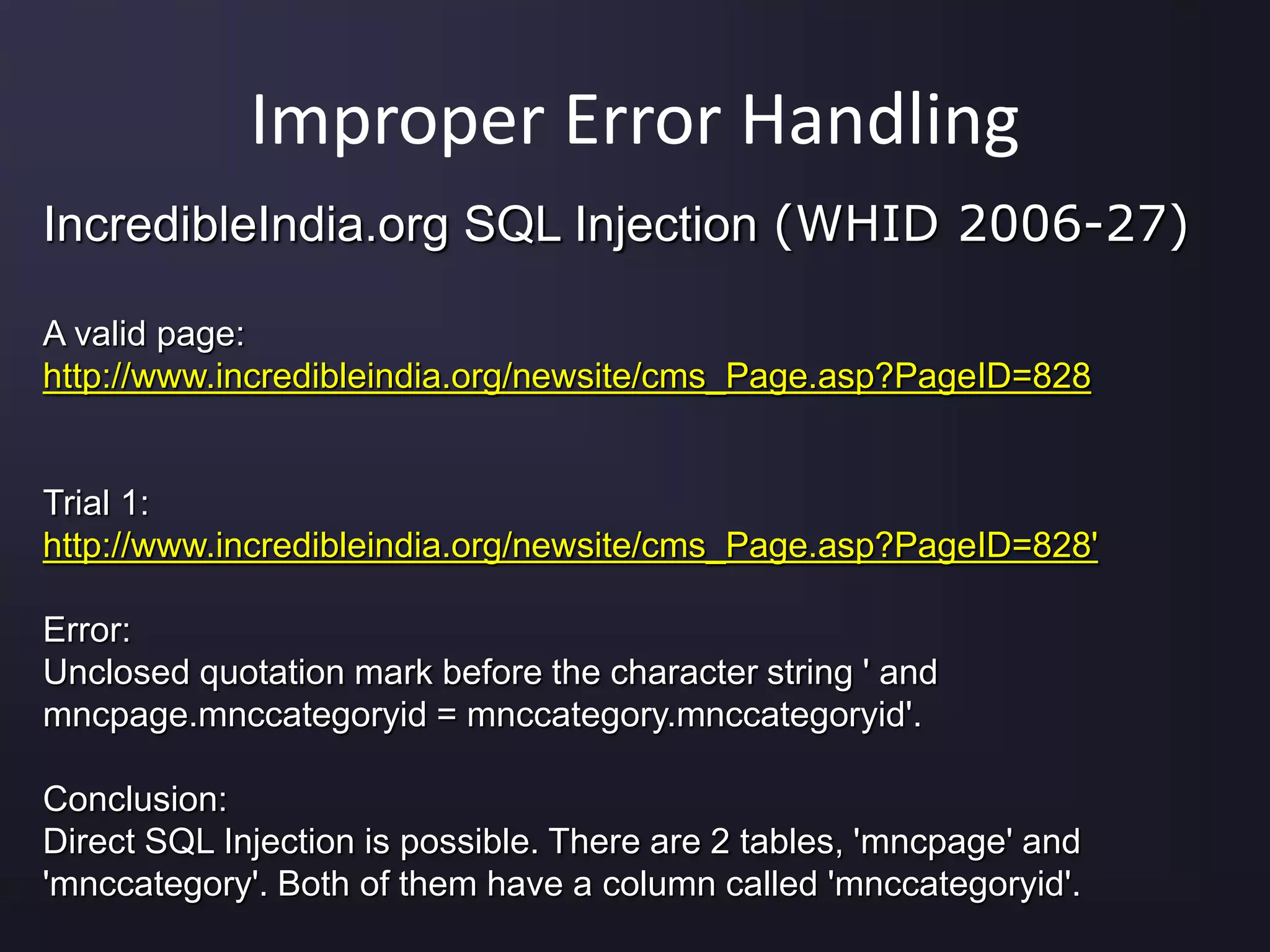
IncredibleIndia.org SQL Injection (WHID 2006-27)
A valid page:
http://www.incredibleindia.org/newsite/cms_Page.asp?PageID=828
Trial 1:
http://www.incredibleindia.org/newsite/cms_Page.asp?PageID=828'
Error:
Unclosed quotation mark before the character string ' and
mncpage.mnccategoryid = mnccategory.mnccategoryid'.
Conclusion:
Direct SQL Injection is possible. There are 2 tables, 'mncpage' and
'mnccategory'. Both of them have a column called 'mnccategoryid'.
Improper Error Handling
IncredibleIndia.org SQL Injection (WHID 2006-27)
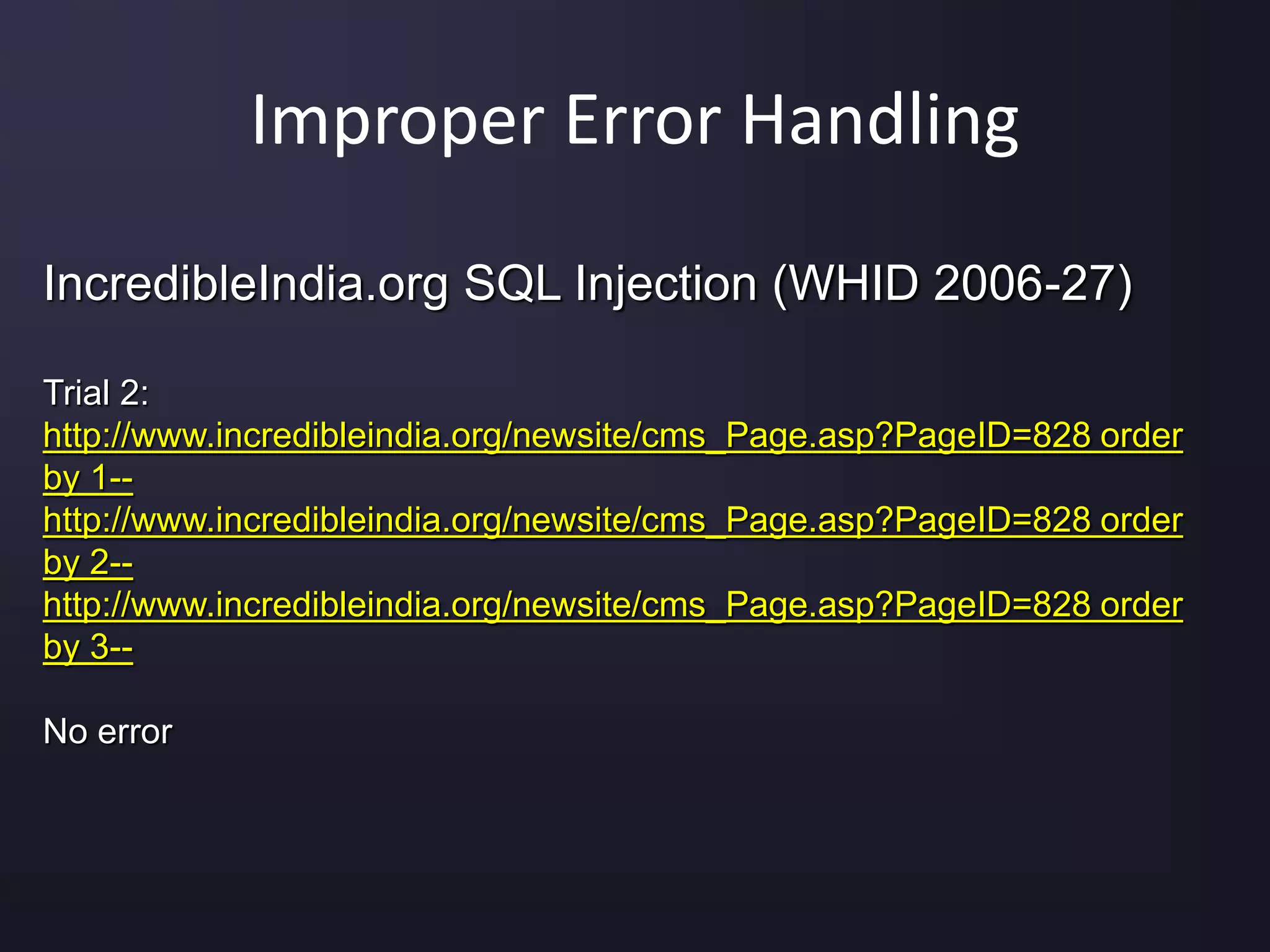
Trial 2:
http://www.incredibleindia.org/newsite/cms_Page.asp?PageID=828 order
by 1--
http://www.incredibleindia.org/newsite/cms_Page.asp?PageID=828 order
by 2--
http://www.incredibleindia.org/newsite/cms_Page.asp?PageID=828 order
by 3--
No error
Improper Error Handling
IncredibleIndia.org SQL Injection (WHID 2006-27)
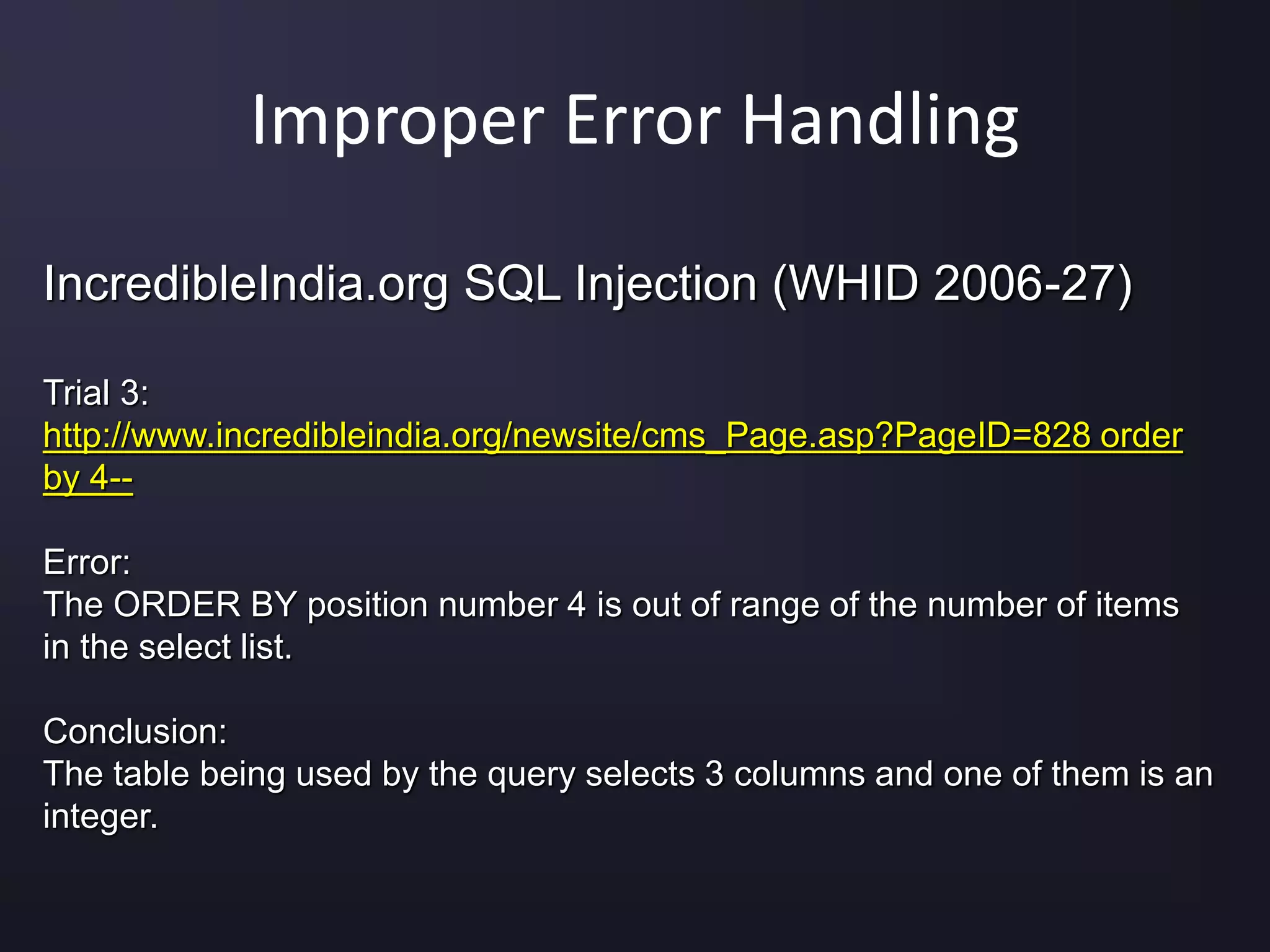
Trial 3:
http://www.incredibleindia.org/newsite/cms_Page.asp?PageID=828 order
by 4--
Error:
The ORDER BY position number 4 is out of range of the number of items
in the select list.
Conclusion:
The table being used by the query selects 3 columns and one of them is an
integer.
Improper Error Handling
IncredibleIndia.org SQL Injection (WHID 2006-27)
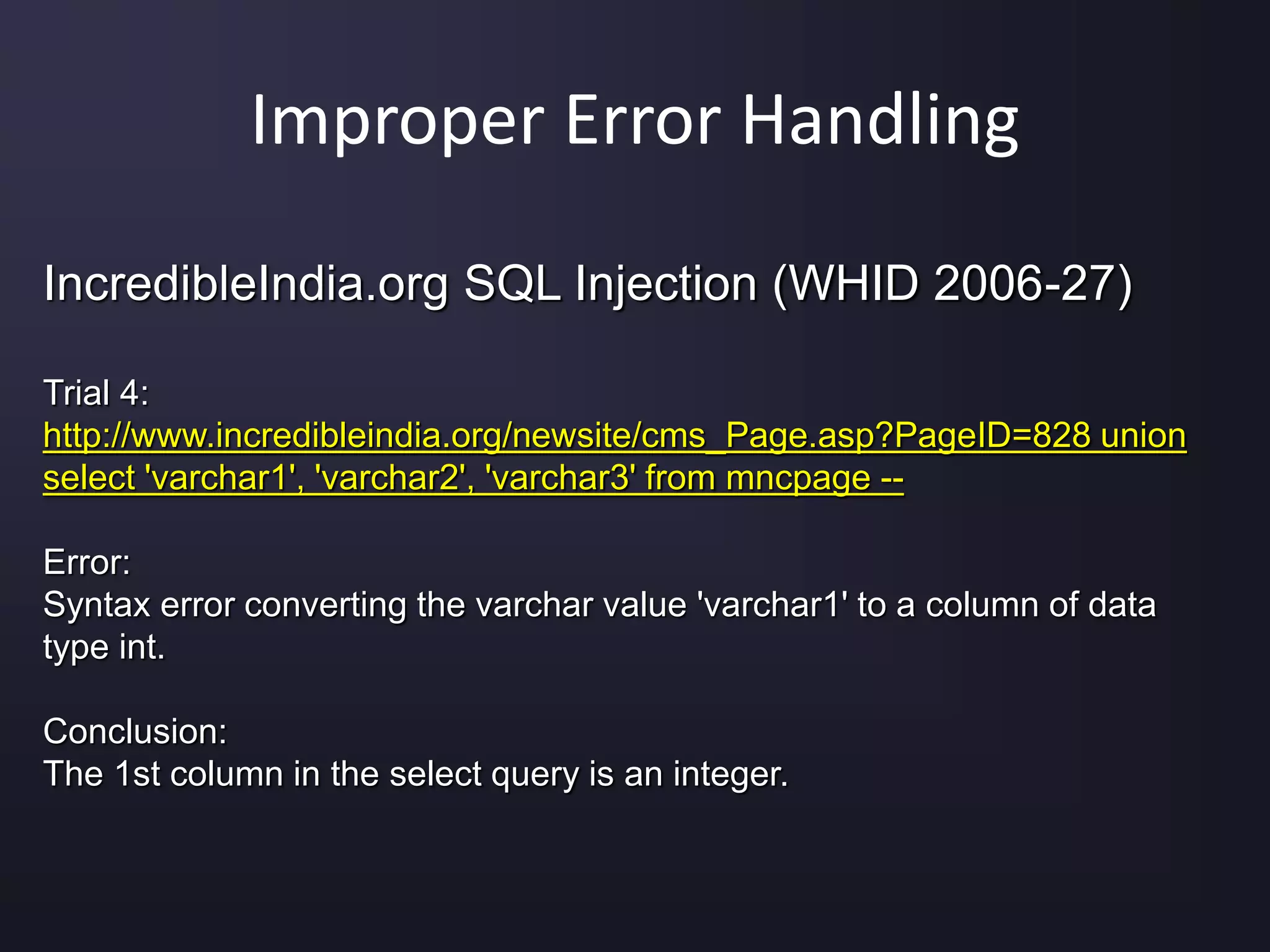
Trial 4:
http://www.incredibleindia.org/newsite/cms_Page.asp?PageID=828 union
select 'varchar1', 'varchar2', 'varchar3' from mncpage --
Error:
Syntax error converting the varchar value 'varchar1' to a column of data
type int.
Conclusion:
The 1st column in the select query is an integer.
Improper Error Handling
IncredibleIndia.org SQL Injection (WHID 2006-27)
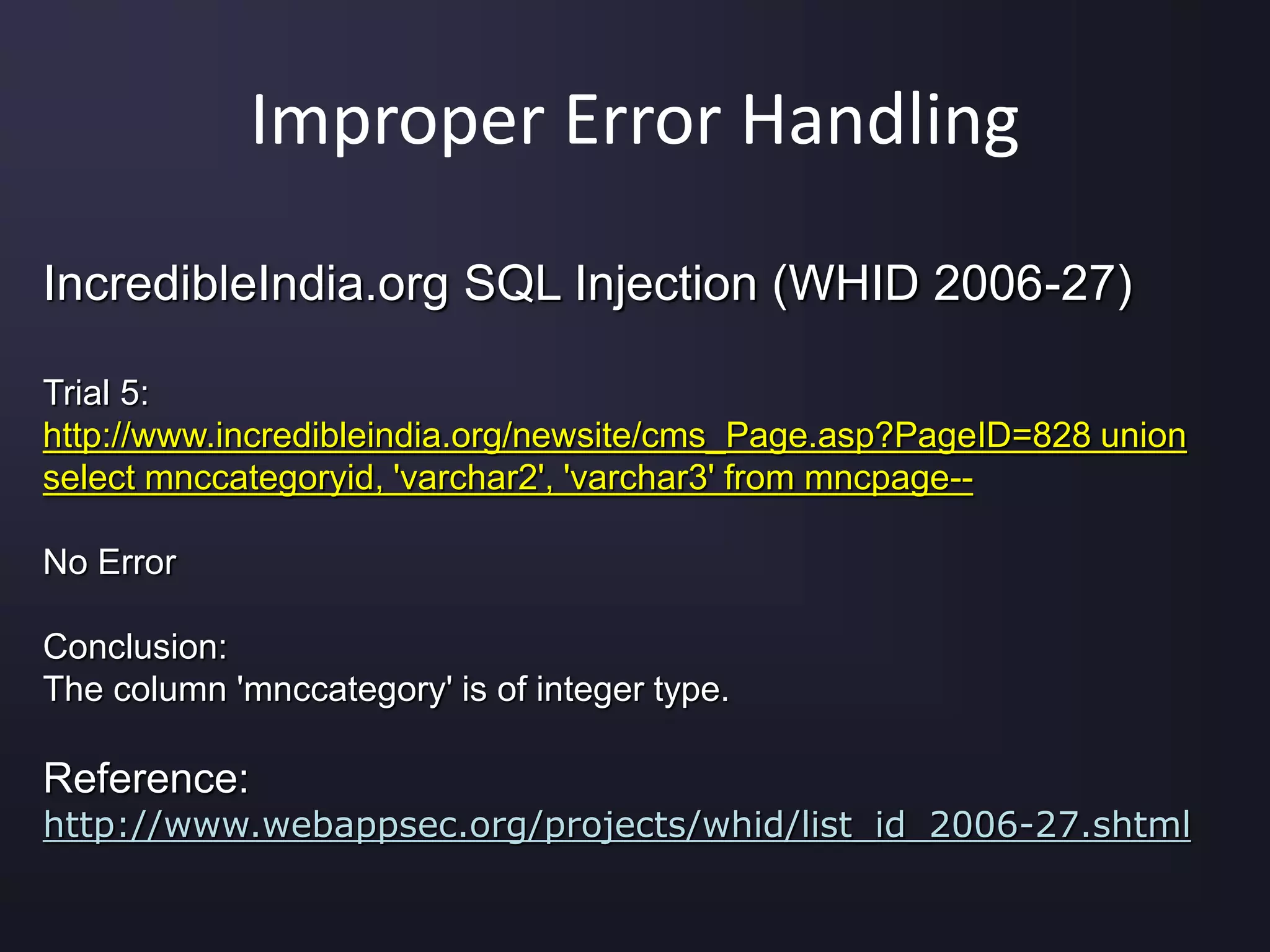
Trial 5:
http://www.incredibleindia.org/newsite/cms_Page.asp?PageID=828 union
select mnccategoryid, 'varchar2', 'varchar3' from mncpage--
No Error
Conclusion:
The column 'mnccategory' is of integer type.
Reference:
http://www.webappsec.org/projects/whid/list_id_2006-27.shtml
Insecure Storage
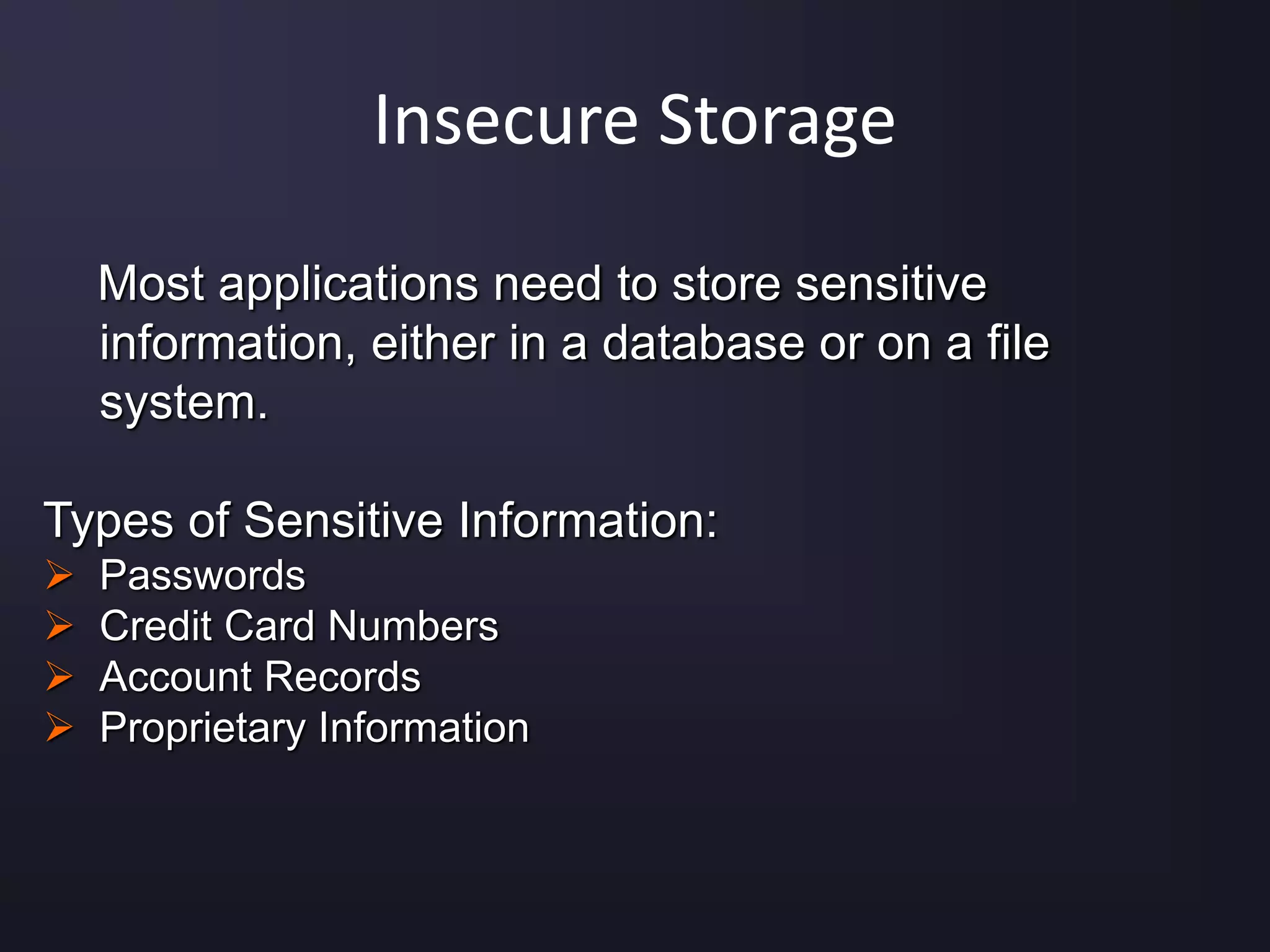
Most applications need to store sensitive
information, either in a database or on a file
system.
Types of Sensitive Information:
 Passwords
 Credit Card Numbers
 Account Records
 Proprietary Information
Insecure Storage
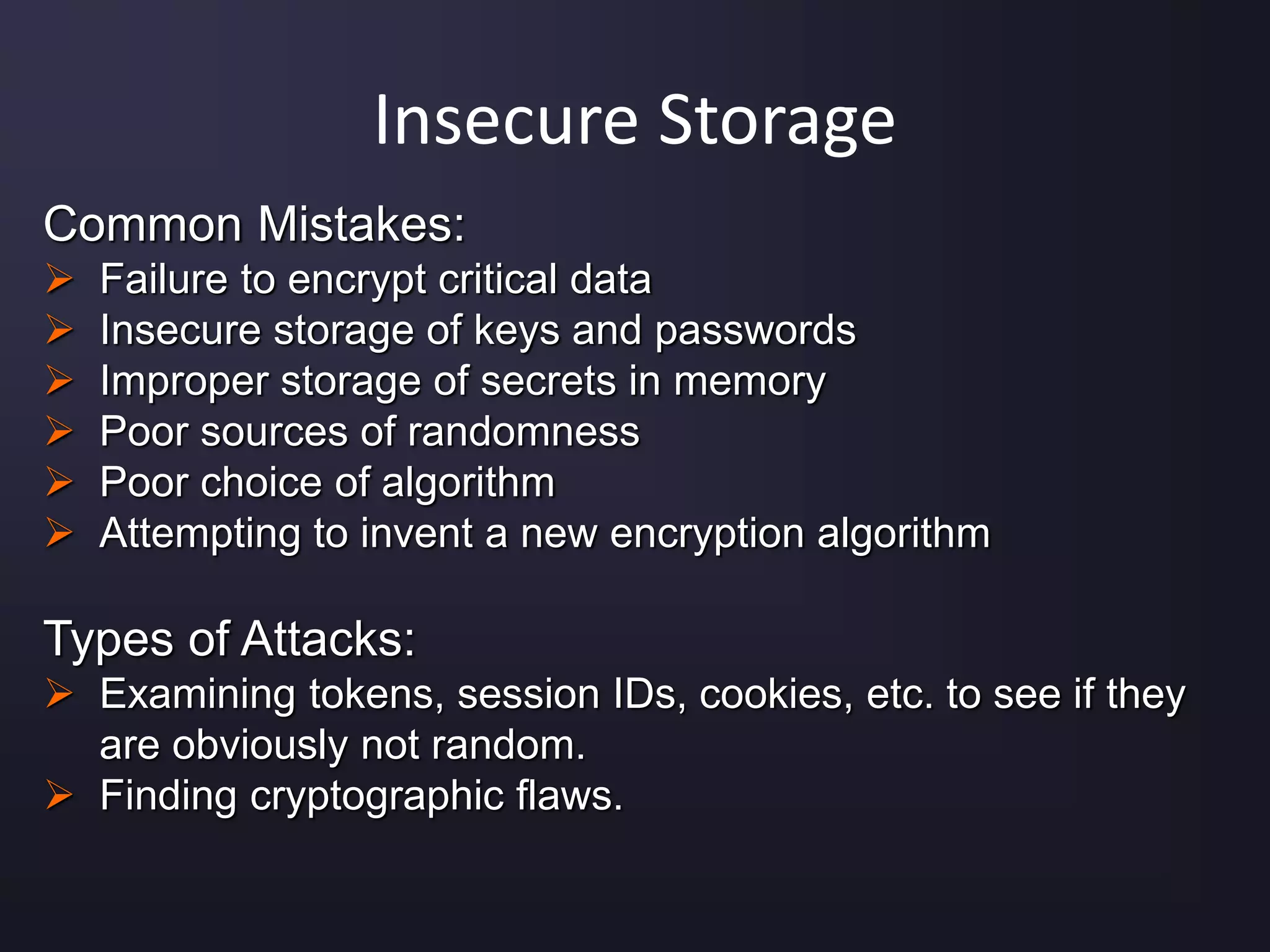
Common Mistakes:
 Failure to encrypt critical data
 Insecure storage of keys and passwords
 Improper storage of secrets in memory
 Poor sources of randomness
 Poor choice of algorithm
 Attempting to invent a new encryption algorithm
Types of Attacks:
 Examining tokens, session IDs, cookies, etc. to see if they
are obviously not random.
 Finding cryptographic flaws.
Insecure Storage
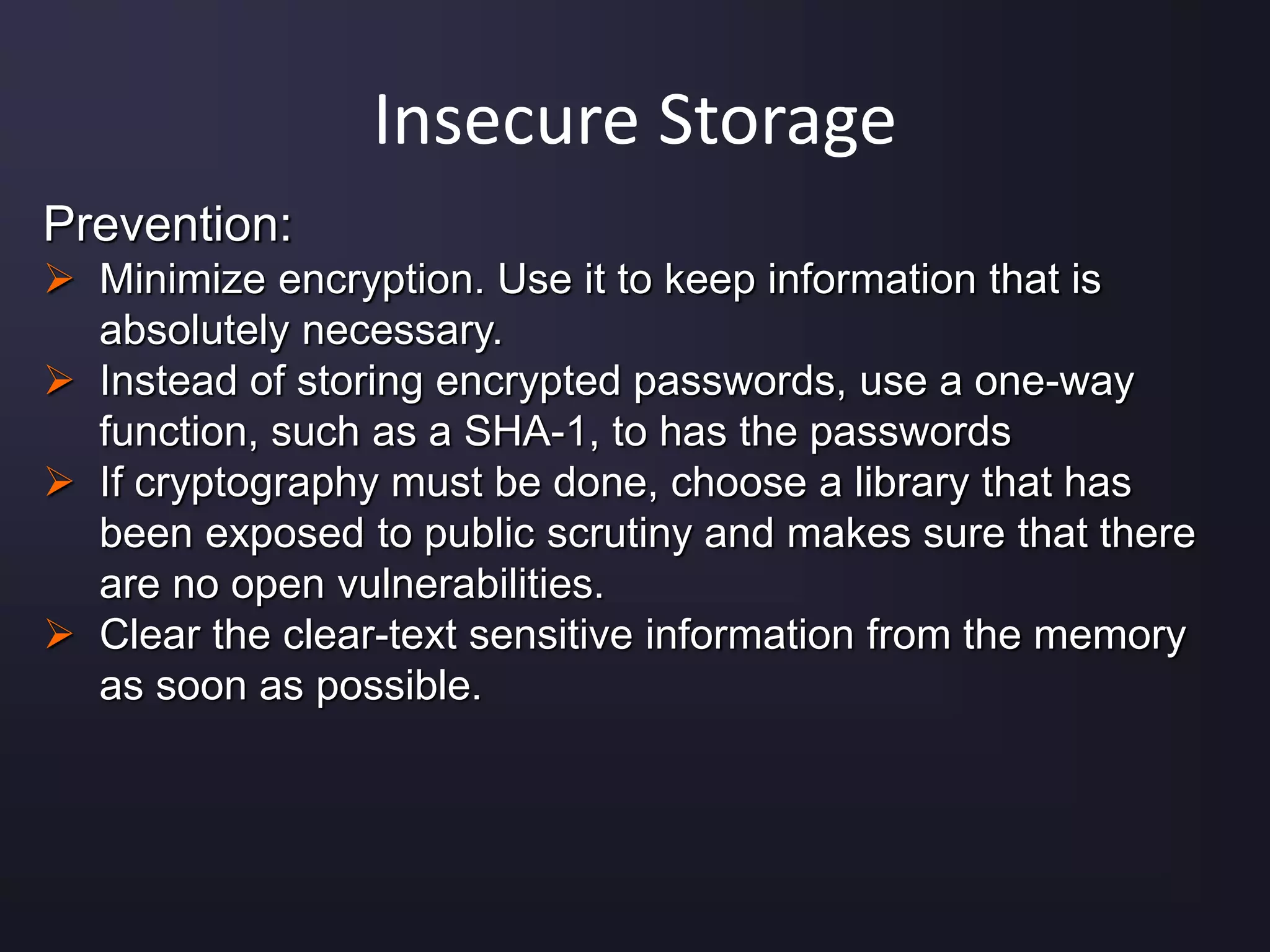
Prevention:
 Minimize encryption. Use it to keep information that is
absolutely necessary.
 Instead of storing encrypted passwords, use a one-way
function, such as a SHA-1, to has the passwords
 If cryptography must be done, choose a library that has
been exposed to public scrutiny and makes sure that there
are no open vulnerabilities.
 Clear the clear-text sensitive information from the memory
as soon as possible.
Denial of Service
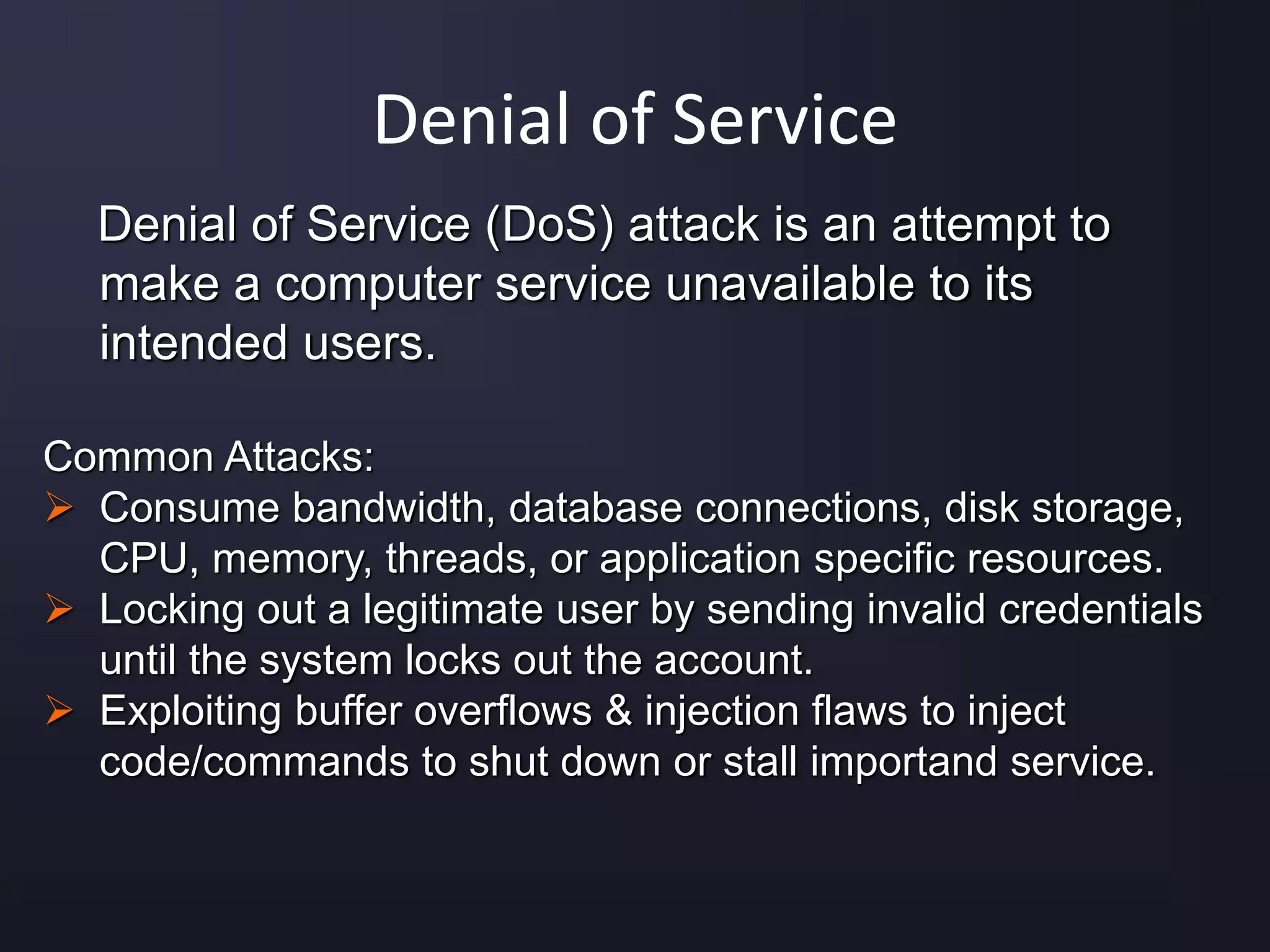
Denial of Service (DoS) attack is an attempt to
make a computer service unavailable to its
intended users.
Common Attacks:
 Consume bandwidth, database connections, disk storage,
CPU, memory, threads, or application specific resources.
 Locking out a legitimate user by sending invalid credentials
until the system locks out the account.
 Exploiting buffer overflows & injection flaws to inject
code/commands to shut down or stall importand service.
Denial of Service
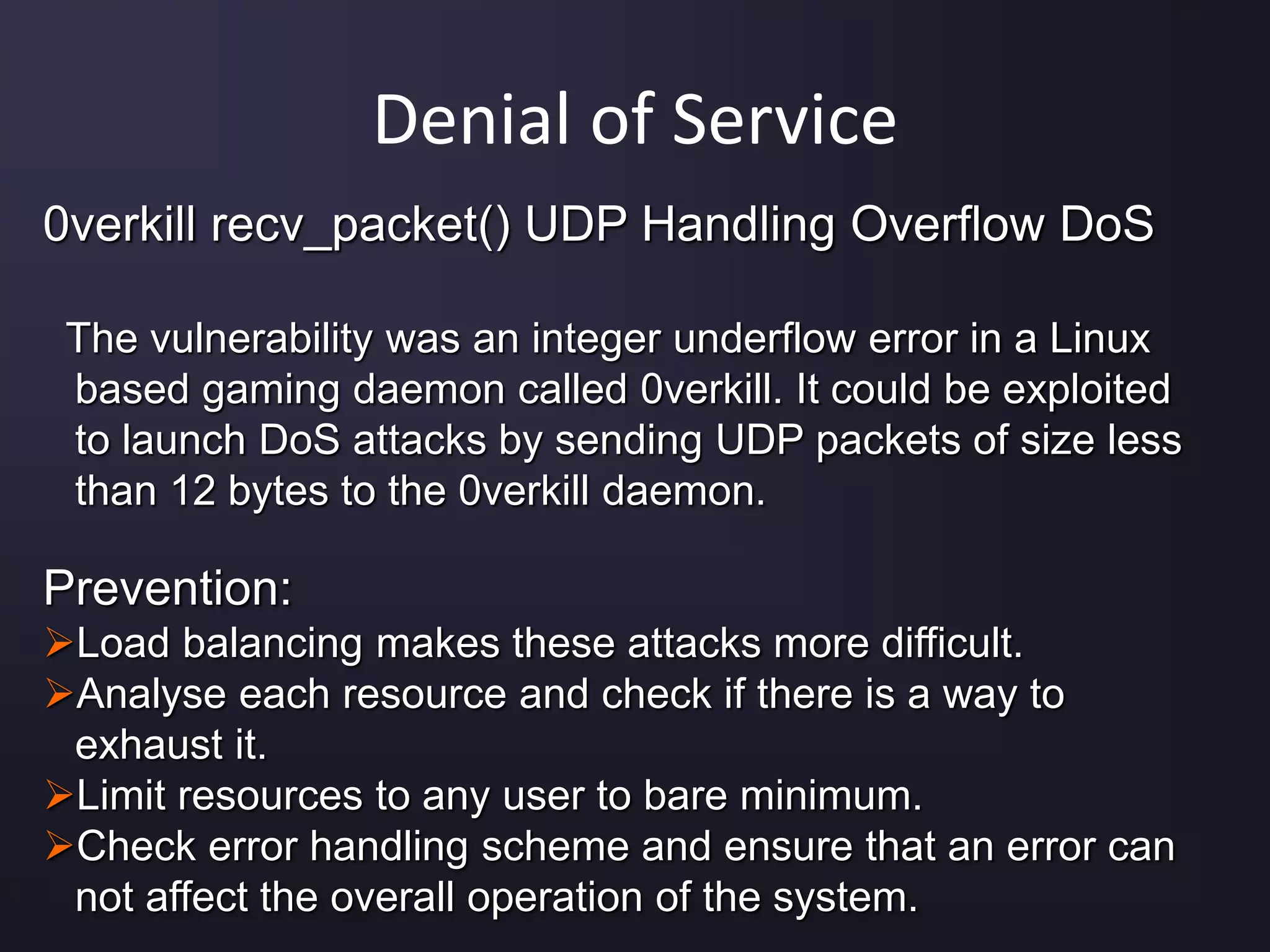
0verkill recv_packet() UDP Handling Overflow DoS
The vulnerability was an integer underflow error in a Linux
based gaming daemon called 0verkill. It could be exploited
to launch DoS attacks by sending UDP packets of size less
than 12 bytes to the 0verkill daemon.
Prevention:
Load balancing makes these attacks more difficult.
Analyse each resource and check if there is a way to
exhaust it.
Limit resources to any user to bare minimum.
Check error handling scheme and ensure that an error can
not affect the overall operation of the system.
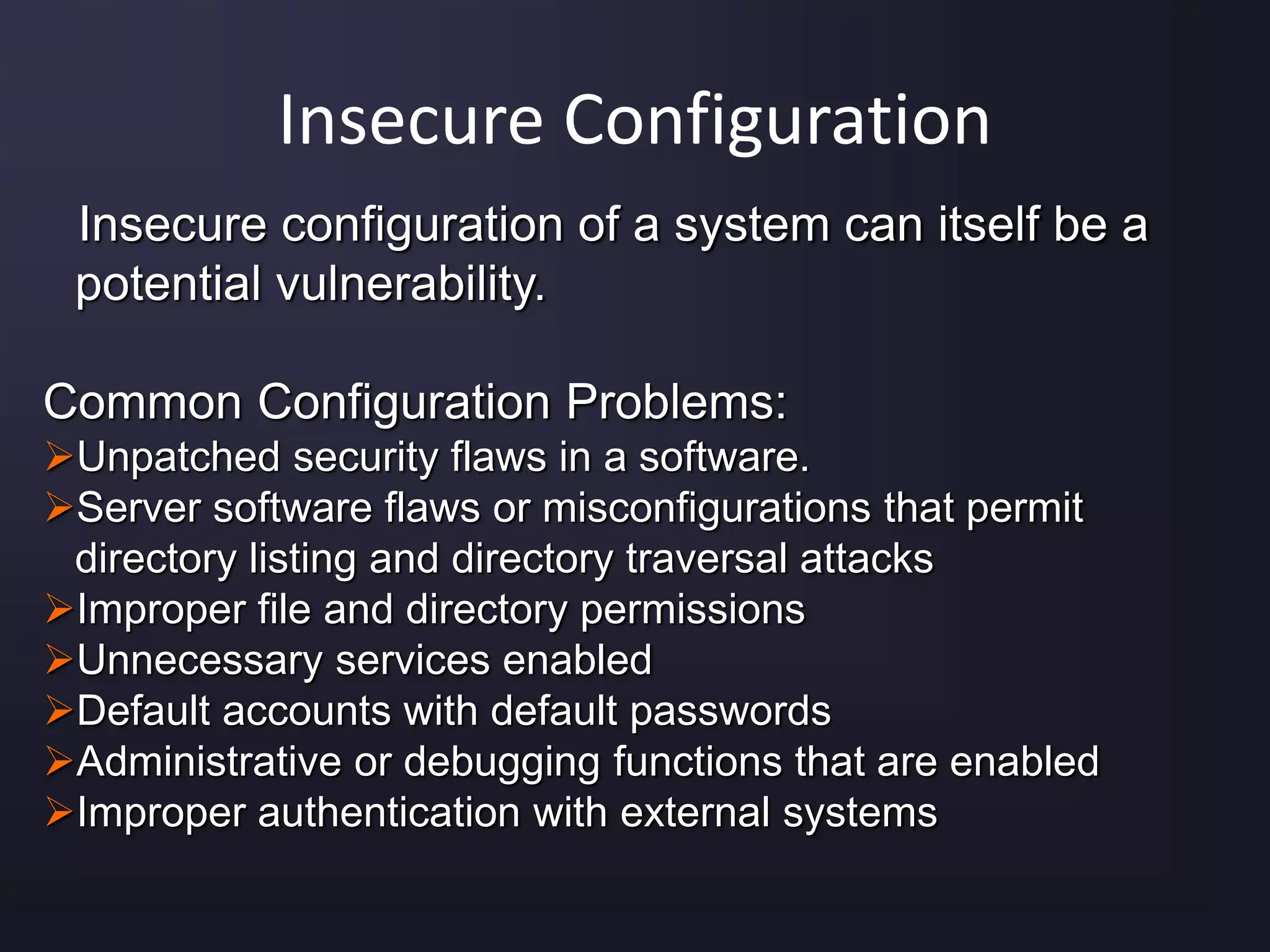
Insecure Configuration
Insecure configuration of a system can itself be a
potential vulnerability.
Common Configuration Problems:
Unpatched security flaws in a software.
Server software flaws or misconfigurations that permit
directory listing and directory traversal attacks
Improper file and directory permissions
Unnecessary services enabled
Default accounts with default passwords
Administrative or debugging functions that are enabled
Improper authentication with external systems
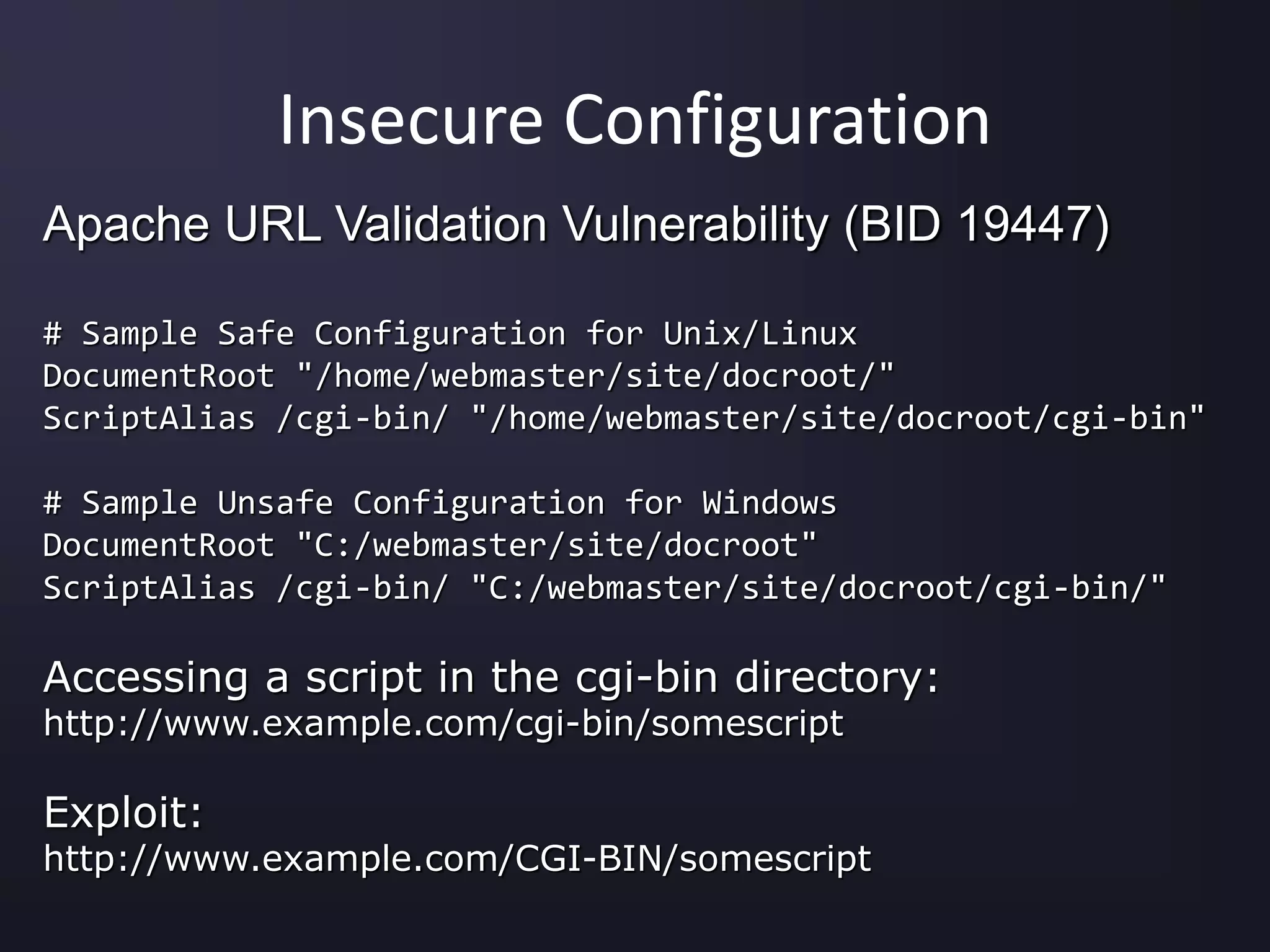
Insecure Configuration
Apache URL Validation Vulnerability (BID 19447)
# Sample Safe Configuration for Unix/Linux
DocumentRoot "/home/webmaster/site/docroot/"
ScriptAlias /cgi-bin/ "/home/webmaster/site/docroot/cgi-bin"
# Sample Unsafe Configuration for Windows
DocumentRoot "C:/webmaster/site/docroot"
ScriptAlias /cgi-bin/ "C:/webmaster/site/docroot/cgi-bin/"
Accessing a script in the cgi-bin directory:
http://www.example.com/cgi-bin/somescript
Exploit:
http://www.example.com/CGI-BIN/somescript
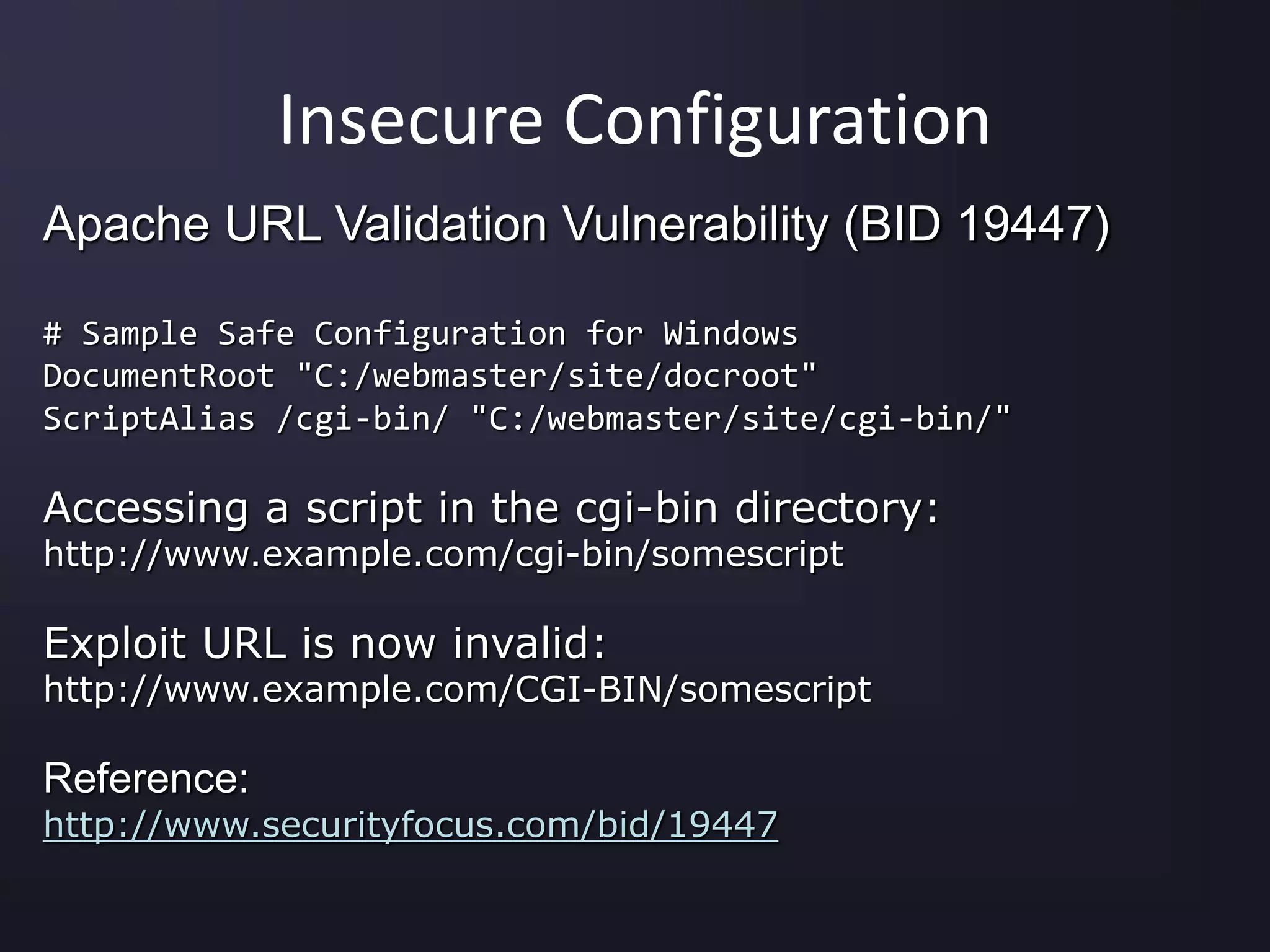
Insecure Configuration
Apache URL Validation Vulnerability (BID 19447)
# Sample Safe Configuration for Windows
DocumentRoot "C:/webmaster/site/docroot"
ScriptAlias /cgi-bin/ "C:/webmaster/site/cgi-bin/"
Accessing a script in the cgi-bin directory:
http://www.example.com/cgi-bin/somescript
Exploit URL is now invalid:
http://www.example.com/CGI-BIN/somescript
Reference:
http://www.securityfocus.com/bid/19447
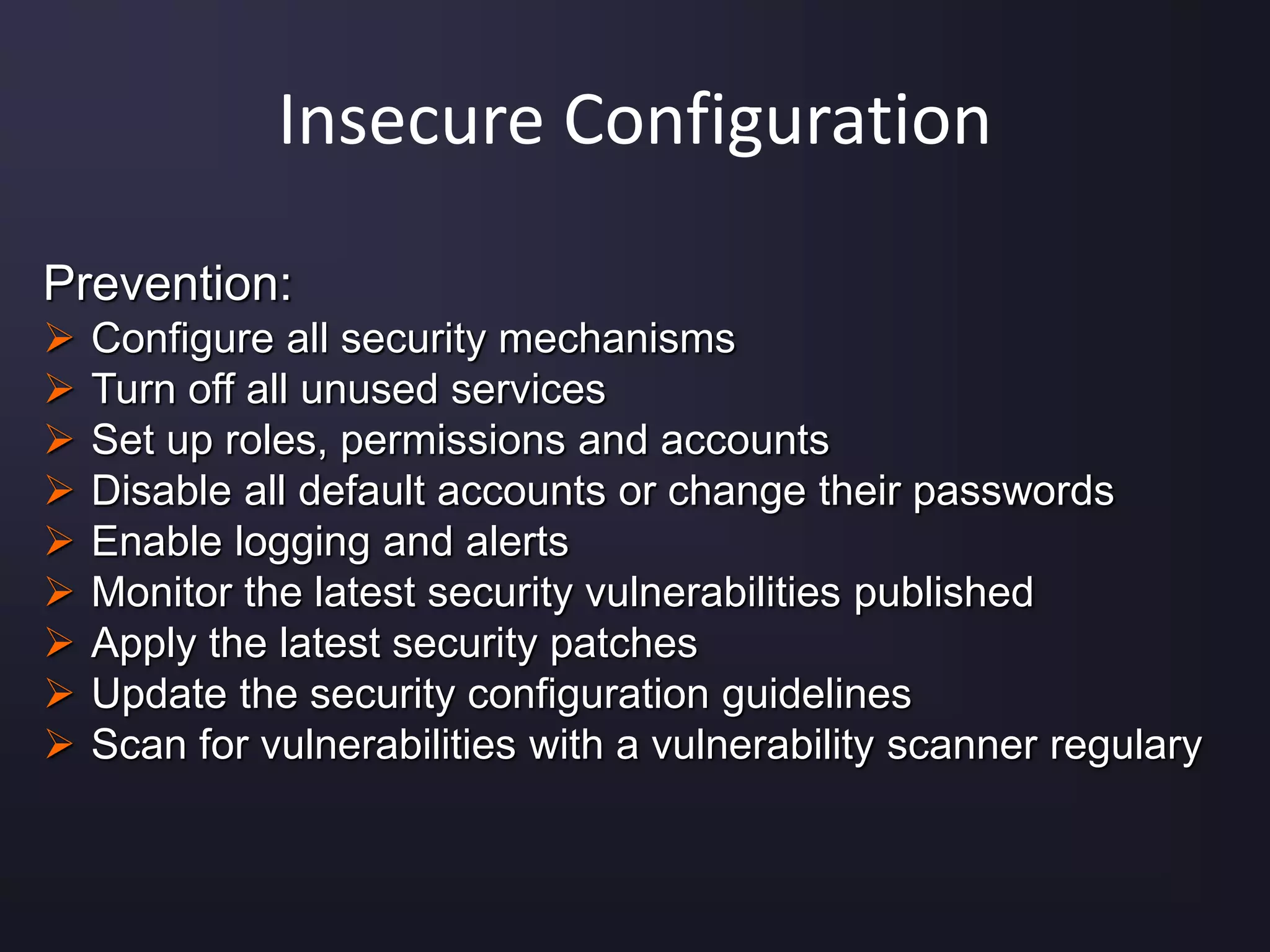
Insecure Configuration
Prevention:
 Configure all security mechanisms
 Turn off all unused services
 Set up roles, permissions and accounts
 Disable all default accounts or change their passwords
 Enable logging and alerts
 Monitor the latest security vulnerabilities published
 Apply the latest security patches
 Update the security configuration guidelines
 Scan for vulnerabilities with a vulnerability scanner regulary
Thank You!

Top 10 Security Vulnerabilities (2006)

  • 1.
    Top 10 SecurityVulnerabilities Susam Pal Based on OWASP Top Ten Project (2006) http://www.owasp.org/index.php/OWASP_Top_Ten_Project Content is available under Creative Commons Attribution-ShareAlike 2.5 License
  • 2.
    Agenda  Unvalidated Input Broken Access Control  Broken Authentication  Cross Site Scripting  Buffer Overflows  Injection Flaws  Improper Error Handling  Insecure Storage  Denial of Service  Insecure Configuration
  • 3.
    Unvalidated Input All inputis evil …. .... until proven otherwise. Types of Input:  HTTP Requests  Commands  Network packets (TCP/IP, UDP, etc.)
  • 4.
    Unvalidated Input Common InputTampering Attacks:  Forced Browsing  Command Insertion  Cross Site Scripting  Buffer Overflows  SQL Injection  Hidden Field Manipulation
  • 5.
    Unvalidated Input Microsoft IISand PWS Extended Unicode Directory Traversal Vulnerability (BID 1806) Web Root: C:Inetpubwwwroot Unsafe Procedure: map [URL] to [path of the resource] on the hard disk; if [path of the resource] starts with [C:Inetpubwwwroot] then allow access; else deny access;
  • 6.
    Unvalidated Input Microsoft IISand PWS Extended Unicode Directory Traversal Vulnerability (BID 1806) Exploit: http://www.example.com/../../windows/system32/cmd.exe URL Mapped to Resource on Hard Disk: C:Inetpubwwwroot....windowssystem32cmd.exe What IIS/PWS forgot to check: C:Inetpubwwwroot....windowssystem32cmd.exe = C:Inetpub..windowssystem32cmd.exe = C:windowssystem32cmd.exe
  • 7.
    Unvalidated Input Microsoft IISand PWS Extended Unicode Directory Traversal Vulnerability (BID 1806) Safe Procedure: map [URL] to [path of the resource] on the hard disk; canonicalize [path of the resource]; if [path of the resource] starts with [C:Inetpubwwwroot] then allow access; else deny access; Reference: http://www.securityfocus.com/bid/1806
  • 8.
    Unvalidated Input Prevention:  Canonicalization:Input should be converted to the simplest form before they are validated.  Server Side Validation: It is must. First code Server Side Validation, then code Client Side Validation.  Validate against a positive (not negative) specification.  Detailed code review for tainted parameters.
  • 9.
    Broken Access Control Accesscontrol, sometimes called authorization, is how a web application grants access to content and functions to some users and not others. Features:  Access control is closely associated with the content and functions of the application.  Users are generally managed by putting them under various groups/roles with various priveleges.
  • 10.
    Broken Access Control CommonMistakes:  Administrative interfaces that allow site administrators to manage a site over the Internet.  Insertion of access control rules in various locations all over the code on an ad hoc basis. Common Attacks:  Exploiting Insecure Id’s  Forced Browsing Past Access Control Checks  Path traversals  Exploiting browser cache
  • 11.
    Broken Access Control Howto disable Browser Cache: HTML <meta> Tag <meta http-equiv="Pragma" content="no-cache"> <meta http-equiv="Expires" content="-1"> <meta http-equiv="Cache-control" content="no-cache"> <meta http-equiv="Cache" content="no-cache"> <meta http-equiv="Expires" content="thu, 01 Jan 1980 12:00:00 GMT"> ASP <% Response.AddHeader "Pragma", "no-cache" %> <% Response.Expires = -1 %> <% Response.CacheControl="private" %> <% Response.CacheControl = "no-cache" %> <% Response.CacheControl = "no-store" %>
  • 12.
    Broken Access Control Howto disable Browser Cache: JSP <% response.setHeader("Pragma","no-cache"); %> <% response.setHeader("Cache-Control","no-cache"); %> <% response.setDateHeader ("Expires", 0); %> <% response.setHeader("Cache-Control","no-store"); %> PHP <?php Header("Pragma: no-cache"); Header("Cache-control: private, no-cache, no-store"); Header("Expires: Mon, 26 Jul 1997 05:00:00 GMT"); ?>
  • 13.
    Broken Authentication Types ofAuthentication:  User ID and Password  Software & Hardware based cryptographic tokens  Biometrics Session Management:  Web applications must establish sessions to keep track of the stream of requests from each user.  HTTP doesn’t provide this capability, so web applications must create it themselves.  Generally developers create session tokens to manage sessions.
  • 14.
    Broken Authentication Common Attacks: “Walk by” Attacks  Session Hijacking Prevention:  Re-authentication for critical functionalities.  Use of SSL to protect authentication credentials and session identifiers.  Code review and penetration testing  POST method to submit authentication & session data.  Use autocomplete=“off” with <form> and <input> tags.  Avoid implicit trust between components.
  • 15.
    Cross Site Scripting XSSoccurs when an attacker uses a web application to send malicious code, generally in the form of a script, to a different end user. Types of XSS attacks:  Stored - Injected code is permanently stored on the target servers, such as in a database, forum, visitor log, comment field, etc.  Reflected – Injected code is reflected off the web server, such as in an error message, search result, or any other response that includes some or all of the input sent to the server as part of the request.
  • 16.
    Cross Site Scripting CommonAttacks:  Annoyance to the end user.  Redirecting the user to some other page or site  Disclosure of the user’s session cookie.  Session hijacking. Prevention:  Code review of all places where input from an HTTP request could possibly make its way into the HTML output.  Validate all headers, cookies, query strings, form fields and all such inputs against a rigorous positive specification.
  • 17.
    Cross Site Scripting CommunityArchitect Guestbook XSS (SA19742) When the attacker is in a good mood:
  • 18.
    Cross Site Scripting CommunityArchitect Guestbook XSS (SA19742) Where the input goes:
  • 19.
    Cross Site Scripting CommunityArchitect Guestbook XSS (SA19742) The Output:
  • 20.
    Cross Site Scripting CommunityArchitect Guestbook XSS (SA19742) If the attacker attacks:
  • 21.
    Cross Site Scripting CommunityArchitect Guestbook XSS (SA19742) Where the input goes:
  • 22.
    Cross Site Scripting CommunityArchitect Guestbook XSS (SA19742) The Output: Reference: http://cve.mitre.org/cgi-bin/cvename.cgi?name=CVE-2006-2003
  • 23.
    Cross Site Scripting PotentialHarmful Tags: <script> <object> <embed> <applet> <form> Decision to be taken for XSS prevention:  Whether tags should appear in the output as a tags.  Whether tags should not appear in the output at all.  Whether text formatting is to be allowed.
  • 24.
    Cross Site Scripting Iftags should appear in the output. Convert special characters to HTML entities
  • 25.
    Cross Site Scripting Iftags should appear in the output. Convert special characters to HTML entities: Special Character HTML Entity < &lt; > &rt; “ &quot; & &amp; ( &#40; ) &#41; # &#35;
  • 26.
    Cross Site Scripting Iftags should not appear in the output. Filter out all tags
  • 27.
    Cross Site Scripting Iftext formatting should be allowed Allow necessary tags only.
  • 28.
    Cross Site Scripting Iftext formatting should be allowed. Tags that can be allowed: <p> <b> <u> <i> <strike> <h1>, <h2>, <h3>, <h4>, <h5>, <h6>
  • 29.
    Buffer Overflows Attackers usebuffer overflows to corrupt the execution stack of an application. Buffer overflows are easy to avoid, difficult to discover and extremely difficult to exploit. Types of Attacks:  Attackers send carefully crafted input to a web application, an attacker can cause the application to execute arbitrary code.  When difficult to exploit, the attackers can crash the application thereby leading to DoS (Denial of Service).
  • 30.
    #include <string.h> void function(char*str) { char buffer[4]; strcpy(buffer, str); } main() { char string[]="Hi!"; function(string); } Buffer Overflows *str – 4th Byte *str – 3rd Byte *str – 2nd Byte *str – 1st Byte EIP – 4th Byte EIP – 3rd Byte EIP – 2nd Byte EIP – 1st Byte EBP – 4th Byte EBP – 3rd Byte EBP – 2nd Byte EBP – 1st Byte Return Address indicates what ESP is pointing to indicates what EBP is pointing to
  • 31.
    #include <string.h> void function(char*str) { char buffer[4]; strcpy(buffer, str); } main() { char string[]="Hi!"; function(string); } Buffer Overflows *str – 4th Byte *str – 3rd Byte *str – 2nd Byte *str – 1st Byte EIP – 4th Byte EIP – 3rd Byte EIP – 2nd Byte EIP – 1st Byte EBP – 4th Byte EBP – 3rd Byte EBP – 2nd Byte EBP – 1st Byte buffer[3] buffer[2] buffer[1] buffer[0] Return Address indicates what ESP is pointing to indicates what EBP is pointing to
  • 32.
    #include <string.h> void function(char*str) { char buffer[4]; strcpy(buffer, str); } main() { char string[]="Hi!"; function(string); } Buffer Overflows *str – 4th Byte *str – 3rd Byte *str – 2nd Byte *str – 1st Byte EIP – 4th Byte EIP – 3rd Byte EIP – 2nd Byte EIP – 1st Byte EBP – 4th Byte EBP – 3rd Byte EBP – 2nd Byte EBP – 1st Byte ‘0’ ‘!’ ‘i’ ‘H’ Return Address indicates what ESP is pointing to indicates what EBP is pointing to
  • 33.
    #include <string.h> void function(char*str) { char buffer[4]; strcpy(buffer, str); } main() { char string[]="Good Morning!"; function(string); } Buffer Overflows *str – 4th Byte *str – 3rd Byte *str – 2nd Byte *str – 1st Byte EIP – 4th Byte EIP – 3rd Byte EIP – 2nd Byte EIP – 1st Byte EBP – 4th Byte EBP – 3rd Byte EBP – 2nd Byte EBP – 1st Byte buffer[3] buffer[2] buffer[1] buffer[0] Return Address indicates what ESP is pointing to indicates what EBP is pointing to
  • 34.
    #include <string.h> void function(char*str) { char buffer[4]; strcpy(buffer, str); } main() { char string[]="Good Morning!"; function(string); } Buffer Overflows *str – 4th byte *str – 3rd byte 0 ! g n i n r o M d o o G Return Address indicates what ESP is pointing to indicates what EBP is pointing to
  • 35.
    #include <string.h> void function(char*str) { char buffer[4]; strcpy(buffer, str); } main() { char string[]="Good Morning!"; function(string); } Buffer Overflows *str - 4th byte *str - 3rd byte 0 00H ! 21H g 67H n 6EH i 69H n 6EH r 72H o 6FH M 4DH 20H d 64H o 6FH o 6FH G 47H Return Address Returns to offset 676E696EH indicates what ESP is pointing to indicates what EBP is pointing to
  • 36.
    Buffer Overflows Major Attacks: CodeRed Virus Attacked a buffer overflow weakness in the Microsoft IIS Server API on July 19, 2001. Damage: $2.6 billion Sasser Worm Attacked the Microsoft LSAS buffer overflow vulnerability on April 30, 2004. Damage: $3.5 billion
  • 37.
    Buffer Overflows Prevention:  CProgrammers now refrain from using strcpy(), strcat() in their programs. They use strncpy(), strncat() instead which perform bound checking. Never use gets().  Programmers now write their applications in languages like Java, Visual Basic which has better stack and memory management features.  Sun Microsystems is trying to make their Sparc processor immune to stack overflow attack by introducing new feature to protect the return address during a subroutine call.
  • 38.
    Injection Flaws Injection flawlets you inject executable code at places where it is not allowed in a secure system which might lead to execution of the code and compromise of the system. Common Attacks:  Relay malicious through a web application to another system.  Calls to operating system via system calls.  Use of external programs via shell commands.  Calls to backend databases via SQL.  Complete script injection into web applications.
  • 39.
    Injection Flaws SQL Injection: SQL injection is particularly widespread and dangerous form of injection.  SQL Injection is possible if the value of any parameter is used in SQL queries and the parameter is not sanitised properly.  The attacker can retrieve, modify, corrupt or destroy database contents.
  • 40.
    Injection Flaws Bloggage SQLInjection: SELECT <some_column> FROM <some_table> WHERE Account_Name = '<user>' AND Password ='<password>' SELECT <some_column> FROM <some_table> WHERE Account_Name ='blackhathacker'' AND Password =''
  • 41.
    Injection Flaws Bloggage SQLInjection: SELECT <some_column> FROM <some_table> WHERE Account_Name = '<user>' AND Password ='<password>' SELECT <some_column> FROM <some_table> WHERE Account_Name = 'blackhathacker' AND Password = 'a' OR 'a' = 'a' (Always a true condition) Account Name: blackhathacker Password: a' OR 'a' = 'a
  • 42.
  • 43.
    Injection Flaws Prevention:  Avoidaccessing external interpreters wherever possible.  For calls to backend databases, carefully validate the data provided to ensure that it does not contain any malicious content.  Structure requests in a manner that ensures that all supplied parameters are treated as data, rather than potentially executable content.  Convert special characters to the correct form.  Run the application with minimum priveleges required.
  • 44.
    Improper Error Handling Improperhandling of errors can introduce a variety of security problems. Common Problems:  Inconsistencies in error messages which can reveal important clues on how the system works.  Stack traces, database dumps and error codes are displayed on error.  Syntax errors are displayed along with portions of the codes.
  • 45.
    Improper Error Handling ABad Error Message
  • 46.
    Improper Error Handling AnIdeal Error Message
  • 47.
    Improper Error Handling IncredibleIndia.orgSQL Injection (WHID 2006-27) A valid page: http://www.incredibleindia.org/newsite/cms_Page.asp?PageID=828 Trial 1: http://www.incredibleindia.org/newsite/cms_Page.asp?PageID=828' Error: Unclosed quotation mark before the character string ' and mncpage.mnccategoryid = mnccategory.mnccategoryid'. Conclusion: Direct SQL Injection is possible. There are 2 tables, 'mncpage' and 'mnccategory'. Both of them have a column called 'mnccategoryid'.
  • 48.
    Improper Error Handling IncredibleIndia.orgSQL Injection (WHID 2006-27) Trial 2: http://www.incredibleindia.org/newsite/cms_Page.asp?PageID=828 order by 1-- http://www.incredibleindia.org/newsite/cms_Page.asp?PageID=828 order by 2-- http://www.incredibleindia.org/newsite/cms_Page.asp?PageID=828 order by 3-- No error
  • 49.
    Improper Error Handling IncredibleIndia.orgSQL Injection (WHID 2006-27) Trial 3: http://www.incredibleindia.org/newsite/cms_Page.asp?PageID=828 order by 4-- Error: The ORDER BY position number 4 is out of range of the number of items in the select list. Conclusion: The table being used by the query selects 3 columns and one of them is an integer.
  • 50.
    Improper Error Handling IncredibleIndia.orgSQL Injection (WHID 2006-27) Trial 4: http://www.incredibleindia.org/newsite/cms_Page.asp?PageID=828 union select 'varchar1', 'varchar2', 'varchar3' from mncpage -- Error: Syntax error converting the varchar value 'varchar1' to a column of data type int. Conclusion: The 1st column in the select query is an integer.
  • 51.
    Improper Error Handling IncredibleIndia.orgSQL Injection (WHID 2006-27) Trial 5: http://www.incredibleindia.org/newsite/cms_Page.asp?PageID=828 union select mnccategoryid, 'varchar2', 'varchar3' from mncpage-- No Error Conclusion: The column 'mnccategory' is of integer type. Reference: http://www.webappsec.org/projects/whid/list_id_2006-27.shtml
  • 52.
    Insecure Storage Most applicationsneed to store sensitive information, either in a database or on a file system. Types of Sensitive Information:  Passwords  Credit Card Numbers  Account Records  Proprietary Information
  • 53.
    Insecure Storage Common Mistakes: Failure to encrypt critical data  Insecure storage of keys and passwords  Improper storage of secrets in memory  Poor sources of randomness  Poor choice of algorithm  Attempting to invent a new encryption algorithm Types of Attacks:  Examining tokens, session IDs, cookies, etc. to see if they are obviously not random.  Finding cryptographic flaws.
  • 54.
    Insecure Storage Prevention:  Minimizeencryption. Use it to keep information that is absolutely necessary.  Instead of storing encrypted passwords, use a one-way function, such as a SHA-1, to has the passwords  If cryptography must be done, choose a library that has been exposed to public scrutiny and makes sure that there are no open vulnerabilities.  Clear the clear-text sensitive information from the memory as soon as possible.
  • 55.
    Denial of Service Denialof Service (DoS) attack is an attempt to make a computer service unavailable to its intended users. Common Attacks:  Consume bandwidth, database connections, disk storage, CPU, memory, threads, or application specific resources.  Locking out a legitimate user by sending invalid credentials until the system locks out the account.  Exploiting buffer overflows & injection flaws to inject code/commands to shut down or stall importand service.
  • 56.
    Denial of Service 0verkillrecv_packet() UDP Handling Overflow DoS The vulnerability was an integer underflow error in a Linux based gaming daemon called 0verkill. It could be exploited to launch DoS attacks by sending UDP packets of size less than 12 bytes to the 0verkill daemon. Prevention: Load balancing makes these attacks more difficult. Analyse each resource and check if there is a way to exhaust it. Limit resources to any user to bare minimum. Check error handling scheme and ensure that an error can not affect the overall operation of the system.
  • 57.
    Insecure Configuration Insecure configurationof a system can itself be a potential vulnerability. Common Configuration Problems: Unpatched security flaws in a software. Server software flaws or misconfigurations that permit directory listing and directory traversal attacks Improper file and directory permissions Unnecessary services enabled Default accounts with default passwords Administrative or debugging functions that are enabled Improper authentication with external systems
  • 58.
    Insecure Configuration Apache URLValidation Vulnerability (BID 19447) # Sample Safe Configuration for Unix/Linux DocumentRoot "/home/webmaster/site/docroot/" ScriptAlias /cgi-bin/ "/home/webmaster/site/docroot/cgi-bin" # Sample Unsafe Configuration for Windows DocumentRoot "C:/webmaster/site/docroot" ScriptAlias /cgi-bin/ "C:/webmaster/site/docroot/cgi-bin/" Accessing a script in the cgi-bin directory: http://www.example.com/cgi-bin/somescript Exploit: http://www.example.com/CGI-BIN/somescript
  • 59.
    Insecure Configuration Apache URLValidation Vulnerability (BID 19447) # Sample Safe Configuration for Windows DocumentRoot "C:/webmaster/site/docroot" ScriptAlias /cgi-bin/ "C:/webmaster/site/cgi-bin/" Accessing a script in the cgi-bin directory: http://www.example.com/cgi-bin/somescript Exploit URL is now invalid: http://www.example.com/CGI-BIN/somescript Reference: http://www.securityfocus.com/bid/19447
  • 60.
    Insecure Configuration Prevention:  Configureall security mechanisms  Turn off all unused services  Set up roles, permissions and accounts  Disable all default accounts or change their passwords  Enable logging and alerts  Monitor the latest security vulnerabilities published  Apply the latest security patches  Update the security configuration guidelines  Scan for vulnerabilities with a vulnerability scanner regulary
  • 61.