The Art of Fighting without Fighting
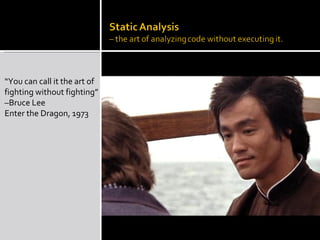
“ You can call it the art of fighting without fighting”  – Bruce Lee Enter the Dragon, 1973
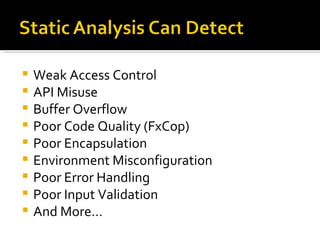
Weak Access Control API Misuse Buffer Overflow Poor Code Quality (FxCop) Poor Encapsulation Environment Misconfiguration Poor Error Handling Poor Input Validation And More…
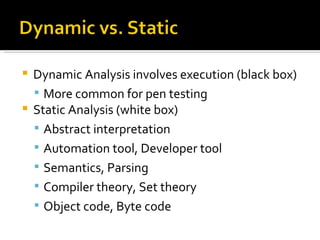
Dynamic Analysis involves execution (black box) More common for pen testing Static Analysis (white box) Abstract interpretation Automation tool, Developer tool Semantics, Parsing Compiler theory, Set theory Object code, Byte code
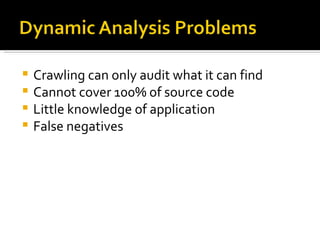
Crawling can only audit what it can find Cannot cover 100% of source code Little knowledge of application False negatives
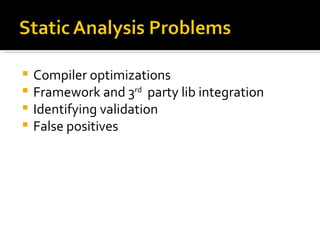
Compiler optimizations Framework and 3 rd   party lib integration Identifying validation False positives
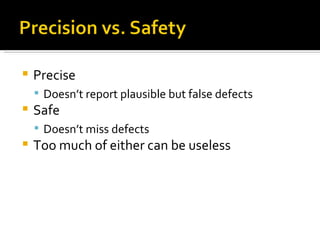
Precise Doesn’t report plausible but false defects Safe Doesn’t miss defects Too much of either can be useless
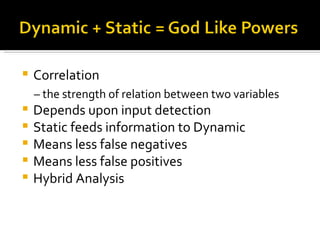
Correlation  –  the strength of relation between two variables Depends upon input detection Static feeds information to Dynamic Means less false negatives Means less false positives Hybrid Analysis
STEPS: Fix vulnerabilities early … Profit CHART:
Cross-site Scripting Response.Write(Request.QueryString[“isbn"]); SQL Injection protected System.Web.UI.WebControls.TextBox Publisher; SqlCommand cmd = new SqlCommand(“SELECT * FROM Books WHERE Publisher = ‘”+Publisher.Text+“’”, conn); HTTP Response Splitting string author = Author.Text;  Cookie cookie = new Cookie("author", author); Path Traversal sting fName = Request.Form[“fileName“]; File.Delete("C:\\users\\files\\" + fName); Command Injection string args = “-a -o “+Request.Param[“arg”]; Process.Start(“program.exe“+args);
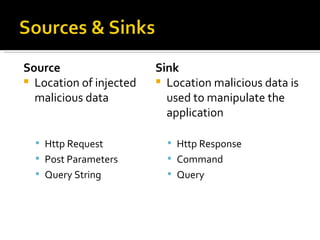
Source Location of injected malicious data Http Request Post Parameters Query String Sink Location malicious data is used to manipulate the application Http Response Command Query
Cross-site Scripting Response.Write ( Request.QueryString[“isbn"] ); SQL Injection protected System.Web.UI.WebControls.TextBox Publisher; SqlCommand cmd = new  SqlCommand (“SELECT * FROM Books WHERE Publisher = ‘”+ Publisher.Text +“’”, conn); HTTP Response Splitting string author =  Author.Text ;  Cookie cookie = new  Cookie ("author", author); Path Traversal sting fName =  Request.Form[“fileName“] ; File.Delete ("C:\\users\\files\\" + fName); Command Injection string args = “-a -o “+ Request.Param[“arg”] ; Process.Start (“program.exe“+args);
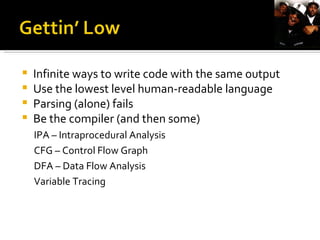
Infinite ways to write code with the same output Use the lowest level human-readable language Parsing (alone) fails  Be the compiler (and then some) IPA – Intraprocedural Analysis CFG – Control Flow Graph DFA – Data Flow Analysis Variable Tracing
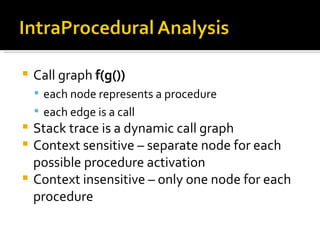
Call graph  f(g()) each node represents a procedure each edge is a call Stack trace is a dynamic call graph Context sensitive – separate node for each possible procedure activation  Context insensitive – only one node for each procedure
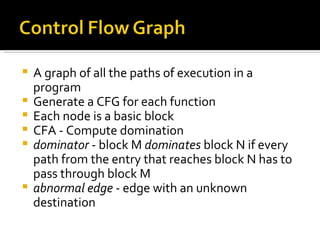
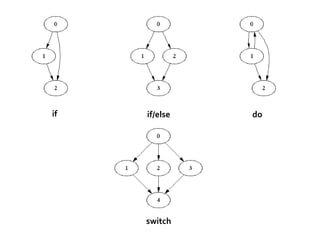
A graph of all the paths of execution in a program Generate a CFG for each function Each node is a basic block CFA - Compute domination dominator  - block M  dominates  block N if every path from the entry that reaches block N has to pass through block M abnormal edge  - edge with an unknown destination
if if/else do switch
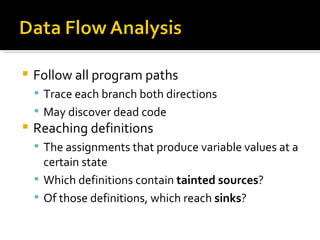
Follow all program paths Trace each branch both directions May discover dead code Reaching definitions The assignments that produce variable values at a certain state Which definitions contain  tainted sources ? Of those definitions, which reach  sinks ?
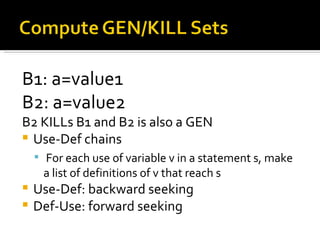
B1: a=value1 B2: a=value2 B2 KILLs B1 and B2 is also a GEN Use-Def chains For each use of variable v in a statement s, make a list of definitions of v that reach s Use-Def: backward seeking Def-Use: forward seeking
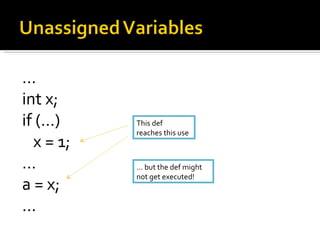
… int x; if (…) x = 1; … a = x; … This def  reaches this use …  but the def might not get executed!
… if (Page.IsValid()) string pwd = Request.Form[“pwd”]; … string sql = “SELECT …” + pwd + “’”; SqlCommand cmd = new SqlCommand(sql); … If this def doesn’t dominate  this use Unvalidated input causes SQL Injection
Formerly called  Microsoft Intermediate Language .NET is Stack based (LIFO) Metadata for compiled classes Reflection - the program in the mirror Common Language Runtime .method public static void Main() cil managed  {  .entrypoint  .maxstack 1  ldstr "Hello, world!"  call void [mscorlib]System.Console::WriteLine(string)  ret  }
Manual Static Analysis
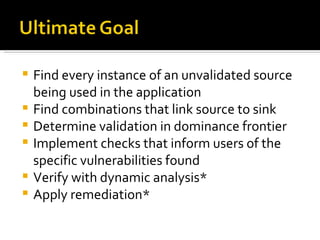
Find every instance of an unvalidated source being used in the application Find combinations that link source to sink Determine validation in dominance frontier Implement checks that inform users of the specific vulnerabilities found Verify with dynamic analysis* Apply remediation*
Great way to find vulnerabilities? Or greatest way to find vulnerabilities? You decide .

Static Analysis: The Art of Fighting without Fighting

  • 1.
    The Art ofFighting without Fighting
  • 2.
    “ You cancall it the art of fighting without fighting” – Bruce Lee Enter the Dragon, 1973
  • 3.
    Weak Access ControlAPI Misuse Buffer Overflow Poor Code Quality (FxCop) Poor Encapsulation Environment Misconfiguration Poor Error Handling Poor Input Validation And More…
  • 4.
    Dynamic Analysis involvesexecution (black box) More common for pen testing Static Analysis (white box) Abstract interpretation Automation tool, Developer tool Semantics, Parsing Compiler theory, Set theory Object code, Byte code
  • 5.
    Crawling can onlyaudit what it can find Cannot cover 100% of source code Little knowledge of application False negatives
  • 6.
    Compiler optimizations Frameworkand 3 rd party lib integration Identifying validation False positives
  • 7.
    Precise Doesn’t reportplausible but false defects Safe Doesn’t miss defects Too much of either can be useless
  • 8.
    Correlation – the strength of relation between two variables Depends upon input detection Static feeds information to Dynamic Means less false negatives Means less false positives Hybrid Analysis
  • 9.
    STEPS: Fix vulnerabilitiesearly … Profit CHART:
  • 10.
    Cross-site Scripting Response.Write(Request.QueryString[“isbn"]);SQL Injection protected System.Web.UI.WebControls.TextBox Publisher; SqlCommand cmd = new SqlCommand(“SELECT * FROM Books WHERE Publisher = ‘”+Publisher.Text+“’”, conn); HTTP Response Splitting string author = Author.Text; Cookie cookie = new Cookie("author", author); Path Traversal sting fName = Request.Form[“fileName“]; File.Delete("C:\\users\\files\\" + fName); Command Injection string args = “-a -o “+Request.Param[“arg”]; Process.Start(“program.exe“+args);
  • 11.
    Source Location ofinjected malicious data Http Request Post Parameters Query String Sink Location malicious data is used to manipulate the application Http Response Command Query
  • 12.
    Cross-site Scripting Response.Write( Request.QueryString[“isbn"] ); SQL Injection protected System.Web.UI.WebControls.TextBox Publisher; SqlCommand cmd = new SqlCommand (“SELECT * FROM Books WHERE Publisher = ‘”+ Publisher.Text +“’”, conn); HTTP Response Splitting string author = Author.Text ; Cookie cookie = new Cookie ("author", author); Path Traversal sting fName = Request.Form[“fileName“] ; File.Delete ("C:\\users\\files\\" + fName); Command Injection string args = “-a -o “+ Request.Param[“arg”] ; Process.Start (“program.exe“+args);
  • 13.
    Infinite ways towrite code with the same output Use the lowest level human-readable language Parsing (alone) fails Be the compiler (and then some) IPA – Intraprocedural Analysis CFG – Control Flow Graph DFA – Data Flow Analysis Variable Tracing
  • 14.
    Call graph f(g()) each node represents a procedure each edge is a call Stack trace is a dynamic call graph Context sensitive – separate node for each possible procedure activation Context insensitive – only one node for each procedure
  • 15.
    A graph ofall the paths of execution in a program Generate a CFG for each function Each node is a basic block CFA - Compute domination dominator - block M dominates block N if every path from the entry that reaches block N has to pass through block M abnormal edge - edge with an unknown destination
  • 16.
  • 17.
    Follow all programpaths Trace each branch both directions May discover dead code Reaching definitions The assignments that produce variable values at a certain state Which definitions contain tainted sources ? Of those definitions, which reach sinks ?
  • 18.
    B1: a=value1 B2:a=value2 B2 KILLs B1 and B2 is also a GEN Use-Def chains For each use of variable v in a statement s, make a list of definitions of v that reach s Use-Def: backward seeking Def-Use: forward seeking
  • 19.
    … int x;if (…) x = 1; … a = x; … This def reaches this use … but the def might not get executed!
  • 20.
    … if (Page.IsValid())string pwd = Request.Form[“pwd”]; … string sql = “SELECT …” + pwd + “’”; SqlCommand cmd = new SqlCommand(sql); … If this def doesn’t dominate this use Unvalidated input causes SQL Injection
  • 21.
    Formerly called Microsoft Intermediate Language .NET is Stack based (LIFO) Metadata for compiled classes Reflection - the program in the mirror Common Language Runtime .method public static void Main() cil managed { .entrypoint .maxstack 1 ldstr "Hello, world!" call void [mscorlib]System.Console::WriteLine(string) ret }
  • 22.
  • 23.
    Find every instanceof an unvalidated source being used in the application Find combinations that link source to sink Determine validation in dominance frontier Implement checks that inform users of the specific vulnerabilities found Verify with dynamic analysis* Apply remediation*
  • 24.
    Great way tofind vulnerabilities? Or greatest way to find vulnerabilities? You decide .