


Developer-First
Security
Andy Chou
CTO and Founder
Coverity

Copyright Coverity, Inc., 2013
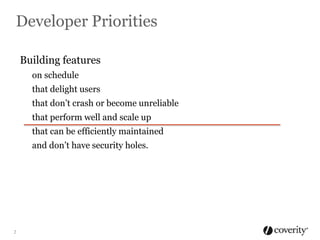
Developer Priorities
Building features
on schedule
that delight users
that don’t crash or become unreliable
that perform well and scale up
that can be efficiently maintained
and don’t have security holes.

2
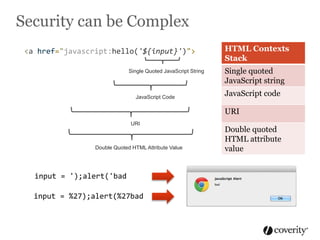
Security can be Complex
<a href="javascript:hello('${input}')">
Single Quoted JavaScript String

JavaScript Code

HTML Contexts
Stack
Single quoted
JavaScript string
JavaScript code
URI

URI

Double Quoted HTML Attribute Value

input = ');alert('bad
input = %27);alert(%27bad

Double quoted
HTML attribute
value
4
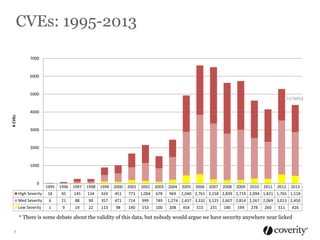
CVEs: 1995-2013
7000

6000

5000

11/2013

# CVEs

4000

3000

2000

1000

0

1995

1996

1997

1998

1999

2000

2001

2002

2003

2004

2005

2006

2007

2008

2009

2010

2011

2012

2013

High Severity

18

45

145

134

424

451

773

1,004

678

969

2,040 2,761 3,158 2,839 2,719 2,094 1,821 1,765 1,518

Med Severity

6

21

88

90

357

471

714

999

749

Low Severity

1

9

19

22

113

98

190

153

100

1,274 2,437 3,332 3,125 2,607 2,814 2,267 2,069 3,013 2,450
208

454

515

231

186

199

278

260

511

426

* There is some debate about the validity of this data, but nobody would argue we have security anywhere near licked
5
What’s Usually Done
•
•
•
•

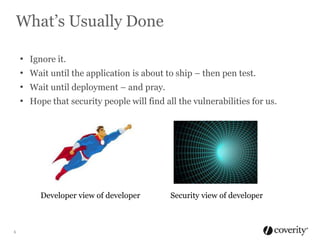
Ignore it.
Wait until the application is about to ship – then pen test.
Wait until deployment – and pray.
Hope that security people will find all the vulnerabilities for us.

Developer view of developer

6

Security view of developer
7
Communicating with Security People
• Ask how to remediate.
• Leverage bug tracking systems.
• Tell them your timeframe for design, coding, and
testing.

•
•
•
•
•

Give access to your code and how to build it easily.
Share architecture diagrams.
Prepare a testing environment.
Budget time to fix the issues that come back.
Know what you don’t know – ask questions about
anything you don’t fully understand, especially how
to fix.

• Move away from the “prove it’s exploitable” attitude
and toward positive “how can I fix it properly”

8
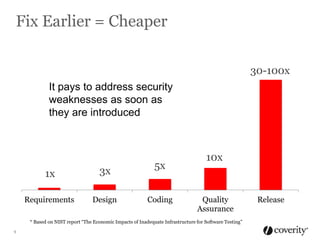
Fix Earlier = Cheaper
30-100x
It pays to address security
weaknesses as soon as
they are introduced

1x

3x

Requirements

Design

5x
Coding

10x

Quality
Assurance

* Based on NIST report “The Economic Impacts of Inadequate Infrastructure for Software Testing”
9

Release
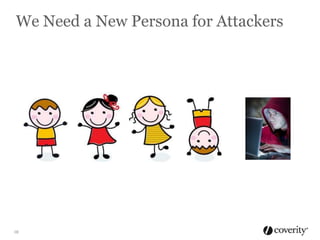
We Need a New Persona for Attackers

10
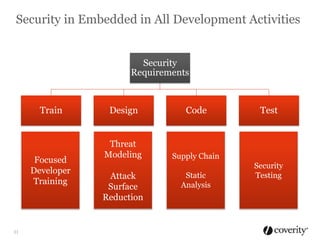
Security in Embedded in All Development Activities

Security
Requirements

Train

Focused
Developer
Training

11

Design

Code

Threat
Modeling

Supply Chain

Attack
Surface
Reduction

Static
Analysis

Test

Security
Testing
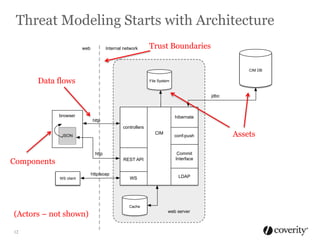
Threat Modeling Starts with Architecture
web

Internal network

Trust Boundaries
CIM DB

Data flows

File System

jdbc

browser

hibernate

http
controllers
CIM

JSON

conf-push

REST API

Commit
Interface

WS

LDAP

http

Components
http/soap
WS client

Cache

(Actors – not shown)
12

web server

Assets
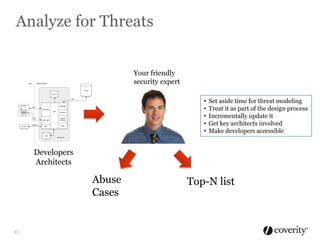
Analyze for Threats

web

Your friendly
security expert

Internal network

CIM DB
File System

•
•
•
•
•

jdbc

browser

hibernate

http
controllers
CIM

JSON

conf-push

REST API

Commit
Interface

WS

LDAP

http

http/soap
WS client

Set aside time for threat modeling
Treat it as part of the design process
Incrementally update it
Get key architects involved
Make developers accessible

Cache

web server

Developers
Architects

Abuse
Cases

13

Top-N list
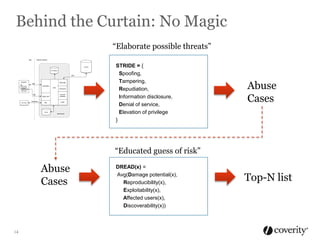
Behind the Curtain: No Magic
“Elaborate possible threats”
web

Internal network

CIM DB
File System

jdbc

browser

hibernate

http
controllers
CIM

JSON

conf-push

REST API

Commit
Interface

WS

LDAP

http

http/soap
WS client

Cache

web server

STRIDE = {
Spoofing,
Tampering,
Repudiation,
Information disclosure,
Denial of service,
Elevation of privilege
}

Abuse
Cases

“Educated guess of risk”

Abuse
Cases

14

DREAD(x) =
Avg(Damage potential(x),
Reproducibility(x),
Exploitability(x),
Affected users(x),
Discoverability(x))

Top-N list
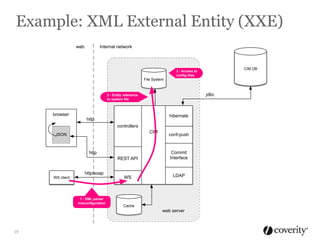
Example: XML External Entity (XXE)
web

Internal network

CIM DB

3 - Access to
config files

File System

jdbc

2 - Entity reference
to system file

browser

hibernate

http
controllers
CIM

JSON

conf-push

REST API

Commit
Interface

WS

LDAP

http

http/soap
WS client

1 - XML parser
misconfiguration

Cache

web server

15
16
CWE Top 25
Find and Fix

Applicable

Design
Review

[1]
[2]
[3]
[4]
[5]
[6]
[7]
[8]
[9]
[10]
[11]
[12]
[13]
[14]
[15]
[16]
[17]
[18]
[19]
[20]
[21]
[22]
[23]
[24]
[25]
17

SQL Injection
OS Command Injection
Classic Buffer Overflow
Cross-site Scripting
Missing Authentication for Critical Function
Missing Authorization
Use of Hard-coded Credentials
Missing Encryption of Sensitive Data
Unrestricted Upload of File with Dangerous Type
Reliance on Untrusted Inputs in a Security Decision
Execution with Unnecessary Privileges
Cross-Site Request Forgery (CSRF)
Path Traversal
Download of Code Without Integrity Check
Incorrect Authorization
Inclusion of Functionality from Untrusted Control Sphere
Incorrect Permission Assignment for Critical Resource
Use of Potentially Dangerous Function
Use of a Broken or Risky Cryptographic Algorithm
Incorrect Calculation of Buffer Size
Improper Restriction of Excessive Authentication Attempts
URL Redirection to Untrusted Site ('Open Redirect')
Uncontrolled Format String
Integer Overflow or Wraparound
Use of a One-Way Hash without a Salt

SA

DA

✗
✗

✗
✗

✗

Mitigations
Code
Review

Pen
Test CSP HSTS

✗

✗

✗
✗
✗

✗
✗
✗

✗
✗

✗
✗

✗

✗
✗
✗

✗

✗
✗
✗
✗

✗
✗
✗
✗
✗

✗
✗
✗
✗

✗
✗
✗
✗
✗
✗
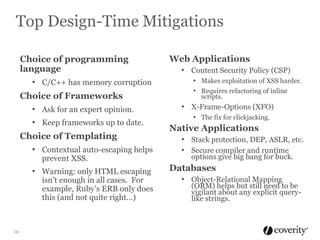
Top Design-Time Mitigations
Choice of programming
language
• C/C++ has memory corruption
Choice of Frameworks
• Ask for an expert opinion.
• Keep frameworks up to date.
Choice of Templating
• Contextual auto-escaping helps
prevent XSS.

• Warning: only HTML escaping

isn’t enough in all cases. For
example, Ruby’s ERB only does
this (and not quite right…)

18

Web Applications
• Content Security Policy (CSP)
• Makes exploitation of XSS harder.
• Requires refactoring of inline
scripts.

• X-Frame-Options (XFO)
• The fix for clickjacking.

Native Applications
• Stack protection, DEP, ASLR, etc.
• Secure compiler and runtime
options give big bang for buck.

Databases
• Object-Relational Mapping

(ORM) helps but still need to be
vigilant about any explicit querylike strings.
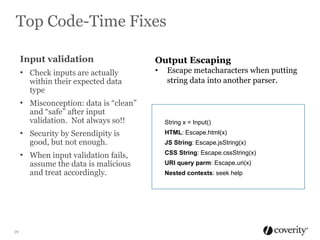
Top Code-Time Fixes
Input validation
• Check inputs are actually

within their expected data
type

Output Escaping
•

Escape metacharacters when putting
string data into another parser.

• Misconception: data is “clean”
and “safe” after input
validation. Not always so!!

• Security by Serendipity is
good, but not enough.

• When input validation fails,

assume the data is malicious
and treat accordingly.

19

String x = Input()
HTML: Escape.html(x)
JS String: Escape.jsString(x)
CSS String: Escape.cssString(x)
URI query parm: Escape.uri(x)
Nested contexts: seek help
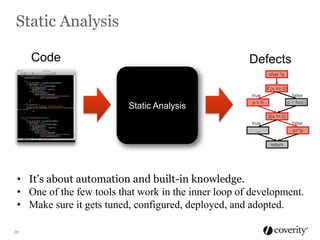
Static Analysis
Code

Defects
char *p
if (x == 0)

Static Analysis

true
p=0

false
p = foo()
if(x != 0)

true

false

...

s=*p

return

• It’s about automation and built-in knowledge.
• One of the few tools that work in the inner loop of development.
• Make sure it gets tuned, configured, deployed, and adopted.
20
21
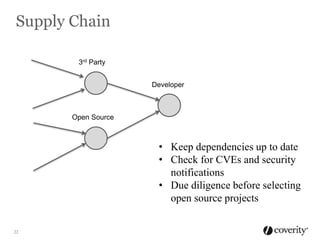
Supply Chain
3rd Party
Developer

Open Source

• Keep dependencies up to date
• Check for CVEs and security
notifications
• Due diligence before selecting
open source projects
22
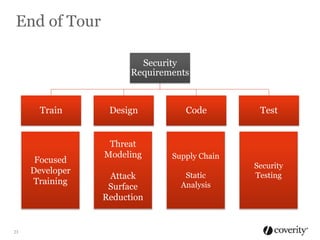
End of Tour
Security
Requirements

Train

Focused
Developer
Training

23

Design

Code

Threat
Modeling

Supply Chain

Attack
Surface
Reduction

Static
Analysis

Test

Security
Testing
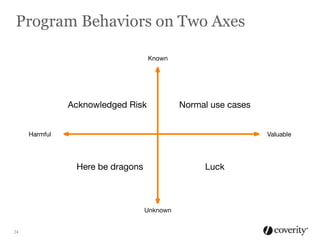
Program Behaviors on Two Axes

24
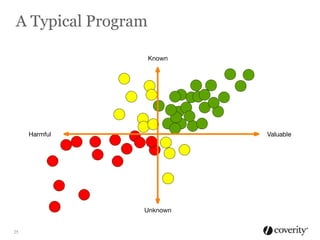
A Typical Program

25
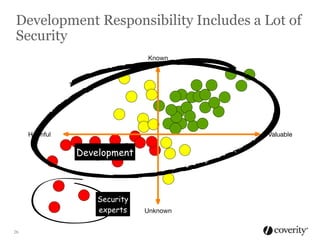
Development Responsibility Includes a Lot of
Security

26
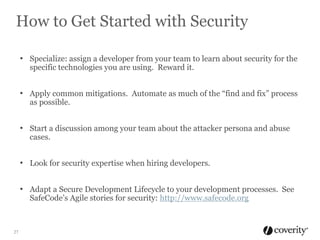
How to Get Started with Security
• Specialize: assign a developer from your team to learn about security for the
specific technologies you are using. Reward it.

• Apply common mitigations. Automate as much of the “find and fix” process
as possible.

• Start a discussion among your team about the attacker persona and abuse
cases.

• Look for security expertise when hiring developers.
• Adapt a Secure Development Lifecycle to your development processes. See
SafeCode’s Agile stories for security: http://www.safecode.org

27
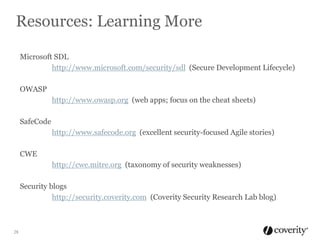
Resources: Learning More
Microsoft SDL
http://www.microsoft.com/security/sdl (Secure Development Lifecycle)
OWASP
http://www.owasp.org (web apps; focus on the cheat sheets)
SafeCode
http://www.safecode.org (excellent security-focused Agile stories)
CWE

http://cwe.mitre.org (taxonomy of security weaknesses)
Security blogs
http://security.coverity.com (Coverity Security Research Lab blog)

28
Thank You
Andy Chou
andy@coverity.com
@_achou
Want to try Coverity on your code?
For a free trial, visit:
www.coverity.com

DevBeat 2013 - Developer-first Security

  • 1.
    Developer-First Security Andy Chou CTO andFounder Coverity Copyright Coverity, Inc., 2013
  • 2.
    Developer Priorities Building features onschedule that delight users that don’t crash or become unreliable that perform well and scale up that can be efficiently maintained and don’t have security holes. 2
  • 3.
    Security can beComplex <a href="javascript:hello('${input}')"> Single Quoted JavaScript String JavaScript Code HTML Contexts Stack Single quoted JavaScript string JavaScript code URI URI Double Quoted HTML Attribute Value input = ');alert('bad input = %27);alert(%27bad Double quoted HTML attribute value
  • 4.
  • 5.
    CVEs: 1995-2013 7000 6000 5000 11/2013 # CVEs 4000 3000 2000 1000 0 1995 1996 1997 1998 1999 2000 2001 2002 2003 2004 2005 2006 2007 2008 2009 2010 2011 2012 2013 HighSeverity 18 45 145 134 424 451 773 1,004 678 969 2,040 2,761 3,158 2,839 2,719 2,094 1,821 1,765 1,518 Med Severity 6 21 88 90 357 471 714 999 749 Low Severity 1 9 19 22 113 98 190 153 100 1,274 2,437 3,332 3,125 2,607 2,814 2,267 2,069 3,013 2,450 208 454 515 231 186 199 278 260 511 426 * There is some debate about the validity of this data, but nobody would argue we have security anywhere near licked 5
  • 6.
    What’s Usually Done • • • • Ignoreit. Wait until the application is about to ship – then pen test. Wait until deployment – and pray. Hope that security people will find all the vulnerabilities for us. Developer view of developer 6 Security view of developer
  • 7.
  • 8.
    Communicating with SecurityPeople • Ask how to remediate. • Leverage bug tracking systems. • Tell them your timeframe for design, coding, and testing. • • • • • Give access to your code and how to build it easily. Share architecture diagrams. Prepare a testing environment. Budget time to fix the issues that come back. Know what you don’t know – ask questions about anything you don’t fully understand, especially how to fix. • Move away from the “prove it’s exploitable” attitude and toward positive “how can I fix it properly” 8
  • 9.
    Fix Earlier =Cheaper 30-100x It pays to address security weaknesses as soon as they are introduced 1x 3x Requirements Design 5x Coding 10x Quality Assurance * Based on NIST report “The Economic Impacts of Inadequate Infrastructure for Software Testing” 9 Release
  • 10.
    We Need aNew Persona for Attackers 10
  • 11.
    Security in Embeddedin All Development Activities Security Requirements Train Focused Developer Training 11 Design Code Threat Modeling Supply Chain Attack Surface Reduction Static Analysis Test Security Testing
  • 12.
    Threat Modeling Startswith Architecture web Internal network Trust Boundaries CIM DB Data flows File System jdbc browser hibernate http controllers CIM JSON conf-push REST API Commit Interface WS LDAP http Components http/soap WS client Cache (Actors – not shown) 12 web server Assets
  • 13.
    Analyze for Threats web Yourfriendly security expert Internal network CIM DB File System • • • • • jdbc browser hibernate http controllers CIM JSON conf-push REST API Commit Interface WS LDAP http http/soap WS client Set aside time for threat modeling Treat it as part of the design process Incrementally update it Get key architects involved Make developers accessible Cache web server Developers Architects Abuse Cases 13 Top-N list
  • 14.
    Behind the Curtain:No Magic “Elaborate possible threats” web Internal network CIM DB File System jdbc browser hibernate http controllers CIM JSON conf-push REST API Commit Interface WS LDAP http http/soap WS client Cache web server STRIDE = { Spoofing, Tampering, Repudiation, Information disclosure, Denial of service, Elevation of privilege } Abuse Cases “Educated guess of risk” Abuse Cases 14 DREAD(x) = Avg(Damage potential(x), Reproducibility(x), Exploitability(x), Affected users(x), Discoverability(x)) Top-N list
  • 15.
    Example: XML ExternalEntity (XXE) web Internal network CIM DB 3 - Access to config files File System jdbc 2 - Entity reference to system file browser hibernate http controllers CIM JSON conf-push REST API Commit Interface WS LDAP http http/soap WS client 1 - XML parser misconfiguration Cache web server 15
  • 16.
  • 17.
    CWE Top 25 Findand Fix Applicable Design Review [1] [2] [3] [4] [5] [6] [7] [8] [9] [10] [11] [12] [13] [14] [15] [16] [17] [18] [19] [20] [21] [22] [23] [24] [25] 17 SQL Injection OS Command Injection Classic Buffer Overflow Cross-site Scripting Missing Authentication for Critical Function Missing Authorization Use of Hard-coded Credentials Missing Encryption of Sensitive Data Unrestricted Upload of File with Dangerous Type Reliance on Untrusted Inputs in a Security Decision Execution with Unnecessary Privileges Cross-Site Request Forgery (CSRF) Path Traversal Download of Code Without Integrity Check Incorrect Authorization Inclusion of Functionality from Untrusted Control Sphere Incorrect Permission Assignment for Critical Resource Use of Potentially Dangerous Function Use of a Broken or Risky Cryptographic Algorithm Incorrect Calculation of Buffer Size Improper Restriction of Excessive Authentication Attempts URL Redirection to Untrusted Site ('Open Redirect') Uncontrolled Format String Integer Overflow or Wraparound Use of a One-Way Hash without a Salt SA DA ✗ ✗ ✗ ✗ ✗ Mitigations Code Review Pen Test CSP HSTS ✗ ✗ ✗ ✗ ✗ ✗ ✗ ✗ ✗ ✗ ✗ ✗ ✗ ✗ ✗ ✗ ✗ ✗ ✗ ✗ ✗ ✗ ✗ ✗ ✗ ✗ ✗ ✗ ✗ ✗ ✗ ✗ ✗ ✗ ✗ ✗
  • 18.
    Top Design-Time Mitigations Choiceof programming language • C/C++ has memory corruption Choice of Frameworks • Ask for an expert opinion. • Keep frameworks up to date. Choice of Templating • Contextual auto-escaping helps prevent XSS. • Warning: only HTML escaping isn’t enough in all cases. For example, Ruby’s ERB only does this (and not quite right…) 18 Web Applications • Content Security Policy (CSP) • Makes exploitation of XSS harder. • Requires refactoring of inline scripts. • X-Frame-Options (XFO) • The fix for clickjacking. Native Applications • Stack protection, DEP, ASLR, etc. • Secure compiler and runtime options give big bang for buck. Databases • Object-Relational Mapping (ORM) helps but still need to be vigilant about any explicit querylike strings.
  • 19.
    Top Code-Time Fixes Inputvalidation • Check inputs are actually within their expected data type Output Escaping • Escape metacharacters when putting string data into another parser. • Misconception: data is “clean” and “safe” after input validation. Not always so!! • Security by Serendipity is good, but not enough. • When input validation fails, assume the data is malicious and treat accordingly. 19 String x = Input() HTML: Escape.html(x) JS String: Escape.jsString(x) CSS String: Escape.cssString(x) URI query parm: Escape.uri(x) Nested contexts: seek help
  • 20.
    Static Analysis Code Defects char *p if(x == 0) Static Analysis true p=0 false p = foo() if(x != 0) true false ... s=*p return • It’s about automation and built-in knowledge. • One of the few tools that work in the inner loop of development. • Make sure it gets tuned, configured, deployed, and adopted. 20
  • 21.
  • 22.
    Supply Chain 3rd Party Developer OpenSource • Keep dependencies up to date • Check for CVEs and security notifications • Due diligence before selecting open source projects 22
  • 23.
  • 24.
  • 25.
  • 26.
  • 27.
    How to GetStarted with Security • Specialize: assign a developer from your team to learn about security for the specific technologies you are using. Reward it. • Apply common mitigations. Automate as much of the “find and fix” process as possible. • Start a discussion among your team about the attacker persona and abuse cases. • Look for security expertise when hiring developers. • Adapt a Secure Development Lifecycle to your development processes. See SafeCode’s Agile stories for security: http://www.safecode.org 27
  • 28.
    Resources: Learning More MicrosoftSDL http://www.microsoft.com/security/sdl (Secure Development Lifecycle) OWASP http://www.owasp.org (web apps; focus on the cheat sheets) SafeCode http://www.safecode.org (excellent security-focused Agile stories) CWE http://cwe.mitre.org (taxonomy of security weaknesses) Security blogs http://security.coverity.com (Coverity Security Research Lab blog) 28
  • 29.
  • 30.
    Want to tryCoverity on your code? For a free trial, visit: www.coverity.com