Dr. Ibrahim Shaikh 
1st Year MDS Periodontology 
Seminar No. 2 – Part B 
Guide – Dr. Varsha Rathod
2
Types of Toothbrushes 
3 
According to Manipulation. 
According to Length/Size. 
According to the Bristle Diameter.
Modifications 
4 
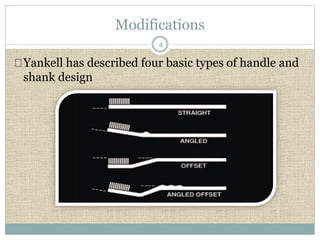
Yankell has described four basic types of handle and 
shank design
Allet et al. 
Finkelstein & Grosssman. 
Davies et al. 
5
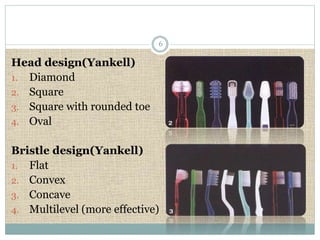
Head design(Yankell) 
1. Diamond 
2. Square 
3. Square with rounded toe 
4. Oval 
6 
Bristle design(Yankell) 
1. Flat 
2. Convex 
3. Concave 
4. Multilevel (more effective)
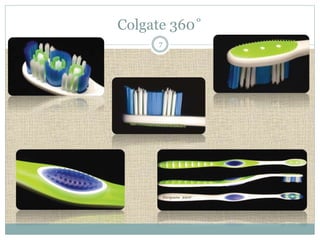
Colgate 360˚ 
7
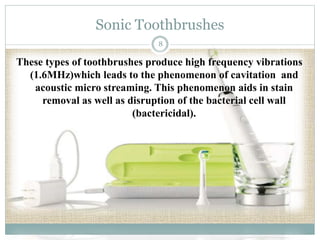
Sonic Toothbrushes 
8 
These types of toothbrushes produce high frequency vibrations 
(1.6MHz)which leads to the phenomenon of cavitation and 
acoustic micro streaming. This phenomenon aids in stain 
removal as well as disruption of the bacterial cell wall 
(bactericidal).
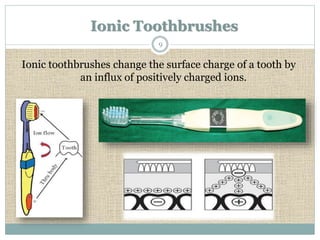
Ionic Toothbrushes 
9 
Ionic toothbrushes change the surface charge of a tooth by 
an influx of positively charged ions.
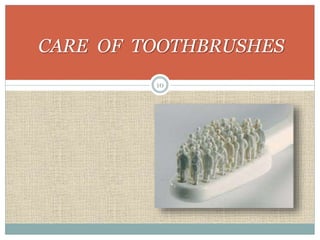
CARE OF TOOTHBRUSHES 
10
Brush Replacement 
11 
 Frequent replacement recommended; every 3 months 
 Brushes need to be replaced before filaments become splayed or frayed 
or lose resiliency. 
 Brush contamination occurs with use. 
 Patients who are debilitated, immunosuppresed, have a known 
infection can be advised to disinfect their brushes or use disposable 
brushes.
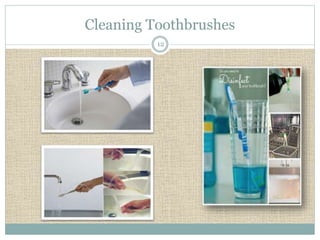
Cleaning Toothbrushes 
12
Modes of Disinfection 
 1. Chemical disinfectants. 
 2. Brush sprays. 
13 
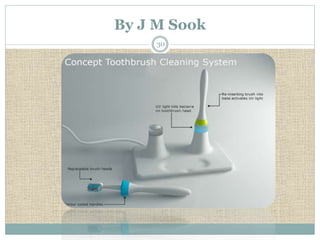
 3. UV light tooth brush sanitizers.
Chemical Disinfectants 
Nelson et al. (1994) 
1% sodium hypochlorite 
 0.12% chlorhexidine gluconate 
Caudry et al. 
1% Virkon, 
 Listerine, 
 Cepacol, 
 Scope 
 Plax 
14
Brush Sprays 
15 
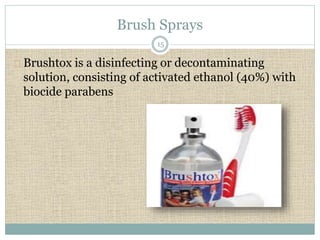
Brushtox is a disinfecting or decontaminating 
solution, consisting of activated ethanol (40%) with 
biocide parabens
Ultraviolet Sanitizers 
16 
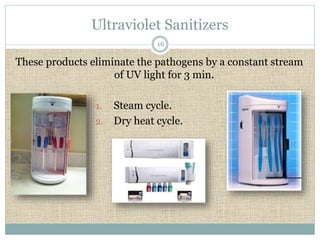
These products eliminate the pathogens by a constant stream 
of UV light for 3 min. 
1. Steam cycle. 
2. Dry heat cycle.
Brush Storage 
17 
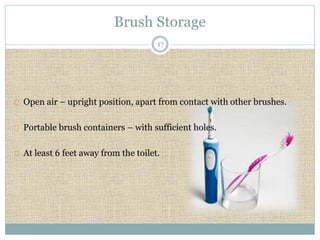
Open air – upright position, apart from contact with other brushes. 
Portable brush containers – with sufficient holes. 
At least 6 feet away from the toilet.
STUDIES 
18
Sforra N M et al. 
19 
J Clin Periodontol 2000; 27 : 212 -216 
Impact of progressive wear of toothbrush on plaque control 
Each individual is capable of maintaining good oral hygiene 
with a low plaque index even by using a toothbrush that 
shows evidence of wear.
Van Der Werjden et al. 
20 
J Clin Periodontol 2004; 31: 620 – 624 
High & low brushing force in relation to plaque 
removing efficacy & gingival abrasion. 
Use of high force is less efficient in plaque removal as 
compared to low force where as the difference in the 
incidence of gingival abrasion was negligible when 
comparing the two forces.
Guljot Singh et al. 
21 
Journal of Indian Society Of Periodontology, 2011 ; 15:210 – 
214 
Compare the efficacy of sonic & ionic toothbrushes 
The sonic toothbrush was better than ionic toothbrush but 
the difference was statistically insignificant.
Ross J. Bastiaan 
22 
J Clin Periodontol 1984:11:331-339 
Comparison of the clinical effectiveness of a single & 
double headed toothbrush 
The double headed toothbrush was equally as 
efficient as a single headed toothbrush in removing 
dental plaque from the buccal surfaces but 
significantly more efficient on the lingual surfaces.
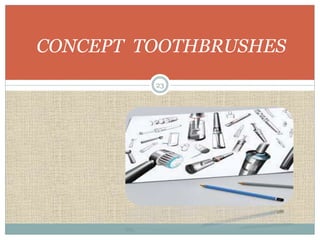
CONCEPT TOOTHBRUSHES 
23
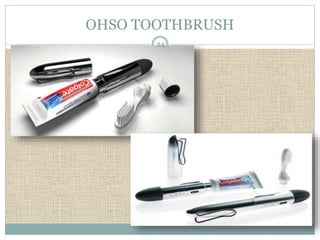
OHSO TOOTHBRUSH 
24
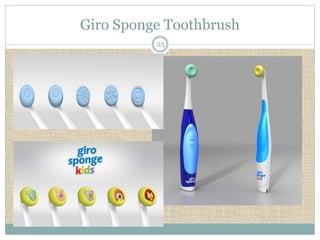
Giro Sponge Toothbrush 
25
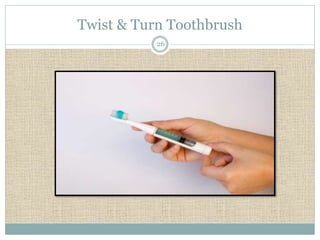
Twist & Turn Toothbrush 
26
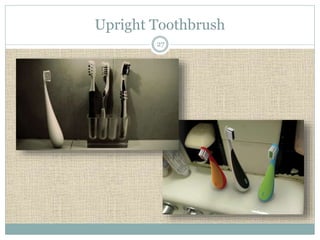
Upright Toothbrush 
27
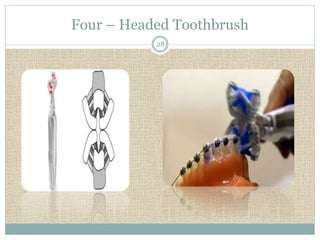
Four – Headed Toothbrush 
28
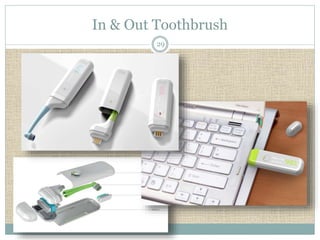
In & Out Toothbrush 
29
By J M Sook 
30
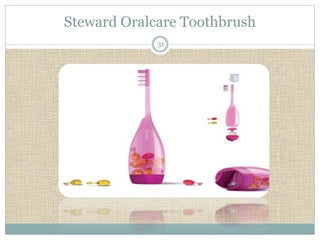
Steward Oralcare Toothbrush 
31
32
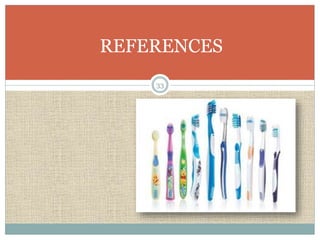
REFERENCES 
33
34 
 Carranza’s Clinical Periodontology, 10th edition 
 Primary Preventive Dentistry, Norman O Harris, 6th edition 
 Clinical Practice of The Dental Hygienist; Esther M. Wilkins 
 History of Periodontology ; Fermin carranza, Vincenzo Guerini 
 Essentials of preventive & Community Dentistry; Soben Peter 
 M.F. Timmerman et al. Comparitive analysis of high & low 
brushing force in relation to efficacy and gingival abrasion. J Clin 
Periodontol 2004, 31 : 620 – 624
35 
 Ankola AV et al. How clean is your toothbrush ? Int J Dent Hygiene 7, 
2009; 237–240 
 Ross J Bastiaan. Comparison of the clinical effectiveness of a single & a 
double headed toothbrush. J Clin Periodontol 1984:11:331-339 
 Guljot Singh et al. Comparison of Sonic & Ionic toothbrush in reductin 
in plaque & gingivitis. JISP 15 (3) : 210 – 214 
 Sforra et al. Plaque removal by worn toothbrush. J Clin Periodontol 
2000; 27: 212 -216 
 Van der weijden et al. High & low brushing force in relation to efficacy 
& gingival abrasion. J Clin Periodontol 2004; 31 : 620 – 624
… F O R T H E P A T I E N C E 
THANK YOU … 
36

Toothbrush b

  • 1.
    Dr. Ibrahim Shaikh 1st Year MDS Periodontology Seminar No. 2 – Part B Guide – Dr. Varsha Rathod
  • 2.
  • 3.
    Types of Toothbrushes 3 According to Manipulation. According to Length/Size. According to the Bristle Diameter.
  • 4.
    Modifications 4 Yankellhas described four basic types of handle and shank design
  • 5.
    Allet et al. Finkelstein & Grosssman. Davies et al. 5
  • 6.
    Head design(Yankell) 1.Diamond 2. Square 3. Square with rounded toe 4. Oval 6 Bristle design(Yankell) 1. Flat 2. Convex 3. Concave 4. Multilevel (more effective)
  • 7.
  • 8.
    Sonic Toothbrushes 8 These types of toothbrushes produce high frequency vibrations (1.6MHz)which leads to the phenomenon of cavitation and acoustic micro streaming. This phenomenon aids in stain removal as well as disruption of the bacterial cell wall (bactericidal).
  • 9.
    Ionic Toothbrushes 9 Ionic toothbrushes change the surface charge of a tooth by an influx of positively charged ions.
  • 10.
  • 11.
    Brush Replacement 11  Frequent replacement recommended; every 3 months  Brushes need to be replaced before filaments become splayed or frayed or lose resiliency.  Brush contamination occurs with use.  Patients who are debilitated, immunosuppresed, have a known infection can be advised to disinfect their brushes or use disposable brushes.
  • 12.
  • 13.
    Modes of Disinfection  1. Chemical disinfectants.  2. Brush sprays. 13  3. UV light tooth brush sanitizers.
  • 14.
    Chemical Disinfectants Nelsonet al. (1994) 1% sodium hypochlorite  0.12% chlorhexidine gluconate Caudry et al. 1% Virkon,  Listerine,  Cepacol,  Scope  Plax 14
  • 15.
    Brush Sprays 15 Brushtox is a disinfecting or decontaminating solution, consisting of activated ethanol (40%) with biocide parabens
  • 16.
    Ultraviolet Sanitizers 16 These products eliminate the pathogens by a constant stream of UV light for 3 min. 1. Steam cycle. 2. Dry heat cycle.
  • 17.
    Brush Storage 17 Open air – upright position, apart from contact with other brushes. Portable brush containers – with sufficient holes. At least 6 feet away from the toilet.
  • 18.
  • 19.
    Sforra N Met al. 19 J Clin Periodontol 2000; 27 : 212 -216 Impact of progressive wear of toothbrush on plaque control Each individual is capable of maintaining good oral hygiene with a low plaque index even by using a toothbrush that shows evidence of wear.
  • 20.
    Van Der Werjdenet al. 20 J Clin Periodontol 2004; 31: 620 – 624 High & low brushing force in relation to plaque removing efficacy & gingival abrasion. Use of high force is less efficient in plaque removal as compared to low force where as the difference in the incidence of gingival abrasion was negligible when comparing the two forces.
  • 21.
    Guljot Singh etal. 21 Journal of Indian Society Of Periodontology, 2011 ; 15:210 – 214 Compare the efficacy of sonic & ionic toothbrushes The sonic toothbrush was better than ionic toothbrush but the difference was statistically insignificant.
  • 22.
    Ross J. Bastiaan 22 J Clin Periodontol 1984:11:331-339 Comparison of the clinical effectiveness of a single & double headed toothbrush The double headed toothbrush was equally as efficient as a single headed toothbrush in removing dental plaque from the buccal surfaces but significantly more efficient on the lingual surfaces.
  • 23.
  • 24.
  • 25.
  • 26.
    Twist & TurnToothbrush 26
  • 27.
  • 28.
    Four – HeadedToothbrush 28
  • 29.
    In & OutToothbrush 29
  • 30.
    By J MSook 30
  • 31.
  • 32.
  • 33.
  • 34.
    34  Carranza’sClinical Periodontology, 10th edition  Primary Preventive Dentistry, Norman O Harris, 6th edition  Clinical Practice of The Dental Hygienist; Esther M. Wilkins  History of Periodontology ; Fermin carranza, Vincenzo Guerini  Essentials of preventive & Community Dentistry; Soben Peter  M.F. Timmerman et al. Comparitive analysis of high & low brushing force in relation to efficacy and gingival abrasion. J Clin Periodontol 2004, 31 : 620 – 624
  • 35.
    35  AnkolaAV et al. How clean is your toothbrush ? Int J Dent Hygiene 7, 2009; 237–240  Ross J Bastiaan. Comparison of the clinical effectiveness of a single & a double headed toothbrush. J Clin Periodontol 1984:11:331-339  Guljot Singh et al. Comparison of Sonic & Ionic toothbrush in reductin in plaque & gingivitis. JISP 15 (3) : 210 – 214  Sforra et al. Plaque removal by worn toothbrush. J Clin Periodontol 2000; 27: 212 -216  Van der weijden et al. High & low brushing force in relation to efficacy & gingival abrasion. J Clin Periodontol 2004; 31 : 620 – 624
  • 36.
    … F OR T H E P A T I E N C E THANK YOU … 36

Editor's Notes

  • #3 History – Gold toothpicks from mesopotamia in 3000 BC to the invention of first toothbrush by William Addis in the year1780…followed by the invention of the first nylon bristle toothbrush by DuPont in 1938 to the first electric toothbrush, Broxodent, in 1954…which was invented in switzerland. Design of a toothbrush – parts included the handle, shank & the toothbrush head – the toothbrush head further included the toe, the heel, the bristles together forming tufts and the brushing plane i.e. the surface formed by the free ends of the bristles or filaments.
  • #4 15 to 19 cm – adult Soft bristle - 0.2mm (0.007inch) Medium bristle - 0.3mm (0.012 inch) Hard bristle - 0.4mm (0.014 inch) Softer bristles are more flexible, clean slightly below the gingival margin & reacH farther onto the proximal surfaces.
  • #5 The offset and angled offset keep the bristles in line with handle.
  • #6 evaluated a brush with a 17-degree angulation handle and compared it with the same brush with straight handle. A significant improvement in plaque removal was found out by the angulated one. Long handle brushes > Short handle brushes
  • #8 Colgate 360° is an advanced design manual toothbrush which includes the following bristle features: cleaning tips on the heel and toe of the brush for cleaning in hard to reach areas; polishing cups to hold toothpaste against the teeth; and vertical tapered bristles for interdental cleaning.
  • #9 Philips Sonicare is based on patented sonic technology. Sonicare achieves its bristle velocity through a combination of high frequency and high amplitude bristle motions. These motions create dynamic cleaning action that drives fluids deep into the tight spaces between your teeth and along the gum line, which results in a cleaner, healthier mouth. Bristles are placed at precise angles to maximize coverage. Finally, it uses extremely soft bristles that are rounded at the top by a diamond grinding wheel, to create a safe and gentle brush head that effectively delivers a powerful clean. Dual Charging System: Charging glass and travel case. Sensitive Mode: Gentle teeth and gum cleaning
  • #10 The plaque with a similar charge is thus repelled from the tooth surface & is attracted by the negatively charged brush.
  • #11 Instead of cleaning the teeth, it might be contaminating it. As clinicians, one must take utmost care in our daily disinfection procedures for our instruments and working environment. However, one often neglects to disinfect the one that is used to clean our mouth daily, that is, toothbrush.
  • #13 Clean thoroughly after each use. Hold brush under strong stream of warm water from faucet to force particles, dentrifice and bacteria from between the filaments. Tap the handle on the edge of sink and completely remove the excess water. Use one toothbrush to clean another brush.
  • #15 C. albicans, Mycobactrium, M. Bovis & Streptococcus mitis. Virkon and Listerine killed all the test species and virtually all microorganisms on toothbrush bristles. Soaking toothbrush in Listerine for 20 min is sufficient to eliminate bacterial contamination.
  • #17 purebrush, germ terminator and essensia Steam cycle starts automatically when you add water. Your toothbrush is being sanitized when you see and hear steam filling the chamber. Dry heat cycle follows automatically and keeps your toothbrush sanitized in the clean chamber until your next brushing. However, costs are a little prohibitive.
  • #18 Under usual conditions of storage, tooth brushes can be a source or a vector for transmission or reinfection of diseases such as herpes or periodontopathogenic microorganisms and coliforms from bathroom environment enteric bacteria dispersed via aerosols from toilet flushing
  • #20 Plaque removal by worn toothbrush…3 month double – blind study…20 students selected…12 teeth selected one molar , one premolar & one incisor in each quadrant. 3 times a day. Two groups. No significant difference.
  • #21 35 subjects selected….baseline index…brushed by hygeinist in two randomly selected contra-lateral quadrants for 60s wither either a low force 1.5N or High force 3.5N…the alternative force was used in opposing quadrant. Significant difference seen in force…but not in abrasion.
  • #22 22 subjects selected…single blind split mouth study over a period of 45 days was carried out…PI…GBI…GI…recorded after every 15 days…subjects advised to brush twice daily for 3 minutes.
  • #23 3 way blind cross over study method carried out with 39 patients
  • #25 the most stylish and futuristic toothbrush/toothpaste contraption on the market today. The toothpaste is self dispensing and easily refillable by turning the handle one direction which creates a suction, bringing the toothpaste into the handle. There is a nozzle below the bristles that delivers toothpaste by turning the end cap the other way– and of course the top is a watertight cap which doubles as a rinsing cup.
  • #26 Massage gums, teeth whitening, kids to old age patients, bristles are replaced by sponge
  • #27 This toothbrush incorporates a toothpaste deposit; before you brush your teeth, just twist the grip to push up the toothpaste onto your toothbrush. 
  • #32 This Steward Oralcare toothbrush by Emami comes with toothpaste, mouthwash and floss. 
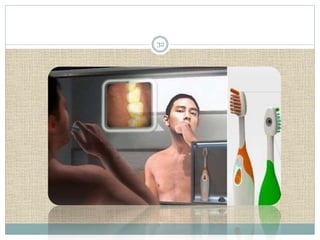
  • #33  This high-tech toothbrush comes integrated with a camera and a UV system; while you brush your teeth the camera takes the images that are displayed on the side screen on the mirror simultaneously. The UV light keeps your toothbrush clean while the camera lets you know the state of your teeth.