Lean Manufacturing
Prepared By- Inderjeet
Lean
Manufacturing
Lean Manufacturing
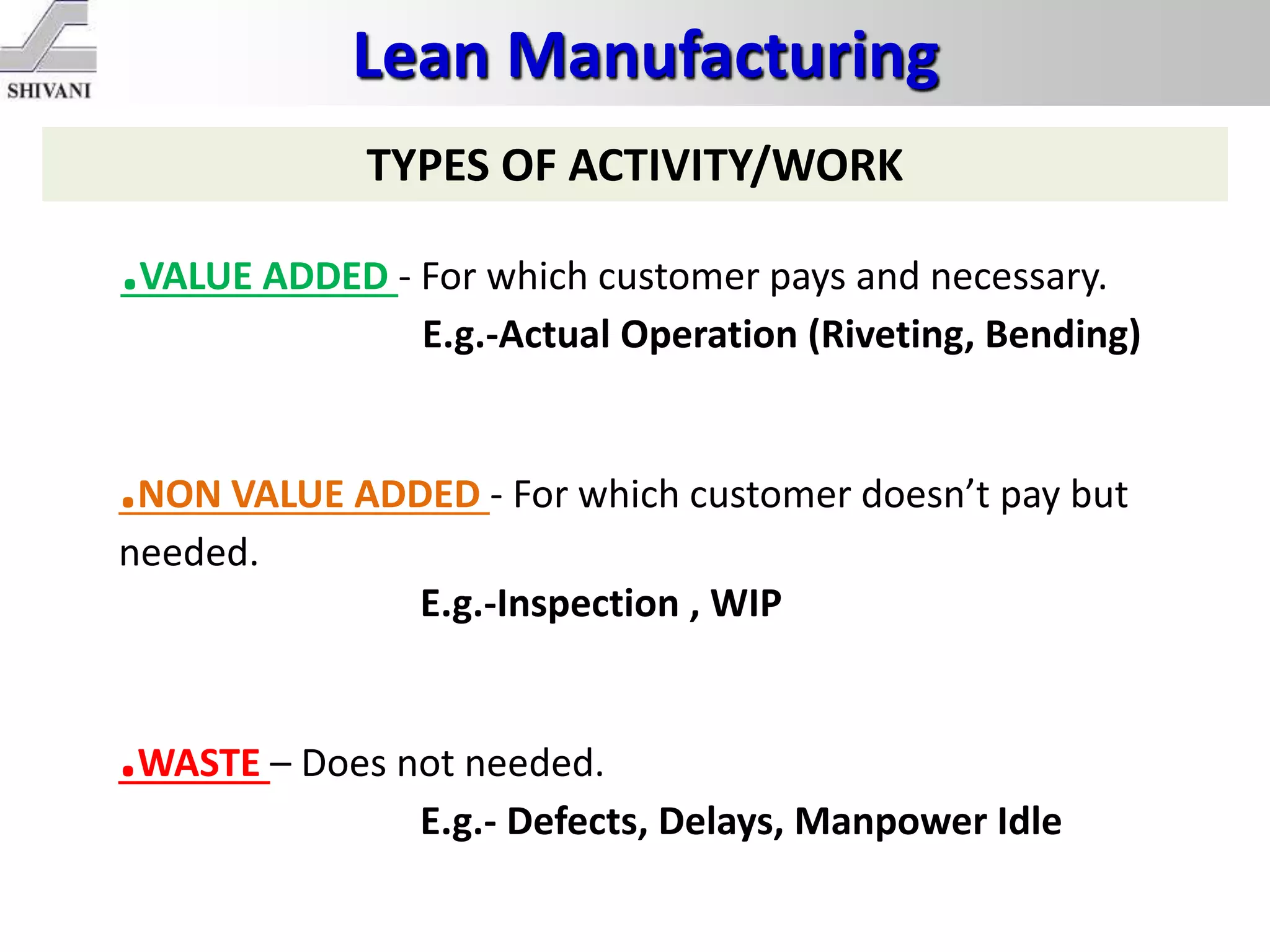
TYPES OF ACTIVITY/WORK
.VALUE ADDED - For which customer pays and necessary.
E.g.-Actual Operation (Riveting, Bending)
.NON VALUE ADDED - For which customer doesn’t pay but
needed.
E.g.-Inspection , WIP
.WASTE – Does not needed.
E.g.- Defects, Delays, Manpower Idle
Lean Manufacturing
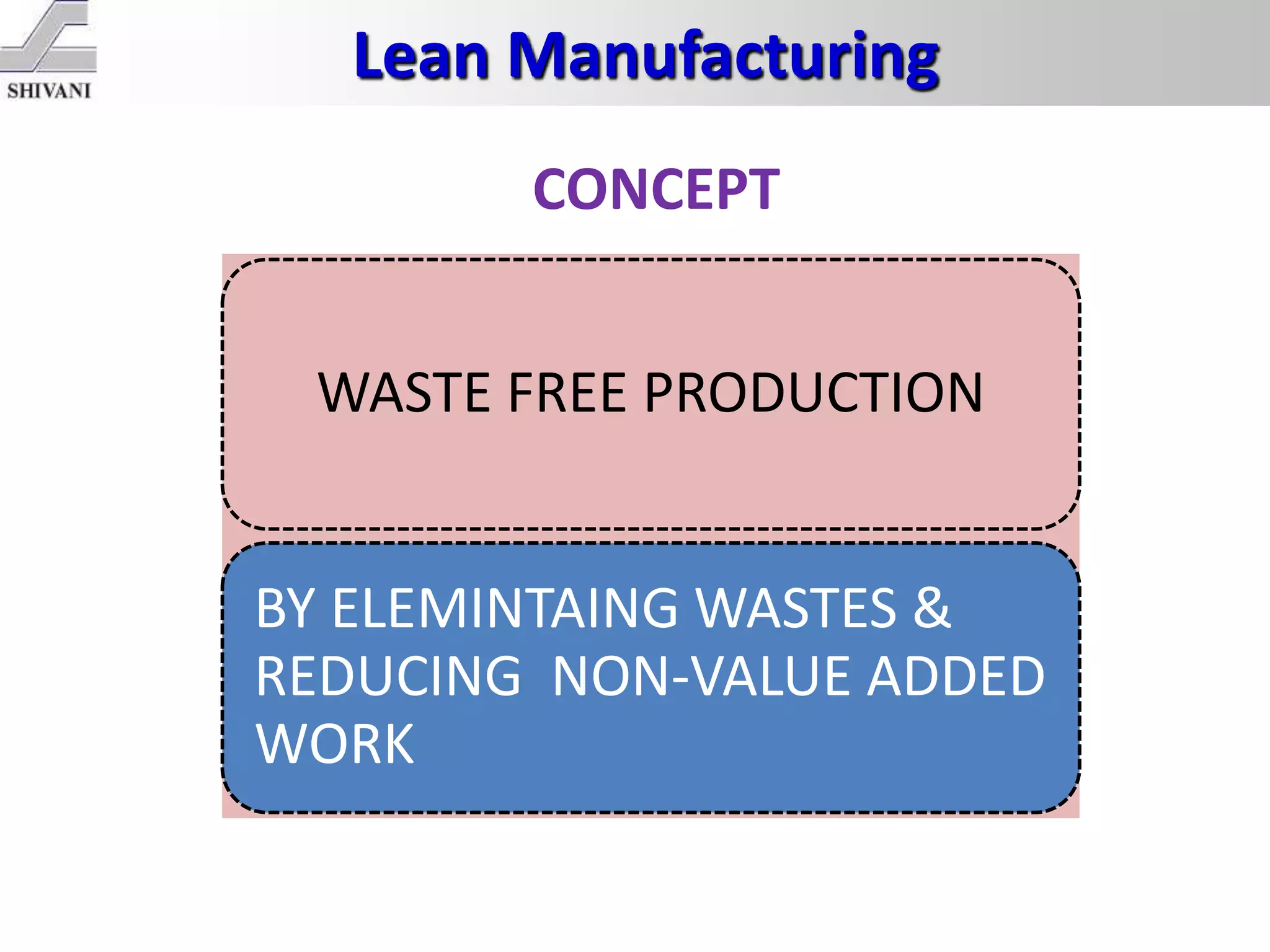
CONCEPT
WASTE FREE PRODUCTION
BY ELEMINTAING WASTES &
REDUCING NON-VALUE ADDED
WORK
Lean Manufacturing
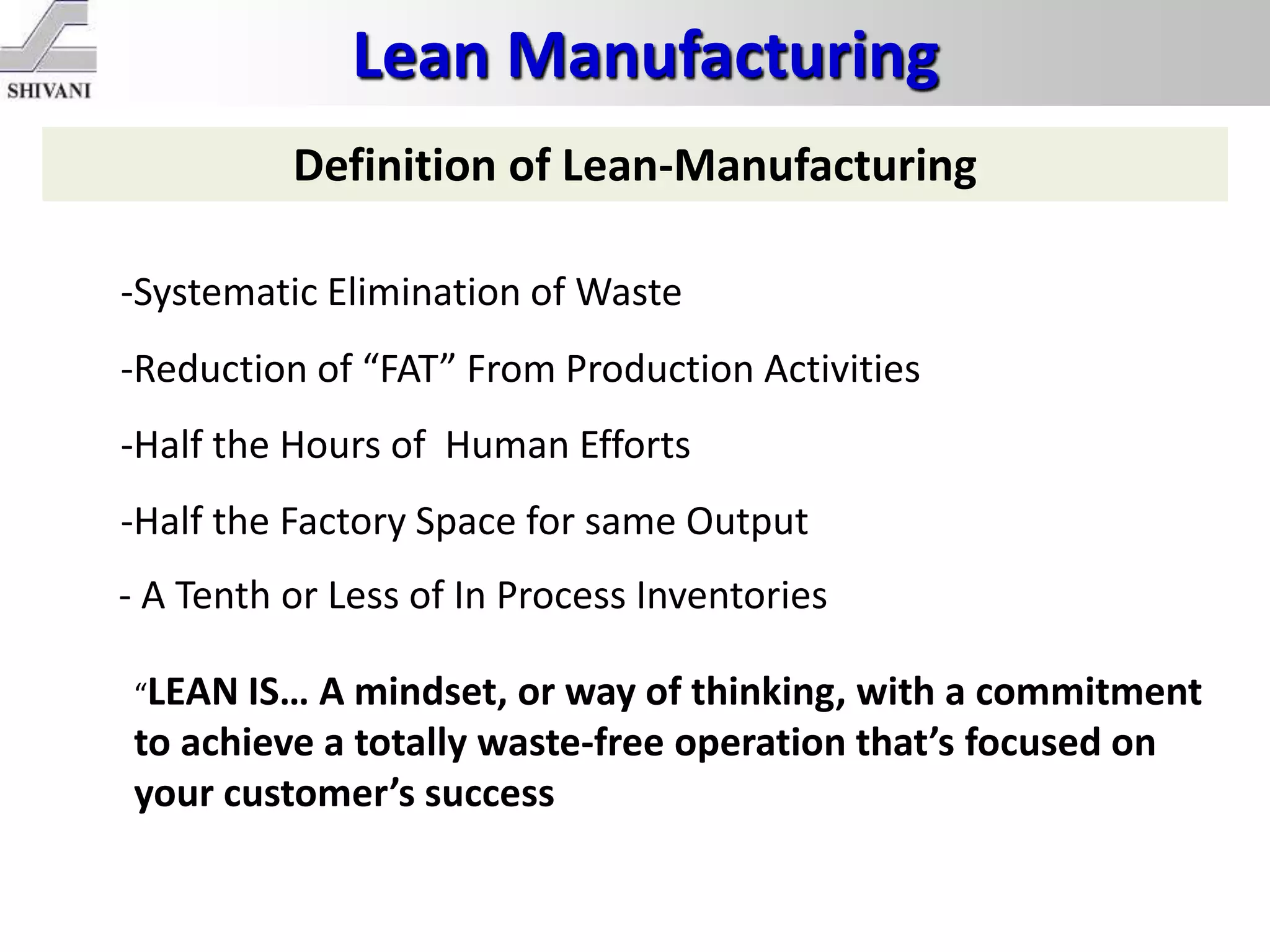
Definition of Lean-Manufacturing
-Systematic Elimination of Waste
-Reduction of “FAT” From Production Activities
-Half the Hours of Human Efforts
-Half the Factory Space for same Output
- A Tenth or Less of In Process Inventories
“LEAN IS… A mindset, or way of thinking, with a commitment
to achieve a totally waste-free operation that’s focused on
your customer’s success
Lean Manufacturing
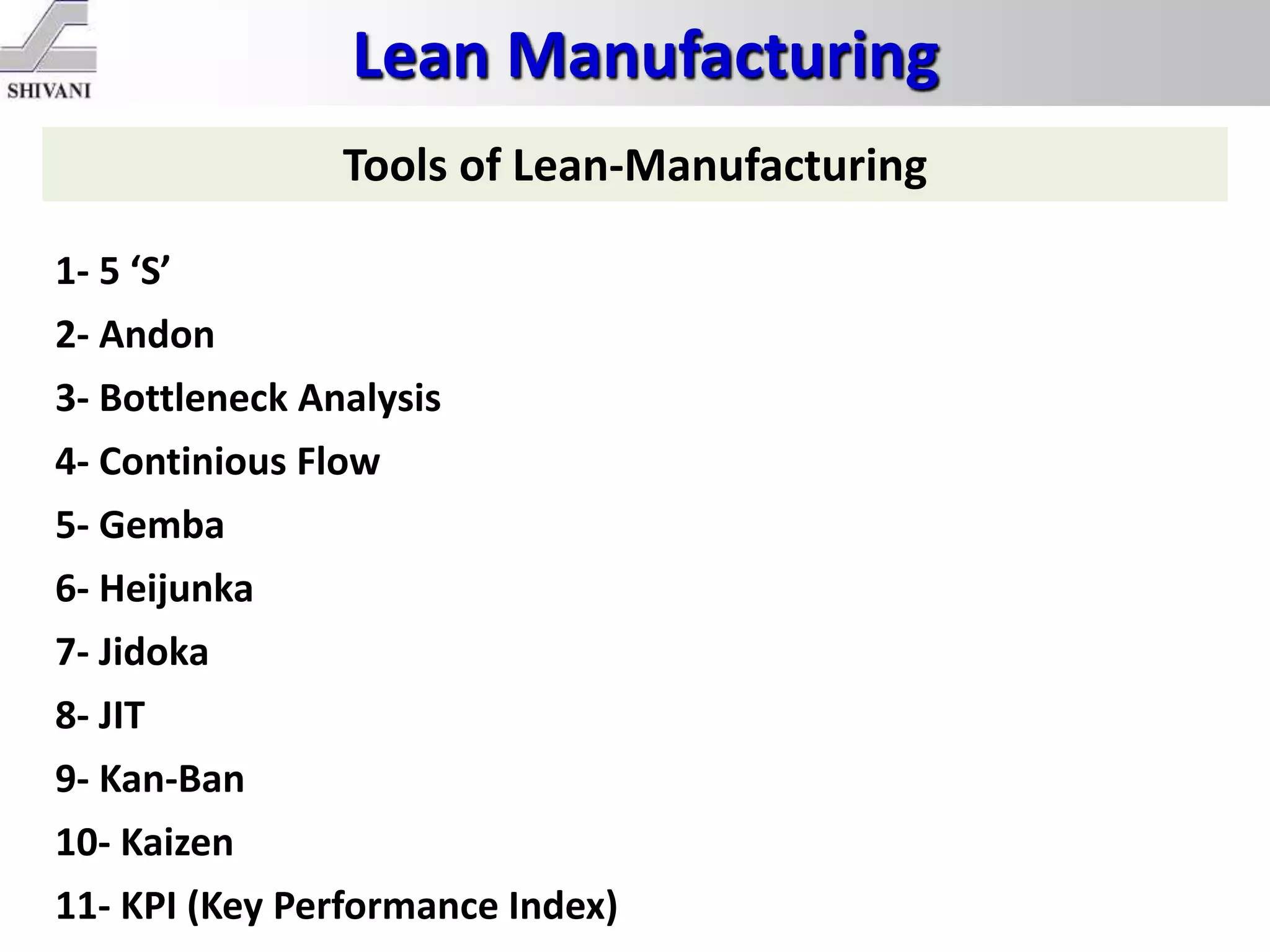
Tools of Lean-Manufacturing
1- 5 ‘S’
2- Andon
3- Bottleneck Analysis
4- Continious Flow
5- Gemba
6- Heijunka
7- Jidoka
8- JIT
9- Kan-Ban
10- Kaizen
11- KPI (Key Performance Index)
Lean Manufacturing
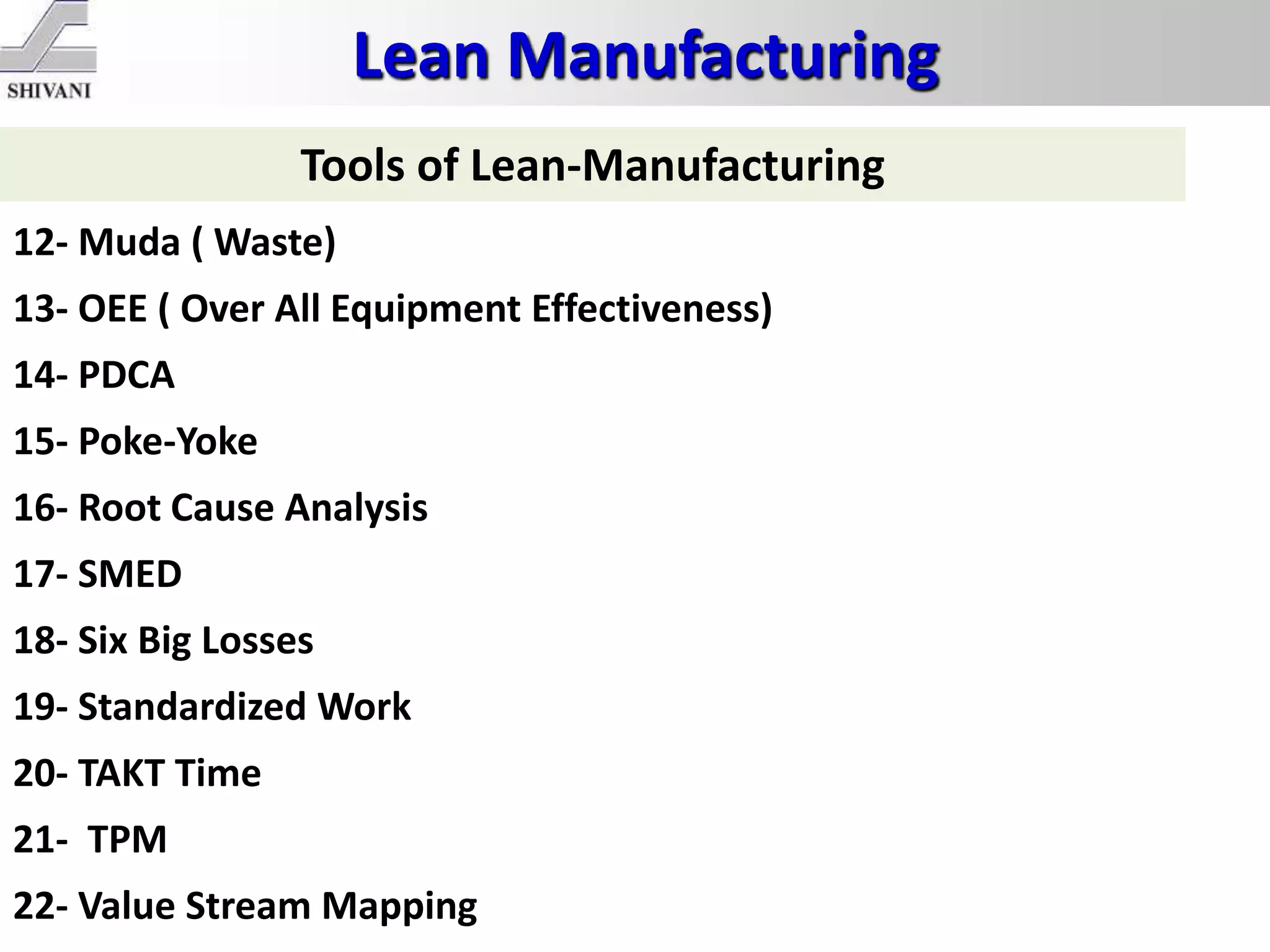
Tools of Lean-Manufacturing
12- Muda ( Waste)
13- OEE ( Over All Equipment Effectiveness)
14- PDCA
15- Poke-Yoke
16- Root Cause Analysis
17- SMED
18- Six Big Losses
19- Standardized Work
20- TAKT Time
21- TPM
22- Value Stream Mapping
Lean Manufacturing
Tools of Lean-Manufacturing
23- Smart Goals
24- Hoshin Kanri
25-Visual Factory
Lean Manufacturing
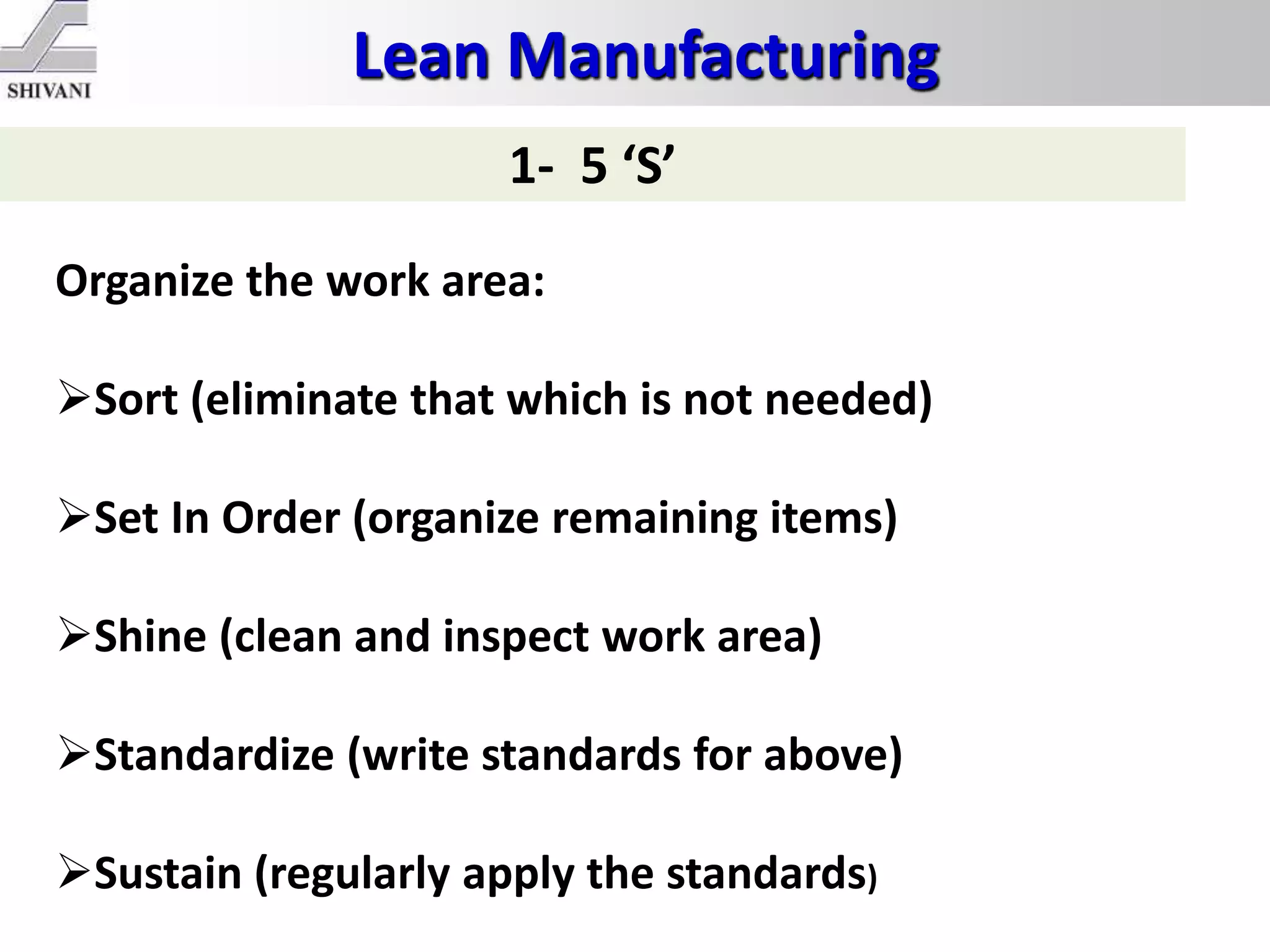
1- 5 ‘S’
Organize the work area:
Sort (eliminate that which is not needed)
Set In Order (organize remaining items)
Shine (clean and inspect work area)
Standardize (write standards for above)
Sustain (regularly apply the standards)
Lean Manufacturing
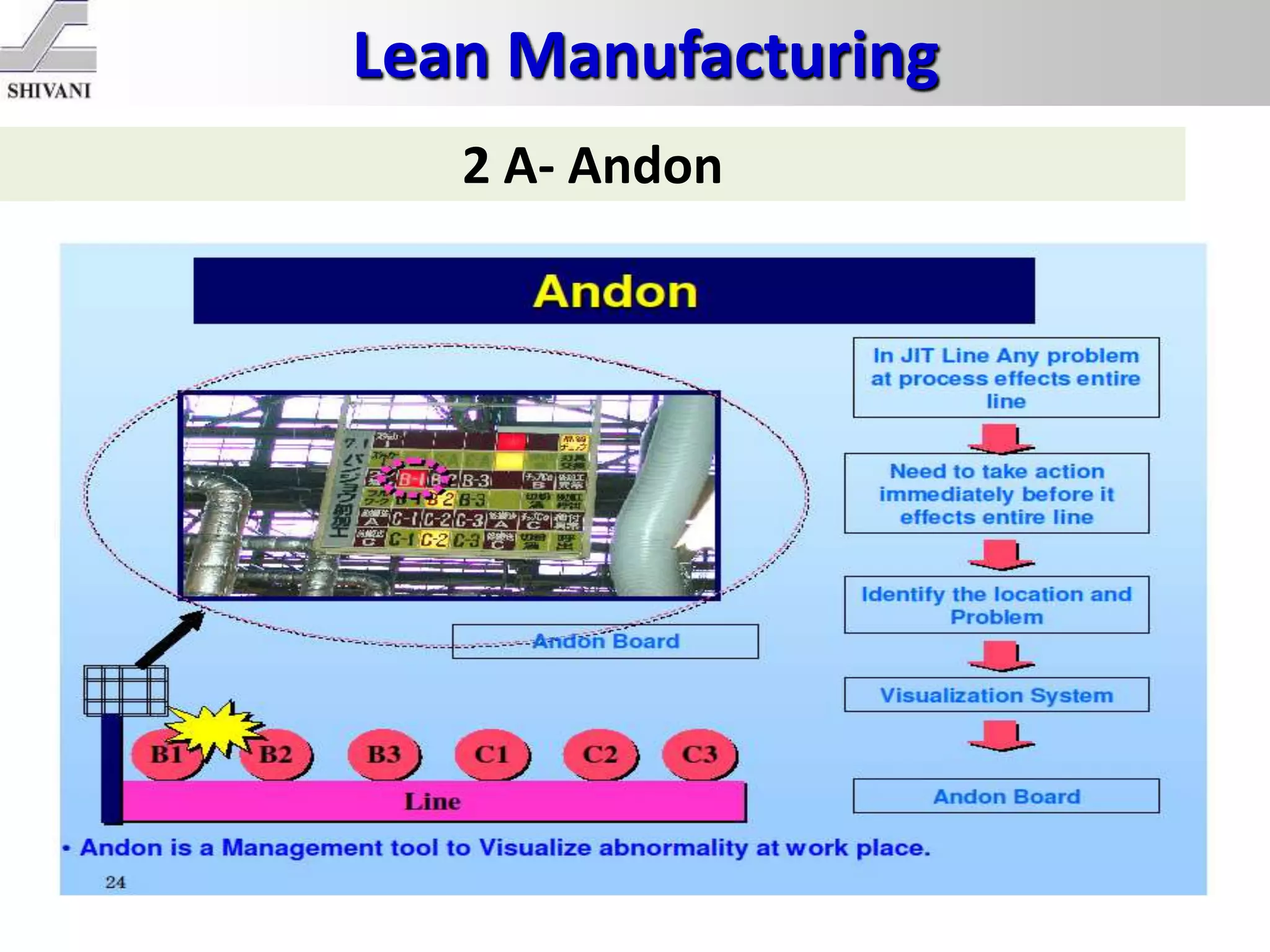
2- Andon
Visual feedback system for the plant floor that
indicates production status, alerts when assistance is
needed, and empowers operators to stop the
production process.
Lean Manufacturing
2 A- Andon
Lean Manufacturing
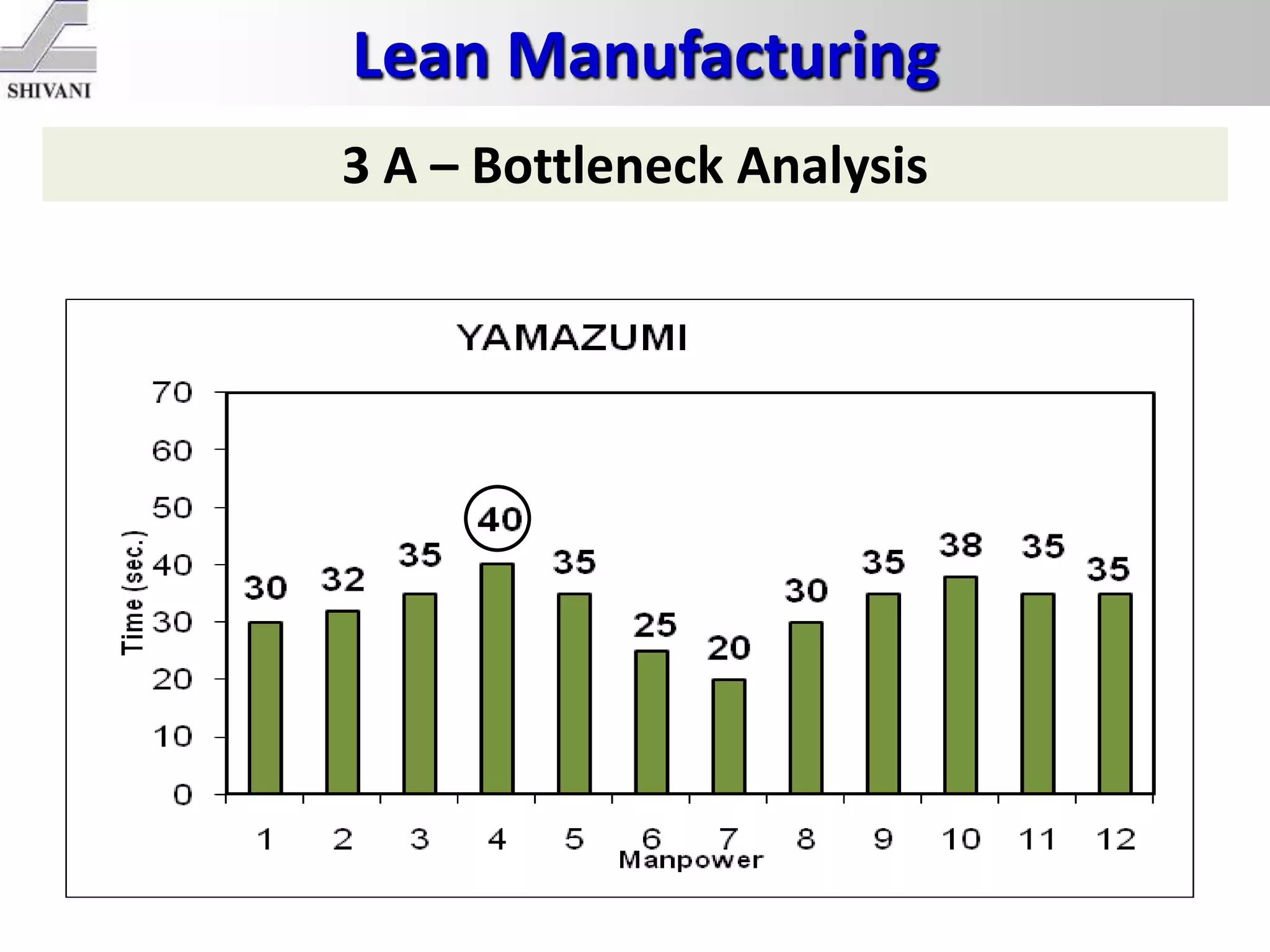
3 -Bottleneck Analysis
Identify which part of the manufacturing process
limits the overall throughput and improve the
performance of that part of the Process
Lean Manufacturing
3 A – Bottleneck Analysis
Lean Manufacturing
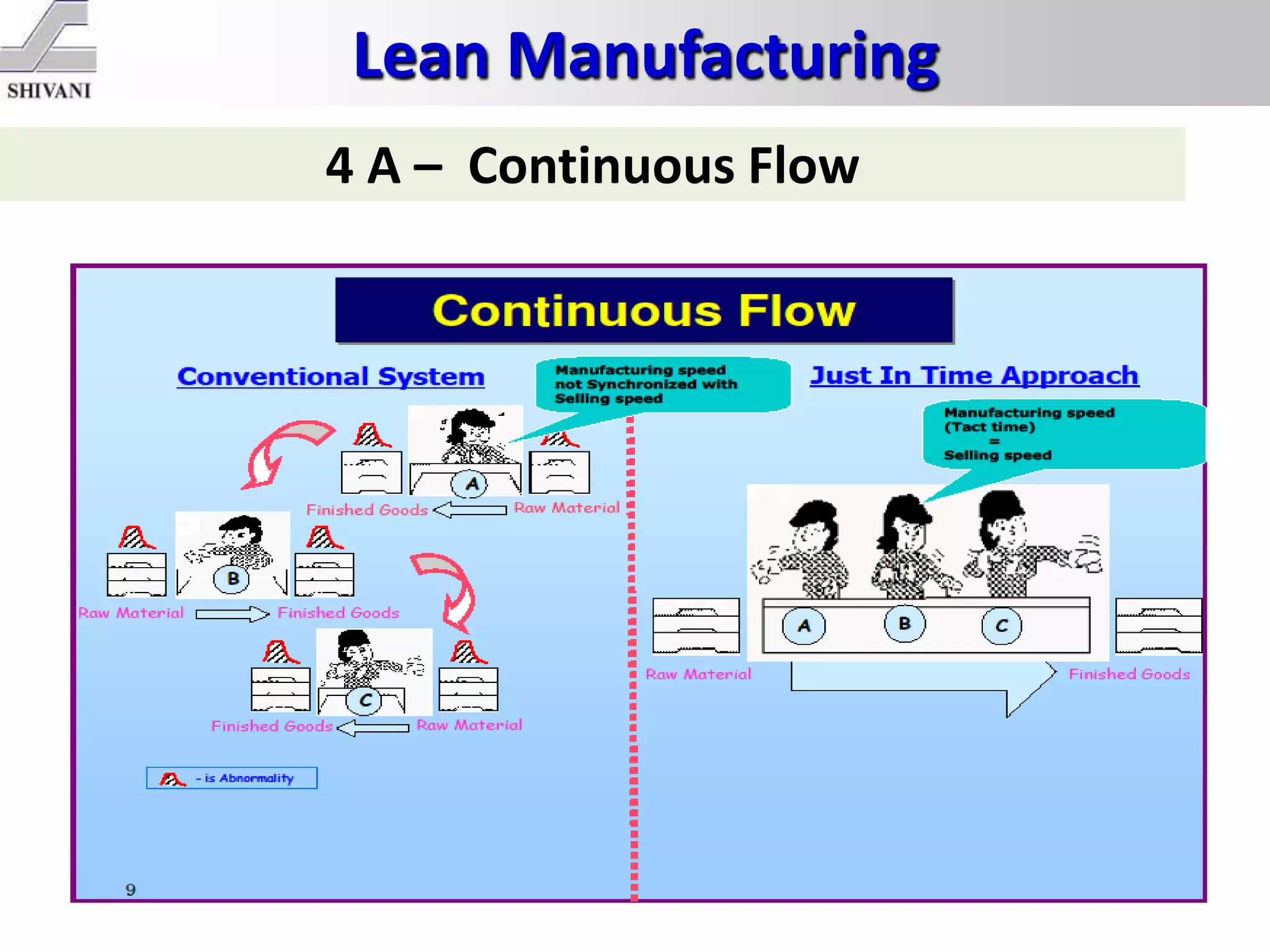
4 – Continuous Flow
Manufacturing where work-in-process smoothly
flows through production with minimal (or no)
buffers between steps of the manufacturing
process.
Lean Manufacturing
4 A – Continuous Flow
Lean Manufacturing
5 – Gemba
A philosophy that reminds us to get out of our
offices and spend time on the plant floor – the
place where real action occurs
Lean Manufacturing
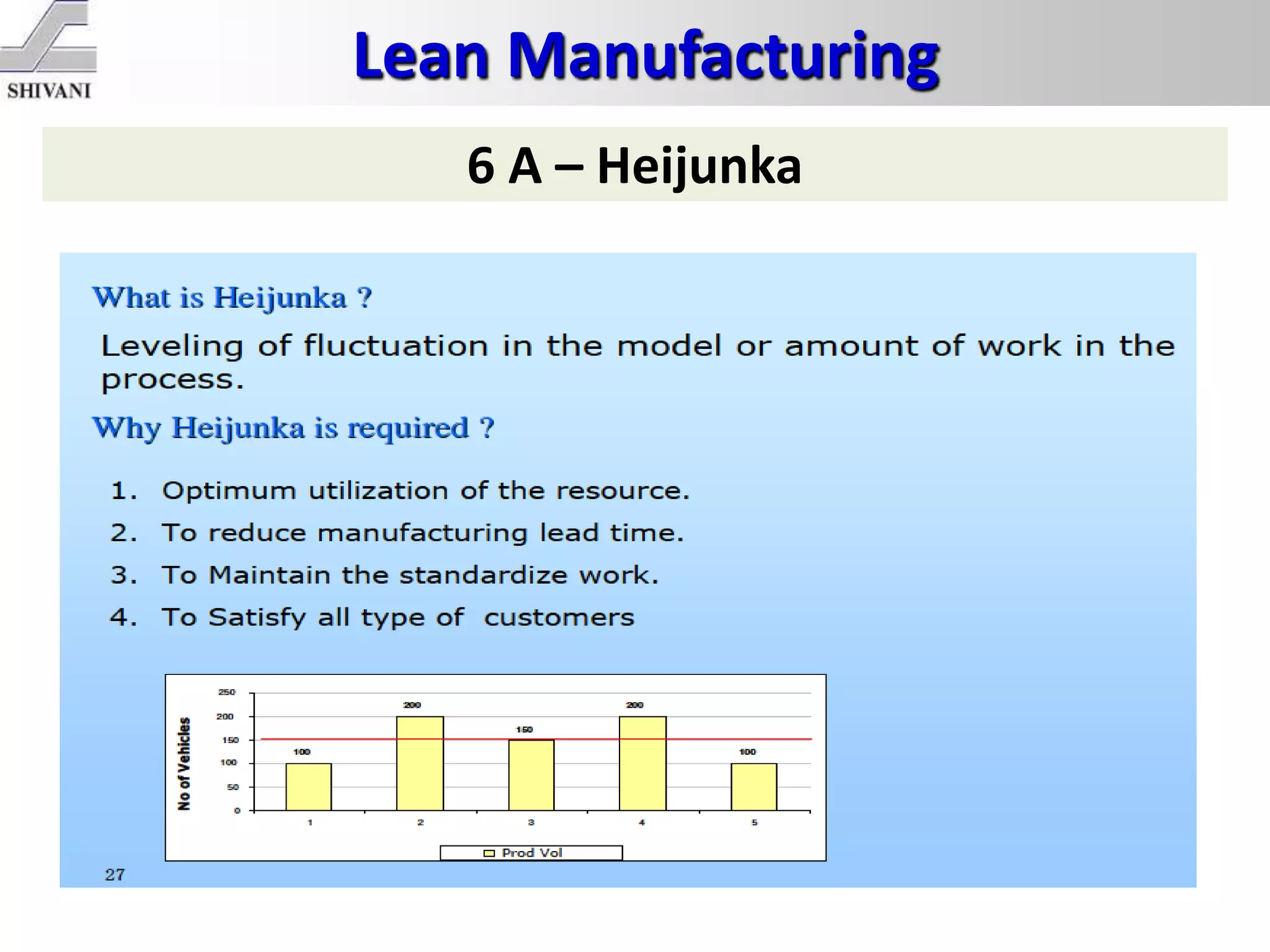
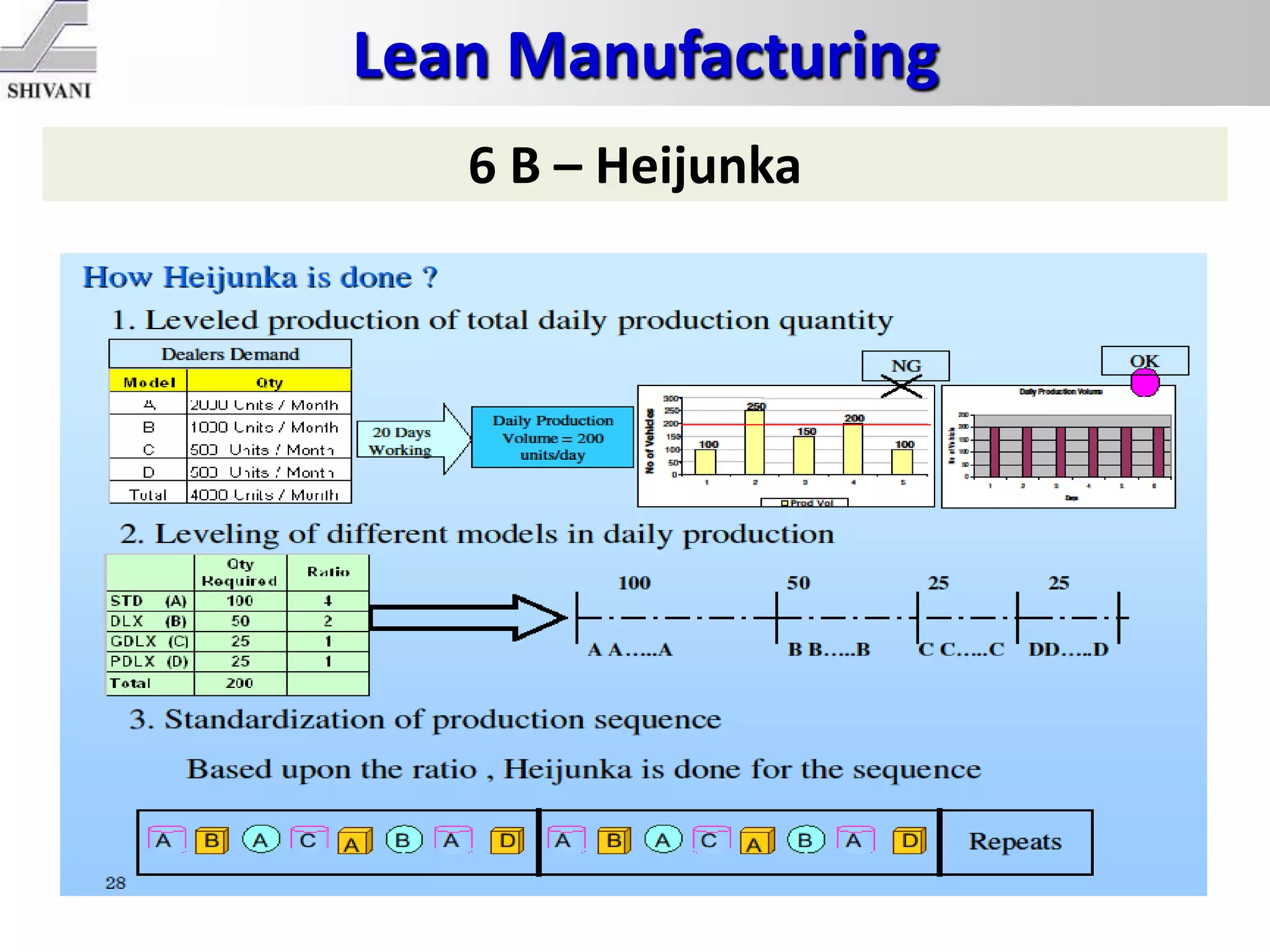
6 – Heijunka
A form of production scheduling that purposely
manufactures in much smaller batches by
sequencing (mixing) product variants within the
same process.
Lean Manufacturing
6 A – Heijunka
Lean Manufacturing
6 B – Heijunka
Lean Manufacturing
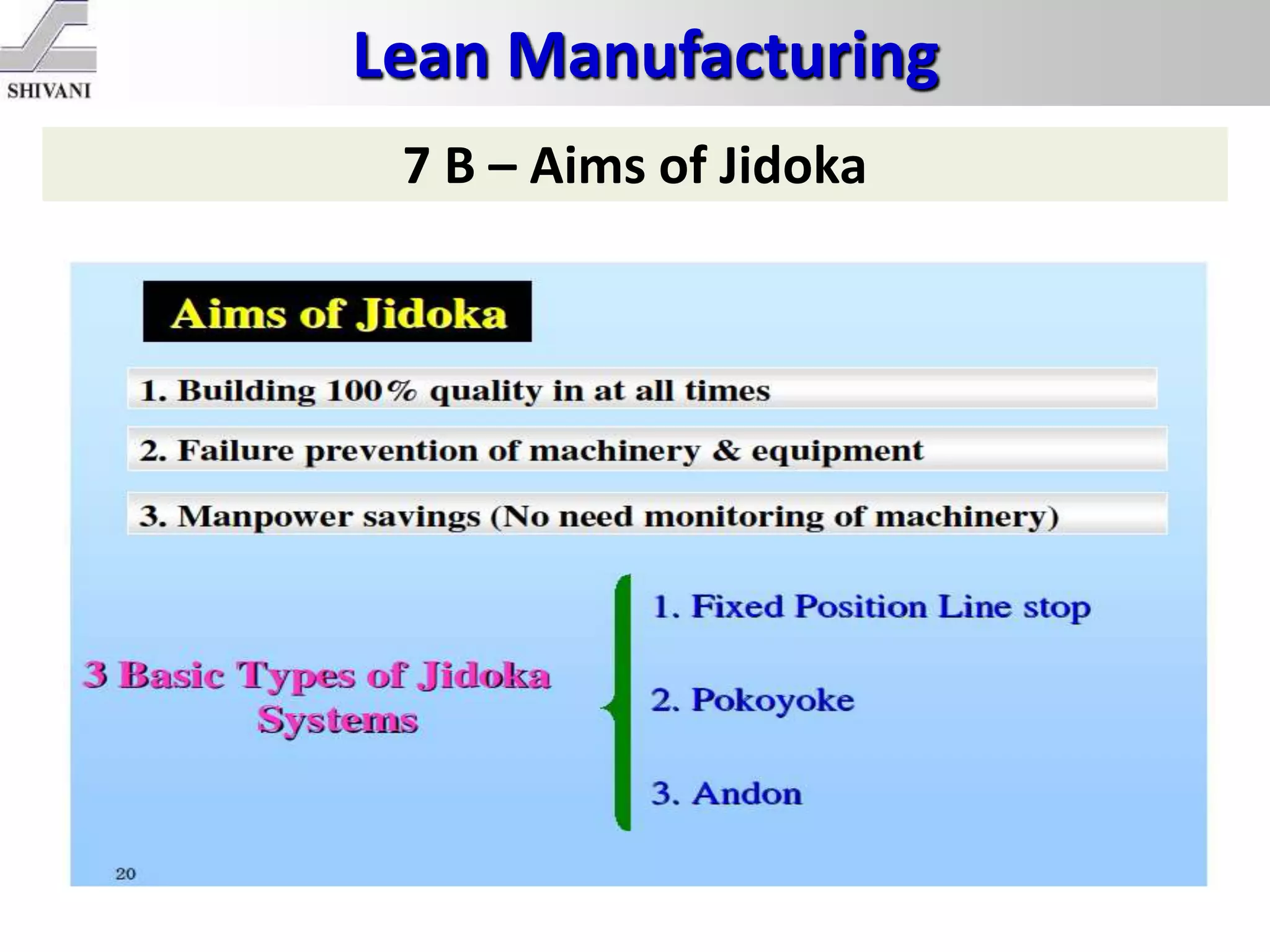
7 – Jidoka
Design equipment to partially automate the
manufacturing process (partial automation is
typically much less expensive than full
automation) and to automatically stop when
defects are detected.
Lean Manufacturing
7 B – Aims of Jidoka
Lean Manufacturing
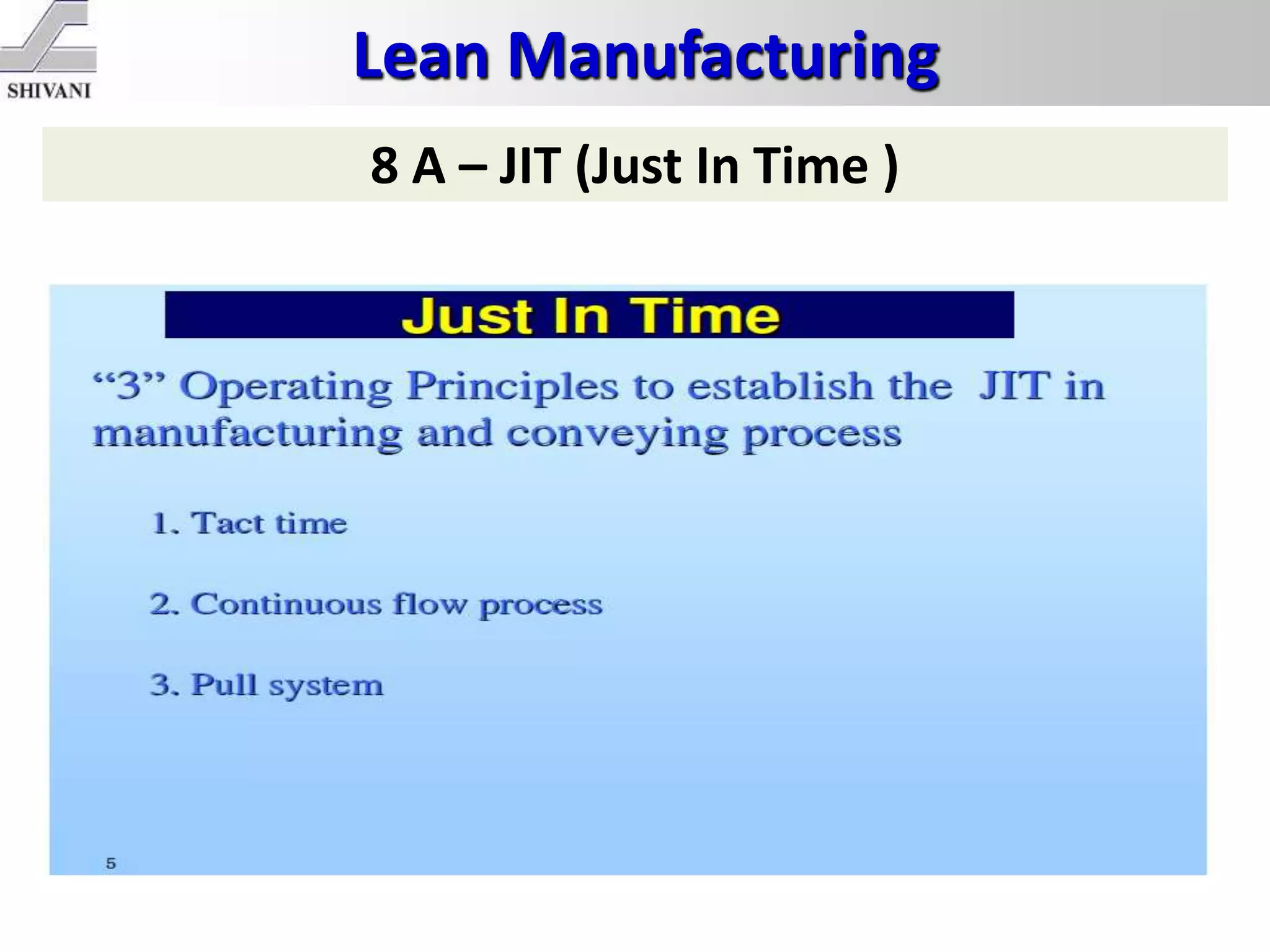
8 – JIT (Just In Time )
Pull parts through production based on customer
demand instead of pushing parts through production
based on projected demand. Depends on many lean
tools, such as Continuous Flow, Heijunka, Kanban,
Standardized Work and Takt Time.
Produce and convey what customers want,
when they want in exactly the amount they want.
Lean Manufacturing
8 A – JIT (Just In Time )
Lean Manufacturing
9 – Kaizen
A strategy where employees work together
proactively to achieve regular, incremental
improvements in the manufacturing process.
Kai + Zen = Better + Change
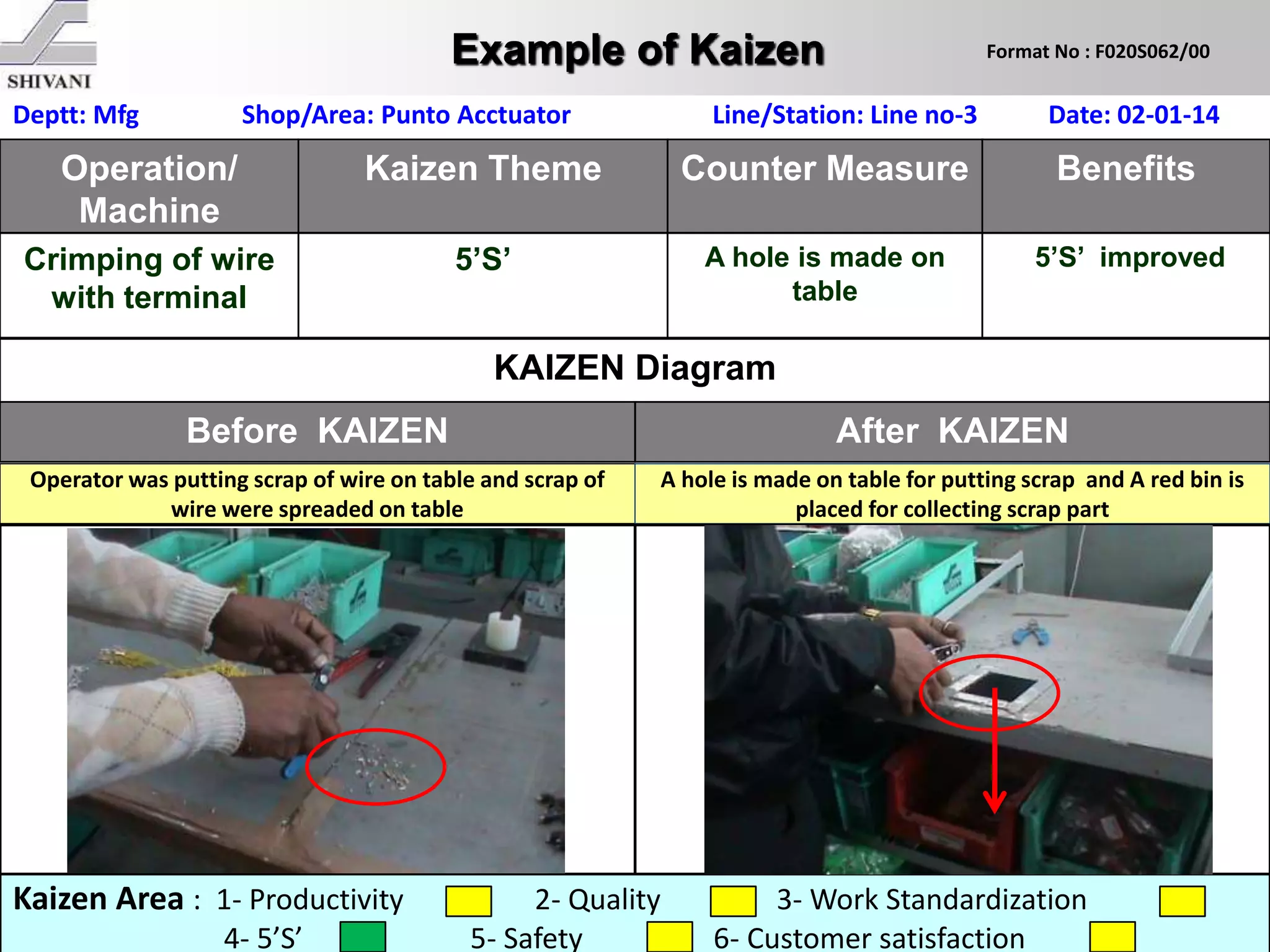
Before KAIZEN After KAIZEN
Operator was putting scrap of wire on table and scrap of
wire were spreaded on table
A hole is made on table for putting scrap and A red bin is
placed for collecting scrap part
Kaizen Area : 1- Productivity 2- Quality 3- Work Standardization
4- 5’S’ 5- Safety 6- Customer satisfaction
Example of Kaizen
Operation/
Machine
Kaizen Theme Counter Measure Benefits
KAIZEN Diagram
Deptt: Mfg Shop/Area: Punto Acctuator Line/Station: Line no-3 Date: 02-01-14
Format No : F020S062/00
Crimping of wire
with terminal
5’S’ A hole is made on
table
5’S’ improved
Lean Manufacturing
10 – Kan-Ban
A method of regulating the flow of goods both
within the factory and with outside suppliers and
customers. Based on automatic replenishment
through signal cards that indicate when more
goods are needed.
Lean Manufacturing
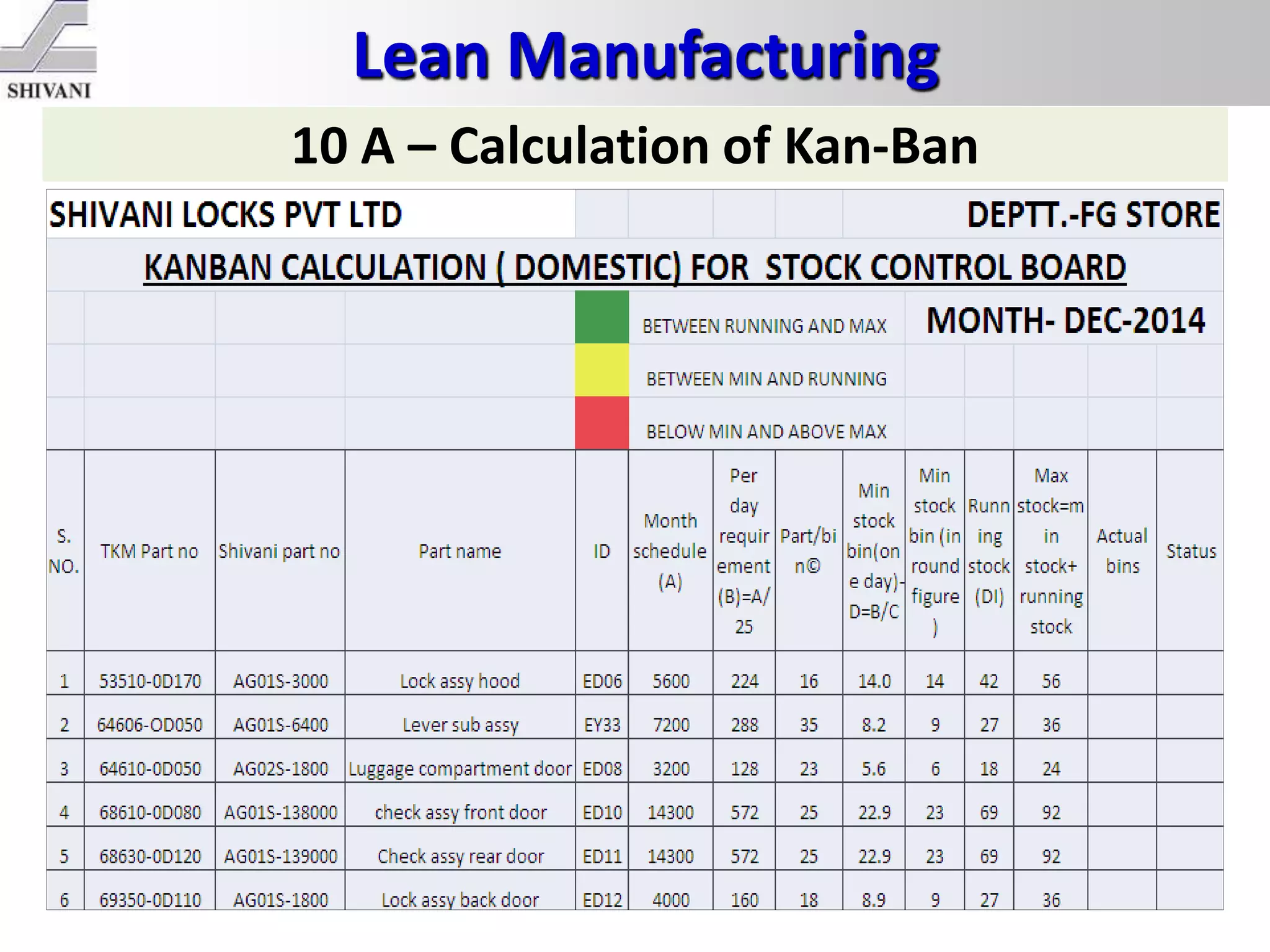
10 A – Calculation of Kan-Ban
Lean Manufacturing
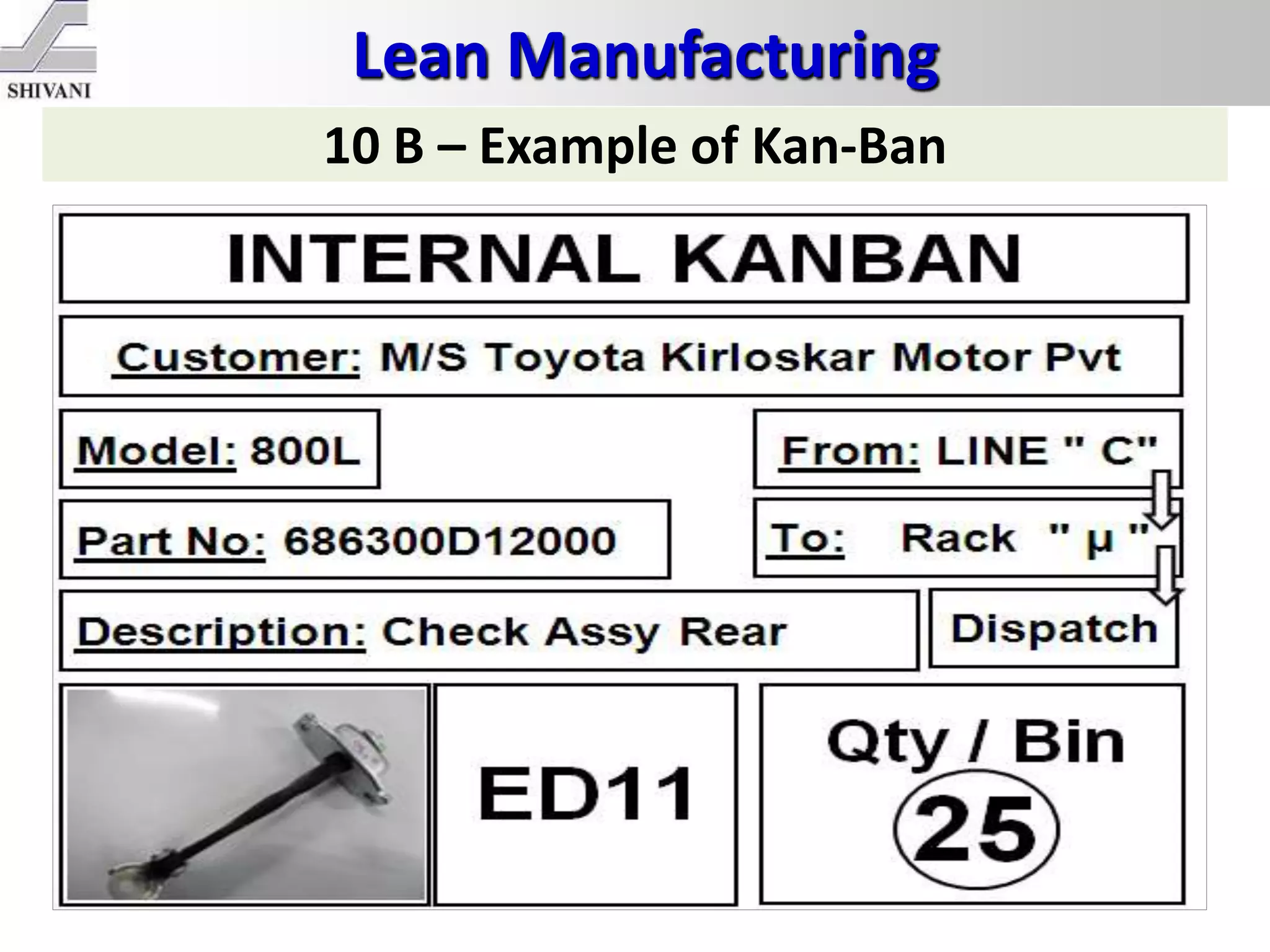
10 B – Example of Kan-Ban
Lean Manufacturing
11 – KPI ( Key Performance Index )
Metrics designed to track and encourage progress
towards critical goals of the organization. Strongly
promoted KPIs can be extremely powerful drivers of
behavior – so it is important to carefully select KPIs
that will drive desired Behavior
Lean Manufacturing
12 – Muda(Waste)
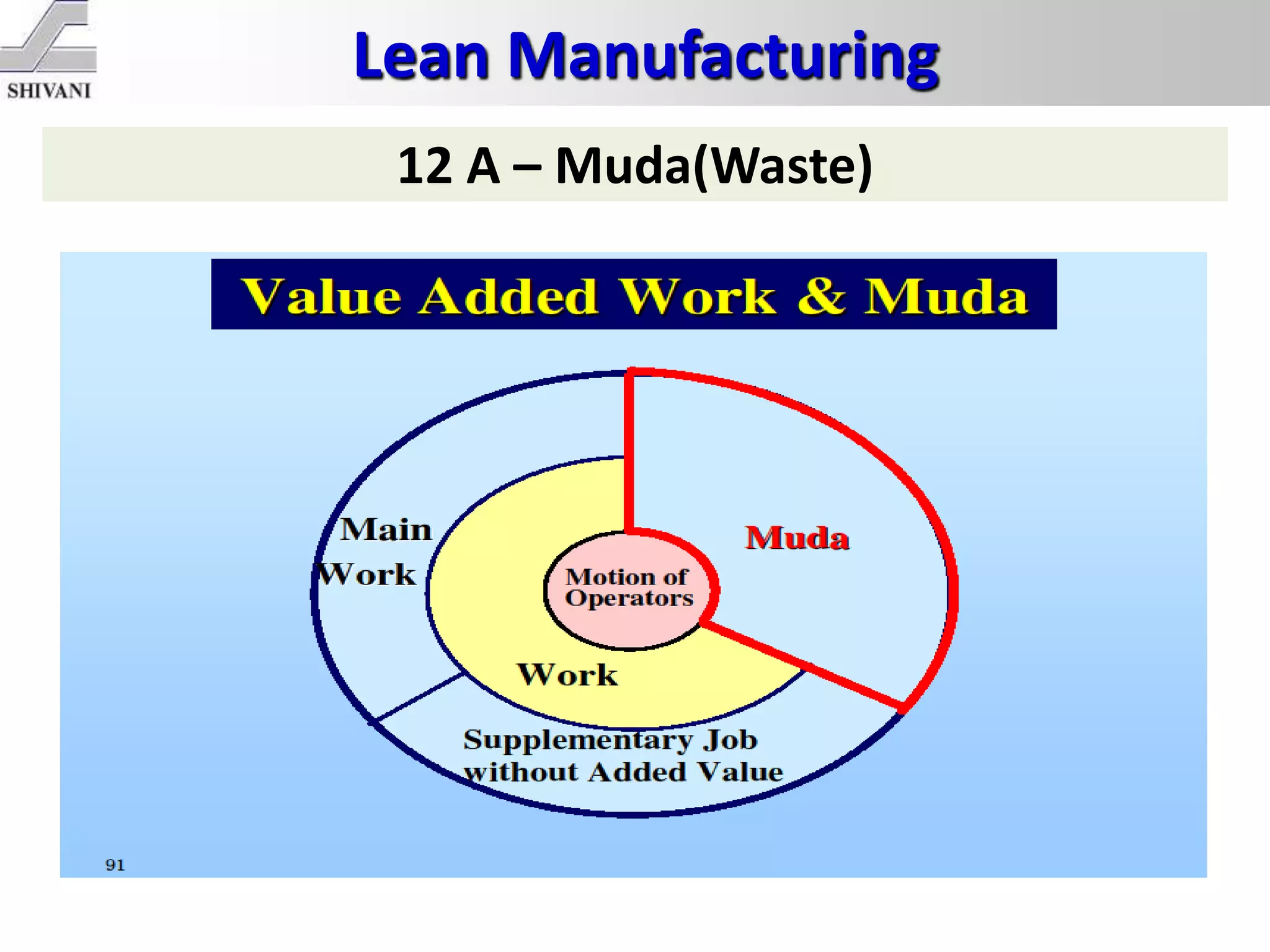
Anything in the manufacturing process that does not
add value from the customer’s perspective
Lean Manufacturing
12 A – Muda(Waste)
Lean Manufacturing
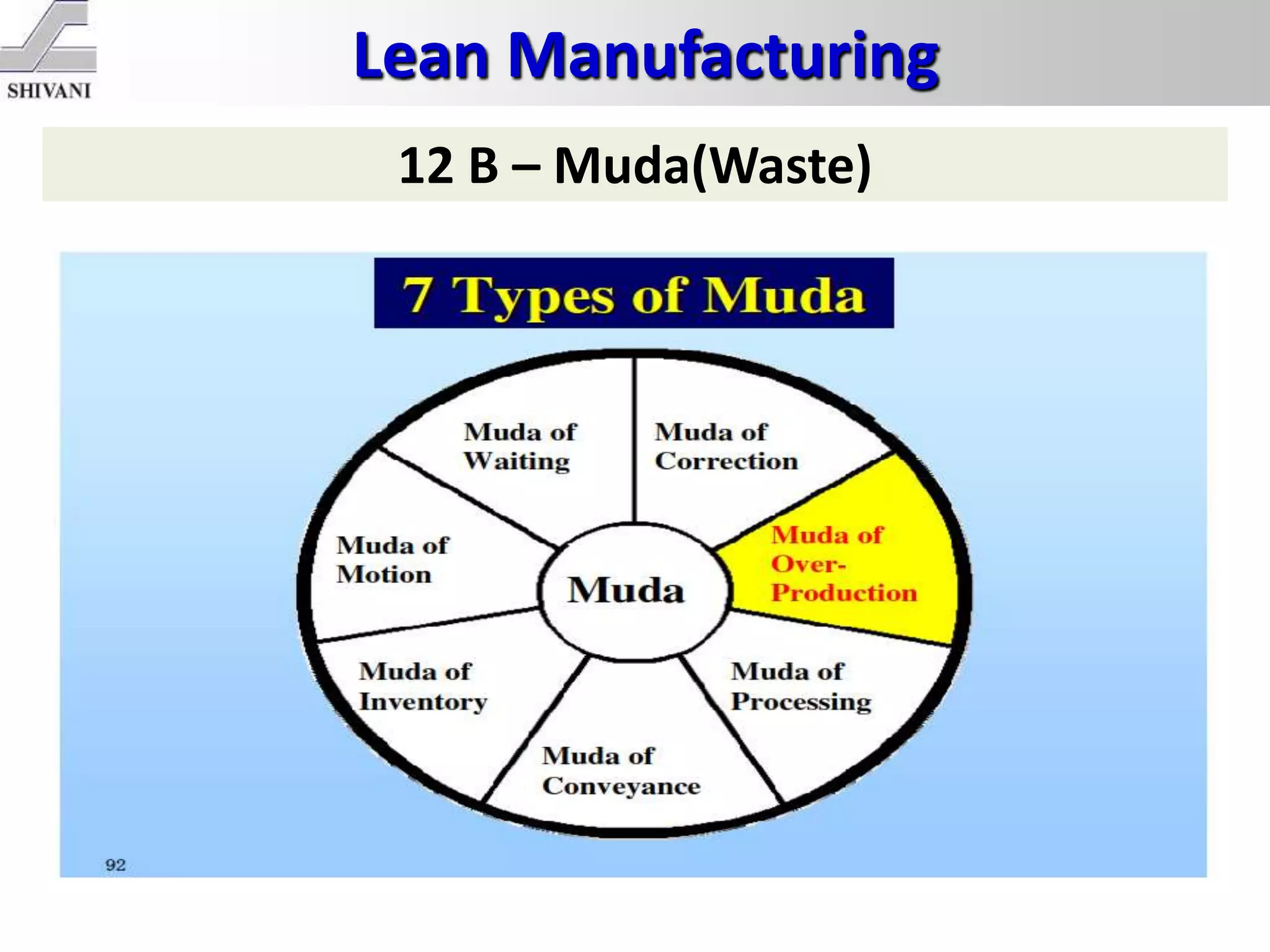
12 B – Muda(Waste)
Lean Manufacturing
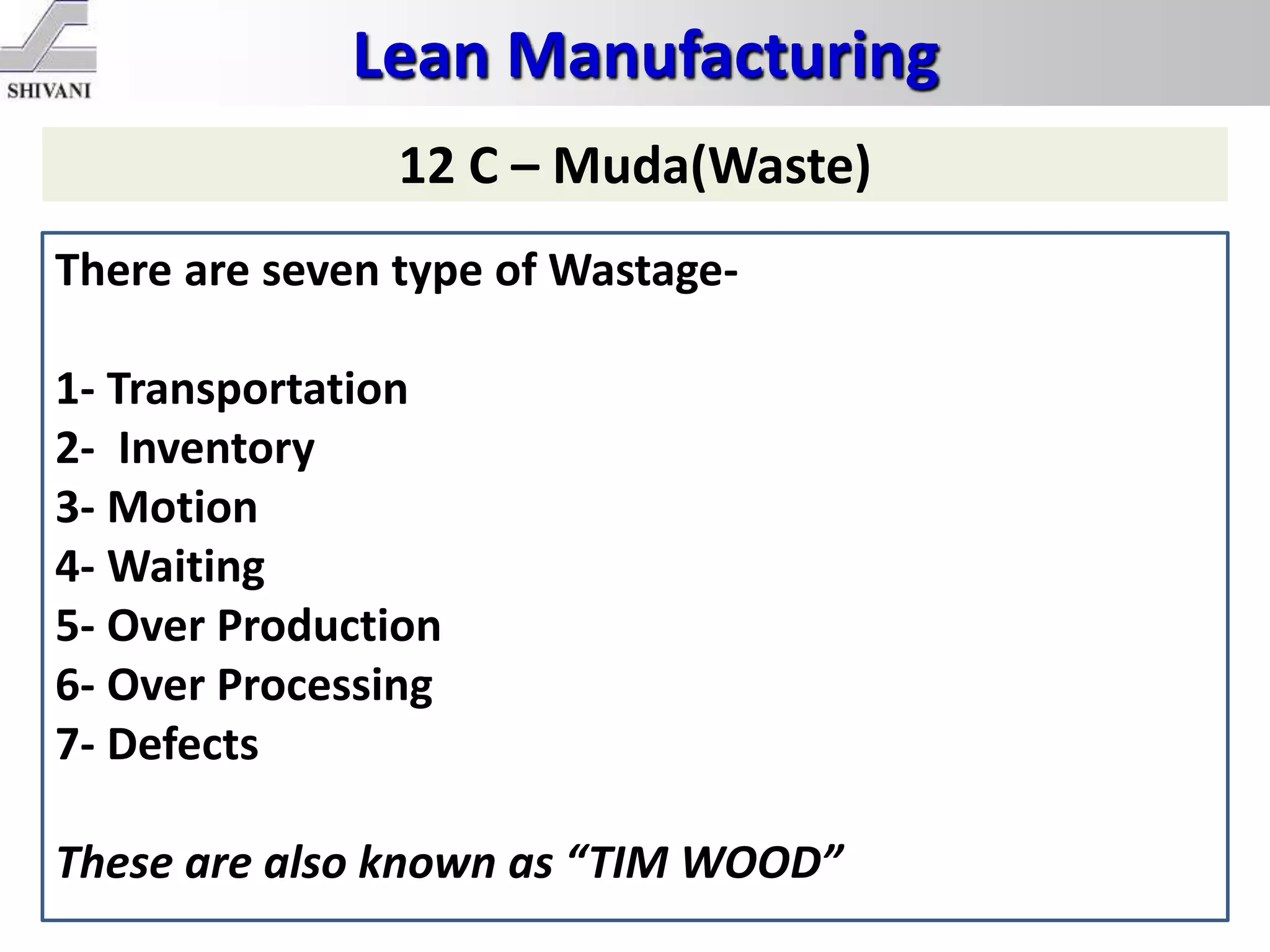
12 C – Muda(Waste)
There are seven type of Wastage-
1- Transportation
2- Inventory
3- Motion
4- Waiting
5- Over Production
6- Over Processing
7- Defects
These are also known as “TIM WOOD”
Lean Manufacturing
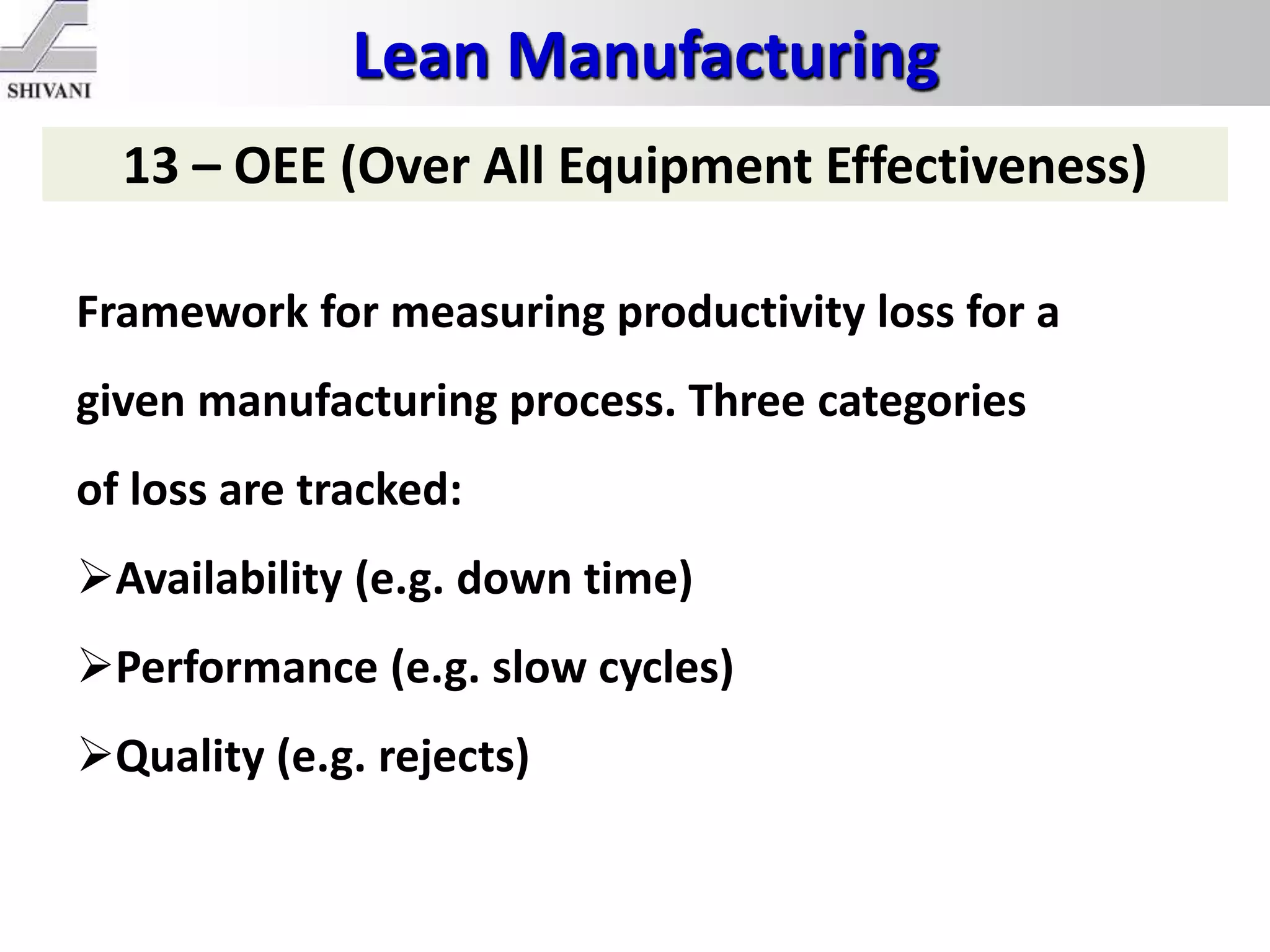
13 – OEE (Over All Equipment Effectiveness)
Framework for measuring productivity loss for a
given manufacturing process. Three categories
of loss are tracked:
Availability (e.g. down time)
Performance (e.g. slow cycles)
Quality (e.g. rejects)
Lean Manufacturing
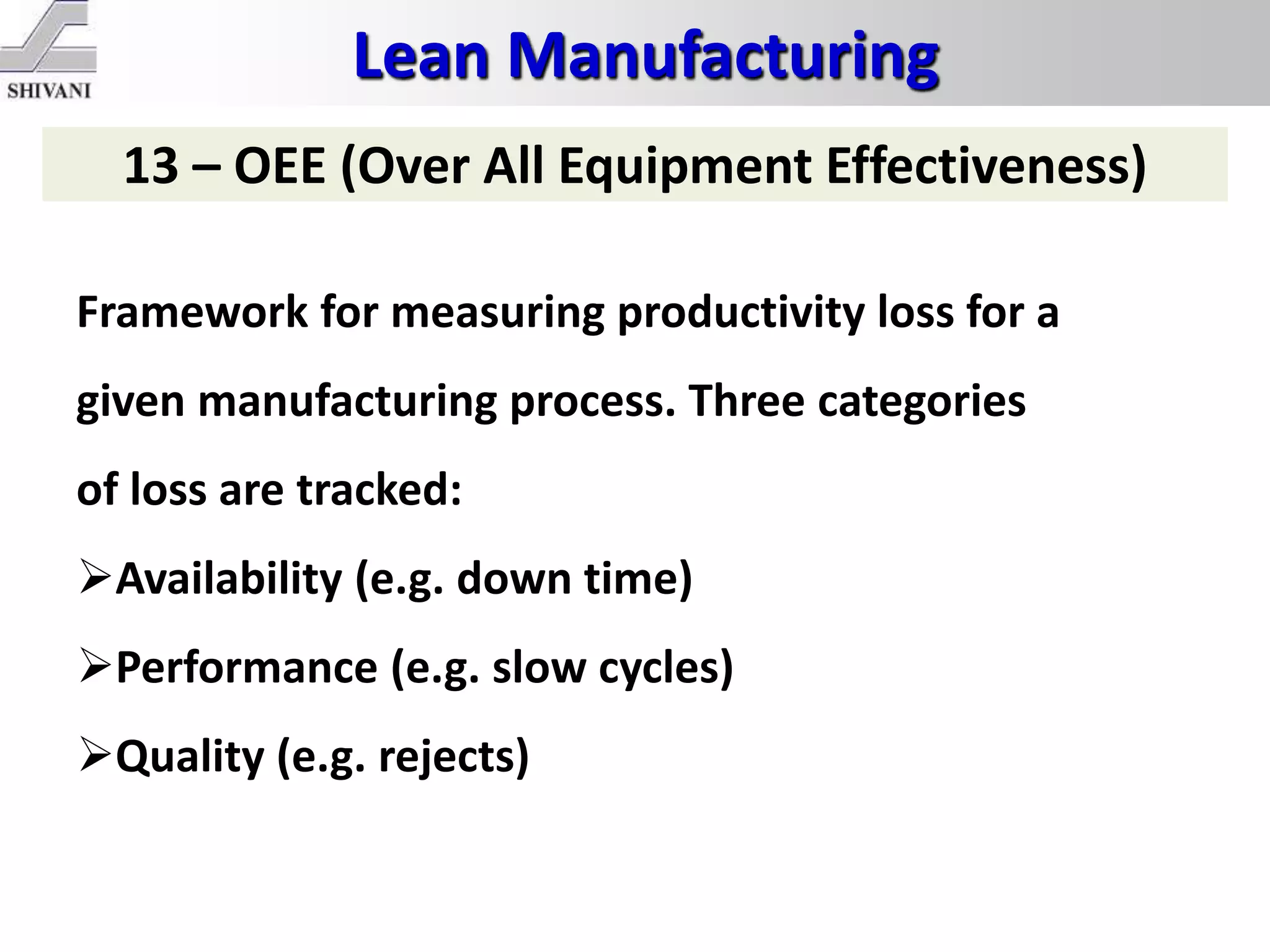
13 – OEE (Over All Equipment Effectiveness)
Framework for measuring productivity loss for a
given manufacturing process. Three categories
of loss are tracked:
Availability (e.g. down time)
Performance (e.g. slow cycles)
Quality (e.g. rejects)
Lean Manufacturing
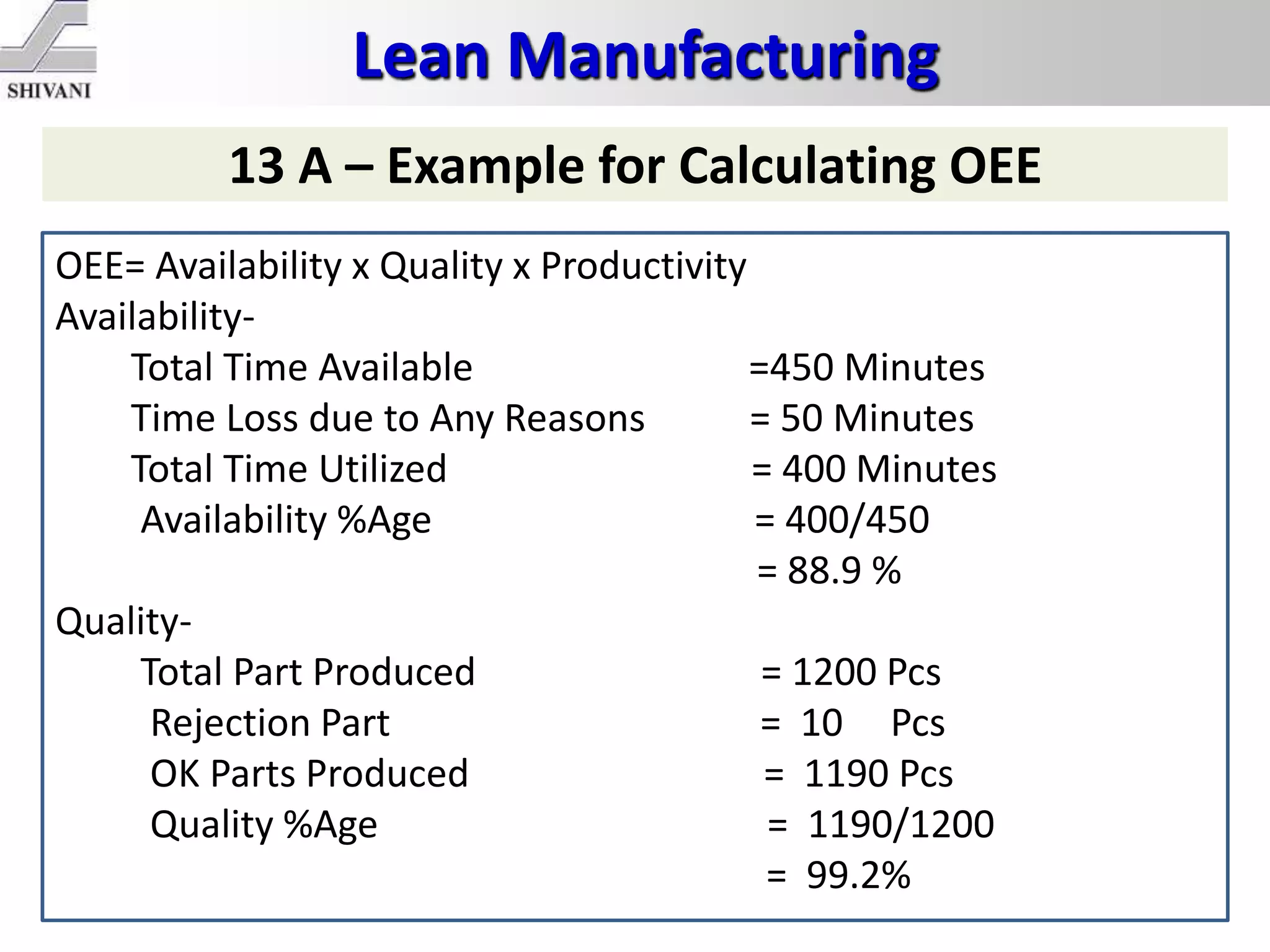
13 A – Example for Calculating OEE
OEE= Availability x Quality x Productivity
Availability-
Total Time Available =450 Minutes
Time Loss due to Any Reasons = 50 Minutes
Total Time Utilized = 400 Minutes
Availability %Age = 400/450
= 88.9 %
Quality-
Total Part Produced = 1200 Pcs
Rejection Part = 10 Pcs
OK Parts Produced = 1190 Pcs
Quality %Age = 1190/1200
= 99.2%
Lean Manufacturing
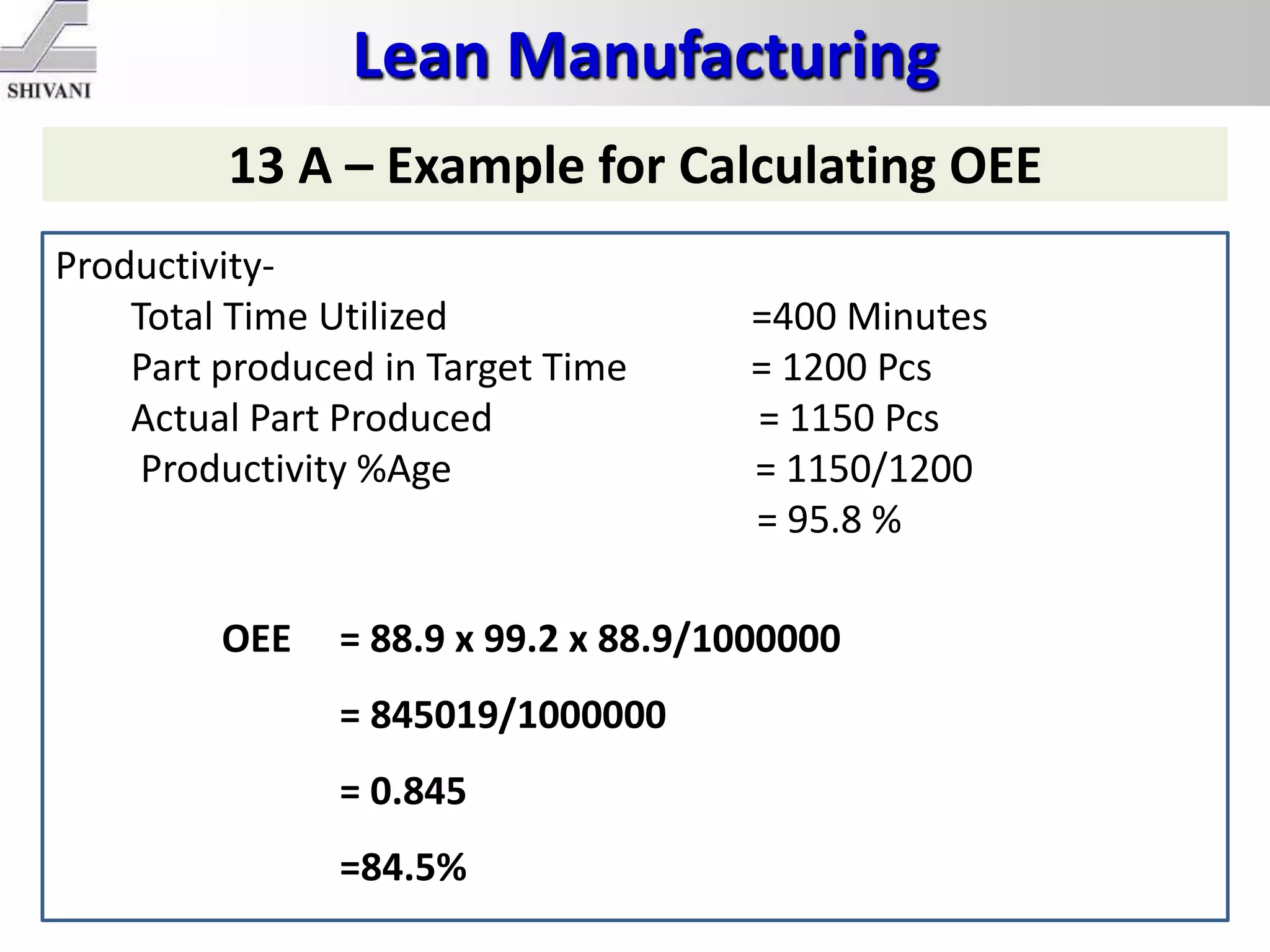
13 A – Example for Calculating OEE
Productivity-
Total Time Utilized =400 Minutes
Part produced in Target Time = 1200 Pcs
Actual Part Produced = 1150 Pcs
Productivity %Age = 1150/1200
= 95.8 %
OEE = 88.9 x 99.2 x 88.9/1000000
= 845019/1000000
= 0.845
=84.5%
Lean Manufacturing
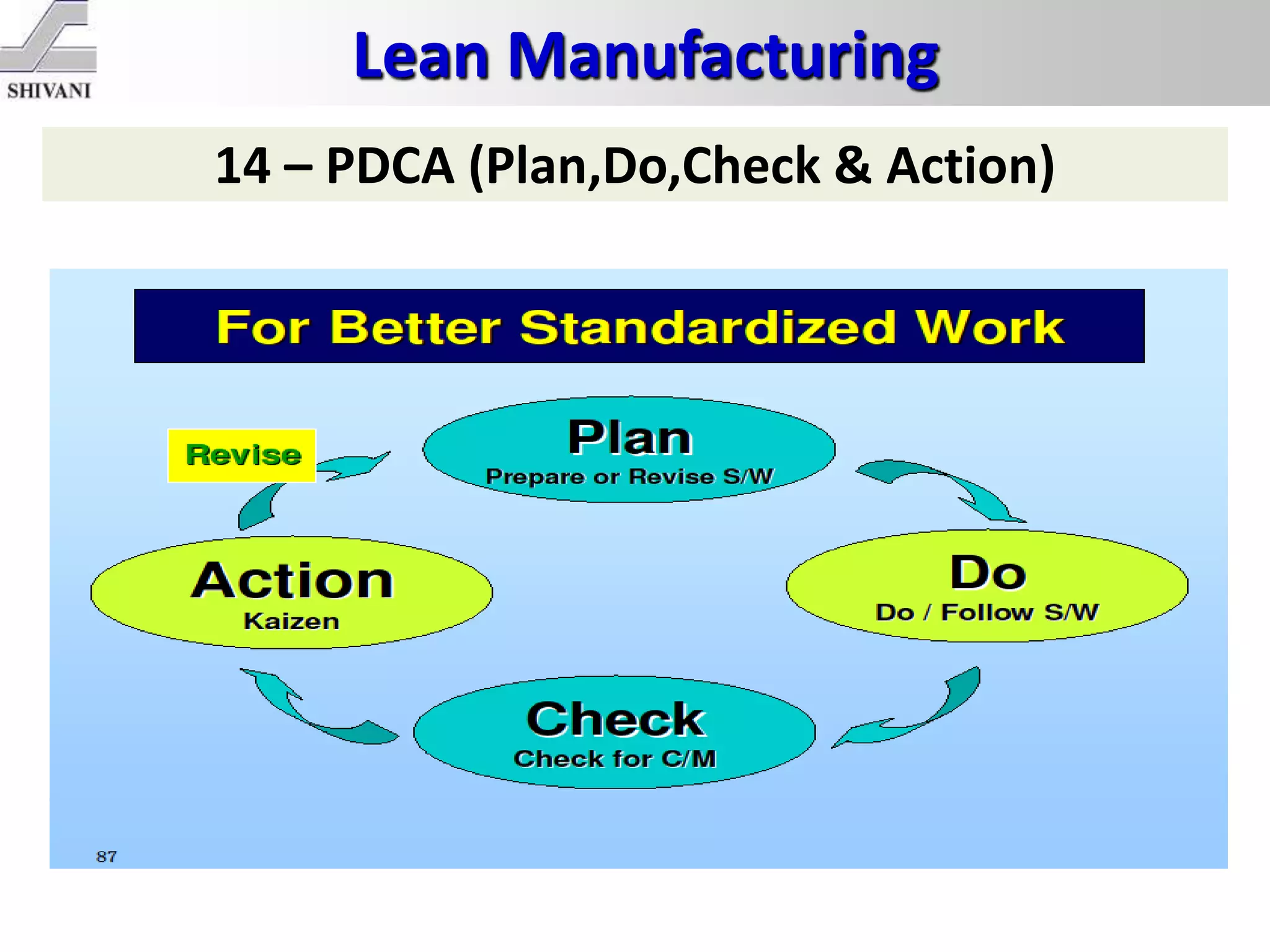
14 – PDCA (Plan,Do,Check & Action)
An iterative methodology for implementing
improvements:
Plan (establish plan and expected results)
Do (implement plan)
Check (verify expected results achieved)
Act (review and assess; do it again)
Lean Manufacturing
14 – PDCA (Plan,Do,Check & Action)
Lean Manufacturing
15 – Poke Yoke
Design error detection and prevention into production
processes with the goal of achieving zero defects.
Lean Manufacturing
15 A – Poke Yoke
Types of Poke Yoke
1-Detection Poke Yoke
2-Prevention Poke Yoke
Based on Theory that-
1-Don’t accept NG Part
2-Don’t produce NG Part
3-Don’t pass the NG Part
Lean Manufacturing
16 – Root Cause Analysis
A problem solving methodology that focuses on
resolving the underlying problem instead of applying
quick fixes that only treat immediate symptoms of the
problem. A common approach is to ask why five times
– each time moving a step closer to discovering the
true underlying Problem
Lean Manufacturing
17 – SMED ( Single Minute Exchange Die)
Reduce setup (changeover) time to less than 10
minutes. Techniques include:
-Convert setup steps to be external
(performed while the process is running)
-Simplify internal setup (e.g. replace bolts
with knobs and levers)
-Eliminate non-essential operations
Create standardized work instructions
Lean Manufacturing
18 – Six Big Losses
Six categories of productivity loss that are almost universally
experienced in manufacturing:
Breakdowns
Setup/Adjustments
Small Stops
Reduced Speed
Startup Rejects
Production Rejects
Lean Manufacturing
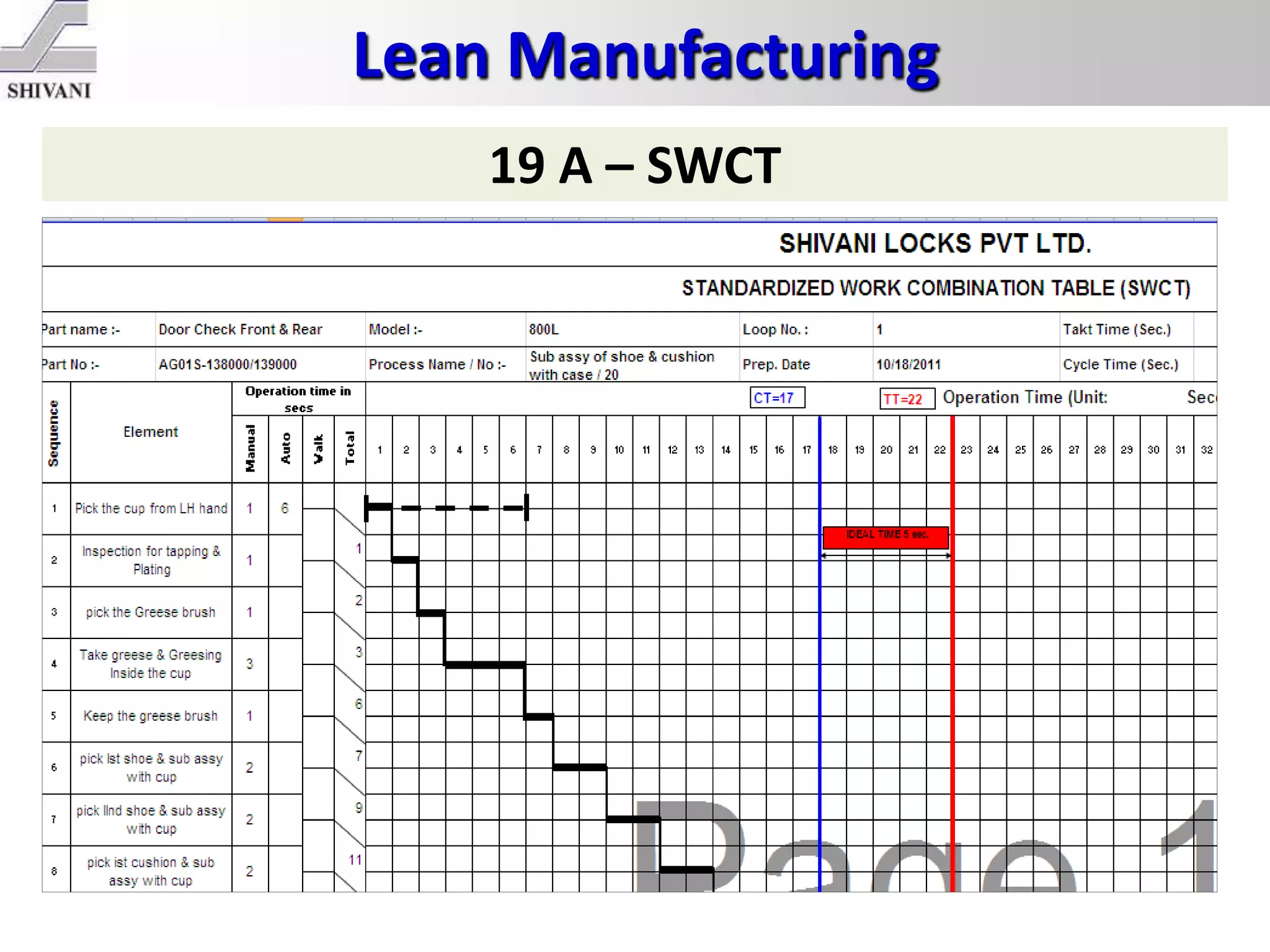
19 – Standardized Work
Documented procedures for manufacturing that
capture best practices (including the time to complete
each task). Must be “living” documentation that is
easy to change.
Lean Manufacturing
19 A – SWCT
Lean Manufacturing
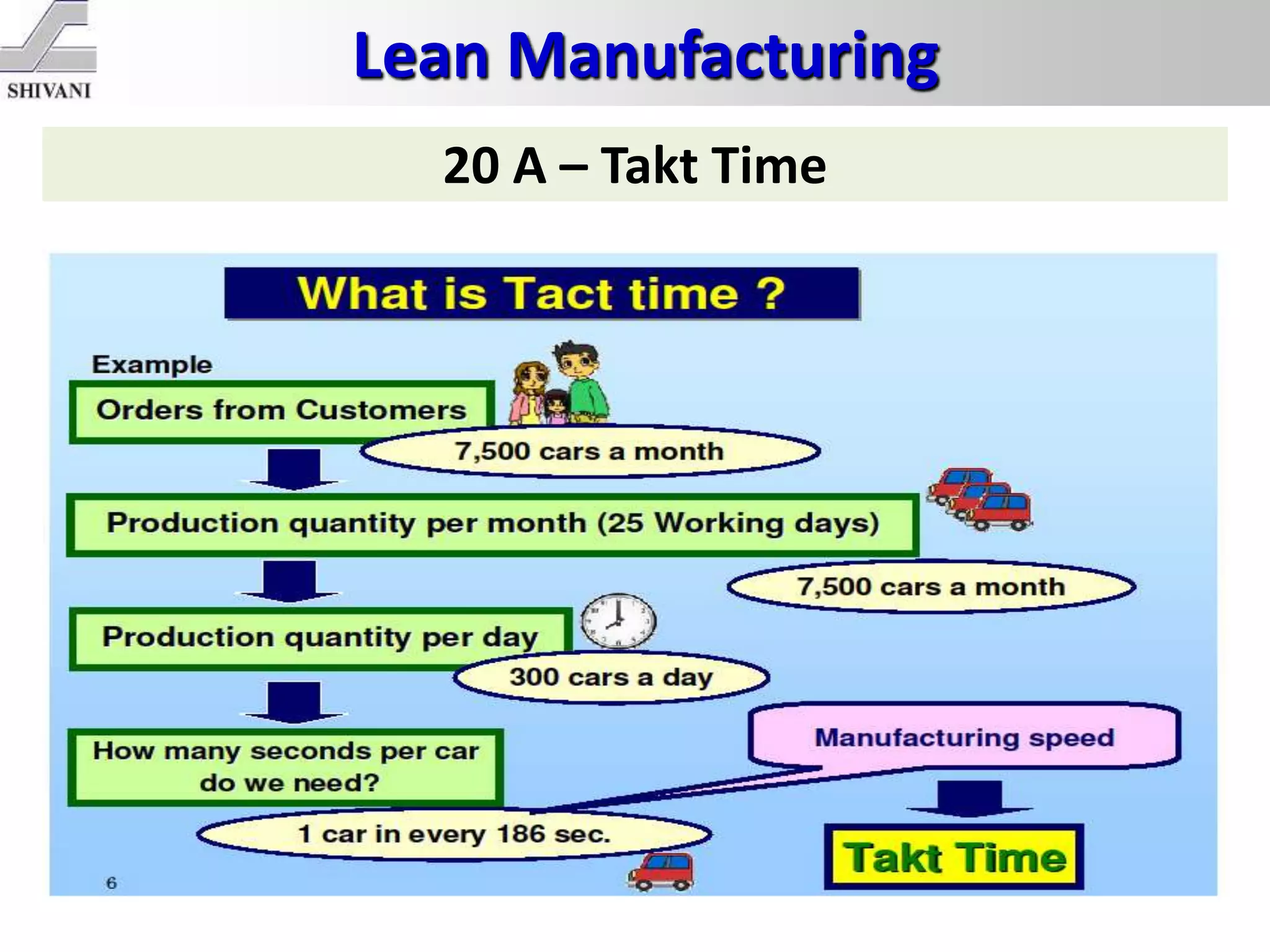
20 – Takt Time
The pace of production (e.g. manufacturing one piece
every 34 seconds) that aligns production with
customer demand. Calculated as Planned Production
Time / Customer Demand.
Lean Manufacturing
20 A – Takt Time
Lean Manufacturing
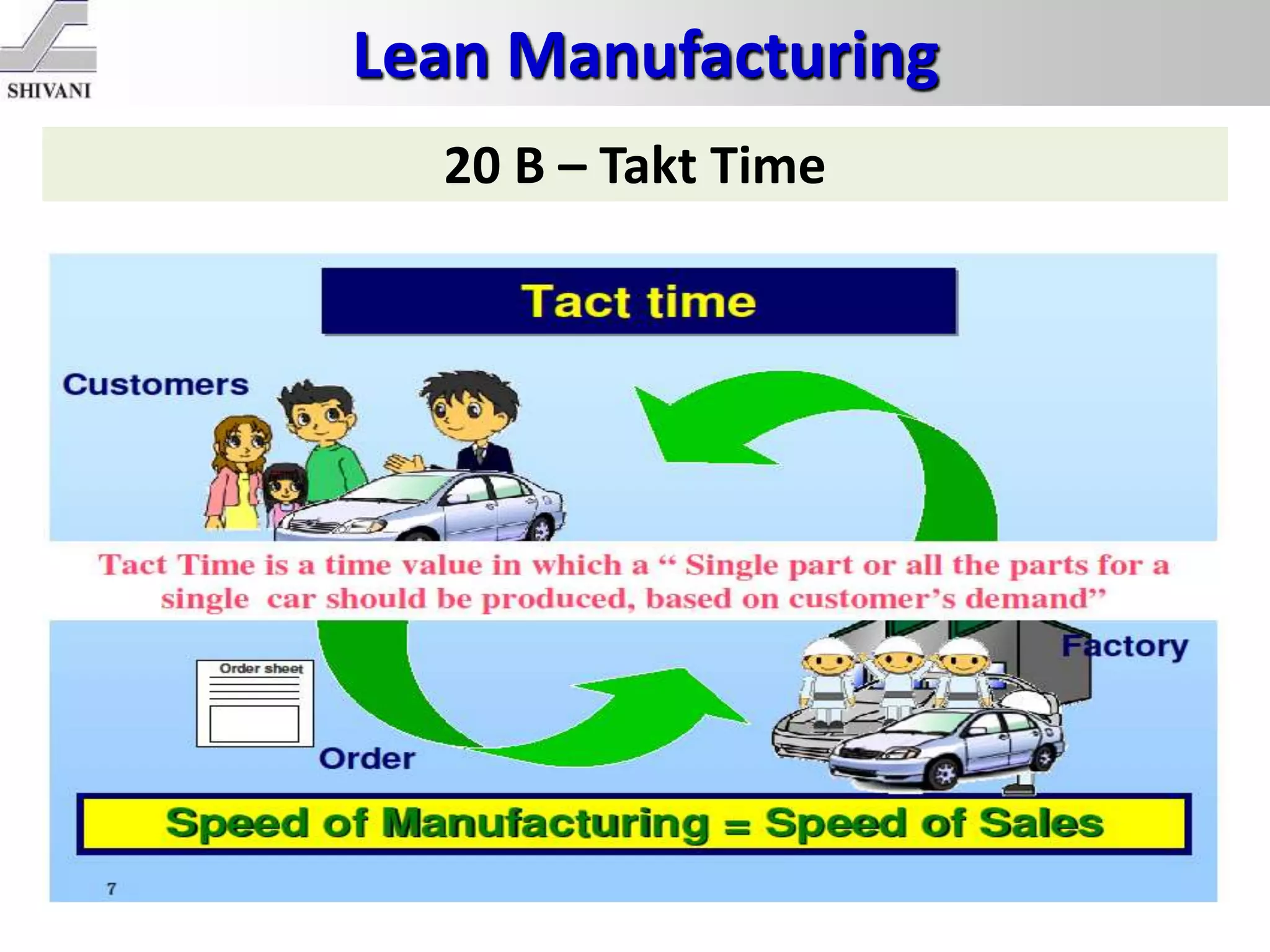
20 B – Takt Time
Lean Manufacturing
21 – TPM
A holistic approach to maintenance that focuses
on proactive and preventative maintenance to
maximize the operational time of equipment.
TPM blurs the distinction between maintenance
and production by placing a strong emphasis on
empowering operators to help maintain their
equipment.
Lean Manufacturing
21 – TPM
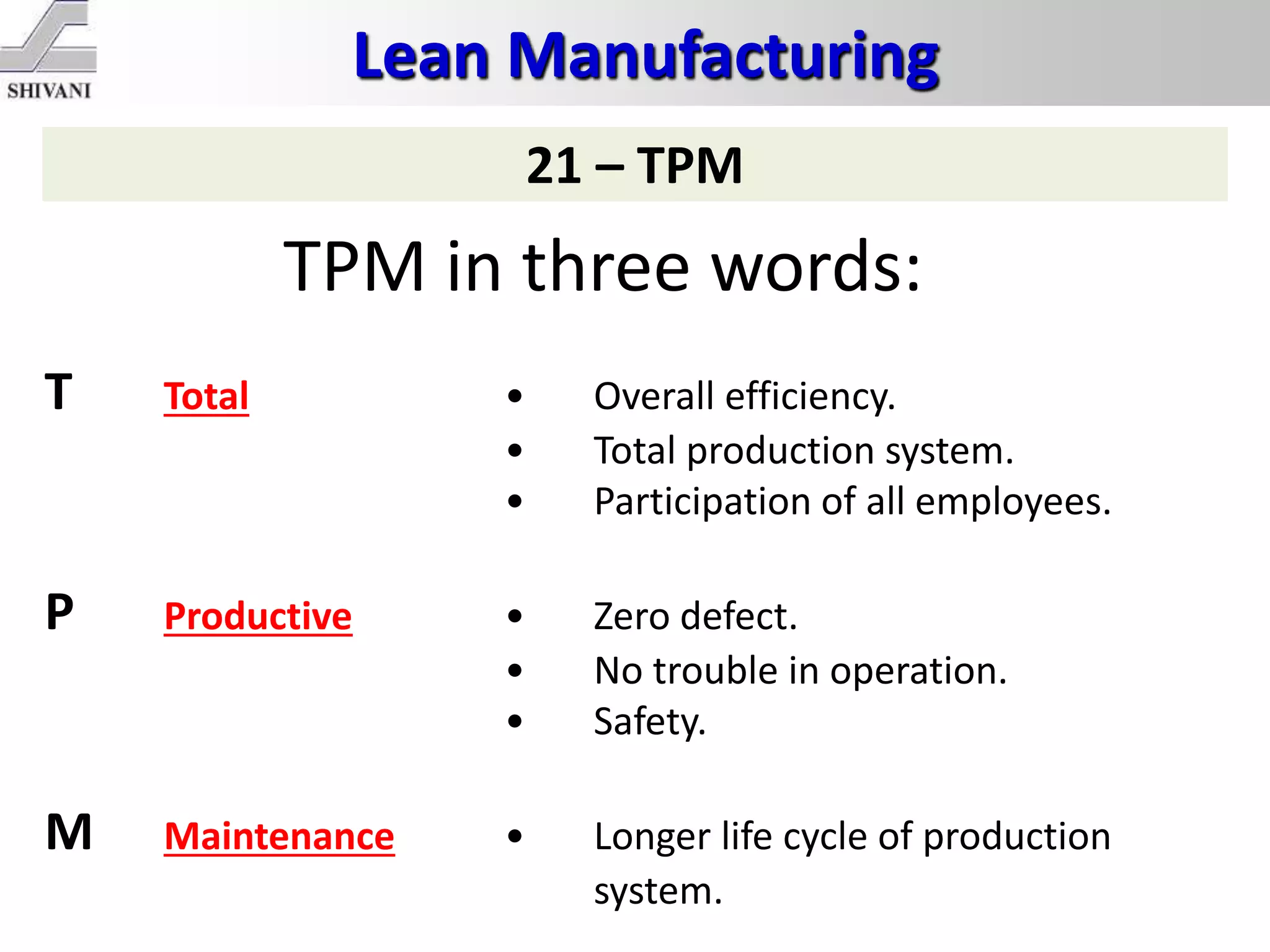
TPM in three words:
T Total • Overall efficiency.
• Total production system.
• Participation of all employees.
P Productive • Zero defect.
• No trouble in operation.
• Safety.
M Maintenance • Longer life cycle of production
system.
Lean Manufacturing
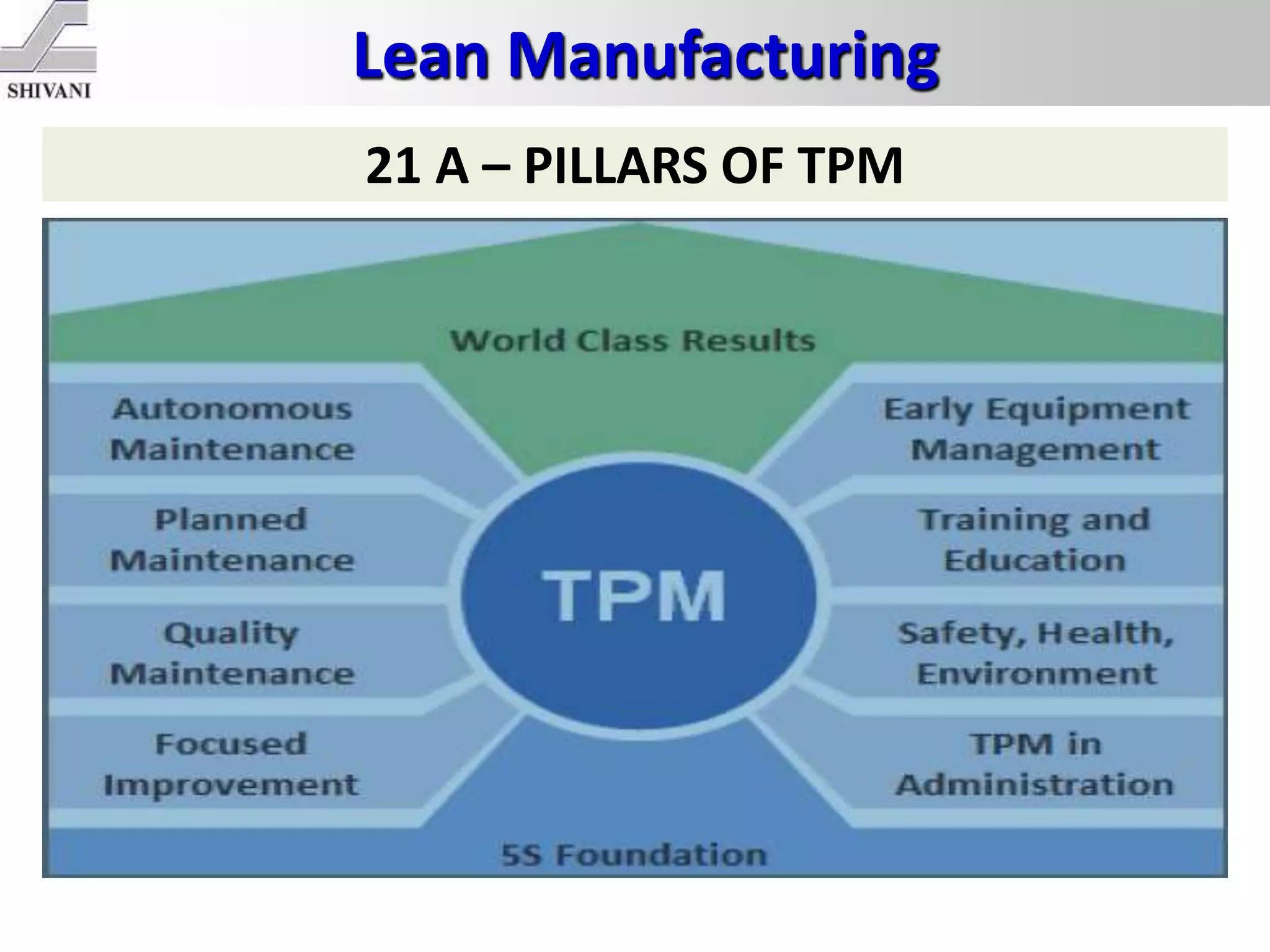
21 A – PILLARS OF TPM
Lean Manufacturing
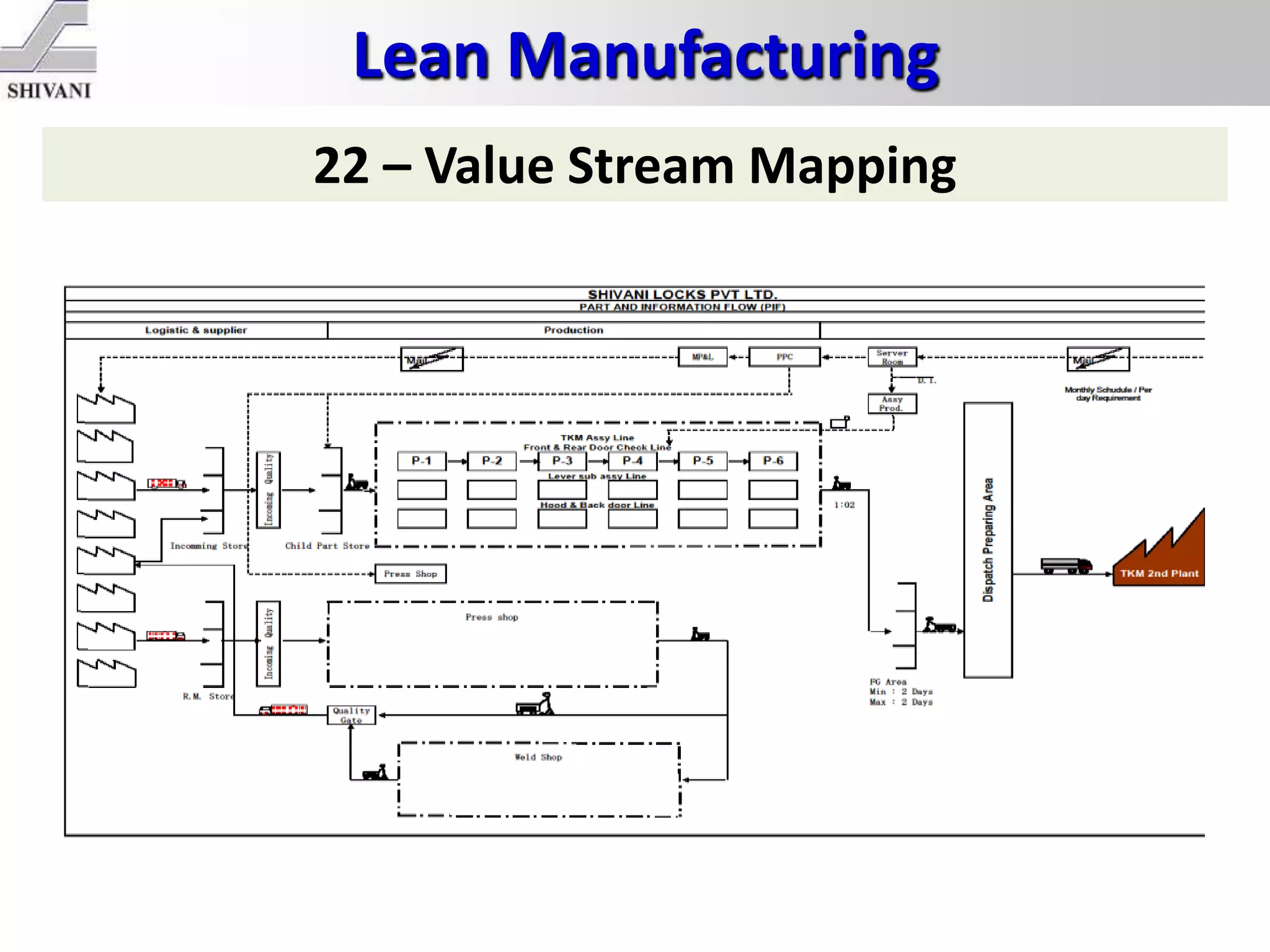
22 – Value Stream Mapping
A tool used to visually map the flow of production.
Shows the current and future state of processes in a
way that highlights opportunities for improvement
Lean Manufacturing
22 – Value Stream Mapping
Lean Manufacturing
23 – Smart Goals
Goals that are: Specific, Measurable, Attainable,
Relevant, and Time-Specific.
Lean Manufacturing
24- Hoshin Kanri
Align the goals of the company (Strategy), with
the plans of middle management (Tactics) and
the work performed on the plant floor (Action).
Lean Manufacturing
25- Visual Factory
Visual indicators, displays and controls used
throughout manufacturing plants to improve
communication of information.
Lean Manufacturing

Tools of lean mfg

  • 1.
    Lean Manufacturing Prepared By-Inderjeet Lean Manufacturing
  • 2.
    Lean Manufacturing TYPES OFACTIVITY/WORK .VALUE ADDED - For which customer pays and necessary. E.g.-Actual Operation (Riveting, Bending) .NON VALUE ADDED - For which customer doesn’t pay but needed. E.g.-Inspection , WIP .WASTE – Does not needed. E.g.- Defects, Delays, Manpower Idle
  • 3.
    Lean Manufacturing CONCEPT WASTE FREEPRODUCTION BY ELEMINTAING WASTES & REDUCING NON-VALUE ADDED WORK
  • 4.
    Lean Manufacturing Definition ofLean-Manufacturing -Systematic Elimination of Waste -Reduction of “FAT” From Production Activities -Half the Hours of Human Efforts -Half the Factory Space for same Output - A Tenth or Less of In Process Inventories “LEAN IS… A mindset, or way of thinking, with a commitment to achieve a totally waste-free operation that’s focused on your customer’s success
  • 5.
    Lean Manufacturing Tools ofLean-Manufacturing 1- 5 ‘S’ 2- Andon 3- Bottleneck Analysis 4- Continious Flow 5- Gemba 6- Heijunka 7- Jidoka 8- JIT 9- Kan-Ban 10- Kaizen 11- KPI (Key Performance Index)
  • 6.
    Lean Manufacturing Tools ofLean-Manufacturing 12- Muda ( Waste) 13- OEE ( Over All Equipment Effectiveness) 14- PDCA 15- Poke-Yoke 16- Root Cause Analysis 17- SMED 18- Six Big Losses 19- Standardized Work 20- TAKT Time 21- TPM 22- Value Stream Mapping
  • 7.
    Lean Manufacturing Tools ofLean-Manufacturing 23- Smart Goals 24- Hoshin Kanri 25-Visual Factory
  • 8.
    Lean Manufacturing 1- 5‘S’ Organize the work area: Sort (eliminate that which is not needed) Set In Order (organize remaining items) Shine (clean and inspect work area) Standardize (write standards for above) Sustain (regularly apply the standards)
  • 9.
    Lean Manufacturing 2- Andon Visualfeedback system for the plant floor that indicates production status, alerts when assistance is needed, and empowers operators to stop the production process.
  • 10.
  • 11.
    Lean Manufacturing 3 -BottleneckAnalysis Identify which part of the manufacturing process limits the overall throughput and improve the performance of that part of the Process
  • 12.
    Lean Manufacturing 3 A– Bottleneck Analysis
  • 13.
    Lean Manufacturing 4 –Continuous Flow Manufacturing where work-in-process smoothly flows through production with minimal (or no) buffers between steps of the manufacturing process.
  • 14.
    Lean Manufacturing 4 A– Continuous Flow
  • 15.
    Lean Manufacturing 5 –Gemba A philosophy that reminds us to get out of our offices and spend time on the plant floor – the place where real action occurs
  • 16.
    Lean Manufacturing 6 –Heijunka A form of production scheduling that purposely manufactures in much smaller batches by sequencing (mixing) product variants within the same process.
  • 17.
  • 18.
  • 19.
    Lean Manufacturing 7 –Jidoka Design equipment to partially automate the manufacturing process (partial automation is typically much less expensive than full automation) and to automatically stop when defects are detected.
  • 20.
    Lean Manufacturing 7 B– Aims of Jidoka
  • 21.
    Lean Manufacturing 8 –JIT (Just In Time ) Pull parts through production based on customer demand instead of pushing parts through production based on projected demand. Depends on many lean tools, such as Continuous Flow, Heijunka, Kanban, Standardized Work and Takt Time. Produce and convey what customers want, when they want in exactly the amount they want.
  • 22.
    Lean Manufacturing 8 A– JIT (Just In Time )
  • 23.
    Lean Manufacturing 9 –Kaizen A strategy where employees work together proactively to achieve regular, incremental improvements in the manufacturing process. Kai + Zen = Better + Change
  • 24.
    Before KAIZEN AfterKAIZEN Operator was putting scrap of wire on table and scrap of wire were spreaded on table A hole is made on table for putting scrap and A red bin is placed for collecting scrap part Kaizen Area : 1- Productivity 2- Quality 3- Work Standardization 4- 5’S’ 5- Safety 6- Customer satisfaction Example of Kaizen Operation/ Machine Kaizen Theme Counter Measure Benefits KAIZEN Diagram Deptt: Mfg Shop/Area: Punto Acctuator Line/Station: Line no-3 Date: 02-01-14 Format No : F020S062/00 Crimping of wire with terminal 5’S’ A hole is made on table 5’S’ improved
  • 25.
    Lean Manufacturing 10 –Kan-Ban A method of regulating the flow of goods both within the factory and with outside suppliers and customers. Based on automatic replenishment through signal cards that indicate when more goods are needed.
  • 26.
    Lean Manufacturing 10 A– Calculation of Kan-Ban
  • 27.
    Lean Manufacturing 10 B– Example of Kan-Ban
  • 28.
    Lean Manufacturing 11 –KPI ( Key Performance Index ) Metrics designed to track and encourage progress towards critical goals of the organization. Strongly promoted KPIs can be extremely powerful drivers of behavior – so it is important to carefully select KPIs that will drive desired Behavior
  • 29.
    Lean Manufacturing 12 –Muda(Waste) Anything in the manufacturing process that does not add value from the customer’s perspective
  • 30.
    Lean Manufacturing 12 A– Muda(Waste)
  • 31.
    Lean Manufacturing 12 B– Muda(Waste)
  • 32.
    Lean Manufacturing 12 C– Muda(Waste) There are seven type of Wastage- 1- Transportation 2- Inventory 3- Motion 4- Waiting 5- Over Production 6- Over Processing 7- Defects These are also known as “TIM WOOD”
  • 33.
    Lean Manufacturing 13 –OEE (Over All Equipment Effectiveness) Framework for measuring productivity loss for a given manufacturing process. Three categories of loss are tracked: Availability (e.g. down time) Performance (e.g. slow cycles) Quality (e.g. rejects)
  • 34.
    Lean Manufacturing 13 –OEE (Over All Equipment Effectiveness) Framework for measuring productivity loss for a given manufacturing process. Three categories of loss are tracked: Availability (e.g. down time) Performance (e.g. slow cycles) Quality (e.g. rejects)
  • 35.
    Lean Manufacturing 13 A– Example for Calculating OEE OEE= Availability x Quality x Productivity Availability- Total Time Available =450 Minutes Time Loss due to Any Reasons = 50 Minutes Total Time Utilized = 400 Minutes Availability %Age = 400/450 = 88.9 % Quality- Total Part Produced = 1200 Pcs Rejection Part = 10 Pcs OK Parts Produced = 1190 Pcs Quality %Age = 1190/1200 = 99.2%
  • 36.
    Lean Manufacturing 13 A– Example for Calculating OEE Productivity- Total Time Utilized =400 Minutes Part produced in Target Time = 1200 Pcs Actual Part Produced = 1150 Pcs Productivity %Age = 1150/1200 = 95.8 % OEE = 88.9 x 99.2 x 88.9/1000000 = 845019/1000000 = 0.845 =84.5%
  • 37.
    Lean Manufacturing 14 –PDCA (Plan,Do,Check & Action) An iterative methodology for implementing improvements: Plan (establish plan and expected results) Do (implement plan) Check (verify expected results achieved) Act (review and assess; do it again)
  • 38.
    Lean Manufacturing 14 –PDCA (Plan,Do,Check & Action)
  • 39.
    Lean Manufacturing 15 –Poke Yoke Design error detection and prevention into production processes with the goal of achieving zero defects.
  • 40.
    Lean Manufacturing 15 A– Poke Yoke Types of Poke Yoke 1-Detection Poke Yoke 2-Prevention Poke Yoke Based on Theory that- 1-Don’t accept NG Part 2-Don’t produce NG Part 3-Don’t pass the NG Part
  • 41.
    Lean Manufacturing 16 –Root Cause Analysis A problem solving methodology that focuses on resolving the underlying problem instead of applying quick fixes that only treat immediate symptoms of the problem. A common approach is to ask why five times – each time moving a step closer to discovering the true underlying Problem
  • 42.
    Lean Manufacturing 17 –SMED ( Single Minute Exchange Die) Reduce setup (changeover) time to less than 10 minutes. Techniques include: -Convert setup steps to be external (performed while the process is running) -Simplify internal setup (e.g. replace bolts with knobs and levers) -Eliminate non-essential operations Create standardized work instructions
  • 43.
    Lean Manufacturing 18 –Six Big Losses Six categories of productivity loss that are almost universally experienced in manufacturing: Breakdowns Setup/Adjustments Small Stops Reduced Speed Startup Rejects Production Rejects
  • 44.
    Lean Manufacturing 19 –Standardized Work Documented procedures for manufacturing that capture best practices (including the time to complete each task). Must be “living” documentation that is easy to change.
  • 45.
  • 46.
    Lean Manufacturing 20 –Takt Time The pace of production (e.g. manufacturing one piece every 34 seconds) that aligns production with customer demand. Calculated as Planned Production Time / Customer Demand.
  • 47.
  • 48.
  • 49.
    Lean Manufacturing 21 –TPM A holistic approach to maintenance that focuses on proactive and preventative maintenance to maximize the operational time of equipment. TPM blurs the distinction between maintenance and production by placing a strong emphasis on empowering operators to help maintain their equipment.
  • 50.
    Lean Manufacturing 21 –TPM TPM in three words: T Total • Overall efficiency. • Total production system. • Participation of all employees. P Productive • Zero defect. • No trouble in operation. • Safety. M Maintenance • Longer life cycle of production system.
  • 51.
    Lean Manufacturing 21 A– PILLARS OF TPM
  • 52.
    Lean Manufacturing 22 –Value Stream Mapping A tool used to visually map the flow of production. Shows the current and future state of processes in a way that highlights opportunities for improvement
  • 53.
    Lean Manufacturing 22 –Value Stream Mapping
  • 54.
    Lean Manufacturing 23 –Smart Goals Goals that are: Specific, Measurable, Attainable, Relevant, and Time-Specific.
  • 55.
    Lean Manufacturing 24- HoshinKanri Align the goals of the company (Strategy), with the plans of middle management (Tactics) and the work performed on the plant floor (Action).
  • 56.
    Lean Manufacturing 25- VisualFactory Visual indicators, displays and controls used throughout manufacturing plants to improve communication of information.
  • 57.