January 24, 2017 Session 1
Chris Loat & Lisa Schwartz
TOOLS FOR MAKING
THINKING VISIBLE
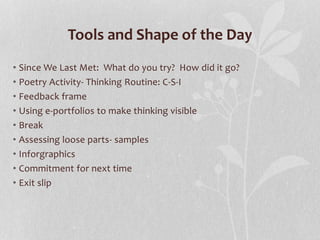
Tools and Shape of the Day
• Since We Last Met: What do you try? How did it go?
• Poetry Activity- Thinking Routine: C-S-I
• Feedback frame
• Using e-portfolios to make thinking visible
• Break
• Assessing loose parts- samples
• Inforgraphics
• Commitment for next time
• Exit slip
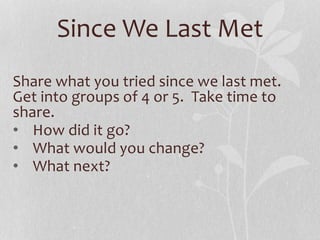
Since We Last Met
Share what you tried since we last met.
Get into groups of 4 or 5. Take time to
share.
• How did it go?
• What would you change?
• What next?
Poetry Activity
•Read the poem, “Starting Now”
•Discuss the author’s message in the poem
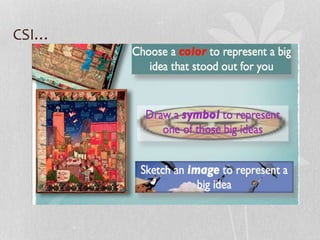
•Use C-S-I strategy to share the message:
Mix and Mingle
CSI…
Thinking About C-S-I and Mix and Mingle
• How does Mix and Mingle support students?
• What is the difference between a symbol and an image?
• How do/would you use C-S-I in your classroom?
• What tool would you ask your students to use to create their C-S-I?
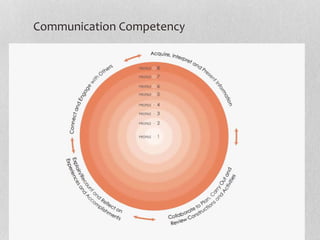
Communication Competency
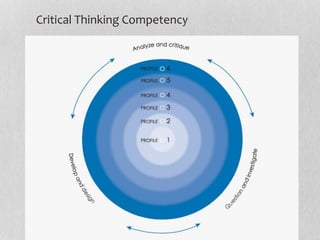
Critical Thinking Competency
Break
First People’s Principles of Learning
Learning is embedded in memory, history
and story.
•Story is used to teach and reflect and
embody our values.
•Stories are passed down from generation to
generation to educate and connect people
to common values.
Teaching Targets
• Make meaningful connections from the story to yourself, other
texts or the world.
• Understand and share the big idea or message that you take away
from the story.
• Share your understanding and connections with others through
talking, loose parts and writing.
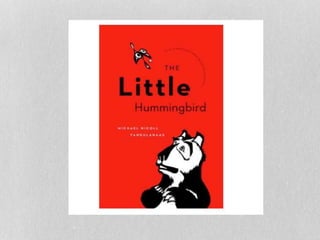
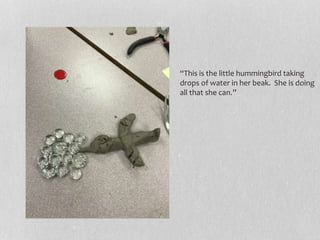
“This is the little hummingbird taking
drops of water in her beak. She is doing
all that she can.”
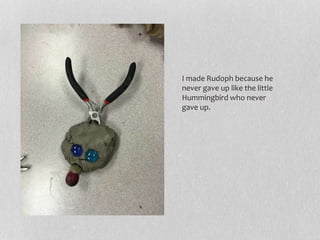
I made Rudoph because he
never gave up like the little
Hummingbird who never
gave up.
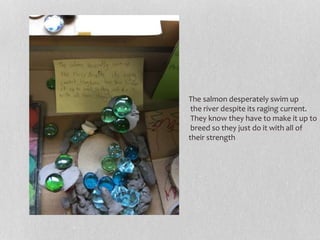
The salmon desperately swim up
the river despite its raging current.
They know they have to make it up to
breed so they just do it with all of
their strength
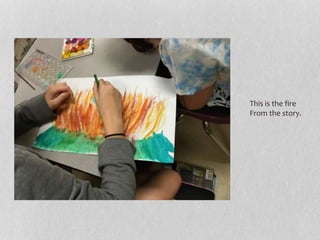
This is the fire
From the story.
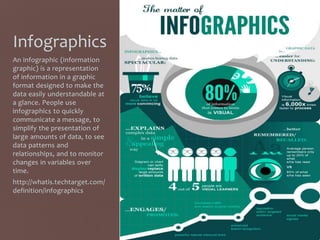
Infographics
An infographic (information
graphic) is a representation
of information in a graphic
format designed to make the
data easily understandable at
a glance. People use
infographics to quickly
communicate a message, to
simplify the presentation of
large amounts of data, to see
data patterns and
relationships, and to monitor
changes in variables over
time.
http://whatis.techtarget.com/
definition/infographics
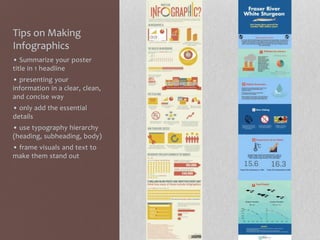
Tips on Making
Infographics
• Summarize your poster
title in 1 headline
• presenting your
information in a clear, clean,
and concise way
• only add the essential
details
• use typography hierarchy
(heading, subheading, body)
• frame visuals and text to
make them stand out
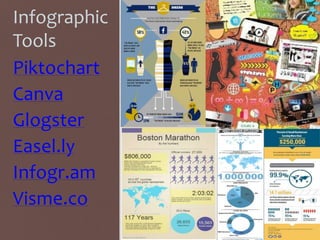
Infographic
Tools
Piktochart
Canva
Glogster
Easel.ly
Infogr.am
Visme.co
What’s your takeaway?
What will you try?
Make a commitment for next time.
Go to http://bit.do/321mtv
NEXT SESSION:
APRIL 26, 2017
8:30-11:30

Tools for Making Thinking Visible

  • 1.
    January 24, 2017Session 1 Chris Loat & Lisa Schwartz TOOLS FOR MAKING THINKING VISIBLE
  • 2.
    Tools and Shapeof the Day • Since We Last Met: What do you try? How did it go? • Poetry Activity- Thinking Routine: C-S-I • Feedback frame • Using e-portfolios to make thinking visible • Break • Assessing loose parts- samples • Inforgraphics • Commitment for next time • Exit slip
  • 3.
    Since We LastMet Share what you tried since we last met. Get into groups of 4 or 5. Take time to share. • How did it go? • What would you change? • What next?
  • 4.
    Poetry Activity •Read thepoem, “Starting Now” •Discuss the author’s message in the poem •Use C-S-I strategy to share the message:
  • 5.
  • 6.
  • 8.
    Thinking About C-S-Iand Mix and Mingle • How does Mix and Mingle support students? • What is the difference between a symbol and an image? • How do/would you use C-S-I in your classroom? • What tool would you ask your students to use to create their C-S-I?
  • 9.
  • 10.
  • 11.
  • 13.
    First People’s Principlesof Learning Learning is embedded in memory, history and story. •Story is used to teach and reflect and embody our values. •Stories are passed down from generation to generation to educate and connect people to common values.
  • 14.
    Teaching Targets • Makemeaningful connections from the story to yourself, other texts or the world. • Understand and share the big idea or message that you take away from the story. • Share your understanding and connections with others through talking, loose parts and writing.
  • 15.
    “This is thelittle hummingbird taking drops of water in her beak. She is doing all that she can.”
  • 16.
    I made Rudophbecause he never gave up like the little Hummingbird who never gave up.
  • 17.
    The salmon desperatelyswim up the river despite its raging current. They know they have to make it up to breed so they just do it with all of their strength
  • 18.
    This is thefire From the story.
  • 19.
    Infographics An infographic (information graphic)is a representation of information in a graphic format designed to make the data easily understandable at a glance. People use infographics to quickly communicate a message, to simplify the presentation of large amounts of data, to see data patterns and relationships, and to monitor changes in variables over time. http://whatis.techtarget.com/ definition/infographics
  • 20.
    Tips on Making Infographics •Summarize your poster title in 1 headline • presenting your information in a clear, clean, and concise way • only add the essential details • use typography hierarchy (heading, subheading, body) • frame visuals and text to make them stand out
  • 21.
  • 22.
    What’s your takeaway? Whatwill you try? Make a commitment for next time. Go to http://bit.do/321mtv NEXT SESSION: APRIL 26, 2017 8:30-11:30

Editor's Notes

  • #10 Communication competency
  • #11 Critical thinking competency
  • #18 The salmon desperately swim up the river despite its raging current. They know they have to make it up to breed so they just do it with all of their strength
  • #19 This is the fire from the story. Why did you make that? I have no idea.