
Learners
and Learning
Section Two: Learning to know
             what we don't know
Writers | Ian Moll, Jill Bradbury, Gisela Winkler,
Maggie Tshule, Merlyn van Voore, Lynne Slonimsky
Editor | John Gultig


The SAIDE Teacher Education Series
Learners and Learning
ISBN 978 0 620 46731 5
© 2010 SAIDE
               This work, a digital version of the SAIDE/Oxford publication of 2002, is
               released under the Creative Commons Attribution 3.0 licence.


1ST EDITION SERIES EDITOR: John Gultig
1ST EDITION AUDIOTAPE: George Lekorotsoana (producer) and John Gultig (concept and script)
DESIGN FOR DIGITAL VERSION: Michelle Randell
ILLUSTRATIONS: Andre Plant

SAIDE	
PO Box 31822	
Braamfontein 2017	
T: (011) 403 2813	
F: (011) 403 2814	
www.saide.org.za; www.oerafrica.org
The first edition was funded by the WK Kellogg foundation. This digital
version has been funded through the International Association of
Digital Publications.
section two


Learning to know
what we don’t know


2.1	 Introduction . .........................................................................................  23
2.2	 How do we begin to know what we don’t know? .....................  25
2.3	 Learning by guessing..........................................................................  33
2.4	 Learning by questioning ...................................................................  47
2.5	 Learning by imagining .......................................................................  57
2.6	 Learning and OBE ................................................................................  64
2.7	 Conclusion and key learning points ..............................................  66
Introduction                                                                                              2.1
In Section One we introduced you to some of the key questions about learning that
will be explored in this module. Can you remember what you learnt? Did your under-
standing of the half-truths change by the end of the section?


What will you learn in this section?
Section Two begins to focus on how we learn in greater detail. In particular, it                      3
explores the following question:
                                                                                         Week 3 begins.


            How is it possible for
          those who do not know
           something to come to
                 know it?


We tackle this question by exploring the ways in which human minds:
•	 construct connections between ideas;
•	 use what is known to understand new and unknown things;
•	 are challenged to change old misunderstandings by new and contradictory
   understandings.

We will also be looking at how teachers can use spontaneous learning actions –
those characteristics which learners naturally possess – to create mental pathways
between what learners already know and what we want them to know (the
unknown).
   We begin by investigating how we learn (Section 2.1). Then, based on this under-
standing, we explore how we can teach so that learning happens. The section
suggests three possible strategies to move learners from the known to the
unknown:
•	 First, by encouraging guessing – by taking risks and making mistakes. We examine
   how Piaget’s ideas of accommodation and assimilation can help us keep a
   balance between the risk of new, unfamiliar ideas and the stability of old, known
   ideas in teaching (Section 2.2).
•	 Second, by encouraging and using questioning – by listening to learner ques-
   tions and asking good teaching questions. We explore a variety of question types
   and how they can be used in lessons (Section 2.3).
•	 Third, by encouraging imagining – by using and escaping from the known, to
   imagine the unknown (Section 2.4).

Learners often use these strategies independently as they learn. But our task is to
find out how we, as teachers, can use these strategies. In order to do this we need to
understand how they both enable and constrain (block) learning.
24                                                        learning to know what we don’t know


     More half-truths to guide your learning
     Before we begin we’d like to activate your minds again by asking you to consider
     these half-truths about learning:


     	 Statement about learning	 What is true about 	                 What is inaccurate
     		                           the statement?	                     or false about the
     			                                                                  statement?
     Learning involves acquiring, retaining,
     and reproducing information.
     As we become better at learning we
     should make less and less mistakes.
     For every question there is only one
     answer.
     A good teacher will be able to answer
     all questions raised in the classroom.
     The use of metaphors and analogies in
     teaching promotes understanding.
     Children are curious and active and
     therefore learn spontaneously.


     Approach this exercise in the same way as you did when you thought about the
     statements made by Dwyer in Section One (page 12). In each case, think about why
     the statement might be considered to be true, why false, and how you might chal-
     lenge and question each statement.
        It is important for you to note that the statements simply present possible under-
     standings of the issues under discussion. Sometimes, by working out why a particu-
     lar understanding is flawed, we can refine our understanding of a phenomenon and
     clarify our own position and our reasons for holding it.
        Remember, these statements should also focus your attention on the key issues
     to be dealt with in this section. In this sense they act as learning outcomes. At the
     end of the section we will reconsider our views on these issues.
How do we begin to know what
we don’t know?                                                                                      2.2
What do we know?
Ask yourself this question, ‘What do I know?’
  The short answer to this question is, ‘A lot!’ In fact, each of us knows so much
about all kinds of things that reporting this knowledge would be impossible.
  So, let’s refine the question and ask one that is more focused about your knowl-
edge in relation to something in particular, ‘What do you know about the game of
soccer?’

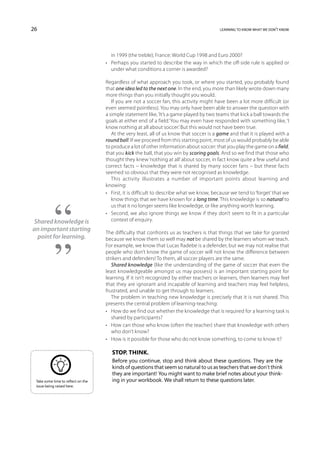
  Stop. Think.
  What do you know about soccer? Write down everything you know about
  the game in three minutes.

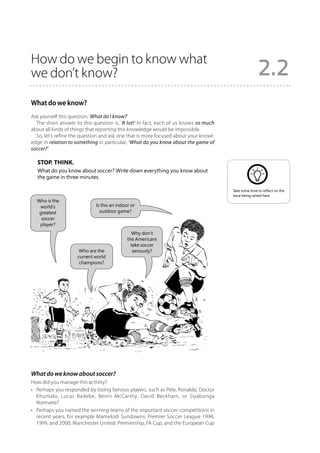
                                                                                     Take some time to reflect on the
                                                                                     issue being raised here.
  Who is the
   world’s                   Is this an indoor or
   greatest                    outdoor game?
    soccer
   player?
                                               Why don’t
                                             the Americans
                                               take soccer
                     Who are the                seriously?
                    current world
                     champions?


What do we know about soccer?
How did you manage this activity?
•	 Perhaps you responded by listing famous players, such as Pele, Ronaldo, Doctor
   Khumalo, Lucas Radebe, Benni McCarthy, David Beckham, or Siyabonga
   Nomvete?
•	 Perhaps you named the winning teams of the important soccer competitions in
   recent years, for example Mamelodi Sundowns: Premier Soccer League 1998,
   1999, and 2000; Manchester United: Premiership, FA Cup, and the European Cup
26                                                                                        learning to know what we don’t know


                                       in 1999 (the treble); France: World Cup 1998 and Euro 2000?
                                    •	 Perhaps you started to describe the way in which the off-side rule is applied or
                                       under what conditions a corner is awarded?

                                    Regardless of what approach you took, or where you started, you probably found
                                    that one idea led to the next one. In the end, you more than likely wrote down many
                                    more things than you initially thought you would.
                                       If you are not a soccer fan, this activity might have been a lot more difficult (or
                                    even seemed pointless). You may only have been able to answer the question with
                                    a simple statement like, ‘It’s a game played by two teams that kick a ball towards the
                                    goals at either end of a field.’ You may even have responded with something like, ‘I
                                    know nothing at all about soccer.’ But this would not have been true.
                                       At the very least, all of us know that soccer is a game and that it is played with a
                                    round ball. If we proceed from this starting point, most of us would probably be able
                                    to produce a lot of other information about soccer: that you play the game on a field,
                                    that you kick the ball, that you win by scoring goals. And so we find that those who
                                    thought they knew ‘nothing at all’ about soccer, in fact know quite a few useful and
                                    correct facts – knowledge that is shared by many soccer fans – but these facts
                                    seemed so obvious that they were not recognised as knowledge.
                                       This activity illustrates a number of important points about learning and
                                    knowing:
                                    •	 First, it is difficult to describe what we know, because we tend to ‘forget’ that we
                                       know things that we have known for a long time. This knowledge is so natural to
                                       us that it no longer seems like knowledge, or like anything worth learning.
                                    •	 Second, we also ignore things we know if they don’t seem to fit in a particular
Shared knowledge is                    context of enquiry.
an important starting               The difficulty that confronts us as teachers is that things that we take for granted
 point for learning.                because we know them so well may not be shared by the learners whom we teach.
                                    For example, we know that Lucas Radebe is a defender, but we may not realise that
                                    people who don’t know the game of soccer will not know the difference between
                                    strikers and defenders! To them, all soccer players are the same.
                                       Shared knowledge (like the understanding of the game of soccer that even the
                                    least knowledgeable amongst us may possess) is an important starting point for
                                    learning. If it isn’t recognized by either teachers or learners, then learners may feel
                                    that they are ignorant and incapable of learning and teachers may feel helpless,
                                    frustrated, and unable to get through to learners.
                                       The problem in teaching new knowledge is precisely that it is not shared. This
                                    presents the central problem of learning-teaching:
                                    •	 How do we find out whether the knowledge that is required for a learning task is
                                       shared by participants?
                                    •	 How can those who know (often the teacher) share that knowledge with others
                                       who don’t know?
                                    •	 How is it possible for those who do not know something, to come to know it?

                                       Stop. Think.
                                       Before you continue, stop and think about these questions. They are the
                                       kinds of questions that seem so natural to us as teachers that we don’t think
                                       they are important! You might want to make brief notes about your think-
 Take some time to reflect on the      ing in your workbook. We shall return to these questions later.
 issue being raised here.
learning to know what we don’t know                                                                                       27


Learning what we don’t know
Sharing knowledge may not sound like a very complicated problem. Surely, you
may think, if people do not know about soccer, they could simply ask someone who
does know to tell them about it! After all this is how we were taught.

   Stop. Think.
   Let’s think about it a bit more carefully. In fact, let’s do a little experiment.
   Without looking at the text, recall as many facts as possible about the game
   of soccer that we have mentioned in this section so far.
                                                                                           Take some time to reflect on the
                                                                                           issue being raised here.
How do we remember things?
If you already knew many things about soccer before you started reading this text,
you probably had no difficulty recalling the information. Even if you didn’t know
every one of the specific facts mentioned beforehand, you would quickly have taken
in any new fact by adding or linking it to your previous knowledge of soccer. This
points to an important idea in good learning:


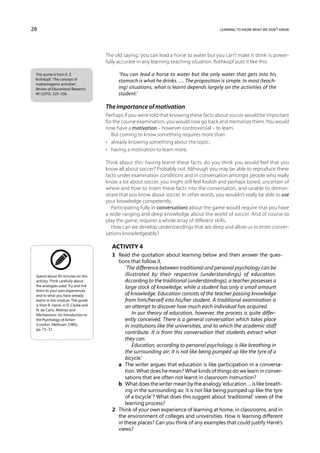
          We learn more by building
          on what we already know.
          Knowing is about making
          relationships by adding to
           our existing networks of
                  knowledge.


If, however, you knew very little about soccer before reading this module you prob-
ably found that you ‘failed the test’. Maybe you didn’t even bother to try, thinking,
‘Why should I try? I am not trying to learn about soccer, it is of no interest to me and
will not help me in any way.’ Ironically your resistance to learning would have identi-
fied another important problem with any learning:


            Learners must experience
              a need to know about
              something and see the
            value of knowing it before
             they can begin learning.
28                                                                                         learning to know what we don’t know


                                      The old saying, ‘you can lead a horse to water but you can’t make it drink’ is power-
                                      fully accurate in any learning-teaching situation. Rothkopf puts it like this:

 This quote is from E. Z.                   ‘You can lead a horse to water but the only water that gets into his
 Rothkopf, ‘The concept of                  stomach is what he drinks. … The proposition is simple. In most (teach-
 mathemagenic activities’,
 Review of Educational Research,            ing) situations, what is learnt depends largely on the activities of the
 40 (1970), 325–336.                        student.’

                                      The importance of motivation
                                      Perhaps if you were told that knowing these facts about soccer would be important
                                      for the course examination, you would now go back and memorize them. You would
                                      now have a motivation – however controversial – to learn.
                                         But coming to know something requires more than:
                                      •	 already knowing something about the topic;
                                      •	 having a motivation to learn more.

                                      Think about this: having learnt these facts, do you think you would feel that you
                                      know all about soccer? Probably not. Although you may be able to reproduce these
                                      facts under examination conditions and in conversation amongst people who really
                                      know a lot about soccer, you might still feel foolish and perhaps bored, uncertain of
                                      where and how to insert these facts into the conversation, and unable to demon-
                                      strate that you know about soccer. In other words, you wouldn’t really be able to use
                                      your knowledge competently.
                                         Participating fully in conversations about the game would require that you have
                                      a wide-ranging and deep knowledge about the world of soccer. And of course to
                                      play the game, requires a whole array of different skills.
                                         How can we develop understandings that are deep and allow us to enter conver-
                                      sations knowledgeably?

                                        Activity 4
                                        1	 Read the quotation about learning below and then answer the ques-
                                           tions that follow it.
                                               ‘The difference between traditional and personal psychology can be
 Spend about 40 minutes on this                illustrated by their respective (understandings) of education.
 activity. Think carefully about               According to the traditional (understandings), a teacher possesses a
 the analogies used. Try and link              large stock of knowledge, while a student has only a small amount
 them to your own experiences,
 and to what you have already                  of knowledge. Education consists of the teacher passing knowledge
 learnt in this module. The quote              from him/herself into his/her student. A traditional examination is
 is from R. Harré, in D. Clarke and            an attempt to discover how much each individual has acquired.
 N. de Carlo, Motives and
 Mechanisms: An Introduction to                    In our theory of education, however, the process is quite differ-
 the Psychology of Action                      ently conceived. There is a general conversation which takes place
 (London, Methuen, 1985),                      in institutions like the universities, and to which the academic staff
 pp. 71–72.
                                               contribute. It is from this conversation that students extract what
                                               they can.
                                                   Education, according to personal psychology, is like breathing in
                                               the surrounding air; it is not like being pumped up like the tyre of a
                                               bicycle.’
                                        	 a	  The writer argues that education is like participation in a conversa-
                                               tion. What does he mean? What kinds of things do we learn in conver-
                                               sations that are often not learnt in classroom instruction?
                                        	 b	  What does the writer mean by the analogy ‘education … is like breath-
                                               ing in the surrounding air, it is not like being pumped up like the tyre
                                               of a bicycle’? What does this suggest about ‘traditional’ views of the
                                               learning process?
                                        2	 Think of your own experience of learning at home, in classrooms, and in
                                           the environment of colleges and universities. How is learning different
                                           in these places? Can you think of any examples that could justify Harré’s
                                           views?
learning to know what we don’t know                                                          29


Learning by ‘breathing the air’
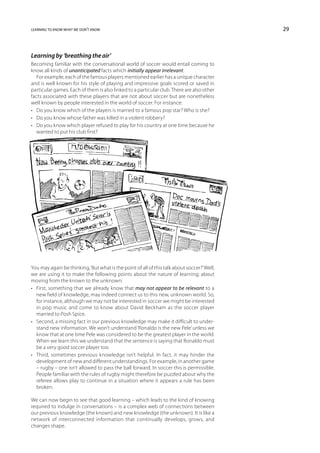
Becoming familiar with the conversational world of soccer would entail coming to
know all kinds of unanticipated facts which initially appear irrelevant.
   For example, each of the famous players mentioned earlier has a unique character
and is well known for his style of playing and impressive goals scored or saved in
particular games. Each of them is also linked to a particular club. There are also other
facts associated with these players that are not about soccer but are nonetheless
well known by people interested in the world of soccer. For instance:
•	 Do you know which of the players is married to a famous pop star? Who is she?
•	 Do you know whose father was killed in a violent robbery?
•	 Do you know which player refused to play for his country at one time because he
   wanted to put his club first?


You may again be thinking, ‘But what is the point of all of this talk about soccer?’ Well,
we are using it to make the following points about the nature of learning; about
moving from the known to the unknown:
•	 First, something that we already know that may not appear to be relevant to a
   new field of knowledge, may indeed connect us to this new, unknown world. So,
   for instance, although we may not be interested in soccer we might be interested
   in pop music and come to know about David Beckham as the soccer player
   married to Posh Spice.
•	 Second, a missing fact in our previous knowledge may make it difficult to under-
   stand new information. We won’t understand ‘Ronaldo is the new Pele’ unless we
   know that at one time Pele was considered to be the greatest player in the world.
   When we learn this we understand that the sentence is saying that Ronaldo must
   be a very good soccer player too.
•	 Third, sometimes previous knowledge isn’t helpful. In fact, it may hinder the
   development of new and different understandings. For example, in another game
   – rugby – one isn’t allowed to pass the ball forward. In soccer this is permissible.
   People familiar with the rules of rugby might therefore be puzzled about why the
   referee allows play to continue in a situation where it appears a rule has been
   broken.

We can now begin to see that good learning – which leads to the kind of knowing
required to indulge in conversations – is a complex web of connections between
our previous knowledge (the known) and new knowledge (the unknown). It is like a
network of interconnected information that continually develops, grows, and
changes shape.
30                                                                                         learning to know what we don’t know


                                     Harré suggests that this kind of learning develops through the act of being within a
                                     conversation, listening to this conversation, and watching how people talk and
                                     behave as they converse. Maybe this is what he means when he says that education
                                     is like ‘breathing the air’? Rather than being fed knowledge, we learn by engaging in
                                     it, observing it, and practising it. What do you think?

                                     Learning about Durban
                                     We now want you to engage in a bit of action to illustrate a number of the points we
                                     have made about learning in this section so far. This time, we want you to think
                                     about what it means to know a city. The city in this case, is Durban. Work through this
                                     example and see if you can identify how this analogy works to illustrate the same
                                     points about learning as those identified in the story about soccer. This example
                                     also introduces some new ideas. If possible, use the example to try to ‘teach’ a
                                     colleague what you have learnt about learning.

                                        Activity 5
                                        1	 Use Appendix A to answer the following questions about the city of
 Spend about an hour on this               Durban. Write your answers in your workbook.
 activity. The appendices with all      	 a	 Where is Durban?
 the information required for
 this activity are at the back of
                                        	 b	Write down as many facts about the history of the city that you can
 this Learning Guide (see pages              find in the material provided.
 213–225).                              	 c	 Describe the population of Durban.
learning to know what we don’t know                                                                                      31


   	 d	 Describe the political profile of Durban.
   	 e	What interesting things are there to do and see in Durban?
   2	 When you have answered the questions, try to connect the facts you
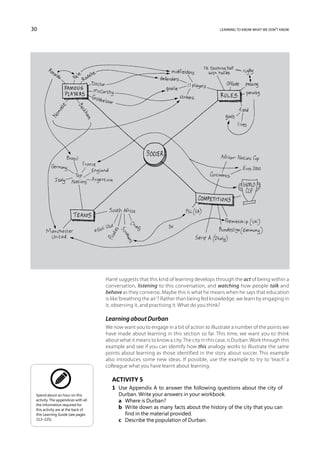
      have unearthed by drawing a mindmap (similar to the one on page 32
      on soccer) of the new knowledge you have acquired about Durban.
   3	 Now think about what this activity has taught you about how people
      move from the known to the unknown. For instance:
   	 a	How would we come to know a place like Durban if we had never
        been there before?
   	 b	How would our knowledge of other cities (and particularly of the
        place where we ourselves live) help us or hinder us in coming to know
        the city of Durban?
   	 c	How would we communicate our knowledge of our home town (or a
        place that we know very well) to someone who doesn’t know it at all?

What did we learn from this activity?
Which of the facts about Durban did you consider to be important? Which facts do
you think are essential to knowing Durban?
   Put yourself in a learner’s position. Think about what you would want to know
about a city and why. Discard the kind of knowing that is associated with recalling
information for an exam. Instead, think about what facts would be useful to a person
living in the city or visiting it as a holiday-maker.
   Would the facts that you have identified above help you to know:
•	 Where to buy cheap, fresh vegetables?
•	 Which are safe and unsafe places to go?
•	 Where there are interesting places to listen to music?
•	 Whether to go there on holiday?
•	 How to look for work there and whether it would be wise to move to the city to
   live there?
•	 Which school to send your children to?
•	 How to get from A to B, from the market taxi-rank to the beachfront for instance,
   or from the airport to Umlazi?

It is interesting that official documents about the city don’t help us very much at all
with developing this sort of knowledge about a place. But the people who live there
certainly have opinions about these things and talking to them and living among
them would enable us to find out this kind of information about the city. To simulate
this experience, we interviewed some Durbanites. Their stories about their home
town are included in Appendix B.

   Stop. Think.
   Turn to Appendix B and read what these Durban residents have to say. Do
   their personal experiences give you greater insight into the aspects of the
   city listed above? Do you notice that the kinds of writing supplied aren’t
   just factual? Instead, they create a kind of conversation about the city, about        Take some time to reflect on the
                                                                                          issue being raised here.
   the experience of living in the city.

These different kinds of knowledge about Durban raise important questions about
how we may go about learning new, previously unknown things about the city:
•	 Which sources of information (for example, the tourist bureau’s brochure, daily
   newspapers, people who live there) would we trust in trying to learn about these
   aspects of the city of Durban?
•	 Would everyone’s knowledge of the city be of the same kind?
•	 Would this make some knowledge of Durban right or wrong?
•	 How would we check or evaluate our own and others’ understandings of
   Durban?
32                                                                                            learning to know what we don’t know


                                        What have we learnt about learning new things?
                                        Think about what the soccer and Durban examples show us about the processes
                                        involved in learning anything new. What general conclusions can we draw that may
                                        apply not just to these examples, but to all processes of knowing and learning to
                                        know new things?
                                           If we assume that knowledge is a system of interrelated facts, we can see how the
                                        task of constructing a mindmap or a network can help us to represent what we think
                                        relationally. By drawing a mindmap we can capture the ideas and the relationships
                                        between them.


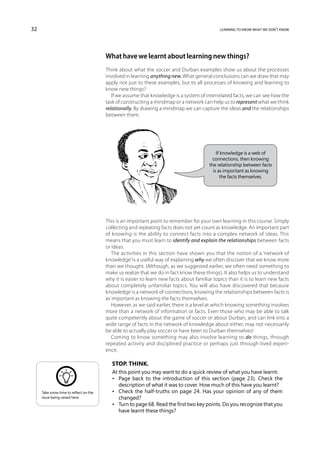
                                                                                             If knowledge is a web of
                                                                                           connections, then knowing
                                                                                         the relationship between facts
                                                                                           is as important as knowing
                                                                                                the facts themselves.


                                        This is an important point to remember for your own learning in this course. Simply
                                        collecting and repeating facts does not yet count as knowledge. An important part
                                        of knowing is the ability to connect facts into a complex network of ideas. This
                                        means that you must learn to identify and explain the relationships between facts
                                        or ideas.
                                           The activities in this section have shown you that the notion of a ‘network of
                                        knowledge’ is a useful way of explaining why we often discover that we know more
                                        than we thought. (Although, as we suggested earlier, we often need something to
                                        make us realize that we do in fact know these things). It also helps us to understand
                                        why it is easier to learn new facts about familiar topics than it is to learn new facts
                                        about completely unfamiliar topics. You will also have discovered that because
                                        knowledge is a network of connections, knowing the relationships between facts is
                                        as important as knowing the facts themselves.
                                           However, as we said earlier, there is a level at which knowing something involves
                                        more than a network of information or facts. Even those who may be able to talk
                                        quite competently about the game of soccer or about Durban, and can link into a
                                        wide range of facts in the network of knowledge about either, may not necessarily
                                        be able to actually play soccer or have been to Durban themselves!
                                           Coming to know something may also involve learning to do things, through
                                        repeated activity and disciplined practice or perhaps just through lived experi-
                                        ence.

                                           Stop. Think.
                                           At this point you may want to do a quick review of what you have learnt:
                                           •	 Page back to the introduction of this section (page 23). Check the
                                              description of what it was to cover. How much of this have you learnt?
     Take some time to reflect on the      •	 Check the half-truths on page 24. Has your opinion of any of them
     issue being raised here.                 changed?
                                           •	 Turn to page 68. Read the first two key points. Do you recognize that you
                                              have learnt these things?
Learning by guessing
                                                                                                               2.3
Our account of learning thus far suggests that the process of learning is both easier
and more difficult than we might have thought! It is easier, because all people
actively think about their worlds and all learners have some knowledge that can be
                                                                                                             4
used in the learning-teaching situation. It is harder, because coming to know about
something entails far more than acquiring and memorizing facts and therefore we
                                                                                              Week 4 begins.
can’t teach learners by simply telling them things. We now move on to suggest three
possible strategies to move from the known to the unknown:
•	 Guessing: learning by taking risks and making mistakes (Section 2.3).
•	 Questioning: listening to learner questions and asking good questions (Section
   2.4).
•	 Imagining: using metaphors and analogies to constitute the unknown (Section
   2.5).


How our fear of the new limits our learning
Learning is always about coming to know something new. This could mean finding
out new information, thinking in a new way, or doing something you have never
done before.
   This is most obvious in school where, for example, we learn new things like how
to do quadratic equations, draw contour maps, and analyse poems. However, living
effectively and independently in the world also involves a process of learning new
things. We learn how to operate a new appliance, to ride a bicycle, to bake a particu-
lar kind of cake, to care for a new-born baby, or to settle an argument between
members of a household.
   This quality of newness or strangeness may generate feelings of curiosity and
excitement, but it may also create a sense of fear about the difficulties and hard work
entailed in learning.
   As teachers, it is easy to forget that the things we now understand – that are easy
– were once strange and unfamiliar to us. As we ‘forget’ that we know things that we
have known for a long time, it becomes very hard to remember that learning them
involved taking risks or making mistakes. Bruner suggests that most of what we
know feels rather more like a well-known story than a list of distinct facts and proce-
dures:

      ‘We live in a sea of stories, and like fish who [according to the proverb]
                                                                                              This quote is from J. Bruner, The
      will be the last to discover water, we have our own difficulties grasping               Culture of Education
      what it is like to swim in stories. It is not that we lack competence [in               (Cambridge, Harvard University
                                                                                              Press, 1996), p. 147.
      doing this]. Far from it. We are, if anything, too expert. Our problem,
      rather, is achieving consciousness of what we so easily do automati-
      cally […]’

In other words, it is difficult to place ourselves in our learners’ shoes. We can’t imagine
the problems they may have with something that is completely familiar to us.
Because we have mastered the equations or the maps etc., we no longer have to
take risks when working with them. So it becomes hard to imagine the feelings of
helplessness or fear some learners experience when they are faced with what seem
to us to be simple tasks.
   But if we don’t begin to understand these feelings – which are very powerful and
can disrupt learning – we limit our abilities as teachers. Let’s begin to understand
these fears by reading through three excerpts describing fear in learning situa-
tions.
34                                                                                           learning to know what we don’t know


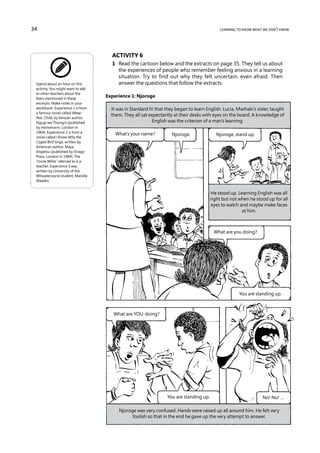
                                      Activity 6
                                      1	 Read the cartoon below and the extracts on page 35. They tell us about
                                         the experiences of people who remember feeling anxious in a learning
                                         situation. Try to find out why they felt uncertain, even afraid. Then
 Spend about an hour on this             answer the questions that follow the extracts.
 activity. You might want to talk
 to other teachers about the
 fears mentioned in these
                                    Experience 1: Njoroge
 excerpts. Make notes in your
 workbook. Experience 1 is from       It was in Standard IV that they began to learn English. Lucia, Mwihaki’s sister, taught
 a famous novel called Weep
                                      them. They all sat expectantly at their desks with eyes on the board. A knowledge of
 Not, Child, by Kenyan author,
 Ngugi wa Thiong’o (published                             English was the criterion of a man’s learning.
 by Heinemann, London in
 1964). Experience 2 is from a          What’s your name?           Njoroge.               Njoroge, stand up.
 novel called I Know Why the
 Caged Bird Sings, written by
 American author, Maya
 Angelou (published by Virago
 Press, London in 1984). The
 ‘Uncle Willie’ referred to is a
 teacher. Experience 3 was
 written by University of the
 Witwatersrand student, Mandla
 Maseko.


                                                                                         He stood up. Learning English was all
                                                                                         right but not when he stood up for all
                                                                                         eyes to watch and maybe make faces
                                                                                                        at him.


                                                                                          What are you doing?


                                                                                                       You are standing up.


                                       What are YOU doing?


                                                                  You are standing up.                            No! No! …

                                         Njoroge was very confused. Hands were raised up all around him. He felt very
                                               foolish so that in the end he gave up the very attempt to answer.
learning to know what we don’t know                                                           35


Experience 2: Maya
      ‘Uncle Willie used to sit like a giant black Z (he had been crippled as a child), and
      hear us testify to the Lafayette County Training School’s abilities. His face pulled
      down on the left side, as if a pulley had been attached to his lower teeth, and his
      left hand was only a mite bigger than Bailey’s. On the second mistake or on the
      third hesitation his big overgrown right hand would catch one of us behind the
      collar, and in the same moment would thrust the culprit toward the dull red
      heater, which throbbed like a toothache. We were never burned, although once
      I might have been when I was so terrified I tried to jump onto the stove to
      remove the possibility of it remaining a threat. Like most children, I thought if I
      could face the worst danger voluntarily, and triumph, I would forever have
      power over it. But in my case the effort was in vain. Uncle Willie held tight to my
      dress and I only got close enough to smell the clean dry scent of hot iron. We
      learnt the times tables without understanding their grand principle, simply
      because we had the capacity and no alternative.’

Experience 3: Mandla
      ‘In 1996, I received a letter that changed my life. It was an acceptance letter
      from Wits University. I could hardly believe it! For the next few days I was so
      excited I could hardly sleep. I had attended a rural school but had always
      dreamt of studying at an institution like Wits. My dream had come true!
          However, being accepted was just the first hurdle. As I began my studies I
      sometimes almost wished I hadn’t been accepted. For starters, it was the first
      time in my life I’d shared a learning area with students of other races, most of
      whom spoke English fluently. The new environment demanded that I speak
      English too. Yet I struggled to construct a sentence for the first few months!
      And asking a question in a lecture was nerve-racking and embarrassing
      because other students – schooled at multiracial or Model C schools – made
      fun of me as I stuttered and mumbled in English. A second problem was the
      library’s computerized catalogue: it looked so sophisticated that I thought I’d
      never be able to use it. I became extremely nervous and worried that I would
      not be able to get a degree and that my family and community would be
      disappointed.
          However, my success in getting in, and my desire to make my family proud,
      made me determined. Although I was still nervous about asking questions in
      class, I realized that doing so helped me learn. Similarly, once I plucked up the
      courage to ask a librarian for help, the computer system in the library proved
      quite easy and a real help in finding information for essays and assignments.
          Perhaps I would have been less anxious in a more comfortable environment
      where I wasn’t pushed to use English constantly and where the library was
      smaller and less imposing. But my excitement about being at Wits was all about
      the wonderful learning opportunity that it represented and so the anxiety
      spurred me on to make sure that I achieved. And so I did, graduating three years
      later, a fully-fledged member of the university community.’

   2	 Now answer these questions:
   	 a	 What makes the learners feel anxious in each experience?
   	 b	Compare the three stories. What is similar in the learners’ experi-
        ences? What is different about their individual experiences?
   	 c	Imagine that you were able to change the conditions of learning for
        these three learners. What would you do for each one?
   	 d	 it possible to remove all the things that made the learners feel
        Is
        anxious?
   	 e	 there any sense in which anxiety may benefit the learning process?
        Is
   	 f	 Can you make a general statement about fear and learning?

The fear of making mistakes
In each of the three experiences, learners report feelings of anxiety:
•	 in Experience 2 the fear is linked to harsh punishment;
•	 in the other two situations there is no such threat. In these instances, the anxiety
36                                                                                learning to know what we don’t know


                             associated with learning is due to a fear of failure or embarrassment.

                           Of course, in some situations, making a mistake may have life-threatening conse-
                           quences, for example, failing to stop at a red robot, putting one’s fingers in an elec-
                           tric socket, or misjudging the intentions of a stranger. Because of this we tell our
                           children, ‘Look left, look right, look left again’; ‘Don’t touch’; ‘Don’t talk to strangers’.
                           We try to ensure that they will avoid these dangerous mistakes, because we want
                           them to survive!
                              However, most mistakes are not of this kind. When we fail to understand a concept,
                           draw a graph incorrectly, or forget the steps in a dance sequence, our lives are not at
                           risk. Yet many of us are terrified of making mistakes. We treat the possibility of error
                           in these and other contexts of learning in the same serious way.
                              It seems that avoiding mistakes is the most important goal in learning. We believe
                           we are always learning to do something ‘right’. Teachers often have similar attitudes
                           to mistakes. They may interpret learners’ mistakes as a failure in their teaching or as
                           an indication that learners are lazy or have not done the necessary work.
                              Either way, mistakes often make teachers angry or frustrated. Here is another
                           extract from Weep Not, Child, Ngugi wa Thiong’o’s novel. It provides us with a good
                           example of how easily teachers can be angered by mistakes.
                              The story is set in colonial Kenya. In the extract, Lucia, the English teacher, has to
                           witness how her class makes mistakes in front of an English-speaking visitor. This
                           provokes very strong feelings in her.

                           The visitor
 Anxiety associated
with learning is often           ‘One day a European woman came to the school. As she was expected, the
due to a fear of failure         school had been cleaned up and put in good order. The children had been told
 or embarrassment.               and shown how to behave. … When she entered, the whole class stood up at
                                 attention. Some had already opened their mouths to answer the expected greet-
                                 ing.
                                     “Good afternoon, children.”
                                     “Good morning, Sir.”
                                     Lucia felt like crying. Had she not taught them the correct thing over and over
                                 again? She had been let down.
                                     The visitor was explaining that, since it was after lunch, after twelve o’clock,
                                 they should talk of “afternoon”, and since she was a woman, they should call her
                                 “Madam”.
                                     “All right?”
                                     “Yes Sir!”
                                     “Madam!” shouted Lucia almost hysterically. She could have killed
                                 someone.
                                     “Yes Madam.”
                                     “Good afternoon.”
                                     “Good afternoon, Madam.” But some still clung to “Sir”. It had come to be
                                 part of their way of greeting. Even when one pupil greeted another, “Sir” accom-
                                 panied the answer.
                                     When the European went away, the children regretted the incident. Lucia
                                 beat them to cool her rage and shame. In the future they were to know the
                                 difference between “a morning” and “an afternoon”, and between “a Sir” and “a
                                 Madam”.’
learning to know what we don’t know                                                                                      37


   Stop. Think.
   Do you notice how strongly Lucia’s fear is driven by her ego? She is terrified
   of being embarrassed by the learners. She is frightened she will be regard-
   ed as a failure. Have you experienced such feelings? Can you suggest better
   ways of responding to mistakes that learners make? How could these                      Take some time to reflect on the
   mistakes be used to support learning that will lead to understanding?                   issue being raised here.


Making mistakes: the secret of successful learning?
The philosopher Dennett makes the strong and unusual claim that attempting to
avoid mistakes is counterproductive to the learning process. He argues that ‘there
are times when making mistakes is the secret of success’. What do you think about
this assertion? Surely success is measured by the lack of mistakes? Let’s read and see
why Dennett says this.

   Activity 7
   1	 Turn to Reading 11. Read the first paragraph only of ‘How to make
      mistakes’ by Dennett. Then answer the following questions.
   	 a	What is Dennett saying that is different from the way you have
        thought about taking risks in learning new things?                                 Spend about an hour on this
   	 b	 Dennett suggesting that every mistake will necessarily be of value
        Is                                                                                 activity.
        for learning?
   	 	 •  What kinds of mistakes would be counterproductive?
   	 	 •  What kind of response to mistakes does Dennett propose as useful
           for learning?

   You will notice that all these questions can be answered, briefly, by reading
   just the first paragraph of the article. Dennett presents the core of his argu-
   ment in the first paragraph. In the rest of the article he establishes the
   reasons and evidence for his position.
      Many academic articles take this form and you can therefore usually use
   the first paragraph to get a general sense of what an article is about. It often
   helps to stop after reading the first paragraph and to try to establish this
   general sense for yourself. Orientating your mind in this way, getting in
   tune with the author, helps you to organize and structure the rest of what
   you read in relation to this general idea.

   2	 Now read the whole article by Dennett before answering the next set of
      questions.
   	 a	Read Dennett’s description of how to learn long division and note
        what he says about the value of guessing. Can you remember an
        example from your own experience where guessing was a valuable
        tool for learning?
   	 b	What, according to Dennett, is the significance of making mistakes in
        public?

A note about good reading and learning
Our questions focus your reading on important parts of the text. Although Dennett,
for instance, discusses the role of ‘mistakes’ in evolution and artificial intelligence,
you have not been asked any direct questions about these sections of the text. This
is because a full understanding of these parts of his argument require other knowl-
edge that you may not have.
   But it is possible to follow Dennett’s central argument about guessing and making
mistakes without grasping these details. Part of becoming a good reader involves
learning which parts of a text to focus on and which can be left for another reading
38                                                                                      learning to know what we don’t know


                                 or another context of learning. Identifying the central argument clearly as we did in
                                 the last activity is one reading strategy. You also need to become comfortable with
                                 skipping or moving quickly through parts of an article without worrying if all of it
                                 makes complete and immediate sense to you.
                                    However, imagine if we told those of you who have no idea what ‘artificial intelli-
                                 gence’ is that it is:

                                       ‘1.	A label for a relatively new interdisciplinary field combining research
                                            and theory from cognitive psychology and computer sciences,
                                            which is focused on the development of artificial systems that
                                            display human-like thinking or “intelligence”.
 This is from A. S. Reber, The         2.	Any manufactured intelligence, i.e. the goal of the field of study in 1.
 Penguin Dictionary of
                                           The work in AI [artificial intelligence] should be, although it often is
 Psychology (Harmondsworth,
 Penguin, 1995).                           not, distinguished from work in computer simulation, in which the
                                           intelligence is in the programmer of the computer and not the
                                           machine itself.’

                                 Once you have understood this definition, reread the sections in Dennett that deal
                                 with artificial intelligence. You will probably understand the references in the
                                 Dennett article that much better now. As we have said before, one way of expand-
                                 ing your existing network of knowledge about any subject is, of course, to read
                                 further on the subject. Then build the new links …


                                 Why is it important to take risks and make mistakes?
                                 Dennett suggests that the key to learning lies in a willingness to guess and take risks
                                 even when these risks lead to mistakes. He goes further to suggest that mistakes
                                 may be more productive for learning than correct guesses.
                                    He accepts that there are times when mistakes are dangerous and should be
                                 avoided, but goes on to argue that we are more afraid of mistakes than we need to
                                 be. In school learning guessing is nerve-racking and many learners prefer to remain
                                 silent and inactive rather than risk a mistake. But because classrooms are places
                                 where we learn new things, school tasks often put us in a situation where, as Dennett
                                 puts it:

                                       ‘the only way to come up with the answer is to take some creative leaps
                                       in the dark and be informed by the results’.

                                 Mistakes can be productive if we make educated guesses. These are guesses that
                                 build on what we already know. Once made, we need to look carefully at the results
                                 to establish whether they are correct or not. Dennett argues that:

                                       ‘we don’t usually have to risk life and limb in order to learn from our
                                       mistakes, but we do have to keep track and actually attend to them’.

                                 If we do not take our mistakes seriously and ‘attend to them’ – look carefully at what
                                 went wrong and why – we limit our opportunities for learning. Think back to Uncle
                                 Willie’s children (see page 38). They recited the times-tables without risking mistakes
                                 because they were afraid of the punishment they would get for ‘being wrong’.
                                 However, because they avoided mistakes, they avoided opportunities for true
                                 understanding. In the end they ‘learnt the times-tables without understanding their
                                 grand principle’.
                                    Most of us may be willing to contemplate the idea that we can learn from our
                                 mistakes as Dennett suggests. By reflecting on the unexpected results or negative
                                 consequences of our actions, we may come to a new understanding of what
                                 happened and why. However, most of us find it very difficult to attend to our mistakes
                                 in public. We prefer to see ‘learning from our mistakes’ as a private, individual experi-
                                 ence to be hidden from others to whom we pretend that we know much more than
learning to know what we don’t know                                                                                       39


we do. The following poem by Laing illustrates this attitude rather well.

      There is something I don’t know
      that I am supposed to know.
      I don’t know what it is I don’t know,
      and yet I am supposed to know,
      and I feel I look stupid
      if I seem both not to know it
      and not to know what it is I don’t know.
      Therefore I pretend I know it.
      This is nerve-racking
      since I don’t know what I must pretend to know.
      Therefore I pretend to know everything.
      I feel you know what I am supposed to know
      but you can’t tell me what it is
      because you don’t know that I don’t know what it is.
      You may know what I don’t know, but not
      that I don’t know it,
      and I can’t tell you.                                                              This poem is from R. D. Laing,
                                                                                         Knots (Random House, 1972).
      So you will have to tell me everything.


Becoming conscious of our mistakes
The all-too-familiar experience captured in Laing’s poem highlights a crucial
problem in the process of learning from mistakes: we often do not realize we have
made a mistake until others tell us so.
   Sometimes our actions may themselves produce negative results that enable us
to learn directly and independently from our mistakes. We can then learn lessons
and draw conclusions from the consequences of our actions that will allow us to do
things differently the next time around. As Dennett says:

      ‘We can actually think the thought, reflecting on what we have just done.
      And when we reflect, we confront directly the problem that must be
      solved by any mistake maker: What, exactly is that? What was it about
      what I just did that got me into all this trouble? The trick is to take advan-
      tage of the particular details of the mess you’ve made, so that your next
      attempt will be informed by it, and not just be another blind stab in the
      dark. In which direction should the next attempt be launched, given that
      this attempt failed?’

Our capacity to learn reflexively is a remarkable human characteristic. This means
that each new guess or creative leap in the dark, is seldom completely random or
undirected. We may feel as if we know nothing about a particular topic (such as
soccer, mathematics, or jazz) or about how to perform a particular task (play a piano,
drive a car, write a poem, make a table). However, our guesses about these things are
never completely uninformed. Rather, they always draw on our previous experi-
ences, and on a lifetime of reflecting on our actions and drawing conclusions. This
uniquely human intelligence is what helps people to deal with the uncertain future.
We use our past experiences and knowledge to guess about the future and antici-
pate likely outcomes of our actions. We can assume that this process of anticipating,
guessing, and moving ahead of what is already known occurs in all learners regard-
less of who they are and what they are trying to learn.

Using others to point out our mistakes
However, sometimes our learning actions may not produce an immediately obvious
negative consequence that tells us of our mistake, or may produce a consequence
that we cannot interpret or learn from. Often the best feedback about our mistakes
40                                                                                          learning to know what we don’t know


                                       comes in conversation with other people, who help us to see our actions in a new
                                       light.
                                          So, while reflection alone may have limited value, reflection with feedback offers
                                       powerful possibilities for changing and developing our understanding. The response
                                       of teachers to mistakes should therefore be to enhance the possibilities for learning
                                       from mistakes by providing feedback that will change understanding and allow for
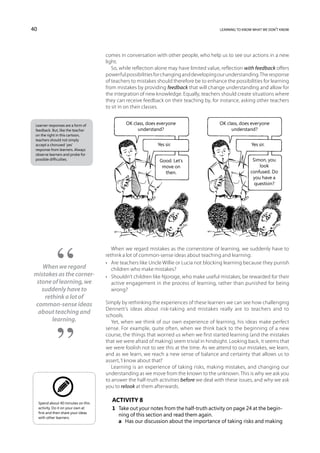
                                       the integration of new knowledge. Equally, teachers should create situations where
                                       they can receive feedback on their teaching by, for instance, asking other teachers
                                       to sit in on their classes.


 Learner responses are a form of                OK class, does everyone                    OK class, does everyone
 feedback. But, like the teacher                     understand?                                understand?
 on the right in this cartoon,
 teachers should not simply
 accept a chorused ‘yes’                                       Yes sir.                                    Yes sir.
 response from learners. Always
 observe learners and probe for
 possible difficulties.                                         Good. Let’s                                 Simon, you
                                                                 move on                                       look
                                                                  then.                                    confused. Do
                                                                                                            you have a
                                                                                                             question?


                                          When we regard mistakes as the cornerstone of learning, we suddenly have to
                                       rethink a lot of common-sense ideas about teaching and learning:
                                       •	 Are teachers like Uncle Willie or Lucia not blocking learning because they punish
   When we regard                         children who make mistakes?
mistakes as the corner-                •	 Shouldn’t children like Njoroge, who make useful mistakes, be rewarded for their
 stone of learning, we                    active engagement in the process of learning, rather than punished for being
   suddenly have to                       wrong?
    rethink a lot of
common-sense ideas                     Simply by rethinking the experiences of these learners we can see how challenging
                                       Dennett’s ideas about risk-taking and mistakes really are to teachers and to
  about teaching and                   schools.
       learning.                          Yet, when we think of our own experience of learning, his ideas make perfect
                                       sense. For example, quite often, when we think back to the beginning of a new
                                       course, the things that worried us when we first started learning (and the mistakes
                                       that we were afraid of making) seem trivial in hindsight. Looking back, it seems that
                                       we were foolish not to see this at the time. As we attend to our mistakes, we learn,
                                       and as we learn, we reach a new sense of balance and certainty that allows us to
                                       assert, ‘I know about that!’
                                          Learning is an experience of taking risks, making mistakes, and changing our
                                       understanding as we move from the known to the unknown. This is why we ask you
                                       to answer the half-truth activities before we deal with these issues, and why we ask
                                       you to relook at them afterwards.


     Spend about 40 minutes on this
                                         Activity 8
     activity. Do it on your own at      1	 Take out your notes from the half-truth activity on page 24 at the begin-
     first and then share your ideas
     with other learners.
                                            ning of this section and read them again.
                                         	 a	 Has our discussion about the importance of taking risks and making
learning to know what we don’t know                                                          41


         mistakes changed your ideas about learning?
   	 b	 How would you now describe the path from the known to the
         unknown?
   2	 Do you remember the learning experience of Njoroge in Activity 6? He
      is made to feel foolish because he makes a mistake and therefore gives
      up his attempts to answer the teacher’s questions. Look at the transcript
      again (page 34).
   	 a	 What errors did Njoroge make?
   	 b	 What do they tell you about Njoroge’s understanding of pronouns?
   	 c	 Explain why you think Njoroge is making these mistakes.
   	 d	 How would you correct Njoroge’s mistakes?


Assimilation and accommodation in learning
The process of learning through guessing (and inevitably making mistakes) can be
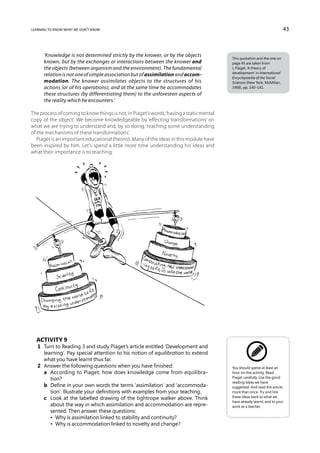
compared to the experience of walking a tightrope. The tightrope walker takes
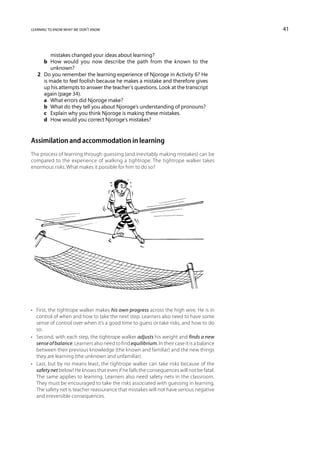
enormous risks. What makes it possible for him to do so?


•	 First, the tightrope walker makes his own progress across the high wire. He is in
   control of when and how to take the next step. Learners also need to have some
   sense of control over when it’s a good time to guess or take risks, and how to do
   so.
•	 Second, with each step, the tightrope walker adjusts his weight and finds a new
   sense of balance. Learners also need to find equilibrium. In their case it is a balance
   between their previous knowledge (the known and familiar) and the new things
   they are learning (the unknown and unfamiliar).
•	 Last, but by no means least, the tightrope walker can take risks because of the
   safety net below! He knows that even if he falls the consequences will not be fatal.
   The same applies to learning. Learners also need safety nets in the classroom.
   They must be encouraged to take the risks associated with guessing in learning.
   The safety net is teacher reassurance that mistakes will not have serious negative
   and irreversible consequences.
42                                                                                     learning to know what we don’t know


                                  There is another reason why the safety net is important for learning. Even when
                                  guessing takes place in the best possible way, giving the learner control and provid-
                                  ing support, there is no guarantee of immediate, complete, faultless understanding.
                                  New understandings may include new errors and new possibilities for mistakes. So
                                  learning is a continuous process of seeking a state of mental balance, integrating
                                  new knowledge with what we already know, and adjusting our previous under-
                                  standings in the light of new knowledge.
                                     The comparison between the tightrope walker and learning is a useful way of
                                  introducing the ideas of Piaget.


                                  What can we learn from Piaget?

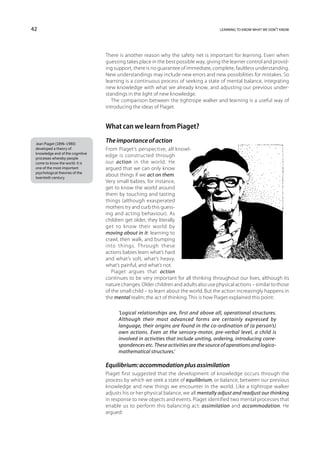
 Jean Piaget (1896–1980)
                                  The importance of action
 developed a theory of            From Piaget’s perspective, all knowl-
 knowledge and of the cognitive
 processes whereby people
                                  edge is constructed through
 come to know the world. It is    our action in the world. He
 one of the most important        argued that we can only know
 psychological theories of the
 twentieth century.
                                  about things if we act on them.
                                  Very small babies, for instance,
                                  get to know the world around
                                  them by touching and tasting
                                  things (although exasperated
                                  mothers try and curb this guess-
                                  ing and acting behaviour). As
                                  children get older, they literally
                                  get to know their world by
                                  moving about in it: learning to
                                  crawl, then walk, and bumping
                                  into things. Through these
                                  actions babies learn what’s hard
                                  and what’s soft, what’s heavy,
                                  what’s painful, and what’s not.
                                     Piaget argues that action
                                  continues to be very important for all thinking throughout our lives, although its
                                  nature changes. Older children and adults also use physical actions – similar to those
                                  of the small child – to learn about the world. But the action increasingly happens in
                                  the mental realm; the act of thinking. This is how Piaget explained this point:

                                        ‘Logical relationships are, first and above all, operational structures.
                                        Although their most advanced forms are certainly expressed by
                                        language, their origins are found in the co-ordination of (a person’s)
                                        own actions. Even at the sensory-motor, pre-verbal level, a child is
                                        involved in activities that include uniting, ordering, introducing corre-
                                        spondences etc. These activities are the source of operations and logico-
                                        mathematical structures.’

                                  Equilibrium: accommodation plus assimilation
                                  Piaget first suggested that the development of knowledge occurs through the
                                  process by which we seek a state of equilibrium, or balance, between our previous
                                  knowledge and new things we encounter in the world. Like a tightrope walker
                                  adjusts his or her physical balance, we all mentally adjust and readjust our thinking
                                  in response to new objects and events. Piaget identified two mental processes that
                                  enable us to perform this balancing act: assimilation and accommodation. He
                                  argued:
learning to know what we don’t know                                                                                       43


      ‘Knowledge is not determined strictly by the knower, or by the objects
                                                                                          This quotation and the one on
      known, but by the exchanges or interactions between the knower and                  page 45 are taken from
      the objects (between organism and the environment). The fundamental                 J. Piaget, ‘A theory of
                                                                                          development’ in International
      relation is not one of simple association but of assimilation and accom-
                                                                                          Encyclopaedia of the Social
      modation. The knower assimilates objects to the structures of his                   Sciences (New York, McMillan,
      actions (or of his operations), and at the same time he accommodates                1968), pp. 140–141.
      these structures (by differentiating them) to the unforeseen aspects of
      the reality which he encounters.’

The process of coming to know things is not, in Piaget’s words, ‘having a static mental
copy of the object’. We become knowledgeable by ‘effecting transformations’ on
what we are trying to understand and, by so doing, ‘reaching some understanding
of the mechanisms of these transformations’.
   Piaget is an important educational theorist. Many of the ideas in this module have
been inspired by him. Let’s spend a little more time understanding his ideas and
what their importance is to teaching.


  Activity 9
   1	 Turn to Reading 3 and study Piaget’s article entitled ‘Development and
      learning’. Pay special attention to his notion of equilibration to extend
      what you have learnt thus far.
   2	 Answer the following questions when you have finished:                              You should spend at least an
   	 a	 According to Piaget, how does knowledge come from equilibra-                     hour on this activity. Read
         tion?                                                                            Piaget carefully. Use the good
                                                                                          reading ideas we have
   	 b	 Define in your own words the terms ‘assimilation’ and ‘accommoda-                suggested. And read the article
         tion’. Illustrate your definitions with examples from your teaching.             more than once. Try and link
   	 c	 Look at the labelled drawing of the tightrope walker above. Think                these ideas back to what we
                                                                                          have already learnt, and to your
         about the way in which assimilation and accommodation are repre-                 work as a teacher.
         sented. Then answer these questions:
   	 	 •  Why is assimilation linked to stability and continuity?
   	 	 •  Why is accommodation linked to novelty and change?
44                                                                                     learning to know what we don’t know


                                   What have we learnt about guessing and learning?
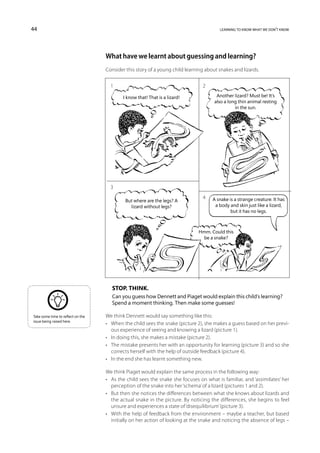
                                   Consider this story of a young child learning about snakes and lizards.

                                     1                                          2

                                           I know that! That is a lizard!             Another lizard? Must be! It’s
                                                                                     also a long thin animal resting
                                                                                               in the sun.


                                     3
                                                                                4   A snake is a strange creature. It has
                                            But where are the legs? A
                                              lizard without legs?                   a body and skin just like a lizard,
                                                                                             but it has no legs.


                                                                              Hmm. Could this
                                                                               be a snake?


                                     Stop. Think.
                                     Can you guess how Dennett and Piaget would explain this child’s learning?
                                     Spend a moment thinking. Then make some guesses!

Take some time to reflect on the   We think Dennett would say something like this:
issue being raised here.
                                   •	 When the child sees the snake (picture 2), she makes a guess based on her previ-
                                      ous experience of seeing and knowing a lizard (picture 1).
                                   •	 In doing this, she makes a mistake (picture 2).
                                   •	 The mistake presents her with an opportunity for learning (picture 3) and so she
                                      corrects herself with the help of outside feedback (picture 4).
                                   •	 In the end she has learnt something new.

                                   We think Piaget would explain the same process in the following way:
                                   •	 As the child sees the snake she focuses on what is familiar, and ‘assimilates’ her
                                      perception of the snake into her ‘schema’ of a lizard (pictures 1 and 2).
                                   •	 But then she notices the differences between what she knows about lizards and
                                      the actual snake in the picture. By noticing the differences, she begins to feel
                                      unsure and experiences a state of ‘disequilibrium’ (picture 3).
                                   •	 With the help of feedback from the environment – maybe a teacher, but based
                                      initially on her action of looking at the snake and noticing the absence of legs –
learning to know what we don’t know                                                                                       45


   she develops a new understanding (a new ‘schema’) of what a snake is (picture 4).
•	 This enables her to ‘accommodate’ the differences.

Without assimilating (using her previous knowledge to make sense of what she
sees), the child would be unable to understand the world. However, without accom-
modating the new and different information that she encounters, her knowledge
would remain static and unchanging. Both aspects of her thinking enable her to
achieve new and more complex states of mental equilibrium.

   Stop. Think.
   Read through these explanations again. Do you notice any similarities
   between these and the process of learning that Socrates took his learner
   through (Section One)? Do you remember the disequilibrium felt by the
   boy in that process?                                                                    Take some time to reflect on the
                                                                                           issue being raised here.

Piaget’s theory offers a formal explanation of the ideas that we have already explored
in the first part of this section (in the examples of learning about soccer and the city
of Durban). He offers us a way to answer our central question, ‘How does the unknown
become known?’
   We do so through a process of equilibration. This involves:
•	 connecting new information to what we already know (assimilation);
•	 noticing, through our action (which includes thinking about what we are doing
   or looking at), that our understanding doesn’t quite explain things (disequilibri-
   um/conflict);
•	 filling in missing gaps in our knowledge by identifying other facts that will help us
   interpret new information;
•	 recognizing novel and contradictory aspects of new knowledge that our previous
   understandings cannot account for, and accommodating these into our new and
   more advanced understanding.

   Activity 10
   1	 Listen to Part 2 of the audiotape. You will first hear Ronny Miller (whom
      you met in Part 1), then some music, and then the author of this section,
      Jill Bradbury. Miller and Bradbury discuss many of the ideas raised in this
      section so far. In particular, listen to how they explain the idea of action
      and experience in learning.                                                          Spend about an hour on this
                                                                                           activity. The audiotape runs for
   2	 Answer these questions when you have finished listening:                             about 9 minutes. Listen
   	 a	   How is their understanding of action and experience (which they call            carefully and take notes as you
           ‘spontaneous discovery learning’) different from what is commonly               listen. The activity is designed
                                                                                           to help you consolidate and
           practised in schools?                                                           apply many of the ideas you
   	 b	   What kinds of skills do teachers need to construct the kind of active           have learnt so far. If you are
           learning environment they suggest?                                              feeling uncertain about these
                                                                                           ideas, relisten to the
   3	 Before you continue we’d like you to do a quick recap of what you have               Introduction and Part 1 of your
      learnt so far. Page back to the introduction to this section. Read through           tape, and reread Sections One
      the half-truths again. Have you changed any of your opinions yet?                    and Two before continuing.
   4	 Choose one idea about learning that you have learnt (and which is new
      to you). Think of how you’d use this to improve your teaching. Explain
      your idea to another teacher and ask for feedback.
46   learning to know what we don’t know
Learning by questioning                                                                                     2.4
What function do questions play in learning?
Questioning is a critical part of both teaching and learning, second only to explana-                   5
tion in its use by teachers in classroom teaching. Unfortunately, however, question-
ing is too often used in a very limited way. Questions are usually:                        Week 5 begins.
•	 asked by teachers and answered by learners;
•	 used to test knowledge recall.

So, while questioning is a valuable and very important teaching tool, it is under-
used.
  Rather than simply assessing the product of learning, questions can and should
be used to drive the process of learning.


     Questioning                    Teachers can                    Listening to
    can be used to                   deepen and                    learner ques-
      predispose                   widen learners’                    tions can
      learners to                   criticality and               provide teach-
        learn. By                    thinking by                  ers with impor-         Although questioning
    asking intrigu-                 using a wide                    tant tools to
    ing questions                     variety of                     guide their
                                                                                          is a valuable and very
     we can make                   question types.                    teaching.             important teaching
    learners more                                                                          tool, it is under-used.
     receptive to
       teaching.


The roles of teacher-as-questioner and learner-as-answerer are sometimes reversed.
Teachers are often expected to possess an encyclopaedic knowledge because
learners frequently see the teacher as a person who will have answers to every ques-
tion. In turn, many teachers believe that their role is to provide the information that
learners seek.
   Playing this role has two key weaknesses:
•	 First, while teachers should know more than their students, it is impossible for
   teachers to know the answer to every question. This isn’t because they are inad-
   equately trained or haven’t studied enough (although sometimes this is the
   reason). It is simply due to the fact that networks of knowledge present us with a
   variety of possible linkages (and thus answers) to questions. As we suggested
   earlier, the more we know the more we know we don’t know!
•	 Second, not all kinds of questions can be answered by simply providing a specific
   piece of information. Sometimes the relationships between facts are very
   complex. It is therefore impossible for teachers to answer some questions by
   simply stating facts. By trying to do so teachers curtail learner motivation to
   enquire further. Do you remember Socrates’ student? He became complacent
   because he thought he knew. Providing answers rather than provoking questions
   can close down learning!
48                                                           learning to know what we don’t know


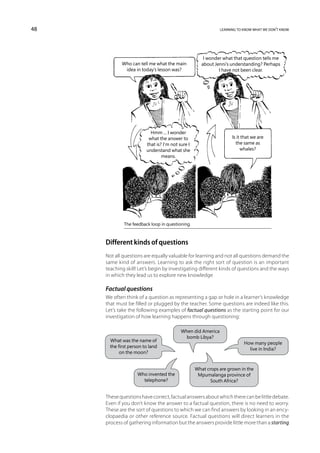
                                                      I wonder what that question tells me
            Who can tell me what the main            about Jenni’s understanding? Perhaps
             idea in today’s lesson was?                     I have not been clear.


                          Hmm ... I wonder
                         what the answer to                        Is it that we are
                        that is? I’m not sure I                      the same as
                        understand what she                             whales?
                                means.


             The feedback loop in questioning.


     Different kinds of questions
     Not all questions are equally valuable for learning and not all questions demand the
     same kind of answers. Learning to ask the right sort of question is an important
     teaching skill! Let’s begin by investigating different kinds of questions and the ways
     in which they lead us to explore new knowledge

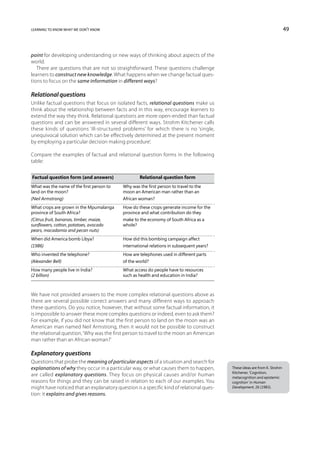
     Factual questions
     We often think of a question as representing a gap or hole in a learner’s knowledge
     that must be filled or plugged by the teacher. Some questions are indeed like this.
     Let’s take the following examples of factual questions as the starting point for our
     investigation of how learning happens through questioning:

                                          When did America
                                            bomb Libya?
      What was the name of
                                                                         How many people
      the first person to land
                                                                           live in India?
           on the moon?


                                                  What crops are grown in the
                    Who invented the               Mpumalanga province of
                      telephone?                         South Africa?


     These questions have correct, factual answers about which there can be little debate.
     Even if you don’t know the answer to a factual question, there is no need to worry.
     These are the sort of questions to which we can find answers by looking in an ency-
     clopaedia or other reference source. Factual questions will direct learners in the
     process of gathering information but the answers provide little more than a starting
learning to know what we don’t know                                                                                          49


point for developing understanding or new ways of thinking about aspects of the
world.
   There are questions that are not so straightforward. These questions challenge
learners to construct new knowledge. What happens when we change factual ques-
tions to focus on the same information in different ways?

Relational questions
Unlike factual questions that focus on isolated facts, relational questions make us
think about the relationship between facts and in this way, encourage learners to
extend the way they think. Relational questions are more open-ended than factual
questions and can be answered in several different ways. Strohm Kitchener calls
these kinds of questions ‘ill-structured problems’ for which there is no ‘single,
unequivocal solution which can be effectively determined at the present moment
by employing a particular decision making procedure’.

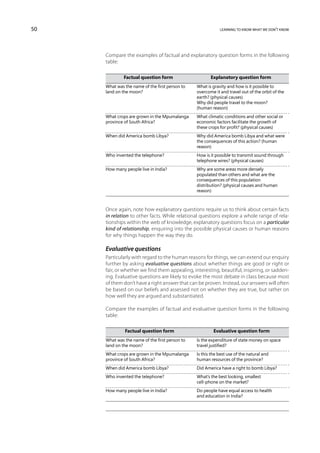
Compare the examples of factual and relational question forms in the following
table:


	Factual question form (and answers)	                Relational question form
What was the name of the first person to 	   Why was the first person to travel to the
land on the moon?	                           moon an American man rather than an
(Neil Armstrong)	                            African woman?
What crops are grown in the Mpumalanga 	     How do these crops generate income for the
province of South Africa?	                   province and what contribution do they
(Citrus fruit, bananas, timber, maize, 	     make to the economy of South Africa as a
sunflowers, cotton, potatoes, avocado 	      whole?
pears, macadamia and pecan nuts)	
When did America bomb Libya?	                How did this bombing campaign affect
(1986)	                                      international relations in subsequent years?
Who invented the telephone?	                 How are telephones used in different parts
(Alexander Bell)	                            of the world?
How many people live in India?	              What access do people have to resources
(2 billion)	                                 such as health and education in India?


We have not provided answers to the more complex relational questions above as
there are several possible correct answers and many different ways to approach
these questions. Do you notice, however, that without some factual information, it
is impossible to answer these more complex questions or indeed, even to ask them?
For example, if you did not know that the first person to land on the moon was an
American man named Neil Armstrong, then it would not be possible to construct
the relational question, ‘Why was the first person to travel to the moon an American
man rather than an African woman?’

Explanatory questions
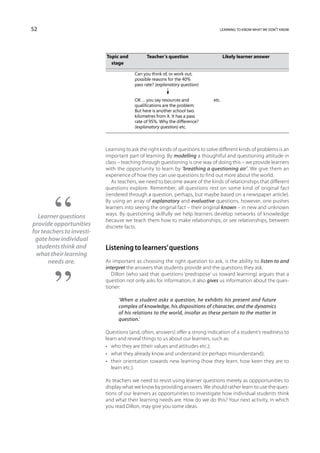
Questions that probe the meaning of particular aspects of a situation and search for
explanations of why they occur in a particular way, or what causes them to happen,          These ideas are from K. Strohm
                                                                                            Kitchener, ‘Cognition,
are called explanatory questions. They focus on physical causes and/or human                metacognition and epistemic
reasons for things and they can be raised in relation to each of our examples. You          cognition’ in Human
might have noticed that an explanatory question is a specific kind of relational ques-      Development, 26 (1983).
tion: it explains and gives reasons.
50                                                            learning to know what we don’t know


     Compare the examples of factual and explanatory question forms in the following
     table:

     	        Factual question form 	                    Explanatory question form
     What was the name of the first person to 	   What is gravity and how is it possible to
     land on the moon?	                           overcome it and travel out of the orbit of the
     		                                           earth? (physical causes)
     		                                           Why did people travel to the moon?
     		                                           (human reason)
     What crops are grown in the Mpumalanga 	     What climatic conditions and other social or
     province of South Africa?	                   economic factors facilitate the growth of
     		                                           these crops for profit? (physical causes)
     When did America bomb Libya?	                Why did America bomb Libya and what were
     		                                           the consequences of this action? (human
     		                                           reason)
     Who invented the telephone?	                 How is it possible to transmit sound through
     		                                           telephone wires? (physical causes)
     How many people live in India?	              Why are some areas more densely
     		                                           populated than others and what are the
     		                                           consequences of this population
     		                                           distribution? (physical causes and human
     		                                           reason)


     Once again, note how explanatory questions require us to think about certain facts
     in relation to other facts. While relational questions explore a whole range of rela-
     tionships within the web of knowledge, explanatory questions focus on a particular
     kind of relationship, enquiring into the possible physical causes or human reasons
     for why things happen the way they do.

     Evaluative questions
     Particularly with regard to the human reasons for things, we can extend our enquiry
     further by asking evaluative questions about whether things are good or right or
     fair, or whether we find them appealing, interesting, beautiful, inspiring, or sadden-
     ing. Evaluative questions are likely to evoke the most debate in class because most
     of them don’t have a right answer that can be proven. Instead, our answers will often
     be based on our beliefs and assessed not on whether they are true, but rather on
     how well they are argued and substantiated.

     Compare the examples of factual and evaluative question forms in the following
     table:

     	        Factual question form	                       Evaluative question form
     What was the name of the first person to 	   Is the expenditure of state money on space
     land on the moon?	                           travel justified?
     What crops are grown in the Mpumalanga 	     Is this the best use of the natural and
     province of South Africa?	                   human resources of the province?
     When did America bomb Libya?	                Did America have a right to bomb Libya?
     Who invented the telephone?	                 What’s the best looking, smallest
     	                                            cell-phone on the market?
     How many people live in India?	              Do people have equal access to health
     	                                            and education in India?
learning to know what we don’t know                                                                                           51


Using a range of questions in teaching
The kinds of questions that focus on the relations between facts, generate a search
for explanations, or evaluate the state of affairs, require more complex processes of
answering than simply ‘filling the gap’ as demanded by factual questions. They are
questions that:
•	 can extend and change our thinking;
•	 help us to focus on unfamiliar aspects of what we already know;
•	 encourage us to actively construct new links between existing facts.

This makes them excellent teaching tools. Rather than limiting questions to those
that have a right answer, and thus encouraging an atmosphere where learners don’t
risk making mistakes, and limiting opportunities for thinking and debate, these
kinds of questions generate new thought and controversy. They ‘predispose’ learn-
ers toward thinking, risk-taking, and thus learning.
   But let’s get active again. We’d like you to practise designing these kinds of ques-
tions.

    Activity 11
    1	 Take another look at the different kinds of questions (factual, relational,
       explanatory, and evaluative) we have used as examples in this subsec-
       tion. Using the same question topics we’d like you to add one or two of
       your own examples for each kind of question. You could, for instance,
                                                                                               Spend about an hour on this
       add a factual question like ‘How old was Neil Armstrong when he walked
                                                                                               activity. You may want to
       on the moon?’ to the question about the first person on the moon. Or a                  ‘practise’ using these questions
       relational question like ‘In what way did the first man on the moon make                with a group of fellow teachers.
       history?’
    2	 Next, we’d like you to think up examples of each kind of question but
       using new ‘topics’. For example, ‘When was Nelson Mandela inaugu-
       rated as South Africa’s president?’ (a factual question in History or
       Human and Social Studies), or ‘Should South Africa use nuclear energy
       as it’s main source of electrical power?’ (an evaluative question).
    3	 Finally, design a short, fifteen-minute lesson teaching a concept or idea
       in an area with which your are familiar using only questions. We’d like
       you to use a range of questions so that you evoke different kinds of
       learning. (Read the subsection on questioning again to see why we use
       questions.) You will also need to imagine how learners will respond to
       each question you ask and build on this. Maybe use a table similar to the
       one below:

	Topic and 	         Teacher’s question	                    Likely learner answer
	 stage
Introduction 	 (Give learners a newspaper article
(evoke 	       with sensationalist report on
interest).	    matric pass rate.)


	              What % of matriculants at X	             Simple question … some might have
	              passed in 2000? (factual question)	      have difficulty working out
		                                                      percentages but should get right
		                                                      answer (40%).


	              Do you think 40% is a good pass 	        Most will say no, some might say
	              rate? (evaluative question)	             yes … mixed response.


	              Yes, it is difficult to answer that. 	   Mixed response … too few
	              Maybe we should explore why the 	        resources … qualification of
	              school has this kind of pass rate. 	     teachers … attitude of learners etc.
52                                                                                learning to know what we don’t know


                           	Topic and 	         Teacher’s question	                   Likely learner answer
                           	 stage

                           	              Can you think of, or work out, 	
                           	              possible reasons for the 40%
                           	              pass rate? (explanatory question)	


                           	              OK … you say resources and 	         etc.
                           	              qualifications are the problem.
                           	              But here is another school two
                           	              kilometres from X. It has a pass
                           	              rate of 95%. Why the difference?
                           	              (explanatory question) etc.


                           Learning to ask the right kinds of questions to solve different kinds of problems is an
                           important part of learning. By modelling a thoughtful and questioning attitude in
                           class – teaching through questioning is one way of doing this – we provide learners
                           with the opportunity to learn by ‘breathing a questioning air’. We give them an
                           experience of how they can use questions to find out more about the world.
                              As teachers, we need to become aware of the kinds of relationships that different
                           questions explore. Remember, all questions rest on some kind of original fact
                           (rendered through a question, perhaps, but maybe based on a newspaper article).
                           By using an array of explanatory and evaluative questions, however, one pushes
                           learners into seeing the original fact – their original known – in new and unknown
                           ways. By questioning skilfully we help learners develop networks of knowledge
  Learner questions
                           because we teach them how to make relationships, or see relationships, between
provide opportunities      discrete facts.
for teachers to investi-
 gate how individual
  students think and       Listening to learners’ questions
  what their learning
       needs are.          As important as choosing the right question to ask, is the ability to listen to and
                           interpret the answers that students provide and the questions they ask.
                              Dillon (who said that questions ‘predispose’ us toward learning) argues that a
                           question not only asks for information, it also gives us information about the ques-
                           tioner:

                                 ‘When a student asks a question, he exhibits his present and future
                                 complex of knowledge, his dispositions of character, and the dynamics
                                 of his relations to the world, insofar as these pertain to the matter in
                                 question.’

                           Questions (and, often, answers) offer a strong indication of a student’s readiness to
                           learn and reveal things to us about our learners, such as:
                           •	 who they are (their values and attitudes etc.);
                           •	 what they already know and understand (or perhaps misunderstand);
                           •	 their orientation towards new learning (how they learn, how keen they are to
                              learn etc.).

                           As teachers we need to resist using learner questions merely as oppportunities to
                           display what we know by providing answers. We should rather learn to use the ques-
                           tions of our learners as opportunities to investigate how individual students think
                           and what their learning needs are. How do we do this? Your next activity, in which
                           you read Dillon, may give you some ideas.
learning to know what we don’t know                                                                                        53


   Activity 12
   1	 Turn to Reading 12, ‘Student questions and individual learning’ by Dillon.
      Start by scanning the whole article and reading the headings of each
      section. This will give you an idea of what the article is about.
   2	 Focus on Dillon’s ideas about how questions reveal learners’ ‘pre-under-            This is a reading activity and
      standing’. Then answer the following questions:                                     should take you no less than an
                                                                                          hour to complete. Use the good
   	 a	 What do the following questions tell us about what the questioner                reading tips we have already
         already knows:                                                                   taught you. If you’d like to
                                                                                          discuss the ideas in this reading,
   	 	 •  Do you think that dagga should be legalized?                                    do so only after you have
   	 	 •  Would you help me with this problem, I am very confused?                        answered the questions and
   	 	 •  Why are you being so difficult?                                                 thought carefully about the
                                                                                          ideas.
   	 	 •  Don’t you think this picture of a river is beautiful?
   	 b	 Look at each of the questions above again. What do they tell us about
         the questioner’s ‘dispositions’ (the kind of person she is, her attitudes
         towards the issue about which she is asking and towards the person
         whom she is asking)?
   3	 Now reread the first three paragraphs of the section in which Dillon
      deals with ‘the question sentence’. He argues here that a question may
      reveal a misunderstanding that needs correcting before any kind of
      answering can make sense. We can refer to the understanding implicit
      in a question as a kind of ‘preunderstanding’. It is the understanding that
      exists prior to the question and on the basis of which the question is
      formed.
   	 a	 Reread the question about the man who beats his wife and explain
         why this question cannot and should not be answered.
   4	 Finally, read the section called ‘The questioning act’. As you read, make
      a note of the positive and negative feelings that the act of questioning
      provokes.
   	 a	 Using your notes, how would you explain the observation that many
         learners do not like to ask questions in class? How would you encour-
         age questioning in the classroom?

What can we learn from Dillon?
Questions seem to demand answers and we often think that the quicker and more
certain the answer, the better it is.
   However, Dillon says that ‘to begin by answering the question may be a peda-
gogical blunder’. He suggests that, instead, we should treat a question like a doorway
that opens into a new room. Rather than simply closing the door as soon as it is
opened (by answering a question the moment it is asked), we should pay attention
to the question itself. This will allow us to enter into the space that it creates for
dialogue and discussion.
   For example, when learners ask questions that cannot be answered easily, we can
use them to trigger discussions that will focus the whole group’s learning in new
ways. Our teaching response to the questions of our students may very often take
the form of yet more questions rather than answers.
   You will have noticed that some questions reveal more about what a person
knows than others. Some questions tell us very little about the disposition (person-
ality or attitudes) of the questioner, whereas other questions reveal a lot. However,
all questions reveal something about the questioner – about what they know and
about who they are. For these reasons we should pay attention to the question
rather than just rushing to answer it. We need to pay attention to the partly-disguised
clues or hints in questions by ‘reading’ and interpreting their meanings more care-
fully. By doing this we will be able to respond to learners in more effective ways.
   Remember though that questions alone do not necessarily lead to learning. Also,
if we ask the wrong kinds of questions, we may block rather than facilitate learning.
The following activity will illustrate this point.
54                                                                                   learning to know what we don’t know


                                   Activity 13
                                   1	 Read the exchange below between a teacher and a group of learners.
                                      The teacher is using a question- and-answer method to introduce the
                                      learners to a new idea (in this case the notion of ‘homology’).
                                   2	 As you follow the lesson, pay particular attention to the questions the
                                      teacher asks. Consider:
                                   	 a	 Which questions block learning and which encourage learning?
 Spend about 30 minutes on this          Explain your answer.
 activity. When you have           	 b	 How would you judge the quality of the questions asked? Your
 finished, relisten to Part 2 of
 your tape. Do Miller and
                                         comment on the quality of the questions should make use of the
 Bradbury’s ideas about                  ideas we have discussed so far. For example:
 questioning provide you with      	 	 •  What kinds of questions are being asked?
 any new ways of thinking about
 this activity?
                                   	 	 •  Are they factual, relational, explanatory, or evaluative?
                                   	 	 •  What knowledge do these questions presuppose?
                                   	 	 •  What do the questions tell you about the disposition of the
                                           teacher?
                                   3	 Compare the kinds of questions in this activity with those you devised
                                      for your lesson in Activity 11. On reflection, do you think that some of
                                      your questions may block learning? Why?


                                      I am going to explain to you what a homology is and why it is an important
                                         concept in evolutionary theory. Who can tell me what a homology is?


                                                                         Homology means that we share the same
                                                                         structure of certain body parts with other
                                                                           animals. OK. Like for instance, my hand
                                                                          has five digits. A whale, unbelievably, has
                                                                           five digits too. OK. So what homologies
                                                                         show is that we share a common ancestor.
                                                                          Homologies show similar structures but
                                                                           different functions, OK? My hand has a
                                                                         similar structure to a whale’s flipper. Look
                                                                         at the diagram. But clearly the function or
                                                                              use of my hand is different isn’t it?


                                                                                                         Yes.


                                            I don’t use my hand for swimming. What does the whale use its flipper
                                                                           for?

                                                          Swimming.
learning to know what we don’t know                                                                                       55


   For swimming. OK. The whale is wonderfully adapted for being in water and I am
           not. However, we have the same structure. What do we have?

   The same structure.


                           OK. That’s homologies. If we have the same structures we can
                                   show that we come from the same ancestor.


What can we learn from this activity?
This teacher uses a lot of questions in a fairly short space of time. One might think
about this, ‘Good, she knows that questions are part of good teaching!’
   The problem is that her questions don’t lead students into the unknown. They
also don’t provoke learning. Notice that she gets two kinds of responses to her ques-
tions:
•	 Her first question is met with complete silence. Why? Because the students can’t
   possibly answer it! If they could answer it and knew what ‘homologies’ were, the
   lesson would be unnecessary. They know that this is not a ‘real’ question and so
   don’t respond. It serves right at the outset to establish the students’ ignorance
   and the teacher’s knowledge.
•	 Her other questions are answered enthusiastically. Why the difference in response?
   And does this signal a better use of questions? Learners answer these questions
   because they are safe questions. They are safe for the teacher because she knows
   learners can answer them and so she feels affirmed. They are safe for the learners
   because they know exactly what the teacher wants to hear. The problem is that
   these questions are not really questions that promote learning; they only serve to
   prompt the students to repeat the teacher’s story. It isn’t possible for us to tell
   from their answers whether the learners have understood the concept of homol-
   ogies or why it is important for evolutionary theory.

If the teacher asked her first question again at the end of the lesson, do you think the
students would now be able to answer it?
    We don’t think so!

   Stop. Think.
   We have come to the end of this subsection. Before you rush off, or move
   on to the next subsection, stop and think.
   •	 Try and organize what you have learnt so far. Make links, and think of
      practical applications.                                                              Take some time to reflect on the
                                                                                           issue being raised here.
   •	 Check whether you have understood the ideas well enough to use them
      in your teaching and learning. See if you can talk about them by talking
      to other teacher-learners.
   •	 Can you link the ideas together into a network of knowledge about
      learning?
   •	 Refer back to the half-truths (page 24). Have you changed, or added to,
      any of your earlier ideas?
56                                                        learning to know what we don’t know


     This is what we think we have covered so far
     We began our discussion on asking and answering questions by wondering how
     questions can help learners to bridge the gap between the known and the unknown.
     We then showed how different kinds of questions bridge this gap in different ways.
        Although our common sense tells us that good answers are more important for
     learning than good questions, Dillon’s article challenges us to turn this thinking on
     its head. The reading showed that questions can be more important than answers
     because they:
     •	 allow us to construct new relationships between facts;
     •	 reveal a lot of useful information about the learner.

     What happens before the answer (be it a question, a guess, or a mistake) is what
     really counts when we chart the path from the known to the unknown.
Learning by imagining                                                                                         2.5
The power of our imagination
A remarkable feature of human thinking is our capacity to imagine things.                                  6
We can create pictures in our minds about things we have never seen or events that
we have never personally experienced. We can compose stories that take place in              Week 6 begins.
other worlds, or in our world but which have characters that don’t exist (who are
invented by the author). The ability to imagine is one of the characteristics that
distinguish human beings from other living creatures.
   Yet although imagination is often spoken of as an important part of teaching and
learning, it is seldom used to its full potential. How can we use it to assist learners to
move from the familiar known, to the unknown?
   The unknown can be imagined or created in the mind’s eye if we, as teachers,
create the opportunity for learners to do this. Imagining is, if you think about it, a
kind of guessing. We guess, or imagine, what might happen if we do something (or
don’t do it). We guess about things that we don’t yet know and in so doing we create
possibilities for exploration and testing.
   However, the imagined world is seldom (if ever) created out of nothing. We draw
on what we already know to imagine what is possible. We create a path between the
known and the unknown. The closer the imagined possibility is to what we have
previously experienced and already know, the easier it is to learn. The further away
from our own experience we travel, the more room there is for ‘error’ in our imagined
reality and the greater the possibility for surprise.
   The power of imagination lies primarily in that it allows us to loosen our mental
grip on familiar things. By doing this we are able to think of new worlds that would
not be possible if we held tightly to the familiar. By opening up these new worlds,
we can also begin to change our understandings.
   Rather than tell you how to use imagination as a teaching tool, we’d like you to try
the following activity. Through action you will experience both:
•	 the power of imagination and surprise;
•	 how our ‘familiar’ shapes and constrains our ability to imagine.

   Activity 14
   1	 Imagine the people, objects, or events described below. In each case jot
      down a few words that describe what you imagine or, if you prefer, make
      a simple sketch.
   	 a	 woman who testified about the murder of her father at the Truth
         A                                                                                   Do this activity quickly. Spend
         and Reconciliation Commission.                                                      no more than 15 minutes on it.

   	 b	 A vast crowd of people.
   	 c	 A man jumping off a high bridge.
   	 d	 A child swimming in a large pool.
   	 e	 A powerful, democratic leader.
   	 f	 Landing on the moon.
   2	 Now look at the photographs in Appendix C on page 223. Compare the
      images with those that you imagined. Were there things about these
      images that surprised you?
58                                                                                          learning to know what we don’t know


                                     How does our imagination work?
                                     Did you imagine the woman who testified at the TRC as a black woman or a white
                                     woman? Given that most victims of apartheid were black, most readers probably
                                     imagined a black woman, possibly an older woman in a great deal of distress. (We
                                     would also have ‘learnt’ this from seeing clips from TRC hearings on television.)
 These extracts are taken from          Given that the photograph is of a young, white woman can you imagine who she
 an article by J. Turner published   is and what story she told? Maybe you said she had been bombed by ANC guerrillas?
 in the Mail  Guardian on 2
 September 1997.                     Maybe you thought she was asking for compensation from the ANC? Read this
                                     excerpt from a newspaper. It tells you who the woman is.


 Will somebody please just tell me who killed my father?
 Activist Rick Turner was gunned            The Truth and Reconciliation              1993. I had been filming in the house
 down at his door in 1978, one of the       Commission offered the first and          at Dalton Avenue. It was late at night,
 early victims of apartheid hit squads.     last hope that my father’s assassina-     the crew wrapped and piled outside
 For years his daughter, Jann Turner,       tion would be officially investigat-      into the car. They left me alone to
 has been trying to find the killer. This   ed. It was a real chance to break         close the place up. It’s very hard to
 is the moving story of her search ...      through the wall of silence surround-     articulate what happened next,
                                            ing Boss and the security police.         because what I felt was so intense
 ‘I began searching for my father’s
                                                                                      that I seemed to see it and hear it as
 killer in 1989. I was living in New        This week sources within the              well. As I walked around the house
 York City at the time. I read in the       commission told me that their inves-      locking up, I felt the house leaving
 paper that an investigative journalist     tigations have revealed a high-level      me. Each room; his bedroom, the
 called Jacques Pauw had blown the          cover up. But that is all. It seems       bathroom, the kitchen – the rooms
 lid on a place called Vlakplaas,           they’ve been thorough in checking         and I said our farewells to one
 South Africa’s death squad HQ.             out the police, but have they request-    another.
 Horror unfolded in the forms of            ed Boss and security police files?
 Almond Nofomela and Dirk Coetzee           Have they subpoenaed everyone I           Finally I stood on the place where
 and for the first time I pictured my       listed in my submission, everyone         my father died. I felt him leave the
 father’s murderer as a person, rather      with something to tell us about my        place on the floor, I saw him rise up
 than a state or a system. [...]            father’s murder? If not, why not?         from there and leave that dying-
                                                                                      place. I had this vision – I don’t know
 No one has applied for amnesty for         Alex Borraine, acting chair of the        what else to describe it as. It was a
 the murder of Dr Rick Turner. Over         commission, re-emphasized to me           vision of me and him in a place like a
 the years there have been a series of      this week that “the time we would         wind tunnel, but the wind was pulling
 leads, flutterings of hope when it         like to devote to individual incidents    us in different directions. We were
 seemed we might discover who               just isn’t available, there are so many   literally flying, but we were holding
 killed him and why, but we’ve              others to do”. It’s awful, but I do       onto each other by our fingertips and
 always ended up with the fantasies         understand. Truth commissioner            the effort of holding on was
 of cranks or hitting the wall of silence   Richard Lyster also pointed out to        enormous,the strain was unbearable.
 surrounding Boss (the Bureau of            me that “in Natal there are 12 inves-     Then suddenly Dad and I let go of
 State Security) and the security           tigators and 4 600 cases”. Perhaps        each other. We just flew away from
 police. This week I slammed into the       the commission’s investigation unit       each other, ripped apart by the oppos-
 very last cul de sac. I am tired of it,    was doomed from the start. Perhaps        ing forces in the tunnel. The relief
 tired of returning to the horror of the    it would have been more apt to have       was intense. I felt peace flooding
 night my dad was killed, tired of          named it the Verification and             through me. It rose up from the floor,
 pushing and pushing to get to the          Research Unit.                            through my feet and into my body.
 ever elusive truth about who killed                                                  When I walked out of that house,
                                            And yet – through the search for my
 him and why, tired of doing this                                                     down the steps to the van, it was in
                                            father’s killer, culminating in the
 alone. There is a chance – because                                                   the present that I did so, it was now.
                                            truth commission, I have found
 the cut off-date for receipt of appli-                                               My father didn’t live there any more.
                                            healing. Whatever I was looking for,
 cations is an ever-receding one – that                                               I had broken past the barrier of that
                                            I have found part of it.
 someone will confess. But it’s                                                       terrible night of his murder, past him
 unlikely. [...]                            The emotional closure began in            dying and beyond to him alive. I had
learning to know what we don’t know                                                                                            59


 to walk through a wall of grief to get   The wakes and memorials culmi-           Hegel. A man who was thinking
 there, but since then I have felt him    nated at the hearing in Durban.          about going for a walk on the beach
 alive in me, present to me in a way he   Going over all that old ground was       tomorrow with his daughters, if only
 was not before. [...]                    harder and more painful that I           the rain would let up. What do you
                                          expected, but after testifying I felt    think went through his mind in those
 The emotional closure was complet-
                                          lighter. I felt somehow unburdened.      20 long minutes after the bullet
 ed in October last year. My sister and
                                          To be heard out by officials of Nelson   ripped through him? Those 20
 mother and stepmother flew out
                                          Mandela’s government, to have our        minutes before he died? How much
 from Britain to testify with me before
                                          loss so publicly acknowledged – it       fear? How much regret? How much
 the Human Rights Violations
                                          was terribly important. [...]            love? How much forgetting? How
 Committee of the truth commission.
                                                                                   much forgiveness?
 Before testifying we spent a week        It is very, very hard for me to accept
 travelling around South Africa, visit-   that I may never know who killed         The truth is I’m depressed by this
 ing my grandmother and gathering         him and why. It is very hard to accept   process. I wish that anger would spur
 with friends of my father’s to remem-    that the truth will remain obscured.     me to action, but I know further
 ber and to celebrate him. At Natal       Somebody shot down this man who          action is pointless. I just feel dull and
 University we opened the Rick            spoke gently of reason and freedom,      low. The truth is I feel I have failed
 Turner Memorial Building and met         who swore violently at the failures      him. There are people out there who
 students and teachers in whom my         of his DIY projects, loved bad           do know the truth. Will someone
 father and his work are very much        English cooking and Elvis and            please just tell me?’
 alive.


Were you surprised? Maybe. Maybe not. The fact that many of us imagined that this
photograph would have been about a black woman tells us a lot about our ability to
imagine but also about how our imagination is constrained by our ‘known’. Our
imagination is strongly coloured by our experience, our reality.
   The second image is quite surprising, perhaps even shocking. While it is an image
of a large crowd, our guess is that none of you imagined the crowd to be a sea of
bridal couples! It is far more likely that you would have imagined a rally of some kind,
or a church congregation.
   Did you imagine the man jumping off a bridge to be suicidal, thus evoking feel-
ings of sadness? Were you surprised by the contrast: the delight of a young bungee-
jumper as he leaps daringly from a bridge?
   Even the ordinary experiences that are part of everyday life, such as swimming in
a pool, may be imagined in a range of different ways. These imaginings are strongly
shaped by your experiences and previous knowledge of these things: different
people will call to mind different sorts of swimming pool, or will have a different
experience of swimming ‘triggered’.
   The other photographs were probably not very surprising to you at all. Even if
your own personal images differed from these, they are so famous that they would
have been instantly recognizable to you. Some people and events are popularized                 Our imaginations are
by contemporary culture, recognized by millions, and represent memories of the                  strongly influenced by
past and hopes for the future that transcend cultural and other boundaries.
                                                                                                   our experiences.
   Our imaginations are amazingly powerful, creating people, places, and events
seemingly out of thin air! You remained seated and reading and even though you
didn’t change your activity, your imagination created new worlds.
   This is where the power of imagination for learning can be found. Learners can be
enticed down the path from the known to the unknown by the use of images that
draw on what they already know, but which simultaneously introduce new and
often surprising possibilities. By drawing on learner imaginations of the TRC (and
having a good idea of the likely imaginings they will come up with) and then present-
ing them with a very different imagination (an actual photograph), one creates a
disequilibrium in the learners’ heads. This state, you may remember, jolts learners
out of their complacency and forces them to look for explanations. Why did I assume
these things? What does it tell me about my thinking? etc.
60                                                                                        learning to know what we don’t know


                                    Using metaphors to evoke imagination
                                    Metaphors and analogies can also be used to evoke learners’ imaginations. These
                                    are generally powerful word images that force an association with something else.
                                    For example, we said earlier that ‘Ronaldo is the new Pele’. We associated Ronaldo
                                    with Pele, who many people regard as the best footballer ever.
                                       South African soccer fans do this regularly. Someone who is a very poor soccer
                                    player is called an ‘uyinkomo’ (in Zulu) or ‘ke kgomo’ (in Sotho). Yes, a ‘cow’! What
                                    image does this analogy conjure in your head? A big, clumsy animal that walks
                                    around grazing grass and periodically stamping the ground and kicking up the turf?
                                    This is exactly what the users of this metaphor want you to imagine. It refers to
                                    soccer players who spend their time wandering aimlessly around a soccer field and
                                    who miss the ball when it does come their way, kicking the ground instead!
                                       Many South African soccer players have metaphorical nicknames. A 1970s Chiefs
                                    goalkeeper was called ‘Banks’ Setlhodi. The association may have been with the
                                    English goalkeeper, Gordon Banks, who was regarded at that time as the best in the
                                    world. But a friend told us that it had another association: supporters knew that
                                    Setlhodi would invariably save kicks from strikers of opposing teams. His hands were
                                    as safe as a bank. This example demonstrates vividly how a metaphor (in this case a
                                    nickname) can help us to imagine the unknown (in this case the attributes of a
                                    player we may never have heard of ).

                                       Stop. Think.
                                       What associations do these other nicknames conjure up?
                                       •  ‘Spiderman’ Baloyi (the current Chiefs goalkeeper).
                                       •  ‘Yster’ Khomane (a Pirates defender from the past).
 Take some time to reflect on the      •  ‘Computer’ Lamula (a former Chiefs mid-field player).
 issue being raised here.              •  ‘Telephone Exchange’ Molatedi (another Chiefs mid-fielder).

                                    What did we think?
                                    Did you notice how the metaphors used allow even those of us who have never
                                    heard of these people to imagine something about their skills? In other words, the
                                    metaphor of a ‘telephone exchange’ allows the unknown – the kind of player
                                    Molatedi was – to become part of our known (because we understand something
                                    of what a telephone exchange does). Molatedi was a player in the late 1980s and
                                    early 1990s. He was nicknamed ‘telephone exchange’ because of his ball distribution
                                    skills and accurate passes. The ball was always passed to him in the centre of the park
                                    and he would make sure that it was distributed to Chiefs players all over the
                                    ground.
                                       By thinking of a new, unknown thing as ‘like’ something already known, we can
                                    imagine the thing we don’t yet know. The connections created between the known
                                    and the unknown, and the simultaneous sense of confidence and uncertainty that
                                    learners feel, make this process of imagination very productive for learning. Can you
                                    see how metaphors or analogies are like photographs or pictures? To learn more
                                    about how and why you should use these ideas in classrooms we’d like you to do
                                    some reading.

                                       Activity 15
                                       1	 Turn to Reading 10, ‘Learning to think metaphorically’ by Joyce et al.
 Spend about 30 minutes on this        2	 Before you start reading, look through the article and note the head-
 activity. Do the reading and             ings. You will see that it is a text written to assist teachers who would like
 then share your ideas with
                                          to encourage metaphorical thinking in class. Consider:
 other teachers. See if you can
 think of metaphors you can use        	 a	 How has the use of metaphors and analogies helped learners to think
 in class to assist learners to              about poems in a new way?
 understand something they
                                       	 b	 Can you link Joyce et al.’s suggestions about the use of metaphorical
 know nothing about.
                                             thinking in the classroom to Dennett’s arguments about risk-taking?
learning to know what we don’t know                                                                                        61


What did we learn from Joyce et al.?
Aha! So, after all of that we find that metaphors don’t always work. Sometimes they
may even block learning!
   This should not surprise you. Although photographs or images are a powerful
means of evoking imagination, they can also fail dismally if:
•	 learners are too familiar with the photograph (they stay in their known);
•	 the photograph contains images of something utterly unfamiliar (learners are
   unable to use their known to access the unknown, because there is no known in
   the photograph).

The trick in developing metaphors for learning and teaching lies in creating the
correct balance between the known and unknown components. If we assume that
something is familiar and known to our learners when it is not, the metaphor will fail
to provide an access route into the new information that we want them to learn. On
the other hand, if the image or metaphor is too familiar, learners may latch onto this
and be unable to ‘see’ what’s new.
Let’s examine these problems in more detail.
   An analogy cannot work unless something about it is familiar. For example, earlier
in this section we likened the process of learning to the progress of a tightrope
walker across a high wire. If you did not know what a tightrope walker is, the analogy
would not have helped you to understand how important equilibrium is for learn-
ing. The picture we included to ‘explain’ the analogy might have assisted you to
understand the association, but if you were unfamiliar with the analogy and the
image, it is likely that you skipped that bit of the module. The potential explanatory
power of the association would have been lost entirely. Even worse, the metaphori-
cal explanation may have confused you rather than helped you to imagine the more
abstract processes of mental equilibration.
   An important part of teaching therefore involves listening to your learners so that
you can enter and use their familiar worlds to make connections to the new ideas
that must be taught. Are you familiar with the television programmes your students         The trick in developing
watch? Do they have favourite music groups? Who are their role models and why do            metaphors for learn-
they admire these people? What about the family circumstances of your learners?            ing and teaching lies in
We need to be aware of the distances that may exist between us as teachers and our           creating the correct
learners. In the end, it is our responsibility to build bridges that help to close these
distances.
                                                                                            balance between the
   Being aware of our learners’ worlds and the things they value doesn’t mean that          known and unknown
we must necessarily agree with them. Adolescents in particular are highly sensitive             components.
to, and even resentful of, insincere attempts to identify with their worlds. However,
our knowledge of what is familiar to them will enable us to use what they know to
introduce them to ideas that they don’t yet know. In short, we cannot just assume
that things are familiar to students. We have to work at creating a shared world of
meaning and experience.

   Activity 16
   1	 ‘Education is like banking.’
   	 What does this statement bring to mind? Think about what pictures it
      evokes in your head.
   2	 Now read through the cartoon on page 62.
   	 Comment on the way in which the analogy goes wrong in the learning
      situation depicted. How could the teacher overcome this problem?
                                                                                             Spend about 30 minutes on this
                                                                                             activity, which is a good one to
Misreading metaphors                                                                         do with other teachers. Listen
                                                                                             to the different ways in which
This cartoon demonstrates a rather unexpected problem with using analogies in                they interpret these
class. New ideas may be blocked by:                                                          misunderstandings.
•	 ambiguities of language (one learner thinks of a riverbank instead of a money
   bank);
62                                                         learning to know what we don’t know


     •	 the learners knowing too much about the analogy.

     Knowing too much might seem like a strange problem, especially because we have
     already seen that analogies cannot work when meaning is not shared. However, if
     analogies are too well known, the familiar content may overwhelm the imaginative
     process leaving no room for the new ideas to develop.
        For example, the learner who imagines the teacher receiving money from a pupil,


       Imagine that learning is
            like banking.


     may immediately link the analogy very concretely to his own context in which
     concerns with the costs of education and the possibilities for corruption are pre-
     eminent. In the end, his detailed knowledge blocks his understanding because he
     cannot see the general point the teacher is trying to make by using the analogy.
        The cartoon also reminds us that we cannot simply assume that the worlds we
     imagine as teachers will be reproduced precisely in the minds of our learners.
     Sometimes what sits in our learners’ heads may prevent them from thinking of the
     new things we try to teach them.
        The Joyce reading contained an example which illustrated a different problem.
     Learners knew that a poem is not like a giraffe, but when they had to find similarities
     between the two, they made surprising connections and as a result they came to
     think about both giraffes and poems in a new and interesting way. This underlines
     an important point: new ideas may be continuous with our previous knowledge
     and build on it, or they may be entirely different from our previous understandings
     and even contradict what we already know. In both cases they assist us in learning.
        We must remember that although analogies or metaphors play on some element
     of similarity between two things, they need not be alike in every respect. In fact in
     some cases, the differences between things may be misleading at first (there are lots
     of things about giraffes that are very different to poems, and banking can be quite
     different to education). Part of the teacher’s task is to carefully elaborate how the
     familiar can be used to imagine the new. In order to avoid confusion, teachers might
     also need to point out the limits of the comparisons they are making.
learning to know what we don’t know                                                                                         63


  In other words, as teachers we must use analogies to create a world of shared
understanding. Despite the difficulties associated with the use of analogies and
metaphors, they remain exciting tools for challenging what we already know and for
suggesting new possibilities. By using symbolic representation, language, and
images we can create pathways into the unknown.
  Can you see that this idea of a pathway into the unknown is itself a metaphor,
repeated throughout this section? We have also constantly referred to worlds of
meaning that have to be shared (another metaphor).
  Before you move on to the next subsection, try the following activity. It will help
you to sum up what you have learnt about using the known to imagine the
unknown.

   Activity 17
   1	 A number of metaphors or analogies have been used in this section to
      create the possibilities for you to learn new things and to help you think
      about the process of learning in new ways. Read through the whole
      section again and list as many metaphors or analogies as you can. (There
      are lots – far more than ten!)
   2	 Which of these analogies work or do not work for you? Give reasons for            Spend about an hour on this
                                                                                        activity. Ideally, do it alone at
      your answers. Here are a few metaphorical questions to get you thinking:          first. Then get a group of
   	 •  How is learning like forgetting?                                                teachers (who have all also
   	 •  How is learning like knowing?                                                   done this activity on their own)
                                                                                        to share their ideas.
   	 •  How is learning like eating?
   	 •  How is learning like a giraffe?

   Stop. Listen. Think.
   At this point you might want to relisten to Part 2 of your audiotape. Refer
   back to the notes you made when you listened to it previously (page 45).
   Have any of your understandings changed or deepened? Why?
                                                                                        Take some time to reflect on the
                                                                                        issue being raised here.
2.6                                Learning and OBE
                                   What did Curriculum 2005 say about learner-centred educa-
                                   tion?
                                   Early on in the implementation of the new OBE curriculum in South African schools,
                                   the Department of Education called on teachers to develop ‘a new way of looking at
                                   learners’.
                                      Learners were not to be seen as empty vessels, as clever or stupid, or as being in
                                   competition with each other. Rather, every learner was to be considered unique and
                                   able to succeed in school. A more recent education policy discussion document has
                                   confirmed this principle. South African learners, it suggests, must be ‘viewed as
These quotations are from
Media in Education Trust for the   thinkers with emerging theories about the world’ and ‘not viewed as blank slates
National Department of             onto which information is etched by the teacher’.
Education (poster 5c),                The general idea is that what is learnt at school needs to be determined by, and
Curriculum 2005 Orientation
Programme (1997), and              relevant to, the needs and interests of learners, and not by a rigid syllabus. Teachers
Department of Education,           should ‘seek the learners’ points of view in order to understand learners’ present
Curriculum 2005: Towards a         conceptions for use in subsequent lessons’. This principle of learner-centredness,
Theoretical Framework
(Pretoria, 2000).                  and the related idea of relevance to the learner, has led to an important debate in
                                   school staffrooms:

                                   The one side of the debate
                                   Some teachers argue that learners must suggest the topics they want to learn. In
                                   other words, the syllabus should be constructed on the basis of learner interests.
                                   This is justified by the argument that learners bring with them rich, unique, personal
                                   experiences and knowledge and that out of this, topics relevant to them can be
                                   generated collectively. The proponents of this view argue that when learners don’t
                                   know all the details of a topic, they will learn these details by exposure to the collec-
                                   tive knowledge of their peers and to selected learning materials. Through this
                                   process, all learners will discover, or construct, new knowledge for themselves.

                                   The other side of the debate
                                   Other teachers argue that the relevance of any topic for the learners cannot be
                                   determined in advance, before the learning process begins. In other words, learners
                                   don’t arrive at the classroom door knowing about what they need to learn. It is very
                                   likely that they aren’t interested in, and so won’t choose to learn about, adjectives
                                   and adverbs, the laws of motion, the international date line, or historical conflicts in
                                   the Eastern Cape. These teachers suggest, though, that it is vital that learners learn
                                   about things that aren’t initially regarded by them as interesting or relevant. This
                                   argument holds that the initial lack of interest by learners can be overcome in the
                                   process of learning. As learners learn, they will begin to see the relevance of concepts
                                   or analytic processes that they did not anticipate before.

                                      Stop. Think.
                                      Does this debate ring any bells? Does the second argument remind you of
                                      the learning paradox in any way? You might want to reread Section 1.4.
                                      Much of Section Two also talks about how to get someone who doesn’t
Take some time to reflect on the      know to know that they don’t know. Given what you have learnt so far,
issue being raised here.
                                      which side of the debate would you vote for?
learning to know what we don’t know                                                                                    65


How has Section Two addressed this OBE debate?
In Section Two we have focused on the individual learner and on his or her sponta-
neous, natural ability to learn new things. We explored how different learners learn
and discussed the different pathways along which they move in order to get from
the known to the unknown:
•	 through guessing and making mistakes;
•	 by asking questions;
•	 by imagining new possibilities.

Piaget’s theory of equilibration helped us to understand that these acts by learners
are the ways in which they construct new knowledge for themselves. In this sense,
learners do generate their own learning.
   However, Piaget also warned us that the learning process is a balancing act
between the known and the unknown. His twin notions of assimilation and accom-
modation help us to understand that it is both the learners’ existing knowledge and
the nature of the learning task, in interaction with one another, that challenge the
learners and allow them to learn.
   The teaching challenge is, therefore, to maintain a relationship between the
known and the unknown. School learning isn’t something that learners construct
for themselves in splendid isolation. The different disciplines of knowledge, and the
history of ideas that has developed over time, challenge and enlarge individual
experience. They open up new worlds of knowledge for the learner. Importantly,                 The constant
teachers, other learners, and books all provide new opportunities for learning in that       challenge facing
they mediate the different ways in which different kinds of specialists (mathemati-      teachers is to maintain
cians, historians, psychologists etc.) think, reason, and argue.                         a relationship between
   If we understand learning as a balancing act – as a process which requires both          the known and the
learner action and imagination and learners who are willing and able to discipline
                                                                                                unknown.
themselves by learning existing knowledge – then the current debate in OBE doesn’t
help us to think meaningfully about learning. The first position emphasizes only the
existing knowledge of the learner; it over-balances on the side of learner action or
what Piaget would call assimilation. The second position over-emphasizes the
learning of accumulated school knowledge; it over-balances towards the unknown
knowledge of the task, or the action of accommodation.
   Our argument is that when learners construct their own knowledge, they must do
both; they must assimilate and accommodate.
   Nonetheless, in a broad sense, the OBE idea that learners construct their own
learning is an important one. As the national Department of Education has put it in
elaborating its conception of learner-centredness, OBE is about:

      •  helping learners to internalize and reshape, or transform, new informa-
          tion (transformation occurs through the creation of new understandings
          that result from the emergence in action of new cognitive structures or
          ways of knowing);
      •  learner intellectual activity such as questioning, investigating, problem
          generating and problem solving (it’s about constructing knowledge, not
          receiving it);
                                                                                          This quotation is from
      •  understanding and applying, not repeating back;                                  Department of Education,
      •  t hinking and analysing, not accumulating and memorizing informa-               Curriculum 2005: Towards a
                                                                                          Theoretical Framework
          tion;                                                                           (Pretoria, 2000).
      •  active, not passive learning.
Conclusion and key learning
2.7                                points

                                   Reassessing the half-truths
                                      Stop. Think.
                                      In order to conclude this section we’d like you to go back to the half-truths
                                      on page 24 and the notes that you made in response to them. Reconsider
Take some time to reflect on the
                                      the statements in the light of what you have learnt in this section. Have you
issue being raised here.              changed your opinions? How? Why? Note these changes in your work-
                                      book.

                                   We will now provide you with our response to these half-truths and explain how we
                                   have explored them in Section Two. Use this as an example to guide your thinking
                                   about the half-truth statements at the beginning and end of each of the sections
                                   that follow.

                                   Learning involves acquiring, retaining, and reproducing
                                   information
                                   This statement is partly true. Learning does involve gathering new facts, whether
                                   these be about soccer, or a city like Durban, or about Piaget’s theory of equilibration.
                                   Part of your task in studying this course on learning involves acquiring new facts, for
                                   example that assimilation is the process of understanding new information on the
                                   basis of what is already known. Or that accommodation is the process of changing
                                   previous knowledge in the light of new information.
                                      However, in another important way, this statement is incorrect or at least incom-
                                   plete. Learning involves far more than just acquiring isolated facts. Our discussion of
                                   the networks of knowledge (see pages 27–35) and of different kinds of questions
                                   (see pages 49–58) makes it clear that developing connections between ideas is as
                                   important as learning facts in the process of coming to know and understand new
                                   knowledge.
                                      For example, to understand Piaget’s theory fully, we need to understand the rela-
                                   tionship between the processes of assimilation and accommodation. We also need
                                   to understand Piaget’s theory in relation to other theories that you will encounter
                                   later in the course, like Vygotsky’s theory of learning (see page 95 in Section Three).

                                   As we become better at learning we should make fewer mistakes
                                   This statement is true from a common-sense point of view. As we come to know
                                   more about something, we will make less errors and are likely to reproduce our
                                   knowledge in a more factually accurate way. We will also make fewer mistakes in the
                                   procedures that must be followed, whether these be the physical actions required
                                   for baking a cake or playing a good game of soccer, or the mental actions required
                                   for reading or writing a good essay.
                                      However, in another important way this statement is very wrong. As we become
                                   better learners we become more willing to guess, to take risks, and therefore more
                                   likely to make mistakes! But, and this is important, we will know how to use our
                                   mistakes to learn new things. Our new mistakes will reveal new possibilities for
                                   knowledge and understanding. As Dennett (and others) have suggested:
                                         ‘The more we know, the more we know that we don’t know!’
learning to know what we don’t know                                                       67


For every question there is only one answer
You will now know that this statement is inaccurate. As we saw in this section, some
kinds of questions have many different possible answers. Relational, explanatory,
and evaluative questions can be answered in several different ways (see pages
51–52). Indeed, the tasks that you do in this course all require you to generate
answers that are uniquely your own. There is no single, correct, model answer.
   However, we also know that factual questions generally do only have one correct
answer. If we ask who developed the theory of equilibration, the answer is Piaget
and can be no other. It is also true that over time, and as we learn more about the
world (or about learning), our previously ‘correct’ facts may change. Also, while some
explanatory questions (for instance) may have the possibility of a number of answers,
one answer may be far more convincing (and thus more acceptable) than other
answers.
   Teachers and learners need to learn to differentiate between different kinds of
questions and the kinds of answers that they demand.

A good teacher will be able to answer all questions raised in the
classroom
This statement is wrong. It is impossible for even the most knowledgeable teacher
to know all there is to know about everything! An active class of enquiring children
will pose problems and questions that cannot be anticipated. Dillon also suggests
that answering a question immediately may stop or interrupt the learning process
rather than encourage and provoke it.
   Of course, teachers should prepare their lessons thoroughly and research the
topics that they are going to work on with their classes. The teacher’s own active
engagement with trying to find answers serves as a model for learners. A question
to which an answer cannot be given should be met with suggestions about how to
find an answer.

The use of metaphors and analogies in teaching promotes
understanding
This statement is true. Metaphors that link new ideas to that which is known and
familiar help learners to enter the unknown (see pages 59–65).
   However, sometimes metaphors may fail to promote understanding, and may
even hinder it. This happens both when the knowledge that we assume to be famil-
iar is not shared by learners, and when the metaphor is so strongly tied to the famil-
iar, known world that learners are unable to ascertain in what way the new idea is
different and unfamiliar (see Activity 16 on page 64). This means that although the
use of metaphor and analogy is a useful strategy for teaching and learning, the
elements of the known and unknown must be carefully balanced by the teacher.

Children are curious and active and therefore learn
spontaneously
We strongly agree with this statement. Piaget’s theory provides us with a model of
human thought that is highly active. Teachers that recognize and enhance this natu-
rally powerful capacity create classrooms that build the self-esteem of their learners
and enable them to reach their full potential.
   However, and this is important, some learning doesn’t occur spontaneously and
requires the intervention of a teacher or someone else to help us learn. Feedback
from others can help learners to change their understandings and correct mistakes
that they may otherwise be unaware of.
   This view, and the important role of the teacher in the learning process it implies,
is explored further in the rest of this module.
68                                                                                    learning to know what we don’t know


                                Key learning points
                                The aim of this section was to explore the question, ‘How is it possible for those who
                                do not know something to come to know it?’ Here is a summary of how we attempt-
                                ed to address it:

                                1.	 We suggested that the process of learning is both easier and more difficult than
                                    we think:
                                	 •  Easier, because all people actively think about their worlds and all learners
                                      have some knowledge that can be used in the learning-teaching situation.
                                	 •  Harder, because coming to know about something entails far more than
                                      acquiring and memorizing facts and therefore we can’t teach learners by
                                      simply telling them things.
                                	
                                2.	 found out that learning was a complex and contradictory process. For
                                    We
                                    instance:
                                	 •  Even when we think we know nothing at all, we may in fact know quite a lot
                                      (but because it is so familiar, we ‘forget’ that we know it)!
 The basic principle of         	 •  Knowing some facts about a topic often makes it easier to acquire new knowl-
    active education                  edge.
                                	 •  sometimes what we already know makes it more difficult to learn some-
                                      But
  methods … may be
                                      thing (the new knowledge contradicts our current understanding).
 expressed as follows:          	
   to understand is to          3.	 We looked at three possible paths that could lead learners from the known to
   discover, or recon-              the unknown:
  struct by discovery,          	 •  challenged the assumption that mistakes are ‘bad’ and looked at how
                                      We
  and such conditions                 guessing and mistake-making can become the secret of learning success.
                                	 •  looked at how questions and answers can guide learners towards a new
                                      We
must be complied with
                                      understanding of their world. We identified different kinds of questions
if in the future individ-             (factual, relational, explanatory, and evaluative) and realized that more complex
 uals are to be formed                and open-ended questions generated different kinds of learning. We also
  who are capable of                  noted that questions tell us as much about what learners know as they do
 production and crea-                 about what they don’t know.
 tivity and not simply          	 •  Finally, we explored the possibilities of using metaphors and analogies to
                                      imagine the unknown. In the process of doing that we discovered how learn-
        repetition.
                                      ers could use the familiar to imagine the new.

                                4.	 Piaget offered a formal explanation of how we learn. He called it equilibration
                                    and it involves:
                                	 •  connecting or assimilating new information into what we already know;
                                	 •  feeling that what we have doesn’t really fit, or answer, what we need to answer
                                      (this create a sense of disequilibrium which motivates us to search for new
                                      information);
 This quotation comes from J.   	 •  filling in these missing gaps in our knowledge by identifying other facts that
 Piaget, To Understand is to          will help us interpret new information;
 Invent (New York, Grossman,
 1978), p. 20.
                                	 •  recognizing and accommodating novel and contradictory aspects of new
                                      knowledge that our previous understandings cannot account for.

Learners and Learning: Section Two: Learning to know what we don’t know

  • 1.
    Learners and Learning Section Two:Learning to know what we don't know Writers | Ian Moll, Jill Bradbury, Gisela Winkler, Maggie Tshule, Merlyn van Voore, Lynne Slonimsky Editor | John Gultig The SAIDE Teacher Education Series
  • 2.
    Learners and Learning ISBN978 0 620 46731 5 © 2010 SAIDE This work, a digital version of the SAIDE/Oxford publication of 2002, is released under the Creative Commons Attribution 3.0 licence. 1ST EDITION SERIES EDITOR: John Gultig 1ST EDITION AUDIOTAPE: George Lekorotsoana (producer) and John Gultig (concept and script) DESIGN FOR DIGITAL VERSION: Michelle Randell ILLUSTRATIONS: Andre Plant SAIDE PO Box 31822 Braamfontein 2017 T: (011) 403 2813 F: (011) 403 2814 www.saide.org.za; www.oerafrica.org The first edition was funded by the WK Kellogg foundation. This digital version has been funded through the International Association of Digital Publications.
  • 3.
    section two Learning toknow what we don’t know 2.1 Introduction . .........................................................................................  23 2.2 How do we begin to know what we don’t know? .....................  25 2.3 Learning by guessing..........................................................................  33 2.4 Learning by questioning ...................................................................  47 2.5 Learning by imagining .......................................................................  57 2.6 Learning and OBE ................................................................................  64 2.7 Conclusion and key learning points ..............................................  66
  • 5.
    Introduction 2.1 In Section One we introduced you to some of the key questions about learning that will be explored in this module. Can you remember what you learnt? Did your under- standing of the half-truths change by the end of the section? What will you learn in this section? Section Two begins to focus on how we learn in greater detail. In particular, it 3 explores the following question: Week 3 begins. How is it possible for those who do not know something to come to know it? We tackle this question by exploring the ways in which human minds: • construct connections between ideas; • use what is known to understand new and unknown things; • are challenged to change old misunderstandings by new and contradictory understandings. We will also be looking at how teachers can use spontaneous learning actions – those characteristics which learners naturally possess – to create mental pathways between what learners already know and what we want them to know (the unknown). We begin by investigating how we learn (Section 2.1). Then, based on this under- standing, we explore how we can teach so that learning happens. The section suggests three possible strategies to move learners from the known to the unknown: • First, by encouraging guessing – by taking risks and making mistakes. We examine how Piaget’s ideas of accommodation and assimilation can help us keep a balance between the risk of new, unfamiliar ideas and the stability of old, known ideas in teaching (Section 2.2). • Second, by encouraging and using questioning – by listening to learner ques- tions and asking good teaching questions. We explore a variety of question types and how they can be used in lessons (Section 2.3). • Third, by encouraging imagining – by using and escaping from the known, to imagine the unknown (Section 2.4). Learners often use these strategies independently as they learn. But our task is to find out how we, as teachers, can use these strategies. In order to do this we need to understand how they both enable and constrain (block) learning.
  • 6.
    24 learning to know what we don’t know More half-truths to guide your learning Before we begin we’d like to activate your minds again by asking you to consider these half-truths about learning: Statement about learning What is true about What is inaccurate the statement? or false about the statement? Learning involves acquiring, retaining, and reproducing information. As we become better at learning we should make less and less mistakes. For every question there is only one answer. A good teacher will be able to answer all questions raised in the classroom. The use of metaphors and analogies in teaching promotes understanding. Children are curious and active and therefore learn spontaneously. Approach this exercise in the same way as you did when you thought about the statements made by Dwyer in Section One (page 12). In each case, think about why the statement might be considered to be true, why false, and how you might chal- lenge and question each statement. It is important for you to note that the statements simply present possible under- standings of the issues under discussion. Sometimes, by working out why a particu- lar understanding is flawed, we can refine our understanding of a phenomenon and clarify our own position and our reasons for holding it. Remember, these statements should also focus your attention on the key issues to be dealt with in this section. In this sense they act as learning outcomes. At the end of the section we will reconsider our views on these issues.
  • 7.
    How do webegin to know what we don’t know? 2.2 What do we know? Ask yourself this question, ‘What do I know?’ The short answer to this question is, ‘A lot!’ In fact, each of us knows so much about all kinds of things that reporting this knowledge would be impossible. So, let’s refine the question and ask one that is more focused about your knowl- edge in relation to something in particular, ‘What do you know about the game of soccer?’ Stop. Think. What do you know about soccer? Write down everything you know about the game in three minutes. Take some time to reflect on the issue being raised here. Who is the world’s Is this an indoor or greatest outdoor game? soccer player? Why don’t the Americans take soccer Who are the seriously? current world champions? What do we know about soccer? How did you manage this activity? • Perhaps you responded by listing famous players, such as Pele, Ronaldo, Doctor Khumalo, Lucas Radebe, Benni McCarthy, David Beckham, or Siyabonga Nomvete? • Perhaps you named the winning teams of the important soccer competitions in recent years, for example Mamelodi Sundowns: Premier Soccer League 1998, 1999, and 2000; Manchester United: Premiership, FA Cup, and the European Cup
  • 8.
    26 learning to know what we don’t know in 1999 (the treble); France: World Cup 1998 and Euro 2000? • Perhaps you started to describe the way in which the off-side rule is applied or under what conditions a corner is awarded? Regardless of what approach you took, or where you started, you probably found that one idea led to the next one. In the end, you more than likely wrote down many more things than you initially thought you would. If you are not a soccer fan, this activity might have been a lot more difficult (or even seemed pointless). You may only have been able to answer the question with a simple statement like, ‘It’s a game played by two teams that kick a ball towards the goals at either end of a field.’ You may even have responded with something like, ‘I know nothing at all about soccer.’ But this would not have been true. At the very least, all of us know that soccer is a game and that it is played with a round ball. If we proceed from this starting point, most of us would probably be able to produce a lot of other information about soccer: that you play the game on a field, that you kick the ball, that you win by scoring goals. And so we find that those who thought they knew ‘nothing at all’ about soccer, in fact know quite a few useful and correct facts – knowledge that is shared by many soccer fans – but these facts seemed so obvious that they were not recognised as knowledge. This activity illustrates a number of important points about learning and knowing: • First, it is difficult to describe what we know, because we tend to ‘forget’ that we know things that we have known for a long time. This knowledge is so natural to us that it no longer seems like knowledge, or like anything worth learning. • Second, we also ignore things we know if they don’t seem to fit in a particular Shared knowledge is context of enquiry. an important starting The difficulty that confronts us as teachers is that things that we take for granted point for learning. because we know them so well may not be shared by the learners whom we teach. For example, we know that Lucas Radebe is a defender, but we may not realise that people who don’t know the game of soccer will not know the difference between strikers and defenders! To them, all soccer players are the same. Shared knowledge (like the understanding of the game of soccer that even the least knowledgeable amongst us may possess) is an important starting point for learning. If it isn’t recognized by either teachers or learners, then learners may feel that they are ignorant and incapable of learning and teachers may feel helpless, frustrated, and unable to get through to learners. The problem in teaching new knowledge is precisely that it is not shared. This presents the central problem of learning-teaching: • How do we find out whether the knowledge that is required for a learning task is shared by participants? • How can those who know (often the teacher) share that knowledge with others who don’t know? • How is it possible for those who do not know something, to come to know it? Stop. Think. Before you continue, stop and think about these questions. They are the kinds of questions that seem so natural to us as teachers that we don’t think they are important! You might want to make brief notes about your think- Take some time to reflect on the ing in your workbook. We shall return to these questions later. issue being raised here.
  • 9.
    learning to knowwhat we don’t know 27 Learning what we don’t know Sharing knowledge may not sound like a very complicated problem. Surely, you may think, if people do not know about soccer, they could simply ask someone who does know to tell them about it! After all this is how we were taught. Stop. Think. Let’s think about it a bit more carefully. In fact, let’s do a little experiment. Without looking at the text, recall as many facts as possible about the game of soccer that we have mentioned in this section so far. Take some time to reflect on the issue being raised here. How do we remember things? If you already knew many things about soccer before you started reading this text, you probably had no difficulty recalling the information. Even if you didn’t know every one of the specific facts mentioned beforehand, you would quickly have taken in any new fact by adding or linking it to your previous knowledge of soccer. This points to an important idea in good learning: We learn more by building on what we already know. Knowing is about making relationships by adding to our existing networks of knowledge. If, however, you knew very little about soccer before reading this module you prob- ably found that you ‘failed the test’. Maybe you didn’t even bother to try, thinking, ‘Why should I try? I am not trying to learn about soccer, it is of no interest to me and will not help me in any way.’ Ironically your resistance to learning would have identi- fied another important problem with any learning: Learners must experience a need to know about something and see the value of knowing it before they can begin learning.
  • 10.
    28 learning to know what we don’t know The old saying, ‘you can lead a horse to water but you can’t make it drink’ is power- fully accurate in any learning-teaching situation. Rothkopf puts it like this: This quote is from E. Z. ‘You can lead a horse to water but the only water that gets into his Rothkopf, ‘The concept of stomach is what he drinks. … The proposition is simple. In most (teach- mathemagenic activities’, Review of Educational Research, ing) situations, what is learnt depends largely on the activities of the 40 (1970), 325–336. student.’ The importance of motivation Perhaps if you were told that knowing these facts about soccer would be important for the course examination, you would now go back and memorize them. You would now have a motivation – however controversial – to learn. But coming to know something requires more than: • already knowing something about the topic; • having a motivation to learn more. Think about this: having learnt these facts, do you think you would feel that you know all about soccer? Probably not. Although you may be able to reproduce these facts under examination conditions and in conversation amongst people who really know a lot about soccer, you might still feel foolish and perhaps bored, uncertain of where and how to insert these facts into the conversation, and unable to demon- strate that you know about soccer. In other words, you wouldn’t really be able to use your knowledge competently. Participating fully in conversations about the game would require that you have a wide-ranging and deep knowledge about the world of soccer. And of course to play the game, requires a whole array of different skills. How can we develop understandings that are deep and allow us to enter conver- sations knowledgeably? Activity 4 1 Read the quotation about learning below and then answer the ques- tions that follow it. ‘The difference between traditional and personal psychology can be Spend about 40 minutes on this illustrated by their respective (understandings) of education. activity. Think carefully about According to the traditional (understandings), a teacher possesses a the analogies used. Try and link large stock of knowledge, while a student has only a small amount them to your own experiences, and to what you have already of knowledge. Education consists of the teacher passing knowledge learnt in this module. The quote from him/herself into his/her student. A traditional examination is is from R. Harré, in D. Clarke and an attempt to discover how much each individual has acquired. N. de Carlo, Motives and Mechanisms: An Introduction to In our theory of education, however, the process is quite differ- the Psychology of Action ently conceived. There is a general conversation which takes place (London, Methuen, 1985), in institutions like the universities, and to which the academic staff pp. 71–72. contribute. It is from this conversation that students extract what they can. Education, according to personal psychology, is like breathing in the surrounding air; it is not like being pumped up like the tyre of a bicycle.’ a The writer argues that education is like participation in a conversa- tion. What does he mean? What kinds of things do we learn in conver- sations that are often not learnt in classroom instruction? b What does the writer mean by the analogy ‘education … is like breath- ing in the surrounding air, it is not like being pumped up like the tyre of a bicycle’? What does this suggest about ‘traditional’ views of the learning process? 2 Think of your own experience of learning at home, in classrooms, and in the environment of colleges and universities. How is learning different in these places? Can you think of any examples that could justify Harré’s views?
  • 11.
    learning to knowwhat we don’t know 29 Learning by ‘breathing the air’ Becoming familiar with the conversational world of soccer would entail coming to know all kinds of unanticipated facts which initially appear irrelevant. For example, each of the famous players mentioned earlier has a unique character and is well known for his style of playing and impressive goals scored or saved in particular games. Each of them is also linked to a particular club. There are also other facts associated with these players that are not about soccer but are nonetheless well known by people interested in the world of soccer. For instance: • Do you know which of the players is married to a famous pop star? Who is she? • Do you know whose father was killed in a violent robbery? • Do you know which player refused to play for his country at one time because he wanted to put his club first? You may again be thinking, ‘But what is the point of all of this talk about soccer?’ Well, we are using it to make the following points about the nature of learning; about moving from the known to the unknown: • First, something that we already know that may not appear to be relevant to a new field of knowledge, may indeed connect us to this new, unknown world. So, for instance, although we may not be interested in soccer we might be interested in pop music and come to know about David Beckham as the soccer player married to Posh Spice. • Second, a missing fact in our previous knowledge may make it difficult to under- stand new information. We won’t understand ‘Ronaldo is the new Pele’ unless we know that at one time Pele was considered to be the greatest player in the world. When we learn this we understand that the sentence is saying that Ronaldo must be a very good soccer player too. • Third, sometimes previous knowledge isn’t helpful. In fact, it may hinder the development of new and different understandings. For example, in another game – rugby – one isn’t allowed to pass the ball forward. In soccer this is permissible. People familiar with the rules of rugby might therefore be puzzled about why the referee allows play to continue in a situation where it appears a rule has been broken. We can now begin to see that good learning – which leads to the kind of knowing required to indulge in conversations – is a complex web of connections between our previous knowledge (the known) and new knowledge (the unknown). It is like a network of interconnected information that continually develops, grows, and changes shape.
  • 12.
    30 learning to know what we don’t know Harré suggests that this kind of learning develops through the act of being within a conversation, listening to this conversation, and watching how people talk and behave as they converse. Maybe this is what he means when he says that education is like ‘breathing the air’? Rather than being fed knowledge, we learn by engaging in it, observing it, and practising it. What do you think? Learning about Durban We now want you to engage in a bit of action to illustrate a number of the points we have made about learning in this section so far. This time, we want you to think about what it means to know a city. The city in this case, is Durban. Work through this example and see if you can identify how this analogy works to illustrate the same points about learning as those identified in the story about soccer. This example also introduces some new ideas. If possible, use the example to try to ‘teach’ a colleague what you have learnt about learning. Activity 5 1 Use Appendix A to answer the following questions about the city of Spend about an hour on this Durban. Write your answers in your workbook. activity. The appendices with all a Where is Durban? the information required for this activity are at the back of b Write down as many facts about the history of the city that you can this Learning Guide (see pages find in the material provided. 213–225). c Describe the population of Durban.
  • 13.
    learning to knowwhat we don’t know 31 d Describe the political profile of Durban. e What interesting things are there to do and see in Durban? 2 When you have answered the questions, try to connect the facts you have unearthed by drawing a mindmap (similar to the one on page 32 on soccer) of the new knowledge you have acquired about Durban. 3 Now think about what this activity has taught you about how people move from the known to the unknown. For instance: a How would we come to know a place like Durban if we had never been there before? b How would our knowledge of other cities (and particularly of the place where we ourselves live) help us or hinder us in coming to know the city of Durban? c How would we communicate our knowledge of our home town (or a place that we know very well) to someone who doesn’t know it at all? What did we learn from this activity? Which of the facts about Durban did you consider to be important? Which facts do you think are essential to knowing Durban? Put yourself in a learner’s position. Think about what you would want to know about a city and why. Discard the kind of knowing that is associated with recalling information for an exam. Instead, think about what facts would be useful to a person living in the city or visiting it as a holiday-maker. Would the facts that you have identified above help you to know: • Where to buy cheap, fresh vegetables? • Which are safe and unsafe places to go? • Where there are interesting places to listen to music? • Whether to go there on holiday? • How to look for work there and whether it would be wise to move to the city to live there? • Which school to send your children to? • How to get from A to B, from the market taxi-rank to the beachfront for instance, or from the airport to Umlazi? It is interesting that official documents about the city don’t help us very much at all with developing this sort of knowledge about a place. But the people who live there certainly have opinions about these things and talking to them and living among them would enable us to find out this kind of information about the city. To simulate this experience, we interviewed some Durbanites. Their stories about their home town are included in Appendix B. Stop. Think. Turn to Appendix B and read what these Durban residents have to say. Do their personal experiences give you greater insight into the aspects of the city listed above? Do you notice that the kinds of writing supplied aren’t just factual? Instead, they create a kind of conversation about the city, about Take some time to reflect on the issue being raised here. the experience of living in the city. These different kinds of knowledge about Durban raise important questions about how we may go about learning new, previously unknown things about the city: • Which sources of information (for example, the tourist bureau’s brochure, daily newspapers, people who live there) would we trust in trying to learn about these aspects of the city of Durban? • Would everyone’s knowledge of the city be of the same kind? • Would this make some knowledge of Durban right or wrong? • How would we check or evaluate our own and others’ understandings of Durban?
  • 14.
    32 learning to know what we don’t know What have we learnt about learning new things? Think about what the soccer and Durban examples show us about the processes involved in learning anything new. What general conclusions can we draw that may apply not just to these examples, but to all processes of knowing and learning to know new things? If we assume that knowledge is a system of interrelated facts, we can see how the task of constructing a mindmap or a network can help us to represent what we think relationally. By drawing a mindmap we can capture the ideas and the relationships between them. If knowledge is a web of connections, then knowing the relationship between facts is as important as knowing the facts themselves. This is an important point to remember for your own learning in this course. Simply collecting and repeating facts does not yet count as knowledge. An important part of knowing is the ability to connect facts into a complex network of ideas. This means that you must learn to identify and explain the relationships between facts or ideas. The activities in this section have shown you that the notion of a ‘network of knowledge’ is a useful way of explaining why we often discover that we know more than we thought. (Although, as we suggested earlier, we often need something to make us realize that we do in fact know these things). It also helps us to understand why it is easier to learn new facts about familiar topics than it is to learn new facts about completely unfamiliar topics. You will also have discovered that because knowledge is a network of connections, knowing the relationships between facts is as important as knowing the facts themselves. However, as we said earlier, there is a level at which knowing something involves more than a network of information or facts. Even those who may be able to talk quite competently about the game of soccer or about Durban, and can link into a wide range of facts in the network of knowledge about either, may not necessarily be able to actually play soccer or have been to Durban themselves! Coming to know something may also involve learning to do things, through repeated activity and disciplined practice or perhaps just through lived experi- ence. Stop. Think. At this point you may want to do a quick review of what you have learnt: • Page back to the introduction of this section (page 23). Check the description of what it was to cover. How much of this have you learnt? Take some time to reflect on the • Check the half-truths on page 24. Has your opinion of any of them issue being raised here. changed? • Turn to page 68. Read the first two key points. Do you recognize that you have learnt these things?
  • 15.
    Learning by guessing 2.3 Our account of learning thus far suggests that the process of learning is both easier and more difficult than we might have thought! It is easier, because all people actively think about their worlds and all learners have some knowledge that can be 4 used in the learning-teaching situation. It is harder, because coming to know about something entails far more than acquiring and memorizing facts and therefore we Week 4 begins. can’t teach learners by simply telling them things. We now move on to suggest three possible strategies to move from the known to the unknown: • Guessing: learning by taking risks and making mistakes (Section 2.3). • Questioning: listening to learner questions and asking good questions (Section 2.4). • Imagining: using metaphors and analogies to constitute the unknown (Section 2.5). How our fear of the new limits our learning Learning is always about coming to know something new. This could mean finding out new information, thinking in a new way, or doing something you have never done before. This is most obvious in school where, for example, we learn new things like how to do quadratic equations, draw contour maps, and analyse poems. However, living effectively and independently in the world also involves a process of learning new things. We learn how to operate a new appliance, to ride a bicycle, to bake a particu- lar kind of cake, to care for a new-born baby, or to settle an argument between members of a household. This quality of newness or strangeness may generate feelings of curiosity and excitement, but it may also create a sense of fear about the difficulties and hard work entailed in learning. As teachers, it is easy to forget that the things we now understand – that are easy – were once strange and unfamiliar to us. As we ‘forget’ that we know things that we have known for a long time, it becomes very hard to remember that learning them involved taking risks or making mistakes. Bruner suggests that most of what we know feels rather more like a well-known story than a list of distinct facts and proce- dures: ‘We live in a sea of stories, and like fish who [according to the proverb] This quote is from J. Bruner, The will be the last to discover water, we have our own difficulties grasping Culture of Education what it is like to swim in stories. It is not that we lack competence [in (Cambridge, Harvard University Press, 1996), p. 147. doing this]. Far from it. We are, if anything, too expert. Our problem, rather, is achieving consciousness of what we so easily do automati- cally […]’ In other words, it is difficult to place ourselves in our learners’ shoes. We can’t imagine the problems they may have with something that is completely familiar to us. Because we have mastered the equations or the maps etc., we no longer have to take risks when working with them. So it becomes hard to imagine the feelings of helplessness or fear some learners experience when they are faced with what seem to us to be simple tasks. But if we don’t begin to understand these feelings – which are very powerful and can disrupt learning – we limit our abilities as teachers. Let’s begin to understand these fears by reading through three excerpts describing fear in learning situa- tions.
  • 16.
    34 learning to know what we don’t know Activity 6 1 Read the cartoon below and the extracts on page 35. They tell us about the experiences of people who remember feeling anxious in a learning situation. Try to find out why they felt uncertain, even afraid. Then Spend about an hour on this answer the questions that follow the extracts. activity. You might want to talk to other teachers about the fears mentioned in these Experience 1: Njoroge excerpts. Make notes in your workbook. Experience 1 is from It was in Standard IV that they began to learn English. Lucia, Mwihaki’s sister, taught a famous novel called Weep them. They all sat expectantly at their desks with eyes on the board. A knowledge of Not, Child, by Kenyan author, Ngugi wa Thiong’o (published English was the criterion of a man’s learning. by Heinemann, London in 1964). Experience 2 is from a What’s your name? Njoroge. Njoroge, stand up. novel called I Know Why the Caged Bird Sings, written by American author, Maya Angelou (published by Virago Press, London in 1984). The ‘Uncle Willie’ referred to is a teacher. Experience 3 was written by University of the Witwatersrand student, Mandla Maseko. He stood up. Learning English was all right but not when he stood up for all eyes to watch and maybe make faces at him. What are you doing? You are standing up. What are YOU doing? You are standing up. No! No! … Njoroge was very confused. Hands were raised up all around him. He felt very foolish so that in the end he gave up the very attempt to answer.
  • 17.
    learning to knowwhat we don’t know 35 Experience 2: Maya ‘Uncle Willie used to sit like a giant black Z (he had been crippled as a child), and hear us testify to the Lafayette County Training School’s abilities. His face pulled down on the left side, as if a pulley had been attached to his lower teeth, and his left hand was only a mite bigger than Bailey’s. On the second mistake or on the third hesitation his big overgrown right hand would catch one of us behind the collar, and in the same moment would thrust the culprit toward the dull red heater, which throbbed like a toothache. We were never burned, although once I might have been when I was so terrified I tried to jump onto the stove to remove the possibility of it remaining a threat. Like most children, I thought if I could face the worst danger voluntarily, and triumph, I would forever have power over it. But in my case the effort was in vain. Uncle Willie held tight to my dress and I only got close enough to smell the clean dry scent of hot iron. We learnt the times tables without understanding their grand principle, simply because we had the capacity and no alternative.’ Experience 3: Mandla ‘In 1996, I received a letter that changed my life. It was an acceptance letter from Wits University. I could hardly believe it! For the next few days I was so excited I could hardly sleep. I had attended a rural school but had always dreamt of studying at an institution like Wits. My dream had come true! However, being accepted was just the first hurdle. As I began my studies I sometimes almost wished I hadn’t been accepted. For starters, it was the first time in my life I’d shared a learning area with students of other races, most of whom spoke English fluently. The new environment demanded that I speak English too. Yet I struggled to construct a sentence for the first few months! And asking a question in a lecture was nerve-racking and embarrassing because other students – schooled at multiracial or Model C schools – made fun of me as I stuttered and mumbled in English. A second problem was the library’s computerized catalogue: it looked so sophisticated that I thought I’d never be able to use it. I became extremely nervous and worried that I would not be able to get a degree and that my family and community would be disappointed. However, my success in getting in, and my desire to make my family proud, made me determined. Although I was still nervous about asking questions in class, I realized that doing so helped me learn. Similarly, once I plucked up the courage to ask a librarian for help, the computer system in the library proved quite easy and a real help in finding information for essays and assignments. Perhaps I would have been less anxious in a more comfortable environment where I wasn’t pushed to use English constantly and where the library was smaller and less imposing. But my excitement about being at Wits was all about the wonderful learning opportunity that it represented and so the anxiety spurred me on to make sure that I achieved. And so I did, graduating three years later, a fully-fledged member of the university community.’ 2 Now answer these questions: a What makes the learners feel anxious in each experience? b Compare the three stories. What is similar in the learners’ experi- ences? What is different about their individual experiences? c Imagine that you were able to change the conditions of learning for these three learners. What would you do for each one? d it possible to remove all the things that made the learners feel Is anxious? e there any sense in which anxiety may benefit the learning process? Is f Can you make a general statement about fear and learning? The fear of making mistakes In each of the three experiences, learners report feelings of anxiety: • in Experience 2 the fear is linked to harsh punishment; • in the other two situations there is no such threat. In these instances, the anxiety
  • 18.
    36 learning to know what we don’t know associated with learning is due to a fear of failure or embarrassment. Of course, in some situations, making a mistake may have life-threatening conse- quences, for example, failing to stop at a red robot, putting one’s fingers in an elec- tric socket, or misjudging the intentions of a stranger. Because of this we tell our children, ‘Look left, look right, look left again’; ‘Don’t touch’; ‘Don’t talk to strangers’. We try to ensure that they will avoid these dangerous mistakes, because we want them to survive! However, most mistakes are not of this kind. When we fail to understand a concept, draw a graph incorrectly, or forget the steps in a dance sequence, our lives are not at risk. Yet many of us are terrified of making mistakes. We treat the possibility of error in these and other contexts of learning in the same serious way. It seems that avoiding mistakes is the most important goal in learning. We believe we are always learning to do something ‘right’. Teachers often have similar attitudes to mistakes. They may interpret learners’ mistakes as a failure in their teaching or as an indication that learners are lazy or have not done the necessary work. Either way, mistakes often make teachers angry or frustrated. Here is another extract from Weep Not, Child, Ngugi wa Thiong’o’s novel. It provides us with a good example of how easily teachers can be angered by mistakes. The story is set in colonial Kenya. In the extract, Lucia, the English teacher, has to witness how her class makes mistakes in front of an English-speaking visitor. This provokes very strong feelings in her. The visitor Anxiety associated with learning is often ‘One day a European woman came to the school. As she was expected, the due to a fear of failure school had been cleaned up and put in good order. The children had been told or embarrassment. and shown how to behave. … When she entered, the whole class stood up at attention. Some had already opened their mouths to answer the expected greet- ing. “Good afternoon, children.” “Good morning, Sir.” Lucia felt like crying. Had she not taught them the correct thing over and over again? She had been let down. The visitor was explaining that, since it was after lunch, after twelve o’clock, they should talk of “afternoon”, and since she was a woman, they should call her “Madam”. “All right?” “Yes Sir!” “Madam!” shouted Lucia almost hysterically. She could have killed someone. “Yes Madam.” “Good afternoon.” “Good afternoon, Madam.” But some still clung to “Sir”. It had come to be part of their way of greeting. Even when one pupil greeted another, “Sir” accom- panied the answer. When the European went away, the children regretted the incident. Lucia beat them to cool her rage and shame. In the future they were to know the difference between “a morning” and “an afternoon”, and between “a Sir” and “a Madam”.’
  • 19.
    learning to knowwhat we don’t know 37 Stop. Think. Do you notice how strongly Lucia’s fear is driven by her ego? She is terrified of being embarrassed by the learners. She is frightened she will be regard- ed as a failure. Have you experienced such feelings? Can you suggest better ways of responding to mistakes that learners make? How could these Take some time to reflect on the mistakes be used to support learning that will lead to understanding? issue being raised here. Making mistakes: the secret of successful learning? The philosopher Dennett makes the strong and unusual claim that attempting to avoid mistakes is counterproductive to the learning process. He argues that ‘there are times when making mistakes is the secret of success’. What do you think about this assertion? Surely success is measured by the lack of mistakes? Let’s read and see why Dennett says this. Activity 7 1 Turn to Reading 11. Read the first paragraph only of ‘How to make mistakes’ by Dennett. Then answer the following questions. a What is Dennett saying that is different from the way you have thought about taking risks in learning new things? Spend about an hour on this b Dennett suggesting that every mistake will necessarily be of value Is activity. for learning? •  What kinds of mistakes would be counterproductive? •  What kind of response to mistakes does Dennett propose as useful for learning? You will notice that all these questions can be answered, briefly, by reading just the first paragraph of the article. Dennett presents the core of his argu- ment in the first paragraph. In the rest of the article he establishes the reasons and evidence for his position. Many academic articles take this form and you can therefore usually use the first paragraph to get a general sense of what an article is about. It often helps to stop after reading the first paragraph and to try to establish this general sense for yourself. Orientating your mind in this way, getting in tune with the author, helps you to organize and structure the rest of what you read in relation to this general idea. 2 Now read the whole article by Dennett before answering the next set of questions. a Read Dennett’s description of how to learn long division and note what he says about the value of guessing. Can you remember an example from your own experience where guessing was a valuable tool for learning? b What, according to Dennett, is the significance of making mistakes in public? A note about good reading and learning Our questions focus your reading on important parts of the text. Although Dennett, for instance, discusses the role of ‘mistakes’ in evolution and artificial intelligence, you have not been asked any direct questions about these sections of the text. This is because a full understanding of these parts of his argument require other knowl- edge that you may not have. But it is possible to follow Dennett’s central argument about guessing and making mistakes without grasping these details. Part of becoming a good reader involves learning which parts of a text to focus on and which can be left for another reading
  • 20.
    38 learning to know what we don’t know or another context of learning. Identifying the central argument clearly as we did in the last activity is one reading strategy. You also need to become comfortable with skipping or moving quickly through parts of an article without worrying if all of it makes complete and immediate sense to you. However, imagine if we told those of you who have no idea what ‘artificial intelli- gence’ is that it is: ‘1. A label for a relatively new interdisciplinary field combining research and theory from cognitive psychology and computer sciences, which is focused on the development of artificial systems that display human-like thinking or “intelligence”. This is from A. S. Reber, The 2. Any manufactured intelligence, i.e. the goal of the field of study in 1. Penguin Dictionary of The work in AI [artificial intelligence] should be, although it often is Psychology (Harmondsworth, Penguin, 1995). not, distinguished from work in computer simulation, in which the intelligence is in the programmer of the computer and not the machine itself.’ Once you have understood this definition, reread the sections in Dennett that deal with artificial intelligence. You will probably understand the references in the Dennett article that much better now. As we have said before, one way of expand- ing your existing network of knowledge about any subject is, of course, to read further on the subject. Then build the new links … Why is it important to take risks and make mistakes? Dennett suggests that the key to learning lies in a willingness to guess and take risks even when these risks lead to mistakes. He goes further to suggest that mistakes may be more productive for learning than correct guesses. He accepts that there are times when mistakes are dangerous and should be avoided, but goes on to argue that we are more afraid of mistakes than we need to be. In school learning guessing is nerve-racking and many learners prefer to remain silent and inactive rather than risk a mistake. But because classrooms are places where we learn new things, school tasks often put us in a situation where, as Dennett puts it: ‘the only way to come up with the answer is to take some creative leaps in the dark and be informed by the results’. Mistakes can be productive if we make educated guesses. These are guesses that build on what we already know. Once made, we need to look carefully at the results to establish whether they are correct or not. Dennett argues that: ‘we don’t usually have to risk life and limb in order to learn from our mistakes, but we do have to keep track and actually attend to them’. If we do not take our mistakes seriously and ‘attend to them’ – look carefully at what went wrong and why – we limit our opportunities for learning. Think back to Uncle Willie’s children (see page 38). They recited the times-tables without risking mistakes because they were afraid of the punishment they would get for ‘being wrong’. However, because they avoided mistakes, they avoided opportunities for true understanding. In the end they ‘learnt the times-tables without understanding their grand principle’. Most of us may be willing to contemplate the idea that we can learn from our mistakes as Dennett suggests. By reflecting on the unexpected results or negative consequences of our actions, we may come to a new understanding of what happened and why. However, most of us find it very difficult to attend to our mistakes in public. We prefer to see ‘learning from our mistakes’ as a private, individual experi- ence to be hidden from others to whom we pretend that we know much more than
  • 21.
    learning to knowwhat we don’t know 39 we do. The following poem by Laing illustrates this attitude rather well. There is something I don’t know that I am supposed to know. I don’t know what it is I don’t know, and yet I am supposed to know, and I feel I look stupid if I seem both not to know it and not to know what it is I don’t know. Therefore I pretend I know it. This is nerve-racking since I don’t know what I must pretend to know. Therefore I pretend to know everything. I feel you know what I am supposed to know but you can’t tell me what it is because you don’t know that I don’t know what it is. You may know what I don’t know, but not that I don’t know it, and I can’t tell you. This poem is from R. D. Laing, Knots (Random House, 1972). So you will have to tell me everything. Becoming conscious of our mistakes The all-too-familiar experience captured in Laing’s poem highlights a crucial problem in the process of learning from mistakes: we often do not realize we have made a mistake until others tell us so. Sometimes our actions may themselves produce negative results that enable us to learn directly and independently from our mistakes. We can then learn lessons and draw conclusions from the consequences of our actions that will allow us to do things differently the next time around. As Dennett says: ‘We can actually think the thought, reflecting on what we have just done. And when we reflect, we confront directly the problem that must be solved by any mistake maker: What, exactly is that? What was it about what I just did that got me into all this trouble? The trick is to take advan- tage of the particular details of the mess you’ve made, so that your next attempt will be informed by it, and not just be another blind stab in the dark. In which direction should the next attempt be launched, given that this attempt failed?’ Our capacity to learn reflexively is a remarkable human characteristic. This means that each new guess or creative leap in the dark, is seldom completely random or undirected. We may feel as if we know nothing about a particular topic (such as soccer, mathematics, or jazz) or about how to perform a particular task (play a piano, drive a car, write a poem, make a table). However, our guesses about these things are never completely uninformed. Rather, they always draw on our previous experi- ences, and on a lifetime of reflecting on our actions and drawing conclusions. This uniquely human intelligence is what helps people to deal with the uncertain future. We use our past experiences and knowledge to guess about the future and antici- pate likely outcomes of our actions. We can assume that this process of anticipating, guessing, and moving ahead of what is already known occurs in all learners regard- less of who they are and what they are trying to learn. Using others to point out our mistakes However, sometimes our learning actions may not produce an immediately obvious negative consequence that tells us of our mistake, or may produce a consequence that we cannot interpret or learn from. Often the best feedback about our mistakes
  • 22.
    40 learning to know what we don’t know comes in conversation with other people, who help us to see our actions in a new light. So, while reflection alone may have limited value, reflection with feedback offers powerful possibilities for changing and developing our understanding. The response of teachers to mistakes should therefore be to enhance the possibilities for learning from mistakes by providing feedback that will change understanding and allow for the integration of new knowledge. Equally, teachers should create situations where they can receive feedback on their teaching by, for instance, asking other teachers to sit in on their classes. Learner responses are a form of OK class, does everyone OK class, does everyone feedback. But, like the teacher understand? understand? on the right in this cartoon, teachers should not simply accept a chorused ‘yes’ Yes sir. Yes sir. response from learners. Always observe learners and probe for possible difficulties. Good. Let’s Simon, you move on look then. confused. Do you have a question? When we regard mistakes as the cornerstone of learning, we suddenly have to rethink a lot of common-sense ideas about teaching and learning: • Are teachers like Uncle Willie or Lucia not blocking learning because they punish When we regard children who make mistakes? mistakes as the corner- • Shouldn’t children like Njoroge, who make useful mistakes, be rewarded for their stone of learning, we active engagement in the process of learning, rather than punished for being suddenly have to wrong? rethink a lot of common-sense ideas Simply by rethinking the experiences of these learners we can see how challenging Dennett’s ideas about risk-taking and mistakes really are to teachers and to about teaching and schools. learning. Yet, when we think of our own experience of learning, his ideas make perfect sense. For example, quite often, when we think back to the beginning of a new course, the things that worried us when we first started learning (and the mistakes that we were afraid of making) seem trivial in hindsight. Looking back, it seems that we were foolish not to see this at the time. As we attend to our mistakes, we learn, and as we learn, we reach a new sense of balance and certainty that allows us to assert, ‘I know about that!’ Learning is an experience of taking risks, making mistakes, and changing our understanding as we move from the known to the unknown. This is why we ask you to answer the half-truth activities before we deal with these issues, and why we ask you to relook at them afterwards. Spend about 40 minutes on this Activity 8 activity. Do it on your own at 1 Take out your notes from the half-truth activity on page 24 at the begin- first and then share your ideas with other learners. ning of this section and read them again. a Has our discussion about the importance of taking risks and making
  • 23.
    learning to knowwhat we don’t know 41 mistakes changed your ideas about learning? b How would you now describe the path from the known to the unknown? 2 Do you remember the learning experience of Njoroge in Activity 6? He is made to feel foolish because he makes a mistake and therefore gives up his attempts to answer the teacher’s questions. Look at the transcript again (page 34). a What errors did Njoroge make? b What do they tell you about Njoroge’s understanding of pronouns? c Explain why you think Njoroge is making these mistakes. d How would you correct Njoroge’s mistakes? Assimilation and accommodation in learning The process of learning through guessing (and inevitably making mistakes) can be compared to the experience of walking a tightrope. The tightrope walker takes enormous risks. What makes it possible for him to do so? • First, the tightrope walker makes his own progress across the high wire. He is in control of when and how to take the next step. Learners also need to have some sense of control over when it’s a good time to guess or take risks, and how to do so. • Second, with each step, the tightrope walker adjusts his weight and finds a new sense of balance. Learners also need to find equilibrium. In their case it is a balance between their previous knowledge (the known and familiar) and the new things they are learning (the unknown and unfamiliar). • Last, but by no means least, the tightrope walker can take risks because of the safety net below! He knows that even if he falls the consequences will not be fatal. The same applies to learning. Learners also need safety nets in the classroom. They must be encouraged to take the risks associated with guessing in learning. The safety net is teacher reassurance that mistakes will not have serious negative and irreversible consequences.
  • 24.
    42 learning to know what we don’t know There is another reason why the safety net is important for learning. Even when guessing takes place in the best possible way, giving the learner control and provid- ing support, there is no guarantee of immediate, complete, faultless understanding. New understandings may include new errors and new possibilities for mistakes. So learning is a continuous process of seeking a state of mental balance, integrating new knowledge with what we already know, and adjusting our previous under- standings in the light of new knowledge. The comparison between the tightrope walker and learning is a useful way of introducing the ideas of Piaget. What can we learn from Piaget? Jean Piaget (1896–1980) The importance of action developed a theory of From Piaget’s perspective, all knowl- knowledge and of the cognitive processes whereby people edge is constructed through come to know the world. It is our action in the world. He one of the most important argued that we can only know psychological theories of the twentieth century. about things if we act on them. Very small babies, for instance, get to know the world around them by touching and tasting things (although exasperated mothers try and curb this guess- ing and acting behaviour). As children get older, they literally get to know their world by moving about in it: learning to crawl, then walk, and bumping into things. Through these actions babies learn what’s hard and what’s soft, what’s heavy, what’s painful, and what’s not. Piaget argues that action continues to be very important for all thinking throughout our lives, although its nature changes. Older children and adults also use physical actions – similar to those of the small child – to learn about the world. But the action increasingly happens in the mental realm; the act of thinking. This is how Piaget explained this point: ‘Logical relationships are, first and above all, operational structures. Although their most advanced forms are certainly expressed by language, their origins are found in the co-ordination of (a person’s) own actions. Even at the sensory-motor, pre-verbal level, a child is involved in activities that include uniting, ordering, introducing corre- spondences etc. These activities are the source of operations and logico- mathematical structures.’ Equilibrium: accommodation plus assimilation Piaget first suggested that the development of knowledge occurs through the process by which we seek a state of equilibrium, or balance, between our previous knowledge and new things we encounter in the world. Like a tightrope walker adjusts his or her physical balance, we all mentally adjust and readjust our thinking in response to new objects and events. Piaget identified two mental processes that enable us to perform this balancing act: assimilation and accommodation. He argued:
  • 25.
    learning to knowwhat we don’t know 43 ‘Knowledge is not determined strictly by the knower, or by the objects This quotation and the one on known, but by the exchanges or interactions between the knower and page 45 are taken from the objects (between organism and the environment). The fundamental J. Piaget, ‘A theory of development’ in International relation is not one of simple association but of assimilation and accom- Encyclopaedia of the Social modation. The knower assimilates objects to the structures of his Sciences (New York, McMillan, actions (or of his operations), and at the same time he accommodates 1968), pp. 140–141. these structures (by differentiating them) to the unforeseen aspects of the reality which he encounters.’ The process of coming to know things is not, in Piaget’s words, ‘having a static mental copy of the object’. We become knowledgeable by ‘effecting transformations’ on what we are trying to understand and, by so doing, ‘reaching some understanding of the mechanisms of these transformations’. Piaget is an important educational theorist. Many of the ideas in this module have been inspired by him. Let’s spend a little more time understanding his ideas and what their importance is to teaching. Activity 9 1 Turn to Reading 3 and study Piaget’s article entitled ‘Development and learning’. Pay special attention to his notion of equilibration to extend what you have learnt thus far. 2 Answer the following questions when you have finished: You should spend at least an a According to Piaget, how does knowledge come from equilibra- hour on this activity. Read tion? Piaget carefully. Use the good reading ideas we have b Define in your own words the terms ‘assimilation’ and ‘accommoda- suggested. And read the article tion’. Illustrate your definitions with examples from your teaching. more than once. Try and link c Look at the labelled drawing of the tightrope walker above. Think these ideas back to what we have already learnt, and to your about the way in which assimilation and accommodation are repre- work as a teacher. sented. Then answer these questions: •  Why is assimilation linked to stability and continuity? •  Why is accommodation linked to novelty and change?
  • 26.
    44 learning to know what we don’t know What have we learnt about guessing and learning? Consider this story of a young child learning about snakes and lizards. 1 2 I know that! That is a lizard! Another lizard? Must be! It’s also a long thin animal resting in the sun. 3 4 A snake is a strange creature. It has But where are the legs? A lizard without legs? a body and skin just like a lizard, but it has no legs. Hmm. Could this be a snake? Stop. Think. Can you guess how Dennett and Piaget would explain this child’s learning? Spend a moment thinking. Then make some guesses! Take some time to reflect on the We think Dennett would say something like this: issue being raised here. • When the child sees the snake (picture 2), she makes a guess based on her previ- ous experience of seeing and knowing a lizard (picture 1). • In doing this, she makes a mistake (picture 2). • The mistake presents her with an opportunity for learning (picture 3) and so she corrects herself with the help of outside feedback (picture 4). • In the end she has learnt something new. We think Piaget would explain the same process in the following way: • As the child sees the snake she focuses on what is familiar, and ‘assimilates’ her perception of the snake into her ‘schema’ of a lizard (pictures 1 and 2). • But then she notices the differences between what she knows about lizards and the actual snake in the picture. By noticing the differences, she begins to feel unsure and experiences a state of ‘disequilibrium’ (picture 3). • With the help of feedback from the environment – maybe a teacher, but based initially on her action of looking at the snake and noticing the absence of legs –
  • 27.
    learning to knowwhat we don’t know 45 she develops a new understanding (a new ‘schema’) of what a snake is (picture 4). • This enables her to ‘accommodate’ the differences. Without assimilating (using her previous knowledge to make sense of what she sees), the child would be unable to understand the world. However, without accom- modating the new and different information that she encounters, her knowledge would remain static and unchanging. Both aspects of her thinking enable her to achieve new and more complex states of mental equilibrium. Stop. Think. Read through these explanations again. Do you notice any similarities between these and the process of learning that Socrates took his learner through (Section One)? Do you remember the disequilibrium felt by the boy in that process? Take some time to reflect on the issue being raised here. Piaget’s theory offers a formal explanation of the ideas that we have already explored in the first part of this section (in the examples of learning about soccer and the city of Durban). He offers us a way to answer our central question, ‘How does the unknown become known?’ We do so through a process of equilibration. This involves: • connecting new information to what we already know (assimilation); • noticing, through our action (which includes thinking about what we are doing or looking at), that our understanding doesn’t quite explain things (disequilibri- um/conflict); • filling in missing gaps in our knowledge by identifying other facts that will help us interpret new information; • recognizing novel and contradictory aspects of new knowledge that our previous understandings cannot account for, and accommodating these into our new and more advanced understanding. Activity 10 1 Listen to Part 2 of the audiotape. You will first hear Ronny Miller (whom you met in Part 1), then some music, and then the author of this section, Jill Bradbury. Miller and Bradbury discuss many of the ideas raised in this section so far. In particular, listen to how they explain the idea of action and experience in learning. Spend about an hour on this activity. The audiotape runs for 2 Answer these questions when you have finished listening: about 9 minutes. Listen a How is their understanding of action and experience (which they call carefully and take notes as you ‘spontaneous discovery learning’) different from what is commonly listen. The activity is designed to help you consolidate and practised in schools? apply many of the ideas you b What kinds of skills do teachers need to construct the kind of active have learnt so far. If you are learning environment they suggest? feeling uncertain about these ideas, relisten to the 3 Before you continue we’d like you to do a quick recap of what you have Introduction and Part 1 of your learnt so far. Page back to the introduction to this section. Read through tape, and reread Sections One the half-truths again. Have you changed any of your opinions yet? and Two before continuing. 4 Choose one idea about learning that you have learnt (and which is new to you). Think of how you’d use this to improve your teaching. Explain your idea to another teacher and ask for feedback.
  • 28.
    46 learning to know what we don’t know
  • 29.
    Learning by questioning 2.4 What function do questions play in learning? Questioning is a critical part of both teaching and learning, second only to explana- 5 tion in its use by teachers in classroom teaching. Unfortunately, however, question- ing is too often used in a very limited way. Questions are usually: Week 5 begins. • asked by teachers and answered by learners; • used to test knowledge recall. So, while questioning is a valuable and very important teaching tool, it is under- used. Rather than simply assessing the product of learning, questions can and should be used to drive the process of learning. Questioning Teachers can Listening to can be used to deepen and learner ques- predispose widen learners’ tions can learners to criticality and provide teach- learn. By thinking by ers with impor- Although questioning asking intrigu- using a wide tant tools to ing questions variety of guide their is a valuable and very we can make question types. teaching. important teaching learners more tool, it is under-used. receptive to teaching. The roles of teacher-as-questioner and learner-as-answerer are sometimes reversed. Teachers are often expected to possess an encyclopaedic knowledge because learners frequently see the teacher as a person who will have answers to every ques- tion. In turn, many teachers believe that their role is to provide the information that learners seek. Playing this role has two key weaknesses: • First, while teachers should know more than their students, it is impossible for teachers to know the answer to every question. This isn’t because they are inad- equately trained or haven’t studied enough (although sometimes this is the reason). It is simply due to the fact that networks of knowledge present us with a variety of possible linkages (and thus answers) to questions. As we suggested earlier, the more we know the more we know we don’t know! • Second, not all kinds of questions can be answered by simply providing a specific piece of information. Sometimes the relationships between facts are very complex. It is therefore impossible for teachers to answer some questions by simply stating facts. By trying to do so teachers curtail learner motivation to enquire further. Do you remember Socrates’ student? He became complacent because he thought he knew. Providing answers rather than provoking questions can close down learning!
  • 30.
    48 learning to know what we don’t know I wonder what that question tells me Who can tell me what the main about Jenni’s understanding? Perhaps idea in today’s lesson was? I have not been clear. Hmm ... I wonder what the answer to Is it that we are that is? I’m not sure I the same as understand what she whales? means. The feedback loop in questioning. Different kinds of questions Not all questions are equally valuable for learning and not all questions demand the same kind of answers. Learning to ask the right sort of question is an important teaching skill! Let’s begin by investigating different kinds of questions and the ways in which they lead us to explore new knowledge Factual questions We often think of a question as representing a gap or hole in a learner’s knowledge that must be filled or plugged by the teacher. Some questions are indeed like this. Let’s take the following examples of factual questions as the starting point for our investigation of how learning happens through questioning: When did America bomb Libya? What was the name of How many people the first person to land live in India? on the moon? What crops are grown in the Who invented the Mpumalanga province of telephone? South Africa? These questions have correct, factual answers about which there can be little debate. Even if you don’t know the answer to a factual question, there is no need to worry. These are the sort of questions to which we can find answers by looking in an ency- clopaedia or other reference source. Factual questions will direct learners in the process of gathering information but the answers provide little more than a starting
  • 31.
    learning to knowwhat we don’t know 49 point for developing understanding or new ways of thinking about aspects of the world. There are questions that are not so straightforward. These questions challenge learners to construct new knowledge. What happens when we change factual ques- tions to focus on the same information in different ways? Relational questions Unlike factual questions that focus on isolated facts, relational questions make us think about the relationship between facts and in this way, encourage learners to extend the way they think. Relational questions are more open-ended than factual questions and can be answered in several different ways. Strohm Kitchener calls these kinds of questions ‘ill-structured problems’ for which there is no ‘single, unequivocal solution which can be effectively determined at the present moment by employing a particular decision making procedure’. Compare the examples of factual and relational question forms in the following table: Factual question form (and answers) Relational question form What was the name of the first person to Why was the first person to travel to the land on the moon? moon an American man rather than an (Neil Armstrong) African woman? What crops are grown in the Mpumalanga How do these crops generate income for the province of South Africa? province and what contribution do they (Citrus fruit, bananas, timber, maize, make to the economy of South Africa as a sunflowers, cotton, potatoes, avocado whole? pears, macadamia and pecan nuts) When did America bomb Libya? How did this bombing campaign affect (1986) international relations in subsequent years? Who invented the telephone? How are telephones used in different parts (Alexander Bell) of the world? How many people live in India? What access do people have to resources (2 billion) such as health and education in India? We have not provided answers to the more complex relational questions above as there are several possible correct answers and many different ways to approach these questions. Do you notice, however, that without some factual information, it is impossible to answer these more complex questions or indeed, even to ask them? For example, if you did not know that the first person to land on the moon was an American man named Neil Armstrong, then it would not be possible to construct the relational question, ‘Why was the first person to travel to the moon an American man rather than an African woman?’ Explanatory questions Questions that probe the meaning of particular aspects of a situation and search for explanations of why they occur in a particular way, or what causes them to happen, These ideas are from K. Strohm Kitchener, ‘Cognition, are called explanatory questions. They focus on physical causes and/or human metacognition and epistemic reasons for things and they can be raised in relation to each of our examples. You cognition’ in Human might have noticed that an explanatory question is a specific kind of relational ques- Development, 26 (1983). tion: it explains and gives reasons.
  • 32.
    50 learning to know what we don’t know Compare the examples of factual and explanatory question forms in the following table: Factual question form Explanatory question form What was the name of the first person to What is gravity and how is it possible to land on the moon? overcome it and travel out of the orbit of the earth? (physical causes) Why did people travel to the moon? (human reason) What crops are grown in the Mpumalanga What climatic conditions and other social or province of South Africa? economic factors facilitate the growth of these crops for profit? (physical causes) When did America bomb Libya? Why did America bomb Libya and what were the consequences of this action? (human reason) Who invented the telephone? How is it possible to transmit sound through telephone wires? (physical causes) How many people live in India? Why are some areas more densely populated than others and what are the consequences of this population distribution? (physical causes and human reason) Once again, note how explanatory questions require us to think about certain facts in relation to other facts. While relational questions explore a whole range of rela- tionships within the web of knowledge, explanatory questions focus on a particular kind of relationship, enquiring into the possible physical causes or human reasons for why things happen the way they do. Evaluative questions Particularly with regard to the human reasons for things, we can extend our enquiry further by asking evaluative questions about whether things are good or right or fair, or whether we find them appealing, interesting, beautiful, inspiring, or sadden- ing. Evaluative questions are likely to evoke the most debate in class because most of them don’t have a right answer that can be proven. Instead, our answers will often be based on our beliefs and assessed not on whether they are true, but rather on how well they are argued and substantiated. Compare the examples of factual and evaluative question forms in the following table: Factual question form Evaluative question form What was the name of the first person to Is the expenditure of state money on space land on the moon? travel justified? What crops are grown in the Mpumalanga Is this the best use of the natural and province of South Africa? human resources of the province? When did America bomb Libya? Did America have a right to bomb Libya? Who invented the telephone? What’s the best looking, smallest cell-phone on the market? How many people live in India? Do people have equal access to health and education in India?
  • 33.
    learning to knowwhat we don’t know 51 Using a range of questions in teaching The kinds of questions that focus on the relations between facts, generate a search for explanations, or evaluate the state of affairs, require more complex processes of answering than simply ‘filling the gap’ as demanded by factual questions. They are questions that: • can extend and change our thinking; • help us to focus on unfamiliar aspects of what we already know; • encourage us to actively construct new links between existing facts. This makes them excellent teaching tools. Rather than limiting questions to those that have a right answer, and thus encouraging an atmosphere where learners don’t risk making mistakes, and limiting opportunities for thinking and debate, these kinds of questions generate new thought and controversy. They ‘predispose’ learn- ers toward thinking, risk-taking, and thus learning. But let’s get active again. We’d like you to practise designing these kinds of ques- tions. Activity 11 1 Take another look at the different kinds of questions (factual, relational, explanatory, and evaluative) we have used as examples in this subsec- tion. Using the same question topics we’d like you to add one or two of your own examples for each kind of question. You could, for instance, Spend about an hour on this add a factual question like ‘How old was Neil Armstrong when he walked activity. You may want to on the moon?’ to the question about the first person on the moon. Or a ‘practise’ using these questions relational question like ‘In what way did the first man on the moon make with a group of fellow teachers. history?’ 2 Next, we’d like you to think up examples of each kind of question but using new ‘topics’. For example, ‘When was Nelson Mandela inaugu- rated as South Africa’s president?’ (a factual question in History or Human and Social Studies), or ‘Should South Africa use nuclear energy as it’s main source of electrical power?’ (an evaluative question). 3 Finally, design a short, fifteen-minute lesson teaching a concept or idea in an area with which your are familiar using only questions. We’d like you to use a range of questions so that you evoke different kinds of learning. (Read the subsection on questioning again to see why we use questions.) You will also need to imagine how learners will respond to each question you ask and build on this. Maybe use a table similar to the one below: Topic and Teacher’s question Likely learner answer stage Introduction (Give learners a newspaper article (evoke with sensationalist report on interest). matric pass rate.) What % of matriculants at X Simple question … some might have passed in 2000? (factual question) have difficulty working out percentages but should get right answer (40%). Do you think 40% is a good pass Most will say no, some might say rate? (evaluative question) yes … mixed response. Yes, it is difficult to answer that. Mixed response … too few Maybe we should explore why the resources … qualification of school has this kind of pass rate. teachers … attitude of learners etc.
  • 34.
    52 learning to know what we don’t know Topic and Teacher’s question Likely learner answer stage Can you think of, or work out, possible reasons for the 40% pass rate? (explanatory question) OK … you say resources and etc. qualifications are the problem. But here is another school two kilometres from X. It has a pass rate of 95%. Why the difference? (explanatory question) etc. Learning to ask the right kinds of questions to solve different kinds of problems is an important part of learning. By modelling a thoughtful and questioning attitude in class – teaching through questioning is one way of doing this – we provide learners with the opportunity to learn by ‘breathing a questioning air’. We give them an experience of how they can use questions to find out more about the world. As teachers, we need to become aware of the kinds of relationships that different questions explore. Remember, all questions rest on some kind of original fact (rendered through a question, perhaps, but maybe based on a newspaper article). By using an array of explanatory and evaluative questions, however, one pushes learners into seeing the original fact – their original known – in new and unknown ways. By questioning skilfully we help learners develop networks of knowledge Learner questions because we teach them how to make relationships, or see relationships, between provide opportunities discrete facts. for teachers to investi- gate how individual students think and Listening to learners’ questions what their learning needs are. As important as choosing the right question to ask, is the ability to listen to and interpret the answers that students provide and the questions they ask. Dillon (who said that questions ‘predispose’ us toward learning) argues that a question not only asks for information, it also gives us information about the ques- tioner: ‘When a student asks a question, he exhibits his present and future complex of knowledge, his dispositions of character, and the dynamics of his relations to the world, insofar as these pertain to the matter in question.’ Questions (and, often, answers) offer a strong indication of a student’s readiness to learn and reveal things to us about our learners, such as: • who they are (their values and attitudes etc.); • what they already know and understand (or perhaps misunderstand); • their orientation towards new learning (how they learn, how keen they are to learn etc.). As teachers we need to resist using learner questions merely as oppportunities to display what we know by providing answers. We should rather learn to use the ques- tions of our learners as opportunities to investigate how individual students think and what their learning needs are. How do we do this? Your next activity, in which you read Dillon, may give you some ideas.
  • 35.
    learning to knowwhat we don’t know 53 Activity 12 1 Turn to Reading 12, ‘Student questions and individual learning’ by Dillon. Start by scanning the whole article and reading the headings of each section. This will give you an idea of what the article is about. 2 Focus on Dillon’s ideas about how questions reveal learners’ ‘pre-under- This is a reading activity and standing’. Then answer the following questions: should take you no less than an hour to complete. Use the good a What do the following questions tell us about what the questioner reading tips we have already already knows: taught you. If you’d like to discuss the ideas in this reading, •  Do you think that dagga should be legalized? do so only after you have •  Would you help me with this problem, I am very confused? answered the questions and •  Why are you being so difficult? thought carefully about the ideas. •  Don’t you think this picture of a river is beautiful? b Look at each of the questions above again. What do they tell us about the questioner’s ‘dispositions’ (the kind of person she is, her attitudes towards the issue about which she is asking and towards the person whom she is asking)? 3 Now reread the first three paragraphs of the section in which Dillon deals with ‘the question sentence’. He argues here that a question may reveal a misunderstanding that needs correcting before any kind of answering can make sense. We can refer to the understanding implicit in a question as a kind of ‘preunderstanding’. It is the understanding that exists prior to the question and on the basis of which the question is formed. a Reread the question about the man who beats his wife and explain why this question cannot and should not be answered. 4 Finally, read the section called ‘The questioning act’. As you read, make a note of the positive and negative feelings that the act of questioning provokes. a Using your notes, how would you explain the observation that many learners do not like to ask questions in class? How would you encour- age questioning in the classroom? What can we learn from Dillon? Questions seem to demand answers and we often think that the quicker and more certain the answer, the better it is. However, Dillon says that ‘to begin by answering the question may be a peda- gogical blunder’. He suggests that, instead, we should treat a question like a doorway that opens into a new room. Rather than simply closing the door as soon as it is opened (by answering a question the moment it is asked), we should pay attention to the question itself. This will allow us to enter into the space that it creates for dialogue and discussion. For example, when learners ask questions that cannot be answered easily, we can use them to trigger discussions that will focus the whole group’s learning in new ways. Our teaching response to the questions of our students may very often take the form of yet more questions rather than answers. You will have noticed that some questions reveal more about what a person knows than others. Some questions tell us very little about the disposition (person- ality or attitudes) of the questioner, whereas other questions reveal a lot. However, all questions reveal something about the questioner – about what they know and about who they are. For these reasons we should pay attention to the question rather than just rushing to answer it. We need to pay attention to the partly-disguised clues or hints in questions by ‘reading’ and interpreting their meanings more care- fully. By doing this we will be able to respond to learners in more effective ways. Remember though that questions alone do not necessarily lead to learning. Also, if we ask the wrong kinds of questions, we may block rather than facilitate learning. The following activity will illustrate this point.
  • 36.
    54 learning to know what we don’t know Activity 13 1 Read the exchange below between a teacher and a group of learners. The teacher is using a question- and-answer method to introduce the learners to a new idea (in this case the notion of ‘homology’). 2 As you follow the lesson, pay particular attention to the questions the teacher asks. Consider: a Which questions block learning and which encourage learning? Spend about 30 minutes on this Explain your answer. activity. When you have b How would you judge the quality of the questions asked? Your finished, relisten to Part 2 of your tape. Do Miller and comment on the quality of the questions should make use of the Bradbury’s ideas about ideas we have discussed so far. For example: questioning provide you with •  What kinds of questions are being asked? any new ways of thinking about this activity? •  Are they factual, relational, explanatory, or evaluative? •  What knowledge do these questions presuppose? •  What do the questions tell you about the disposition of the teacher? 3 Compare the kinds of questions in this activity with those you devised for your lesson in Activity 11. On reflection, do you think that some of your questions may block learning? Why? I am going to explain to you what a homology is and why it is an important concept in evolutionary theory. Who can tell me what a homology is? Homology means that we share the same structure of certain body parts with other animals. OK. Like for instance, my hand has five digits. A whale, unbelievably, has five digits too. OK. So what homologies show is that we share a common ancestor. Homologies show similar structures but different functions, OK? My hand has a similar structure to a whale’s flipper. Look at the diagram. But clearly the function or use of my hand is different isn’t it? Yes. I don’t use my hand for swimming. What does the whale use its flipper for? Swimming.
  • 37.
    learning to knowwhat we don’t know 55 For swimming. OK. The whale is wonderfully adapted for being in water and I am not. However, we have the same structure. What do we have? The same structure. OK. That’s homologies. If we have the same structures we can show that we come from the same ancestor. What can we learn from this activity? This teacher uses a lot of questions in a fairly short space of time. One might think about this, ‘Good, she knows that questions are part of good teaching!’ The problem is that her questions don’t lead students into the unknown. They also don’t provoke learning. Notice that she gets two kinds of responses to her ques- tions: • Her first question is met with complete silence. Why? Because the students can’t possibly answer it! If they could answer it and knew what ‘homologies’ were, the lesson would be unnecessary. They know that this is not a ‘real’ question and so don’t respond. It serves right at the outset to establish the students’ ignorance and the teacher’s knowledge. • Her other questions are answered enthusiastically. Why the difference in response? And does this signal a better use of questions? Learners answer these questions because they are safe questions. They are safe for the teacher because she knows learners can answer them and so she feels affirmed. They are safe for the learners because they know exactly what the teacher wants to hear. The problem is that these questions are not really questions that promote learning; they only serve to prompt the students to repeat the teacher’s story. It isn’t possible for us to tell from their answers whether the learners have understood the concept of homol- ogies or why it is important for evolutionary theory. If the teacher asked her first question again at the end of the lesson, do you think the students would now be able to answer it? We don’t think so! Stop. Think. We have come to the end of this subsection. Before you rush off, or move on to the next subsection, stop and think. • Try and organize what you have learnt so far. Make links, and think of practical applications. Take some time to reflect on the issue being raised here. • Check whether you have understood the ideas well enough to use them in your teaching and learning. See if you can talk about them by talking to other teacher-learners. • Can you link the ideas together into a network of knowledge about learning? • Refer back to the half-truths (page 24). Have you changed, or added to, any of your earlier ideas?
  • 38.
    56 learning to know what we don’t know This is what we think we have covered so far We began our discussion on asking and answering questions by wondering how questions can help learners to bridge the gap between the known and the unknown. We then showed how different kinds of questions bridge this gap in different ways. Although our common sense tells us that good answers are more important for learning than good questions, Dillon’s article challenges us to turn this thinking on its head. The reading showed that questions can be more important than answers because they: • allow us to construct new relationships between facts; • reveal a lot of useful information about the learner. What happens before the answer (be it a question, a guess, or a mistake) is what really counts when we chart the path from the known to the unknown.
  • 39.
    Learning by imagining 2.5 The power of our imagination A remarkable feature of human thinking is our capacity to imagine things. 6 We can create pictures in our minds about things we have never seen or events that we have never personally experienced. We can compose stories that take place in Week 6 begins. other worlds, or in our world but which have characters that don’t exist (who are invented by the author). The ability to imagine is one of the characteristics that distinguish human beings from other living creatures. Yet although imagination is often spoken of as an important part of teaching and learning, it is seldom used to its full potential. How can we use it to assist learners to move from the familiar known, to the unknown? The unknown can be imagined or created in the mind’s eye if we, as teachers, create the opportunity for learners to do this. Imagining is, if you think about it, a kind of guessing. We guess, or imagine, what might happen if we do something (or don’t do it). We guess about things that we don’t yet know and in so doing we create possibilities for exploration and testing. However, the imagined world is seldom (if ever) created out of nothing. We draw on what we already know to imagine what is possible. We create a path between the known and the unknown. The closer the imagined possibility is to what we have previously experienced and already know, the easier it is to learn. The further away from our own experience we travel, the more room there is for ‘error’ in our imagined reality and the greater the possibility for surprise. The power of imagination lies primarily in that it allows us to loosen our mental grip on familiar things. By doing this we are able to think of new worlds that would not be possible if we held tightly to the familiar. By opening up these new worlds, we can also begin to change our understandings. Rather than tell you how to use imagination as a teaching tool, we’d like you to try the following activity. Through action you will experience both: • the power of imagination and surprise; • how our ‘familiar’ shapes and constrains our ability to imagine. Activity 14 1 Imagine the people, objects, or events described below. In each case jot down a few words that describe what you imagine or, if you prefer, make a simple sketch. a woman who testified about the murder of her father at the Truth A Do this activity quickly. Spend and Reconciliation Commission. no more than 15 minutes on it. b A vast crowd of people. c A man jumping off a high bridge. d A child swimming in a large pool. e A powerful, democratic leader. f Landing on the moon. 2 Now look at the photographs in Appendix C on page 223. Compare the images with those that you imagined. Were there things about these images that surprised you?
  • 40.
    58 learning to know what we don’t know How does our imagination work? Did you imagine the woman who testified at the TRC as a black woman or a white woman? Given that most victims of apartheid were black, most readers probably imagined a black woman, possibly an older woman in a great deal of distress. (We would also have ‘learnt’ this from seeing clips from TRC hearings on television.) These extracts are taken from Given that the photograph is of a young, white woman can you imagine who she an article by J. Turner published is and what story she told? Maybe you said she had been bombed by ANC guerrillas? in the Mail Guardian on 2 September 1997. Maybe you thought she was asking for compensation from the ANC? Read this excerpt from a newspaper. It tells you who the woman is. Will somebody please just tell me who killed my father? Activist Rick Turner was gunned The Truth and Reconciliation 1993. I had been filming in the house down at his door in 1978, one of the Commission offered the first and at Dalton Avenue. It was late at night, early victims of apartheid hit squads. last hope that my father’s assassina- the crew wrapped and piled outside For years his daughter, Jann Turner, tion would be officially investigat- into the car. They left me alone to has been trying to find the killer. This ed. It was a real chance to break close the place up. It’s very hard to is the moving story of her search ... through the wall of silence surround- articulate what happened next, ing Boss and the security police. because what I felt was so intense ‘I began searching for my father’s that I seemed to see it and hear it as killer in 1989. I was living in New This week sources within the well. As I walked around the house York City at the time. I read in the commission told me that their inves- locking up, I felt the house leaving paper that an investigative journalist tigations have revealed a high-level me. Each room; his bedroom, the called Jacques Pauw had blown the cover up. But that is all. It seems bathroom, the kitchen – the rooms lid on a place called Vlakplaas, they’ve been thorough in checking and I said our farewells to one South Africa’s death squad HQ. out the police, but have they request- another. Horror unfolded in the forms of ed Boss and security police files? Almond Nofomela and Dirk Coetzee Have they subpoenaed everyone I Finally I stood on the place where and for the first time I pictured my listed in my submission, everyone my father died. I felt him leave the father’s murderer as a person, rather with something to tell us about my place on the floor, I saw him rise up than a state or a system. [...] father’s murder? If not, why not? from there and leave that dying- place. I had this vision – I don’t know No one has applied for amnesty for Alex Borraine, acting chair of the what else to describe it as. It was a the murder of Dr Rick Turner. Over commission, re-emphasized to me vision of me and him in a place like a the years there have been a series of this week that “the time we would wind tunnel, but the wind was pulling leads, flutterings of hope when it like to devote to individual incidents us in different directions. We were seemed we might discover who just isn’t available, there are so many literally flying, but we were holding killed him and why, but we’ve others to do”. It’s awful, but I do onto each other by our fingertips and always ended up with the fantasies understand. Truth commissioner the effort of holding on was of cranks or hitting the wall of silence Richard Lyster also pointed out to enormous,the strain was unbearable. surrounding Boss (the Bureau of me that “in Natal there are 12 inves- Then suddenly Dad and I let go of State Security) and the security tigators and 4 600 cases”. Perhaps each other. We just flew away from police. This week I slammed into the the commission’s investigation unit each other, ripped apart by the oppos- very last cul de sac. I am tired of it, was doomed from the start. Perhaps ing forces in the tunnel. The relief tired of returning to the horror of the it would have been more apt to have was intense. I felt peace flooding night my dad was killed, tired of named it the Verification and through me. It rose up from the floor, pushing and pushing to get to the Research Unit. through my feet and into my body. ever elusive truth about who killed When I walked out of that house, And yet – through the search for my him and why, tired of doing this down the steps to the van, it was in father’s killer, culminating in the alone. There is a chance – because the present that I did so, it was now. truth commission, I have found the cut off-date for receipt of appli- My father didn’t live there any more. healing. Whatever I was looking for, cations is an ever-receding one – that I had broken past the barrier of that I have found part of it. someone will confess. But it’s terrible night of his murder, past him unlikely. [...] The emotional closure began in dying and beyond to him alive. I had
  • 41.
    learning to knowwhat we don’t know 59 to walk through a wall of grief to get The wakes and memorials culmi- Hegel. A man who was thinking there, but since then I have felt him nated at the hearing in Durban. about going for a walk on the beach alive in me, present to me in a way he Going over all that old ground was tomorrow with his daughters, if only was not before. [...] harder and more painful that I the rain would let up. What do you expected, but after testifying I felt think went through his mind in those The emotional closure was complet- lighter. I felt somehow unburdened. 20 long minutes after the bullet ed in October last year. My sister and To be heard out by officials of Nelson ripped through him? Those 20 mother and stepmother flew out Mandela’s government, to have our minutes before he died? How much from Britain to testify with me before loss so publicly acknowledged – it fear? How much regret? How much the Human Rights Violations was terribly important. [...] love? How much forgetting? How Committee of the truth commission. much forgiveness? Before testifying we spent a week It is very, very hard for me to accept travelling around South Africa, visit- that I may never know who killed The truth is I’m depressed by this ing my grandmother and gathering him and why. It is very hard to accept process. I wish that anger would spur with friends of my father’s to remem- that the truth will remain obscured. me to action, but I know further ber and to celebrate him. At Natal Somebody shot down this man who action is pointless. I just feel dull and University we opened the Rick spoke gently of reason and freedom, low. The truth is I feel I have failed Turner Memorial Building and met who swore violently at the failures him. There are people out there who students and teachers in whom my of his DIY projects, loved bad do know the truth. Will someone father and his work are very much English cooking and Elvis and please just tell me?’ alive. Were you surprised? Maybe. Maybe not. The fact that many of us imagined that this photograph would have been about a black woman tells us a lot about our ability to imagine but also about how our imagination is constrained by our ‘known’. Our imagination is strongly coloured by our experience, our reality. The second image is quite surprising, perhaps even shocking. While it is an image of a large crowd, our guess is that none of you imagined the crowd to be a sea of bridal couples! It is far more likely that you would have imagined a rally of some kind, or a church congregation. Did you imagine the man jumping off a bridge to be suicidal, thus evoking feel- ings of sadness? Were you surprised by the contrast: the delight of a young bungee- jumper as he leaps daringly from a bridge? Even the ordinary experiences that are part of everyday life, such as swimming in a pool, may be imagined in a range of different ways. These imaginings are strongly shaped by your experiences and previous knowledge of these things: different people will call to mind different sorts of swimming pool, or will have a different experience of swimming ‘triggered’. The other photographs were probably not very surprising to you at all. Even if your own personal images differed from these, they are so famous that they would have been instantly recognizable to you. Some people and events are popularized Our imaginations are by contemporary culture, recognized by millions, and represent memories of the strongly influenced by past and hopes for the future that transcend cultural and other boundaries. our experiences. Our imaginations are amazingly powerful, creating people, places, and events seemingly out of thin air! You remained seated and reading and even though you didn’t change your activity, your imagination created new worlds. This is where the power of imagination for learning can be found. Learners can be enticed down the path from the known to the unknown by the use of images that draw on what they already know, but which simultaneously introduce new and often surprising possibilities. By drawing on learner imaginations of the TRC (and having a good idea of the likely imaginings they will come up with) and then present- ing them with a very different imagination (an actual photograph), one creates a disequilibrium in the learners’ heads. This state, you may remember, jolts learners out of their complacency and forces them to look for explanations. Why did I assume these things? What does it tell me about my thinking? etc.
  • 42.
    60 learning to know what we don’t know Using metaphors to evoke imagination Metaphors and analogies can also be used to evoke learners’ imaginations. These are generally powerful word images that force an association with something else. For example, we said earlier that ‘Ronaldo is the new Pele’. We associated Ronaldo with Pele, who many people regard as the best footballer ever. South African soccer fans do this regularly. Someone who is a very poor soccer player is called an ‘uyinkomo’ (in Zulu) or ‘ke kgomo’ (in Sotho). Yes, a ‘cow’! What image does this analogy conjure in your head? A big, clumsy animal that walks around grazing grass and periodically stamping the ground and kicking up the turf? This is exactly what the users of this metaphor want you to imagine. It refers to soccer players who spend their time wandering aimlessly around a soccer field and who miss the ball when it does come their way, kicking the ground instead! Many South African soccer players have metaphorical nicknames. A 1970s Chiefs goalkeeper was called ‘Banks’ Setlhodi. The association may have been with the English goalkeeper, Gordon Banks, who was regarded at that time as the best in the world. But a friend told us that it had another association: supporters knew that Setlhodi would invariably save kicks from strikers of opposing teams. His hands were as safe as a bank. This example demonstrates vividly how a metaphor (in this case a nickname) can help us to imagine the unknown (in this case the attributes of a player we may never have heard of ). Stop. Think. What associations do these other nicknames conjure up? •  ‘Spiderman’ Baloyi (the current Chiefs goalkeeper). •  ‘Yster’ Khomane (a Pirates defender from the past). Take some time to reflect on the •  ‘Computer’ Lamula (a former Chiefs mid-field player). issue being raised here. •  ‘Telephone Exchange’ Molatedi (another Chiefs mid-fielder). What did we think? Did you notice how the metaphors used allow even those of us who have never heard of these people to imagine something about their skills? In other words, the metaphor of a ‘telephone exchange’ allows the unknown – the kind of player Molatedi was – to become part of our known (because we understand something of what a telephone exchange does). Molatedi was a player in the late 1980s and early 1990s. He was nicknamed ‘telephone exchange’ because of his ball distribution skills and accurate passes. The ball was always passed to him in the centre of the park and he would make sure that it was distributed to Chiefs players all over the ground. By thinking of a new, unknown thing as ‘like’ something already known, we can imagine the thing we don’t yet know. The connections created between the known and the unknown, and the simultaneous sense of confidence and uncertainty that learners feel, make this process of imagination very productive for learning. Can you see how metaphors or analogies are like photographs or pictures? To learn more about how and why you should use these ideas in classrooms we’d like you to do some reading. Activity 15 1 Turn to Reading 10, ‘Learning to think metaphorically’ by Joyce et al. Spend about 30 minutes on this 2 Before you start reading, look through the article and note the head- activity. Do the reading and ings. You will see that it is a text written to assist teachers who would like then share your ideas with to encourage metaphorical thinking in class. Consider: other teachers. See if you can think of metaphors you can use a How has the use of metaphors and analogies helped learners to think in class to assist learners to about poems in a new way? understand something they b Can you link Joyce et al.’s suggestions about the use of metaphorical know nothing about. thinking in the classroom to Dennett’s arguments about risk-taking?
  • 43.
    learning to knowwhat we don’t know 61 What did we learn from Joyce et al.? Aha! So, after all of that we find that metaphors don’t always work. Sometimes they may even block learning! This should not surprise you. Although photographs or images are a powerful means of evoking imagination, they can also fail dismally if: • learners are too familiar with the photograph (they stay in their known); • the photograph contains images of something utterly unfamiliar (learners are unable to use their known to access the unknown, because there is no known in the photograph). The trick in developing metaphors for learning and teaching lies in creating the correct balance between the known and unknown components. If we assume that something is familiar and known to our learners when it is not, the metaphor will fail to provide an access route into the new information that we want them to learn. On the other hand, if the image or metaphor is too familiar, learners may latch onto this and be unable to ‘see’ what’s new. Let’s examine these problems in more detail. An analogy cannot work unless something about it is familiar. For example, earlier in this section we likened the process of learning to the progress of a tightrope walker across a high wire. If you did not know what a tightrope walker is, the analogy would not have helped you to understand how important equilibrium is for learn- ing. The picture we included to ‘explain’ the analogy might have assisted you to understand the association, but if you were unfamiliar with the analogy and the image, it is likely that you skipped that bit of the module. The potential explanatory power of the association would have been lost entirely. Even worse, the metaphori- cal explanation may have confused you rather than helped you to imagine the more abstract processes of mental equilibration. An important part of teaching therefore involves listening to your learners so that you can enter and use their familiar worlds to make connections to the new ideas that must be taught. Are you familiar with the television programmes your students The trick in developing watch? Do they have favourite music groups? Who are their role models and why do metaphors for learn- they admire these people? What about the family circumstances of your learners? ing and teaching lies in We need to be aware of the distances that may exist between us as teachers and our creating the correct learners. In the end, it is our responsibility to build bridges that help to close these distances. balance between the Being aware of our learners’ worlds and the things they value doesn’t mean that known and unknown we must necessarily agree with them. Adolescents in particular are highly sensitive components. to, and even resentful of, insincere attempts to identify with their worlds. However, our knowledge of what is familiar to them will enable us to use what they know to introduce them to ideas that they don’t yet know. In short, we cannot just assume that things are familiar to students. We have to work at creating a shared world of meaning and experience. Activity 16 1 ‘Education is like banking.’ What does this statement bring to mind? Think about what pictures it evokes in your head. 2 Now read through the cartoon on page 62. Comment on the way in which the analogy goes wrong in the learning situation depicted. How could the teacher overcome this problem? Spend about 30 minutes on this activity, which is a good one to Misreading metaphors do with other teachers. Listen to the different ways in which This cartoon demonstrates a rather unexpected problem with using analogies in they interpret these class. New ideas may be blocked by: misunderstandings. • ambiguities of language (one learner thinks of a riverbank instead of a money bank);
  • 44.
    62 learning to know what we don’t know • the learners knowing too much about the analogy. Knowing too much might seem like a strange problem, especially because we have already seen that analogies cannot work when meaning is not shared. However, if analogies are too well known, the familiar content may overwhelm the imaginative process leaving no room for the new ideas to develop. For example, the learner who imagines the teacher receiving money from a pupil, Imagine that learning is like banking. may immediately link the analogy very concretely to his own context in which concerns with the costs of education and the possibilities for corruption are pre- eminent. In the end, his detailed knowledge blocks his understanding because he cannot see the general point the teacher is trying to make by using the analogy. The cartoon also reminds us that we cannot simply assume that the worlds we imagine as teachers will be reproduced precisely in the minds of our learners. Sometimes what sits in our learners’ heads may prevent them from thinking of the new things we try to teach them. The Joyce reading contained an example which illustrated a different problem. Learners knew that a poem is not like a giraffe, but when they had to find similarities between the two, they made surprising connections and as a result they came to think about both giraffes and poems in a new and interesting way. This underlines an important point: new ideas may be continuous with our previous knowledge and build on it, or they may be entirely different from our previous understandings and even contradict what we already know. In both cases they assist us in learning. We must remember that although analogies or metaphors play on some element of similarity between two things, they need not be alike in every respect. In fact in some cases, the differences between things may be misleading at first (there are lots of things about giraffes that are very different to poems, and banking can be quite different to education). Part of the teacher’s task is to carefully elaborate how the familiar can be used to imagine the new. In order to avoid confusion, teachers might also need to point out the limits of the comparisons they are making.
  • 45.
    learning to knowwhat we don’t know 63 In other words, as teachers we must use analogies to create a world of shared understanding. Despite the difficulties associated with the use of analogies and metaphors, they remain exciting tools for challenging what we already know and for suggesting new possibilities. By using symbolic representation, language, and images we can create pathways into the unknown. Can you see that this idea of a pathway into the unknown is itself a metaphor, repeated throughout this section? We have also constantly referred to worlds of meaning that have to be shared (another metaphor). Before you move on to the next subsection, try the following activity. It will help you to sum up what you have learnt about using the known to imagine the unknown. Activity 17 1 A number of metaphors or analogies have been used in this section to create the possibilities for you to learn new things and to help you think about the process of learning in new ways. Read through the whole section again and list as many metaphors or analogies as you can. (There are lots – far more than ten!) 2 Which of these analogies work or do not work for you? Give reasons for Spend about an hour on this activity. Ideally, do it alone at your answers. Here are a few metaphorical questions to get you thinking: first. Then get a group of •  How is learning like forgetting? teachers (who have all also •  How is learning like knowing? done this activity on their own) to share their ideas. •  How is learning like eating? •  How is learning like a giraffe? Stop. Listen. Think. At this point you might want to relisten to Part 2 of your audiotape. Refer back to the notes you made when you listened to it previously (page 45). Have any of your understandings changed or deepened? Why? Take some time to reflect on the issue being raised here.
  • 46.
    2.6 Learning and OBE What did Curriculum 2005 say about learner-centred educa- tion? Early on in the implementation of the new OBE curriculum in South African schools, the Department of Education called on teachers to develop ‘a new way of looking at learners’. Learners were not to be seen as empty vessels, as clever or stupid, or as being in competition with each other. Rather, every learner was to be considered unique and able to succeed in school. A more recent education policy discussion document has confirmed this principle. South African learners, it suggests, must be ‘viewed as These quotations are from Media in Education Trust for the thinkers with emerging theories about the world’ and ‘not viewed as blank slates National Department of onto which information is etched by the teacher’. Education (poster 5c), The general idea is that what is learnt at school needs to be determined by, and Curriculum 2005 Orientation Programme (1997), and relevant to, the needs and interests of learners, and not by a rigid syllabus. Teachers Department of Education, should ‘seek the learners’ points of view in order to understand learners’ present Curriculum 2005: Towards a conceptions for use in subsequent lessons’. This principle of learner-centredness, Theoretical Framework (Pretoria, 2000). and the related idea of relevance to the learner, has led to an important debate in school staffrooms: The one side of the debate Some teachers argue that learners must suggest the topics they want to learn. In other words, the syllabus should be constructed on the basis of learner interests. This is justified by the argument that learners bring with them rich, unique, personal experiences and knowledge and that out of this, topics relevant to them can be generated collectively. The proponents of this view argue that when learners don’t know all the details of a topic, they will learn these details by exposure to the collec- tive knowledge of their peers and to selected learning materials. Through this process, all learners will discover, or construct, new knowledge for themselves. The other side of the debate Other teachers argue that the relevance of any topic for the learners cannot be determined in advance, before the learning process begins. In other words, learners don’t arrive at the classroom door knowing about what they need to learn. It is very likely that they aren’t interested in, and so won’t choose to learn about, adjectives and adverbs, the laws of motion, the international date line, or historical conflicts in the Eastern Cape. These teachers suggest, though, that it is vital that learners learn about things that aren’t initially regarded by them as interesting or relevant. This argument holds that the initial lack of interest by learners can be overcome in the process of learning. As learners learn, they will begin to see the relevance of concepts or analytic processes that they did not anticipate before. Stop. Think. Does this debate ring any bells? Does the second argument remind you of the learning paradox in any way? You might want to reread Section 1.4. Much of Section Two also talks about how to get someone who doesn’t Take some time to reflect on the know to know that they don’t know. Given what you have learnt so far, issue being raised here. which side of the debate would you vote for?
  • 47.
    learning to knowwhat we don’t know 65 How has Section Two addressed this OBE debate? In Section Two we have focused on the individual learner and on his or her sponta- neous, natural ability to learn new things. We explored how different learners learn and discussed the different pathways along which they move in order to get from the known to the unknown: • through guessing and making mistakes; • by asking questions; • by imagining new possibilities. Piaget’s theory of equilibration helped us to understand that these acts by learners are the ways in which they construct new knowledge for themselves. In this sense, learners do generate their own learning. However, Piaget also warned us that the learning process is a balancing act between the known and the unknown. His twin notions of assimilation and accom- modation help us to understand that it is both the learners’ existing knowledge and the nature of the learning task, in interaction with one another, that challenge the learners and allow them to learn. The teaching challenge is, therefore, to maintain a relationship between the known and the unknown. School learning isn’t something that learners construct for themselves in splendid isolation. The different disciplines of knowledge, and the history of ideas that has developed over time, challenge and enlarge individual experience. They open up new worlds of knowledge for the learner. Importantly, The constant teachers, other learners, and books all provide new opportunities for learning in that challenge facing they mediate the different ways in which different kinds of specialists (mathemati- teachers is to maintain cians, historians, psychologists etc.) think, reason, and argue. a relationship between If we understand learning as a balancing act – as a process which requires both the known and the learner action and imagination and learners who are willing and able to discipline unknown. themselves by learning existing knowledge – then the current debate in OBE doesn’t help us to think meaningfully about learning. The first position emphasizes only the existing knowledge of the learner; it over-balances on the side of learner action or what Piaget would call assimilation. The second position over-emphasizes the learning of accumulated school knowledge; it over-balances towards the unknown knowledge of the task, or the action of accommodation. Our argument is that when learners construct their own knowledge, they must do both; they must assimilate and accommodate. Nonetheless, in a broad sense, the OBE idea that learners construct their own learning is an important one. As the national Department of Education has put it in elaborating its conception of learner-centredness, OBE is about: •  helping learners to internalize and reshape, or transform, new informa- tion (transformation occurs through the creation of new understandings that result from the emergence in action of new cognitive structures or ways of knowing); •  learner intellectual activity such as questioning, investigating, problem generating and problem solving (it’s about constructing knowledge, not receiving it); This quotation is from •  understanding and applying, not repeating back; Department of Education, •  t hinking and analysing, not accumulating and memorizing informa- Curriculum 2005: Towards a Theoretical Framework tion; (Pretoria, 2000). •  active, not passive learning.
  • 48.
    Conclusion and keylearning 2.7 points Reassessing the half-truths Stop. Think. In order to conclude this section we’d like you to go back to the half-truths on page 24 and the notes that you made in response to them. Reconsider Take some time to reflect on the the statements in the light of what you have learnt in this section. Have you issue being raised here. changed your opinions? How? Why? Note these changes in your work- book. We will now provide you with our response to these half-truths and explain how we have explored them in Section Two. Use this as an example to guide your thinking about the half-truth statements at the beginning and end of each of the sections that follow. Learning involves acquiring, retaining, and reproducing information This statement is partly true. Learning does involve gathering new facts, whether these be about soccer, or a city like Durban, or about Piaget’s theory of equilibration. Part of your task in studying this course on learning involves acquiring new facts, for example that assimilation is the process of understanding new information on the basis of what is already known. Or that accommodation is the process of changing previous knowledge in the light of new information. However, in another important way, this statement is incorrect or at least incom- plete. Learning involves far more than just acquiring isolated facts. Our discussion of the networks of knowledge (see pages 27–35) and of different kinds of questions (see pages 49–58) makes it clear that developing connections between ideas is as important as learning facts in the process of coming to know and understand new knowledge. For example, to understand Piaget’s theory fully, we need to understand the rela- tionship between the processes of assimilation and accommodation. We also need to understand Piaget’s theory in relation to other theories that you will encounter later in the course, like Vygotsky’s theory of learning (see page 95 in Section Three). As we become better at learning we should make fewer mistakes This statement is true from a common-sense point of view. As we come to know more about something, we will make less errors and are likely to reproduce our knowledge in a more factually accurate way. We will also make fewer mistakes in the procedures that must be followed, whether these be the physical actions required for baking a cake or playing a good game of soccer, or the mental actions required for reading or writing a good essay. However, in another important way this statement is very wrong. As we become better learners we become more willing to guess, to take risks, and therefore more likely to make mistakes! But, and this is important, we will know how to use our mistakes to learn new things. Our new mistakes will reveal new possibilities for knowledge and understanding. As Dennett (and others) have suggested: ‘The more we know, the more we know that we don’t know!’
  • 49.
    learning to knowwhat we don’t know 67 For every question there is only one answer You will now know that this statement is inaccurate. As we saw in this section, some kinds of questions have many different possible answers. Relational, explanatory, and evaluative questions can be answered in several different ways (see pages 51–52). Indeed, the tasks that you do in this course all require you to generate answers that are uniquely your own. There is no single, correct, model answer. However, we also know that factual questions generally do only have one correct answer. If we ask who developed the theory of equilibration, the answer is Piaget and can be no other. It is also true that over time, and as we learn more about the world (or about learning), our previously ‘correct’ facts may change. Also, while some explanatory questions (for instance) may have the possibility of a number of answers, one answer may be far more convincing (and thus more acceptable) than other answers. Teachers and learners need to learn to differentiate between different kinds of questions and the kinds of answers that they demand. A good teacher will be able to answer all questions raised in the classroom This statement is wrong. It is impossible for even the most knowledgeable teacher to know all there is to know about everything! An active class of enquiring children will pose problems and questions that cannot be anticipated. Dillon also suggests that answering a question immediately may stop or interrupt the learning process rather than encourage and provoke it. Of course, teachers should prepare their lessons thoroughly and research the topics that they are going to work on with their classes. The teacher’s own active engagement with trying to find answers serves as a model for learners. A question to which an answer cannot be given should be met with suggestions about how to find an answer. The use of metaphors and analogies in teaching promotes understanding This statement is true. Metaphors that link new ideas to that which is known and familiar help learners to enter the unknown (see pages 59–65). However, sometimes metaphors may fail to promote understanding, and may even hinder it. This happens both when the knowledge that we assume to be famil- iar is not shared by learners, and when the metaphor is so strongly tied to the famil- iar, known world that learners are unable to ascertain in what way the new idea is different and unfamiliar (see Activity 16 on page 64). This means that although the use of metaphor and analogy is a useful strategy for teaching and learning, the elements of the known and unknown must be carefully balanced by the teacher. Children are curious and active and therefore learn spontaneously We strongly agree with this statement. Piaget’s theory provides us with a model of human thought that is highly active. Teachers that recognize and enhance this natu- rally powerful capacity create classrooms that build the self-esteem of their learners and enable them to reach their full potential. However, and this is important, some learning doesn’t occur spontaneously and requires the intervention of a teacher or someone else to help us learn. Feedback from others can help learners to change their understandings and correct mistakes that they may otherwise be unaware of. This view, and the important role of the teacher in the learning process it implies, is explored further in the rest of this module.
  • 50.
    68 learning to know what we don’t know Key learning points The aim of this section was to explore the question, ‘How is it possible for those who do not know something to come to know it?’ Here is a summary of how we attempt- ed to address it: 1. We suggested that the process of learning is both easier and more difficult than we think: •  Easier, because all people actively think about their worlds and all learners have some knowledge that can be used in the learning-teaching situation. •  Harder, because coming to know about something entails far more than acquiring and memorizing facts and therefore we can’t teach learners by simply telling them things. 2. found out that learning was a complex and contradictory process. For We instance: •  Even when we think we know nothing at all, we may in fact know quite a lot (but because it is so familiar, we ‘forget’ that we know it)! The basic principle of •  Knowing some facts about a topic often makes it easier to acquire new knowl- active education edge. •  sometimes what we already know makes it more difficult to learn some- But methods … may be thing (the new knowledge contradicts our current understanding). expressed as follows: to understand is to 3. We looked at three possible paths that could lead learners from the known to discover, or recon- the unknown: struct by discovery, •  challenged the assumption that mistakes are ‘bad’ and looked at how We and such conditions guessing and mistake-making can become the secret of learning success. •  looked at how questions and answers can guide learners towards a new We must be complied with understanding of their world. We identified different kinds of questions if in the future individ- (factual, relational, explanatory, and evaluative) and realized that more complex uals are to be formed and open-ended questions generated different kinds of learning. We also who are capable of noted that questions tell us as much about what learners know as they do production and crea- about what they don’t know. tivity and not simply •  Finally, we explored the possibilities of using metaphors and analogies to imagine the unknown. In the process of doing that we discovered how learn- repetition. ers could use the familiar to imagine the new. 4. Piaget offered a formal explanation of how we learn. He called it equilibration and it involves: •  connecting or assimilating new information into what we already know; •  feeling that what we have doesn’t really fit, or answer, what we need to answer (this create a sense of disequilibrium which motivates us to search for new information); This quotation comes from J. •  filling in these missing gaps in our knowledge by identifying other facts that Piaget, To Understand is to will help us interpret new information; Invent (New York, Grossman, 1978), p. 20. •  recognizing and accommodating novel and contradictory aspects of new knowledge that our previous understandings cannot account for.