Visible Thinking Language Study Group  December Meeting, 2011 Lic. Mariana Ferrarelli
Harvard University Graduate School of Education Project Zero (Research Group) Cultures of Thinking Innovating with Intelligence Artful Thinking [email_address] Visible Thinking
Visible Thinking –  ppt layout PART ONE: Theory Main Tenet The Big Question Elements of the approach: Routines Ideals Documentation PART TWO: Practice Sample Routines Visible Thinking at the Biltmore School (Class observation: videos & photos) Florida International University
PART ONE Theory
1. Visible Thinking – Main Tenet When  thinking  becomes a more  visible and apparent element  in the classroom… Students develop  thinking dispositions … which in turn allow for  thoughtful and deep learning .
1. Visible Thinking – Main Tenet VISIBLE THINKING DEEP LEARNING
2. Visible Thinking – The big Q How  can teachers  make thinking visible  so that genuine and long-term learning can take place? ROUTINES   DOCUMENTATION THINKING IDEALS
3.1. ROUTINES Routines can be used at any level / age / subject area From an epistemological point of view routines consist of a few steps which demand a series of  cognitive behaviours  as students are asked to…
3.1. ROUTINES Think critically Provide evidence Justify with explanations Compare & connect Summarise  Explore multiple perspectives Identify parts in a whole Draw conclusions Hypothesize Reflect on their own learning process
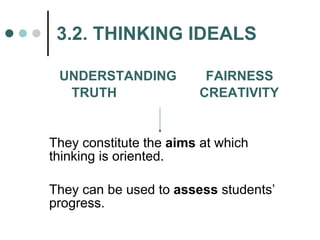
3.2. THINKING IDEALS UNDERSTANDING   FAIRNESS TRUTH   CREATIVITY They constitute the  aims  at which thinking is oriented. They can be used to  assess  students’ progress.
3.3. DOCUMENTATION When thinking is visible it can be recorded in different ways: Mind maps Charts Lists Videos of classroom work Diagrams Students’ reflections in a journal or logbook
3.3. DOCUMENTATION Once students’ work has been documented, teachers get together in  study groups  and analyze what their students have achieved. LAST** MYST** Protocols ** For more information refer to: http://pzweb.harvard.edu/vt/VisibleThinking
RECAP ROUTINES THINKING IDEALS  Thinking  DOCUMENTATION   Visible Deep Learning ≠  rote learning   personal involvement new to prior knowledge
PART TWO Practice
1.1. Sample Routines Looking 10x2 1. Look at the image or artifact for at least 30 seconds. Let your eyes wander. 2. List ten words or phrases about it (3. Share your thoughts with your partner) 4. Repeat steps 1 & 2 This routine helps students  explore  a new topic and  compare  different perspectives.
1. What's going on? 2. What do you see that makes you say that?  This routine helps students describe what they see or know and asks them to build  explanations *. It calls for evidence and helps learners learn how to justify their claims.  1.2. Sample Routines What makes you say that? * Source: http://pzweb.harvard.edu/vt/VisibleThinking
If you were to write a headline for this topic or issue right now that captured the most important aspect that should be remembered, what would that headline be?   This routine helps students think of a  summary  or synopsis of the topic discussed. It works especially well at the end of a class discussion or session in which students have explored a topic and gathered a fair amount of new information or opinions about it*.  1.3. Sample Routines Headlines
2. Visible Thinking at the Biltmore School School: Founded in 1926 150 students & 30 teachers Annual tuition & fees: USD 10,000 Headmistress: Gina Romero
Class: 3rd form 8 & 9 year-olds Teacher’s name: Daphne Vega Number of Stds:  12 Visible Thinking at the Biltmore School
CLASS OBSERVATION 1. Intro: Looking 10x2 (video)
2. Share-Look again (video)
3. Where are they from?
4. Smart-board search
5. Headlines
Aulas Heterogéneas (video)
3. FIU – Angela Salmon, PhD
Learning is  doing , not just absorbing information passively Learning starts with the learner’s own ideas: students are asked to draw on previous knowledge  motivation Learning is an  active process  in which learners construct new knowledge by building on ideas they already have 3. FIU Highlights
Learning means getting personally  involved engagement Questions are means and ends: routines are based on  questions  to create debates, look for connections and expand knowledge Learning is an  enquiry-oriented process 3. FIU Highlights
Visible Thinking allows for  metacognition the thinking process becomes explicit and so it can be  analyzed, assessed and finally improved 3. FIU Highlights
FURTHER RESOURCES "Making Thinking Visible"  Ron Ritchhart and David Perkins. "Making Thinking Visible,"  Educational Leadership  65, no. 5 (February 2008): 57-61. "Uncovering Students' Thinking about Thinking Using Concept Maps"- a paper prepared for the AERA Conference, March 2008.  Cultivating a Culture of Thinking in Museums Ron Ritchhart, “Cultivating a Culture of Thinking in Museums,”  Journal of Museum Education  32, no. 2 (Summer 2007): 137-54. Life in the Mindful Classroom: Nurturing the Disposition of Mindfulness  Ron Ritchhart and David N. Perkins, “Life in the Mindful Classroom: Nurturing the Disposition of Mindfulness,”  Journal of Social Issues  56, no. 1 (2000), 27–47.  Making Thinking Visible David N. Perkins, “Making Thinking Visible,” (2003) Visible Thinking Shari Tishman and Patricia Palmer, “Visible Thinking,”  Leadership Compass  2, no. 4  ( Summer 2005). The Thinking Classroom , Shari TIshman, David Perkins & Eileen Jay. Allyn & Bacon, 1994. Making Thinking Visible: How to Promote Engagement, Understanding, and Independence for All Learners , Ron Ritchhart, Mark Church & Karin Morrison, Jossey-Bass, 2011.
[email_address]

Visible Thinking sac conference 2011

  • 1.
    Visible Thinking LanguageStudy Group December Meeting, 2011 Lic. Mariana Ferrarelli
  • 2.
    Harvard University GraduateSchool of Education Project Zero (Research Group) Cultures of Thinking Innovating with Intelligence Artful Thinking [email_address] Visible Thinking
  • 3.
    Visible Thinking – ppt layout PART ONE: Theory Main Tenet The Big Question Elements of the approach: Routines Ideals Documentation PART TWO: Practice Sample Routines Visible Thinking at the Biltmore School (Class observation: videos & photos) Florida International University
  • 4.
  • 5.
    1. Visible Thinking– Main Tenet When thinking becomes a more visible and apparent element in the classroom… Students develop thinking dispositions … which in turn allow for thoughtful and deep learning .
  • 6.
    1. Visible Thinking– Main Tenet VISIBLE THINKING DEEP LEARNING
  • 7.
    2. Visible Thinking– The big Q How can teachers make thinking visible so that genuine and long-term learning can take place? ROUTINES DOCUMENTATION THINKING IDEALS
  • 8.
    3.1. ROUTINES Routinescan be used at any level / age / subject area From an epistemological point of view routines consist of a few steps which demand a series of cognitive behaviours as students are asked to…
  • 9.
    3.1. ROUTINES Thinkcritically Provide evidence Justify with explanations Compare & connect Summarise Explore multiple perspectives Identify parts in a whole Draw conclusions Hypothesize Reflect on their own learning process
  • 10.
    3.2. THINKING IDEALSUNDERSTANDING FAIRNESS TRUTH CREATIVITY They constitute the aims at which thinking is oriented. They can be used to assess students’ progress.
  • 11.
    3.3. DOCUMENTATION Whenthinking is visible it can be recorded in different ways: Mind maps Charts Lists Videos of classroom work Diagrams Students’ reflections in a journal or logbook
  • 12.
    3.3. DOCUMENTATION Oncestudents’ work has been documented, teachers get together in study groups and analyze what their students have achieved. LAST** MYST** Protocols ** For more information refer to: http://pzweb.harvard.edu/vt/VisibleThinking
  • 13.
    RECAP ROUTINES THINKINGIDEALS Thinking DOCUMENTATION Visible Deep Learning ≠ rote learning personal involvement new to prior knowledge
  • 14.
  • 15.
    1.1. Sample RoutinesLooking 10x2 1. Look at the image or artifact for at least 30 seconds. Let your eyes wander. 2. List ten words or phrases about it (3. Share your thoughts with your partner) 4. Repeat steps 1 & 2 This routine helps students explore a new topic and compare different perspectives.
  • 16.
    1. What's goingon? 2. What do you see that makes you say that? This routine helps students describe what they see or know and asks them to build explanations *. It calls for evidence and helps learners learn how to justify their claims. 1.2. Sample Routines What makes you say that? * Source: http://pzweb.harvard.edu/vt/VisibleThinking
  • 17.
    If you wereto write a headline for this topic or issue right now that captured the most important aspect that should be remembered, what would that headline be? This routine helps students think of a summary or synopsis of the topic discussed. It works especially well at the end of a class discussion or session in which students have explored a topic and gathered a fair amount of new information or opinions about it*. 1.3. Sample Routines Headlines
  • 18.
    2. Visible Thinkingat the Biltmore School School: Founded in 1926 150 students & 30 teachers Annual tuition & fees: USD 10,000 Headmistress: Gina Romero
  • 19.
    Class: 3rd form8 & 9 year-olds Teacher’s name: Daphne Vega Number of Stds: 12 Visible Thinking at the Biltmore School
  • 20.
    CLASS OBSERVATION 1.Intro: Looking 10x2 (video)
  • 21.
  • 22.
    3. Where arethey from?
  • 23.
  • 24.
  • 25.
  • 26.
    3. FIU –Angela Salmon, PhD
  • 27.
    Learning is doing , not just absorbing information passively Learning starts with the learner’s own ideas: students are asked to draw on previous knowledge motivation Learning is an active process in which learners construct new knowledge by building on ideas they already have 3. FIU Highlights
  • 28.
    Learning means gettingpersonally involved engagement Questions are means and ends: routines are based on questions to create debates, look for connections and expand knowledge Learning is an enquiry-oriented process 3. FIU Highlights
  • 29.
    Visible Thinking allowsfor metacognition the thinking process becomes explicit and so it can be analyzed, assessed and finally improved 3. FIU Highlights
  • 30.
    FURTHER RESOURCES "MakingThinking Visible" Ron Ritchhart and David Perkins. "Making Thinking Visible," Educational Leadership 65, no. 5 (February 2008): 57-61. "Uncovering Students' Thinking about Thinking Using Concept Maps"- a paper prepared for the AERA Conference, March 2008. Cultivating a Culture of Thinking in Museums Ron Ritchhart, “Cultivating a Culture of Thinking in Museums,” Journal of Museum Education 32, no. 2 (Summer 2007): 137-54. Life in the Mindful Classroom: Nurturing the Disposition of Mindfulness Ron Ritchhart and David N. Perkins, “Life in the Mindful Classroom: Nurturing the Disposition of Mindfulness,” Journal of Social Issues 56, no. 1 (2000), 27–47. Making Thinking Visible David N. Perkins, “Making Thinking Visible,” (2003) Visible Thinking Shari Tishman and Patricia Palmer, “Visible Thinking,” Leadership Compass 2, no. 4 ( Summer 2005). The Thinking Classroom , Shari TIshman, David Perkins & Eileen Jay. Allyn & Bacon, 1994. Making Thinking Visible: How to Promote Engagement, Understanding, and Independence for All Learners , Ron Ritchhart, Mark Church & Karin Morrison, Jossey-Bass, 2011.
  • 31.