


Ms.Neethu Jose
RESEARCH TOOL
AND
DATA COLLECTION METHOD
Ms.Neethu Jose
Data
• Data are observable measurable fact
that provide information about the
phenomenon under study
Ms.Neethu Jose
Tools
Tools are instruments used to collect information
for performance assessments, self- evaluations,
and external evaluations.
Tools need to be strong enough to support what
the evaluations find during research.
Depending on the nature of the information to
be gathered, different instruments are used to
conduct the assessment forms for gathering data.
Ms.Neethu Jose
DEFINITION OF TOOL
It is a testing device for measuring a given
event, such as , a questionnaire, an interview
or a set of guidelines or checklist for
observation.
It is an instrument or machine that aids in
accomplishing a task.
Ms.Neethu Jose
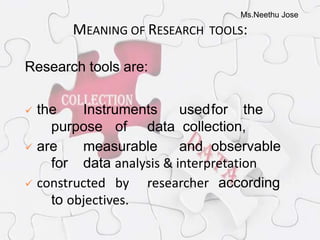
Research tools are:
 the Instruments usedfor the
purpose of data collection,
 are measurable and observable
for data analysis & interpretation
 constructed by researcher according
to objectives.
MEANING OF RESEARCH TOOLS:
Ms.Neethu Jose
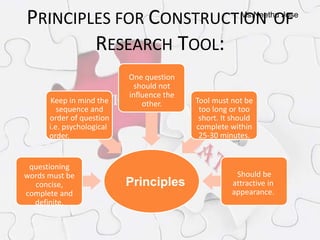
PRINCIPLES FOR CONSTRUCTION OF
RESEARCH TOOL:
questioning
words must be
concise,
complete and
definite.
Keep in mind the
sequence and
order of question
i.e. psychological
order.
One question
should not
influence the
other. Tool must not be
too long or too
short. It should
complete within
25-30 minutes.
Should be
attractive in
appearance.
Principles
Ms.Neethu Jose
DEFINITION OF DATA
• Data collection is a systematic process
of collecting detail information about
desire objective from selected sample
under controlled settings.
Ms.Neethu Jose
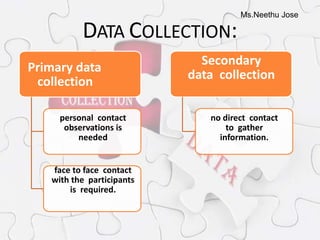
DATA COLLECTION:
Primary data
collection
personal contact
observations is
needed
face to face contact
with the participants
is required.
Secondary
data collection
no direct contact
to gather
information.
Ms.Neethu Jose
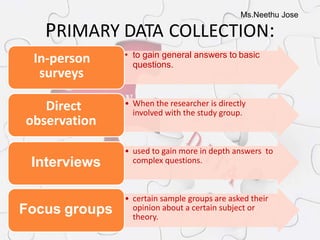
PRIMARY DATA COLLECTION:
• to gain general answers to basic
questions.
In-person
surveys
• When the researcher is directly
involved with the study group.
Direct
observation
• used to gain more in depth answers to
complex questions.Interviews
• certain sample groups are asked their
opinion about a certain subject or
theory.
Focus groups
Ms.Neethu Jose
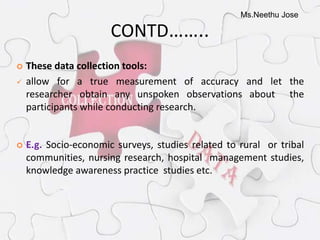
CONTD……..
 These data collection tools:
 allow for a true measurement of accuracy and let the
researcher obtain any unspoken observations about the
participants while conducting research.
 E.g. Socio-economic surveys, studies related to rural or tribal
communities, nursing research, hospital management studies,
knowledge awareness practice studies etc.
Ms.Neethu Jose
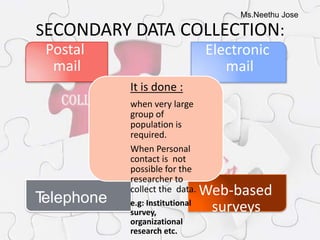
SECONDARY DATA COLLECTION:
Postal
mail
Electronic
mail
Telephone Web-based
surveys
It is done :
when very large
group of
population is
required.
When Personal
contact is not
possible for the
researcher to
collect the data.
e.g: Institutional
survey,
organizational
research etc.
Ms.Neethu Jose
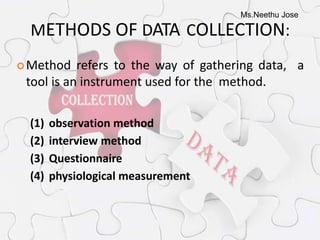
METHODS OF DATA COLLECTION:
Method refers to the way of gathering data, a
tool is an instrument used for the method.
(1) observation method
(2) interview method
(3) Questionnaire
(4) physiological measurement
Ms.Neethu Jose
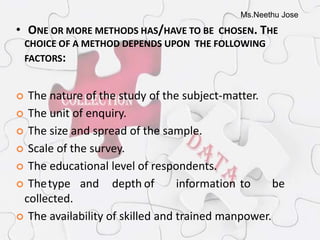
• ONE OR MORE METHODS HAS/HAVE TO BE CHOSEN. THE
CHOICE OF A METHOD DEPENDS UPON THE FOLLOWING
FACTORS:
 The nature of the study of the subject-matter.
 The unit of enquiry.
 The size and spread of the sample.
 Scale of the survey.
 The educational level of respondents.
 Thetype and depth of information to be
collected.
 The availability of skilled and trained manpower.
Ms.Neethu Jose
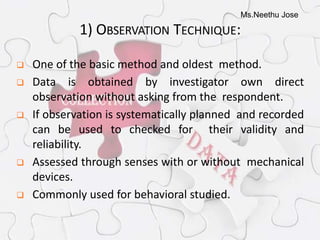
1) OBSERVATION TECHNIQUE:
 One of the basic method and oldest method.
 Data is obtained by investigator own direct
observation without asking from the respondent.
 If observation is systematically planned and recorded
can be used to checked for their validity and
reliability.
 Assessed through senses with or without mechanical
devices.
 Commonly used for behavioral studied.
Ms.Neethu Jose
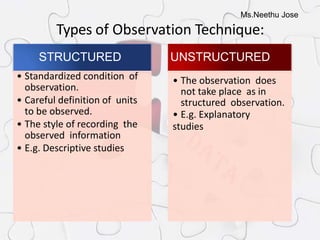
Types of Observation Technique:
• Standardized condition of
observation.
• Careful definition of units
to be observed.
• The style of recording the
observed information
• E.g. Descriptive studies
STRUCTURED UNSTRUCTURED
• The observation does
not take place as in
structured observation.
• E.g. Explanatory
studies
Ms.Neethu Jose
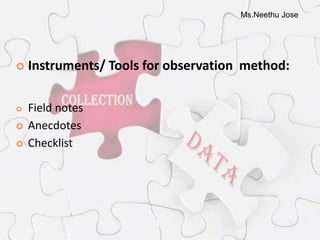
 Instruments/ Tools for observation method:
 Field notes
 Anecdotes
 Checklist
Ms.Neethu Jose
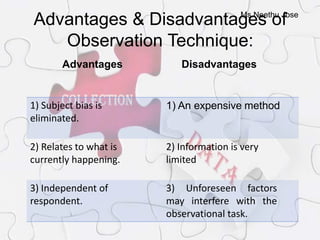
Advantages & Disadvantages of
Observation Technique:
Advantages Disadvantages
1) Subject bias is
eliminated.
1) An expensive method
2) Relates to what is
currently happening.
2) Information is very
limited
3) Independent of
respondent.
3) Unforeseen factors
may interfere with the
observational task.
Ms.Neethu Jose
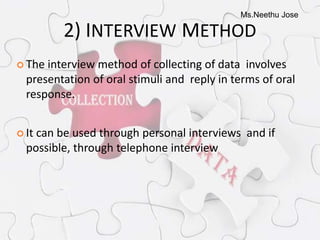
2) INTERVIEW METHOD
 The interview method of collecting of data involves
presentation of oral stimuli and reply in terms of oral
response.
 It can be used through personal interviews and if
possible, through telephone interview
Ms.Neethu Jose
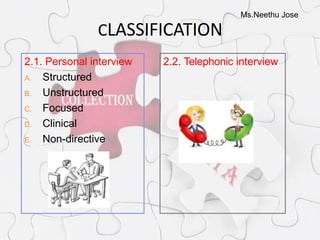
CLASSIFICATION
2.1. Personal interview
A. Structured
B. Unstructured
C. Focused
D. Clinical
E. Non-directive
2.2. Telephonic interview
Ms.Neethu Jose
2.1 Personal interviews:
 Asking question generally in a face to
face to collect the information.
 The sort of investigation may be in the
form of direct personal investigation or
may be indirect .
Ms.Neethu Jose
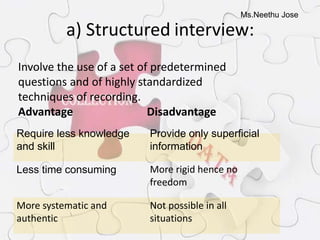
a) Structured interview:
Involve the use of a set of predetermined
questions and of highly standardized
techniques of recording.
Advantage Disadvantage
Require less knowledge
and skill
Provide only superficial
information
Less time consuming More rigid hence no
freedom
More systematic and
authentic
Not possible in all
situations
Ms.Neethu Jose
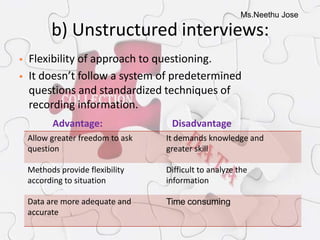
b) Unstructured interviews:
 Flexibility of approach to questioning.
 It doesn’t follow a system of predetermined
questions and standardized techniques of
recording information.
Advantage: Disadvantage
Allow greater freedom to ask
question
It demands knowledge and
greater skill
Methods provide flexibility
according to situation
Difficult to analyze the
information
Data are more adequate and
accurate
Time consuming
Ms.Neethu Jose
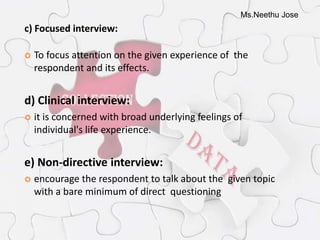
c) Focused interview:
 To focus attention on the given experience of the
respondent and its effects.
d) Clinical interview:
 it is concerned with broad underlying feelings of
individual's life experience.
e) Non-directive interview:
 encourage the respondent to talk about the given topic
with a bare minimum of direct questioning
Ms.Neethu Jose
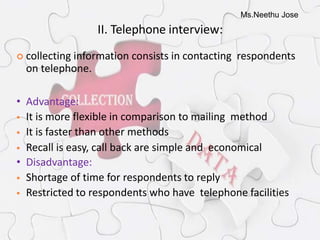
II. Telephone interview:
 collecting information consists in contacting respondents
on telephone.
• Advantage:
 It is more flexible in comparison to mailing method
 It is faster than other methods
 Recall is easy, call back are simple and economical
• Disadvantage:
 Shortage of time for respondents to reply
 Restricted to respondents who have telephone facilities
Ms.Neethu Jose
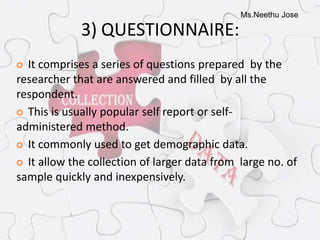
3) QUESTIONNAIRE:
 It comprises a series of questions prepared by the
researcher that are answered and filled by all the
respondent.
 This is usually popular self report or self-
administered method.
 It commonly used to get demographic data.
 It allow the collection of larger data from large no. of
sample quickly and inexpensively.
Ms.Neethu Jose
Structure of Question:
Open ended question
•When researcher want
more information.
• difficult to analyze.
Close
ended/fixed/alternative
•Limited respond.
•Easy to analysis
e.g. Why did you choose to take
your graduate work at this
university?
e.g. Have you ever taken a course in
statistics?
( ) yes
( ) No
Ms.Neethu Jose
ADVANTAGES
Can be posted, e-mailed or faxed.
Can cover a large number of people or organizations.
Wide geographic coverage.
Relatively cheap.
No prior arrangements are needed.
Avoids embarrassment on the part of the respondent.
Respondent can consider responses.
Ms.Neethu Jose
DISADVANTAGES:
Design problems.
Questions have to be relatively simple.
Historically low response rate (although inducements may help).
Time delay whilst waiting for responses to be returned.
Require a return deadline.
Several reminders may be required.
Assumes no literacy problems.
No control over who completes it.
Not possible to give assistance if required.
Ms.Neethu Jose
TYPES OF CLOSED ENDED QUESTION
A. Dichotomous questions
B. Multi choice questions
C. Cafeteria questions
D. Rank order questions
E. Rating scale
F. Checklist
G. Visual analogue scales[VAS]
Ms.Neethu Jose
A. Dichotomous questions
It makes the respondent to make a choice
between two responses such as
“Yes/No” “Male/Female”
E.g. Have you been hospitalized?
Ms.Neethu Jose
B. Multi-choice questions
 It offers more than two response alternatives
 Graded alternatives are preferable for opinion or
attitude questions that give more information
 E.g. how important is to you to avoid a pregnancy
at this time
1. Extremely important
2. Very important
3. Somewhat important
4. Not at all important
Ms.Neethu Jose
C. Cafeteria questions
 These are special type of MCQ that ask respondents to select a
respondent’s response that most closely corresponds to their
view.
• E.g. People have different opinion or attitude about use of
estrogen replacement therapy for women in menopause, which
of the following statements best represents our joint view?
1. Estrogen replacement is dangerous and should be banned
2. Estrogen replacement has some side effects that suggest
need for caution
3. I am undecided about view of Estrogen replacement therapy
4. Estrogen replacement has many beneficial effects
Ms.Neethu Jose
D. Rank-order questions
 It asks respondents to rank target concept along some
continuum such as most favorable or most to least
important.
 Respondents are asked to mark 1,2,3,4…. According to
their importance and their should not be more than10
alternatives
 E.g. people value different things about life. Below is a list of
principles or ideas that are often cited when people are asked to
name things they value most by putting 1,2,3.etc
 Achievement and success
 Family relationship
 Health Money Religion
Ms.Neethu Jose
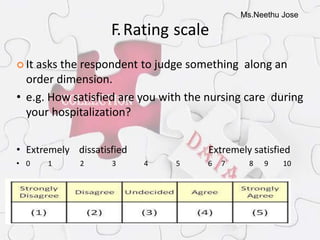
F.Rating scale
 It asks the respondent to judge something along an
order dimension.
• e.g. How satisfied are you with the nursing care during
your hospitalization?
• Extremely dissatisfied Extremely satisfied
• 0 1 2 3 4 5 6 7 8 9 10
Ms.Neethu Jose
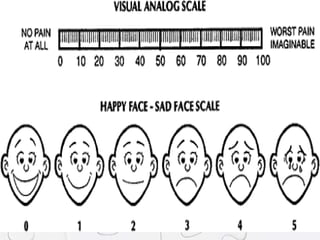
G. VISUAL ANALOG SCALE
 It is useful for assessing perception of physic stimuli
such as pain, sleep, quality and shortness of breath.
 Advantage
It is easy to develop for researcher.
Widest possibility range of expression.
 Disadvantage
It includes concern with reliability and validity.
Ms.Neethu Jose
Ms.Neethu Jose
4) PHYSIOLOGICAL MEASUREMENT:
It can be classified as In Vivo and In Vitro.
In Vivo includes measurements of those which are
performed directly within or living organisms
themselves; such as blood flow determination through
radiography, IVP, cholecystography.
An In Vitro measurement by contrast is performed
outside the organism’s body, such as blood glucose,
blood urea, serum Na+, K+.
Ms.Neethu Jose
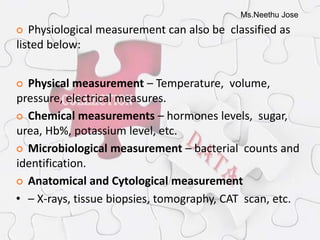
 Physiological measurement can also be classified as
listed below:
 Physical measurement – Temperature, volume,
pressure, electrical measures.
 Chemical measurements – hormones levels, sugar,
urea, Hb%, potassium level, etc.
 Microbiological measurement – bacterial counts and
identification.
 Anatomical and Cytological measurement
• – X-rays, tissue biopsies, tomography, CAT scan, etc.
Ms.Neethu Jose

Tool for data collection

  • 1.
  • 2.
    Ms.Neethu Jose Data • Dataare observable measurable fact that provide information about the phenomenon under study
  • 3.
    Ms.Neethu Jose Tools Tools areinstruments used to collect information for performance assessments, self- evaluations, and external evaluations. Tools need to be strong enough to support what the evaluations find during research. Depending on the nature of the information to be gathered, different instruments are used to conduct the assessment forms for gathering data.
  • 4.
    Ms.Neethu Jose DEFINITION OFTOOL It is a testing device for measuring a given event, such as , a questionnaire, an interview or a set of guidelines or checklist for observation. It is an instrument or machine that aids in accomplishing a task.
  • 5.
    Ms.Neethu Jose Research toolsare:  the Instruments usedfor the purpose of data collection,  are measurable and observable for data analysis & interpretation  constructed by researcher according to objectives. MEANING OF RESEARCH TOOLS:
  • 6.
    Ms.Neethu Jose PRINCIPLES FORCONSTRUCTION OF RESEARCH TOOL: questioning words must be concise, complete and definite. Keep in mind the sequence and order of question i.e. psychological order. One question should not influence the other. Tool must not be too long or too short. It should complete within 25-30 minutes. Should be attractive in appearance. Principles
  • 7.
    Ms.Neethu Jose DEFINITION OFDATA • Data collection is a systematic process of collecting detail information about desire objective from selected sample under controlled settings.
  • 8.
    Ms.Neethu Jose DATA COLLECTION: Primarydata collection personal contact observations is needed face to face contact with the participants is required. Secondary data collection no direct contact to gather information.
  • 9.
    Ms.Neethu Jose PRIMARY DATACOLLECTION: • to gain general answers to basic questions. In-person surveys • When the researcher is directly involved with the study group. Direct observation • used to gain more in depth answers to complex questions.Interviews • certain sample groups are asked their opinion about a certain subject or theory. Focus groups
  • 10.
    Ms.Neethu Jose CONTD……..  Thesedata collection tools:  allow for a true measurement of accuracy and let the researcher obtain any unspoken observations about the participants while conducting research.  E.g. Socio-economic surveys, studies related to rural or tribal communities, nursing research, hospital management studies, knowledge awareness practice studies etc.
  • 11.
    Ms.Neethu Jose SECONDARY DATACOLLECTION: Postal mail Electronic mail Telephone Web-based surveys It is done : when very large group of population is required. When Personal contact is not possible for the researcher to collect the data. e.g: Institutional survey, organizational research etc.
  • 12.
    Ms.Neethu Jose METHODS OFDATA COLLECTION: Method refers to the way of gathering data, a tool is an instrument used for the method. (1) observation method (2) interview method (3) Questionnaire (4) physiological measurement
  • 13.
    Ms.Neethu Jose • ONEOR MORE METHODS HAS/HAVE TO BE CHOSEN. THE CHOICE OF A METHOD DEPENDS UPON THE FOLLOWING FACTORS:  The nature of the study of the subject-matter.  The unit of enquiry.  The size and spread of the sample.  Scale of the survey.  The educational level of respondents.  Thetype and depth of information to be collected.  The availability of skilled and trained manpower.
  • 14.
    Ms.Neethu Jose 1) OBSERVATIONTECHNIQUE:  One of the basic method and oldest method.  Data is obtained by investigator own direct observation without asking from the respondent.  If observation is systematically planned and recorded can be used to checked for their validity and reliability.  Assessed through senses with or without mechanical devices.  Commonly used for behavioral studied.
  • 15.
    Ms.Neethu Jose Types ofObservation Technique: • Standardized condition of observation. • Careful definition of units to be observed. • The style of recording the observed information • E.g. Descriptive studies STRUCTURED UNSTRUCTURED • The observation does not take place as in structured observation. • E.g. Explanatory studies
  • 16.
    Ms.Neethu Jose  Instruments/Tools for observation method:  Field notes  Anecdotes  Checklist
  • 17.
    Ms.Neethu Jose Advantages &Disadvantages of Observation Technique: Advantages Disadvantages 1) Subject bias is eliminated. 1) An expensive method 2) Relates to what is currently happening. 2) Information is very limited 3) Independent of respondent. 3) Unforeseen factors may interfere with the observational task.
  • 18.
    Ms.Neethu Jose 2) INTERVIEWMETHOD  The interview method of collecting of data involves presentation of oral stimuli and reply in terms of oral response.  It can be used through personal interviews and if possible, through telephone interview
  • 19.
    Ms.Neethu Jose CLASSIFICATION 2.1. Personalinterview A. Structured B. Unstructured C. Focused D. Clinical E. Non-directive 2.2. Telephonic interview
  • 20.
    Ms.Neethu Jose 2.1 Personalinterviews:  Asking question generally in a face to face to collect the information.  The sort of investigation may be in the form of direct personal investigation or may be indirect .
  • 21.
    Ms.Neethu Jose a) Structuredinterview: Involve the use of a set of predetermined questions and of highly standardized techniques of recording. Advantage Disadvantage Require less knowledge and skill Provide only superficial information Less time consuming More rigid hence no freedom More systematic and authentic Not possible in all situations
  • 22.
    Ms.Neethu Jose b) Unstructuredinterviews:  Flexibility of approach to questioning.  It doesn’t follow a system of predetermined questions and standardized techniques of recording information. Advantage: Disadvantage Allow greater freedom to ask question It demands knowledge and greater skill Methods provide flexibility according to situation Difficult to analyze the information Data are more adequate and accurate Time consuming
  • 23.
    Ms.Neethu Jose c) Focusedinterview:  To focus attention on the given experience of the respondent and its effects. d) Clinical interview:  it is concerned with broad underlying feelings of individual's life experience. e) Non-directive interview:  encourage the respondent to talk about the given topic with a bare minimum of direct questioning
  • 24.
    Ms.Neethu Jose II. Telephoneinterview:  collecting information consists in contacting respondents on telephone. • Advantage:  It is more flexible in comparison to mailing method  It is faster than other methods  Recall is easy, call back are simple and economical • Disadvantage:  Shortage of time for respondents to reply  Restricted to respondents who have telephone facilities
  • 25.
    Ms.Neethu Jose 3) QUESTIONNAIRE: It comprises a series of questions prepared by the researcher that are answered and filled by all the respondent.  This is usually popular self report or self- administered method.  It commonly used to get demographic data.  It allow the collection of larger data from large no. of sample quickly and inexpensively.
  • 26.
    Ms.Neethu Jose Structure ofQuestion: Open ended question •When researcher want more information. • difficult to analyze. Close ended/fixed/alternative •Limited respond. •Easy to analysis e.g. Why did you choose to take your graduate work at this university? e.g. Have you ever taken a course in statistics? ( ) yes ( ) No
  • 27.
    Ms.Neethu Jose ADVANTAGES Can beposted, e-mailed or faxed. Can cover a large number of people or organizations. Wide geographic coverage. Relatively cheap. No prior arrangements are needed. Avoids embarrassment on the part of the respondent. Respondent can consider responses.
  • 28.
    Ms.Neethu Jose DISADVANTAGES: Design problems. Questionshave to be relatively simple. Historically low response rate (although inducements may help). Time delay whilst waiting for responses to be returned. Require a return deadline. Several reminders may be required. Assumes no literacy problems. No control over who completes it. Not possible to give assistance if required.
  • 29.
    Ms.Neethu Jose TYPES OFCLOSED ENDED QUESTION A. Dichotomous questions B. Multi choice questions C. Cafeteria questions D. Rank order questions E. Rating scale F. Checklist G. Visual analogue scales[VAS]
  • 30.
    Ms.Neethu Jose A. Dichotomousquestions It makes the respondent to make a choice between two responses such as “Yes/No” “Male/Female” E.g. Have you been hospitalized?
  • 31.
    Ms.Neethu Jose B. Multi-choicequestions  It offers more than two response alternatives  Graded alternatives are preferable for opinion or attitude questions that give more information  E.g. how important is to you to avoid a pregnancy at this time 1. Extremely important 2. Very important 3. Somewhat important 4. Not at all important
  • 32.
    Ms.Neethu Jose C. Cafeteriaquestions  These are special type of MCQ that ask respondents to select a respondent’s response that most closely corresponds to their view. • E.g. People have different opinion or attitude about use of estrogen replacement therapy for women in menopause, which of the following statements best represents our joint view? 1. Estrogen replacement is dangerous and should be banned 2. Estrogen replacement has some side effects that suggest need for caution 3. I am undecided about view of Estrogen replacement therapy 4. Estrogen replacement has many beneficial effects
  • 33.
    Ms.Neethu Jose D. Rank-orderquestions  It asks respondents to rank target concept along some continuum such as most favorable or most to least important.  Respondents are asked to mark 1,2,3,4…. According to their importance and their should not be more than10 alternatives  E.g. people value different things about life. Below is a list of principles or ideas that are often cited when people are asked to name things they value most by putting 1,2,3.etc  Achievement and success  Family relationship  Health Money Religion
  • 34.
    Ms.Neethu Jose F.Rating scale It asks the respondent to judge something along an order dimension. • e.g. How satisfied are you with the nursing care during your hospitalization? • Extremely dissatisfied Extremely satisfied • 0 1 2 3 4 5 6 7 8 9 10
  • 35.
    Ms.Neethu Jose G. VISUALANALOG SCALE  It is useful for assessing perception of physic stimuli such as pain, sleep, quality and shortness of breath.  Advantage It is easy to develop for researcher. Widest possibility range of expression.  Disadvantage It includes concern with reliability and validity.
  • 36.
  • 37.
    Ms.Neethu Jose 4) PHYSIOLOGICALMEASUREMENT: It can be classified as In Vivo and In Vitro. In Vivo includes measurements of those which are performed directly within or living organisms themselves; such as blood flow determination through radiography, IVP, cholecystography. An In Vitro measurement by contrast is performed outside the organism’s body, such as blood glucose, blood urea, serum Na+, K+.
  • 38.
    Ms.Neethu Jose  Physiologicalmeasurement can also be classified as listed below:  Physical measurement – Temperature, volume, pressure, electrical measures.  Chemical measurements – hormones levels, sugar, urea, Hb%, potassium level, etc.  Microbiological measurement – bacterial counts and identification.  Anatomical and Cytological measurement • – X-rays, tissue biopsies, tomography, CAT scan, etc.
  • 39.